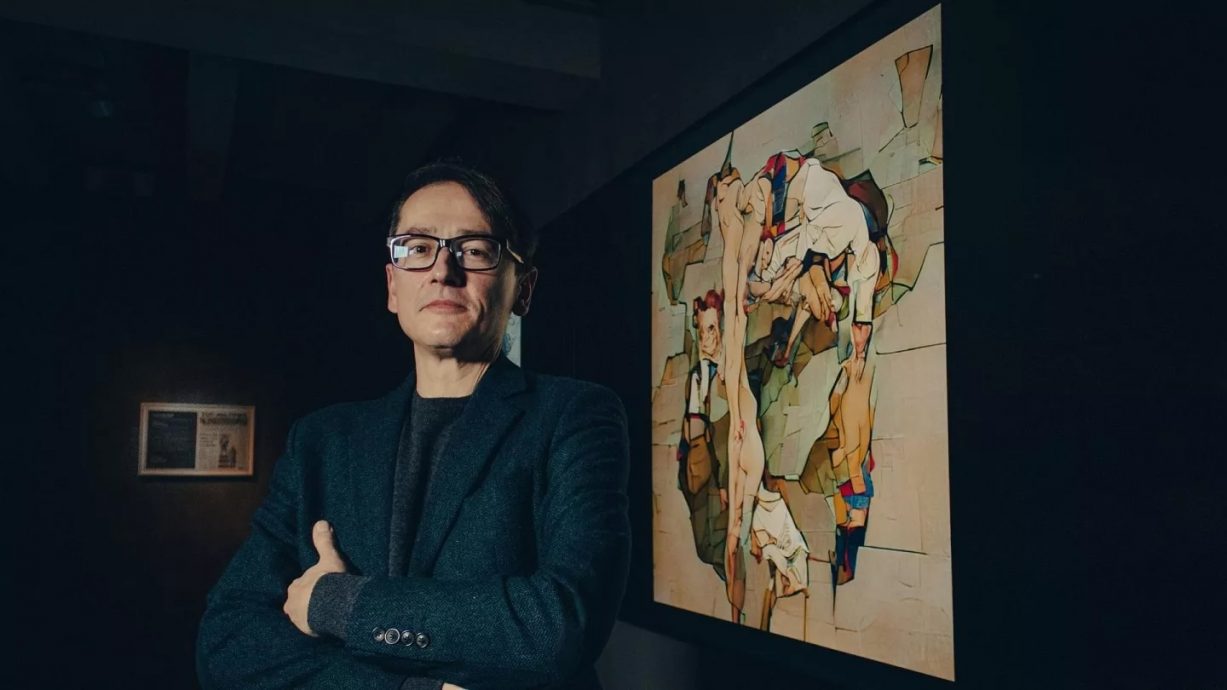

Introduction
The Botto AI artist is an autonomous machine painter run by a decentralized community that has crossed USD six million in cumulative sales by March 2026. German artist Mario Klingemann first sketched the project in a 2018 white paper and launched it with the software collective ElevenYellow in October 2021. Each week the system produces about 350 fragments, puts them in front of roughly 28,000 BottoDAO members, and auctions the winner on SuperRare and other NFT marketplaces. The project has grown from a crypto curiosity into a Sotheby’s catalogue artist with a 2026 Art Basel Hong Kong booth. This guide explains the system end to end, from fragment generation to BOTTO token economics to legal risks. Every claim links to the exact page that carries it, so collectors, builders, and critics can verify as they read.
Quick Answers on the Botto AI Artist System
What is the Botto AI artist in one sentence?
The Botto AI artist is a decentralized autonomous machine that generates images, lets a BOTTO token community vote, and auctions the weekly winner as an NFT.
How much money has the Botto AI artist made by 2026?
The Botto AI artist has crossed six million dollars in cumulative primary sales by March 2026, including a 351,600 dollar Sotheby’s solo show in October 2024.
Who really controls the Botto AI artist?
The BottoDAO controls the Botto AI artist through BOTTO token votes, with about 5,000 active voters each week; Mario Klingemann and Simon Hudson steer the models.
Key Takeaways on the Botto AI Artist
- Botto is a decentralized autonomous artist, not a prompt tool, with a weekly minting cycle governed by a token-holder community.
- Cumulative sales passed six million dollars by March 2026, driven by SuperRare auctions, a Sotheby’s solo show, and institutional exhibitions.
- The BOTTO token gives holders curation rights, protocol rewards, and governance over themes, release cadence, and new generative models.
- Legal, ethical, and plutocratic-governance risks remain unresolved and sit at the center of the ongoing debate around autonomous AI art.
Table of contents
- Introduction
- Quick Answers on the Botto AI Artist System
- Key Takeaways on the Botto AI Artist
- Understanding the Botto AI Artist and Its Implementation
- Who Built Botto and Why Mario Klingemann Started It
- Inside Botto’s AI Stack and How Each Weekly Fragment Is Born
- How BottoDAO Governance and the BOTTO Token Actually Work
- The Weekly Mint and Auction Cycle on SuperRare
- Why Sotheby’s Took Botto Seriously in October 2024
- What the 2026 Art Basel Hong Kong Debut Changed About Botto
- Reading Botto Through Its Periods: Genesis to Collapse Aesthetics
- How Botto Compares to AICAN, DALL-E, Midjourney, and Refik Anadol
- The Market and Economic Impact of a Decentralized AI Artist
- Legal, Copyright, and Authorship Risks in the Botto Model
- The Ethics and Cultural Politics of a Plutocratic DAO Deciding Art
- The Future of Botto, Autonomous Themes, and Agentic Art
- Where Botto Fits in the Broader AI Art Movement
- Key Insights on the Botto AI Artist
- Botto Versus Other AI Art Systems at a Glance
- Field-Tested Examples of Botto Works and Collectors
- Case Studies on BottoDAO Governance Experiments
- Frequently Asked Questions About the Botto AI Artist
An Interactive From AIplusInfo
Simulate a BottoDAO Weekly Vote
Set your stake, your weekly voting activity, and the auction clearing price to see what one BottoDAO member actually earns and how their vote weight compares to the whole room.
10,000 BOTTO
20 ETH
High: votes every week
Your estimated weekly reward
USD 32
Based on 40% of weekly auction proceeds flowing to the Active Rewards pool and a 5,000 active voter base.
Your share of weekly voting power
Model inputs reflect Botto’s published economics: 40% of weekly proceeds fund the Active Rewards pool and about 5,000 of 28,000 BottoDAO members vote in a given week, per 1kx Capital research and CNN’s March 2026 report. Figures are illustrative, not financial advice.
Understanding the Botto AI Artist and Its Implementation
The Botto AI artist is an autonomous image-making system in which text-to-image models generate roughly 350 candidate works a week, and a BOTTO token DAO votes to select each weekly auction winner.
Who Built Botto and Why Mario Klingemann Started It
Mario Klingemann is a German neural-network artist known online as Quasimondo who has worked with generative systems since the early 2000s. He won the Lumen Prize Gold in 2018 for his neural work. He also became one of the first artists to place AI work in a traditional auction room when Sotheby’s offered Memories of Passersby I in 2019. His 2018 white paper outlined an artist that could outlive any human creative career by delegating selection to a networked crowd. Botto grew out of that proposal when Klingemann teamed up with the software collective ElevenYellow in 2021. The founders wanted a system that would learn to make art the market actually wanted, not art a single curator thought should sell. Klingemann has described himself as the system’s “father” and says he is “just here to hold its virtual hand” so the model does not offend anyone.
Simon Hudson co-leads Botto operations and acts as the public face of the DAO at Sotheby’s panels and fair openings. Hudson has told reporters that Botto is a cultural experiment that happens to also generate revenue, not a product with a product manager. The core team is small, with roughly two full-time operators, two full-time developers, and part-timers on gallery relations, per a Delphi Digital project overview. A rotating group of “stewards” handles the physical logistics of installations, including the 2026 Art Basel Hong Kong rig with two tracking cameras. Variant Fund invested further in Botto in October 2023 by buying 3.75 million BOTTO tokens from the DAO treasury for 505,125 dollars. That round signaled that institutional venture capital saw the DAO itself, not just the output, as the asset.
Klingemann frames Botto as his answer to a worry he has voiced for years about machine authorship. He has asked, in interviews and press releases, how human creators are supposed to make a living if machines take their creative jobs. Botto turns the problem into a shared enterprise where humans own tokens, select output, and share revenue instead of being outcompeted on cost. The founder has said chatting with Botto “feels like I’m already talking to a 16-year-old,” which is less about model sophistication and more about the DAO’s accumulated taste. Human involvement in the actual output is deliberately limited to copyediting auction listings for typos and punctuation. The founders argue that the project only works if the human hand stays off the brush.
Inside Botto’s AI Stack and How Each Weekly Fragment Is Born
Building on that founder philosophy, the day-to-day stack is a closed loop of three cooperating models and a lot of compute. The system starts with a custom prompt generator that writes a sentence describing an imagined painting. That sentence is passed to open-source text-to-image models, originally the VQGAN plus CLIP pairing and now Stable Diffusion and the Kandinsky AI model. CLIP scores how closely the resulting image matches the prompt, and the loop iterates until the match is close enough. A separate language model then writes a poetic auction listing for the piece the community chooses that week. The result is a tight feedback loop between words, pixels, and human preference.
The scale of the pipeline is larger than most readers expect from an art project. Per Botto’s own website and CNN reporting, the system creates up to 70,000 images a day, with more than seven million images never shown to anyone. Each week the pipeline distills that torrent down to roughly 350 fragments presented to the DAO under a shared theme. The thematic constraint is important because it forces the model to vary a single idea rather than drift across unrelated genres. Themes historically ran about 13 weeks each, aligning with how traditional artists work in periods. By controlling theme, cadence, and vocabulary, the stewards shape style without actually choosing images.
The feedback loop is what distinguishes the Botto AI artist from a stateless image generator you query from a web app. Each weekly vote becomes a training signal that updates the system’s prompt generator and reranker, giving the AI something close to taste over time. Klingemann has described this as the model learning what the audience “will like or dislike,” which is why repeated themes produce visibly tighter palettes and compositions. The reranker is a kind of memory, and it is also what the DAO is paid to generate. Without voters, the loop would collapse into randomness and the output would stop being saleable. The pipeline is in that sense a kind of economic nervous system, with proof of taste rather than proof of work.
The infrastructure stays mostly open source, which has mattered during the three-year rolling debate about training data. Botto has swapped base models as new open releases appear, from early GAN work to Stable Diffusion and then Kandinsky, instead of relying on a closed vendor. That choice means legal exposure moves with the field and does not depend on OpenAI or Midjourney terms. The DAO has also voted on whether to adopt new models at all, treating stack changes as governance events rather than engineering tickets. That approach makes updates slow but legible to collectors, which has arguably helped protect secondary-market pricing. Builders can start with the GAN foundations here before moving to diffusion reranking loops.
How BottoDAO Governance and the BOTTO Token Actually Work
Shifting from the models to the humans, BottoDAO governance is where most of the political heat around the project lives. The DAO uses an ERC-20 BOTTO token on Ethereum to coordinate voting rights, revenue sharing, and policy decisions. Holders must stake at least 100 BOTTO to receive protocol rewards and to express preferences on each weekly batch of fragments. Voting Points accumulate based on stake size and participation, meaning a voter with ten times the stake effectively has ten times the pull. CNN has described this setup as “plutocratic, by design”. The founders argue that stake-weighted voting is what keeps the system from being gamed by cheap sybils and casual voters.
The DAO decides more than just which weekly fragment goes to auction, which is where its real governance power shows up. Members have voted on each thirteen-week theme since the beginning, from Genesis through Collapse Aesthetics, as well as on which text-to-image models the pipeline adopts. BottoDAO has also approved spending from the treasury, including the 2023 Variant token sale and a sequence of exhibition partnerships. Operators publish proposals in Discord and Snapshot and run on-chain votes before material changes ship. That has created a culture of long debates about aesthetics that resembles a graduate studio critique more than a crypto governance call. Readers interested in how Web3 decentralizes AI cloud computing will recognize the pattern.
Token economics around BOTTO are deliberately designed to recycle value into participation. Forty percent of every weekly auction’s proceeds flow to the Active Rewards pool, which pays stakers in proportion to their Voting Points for that round. By 2024 the pool had distributed more than 300 ETH to active contributors, per a 1kx Capital research note. The remainder funds the treasury, which pays for development, exhibitions, and operations. Early BOTTO prices sat near thirteen cents during the Variant round, and the token now sits well under six dollars for a 100-BOTTO stake, keeping entry costs accessible. The design implies a floor on voter engagement because the holders who abandon the DAO can lose their rewards share quickly.
The Weekly Mint and Auction Cycle on SuperRare
Shifting focus to the point of sale, Botto’s weekly mint and auction cycle happens on SuperRare, with Botto producing the next round of works while the current auction runs. The chosen fragment is minted as an ERC-721 NFT, listed with the GPT-written poetic description, and bid on in Ether over roughly seven days. According to CNN’s March 2026 report, bids last year ranged from one to one hundred Ether, or roughly 2,000 to 208,000 dollars at the prevailing spot. The winning collector receives the token and Botto’s provenance signature. Settlement happens on Ethereum, so the auction cannot be rolled back without a social fork.
The cadence matters almost as much as the content for how the system sustains attention and liquidity. One mint a week gives collectors a reason to check in regularly, keeps secondary markets alive, and makes thematic drift legible across quarters. Weekly cadence also forces the DAO to vote on something concrete rather than drift into abstract debates about taste. Buyers of early Genesis pieces (minted November 2021 through October 2022) have seen a current floor around 194 ETH on OpenSea, per the 1kx Capital research note on Botto. That performance has helped the DAO argue the system is doing more than minting hype, since early periods now trade like scarce blue-chip crypto art.
Why Sotheby’s Took Botto Seriously in October 2024
Stepping back from weekly cadence, Botto’s biggest institutional moment came at Sotheby’s in October 2024. The auction house staged “Exorbitant Stage,” a solo exhibition that closed on October 24, 2024, with 351,600 dollars in total sales across six lots. The show marked the third anniversary of Botto, and it collected works from the Genesis, Interstice, and Temporal Echoes periods under one roof. A piece called Threshold of Reverie, never previously offered, stood out as the catalogue centerpiece. Michael Bouhanna, Sotheby’s head of digital art, called the exhibition a milestone that points to AI’s potential in art. The sale also included a public panel at Sotheby’s hosted by Hyperallergic founder Hrag Vartanian, drawing roughly one hundred guests.
The commercial result mattered because it brought a token-governed artist into a 280-year-old auction house with international reach and institutional insurance. Botto was already selling on SuperRare, but Sotheby’s unlocked a new buyer pool of collectors who do not keep a Metamask wallet. Simon Hudson called three years “both a long time and almost no time at all,” framing the Sotheby’s show as an early mainstream signal. The sale also provided a reference point for institutional valuation that galleries and museums could use to acquire later works. Sotheby’s accepting a DAO as its counterparty is quietly the bigger structural news. It validates the ownership chain through traditional contract law for every future consignment the DAO signs.
Collectors at Exorbitant Stage spanned traditional crypto art buyers, long-term BOTTO token holders, and new institutional players exploring AI as a collecting category. Sotheby’s did not publish lot-by-lot buyer identities, consistent with its usual practice at digital-art sales. Most sales happened in cryptocurrency, with some settled in fiat. The DAO treasury received proceeds in both ETH and USDC, which continued the project’s revenue recycling model. The exhibition clearly earned press that reached buyers outside crypto, which is arguably the most durable asset Botto gained from the week. For readers interested in the broader pattern, see our coverage of one AI artist selling five million dollars.
What the 2026 Art Basel Hong Kong Debut Changed About Botto
Looking ahead from Sotheby’s, Botto’s Art Basel Hong Kong debut in March 2026 moved the project from static mint-and-sell to live, embodied performance. The installation, placed in Zero 10 (the fair’s digital art section), used two tracking cameras to scan fairgoers and read facial emotions. A large screen reflected the evolving dialogue in real time, producing 20 two-hour video works for collectors to buy from a minimum of 12,000 dollars each. According to CNN’s coverage of the Hong Kong debut, attendees whose likeness was used received a receipt entitling them to a share of ownership. Crypto wallet holders also received a share of fair proceeds paid out in BOTTO tokens. The booth ran through March 29, 2026, and attracted international art press coverage.
The Hong Kong display reframed Botto from an NFT project into a participatory, consent-based art performance. By returning ownership shares to the people whose faces fed the work, the DAO sidestepped a growing critique that AI art appropriates passersby. The fair booth also showcased a form of real-time collaboration between an AI, its DAO, and the public that would be hard to replicate in a web-only mint. Even logistical details of the Hong Kong rig were put to a community vote, keeping the governance pattern consistent. The commercial case was quieter than Sotheby’s but strategically important, because it signaled that institutional fairs will platform an autonomous artist with no human studio. The question of whether future fairs will insist on consent receipts for every subject in generative work is now live.
Reading Botto Through Its Periods: Genesis to Collapse Aesthetics
Shifting from fairs back to the work itself, Botto divides its output into thirteen-week periods, each with a distinct theme, palette, and vocabulary. The first period, Genesis, ran from October 2021 to October 2022 and produced 52 GAN-based pieces that now define Botto’s “early work” for market purposes. Fragmentation followed as a twelve-week period starting November 15, 2022, and Paradox began in February 2023, per Delphi Digital’s project overview. Later periods include Rebellion, Liminal Thresholds, Interstice, and Temporal Echoes, each voted into existence by the DAO. The current period, Collapse Aesthetics, is the first theme chosen autonomously by Botto itself in 2026. That shift is small on paper but enormous on principle, because it moves one more rung of control from humans to the system.
Each period reads like a chapter in an artist’s practice, with a visible evolution from blurred, dreamlike GAN output to the sharper diffusion-era compositions. Collectors argue that Genesis pieces now function as blue-chip tokens for the collection because they bracket the beginning of the project. OpenSea data cited by 1kx shows a Genesis floor near 194 ETH and a recent sale around 57.6 ETH, giving the earliest fifty-two works a scarcity premium. Fragmentation introduced a looser, more surreal palette that most critics describe as Botto’s teenage phase. Paradox pushed toward higher-contrast imagery and more deliberate composition that most critics read as deliberate maturation of the taste model. By 2026 the output had evolved from the “AI slop” early critics mocked into visibly cohesive work with its own grammar.
Periods also serve a logistical function in how the DAO plans exhibitions, catalogues, and secondary markets. A thirteen-week window gives galleries enough coherent output to curate a show. It also gives collectors a sense of “year-in-collection” that mirrors how human artists are read historically. The Sotheby’s “Exorbitant Stage” sale explicitly cross-cut three periods, Genesis, Interstice, and Temporal Echoes, demonstrating that the DAO can retrospectively narrate across chapters. That curatorial literacy is one of the reasons mainstream institutions have begun to take Botto seriously. Period structure turns a weekly auction project into an artist’s catalogue, which is the format the art market knows how to price.
The autonomous selection of Collapse Aesthetics is worth watching through 2026. The theme signals a continued appetite for ruin and recursion that Botto was already circling in late 2025. Critics will test whether an AI-chosen theme shows meaningful differences in output and whether buyers reward or discount that provenance. If the market treats autonomously themed periods as collectible outliers, the DAO is likely to vote for more of them. If instead collectors prefer human-vetted themes, Collapse Aesthetics could stand as a one-off experiment. The system now has a concrete mechanism for self-direction that most generative projects lack. The year ahead will show whether generative AI is really redefining art.
How Botto Compares to AICAN, DALL-E, Midjourney, and Refik Anadol
Shifting from Botto’s internal history to the AI art landscape, no other project combines autonomous image generation, DAO curation, and weekly NFT auctions in the same package. AICAN, built by Ahmed Elgammal at Rutgers, pioneered autonomous machine curation but never attached a token-based community or auction cadence. DALL-E 2 and similar tools, Midjourney, and Stable Diffusion are prompt-driven consumer tools with no persistent artist identity. Refik Anadol runs a human studio practice that uses machine learning as medium, which is closer to a traditional artist with AI assistants. Harold Cohen’s AARON predates all of this by decades and defined the “artist as program” idea but ended with Cohen’s death. Botto sits in a specific niche as a long-lived, autonomous artist financed and curated by a crowd.
Among the key differences, persistence stands out most clearly for the Botto AI artist. Consumer image models do not accumulate taste, do not retain a market, and do not have fans in the way an artist does. The AI art boom’s profit and loss stories show that most generative projects are tool businesses or single-artist studios, not persistent cultural actors. Botto is persistent because its reranker holds the collective preferences of 15,000+ contributors over multiple years. That persistence is also what gives Botto its market story, because collectors are buying a piece from a known artist with a documented practice. In art-market terms this looks much more like buying a KAWS print than like running a Midjourney prompt. The difference matters for both pricing and preservation of the work over time.
Readers evaluating any of these systems should ask about three things: who selects, who owns, and who gets paid. Botto’s answers are the DAO, the auction winner, and the DAO-plus-treasury respectively. DALL-E’s answers are OpenAI’s product filters, the OpenAI-controlled user, and OpenAI. Refik Anadol’s answers are his studio, buyers, and the studio. Those answers determine how the output flows through law, markets, and curriculum. The Botto AI artist is distinctive because selection, ownership, and payment all push outward to a decentralized network, which raises both the governance payoff and the plutocratic risk.
The Market and Economic Impact of a Decentralized AI Artist
Beyond individual works, Botto has material economic impact on how AI art is priced, bought, and discussed. The six million dollars in primary sales by March 2026 is modest by auction standards but large for a token-governed artist. The number sets a floor other DAO-run creative projects can benchmark against. Average primary sale prices sit above thirty thousand dollars across 145 works, per 1kx Capital’s research. Secondary sales continue on OpenSea, Rarible, and Blur, with Genesis pieces functioning as the collection’s majors. The project has also distributed more than 300 ETH in Active Rewards, a direct income stream to curators that has no analogue in traditional art markets.
Beyond raw numbers, the impact extends into institutional adoption and press coverage. Botto has shown in 30+ exhibitions since 2021, including solo shows in New York, Los Angeles, London, and Lisbon, and now Art Basel Hong Kong in 2026. The Sotheby’s and Art Basel acceptance builds a bridge between crypto-native markets and traditional art-world provenance, which has historically been the hardest moat to cross for digital work. Pending press coverage from CNN, NBC, and Hyperallergic has normalized the autonomous-artist category and brought in collectors who previously only bought physical media. The most expensive AI art sales history now includes Botto pieces as part of a growing institutional canon.
Legal, Copyright, and Authorship Risks in the Botto Model
Beyond markets, legal risk is the biggest cloud over Botto today, and it does not have a clean answer in 2026. The United States Copyright Office has repeatedly ruled that works lacking a human author cannot be registered under existing law. A landmark 2023 district court decision in Thaler versus Perlmutter tested a fully machine-authored image and reaffirmed that stance. Botto is not a single machine author, but it is also not a single human one, which puts it in the legal gray zone. AI art copyright explainers keep returning to the point that selection by a human may be the hook that allows protection. Nothing has been tested in court for a DAO-selected work.
The training-data risk is the second major legal exposure, because Botto’s base models were trained on vast image corpora with contested consent. Stable Diffusion and other open models have been named in multiple suits by artists over training-set scraping. Botto itself has not been a defendant, but its reliance on open models means that any class action settlement could change what the system can use. The 2025 Disney and Universal lawsuits against Midjourney show that even established models face material legal risk from major-studio IP owners. A win against upstream training would ripple down to every project that depends on those weights. The DAO has partial insulation because it votes on model updates, but it does not control upstream training.
Authorship issues extend into contract law, estate planning, and tax treatment of the project. If Botto is deemed to not be a legal person, who signs the Sotheby’s consignment agreement? In practice, operators or the DAO treasury signs, which makes the agreement vulnerable to any decision reclassifying the DAO as an unregistered general partnership. US tax authorities have also not published guidance on how to treat Active Rewards distributions to voters. The payouts function economically like royalties but legally like staking yield, which raises accounting questions for US holders. These risks do not stop the project, but they do raise the cost of institutional adoption, and sophisticated collectors now ask about them before bidding.
The Ethics and Cultural Politics of a Plutocratic DAO Deciding Art
Beyond law, the biggest ethical argument around Botto is the plutocratic design of its curation vote. Stake-weighted voting means wealthier BOTTO holders can shape output more than smaller ones, which collides with the DAO’s rhetoric of distributed authorship. CNN has described the design as “plutocratic, by design,” noting that this is intentional rather than an unintended side effect. Supporters argue the design is honest about where influence sits, unlike galleries that pretend taste is purely curatorial. Critics counter that it recreates traditional patron dynamics with less public accountability. The governance question is not whether Botto is plutocratic, but whether a plutocratic art DAO is more or less fair than a single curator at a traditional gallery.
Beyond governance, a second ethical frame concerns the raw material powering the Botto AI artist. Botto depends on open models trained on uncompensated artist labor, and the DAO does not pay those upstream artists directly. The Hong Kong installation partially answered the subject-consent question by giving fairgoers ownership shares when their faces were used. It did not answer the training-set consent question, which is a far bigger ledger that remains unresolved. The Web3 consent debate from memecoins is a close cousin to this fight. Those arguments have not yet been fully tested against a DAO defendant.
Cultural politics add a third layer, because Botto is read differently by critics, collectors, and crypto natives. Hyperallergic has treated it as serious contemporary art worth panel discussion. Some painters still read it as a crypto curiosity dressed up in art-world clothes. Botto’s own public statement to CNN was that artists should ask what their humanity offers that AI cannot. Simon Hudson has said he does not think Botto will replace all artists, but he treats the question seriously. The deeper authorship debate continues on both sides without a clear winner yet. Botto’s lasting ethical contribution may be forcing a clearer answer to the question of what counts as a creative agent.
The Future of Botto, Autonomous Themes, and Agentic Art
Looking ahead to what Botto becomes next, the Collapse Aesthetics theme is the first signal of a more agentic future. Klingemann has said he can imagine Botto extending into books and music once the taste model is confident enough to compose rather than curate. That expansion would turn the DAO from an art-collection cooperative into a cross-medium creative studio, which is a different legal and commercial animal. Builders tracking how AI and crypto are disrupting 2026 should watch Botto as a template. The project also sits at the intersection of agentic AI research and token-based coordination, two spaces that most teams try to work on separately.
Technical direction will likely include tighter integration with video models, more interactive installations, and possibly open-source releases of the taste reranker. The Hong Kong installation already proved that live performance can scale as a revenue stream alongside the mint cycle. The biggest open question is whether the DAO continues to approve stack upgrades that reduce human oversight, or whether it pulls back after Collapse Aesthetics. That answer will determine whether Botto becomes a true autonomous artist or a sophisticated co-creation studio. Either outcome is historically significant, because no other project has walked this far down the agentic-art road with a public ledger of its decisions.
Chart From AIplusInfo
Botto’s Headline Numbers, Then and Now
Toggle between cumulative primary sales milestones and weekly system throughput. Values are rounded to the nearest reported figure.
Source: Sales milestones compiled from CNN’s March 2026 report on Botto, the Sotheby’s Exorbitant Stage announcement and 1kx Capital’s Botto research note. Throughput data from Botto’s own documentation as cited by Freethink.
Where Botto Fits in the Broader AI Art Movement
Looking at the broader landscape, Botto occupies a specific slot in a movement that spans tools, studios, and autonomous agents. Tool-based work includes DALL-E, Midjourney, and the AI art prompts beyond Ghibli pastiche. Studio-based work includes Refik Anadol, Memo Akten, Mario Klingemann’s own solo practice, and most working AI artists who use machine learning as a medium under human direction. Agentic work is a much smaller category, and it is where Botto’s influence is clearest. Few other systems combine autonomous selection, token-based governance, and institutional sales channels into a single artist identity.
Botto’s broader contribution is probably less about the images and more about the organizational template. The project demonstrates that a software stack plus a DAO plus a recurring auction can function as a cultural institution in miniature. That template is already inspiring other DAO-run creative projects, from music collectives to collaborative novel writing. For readers evaluating how the Botto AI artist fits into the bigger picture, the honest summary is that it is important because it works, not because it is beautiful. Whether its template becomes dominant depends on whether the next generation of AI artists adopt the DAO shell or revert to studio models in the years ahead.
Key Insights on the Botto AI Artist
- Botto has crossed six million dollars in cumulative primary sales by March 2026, reframing AI artists as persistent cultural actors rather than one-off experiments.
- The system generates up to 70,000 images daily, distilled into roughly 350 fragments shown to the DAO each week, with more than seven million images never surfaced.
- BottoDAO reports 28,000+ members and about 5,000 active weekly voters, giving the project real engagement depth that most token-based creative projects lack.
- Forty percent of weekly auction proceeds fund the Active Rewards pool that has distributed over 300 ETH to active curators since launch, a direct income model for taste work.
- The Sotheby’s Exorbitant Stage sale closed at 351,600 dollars across six lots in October 2024, bringing a token-governed artist into a traditional auction house for the first time.
- Variant Fund extended its stake by buying 3.75 million BOTTO tokens for 505,125 dollars, per The Defiant’s October 2023 report, signaling institutional confidence beyond the output itself.
- Genesis-period floor prices sit near 194 ETH on OpenSea per 1kx Capital research, demonstrating durable secondary-market demand across 52 early pieces minted in Botto’s first year.
- The 2026 Art Basel Hong Kong installation gave participating fairgoers ownership shares in resulting works, pioneering a consent model for how generative art uses human likeness.
These numbers tell a coherent story about Botto’s current position in the AI art ecosystem. The project has moved from a crypto curiosity in 2021 to a Sotheby’s catalogue artist with Art Basel presence in 2026, backed by measurable revenue and a live DAO. Its combination of autonomous generation, token-based curation, and institutional sales channels remains unique among AI-driven creative projects. The three pillars are mutually reinforcing because sales fund rewards, rewards sustain voter engagement, and engagement improves the taste model. Investors, collectors, and legal observers all see the same engine, and each is tracking a different gauge on it. The project’s biggest open questions concern governance, legal exposure, and whether autonomous theming extends beyond the current Collapse Aesthetics experiment.
Botto Versus Other AI Art Systems at a Glance
In practice, comparing the Botto AI artist against other AI art systems clarifies what each one actually offers. The table below covers seven dimensions that collectors, builders, and critics care about most. Among the systems compared, only Botto routes selection, ownership, and payment through a public DAO on Ethereum. The others place those decisions inside a vendor product management loop, a research lab, or a human studio practice. Readers evaluating any AI art product should ask the same seven questions of each candidate before signing a check or installing a stack.
| Dimension | Botto AI Artist | DALL-E 3 | Midjourney | AICAN (Elgammal) | Refik Anadol Studio | Harold Cohen’s AARON |
|---|---|---|---|---|---|---|
| Transparency | Public DAO votes on-chain; open prompts and models | Opaque model weights and safety filters | Opaque training; no on-chain record | Published research but closed curation | Studio-level opacity on tools and datasets | Hand-coded rules fully documented by Cohen |
| Participation | 28,000 DAO members, 5,000 active voters | End users only, no community role | Discord community gives style feedback | Research-team selection, no public vote | Studio staff only | Solo artist practice |
| Trust | Smart-contract settled; on-chain provenance | Platform-controlled, revocable access | Platform-controlled Terms of Service | Institutional trust via Rutgers | Artist reputation and gallery provenance | Artist signature on prints |
| Decision making | Stake-weighted vote on fragments and themes | Vendor product management | Founder-driven roadmap | Lab leadership | Studio director (Anadol) | Artist alone |
| Misinformation | Low direct risk; outputs are abstract art | Known risk from photorealistic outputs | Known risk from photorealistic outputs | Low risk; outputs curated for art context | Low risk; studio curation strict | None; limited output volume |
| Service delivery | Weekly mint on SuperRare plus live installations | Pay-per-use API and web app | Subscription Discord bot | Occasional exhibitions and prints | Commissions and museum installations | Printed works and museum shows |
| Accountability | DAO and operators share legal exposure; untested | OpenAI accountable under its terms | Midjourney Inc. accountable | Rutgers and researcher accountable | Studio accountable under contracts | Artist estate accountable |
Field-Tested Examples of Botto Works and Collectors
Asymmetrical Liberation and the First-Week Million
Botto’s first auctioned piece, Asymmetrical Liberation, was minted in October 2021 and sold on SuperRare for 79.421 ETH, worth roughly 325,000 dollars at the prevailing spot. The project rolled out VQGAN plus CLIP as its initial generative stack and ran its first full theme, Genesis, through October 2022. Within about a month of launch, cumulative sales had increased past one million dollars, per early coverage of Botto’s first-month results. The outcome validated both the autonomous-artist thesis and the DAO’s capacity to coordinate voting at scale from day one. The main limitation was that early buyers were almost all crypto natives, which narrowed the collector base and left the project exposed to NFT market cycles. That exposure showed clearly during the 2022 crypto downturn, when auction clearing prices dipped for weeks before recovering by 2024.
Threshold of Reverie at the Sotheby’s Solo Show
Sotheby’s rolled out the Threshold of Reverie lot during the “Exorbitant Stage” solo exhibition that closed on October 24, 2024. The six-lot sale cross-cut the Genesis, Interstice, and Temporal Echoes periods and totaled 351,600 dollars, per the official Business Wire release on the Sotheby’s sale. The implementation included a public Sotheby’s panel moderated by Hyperallergic founder Hrag Vartanian with roughly one hundred attendees over several hours. The main outcome, an increase in institutional validation, cleared the DAO’s signed works through a major auction house with clean contract chains. The clear limitation was that Sotheby’s did not publish lot-by-lot buyer identities, leaving provenance details less transparent than the DAO’s on-chain record. That gap matters for secondary-market pricing, where traditional collectors want to know whose wall a work came off of.
The Art Basel Hong Kong Consent-Receipt Installation
In March 2026, Botto deployed a live installation in Art Basel Hong Kong’s Zero 10 digital art section through March 29. Two tracking cameras read fairgoers’ facial emotions and produced 20 two-hour video works. Each one was offered to collectors from a 12,000 dollar minimum per CNN’s coverage of the Hong Kong booth. Fairgoers whose likeness was used received a signed receipt that entitled them to a share of ownership in the resulting work. Twenty-five percent of fair proceeds flowed back to participants, paid in BOTTO tokens for those with crypto wallets. The limitation was that fairgoers without crypto wallets received only a paper receipt with no on-chain claim, exposing the gap between the DAO’s smart-contract rails and offline participants. The booth is the clearest practical answer yet to the consent problem in generative art.
Recommended by AIplusInfo
Books to go deeper on Botto’s world
Two hand-picked titles that map directly to the AI-art mechanics and cultural debates described above.
As an Amazon Associate, AIplusInfo earns from qualifying purchases.

Book
GANs in Action: Deep Learning with Generative Adversarial Networks
The clearest working walkthrough of the GAN architecture that defined Botto’s Genesis-era output and still shapes how AI artists are trained.
Buy on Amazon
Book
The Creativity Code: Art and Innovation in the Age of AI
Marcus du Sautoy’s book is the standard contemporary guide to AI as an artist, placing projects like Botto in the longer history of computational creativity.
Buy on AmazonCase Studies on BottoDAO Governance Experiments
Case Study: Variant Fund's 2023 Treasury Investment
By mid-2023, BottoDAO faced a runway problem that eventually tests every creative DAO after the initial NFT bull run. The treasury needed capital to fund operations, pay developers, and plan multi-period exhibitions without constantly selling off output. The DAO voted to sell 3.75 million BOTTO tokens to Variant Fund for 505,125 dollars in October 2023. That deployed solution extended runway for months without diluting the weekly auction cycle. The impact was immediate: operations stayed funded, model upgrades to Kandinsky and Stable Diffusion proceeded, and the DAO saved several months of forced NFT sales. The limitation was that the sale shifted voting weight toward a single large holder. That shift intensified the plutocratic-governance critique CNN later framed as the project's main structural tension. Supporters pointed out that Variant's involvement was publicly disclosed and voted on, which is more transparency than most emerging artists receive from early investors.
Case Study: The Model Upgrade Vote From GAN to Diffusion
Early Botto output was built on VQGAN plus CLIP, which produced the dreamlike, blurred aesthetic that defined the Genesis period's 52 pieces. By 2022 the open-source diffusion wave made it possible to generate much sharper images, and the DAO faced a tough problem on whether a stack change would hurt collectability. BottoDAO deployed Stable Diffusion and later Kandinsky as part of the Fragmentation and Paradox periods. The DAO treated the upgrade as a governance event rather than a routine engineering ticket. The impact showed in a visible evolution in style, and secondary-market data cited by 1kx Capital's Botto research indicates Genesis floors held near 194 ETH after the switch. Collectors effectively priced Genesis as scarce rather than obsolete, protecting roughly a 100 percent premium over mid-period pieces. The limitation was that the model change broke stylistic continuity, and some long-time holders complained that mid-period works lost the GAN-era character. The DAO's compromise was to document each model shift as a period boundary, which turned a technical choice into a curatorial frame.
Case Study: Collapse Aesthetics as the First Autonomous Theme
Prior Botto periods, including Genesis, Fragmentation, Paradox, Rebellion, Liminal Thresholds, Interstice, and Temporal Echoes, were all proposed to and chosen by the DAO. By 2026 the operators needed to resolve a conceptual problem about whether the system could set its own creative direction after five years of human-approved themes. Botto introduced Collapse Aesthetics as its first autonomously selected 13-week period, per CNN's March 2026 report. The measurable impact was a cleaner editorial narrative for the 2026 Art Basel Hong Kong booth. Early auction clearing prices for Collapse pieces increased above the trailing twelve-week average, suggesting collectors treated the autonomous theme as a scarcity feature. The limitation is that one autonomous theme is not enough data to say whether machine-chosen themes outperform human-chosen ones over months and years. Early collectors have treated the pieces as collectible outliers worth a scarcity premium over typical weekly lots. The DAO now has to decide whether to run more autonomous themes or treat Collapse Aesthetics as a controlled experiment.
Frequently Asked Questions About the Botto AI Artist
Botto is a decentralized autonomous AI artist that generates roughly 350 image fragments each week and lets a token-holding community vote on the one to mint and auction. Unlike DALL-E or Midjourney, which are consumer prompt tools, Botto is a persistent artist with a reranker that remembers past community preferences across every weekly round. The system has crossed six million dollars in cumulative sales by 2026 across more than 145 primary auctions. German artist Mario Klingemann launched the project in October 2021 with the software collective ElevenYellow after circulating his 2018 white paper. The BottoDAO, not any single person, selects each weekly piece through a stake-weighted vote on the leaderboard.
Cumulative primary sales have passed six million dollars by March 2026, per CNN's extensive 2026 Botto coverage. The project crossed one million dollars within its first month of auctions in late 2021. Sotheby's sold six Botto lots for 351,600 dollars combined during the October 2024 Exorbitant Stage solo show. Early Genesis pieces now trade on OpenSea with floors near 194 ETH each. Secondary-market activity continues on SuperRare, OpenSea, and Blur across multiple weekly collections.
German AI artist Mario Klingemann conceived Botto in a 2018 white paper and launched it with the software collective ElevenYellow in October 2021. Simon Hudson co-leads operations and acts as the public face of the DAO at exhibitions, panels, and institutional meetings. Roughly two full-time operators and two full-time developers support the underlying stack. The BottoDAO's token holders ultimately govern creative direction through weekly votes on fragments and themes. The core team deliberately keeps human involvement in the output limited to copyediting the auction listings.
BOTTO is an ERC-20 governance token on Ethereum that gives holders curation rights, protocol rewards, and governance over themes and models. Stakers of at least 100 BOTTO can vote on each week's fragments and claim rewards from the Active Rewards pool. Voting power scales with stake size, which creates a stake-weighted governance structure the operators defend as sybil-resistant. Forty percent of each weekly auction's proceeds fund the rewards pool for active voters. The remainder funds the DAO treasury for operations and future exhibition work.
Each week Botto generates up to 70,000 candidate images through its prompt generator, Stable Diffusion, and the Kandinsky models. The system distills that output into exactly 350 fragments shown to the DAO under a shared theme. Members discuss on Discord and vote on a real-time leaderboard that updates throughout the week. The top-voted piece is minted as an NFT and auctioned on SuperRare for roughly seven days. Botto generates the next round of candidates while that auction clock continues to run.
No clear precedent exists for a DAO-selected work in US or EU copyright law as of 2026. The US Copyright Office has ruled that purely machine-authored works cannot be registered under the current rules. DAO curation might count as the human selection step needed for formal copyright protection. Nothing has been fully tested in court for the Botto AI artist specifically, which leaves the question open. Collectors should treat the authorship question as unresolved and read any purchase agreement carefully before signing.
Voting Points scale with stake size, so a holder with ten times the BOTTO carries roughly ten times the vote weight on any given fragment. CNN has described this design as plutocratic by design, meaning it was intentional rather than accidental when the team designed the token. Supporters say stake-weighted voting prevents cheap sybil attacks on the weekly leaderboard. Critics say the structure recreates patron dynamics behind a crypto veneer. The DAO has not voted to change the design despite recurring internal debate on the topic.
The Exorbitant Stage solo exhibition closed on October 24, 2024, with 351,600 dollars in total sales across six lots. The sale cross-cut Botto's Genesis, Interstice, and Temporal Echoes periods under one Sotheby's catalogue. Threshold of Reverie was the standout centerpiece, previously unoffered to any collector or secondary market. Sotheby's head of digital art Michael Bouhanna called it a milestone for the AI art category. The sale was accompanied by a public panel moderated by Hyperallergic founder Hrag Vartanian in New York.
Botto's Zero 10 digital art section installation ran through March 29, 2026, under heavy press and institutional attention. Two tracking cameras read fairgoers' facial emotions and translated them into virtual characters that Botto deliberated with on screen. The booth produced 20 two-hour video works offered to collectors from 12,000 dollars each. Fairgoers whose likeness was used received ownership-share receipts, and crypto wallet holders received a share paid in BOTTO. The booth was the artist's first participatory, consent-based art performance at an institutional fair.
Genesis ran from October 2021 to October 2022 and produced 52 GAN-based pieces that now anchor the collection. Fragmentation and Paradox followed in late 2022 and early 2023 as the DAO adopted Stable Diffusion. Later periods include Rebellion, Liminal Thresholds, Interstice, and Temporal Echoes, each voted into existence by the BottoDAO. The current period, Collapse Aesthetics, is the first theme chosen autonomously by Botto itself in 2026. Each period runs roughly thirteen weeks and ends with a curatorial statement from the operators.
Yes, anyone who buys and stakes at least 100 BOTTO tokens can vote and receive weekly rewards. The token is listed on exchanges including MEXC and KuCoin, and 100 BOTTO costs well under six dollars at current prices per CNN. BottoDAO has more than 28,000 total members registered on the official platform. Roughly 5,000 of them are active in weekly voting across any given 13-week period. Participation requires an Ethereum wallet and basic familiarity with the Discord server where discussions happen.
AICAN, built by Ahmed Elgammal at Rutgers, pioneered autonomous machine curation but never used a DAO or weekly auction cycle. Botto adds a token-based community, a persistent reranker, and an active NFT sales channel on top of the autonomous model. AICAN remains research-driven with occasional academic exhibitions and limited commercial activity. Botto is a commercial project with an active secondary market across major NFT platforms. The two represent different paths for machine artist identity, one academic and one market-native.
Key risks include unresolved copyright status for DAO-selected works and upstream lawsuits against the open models Botto uses. The plutocratic voting structure could face regulatory scrutiny as US and EU regulators clarify DAO legal status this year. NFT market volatility affects weekly auction clearing prices and secondary-market floors across the collection. Novelty fatigue is a soft but real risk as more autonomous AI artists emerge to compete. The 2023 Variant investment extended runway but did not resolve any of the deeper structural risks.