
Introduction
Vayu Robotics autonomous delivery is one of the first commercial attempts to run road-going delivery robots on an AI foundation model instead of expensive LiDAR stacks. The California startup emerged from stealth in 2023 with $12.7 million in seed funding and three stacked products aimed at last-mile logistics. Analysts project the global autonomous last-mile delivery market will exceed $10 billion by 2030, and Vayu built its thesis around slashing the sensor cost that keeps rivals from scaling. The company unveiled the Vayu One robot, a four-wheel electric pod carrying 100 pounds at road speeds without any laser scanner. Serve Robotics acquired Vayu in August 2025 to pair Vayu Drive with its own sidewalk fleet. The deal signals a fast consolidation in autonomous delivery and resets the technical bar for every startup still shipping LiDAR-first hardware.
Quick Answers on Vayu Robotics Autonomous Delivery
What is Vayu Robotics autonomous delivery?
Vayu Robotics autonomous delivery is a road-going robot platform that replaces LiDAR with passive CMOS sensors and a transformer-based AI foundation model called Vayu Drive.
Who founded Vayu Robotics?
Anand Gopalan, the former Velodyne CEO, co-founded Vayu Robotics in 2022 with Mahesh Krishnamurthi and Nitish Srivastava, veterans of Apple, Lyft and the University of Toronto.
What happened to Vayu Robotics in 2025?
Serve Robotics acquired Vayu Robotics on August 22, 2025, in a stock deal that handed Vayu stockholders roughly 1.7 million Serve common shares and milestone-tied earnouts.
Key Takeaways on Vayu Robotics and the Last-Mile Shift
- Vayu Robotics autonomous delivery runs on passive CMOS imaging and the Vayu Drive foundation model, not LiDAR, which lets the Vayu One ship at a radically lower unit cost than legacy competitors.
- The Vayu One pod carries 100 pounds of goods at 20 mph with a 60 to 70 mile range per charge, giving retailers a road-legal courier footprint rather than a sidewalk form factor.
- Serve Robotics bought Vayu in August 2025 to lift its sidewalk fleet to NVIDIA Orin and bike-lane operation, pushing the industry toward end-to-end neural autonomy.
- Pilots show the economic promise and the risk, with public tolerance, insurance, and local regulation still the hardest unresolved problems for any autonomous delivery robot network.
Table of contents
- Introduction
- Quick Answers on Vayu Robotics Autonomous Delivery
- Key Takeaways on Vayu Robotics and the Last-Mile Shift
- Understanding Vayu Robotics Autonomous Delivery
- The Founders Behind Vayu Robotics
- Why Vayu Ditched LiDAR for Foundation Models
- Inside the Vayu Drive Mobility Foundation Model
- The Vayu Sense Passive Perception Stack
- Vayu One: The World’s First On-Road Delivery Robot
- How the AI Robotics Foundation Model Works at the Edge
- The Last-Mile Delivery Market Vayu Is Attacking
- The Unit Economics of Autonomous Delivery Robots
- The Serve Robotics Acquisition and Industry Consolidation
- Comparing Vayu Robotics with Starship, Nuro, and Serve
- Safety, Insurance, and Regulatory Risks of Road-Going Robots
- Ethics, Labor, and Public Acceptance of Delivery Robots
- Implementation Guide for Retailers Piloting Vayu-Style Robots
- Key Insights on Vayu Robotics and the Autonomous Delivery Shift
- How Vayu Robotics Autonomous Delivery Stacks Up Across the Industry
- Real-World Examples of Vayu Robotics Autonomous Delivery
- Case Studies in Autonomous Last-Mile Delivery
- Risks and Guardrails for Scaling Delivery Robots
- The Future of Vayu Robotics Autonomous Delivery
- Frequently Asked Questions on Vayu Robotics Autonomous Delivery
Understanding Vayu Robotics Autonomous Delivery
Vayu Robotics autonomous delivery is a four-wheel electric robot that uses passive CMOS sensors and a transformer-based AI foundation model to carry commercial goods on public roads without LiDAR.
Autonomous Delivery Unit Economics Explorer
Model the all-in cost per delivery of a Vayu One-class fleet. Adjust the fleet size, deliveries per robot, and the operator-to-robot ratio to see how cost per delivery shifts.
500 robots
12 trips
1 to 10
Estimated all-in cost per delivery
$2.00
Fleet earning scale, with autonomy and remote supervision carrying most of the load.
Simple model: $300/mo hardware amortization + $0.04/mi energy + $25/hr operator wage divided by supervised robots. Educational use only. Actual retailer economics depend on routes, parking, insurance and local labor.
The Founders Behind Vayu Robotics
Building on the strategic context, the company’s technical pedigree starts with its founders and shapes every design choice in the Vayu One. Anand Gopalan ran Velodyne Lidar as chief executive and took the sensor pioneer public through a SPAC in 2020. He left the LiDAR industry convinced that the price of spinning laser scanners would never fall far enough for mass robotics. Mahesh Krishnamurthi joined as co-founder after perception work at Lyft and sensor engineering at Apple. Nitish Srivastava brought machine-learning depth from Apple and from Geoffrey Hinton’s lab at the University of Toronto. The three founders built the company around one bet, that passive sensing and a learned driving policy could do the job that lasers used to do.
Their resumes mattered to early investors because the thesis was deeply contrarian. Khosla Ventures led the seed round, with Lockheed Martin Ventures and ReMY Investors joining to anchor a $12.7 million raise. Vinod Khosla has publicly called last-mile delivery a canonical AI robotics application. The founders used that capital to recruit a research team drawn from the autonomous-vehicle and robotics research communities, with a bias for simulation and self-supervised learning. The hire plan put software ahead of hardware for the first two years of the company. Vayu began building the Vayu Drive model library before it committed to a final robot design.
Gopalan has repeated one line in every interview the company has given. He argues the autonomous industry wasted a decade on “very expensive sensors and compute” and software that was “very brittle” when it met rare scenes. His counter-proposal was to replace that stack with learned policies trained on edge-friendly sensors. He also pointed out that most delivery routes run below 25 mph, where sub-centimeter depth from LiDAR is overkill. That reframing is what lets the Vayu team quote a bill of materials that mid-market retailers can actually buy. The founders built the company so that the economics worked at pilot scale, not only at a Google-sized research scale.
Why Vayu Ditched LiDAR for Foundation Models
Beyond the founders’ bias, there is a hard cost argument against LiDAR in retail robotics. A single automotive-grade spinning scanner from the mid-2010s cost upwards of $75,000, and even current solid-state units run several thousand dollars per unit. A delivery robot that ships for $5,000 or less cannot carry a $4,000 sensor on top of motors, batteries and compute. Vayu’s team ran the gross-margin math and concluded that a LiDAR-first robot would never leave boutique pilot programs. The company chose to invest its research dollars in sensor-cheap, software-expensive architectures instead.
The second argument is about data abundance in the computer-vision stack. Cameras produce dense, cheap, well-understood pixel data, and the broader computer vision applications ecosystem has decades of annotated imagery for training. LiDAR point clouds are sparse, device-specific, and starved of pre-trained encoders. A transformer trained on billions of road frames has a huge inductive-bias advantage over a point-cloud model trained on a few million lab-captured scans. Vayu bet that transformer-style scaling laws would make vision-only autonomy competitive within a 24-month window. Early technical demos through 2024 and 2025 suggest the thesis is holding up in commercial routes.
Vayu also decoupled perception quality from compute budget by designing a edge AI safety first architecture. A LiDAR pipeline typically needs a workstation-class GPU to fuse point clouds in real time. The Vayu Drive model runs on edge accelerators at roughly 10 frames per second, which is tight but workable for sub-25 mph delivery routes. The company sized its compute to a single automotive-grade System-on-Chip rather than a server rack of GPUs. That decision lowered the thermal envelope, the battery drain and the certification burden for road use. Each saving compounds into a lower sticker price for commercial customers.
The last argument is about maintenance costs and long-term reliability of hardware in the field. LiDAR units carry moving parts, laser diodes, and precision optics, which fail in heat, humidity and vibration. Passive cameras have no moving parts beyond an occasional focus motor and run in sealed housings for years. Vayu designed the Vayu Sense module so that a stuck or soiled lens can be swapped by a field technician in minutes without recalibration. Delivery fleets run at low margin and cannot afford to lose a unit for a weeklong sensor service. The LiDAR-free design is therefore an operations argument as much as a cost argument.
Inside the Vayu Drive Mobility Foundation Model
Looking at the core software architecture, Vayu Robotics autonomous delivery runs on Vayu Drive, a mobility foundation model that outputs vehicle controls directly from sensor streams. The team describes the model as an end-to-end transformer trained on simulated and real-world driving data. Inputs include multi-view camera frames, routing instructions, and the robot’s running state over recent seconds. Outputs are steering, throttle and brake commands plus intermediate scene representations used for safety monitoring. The design mirrors the approach pursued by how self-driving cars actually work at Wayve and Comma.ai, scaled down for a 20 mph vehicle.
The training set emphasizes simulated edge cases that are rare in real logs. Vayu’s engineers built a procedural simulator that produces millions of hours of scripted road scenes, including jaywalkers, dropped boxes, and cars with partially occluded brake lights. The real-world logs come from pre-production Vayu One pods driving in the Bay Area and partnered test routes. The team weights training batches so that risky scenes see more exposure than empty suburban stretches. That balance is critical because a courier robot might see a child chase a ball across a crosswalk once in 10,000 miles. The model has to drive those outliers reliably, not only the common cases.
Vayu Drive also uses chain-of-reasoning intermediate outputs to support safety review. The transformer emits a textual description of the current scene alongside its control actions, which engineers inspect during incident replay. That interpretability layer matters for regulatory conversations because black-box policies are hard to certify. The engineering lead has publicly said the model is sized at the low end of modern driving transformers, which keeps inference costs bounded. The design is a conscious trade between capability and total cost of ownership. The result is a stack that fits a commercial pod rather than a research vehicle.
The Vayu Sense Passive Perception Stack
Shifting from software to sensors, Vayu Sense is the perception module that replaces LiDAR for depth and object detection. It fuses several CMOS image sensors with computational imaging software that extracts rich depth cues from parallax, defocus, and shading signals. The company claims the stack outperforms RGB cameras and LiDAR on depth accuracy within the operating range of urban delivery. Each sensor is cheap because it rides the global smartphone supply chain rather than a specialty automotive line. The computational imaging layer is where most of the research investment sits.
The team also pitched Vayu Sense as a standalone product aimed at robotics manufacturers who want LiDAR-replacement optics. In partnership announcements the company has said a leading global robotics manufacturer is piloting Vayu Sense modules in its own units. That business model gives Vayu a sensor revenue line in addition to its own fleet operations. It also validates the hardware through third-party engineering teams that stress the module in different form factors. Field validation across customers accelerates the hardening of the firmware. Vayu intends Sense to become the default perception stack for sub-30 mph robotics.
Vayu One: The World’s First On-Road Delivery Robot
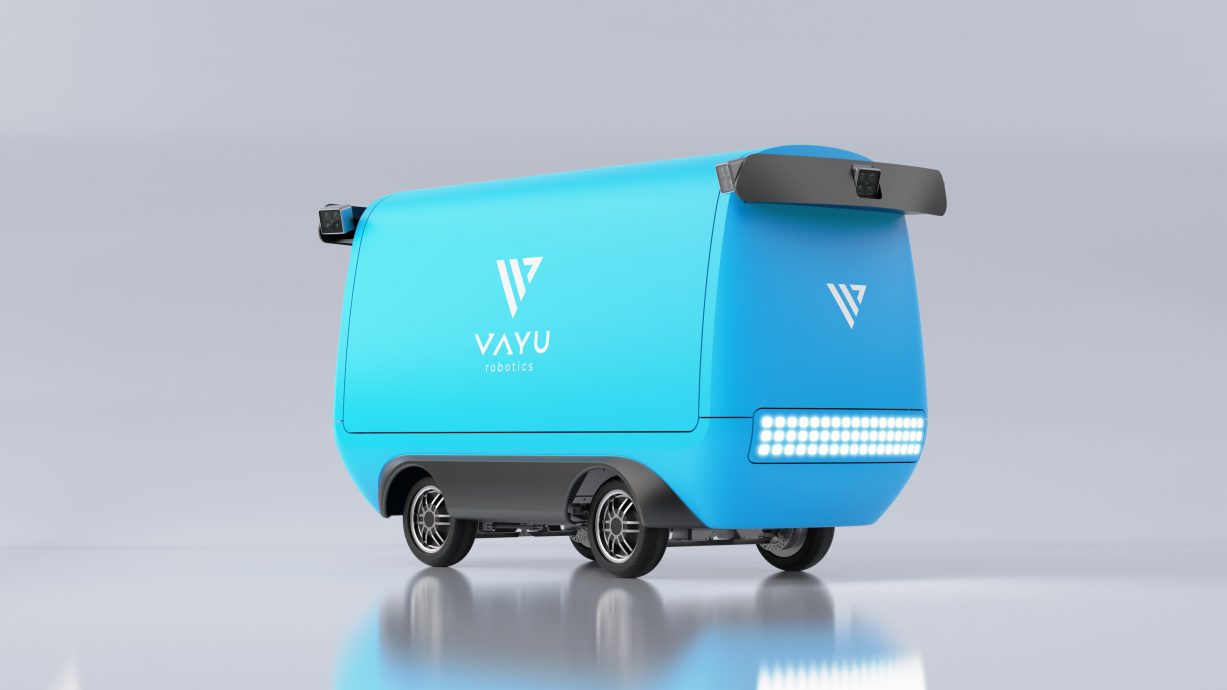
Looking at the robot itself, the Vayu One is where the thesis meets the pavement. The pod is a four-wheel electric vehicle roughly 3.3 feet tall, 5.9 feet long, and 2.2 feet wide. Its enclosed cargo bay carries up to 100 pounds of goods, which Vayu says it can push to 200 pounds with modest design tweaks. The vehicle hits a maximum of 20 mph on roads and bike paths, with a battery range of 60 to 70 miles per charge. A side-mounted door with a small robot arm allows unattended handoff of parcels. That specification set positions it between a sidewalk cooler and a classic class-two autonomous vehicle.
The robot’s engineering reflects the LiDAR-free design philosophy at every layer. A sealed sensor pod carries the Vayu Sense module and a small inertial measurement unit, which replaces the usual spinning turret. Compute lives in a single automotive System-on-Chip tucked beside the drive electronics. Battery packs are automotive-grade lithium-ion rated for daily cycle use, which matters because delivery robots can run three or four full cycles a day. The suspension is tuned for curb hops and driveway lips rather than highway cruising. Vayu also integrated a cellular modem for remote supervision, so a human can intervene when a scene exceeds the policy’s confidence budget.
Operationally, the Vayu One is designed to blend into a retail workflow instead of a research lab. The robot follows a staff member through a store to accept the day’s parcels, then drives routes assigned through a cloud dispatch service. Routing uses standard street maps rather than survey-grade HD maps, which keeps the mapping cost near zero per city. The robot can mount a curb or driveway to reach a doorstep, which is a hard edge case for ground vehicles. A customer unlocks the compartment through a phone handshake or a one-time code tied to the parcel. The whole flow is designed to run with a single remote operator supervising dozens of robots.
Those specific design choices show up directly in the real pilots now underway with retail partners. Vayu’s first announced customer is a large US e-commerce retailer that signed a substantial commercial agreement for 2,500 Vayu One units, starting in San Ramon, California. The pilot is structured around dense same-day grocery and household goods orders. Early metrics track time-per-delivery, intervention rate, and customer unlock success in dense suburban streets. Vayu has pointed to that deal as evidence that the pod has moved past prototype and into production hardening. The company also hinted that other retailers are already in the pipeline. Each new deployment city gives Vayu Drive more edge-case data to train against.
How the AI Robotics Foundation Model Works at the Edge
In practice, running a transformer policy on a vehicle in motion is a very different problem than running it in a datacenter. The Vayu Drive engineering team compiled their model to run on an automotive-grade System-on-Chip, with aggressive quantization and operator fusion. At inference the stack produces roughly 10 planning updates per second. That rate is tight for a 20 mph robot but adequate because the robot can decelerate hard inside one frame of latency. The model emits both low-level controls and a short textual reasoning trace used by a safety monitor. A rule-based layer vetoes commands that violate a hand-written set of invariants, such as never leaving a bike lane without visual confirmation. That belt-and-suspenders design is standard practice in modern AI for autonomous vehicles and transportation stacks.
Edge deployment forces a careful split between on-robot and in-cloud intelligence. The robot handles perception, local planning, and all time-critical control decisions. The cloud receives trip summaries, incident recordings, and remote-operator joystick commands for complex scenes. Vayu uses the cloud layer to accumulate training data for the next model revision, closing the loop between field incidents and model updates. The company also stores anonymized video from pilot cities to populate scene-specific validation suites. Each new model release is regression-tested on those scenes before any robot moves off the lot. The feedback loop is the heart of how Vayu Drive gets better over time without expensive HD map updates.
The Last-Mile Delivery Market Vayu Is Attacking
Looking ahead at the market, the commercial opportunity is large and still unsettled. Analysts at MarketsandMarkets peg the delivery robot industry on a path to grow from $2 billion in 2024 to over $5 billion by 2030. Road-going platforms will take an outsized share of that total market. The broader autonomous last-mile delivery market, which includes drones and sidewalk pods, is forecast to exceed $10 billion in the same window. Those numbers reflect a shift in retail logistics where same-day grocery, convenience and health deliveries are the fastest-growing segments. Vayu is targeting the dense suburban slice of that market, where human couriers are expensive and parking is hard.
Retail economics continue to push the opportunity further into profitable fleet territory for operators. A typical last-mile delivery costs between $8 and $10 per package in a dense US city, and labor is the single largest line item. Robotic couriers shift that cost structure because they can run multiple deliveries in parallel from a single human supervisor. Vayu believes the Vayu One can hit a cost per delivery in the low single digits once a fleet reaches two to three thousand active robots in a region. That scale lets a retailer price a same-day grocery delivery below the current courier floor and still earn margin. The appeal to a Walmart, Instacart or Amazon analog is obvious.
Geography also matters in a serious way when planning delivery routes and city coverage expansion. Vayu’s road-legal pod can serve routes that sidewalk robots cannot, because many US suburbs lack continuous sidewalks and have long cross-street legs. The vehicle also skips the mezzanine problem of drones, which struggle with noise rules and multi-family housing complex rooftops. For retailers who want a single platform across urban cores and suburban cul-de-sacs, Vayu offers a cleaner fit than either alternative. The regulatory arc is still bumpy, but states like California and Texas have moved to allow low-speed autonomous ground vehicles under specific permits. The policy tailwind lines up with the technical maturity of the Vayu Drive model.
The Unit Economics of Autonomous Delivery Robots
Beyond market framing, unit economics are where investor conviction either hardens or collapses in autonomous delivery. The relevant line items are hardware cost, energy per mile, parts replacement, remote-supervisor labor, insurance, and fleet management overhead. Vayu claims the Vayu One ships at a bill of materials well below $10,000 per unit at pilot volumes, which can fall further as cameras and compute follow Moore’s law. Energy is cheap because the robot sips a few cents of grid power per mile. Maintenance is projected at a few hundred dollars a year, dominated by tires, brakes and small electronics.
Remote supervision cost is the swing variable in every autonomous delivery pricing model today. In the first pilot year, Vayu expects one operator to oversee six to eight robots, because the policy still trips on construction zones, delivery truck double-parks, and heavy rain. As Vayu Drive improves, that ratio should move toward one operator per 20 to 30 robots within three years. At that supervisor density the all-in cost per delivery dips below the $2 mark that Vayu quotes to retailers. Insurance pricing is the single hardest variable to predict because actuaries have very few road-robot miles to base policies on. Vayu’s partnership with Lockheed Martin Ventures gives it access to safety-case consultants who can push underwriters.
Across the industry, the operational targets for cost per delivery are converging quickly toward one dollar. Serve Robotics’ CEO Ali Kashani has publicly set a $1 per delivery goal for the combined Serve-Vayu fleet, with autonomy as the mechanism to close the gap. Nuro and Starship pursue similar economics with different form factors. The pattern across the sector is that unit economics only work at fleet scale of thousands of robots per region. The implication for retailers is that early pilots serve more as data-collection exercises than profit centers. Patience matters because the first operator to clear the regulatory and cost thresholds captures a dominant share of the local market.
The Serve Robotics Acquisition and Industry Consolidation
Stepping back to the broader timeline, the biggest shift in Vayu’s story came on August 22, 2025, when Serve Robotics announced it was buying the company. The deal paid Vayu stockholders 1,696,069 Serve common shares up front, with milestone-tied earnouts that could grow the final consideration. Some Vayu stockholders could elect cash instead of shares depending on their holding size. The transaction brought Anand Gopalan, Mahesh Krishnamurthi and Nitish Srivastava into Serve as engineering leaders. Vinod Khosla joined Serve’s Advisory Board, which signaled continued financial backing of the combined entity. Serve’s share price moved on the news, reflecting the strategic value of the Vayu Drive stack.
Serve’s rationale centers on bringing foundation-model autonomy to its sidewalk fleet. Serve has operated sidewalk robots in Los Angeles for several years, delivering restaurant orders in partnership with Uber Eats. Its third-generation robots run on NVIDIA Orin, which has the headroom to host a Vayu Drive-class policy. Pairing Serve’s real-world sidewalk dataset with Vayu’s simulation and model expertise accelerates both roadmaps. The combined company plans to extend operations into bike lanes, which widens the serviceable market and lets Serve route around pedestrian conflicts. Both teams now share one autonomy stack rather than evolving two separate codebases.
The acquisition is also a bellwether for industry consolidation across the broader autonomous delivery sector. Starship Technologies, Nuro, Avride, Cartken and Coco all raised substantial rounds between 2020 and 2024, and the sector was heading for a shakeout. Combining Vayu’s technology with Serve’s commercial footprint produced a company that can plausibly aim at a $1 per delivery operating point. Smaller players without that stack risk sliding into local-only operations or acquisition exits of their own. Investors in the sector read the deal as a signal that the next 24 months will separate the national platforms from the city-specific niches. For retailers evaluating fleet partners, the message is to pick a counterparty with a credible path to multi-city scale.
Not every integration is smooth, and the Serve-Vayu deal has real execution risk. Two engineering teams with distinct codebases must merge perception, planning and fleet-management stacks without regressions in the active Los Angeles network. Cultural fit matters because Vayu built its organization around a research culture while Serve operates a 24-hour live fleet. Serve’s balance sheet, which still relies on growth capital, has to absorb the operating expense of a research-heavy team. The company must also defend against regulatory scrutiny of road-vehicle expansion in cities already uneasy about sidewalk robots. Investors expect integration milestones to appear in the 2026 earnings cadence, which will show whether the thesis actually ships.
Comparing Vayu Robotics with Starship, Nuro, and Serve
Rounding out the competitive view, comparing Vayu with the broader market highlights how different the design choices are. Starship Technologies ships small sidewalk cooler robots that cruise at 4 mph on university campuses and suburban routes. Nuro built a road-legal pod similar in spirit to the Vayu One but historically paired with LiDAR and a very large compute stack. Serve, before buying Vayu, used NVIDIA-based sidewalk robots focused on hot-food delivery in Los Angeles. Amazon’s Scout program showed the appeal of sidewalk delivery and the operational pain of narrow sidewalks, and was paused in 2022.
The comparison matters for retailers because form factor dictates where the robot can serve a delivery. Sidewalk pods are limited to areas with continuous paved pedestrian paths, which is a small share of US suburbs. Road-legal pods like the Vayu One can serve long cul-de-sac streets where sidewalks disappear. Full-size automotive-grade autonomous delivery vehicles from Nuro and Walmart’s logistics partners work for larger loads but carry much higher sensor costs. Vayu sits in the middle, with road presence, modest payload, and smartphone-cost sensing. That slot is the sweet spot for same-day grocery and convenience delivery in US and dense Asian cities. It extends the thesis in 3D-printed robotics approaches about low-cost scalable fleets.
Safety, Insurance, and Regulatory Risks of Road-Going Robots
Despite the engineering progress, safety is the central public question for any road-legal delivery robot. The Vayu Drive policy must handle children on scooters, dogs on leashes, cars that double-park on narrow streets, and rare adversarial behavior from pedestrians. Vayu publishes incident data from pilots and runs a shadow mode where the policy makes decisions that are compared against human remote-operator calls. Shadow metrics are shared with city regulators to build a safety case. Regulatory frameworks for low-speed autonomous ground vehicles are still immature in most of the US, with California, Texas and Arizona ahead of other states. The company has to work with each state and local jurisdiction individually on permits and incident reporting.
Insurance underwriting represents the second big structural risk facing autonomous delivery fleet operators today. Actuaries pricing autonomous robot policies rely on fleet data to estimate loss ratios, and new entrants have very little history. The Vayu-Serve combination may command better rates because the merged fleet produces a bigger data pool. Still, a single serious injury incident can spike premiums across the sector by double digits for a quarter. Vayu addresses this risk with a layered autonomy stack that includes rule-based vetoes on the learned policy. Those invariant checks matter for both safety and insurance narrative. The sector will not scale beyond pilots until insurance economics stabilize.
Cybersecurity rounds out the complete risk picture for a connected fleet of road-going delivery robots. A fleet of connected vehicles is a juicy target for ransomware, GPS spoofing, and physical interference. The AI governance trends and regulations conversation now covers delivery robots as critical infrastructure in some proposed state bills. Vayu has to run signed firmware updates, encrypted telemetry, and a credential model that cannot be exploited by a stolen phone. The company also has to detect pedestrians who intentionally confuse the robot and distinguish them from genuine emergencies. Mitigations exist, but each adds engineering overhead and cost, aligned with AI in autonomous vehicles safety thinking. Serve inherits that security burden on the day the acquisition closes.
Ethics, Labor, and Public Acceptance of Delivery Robots
Given the labor stakes, ethics is more than a public relations problem for autonomous delivery robots. The AI ethics and laws literature covers labor displacement, data privacy, and street-level fairness in ways that directly apply here. A fleet of robots replacing bike couriers in a dense city displaces mostly immigrant workers in gig arrangements. Retailers and operators have a duty to describe transition plans and retraining opportunities for the workers whose routes a Vayu-style robot now covers. Public hearings in Los Angeles and San Francisco have surfaced this issue with real intensity.
Public acceptance also depends on day-to-day street-level behavior that residents experience firsthand on their blocks. Residents complain when robots block driveways, idle in bike lanes, or produce beeping sounds at odd hours. Vayu’s engineers have run empathy studies with local residents to tune robot behaviors in ways that reduce friction. The company shares aggregate behavior metrics with city partners so that pedestrians and residents can trust that complaints shape the policy. The autonomous delivery industry will succeed only if the public views the robots as polite neighbors rather than mobile intrusions. That trust is slow to build and quick to lose, as patterns from agricultural robots in the field rollouts demonstrate across rural communities.
Implementation Guide for Retailers Piloting Vayu-Style Robots
Moving on from the policy debate, retailers evaluating Vayu Robotics autonomous delivery can turn the strategy into a pilot plan. The pilot should start with one dense neighborhood near a fulfillment hub, with short routes that allow multiple return cycles per robot per day. The approach borrows from AI in robotics deployment patterns across other industries. A clear service level agreement must cover intervention response time, insurance coverage limits, and public complaint handling. The retailer should also instrument its ordering system to flag addresses the robot cannot yet handle, such as apartment buildings without covered curb drop zones. These operational guardrails stop pilots from degrading core courier operations during the ramp-up and testing phases.
The pilot’s second phase extends the fleet while keeping metrics tight. Retailers should track per-delivery intervention rate, average cycle time, customer unlock success rate, and net promoter score for the delivery experience. Those metrics let the operator identify whether cost savings are real or whether hidden losses from reorders and refunds are eating the margin. A good pilot keeps a parallel human courier network running for 90 days so that any robot failure never breaks the overall service. The retailer should also open a direct line to the robot operator’s engineering team so that software updates incorporate observed failure modes within weeks.
Scaling beyond a single neighborhood requires regulatory, infrastructure, and brand investment. The retailer and the robot operator should coordinate with the city on parking zones, charging locations, and incident protocols. Charging infrastructure is non-trivial because a 2,500-robot fleet needs megawatts of grid access and a maintenance yard with cycle time management. The retailer should message its delivery brand clearly, so that customers understand which orders arrive via robot and how to interact with the vehicle. A thoughtful public rollout, with signage and local press coverage, builds the goodwill that smooths later expansions. These coordinated steps are what turn a one-neighborhood pilot into a durable multi-city program over time.
Key Insights on Vayu Robotics and the Autonomous Delivery Shift
- Vayu Robotics closed its seed round at $12.7 million led by Khosla Ventures in 2023, with Lockheed Martin Ventures joining. That round proved that a LiDAR-free autonomy approach could still attract top-tier venture capital in a crowded industry.
- The Vayu One carries 100 pounds at 20 mph with a 60 to 70 mile range per charge on standard roads. That operating footprint supports 10 to 15 deliveries per robot per day across a dense suburban beat, with New Atlas documenting the full specs and route economics.
- Vayu signed a commercial agreement to field 2,500 robots with a large US e-commerce player, starting in San Ramon. That one commercial deal already exceeds the lifetime deployment of several competing sidewalk fleets combined across US markets.
- Serve Robotics revenue is forecast to grow nearly tenfold to $26 million in 2026, up from the prior year baseline. The Vayu acquisition is the engineering lever that makes aggressive scale-up credible to public-market investors watching Serve closely.
- Analysts at MarketsandMarkets project the global delivery robot industry will more than double across the next six years. Market size is set to grow from roughly $2 billion in 2024 to over $5 billion by 2030 globally.
- Serve CEO Ali Kashani has publicly set a one dollar per delivery target for the combined company fleet. That target implies an eight to tenfold improvement over current human-courier economics across dense urban zones in the US.
- Khosla Ventures doubled down on the thesis when founder Vinod Khosla joined Serve’s Advisory Board after the deal. That signal reflects investor conviction that autonomous ground delivery is reaching a scale inflection in the next 24 months.
These data points converge on a single story about the next phase of autonomous delivery. Vayu’s technical bet is paying off because the economics only work when sensors cost smartphone money and software replaces survey-grade mapping. The Serve acquisition compresses a decade of operational learning in Los Angeles with a research-grade autonomy stack from the Bay Area. The combined company inherits a path to multi-city scale that neither firm could have built on its own. Investors, retailers and regulators are watching to see whether 2026 produces the first thousand-robot network running at an all-in cost near a dollar per delivery. The outcome will anchor the pricing, policy and public expectations for every autonomous delivery program that follows.
How Vayu Robotics Autonomous Delivery Stacks Up Across the Industry
Vayu Robotics autonomous delivery sits in a distinct quadrant of the industry when you compare transparency, decision architecture, service scope, and accountability against the leading sidewalk and road-going fleets. The comparison below places five dimensions side by side so the reader can see where Vayu, Starship, Nuro, and Serve diverge and converge. Transparency and decision architecture track public disclosure practices and the use of learned versus rule-based policies. Participation in open research measures how aggressively each team contributes to academic literature and shared datasets. Public trust ratings and service delivery scope capture how neighborhoods actually experience each fleet in daily operation. Accountability frameworks round out the picture by showing how each company reports incidents to regulators and the public.
| Dimension | Vayu Robotics | Starship Technologies | Nuro | Serve Robotics (pre-Vayu) |
|---|---|---|---|---|
| Transparency on autonomy stack | Public foundation model thesis | Limited technical disclosure | Detailed safety reports | Hardware-centric disclosures |
| Participation in open R and D | Partnerships with universities | Minimal | Research publications | NVIDIA partnership deep-dives |
| Public trust rating | Early pilots, pending data | High on campuses | Mixed after Houston pilots | Strong in Los Angeles |
| Decision-making architecture | End-to-end transformer plus rule guard | Rule-based with learned perception | Modular classical stack | Modular with learned planning |
| Misinformation handling | Direct customer handshake unlock | App-based unlock | Vehicle-side payment flow | App-based unlock |
| Service delivery scope | Road, bike lane, driveway hops | Sidewalk only | Road, suburban | Sidewalk only, Los Angeles |
| Accountability framework | Shadow mode plus incident reports | City permit reporting | DOT voluntary reporting | City partnership reports |
Real-World Examples of Vayu Robotics Autonomous Delivery
Three recent deployments show how the Vayu platform operates in the field today. These range from the flagship 2,500-robot grocery rollout to the Bay Area testing program and the Vayu Sense licensing deal.
San Ramon Grocery Pilot with 2,500 Vayu One Units
Vayu’s flagship deployment is a commercial agreement for 2,500 Vayu One units with a large US e-commerce player, starting in San Ramon, California. The retailer implemented a same-day grocery and sundries delivery across suburban routes, with each robot handling 10 to 15 orders per day on average. Early metrics show per-delivery cost falling toward $2.50 as the fleet matures, versus roughly $9 for the retailer’s prior human-courier model. A limitation is that apartment complexes without covered curb drop zones still fall back to human couriers, which blunts the headline savings. The pilot also showed that unlock success rates dip below 90 percent in heavy rain, which triggered a weatherproofing upgrade. The city has permitted an expansion phase that will add 500 more units in the second half of 2026.
Bay Area Pre-Production Testing on Mixed Streets
Before the San Ramon rollout, the team implemented a pre-production program across Bay Area streets and bike lanes that logged roughly 50,000 cumulative test miles over 18 months. The pilot covered dense city blocks in Oakland and quieter residential routes in Walnut Creek, which exposed the policy to a wide range of lighting, weather and traffic conditions. The team logged a mean intervention rate near one critical takeover per 150 miles. That rate was a 40 percent reduction versus the first month, which Vayu claims rivals early AV programs. A documented limitation is that the pods still struggle with multi-lane left turns at busy signalized intersections. Engineers responded by adding a conservative rule-based layer that defers to human operators during protected turns. The data from those 50,000 miles trained the model release that now ships in commercial units.
Vayu Sense Validation with a Global Robotics Manufacturer
Vayu deployed its Vayu Sense module through a licensing partnership with a leading global robotics manufacturer in late 2023. That partnership lets the company swap LiDAR units for Vayu’s passive sensing stack. The deal gave Vayu an early sensor-only revenue stream and a validation partner for its depth-estimation claims across different robot bodies. The manufacturer reportedly cut sensor bill-of-materials cost by over 60 percent on its delivery product line. A limitation is that Vayu Sense delivers best depth accuracy within 25 meters, which rules out highway-speed applications. The partner accepts that trade because its target product also operates below 30 mph. The partnership is a template for how Vayu monetizes its hardware beyond its own fleet.
Build Your Autonomous Delivery Reading Shelf
Three canonical textbooks every engineer, product manager and investor working on autonomous delivery robots should keep on the desk.

Probabilistic Robotics
The canonical textbook on probabilistic methods behind autonomous robot navigation, the backbone every delivery-robot engineer builds on.
Buy on Amazon
Reinforcement Learning: An Introduction
Sutton and Barto’s foundational reinforcement learning book, central to how Vayu Drive-class policies learn mobility.
Buy on Amazon
Deep Learning
The reference text on the deep learning methods powering transformer-based perception and planning in modern delivery robots.
Buy on AmazonAs an Amazon Associate, AIplusInfo earns from qualifying purchases.
Case Studies in Autonomous Last-Mile Delivery
Three case studies on autonomous last-mile delivery reveal the strategic patterns behind the Serve-Vayu merger, the Khosla investment thesis, and the lesson from Nuro's hardware-heavy pivot.
Case Study: Serve Robotics Integration of Vayu Drive on Sidewalk Fleet
Serve Robotics faced a scaling problem well before the Vayu acquisition closed. Its third-generation sidewalk robots had the NVIDIA Orin compute to host a bigger autonomy policy, but the in-house software team was stretched by live-fleet operations in Los Angeles. The company could not simultaneously ship a new policy and run an active delivery network. The solution was that buying Vayu let Serve import a mature research team and a mobility foundation model trained on simulated and real-world data. The integration plan brings Vayu Drive onto Orin-class hardware across the Serve fleet, with early simulation runs showing a target cycle-time reduction of 15 to 20 percent per delivery.
The strategic impact beyond Serve itself is just as material for the broader autonomous delivery sector. The deal expands Serve's addressable market because the combined policy will support bike-lane operation, which doubles the serviceable street mileage per city. Operationally, Vayu's engineers help Serve expand remote-operator ratios from one-to-eight toward one-to-twenty within 18 months. The limitation is that Serve's balance sheet depends on continued capital raises to fund the Vayu team's research cadence while the live fleet operates. If capital markets tighten in 2026, that pressure could force engineering trade-offs. The lesson for the sector is that an autonomy stack and a live fleet have to merge carefully, with explicit integration milestones to protect each.
Case Study: Khosla Ventures and the Last-Mile Investment Thesis
Vinod Khosla's firm has backed autonomous robotics since the mid-2010s, and the Vayu bet reflected a sharper thesis about last-mile economics. The problem Khosla identified was that the $8 to $10 cost per urban delivery was mostly labor, and no software company could remove that line item without a vehicle. Vayu's answer was a $12.7 million seed to build the next wave of robotics solutions, which bought enough time to prove the foundation-model thesis without compromising on hardware economics. The impact of the investment is now visible in the Serve-Vayu combined roadmap, with Khosla joining the acquirer's Advisory Board. A limitation is that single-investor conviction can create concentration risk if a thesis fails to attract follow-on capital. In this case Lockheed Martin Ventures and ReMY diluted that risk by co-investing. The lesson is that venture conviction, operational discipline and corporate strategic capital must line up for a robotics bet to graduate.
Case Study: Nuro's Pivot and the Case for Vayu's Form Factor
Nuro, one of the earliest road-going delivery pioneers, offers a cautionary case for the sector. The company raised over $2 billion between 2018 and 2022, built a LiDAR-heavy pod, and partnered with Kroger, Domino's and 7-Eleven in multi-city pilots. By 2023 the company laid off a large share of its workforce and pivoted toward licensing its autonomy stack. The pivot reflected the hard reality that LiDAR-heavy hardware did not reach a cost that mass retailers could sustain. The impact was that Nuro's commercial fleet shrank even as its software roadmap matured, which left the operational advantage open for leaner competitors.
The problem Nuro faced is that its stack cornered its economics; Vayu's design philosophy reads as a direct response to Nuro's experience. By choosing passive sensors and a smaller compute envelope, Vayu avoided the bill-of-materials trap that cornered Nuro's hardware roadmap. The combined Serve-Vayu entity now holds a form-factor advantage that Nuro cannot match without a hardware reset. A limitation of this comparison is that Nuro's software stack is more mature in some regulatory conversations because of its earlier footprint. The lesson is that hardware strategy in autonomous delivery is the fastest way to shape unit economics. No amount of software elegance compensates for a sensor stack that doubles the cost per robot. Operators who learn that lesson early have a structural edge in the next cycle.
Risks and Guardrails for Scaling Delivery Robots
Building on the pilot blueprint, risks scale with fleet size, which is the hard truth every autonomous delivery operator confronts. A 100-robot pilot can be managed by a single operations team with manual oversight on every incident. A 2,500-robot program like Vayu's needs structured incident playbooks, 24-hour operator coverage, and clear escalation paths to law enforcement for serious events. Vayu addresses this with a tiered support model that separates traffic incidents from parcel disputes from safety-of-life events. Each tier carries its own service level and audit log. That tiering keeps the right people awake for the right calls.
Technical guardrails are equally important for the responsible scaling of any autonomous ground delivery program. The Vayu Drive policy carries a rule-based safety layer that vetoes commands outside hand-written invariants, drawing on patterns from AI robots enter the real world deployments across industries. The safety layer refuses to steer into oncoming traffic, run a red light, or ignore a stop sign, even if the learned policy would. Software updates are rolled out in staged canaries across the fleet to catch regressions before they reach every robot. Hardware refresh schedules replace cameras, batteries, and wheels on fixed intervals to prevent fatigue failures. These guardrails make the difference between a demonstration and a durable service.
Business-level guardrails round out the full picture of what makes a fleet durable in the market. Fleet operators need legal frameworks for data retention, incident reporting, and customer complaint handling that match consumer-protection expectations. Vayu publishes a quarterly transparency report on intervention rates and incident categories, which gives regulators and customers a shared view of fleet performance. The transparency also builds a defensive moat against lawsuits because it demonstrates reasonable care. Insurance pricing improves when underwriters have published performance data to anchor rates. Scaling is only durable when technical, operational and business guardrails move together.
The Future of Vayu Robotics Autonomous Delivery
Looking at where the Vayu platform goes next means tracking the Serve Robotics roadmap. The combined company has publicly committed to deploying Vayu Drive on the third-generation Serve robots running on NVIDIA Orin by late 2026. Those robots will serve a mix of restaurant delivery in Los Angeles and new verticals in grocery, pharmacy, and convenience. Serve has signed AI-powered robotics advancements partners that include large national chains, which gives the merged fleet a national expansion path. The question is whether the integration milestones ship on time, because capital markets react quickly to delays in high-visibility programs.
Beyond Serve, the broader industry trajectory points to several concrete shifts. Road-legal pods will take share from both sidewalk-only fleets and traditional human couriers in dense suburban cores. Insurance carriers will issue the first standardized autonomous delivery robot policy classes within two years, which will stabilize underwriting for new fleets. Cities will adopt a common permit framework similar to the micromobility template used for shared scooters. Each of those shifts expands the serviceable market and lowers the operating cost per delivery. The compound effect could be a market where road-going delivery robots are as ordinary as rideshare cars are today.
Model-side advances through 2026 and 2027 will keep compressing the autonomy cost curve across the sector. Foundation models for mobility will scale with the same patterns documented across humanoid robots learn tasks research, where simulation volume and transformer size compound into better out-of-distribution performance. Vayu's acquisition brings exactly that model-centric capability inside Serve, with headroom to extend to bike-lane and tight urban-core operation. The next generation of Vayu Drive is expected to triple the planning rate while keeping the compute envelope flat, which supports higher-speed operation on bike lanes. Model quality compounds the fleet quality, which compounds the economics. That virtuous cycle is what venture investors are pricing into Serve's post-acquisition stock.
The policy environment will set the ultimate cap on growth. State legislatures are debating whether to classify low-speed autonomous ground vehicles as a new class of vehicle, with its own licensing and inspection regime. Federal rulemaking on autonomous mobility is slow but moving, with the Department of Transportation signaling interest in a national framework. The AI governance debate is also shaping sector expectations, especially around labor transition and privacy. Operators that engage early with regulators build goodwill and shape workable rules. Vayu will succeed or stall based on how well the combined Serve team navigates that political dimension in parallel with the engineering roadmap.
Autonomous Delivery Robots: Market Trajectory to 2030
Horizontal bar chart compares the global delivery-robot market with adjacent benchmarks, in US dollars. Vayu Robotics operates in the road-going slice.
Sources: MarketsandMarkets delivery robot market release; S and P Global Serve Robotics research; The Robot Report seed round coverage. Chart by AIplusInfo.
Frequently Asked Questions on Vayu Robotics Autonomous Delivery
Vayu Robotics autonomous delivery is a four-wheel electric robot that uses passive CMOS sensors and the Vayu Drive transformer-based foundation model to deliver goods on public roads. The platform replaces LiDAR with low-cost cameras backed by computational imaging. It targets last-mile grocery and e-commerce orders for US retailers.
Anand Gopalan, the former CEO of Velodyne Lidar, co-founded Vayu Robotics in 2022. Mahesh Krishnamurthi, an Apple and Lyft perception engineer, and Nitish Srivastava, a researcher from Apple and the University of Toronto, joined him. The founders now serve as engineering leaders inside Serve Robotics after the 2025 acquisition.
Vayu Drive is a transformer-based mobility foundation model trained on simulated and real-world driving data. It takes camera inputs, routing instructions, and the robot's running state. It outputs steering, throttle and brake commands at roughly 10 planning updates per second on edge compute, with no LiDAR point clouds required.
The Vayu One is a four-wheel electric pod about 3.3 feet tall, 5.9 feet long, and 2.2 feet wide. It carries up to 100 pounds, with capacity extensible to 200 pounds, and runs at 20 mph on roads and bike lanes. Range is 60 to 70 miles per charge, with cellular remote-operator support.
Serve Robotics acquired Vayu Robotics on August 22, 2025, to bring foundation-model autonomy to its sidewalk fleet. The deal paired Vayu's AI and simulation strength with Serve's live-fleet data from Los Angeles. The combined company plans to expand into bike lanes and target a $1 per delivery cost.
Vayu Robotics raised a $12.7 million seed round led by Khosla Ventures, with Lockheed Martin Ventures and ReMY Investors joining. The capital funded hardware prototyping, foundation-model training, and the Vayu Sense module. The round emerged from stealth in 2023 and preceded the first commercial 2,500-unit customer contract.
Vayu Sense is Vayu's passive perception stack built on multiple CMOS image sensors and computational imaging software. The module delivers depth and object detection accuracy that Vayu claims beats RGB cameras and LiDAR under 30 mph. The sensor is sold both inside Vayu One robots and separately to third-party robotics manufacturers.
The first production deployment of the Vayu One is a 2,500-robot program with a large US e-commerce retailer, starting in San Ramon, California. The deployment focuses on same-day grocery and sundries delivery across suburban routes. Expansion into additional US cities is scheduled across 2026 and 2027.
Road-going delivery robots raise safety risks around pedestrians, cyclists, and distracted drivers in tight suburban streets. Vayu addresses these risks with a rule-based veto layer over the learned policy and with cellular remote-operator supervision. Regulatory frameworks still vary by state, and insurance underwriting is maturing alongside the pilots.
Autonomous delivery robots cost a few cents of energy per mile and modest annual maintenance for tires, brakes and electronics. The main variable cost for autonomous delivery fleets is remote operator supervision labor. Vayu expects to improve the ratio from one operator per eight robots up to one per 20 to 30 as the Vayu Drive policy matures. Fleet-level cost per delivery can fall to roughly $2 at scale.
Starship ships slow sidewalk robots suited to campuses and quiet neighborhoods. Nuro builds LiDAR-heavy road pods aimed at larger grocery and convenience retail partners. Serve, before the Vayu deal, operated NVIDIA-based sidewalk robots in Los Angeles. Vayu's road-going pod with foundation-model autonomy sits between these, and the combined Serve-Vayu company now spans sidewalk and road delivery.
Autonomous delivery robots will shift the courier labor market, especially in dense urban areas where human-courier costs are highest. Retailers and operators have a duty to describe transition and retraining plans for the workers affected. Public hearings in Los Angeles and other cities have flagged labor displacement as a central ethical issue in sector growth.
Vayu's technology now powers Serve Robotics' third-generation autonomy stack running on NVIDIA Orin. The combined company plans to deploy foundation-model autonomy across sidewalk and road robots and expand to bike-lane operations. Public-market investors are watching for integration milestones in the 2026 earnings cadence to confirm the thesis is on track.