
Introduction
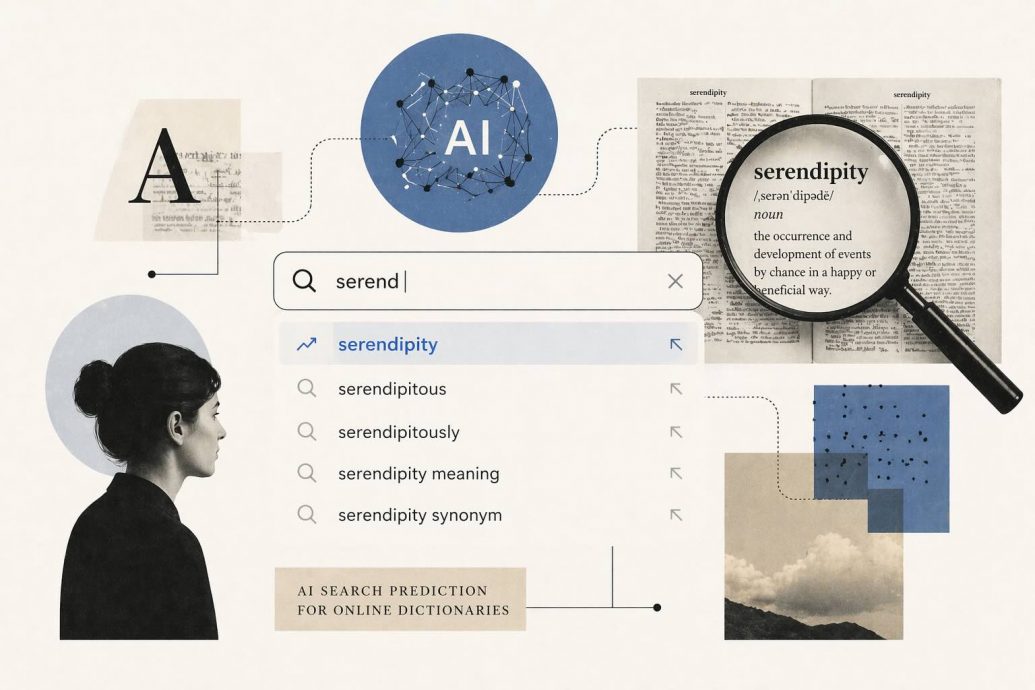
The way people search for words online has changed dramatically in the past five years. Online dictionaries now serve billions of lookups annually, and users expect instant, intelligent results before they finish typing. The global electronic dictionary market is projected to grow from $7 billion in 2025 to $18.2 billion by 2035, driven largely by AI-powered features (Future Market Insights). AI search prediction for online dictionaries uses machine learning and natural language processing to anticipate user queries in real time. These systems analyze partial keystrokes, historical search patterns, and contextual signals to suggest the most relevant word or phrase. Platforms like Merriam-Webster and Cambridge Dictionary have already integrated AI chatbots and predictive search to modernize how users interact with language resources. This shift represents a fundamental transformation in how humans access and discover language through digital tools. The question is no longer whether dictionaries will adopt AI search prediction, but how deeply these systems will reshape our relationship with words.
Key Questions
What Does AI Search Prediction Mean for Dictionaries?
AI search prediction for online dictionaries refers to the use of machine learning algorithms that anticipate and suggest word lookups based on partial user input, search history, and contextual relevance. These systems go beyond simple autocomplete by understanding morphological patterns, semantic relationships, and user intent to deliver accurate results before a query is fully typed. Unlike traditional keyword matching, AI-powered prediction uses deep learning models trained on massive language corpora to rank and surface the most probable dictionary entries in real time.
How Does AI Improve Dictionary Search Accuracy?
AI improves dictionary search accuracy by leveraging natural language processing to understand misspellings, abbreviations, and contextual meaning behind partial queries. Machine learning models trained on millions of real user searches can distinguish between similar-sounding words and prioritize results based on frequency, recency, and user behavior patterns.
Can Predictive Search Help Non-Native Speakers Find Words?
Predictive search significantly helps non-native speakers by correcting phonetic approximations and suggesting words even when users are unsure of exact spellings. AI-driven dictionary tools can detect language proficiency levels and adjust suggestion complexity accordingly, making word discovery accessible to learners at every stage.
Key Takeaways
- AI search prediction transforms online dictionaries from passive reference tools into proactive language assistants that anticipate user needs.
- Natural language processing and word embeddings form the technical backbone of accurate, real-time dictionary search suggestions.
- Bias in training data and privacy concerns with keystroke tracking remain significant challenges for AI-powered dictionary platforms.
- The future points toward context-aware, multilingual, and voice-integrated dictionary search powered by generative AI models.
Table of contents
- Introduction
- Key Questions
- Key Takeaways
- What Exactly Is AI Search Prediction for Dictionaries
- Why Online Dictionaries Need Smarter Search
- How AI Predicts What You Want to Look Up
- The Role of Natural Language Processing in Dictionary Search
- Word Embeddings and Their Influence on Search Accuracy
- Training Predictive Models on Lexicographic Data
- Autocomplete vs. Predictive Search in Dictionary Platforms
- Personalized Dictionary Results Through User Behavior Analysis
- How Google and Merriam-Webster Use AI in Search
- Multilingual Search Prediction and Cross-Language Lookups
- Building a Predictive Search Pipeline for Dictionary Apps
- Reducing Latency in AI-Driven Dictionary Queries
- Bias in AI Language Suggestions and How It Surfaces
- Privacy Concerns With Keystroke Tracking in Dictionary Tools
- Ethical Boundaries for AI-Powered Lexicographic Platforms
- How AI Search Prediction Supports Language Learners
- Voice Search and Its Integration With AI Dictionaries
- Real-World Failures of Predictive Dictionary Search
- The Rise of Context-Aware Definitions
- Generative AI and the Future of Dictionary Entries
- What Linguists Think About AI-Curated Definitions
- Key Insights
- Real-World Examples
- Case Studies
- FAQ’s
What Exactly Is AI Search Prediction for Dictionaries
AI search prediction for online dictionaries is a technology that combines natural language processing, machine learning, and user behavior analysis to forecast and display word suggestions as a user begins typing in a search bar. It transforms dictionary platforms from static lookup tools into dynamic, anticipatory language assistants that learn and adapt over time.
Why Online Dictionaries Need Smarter Search
Online dictionaries have operated on the same basic search model for over two decades, relying on exact keyword matching and alphabetical indexing. This approach fails users who misspell words, use phonetic approximations, or search for concepts without knowing the exact term. A student trying to find “onomatopoeia” might type “onomatapia” and receive zero results on a traditional platform. Research shows that over 23 percent of Google searchers click autocomplete suggestions instead of completing queries manually, revealing strong user preference for predictive assistance. Modern dictionary users expect the same intelligent suggestions they encounter on platforms like Amazon and Spotify. Smarter search is no longer a luxury for online dictionaries but a baseline user expectation shaped by years of AI-powered experiences elsewhere. The gap between what users expect and what most dictionaries deliver creates a compelling case for integrating predictive search technology into lexicographic platforms.
Dictionary platforms that fail to modernize risk losing users to general search engines that already incorporate AI predictions. Google processes approximately 14 billion searches per day, and its autocomplete feature handles a significant portion of those queries through predictive algorithms. Users who cannot find a word quickly on a dictionary site will simply type it into Google instead, bypassing the dictionary entirely. This behavioral shift threatens the relevance of dedicated dictionary platforms in an era where speed determines user loyalty. The rise of AI-powered search assistants like ChatGPT, which crossed one billion weekly searches by 2025, accelerates this competitive pressure. Dictionary publishers must adopt AI search integration to remain viable alternatives in the language reference space.
The educational consequences of outdated dictionary search are equally significant for learners worldwide. Students and non-native speakers often abandon word lookups when they cannot find results through imprecise queries. This abandonment creates missed learning opportunities and reinforces reliance on informal, less accurate language resources. Schools and language programs increasingly depend on digital dictionaries as primary reference tools, making search quality directly tied to learning outcomes. Integrating AI prediction into dictionary search removes friction that discourages exploration and discovery of new vocabulary. Online dictionaries that embrace predictive technology can serve as both reference tools and active learning companions for millions of users.
How AI Predicts What You Want to Look Up
AI prediction in dictionary search begins the moment a user types the first character into the search bar. The system does not wait for a complete query but instead analyzes each keystroke against probabilistic models trained on massive language datasets. These models calculate the likelihood of various word completions based on character sequences, letter frequency distributions, and known dictionary entries. The prediction engine ranks potential matches and presents the most probable suggestions in a dropdown menu within milliseconds. Machine learning algorithms continuously refine these rankings based on which suggestions users actually select over time. The result is a search experience that feels almost telepathic, presenting the right word before the user has fully articulated their query. This approach mirrors the predictive analysis techniques used by major technology companies to anticipate user needs.
Behind the visible dropdown lies a complex architecture of neural networks and language models working in concert. Transformer-based models like BERT analyze the semantic context of partial queries rather than relying solely on character-level pattern matching. This means a user typing “ephem” will see “ephemeral” suggested not just because of letter patterns but because the model understands the word’s frequency and relevance in common usage. The system also considers temporal signals, surfacing words that are trending in news or cultural discourse at that moment. Dictionary platforms like Cambridge and Oxford have begun incorporating these contextual signals to improve suggestion quality beyond simple prefix matching. The sophistication of these systems continues to grow as training data expands and model architectures become more efficient.
User behavior data plays an equally critical role in shaping what appears in the prediction dropdown. Every completed search, every selected suggestion, and every abandoned query provides signal that refines the model’s understanding of user intent. Anonymous usage patterns reveal which words are most commonly searched at particular times of day, in specific regions, or during certain cultural events. A dictionary platform might notice surges in lookups for “tariff” during trade policy debates or “broligarchy” after a viral news cycle. These behavioral signals allow the prediction engine to weight certain completions higher during relevant periods. The system becomes a living mirror of collective curiosity, reflecting what users care about in real time through the words they seek.
The Role of Natural Language Processing in Dictionary Search
Natural language processing forms the foundational technology that allows AI search prediction to understand human language rather than merely match character strings. NLP enables dictionary search systems to parse morphological structures, recognize word roots, and understand the relationships between different forms of the same word. When a user searches for “running,” the NLP layer understands the connection to “run,” “runner,” and “ran” without requiring separate index entries for each variation. This linguistic intelligence separates AI-powered dictionary search from the rigid, exact-match systems of the past. NLP also handles the messy reality of human input, including typos, informal abbreviations, and mixed-language queries. The field has evolved rapidly, and understanding natural language processing challenges is essential for building effective dictionary search systems.
Tokenization and lemmatization are two NLP processes that dramatically improve dictionary search prediction quality. Tokenization breaks user input into meaningful units that the model can process, while lemmatization reduces words to their base or dictionary form. A query for “better” can be traced back to its lemma “good,” enabling the system to suggest related entries and comparative forms. These processes allow dictionary platforms to connect surface-level queries with deep lexicographic knowledge stored in their databases. Without effective lemmatization, a predictive search system would treat every inflected form as an entirely separate entity. This would produce fragmented results that fail to capture the rich morphological relationships inherent in most human languages.
Sentiment and intent classification add another dimension to how NLP improves dictionary search prediction accuracy. The system can distinguish between a user looking for a word’s definition, its pronunciation, its etymology, or its usage in context. This intent detection allows the prediction engine to customize not just which word to suggest but what type of information to prioritize in the results. A language learner searching for “ubiquitous” likely wants a simple definition and example sentence, while an academic might prefer etymology and usage notes. NLP models trained on diverse user populations can detect these subtle intent signals from query patterns and session behavior. Intent-aware prediction transforms the dictionary from a one-size-fits-all reference into a personalized language exploration tool.
The integration of NLP with dictionary-specific ontologies creates search systems that understand language at a level far deeper than surface patterns. Lexicographic databases contain structured information about word relationships, including synonyms, antonyms, hypernyms, and collocations that NLP models can leverage during prediction. When a user types “hap,” the system might suggest “happy,” “happen,” and “hapless” while understanding that these words, despite sharing a prefix, have entirely different semantic fields. This ontological awareness prevents the kind of irrelevant suggestions that plague simple autocomplete systems. Dictionary platforms that combine NLP with rich lexicographic data gain a significant advantage in prediction accuracy over generic search engines. The synergy between computational linguistics and traditional lexicography represents the cutting edge of AI-powered dictionary technology.
Word Embeddings and Their Influence on Search Accuracy
Moving from how NLP processes language at the structural level, word embeddings represent the mathematical foundation that allows AI systems to understand meaning and similarity between words. Word embeddings convert words into dense numerical vectors in a high-dimensional space where semantically similar words cluster together. In a well-trained embedding space, “dictionary” and “lexicon” occupy nearby positions while “dictionary” and “volcano” sit far apart. This mathematical representation of meaning enables dictionary search systems to suggest semantically related words even when they share no common letters. The embedding model understands that a user searching for “scared” might also benefit from seeing “frightened,” “terrified,” and “anxious” as related entries. Word embeddings give AI dictionary search a genuine understanding of meaning rather than a shallow reliance on spelling patterns. Training these embeddings on lexicographic corpora produces vectors that capture fine-grained distinctions specific to dictionary usage patterns.
The quality of word embeddings directly determines how well a predictive search system handles ambiguity and polysemy in dictionary lookups. Words like “bank,” “spring,” and “light” carry multiple meanings that shift depending on context, and embeddings trained on diverse corpora can represent these multiple senses as distinct regions within the vector space. A well-designed dictionary search system uses contextualized embeddings that consider surrounding input signals to disambiguate which sense the user likely intends. Modern embedding approaches like those used in transformer models generate different vector representations for the same word depending on its context. This contextual sensitivity allows the prediction engine to surface the most relevant definition or entry from a dictionary containing dozens of meanings for a single word. The result is a search experience that respects the complexity of language rather than oversimplifying it into a flat list of alphabetical matches.
Training Predictive Models on Lexicographic Data
Building on the importance of embeddings for semantic understanding, training predictive models specifically on lexicographic data presents unique challenges that distinguish dictionary search from general web search prediction. Dictionary corpora contain highly structured information including definitions, pronunciation guides, etymology fields, and usage notes that models must learn to navigate. General-purpose language models trained on web text lack the specialized knowledge needed to predict dictionary-specific queries accurately. A model trained on Reddit comments will struggle to suggest “defenestration” because the word rarely appears in casual conversation despite being a valid dictionary entry. Dictionary platforms must curate training datasets that balance popular usage patterns with comprehensive lexicographic coverage across rare and archaic terms. The gap between common language use and full lexicographic scope is one of the hardest problems in building effective dictionary prediction models.
Data augmentation techniques help bridge the gap between limited dictionary search logs and the diversity of queries a predictive system must handle. Synthetic query generation creates artificial training examples by simulating common misspellings, partial typings, and phonetic approximations for every word in the dictionary. This approach ensures the model encounters rare words during training even if real users have never searched for them on the platform. Techniques borrowed from machine learning theory enable dictionary teams to expand their training datasets without waiting years for organic user data to accumulate. The augmented data includes deliberately misspelled versions of words, truncated queries at various character positions, and multilingual transliterations. These synthetic examples teach the model to handle the full spectrum of imperfect human input that a real dictionary search bar will encounter.
Transfer learning from large pre-trained language models provides another pathway for building robust dictionary prediction systems without massive proprietary datasets. A model pre-trained on billions of web tokens already understands general language patterns, word frequencies, and morphological rules. Dictionary developers can fine-tune these pre-trained models on their specific lexicographic data, adapting general language knowledge to the specialized domain of word lookups. This approach significantly reduces the computational cost and data requirements compared to training a dictionary search model entirely from scratch. The fine-tuned model inherits broad linguistic competence from its pre-training phase while learning dictionary-specific patterns during the fine-tuning stage. Transfer learning has democratized access to powerful predictive search technology, enabling even smaller dictionary platforms to compete with well-resourced competitors.
Autocomplete vs. Predictive Search in Dictionary Platforms
The distinction between autocomplete and predictive search matters significantly for dictionary platforms, even though these terms are often used interchangeably across the technology industry. Autocomplete in its simplest form completes a partially typed word based on prefix matching against a stored list of terms. Predictive search goes substantially further by analyzing user intent, behavioral signals, and semantic context to suggest queries the user has not yet begun to type. A basic autocomplete might suggest “elephant” when a user types “eleph,” while a predictive system might also surface “pachyderm” based on the user’s recent searches about animals. This difference becomes critical for dictionary platforms where users often search for words they cannot spell or do not yet know. Predictive search anticipates the question, while autocomplete merely finishes the sentence the user has already started. Dictionary platforms that implement true predictive search rather than simple autocomplete provide a meaningfully superior experience for language learners.
The technical architecture behind each approach also differs in ways that affect performance and scalability for dictionary applications. Autocomplete typically relies on trie data structures or prefix trees that efficiently store and retrieve words sharing common beginnings. Predictive search requires more sophisticated machine learning infrastructure, including embedding models, user behavior databases, and real-time inference engines. The computational cost of predictive search is higher, but the investment pays dividends in user satisfaction and engagement metrics. Dictionary platforms must balance these costs against the quality improvements that predictive search delivers over basic autocomplete functionality. Platforms that implement hybrid systems, using fast trie-based autocomplete as a first layer with ML-powered prediction as a supplementary ranking signal, often achieve the best results. This layered approach combines the speed of traditional data structures with the intelligence of modern AI models.
Personalized Dictionary Results Through User Behavior Analysis
The evolution from generic prediction to personalized results represents the next frontier for AI-powered dictionary search platforms. Personalization means the system remembers and adapts to individual user patterns, offering different predictions to a medical student than to a casual crossword puzzle solver. Session-level personalization tracks what words a user has looked up during their current visit and adjusts subsequent suggestions to reflect that context. A user who has searched for “mitosis,” “chromosome,” and “cytoplasm” will see biology-related terms prioritized in their next query. This contextual awareness transforms the dictionary from a static reference into a personalized AI-driven experience that understands the user’s current learning focus. Personalized predictions reduce the cognitive effort required for word discovery by meeting users exactly where they are.
Long-term personalization builds user profiles based on accumulated search history, preferred definition styles, and language proficiency indicators. A user who consistently looks up advanced vocabulary and reads etymology sections signals different preferences than someone searching for basic definitions. The system can adjust suggestion complexity, prioritize certain types of entries, and even recommend words the user might find interesting based on their demonstrated interests. This kind of longitudinal personalization creates a feedback loop that makes the dictionary more valuable with every interaction. Privacy-conscious implementation requires careful handling of user data, using techniques like on-device computation and anonymized behavioral models. The balance between personalization depth and user privacy defines the ethical boundary that dictionary platforms must navigate.
Collaborative filtering extends personalization beyond individual user data by leveraging patterns observed across the entire user base. When thousands of users who searched for “existentialism” also searched for “nihilism” and “absurdism,” the system learns a cluster of related philosophical terms. New users searching for any word in this cluster will see the others suggested, benefiting from the collective curiosity of previous visitors. This approach is particularly powerful for dictionary platforms because word relationships are inherently clustered around thematic, etymological, and usage-based groupings. Collaborative filtering can reveal connections between words that even skilled lexicographers might not have explicitly linked in their databases. The collective search behavior of millions of users becomes a form of crowdsourced lexicographic knowledge.
How Google and Merriam-Webster Use AI in Search
Google’s approach to dictionary search prediction exemplifies how massive scale and sophisticated AI infrastructure can transform word lookup experiences. When users search for a word on Google, the search engine displays a dictionary card with definitions, pronunciation, etymology, and usage graphs drawn from Oxford Languages data. The autocomplete system that powers Google’s search bar uses BERT and related transformer models to understand the semantic context of partial queries. Google’s integration of NLP allows it to handle misspellings, phonetic searches, and even conceptual queries like “word for fear of heights” with remarkable accuracy. The company processes over 14 billion searches daily, and a significant portion of those involve language-related queries that benefit from predictive dictionary features. Google has effectively become the world’s most-used dictionary by embedding lexicographic data directly into its AI-powered search infrastructure.
Merriam-Webster has taken a different but equally significant approach to integrating AI into its dictionary platform. The publisher launched an AI chatbot that helps users find words, explore etymology, and answer grammar questions through conversational interaction. This chatbot represents a shift from passive search to active dialogue, where users can describe a word they are trying to remember without knowing its spelling or exact form. Merriam-Webster also provides a Dictionary API that developers can integrate into their own applications, extending AI-powered word lookup beyond the publisher’s own website. The API handles over a thousand queries per day per key for non-commercial use, enabling a growing ecosystem of AI-enhanced language tools. Merriam-Webster’s strategy combines traditional lexicographic authority with modern AI capabilities to maintain relevance against general-purpose search engines.
Oxford Languages has pursued a data licensing model that embeds its dictionary content into third-party AI search systems rather than competing directly as a consumer platform. Google’s dictionary cards, Apple’s built-in dictionary, and numerous language learning apps all draw from Oxford’s lexicographic databases through API partnerships. This approach recognizes that users increasingly encounter dictionary content through intermediary platforms rather than visiting a dedicated dictionary website. Oxford’s strategy focuses on ensuring its data is available wherever AI-powered search prediction operates, rather than trying to drive traffic to its own domain. The company invests heavily in corpus linguistics research that improves the quality of its entries and the signals available to AI systems. By positioning itself as the data layer beneath AI search prediction, Oxford ensures its lexicographic expertise remains central to how people discover words.
Cambridge Dictionary has pursued an approach that blends direct consumer engagement with AI-enhanced features on its own platform. The dictionary added over 6,000 new terms in recent updates, including internet slang and viral terminology, demonstrating responsiveness to evolving language use. Cambridge tracks search spikes and trending lookups to inform which entries receive updates and which new words warrant inclusion in the dictionary. This data-driven editorial process is itself a form of AI-assisted lexicography, where algorithms identify emerging language patterns that human editors then evaluate. Cambridge also offers learner-specific dictionary versions that adjust complexity based on user proficiency, a form of content adaptation through AI. The platform’s emphasis on educational use cases positions it to benefit from predictive search features that specifically serve language learning contexts.
Multilingual Search Prediction and Cross-Language Lookups
The challenge of multilingual search prediction introduces complexity that monolingual dictionary systems never face. Users searching in bilingual or multilingual dictionaries may type in one language while seeking results in another, creating ambiguity that requires sophisticated language detection algorithms. A user typing “maison” might want the French definition, the English translation, or etymological information about the word’s Latin roots. The prediction system must detect the input language, infer the desired output language, and suggest relevant entries across multiple lexicographic databases simultaneously. Cross-language search prediction demands models trained on parallel corpora that map relationships between words across linguistic boundaries. Multilingual prediction represents one of the most technically demanding applications of AI in the dictionary space because it requires understanding multiple language systems at once.
The uneven distribution of training data across languages creates significant performance disparities in multilingual dictionary search systems. English, Spanish, and Mandarin benefit from enormous digital corpora that produce highly accurate prediction models. Languages with smaller digital footprints, including many indigenous and minority languages, lack sufficient training data for reliable AI prediction. Research has documented how Google’s autocomplete algorithms interact problematically with languages like Amharic, Kiswahili, and Somali, producing inappropriate or inaccurate suggestions. Addressing these disparities requires deliberate investment in corpus development, community involvement, and bias mitigation for low-resource languages.
The architectural decisions behind multilingual search prediction systems determine whether they treat languages as isolated silos or interconnected systems. Shared multilingual embedding spaces, where words from different languages occupy the same vector space based on meaning, enable cross-language suggestion that monolingual models cannot achieve. A user searching for “freedom” in an English-French dictionary might see “liberté” suggested even before switching language modes because both words occupy similar positions in the shared embedding. These multilingual embedding approaches benefit from transfer learning, where knowledge gained from high-resource languages improves prediction quality for related low-resource languages. The development of increasingly capable multilingual models by companies building enterprise search and LLM systems has accelerated progress in this area. Cross-language dictionary prediction has the potential to become one of the most impactful applications of AI for global communication and literacy.
Building a Predictive Search Pipeline for Dictionary Apps
Constructing a predictive search pipeline for a dictionary application requires integrating multiple technical components into a system that delivers suggestions within 100 milliseconds of each keystroke. The pipeline begins with an input processing layer that normalizes user keystrokes, handles debouncing to avoid excessive server requests, and passes cleaned query fragments to the prediction engine. A candidate generation module then retrieves a broad set of potentially matching words from the dictionary database using fast prefix matching or embedding-based similarity search. These candidates are then ranked by a machine learning model that considers factors including word frequency, user history, trending terms, and semantic relevance. The ranked list is truncated to the top five or ten suggestions and sent back to the client for display. Every millisecond matters in this pipeline, because users perceive delays beyond 200 milliseconds as sluggish and may abandon the search entirely.
The infrastructure supporting this pipeline must handle variable load patterns that characterize dictionary usage around the world. Search volume on dictionary platforms spikes during school hours, standardized testing periods, and viral word-of-the-year announcements. Dictionary.com’s 2025 word drop added 1,235 new entries in a single update, the platform’s largest ever, which likely triggered significant traffic surges. The prediction pipeline must scale horizontally to accommodate these demand fluctuations without degrading response times. Caching strategies play a critical role, with popular prefix-suggestion pairs stored in memory to avoid redundant model inference. Edge deployment, where prediction models run on servers geographically close to users, reduces network latency that contributes to overall response time. Platforms that understand deep learning infrastructure can architect more efficient and resilient prediction pipelines.
Monitoring and continuous improvement close the loop on a production-grade dictionary prediction pipeline. Every user interaction with the suggestion dropdown generates feedback data that can be used to evaluate and improve model performance. Click-through rate on suggestions, zero-result query frequency, and session completion metrics provide quantitative measures of prediction quality. A/B testing frameworks allow dictionary teams to compare different ranking models, suggestion formats, and personalization strategies against live user traffic. Anomaly detection systems flag sudden drops in prediction accuracy that might indicate data pipeline failures or model degradation. The prediction pipeline is never a finished product but an evolving system that improves continuously through systematic measurement and iteration. Teams that invest in monitoring infrastructure alongside prediction models build more durable and effective dictionary search experiences.
Reducing Latency in AI-Driven Dictionary Queries
Beyond the pipeline architecture, reducing latency in AI-driven dictionary queries requires optimization at every layer of the technology stack. Model compression techniques like quantization and knowledge distillation reduce the size and computational requirements of prediction models without significantly sacrificing accuracy. A quantized model that uses 8-bit integers instead of 32-bit floating point numbers can run four times faster while maintaining nearly identical prediction quality. Pruning removes unnecessary connections within neural networks, creating sparser models that process queries more efficiently. These optimization techniques are especially important for dictionary platforms that serve users on mobile devices with limited processing power and intermittent connectivity. Latency optimization is not a secondary concern but a core design requirement that directly affects whether users will adopt and continue using AI-powered dictionary search.
Client-side prediction models offer another pathway to reducing latency by eliminating network round trips entirely for common queries. Small, specialized models can run directly in the user’s browser or mobile app, providing instant suggestions for frequent word prefixes without contacting a server. These lightweight models handle the most common prediction scenarios while deferring rare or complex queries to more powerful server-side models. The split between client and server processing can be optimized based on the user’s device capabilities and network conditions. Progressive loading strategies ensure that the client-side model is ready to provide predictions from the moment the user taps the search bar. This hybrid approach combines the speed of local computation with the intelligence of cloud-based AI, delivering the best possible user experience across diverse access conditions.
Bias in AI Language Suggestions and How It Surfaces
AI prediction models trained on historical data inevitably absorb and reproduce the biases present in their training corpora, creating concerning patterns in dictionary search suggestions. Language data from the internet overrepresents certain dialects, demographics, and cultural perspectives while underrepresenting others. A prediction model trained primarily on American English web text may deprioritize British English spellings, Australian slang, or Indian English vocabulary in its suggestions. These biases become particularly problematic in dictionary contexts where users expect comprehensive, neutral coverage of language. The model might suggest informal or colloquial terms more frequently than formal equivalents simply because casual language dominates online text. Understanding the broader landscape of AI bias and discrimination helps dictionary platforms identify and address these patterns systematically.
Cultural and social biases in AI language suggestions can cause real harm when users encounter offensive or stereotypical content in their dictionary search predictions. Research has documented instances where autocomplete algorithms associate certain ethnicities, genders, or nationalities with negative terms, reflecting prejudices embedded in training data. A user typing the name of a particular country might see derogatory associations surface as predictions, reinforcing harmful stereotypes under the guise of algorithmic neutrality. Dictionary platforms carry a special responsibility because users trust them as authoritative language references, making biased suggestions especially damaging. Bias in dictionary search prediction is not a minor technical glitch but a systemic issue that requires deliberate intervention at every stage of the model development process. Detoxification techniques and content filtering must be integrated into prediction pipelines to prevent harmful suggestions from reaching users.
Addressing bias in dictionary search prediction requires a multi-pronged approach combining technical mitigation with editorial oversight. Debiasing techniques applied during model training can reduce the association strength between sensitive terms and negative contexts in the embedding space. Post-processing filters can block suggestions that contain profanity, slurs, or contextually inappropriate content before they appear in the dropdown. Human editorial review adds a layer of judgment that purely algorithmic systems cannot provide, catching subtle biases that automated filters miss. Dictionary platforms can also diversify their training data by incorporating text from a wider range of geographic, cultural, and demographic sources. Regular bias audits that systematically test the prediction system across sensitive categories ensure that improvements are maintained over time and new biases are caught early.
Privacy Concerns With Keystroke Tracking in Dictionary Tools
The data that powers AI search prediction in dictionaries necessarily involves capturing and analyzing user keystroke patterns, raising significant privacy concerns. Every character a user types into a dictionary search bar becomes a data point that the prediction system can use for model training and personalization. This keystroke data can reveal sensitive information about a user’s knowledge gaps, health concerns, legal situations, or emotional state. A user searching for medical terminology might be researching a personal health condition they have not shared with anyone else. The granularity of keystroke-level data, which captures not just completed searches but also abandoned queries and typing patterns, makes it particularly intimate. Platforms that handle data privacy and security responsibly must implement strict protections around this type of user information.
The legal landscape around keystroke data collection varies significantly across jurisdictions, creating compliance challenges for dictionary platforms that serve global audiences. The European Union’s General Data Protection Regulation requires explicit consent before collecting personal data and provides users with rights to access, correct, and delete their information. The California Consumer Privacy Act and similar state-level legislation in the United States impose additional requirements on data collection transparency and user control. Dictionary platforms operating internationally must navigate a patchwork of privacy regulations while maintaining consistent prediction quality across all markets. Many platforms have responded by implementing tiered consent models where users choose between anonymous basic prediction and personalized prediction that requires data collection. The tension between prediction quality and privacy protection defines one of the most important design tradeoffs for AI-powered dictionary platforms.
Technical approaches to privacy-preserving prediction offer promising pathways for maintaining search quality without centralizing sensitive user data. Federated learning allows prediction models to be trained on user data that never leaves the user’s device, sending only model updates rather than raw keystroke data to central servers. Differential privacy adds calibrated noise to aggregated data, making it mathematically impossible to reconstruct individual user behavior from the training dataset. On-device prediction models eliminate the need to transmit keystroke data entirely by running inference locally on the user’s phone or computer. These privacy-preserving techniques require additional engineering investment but enable dictionary platforms to offer personalized predictions without becoming repositories of sensitive user information. The adoption of these techniques is increasingly driven by regulatory requirements, user demand for transparency, and platform reputational concerns.
Ethical Boundaries for AI-Powered Lexicographic Platforms
The ethical considerations surrounding AI search prediction in dictionaries extend beyond privacy and bias to encompass fundamental questions about linguistic authority and representation. Dictionaries have historically served as normative references that define what constitutes correct language use, and AI systems inherit this authoritative position. When a prediction algorithm prioritizes certain words or word forms over others, it implicitly shapes which language varieties are considered standard and which are marginalized. This algorithmic authority raises questions about who gets to decide what the prediction model considers important, frequent, or correct. Dictionary platforms must grapple with the tension between reflecting language as it is actually used and prescribing how it should be used. A thorough understanding of AI ethics and regulations provides a framework for navigating these complex decisions.
The question of editorial transparency becomes especially urgent when AI systems make decisions that were previously the exclusive domain of human lexicographers. Users typically do not understand that their search suggestions are generated by machine learning models trained on particular datasets with particular biases. This opacity creates an asymmetry of knowledge between the platform and its users that ethical frameworks demand be addressed. Dictionary publishers should disclose how their prediction systems work, what data they are trained on, and what editorial choices have been made in filtering or ranking suggestions. Transparency about algorithmic decision-making is an ethical imperative for platforms that hold positions of linguistic authority in society. Users deserve to know whether the words suggested to them reflect genuine language patterns or artifacts of biased training data and commercial optimization.
How AI Search Prediction Supports Language Learners
AI search prediction offers transformative benefits for language learners who face unique challenges when using dictionary platforms compared to native speakers. Learners frequently misspell words they have only heard spoken, use phonetic approximations from their first language, or search for translations using mixed-language queries. Traditional exact-match dictionary search fails these users at precisely the moments they need help most, turning potential learning opportunities into frustrating dead ends. AI prediction models trained on learner error patterns can anticipate and correct these mistakes, suggesting the intended word even from significantly mangled input. A Spanish speaker searching for “beutiful” in an English dictionary receives “beautiful” as the top suggestion because the model has learned common interference patterns from Spanish phonology. For language learners, AI search prediction is not merely a convenience but an accessibility tool that makes dictionary resources genuinely usable.
The scaffolding potential of predictive search extends beyond error correction to active vocabulary building and discovery. When a learner searches for a word they know, the prediction dropdown can expose them to related words they have not yet encountered, expanding their vocabulary organically. A learner looking up “happy” might see “happiness,” “happenstance,” and “hapless” in the suggestions, each representing a learning opportunity triggered by the original search. This serendipitous discovery replicates how native speakers naturally expand their vocabulary through contextual exposure rather than rote memorization. Dictionary platforms can enhance this effect by tagging suggestions with difficulty levels and presenting words that slightly stretch the learner’s current proficiency. The prediction system becomes an intelligent tutor that guides vocabulary acquisition rather than simply answering isolated queries.
Adaptive difficulty in search prediction allows dictionary platforms to calibrate their suggestions to each learner’s demonstrated proficiency level. A beginner learner receives simpler, more common word suggestions while an advanced learner sees rarer, more nuanced vocabulary prioritized in the dropdown. The system infers proficiency from the complexity of previous searches, the time spent reading definitions, and the frequency of repeat lookups for the same word. This adaptive approach prevents overwhelming beginners with obscure suggestions while keeping advanced learners engaged with appropriately challenging vocabulary. Language learning applications that incorporate adaptive dictionary prediction report higher engagement rates and longer session durations than those with static search interfaces. The personalization of prediction difficulty represents one of the most promising applications of AI for educational technology.
Integration with structured language learning curricula amplifies the impact of AI search prediction for students in formal educational settings. Dictionary platforms can align their prediction models with common language learning frameworks like the Common European Framework of Reference for Languages or TOEFL vocabulary lists. Predictions for students at the A1 level prioritize high-frequency, foundational vocabulary while predictions for C2 learners surface advanced academic and literary terms. Teachers can configure prediction settings to match their current lesson focus, ensuring that dictionary search reinforces classroom instruction rather than introducing confusing tangential vocabulary. The future of chatbot development points toward increasingly sophisticated educational tools that combine dictionary search with conversational practice. This integration of AI prediction with pedagogical structure represents a significant advancement over generic dictionary search for educational contexts.
Voice Search and Its Integration With AI Dictionaries
Voice search introduces entirely new possibilities and challenges for AI-powered dictionary platforms that have historically relied on text-based input. Users can speak a word they want to look up, and the system must convert speech to text, handle pronunciation variations, and match the spoken input against dictionary entries. This process requires automatic speech recognition technology that can handle diverse accents, speaking speeds, and ambient noise conditions. Voice-based dictionary lookup is particularly valuable for language learners who may know how a word sounds but not how it is spelled. The growing prevalence of voice assistants has conditioned users to expect voice input capabilities across all search interfaces, including dictionary platforms. Dictionary developers looking at voice AI transformation can draw lessons from contact center applications that have already solved many voice recognition challenges.
The acoustic similarity between different words creates unique challenges for voice-based dictionary prediction that text-based systems never encounter. Words that sound alike but have different meanings and spellings, such as “their,” “there,” and “they’re,” require the prediction system to use contextual cues to disambiguate spoken input. The system must also handle the fundamental uncertainty of speech recognition, where confidence scores for different interpretations vary based on audio quality and speaker clarity. Presenting multiple possible interpretations as a ranked list, similar to text-based autocomplete suggestions, allows users to select the correct word from alternatives. Voice-specific prediction models can learn from correction patterns, improving their disambiguation accuracy over time. Voice search prediction for dictionaries must solve the dual problem of recognizing what was said and understanding what was meant, making it significantly more complex than text-based prediction.
The convergence of voice search with multimodal dictionary interfaces points toward future dictionary experiences that combine spoken queries with visual responses. A user might say “What’s the word for the fear of enclosed spaces?” and receive both the spoken answer “claustrophobia” and a visual card showing the definition, pronunciation guide, and etymology. This multimodal approach leverages the strengths of both voice input, which is natural and hands-free, and visual output, which supports detailed information consumption. Dictionary platforms that invest in multimodal interfaces position themselves for a future where voice-first interaction becomes the dominant paradigm for information retrieval. The technical infrastructure required includes not just speech recognition but also natural language understanding systems that can interpret conceptual queries and match them to specific dictionary entries. Early implementations of these multimodal dictionary experiences are already appearing in smart speaker applications and mobile dictionary apps.
Real-World Failures of Predictive Dictionary Search
Examining failures of predictive dictionary search reveals important lessons about the limitations of current AI approaches and the gaps that remain in the technology. Autocomplete systems have notoriously suggested offensive, misleading, or inappropriate completions when users begin typing sensitive terms, a problem documented extensively across major search platforms. Dictionary platforms are not immune to these failures, and instances where prediction algorithms surface slurs, politically charged completions, or contextually inappropriate words erode user trust. Google’s autocomplete has been documented suggesting problematic content for queries in marginalized languages like Somali, revealing how bias affects specific linguistic communities disproportionately. These failures demonstrate that prediction systems optimized purely for statistical likelihood can produce outputs that violate social norms and cause genuine harm. Every public failure of predictive search reinforces the need for human oversight, diverse training data, and robust content filtering in dictionary applications.
Technical failures in prediction latency, accuracy, and coverage present equally important challenges for dictionary platforms attempting to implement AI search. Systems that perform well for common English vocabulary often degrade significantly when users search for specialized terminology, archaic words, or newly coined terms that have not yet accumulated sufficient training data. Latency spikes during peak usage periods can render prediction features useless, as suggestions that arrive after a user has already finished typing provide no value. Coverage gaps for regional dialects, professional jargon, and informal language create inconsistent experiences that frustrate users who expect comprehensive dictionary coverage. These technical failures are often invisible to platform operators who test primarily with common queries and standard hardware configurations. Systematic failure analysis that tests prediction quality across the full diversity of user queries, languages, and access conditions is essential for building reliable dictionary search systems.
The Rise of Context-Aware Definitions
The next evolution of AI search prediction for dictionaries moves beyond suggesting words to suggesting the right definition of a word based on the user’s context. Context-aware definition delivery analyzes signals from the user’s browsing history, current document, or conversation to determine which meaning of a polysemous word is most relevant. A user reading a biology article who looks up “culture” should see the biological definition first, while a user reading about anthropology should see the social science definition prioritized. This contextual intelligence requires the prediction system to extend its analysis beyond the search bar to incorporate external signals about the user’s current activity. Context-aware definitions represent a shift from reactive word lookup to proactive meaning delivery tailored to the user’s specific situation. The approach builds on the same AI-driven content capabilities that are reshaping how machines understand and generate language.
Implementing context-aware definitions requires dictionary platforms to develop sophisticated user modeling capabilities that go beyond simple search history analysis. The system must integrate signals from multiple sources, including the referring webpage, time of day, geographic location, and the user’s demonstrated language proficiency. A medical professional looking up “depression” at 2 PM on a weekday likely wants the clinical definition, while a geology student searching the same term during a mineralogy lecture wants the topographic meaning. These contextual inferences require probabilistic reasoning that balances multiple competing signals to identify the most likely intended meaning. The prediction model must also handle uncertainty gracefully, offering the most probable definition while making alternative meanings easily accessible. Context-aware definition delivery transforms the dictionary from a tool that answers the question “What does this word mean?” to one that answers “What does this word mean right now, for you?”
The technical architecture for context-aware definitions typically involves a multi-stage pipeline that processes contextual signals alongside the dictionary query itself. A context extraction module analyzes available signals and generates a contextual embedding that represents the user’s current informational environment. This contextual embedding is then combined with the word embedding for the queried term to produce a contextualized representation that reflects both the word and the situation. A ranking model uses this combined representation to order the multiple definitions of the queried word from most to least relevant given the detected context. The entire process must execute within the same latency constraints as standard search prediction, typically under 200 milliseconds. This architectural complexity explains why context-aware definitions remain an emerging capability rather than a widely deployed feature across dictionary platforms.
Generative AI and the Future of Dictionary Entries
Generative AI models are beginning to reshape not just how users search for dictionary entries but how those entries are created, updated, and maintained by lexicographic teams. Large language models can draft preliminary definitions, generate example sentences, and identify emerging word usage patterns from vast text corpora faster than human lexicographers working alone. Dictionary publishers are exploring workflows where AI generates candidate entries that human editors then review, refine, and approve for publication. This human-AI collaboration accelerates the pace at which dictionaries can incorporate new words and update existing definitions to reflect evolving usage. Dictionary.com’s 2025 update added 1,235 new entries in a single release, and AI-assisted workflows make such large-scale updates increasingly feasible. The integration of generative AI into lexicographic workflows promises to keep dictionaries more current and comprehensive than purely manual processes allow.
The prospect of AI-generated definitions raises important questions about authority, accuracy, and the distinctive voice that distinguishes one dictionary publisher from another. Merriam-Webster’s definitions have a recognizable style that reflects over 190 years of editorial tradition, and readers trust that style as a marker of quality and reliability. AI-generated definitions risk homogenizing dictionary voice, producing technically correct but stylistically bland entries that lack the craft of human lexicography. The challenge for dictionary publishers is to use generative AI as a productivity tool without sacrificing the editorial identity that differentiates their product in the market. Effective implementation requires fine-tuning language models on each publisher’s historical definition corpus to capture and reproduce their distinctive editorial voice. The future of dictionary entries lies not in replacing human lexicographers with AI but in creating a partnership where AI handles volume and humans ensure quality, voice, and judgment.
Looking ahead, generative AI could enable entirely new types of dictionary entries that adapt dynamically to user needs and contexts. Instead of displaying a fixed definition, a generative dictionary might construct a custom explanation calibrated to the user’s vocabulary level, native language, and area of interest. A medical student looking up “homeostasis” would receive a technical, clinical definition, while a middle school student would see a simplified explanation with everyday analogies. These dynamic entries would be generated on demand rather than pre-written, allowing dictionaries to serve infinitely diverse user needs from a single underlying knowledge base. The combination of predictive search and generative definition delivery creates a dictionary experience that is personalized end-to-end, from the words suggested to the definitions displayed. This vision represents the logical culmination of current trends in AI-powered dictionary technology, though significant challenges in accuracy, consistency, and quality control remain.
What Linguists Think About AI-Curated Definitions
Professional linguists and lexicographers hold diverse and often conflicting views about the role of AI in shaping dictionary content and search experiences. Some embrace AI as a powerful tool that amplifies human expertise, enabling lexicographers to analyze larger corpora and identify language trends that would be invisible through manual analysis alone. Others express concern that algorithmic curation introduces systematic biases that contradict the descriptive principles underlying modern lexicography. The descriptive tradition holds that dictionaries should document how language is actually used rather than prescribing how it should be used, and critics worry that AI models trained on skewed data distort this descriptive mission. These debates within the linguistic community reflect broader societal conversations about the appropriate role of AI in institutions that shape cultural knowledge. The tension between computational efficiency and linguistic integrity remains unresolved in current dictionary practice.
Corpus linguists who specialize in analyzing large text collections generally view AI search prediction as a natural extension of computational methods they have used for decades. These researchers note that dictionaries have always relied on evidence-based analysis of language data, and AI simply scales this process to datasets of unprecedented size and diversity. The Oxford English Dictionary’s use of quotation evidence to document word usage over centuries represents the same empirical approach that modern NLP applies at computational scale. Corpus linguists tend to focus their criticism not on the principle of AI-assisted lexicography but on the quality and representativeness of the data that AI systems consume. They advocate for more transparent documentation of training data sources, more deliberate inclusion of underrepresented language varieties, and more rigorous evaluation of AI outputs against established lexicographic standards. The most constructive contribution linguists make to AI dictionary development is insisting on standards of evidence and representation that purely technical teams might overlook.
Sociolinguists raise a distinct set of concerns about how AI prediction systems interact with language variation, power dynamics, and cultural identity. Predictive search that favors standard or prestige language varieties over dialects, creoles, and vernacular forms can marginalize speakers of non-standard varieties who turn to dictionaries for validation and representation. A prediction system that consistently suggests the standard English spelling of a word over its accepted variant in African American Vernacular English, for example, implicitly devalues that linguistic variety. Sociolinguists argue that dictionary platforms must actively design prediction systems that respect linguistic diversity rather than defaulting to majority language norms. This requires intentional work to include diverse language data, consult with community representatives, and test prediction outputs across different user populations. The ethical dimensions identified by these scholars complement the technical considerations discussed by computational linguists, creating a more comprehensive framework for responsible AI dictionary development.
Key Insights
- Autocomplete suggestions can boost conversion rates by up to 24 percent in ecommerce search, suggesting similar engagement benefits for dictionary platforms that implement intelligent prediction (Experro).
- The electronic dictionary market is projected to grow from $7 billion in 2025 to $18.2 billion by 2035 at a 10 percent compound annual growth rate, indicating massive demand for digital language tools (Future Market Insights).
- Over 23 percent of Google searchers click autocomplete suggestions rather than completing their queries manually, demonstrating strong user preference for predictive search assistance (Freelancerfi).
- Gartner predicts traditional search engine volume will drop 25 percent by 2026 as users shift to generative AI assistants, placing competitive pressure on dictionary platforms to adopt AI search (TTMS).
- Cambridge Dictionary added over 6,000 new terms in recent updates including internet slang and viral terminology, showing how rapidly dictionary content must evolve to remain relevant (Accio).
- Dictionary.com’s 2025 word drop added 1,235 new entries in a single release, its largest ever, highlighting the accelerating pace of vocabulary expansion that AI prediction must accommodate (Mental Floss).
- Research documents how Google’s autocomplete algorithms produce inappropriate suggestions for marginalized languages like Amharic, Kiswahili, and Somali, revealing critical bias concerns in predictive text systems (Modern Languages Open).
- Merriam-Webster launched an AI chatbot that enables conversational word discovery, allowing users to describe words they cannot spell and receive accurate suggestions through dialogue rather than typing (Merriam-Webster).
| Dimension | Traditional Dictionary Search | AI-Powered Predictive Search |
|---|---|---|
| Transparency | Results based on clear alphabetical or exact-match logic users can understand | Algorithmic ranking based on opaque ML models with limited explainability |
| User Participation | Passive lookup requiring exact input from user | Active dialogue where system and user co-construct the query |
| Trust | Built on centuries of editorial authority and institutional reputation | Emerging trust dependent on accuracy, bias mitigation, and transparency |
| Decision Making | User must know the word or close spelling before searching | System assists decision by suggesting words user may not have considered |
| Misinformation Risk | Low risk since entries are editorially vetted | Higher risk from AI suggesting trending but unverified or offensive terms |
| Service Delivery | Uniform experience for all users regardless of skill level | Personalized delivery adapted to user proficiency, context, and history |
| Accountability | Editorial team bears responsibility for content accuracy | Diffused accountability between algorithm designers, data sources, and editors |
| Multilingual Support | Separate databases with limited cross-language capability | Shared embedding spaces enabling cross-language prediction and discovery |
Real-World Examples
Google’s Integration of Oxford Languages Data Into Search Autocomplete
Google embedded Oxford Languages dictionary data directly into its search autocomplete and definition card features, creating the most widely used dictionary experience in the world. When users type a word into Google search, they receive instant definitions, pronunciation audio, etymology, and usage frequency graphs without needing to visit a separate dictionary website. This integration leverages Google’s BERT transformer model to handle misspellings and conceptual queries, with the system processing over 14 billion searches daily. The measurable outcome is that Google has effectively captured a massive share of dictionary lookup traffic, with many users never visiting dedicated dictionary sites. The limitation of this approach is that it reduces dictionary lookup to a brief information snippet, removing the deeper exploratory experience that dedicated dictionary platforms provide. Users who rely solely on Google’s dictionary cards miss the nuanced usage notes, learner resources, and editorial context that publishers like Oxford invest significant effort in creating (Google Search).
Merriam-Webster’s AI Chatbot for Conversational Word Discovery
Merriam-Webster launched an AI chatbot that allows users to find words through natural conversation rather than traditional search bar input, representing a fundamental shift in dictionary interaction design. Users can type descriptions like “What is the word for someone who loves words?” and receive “logophile” as a suggestion, even though they never typed any part of the target word itself. The chatbot also answers grammar questions, explains etymology, and provides contextual usage guidance through a conversational interface. This implementation addresses the longstanding challenge of users who cannot search for words they do not know how to spell, a critical barrier for language learners and non-native speakers. The limitation is that conversational interfaces introduce latency and friction compared to instant autocomplete suggestions, and the chatbot’s accuracy depends on the quality of its underlying language model. Early user reception has been positive, but the chatbot supplements rather than replaces traditional search functionality on the platform (Merriam-Webster Chatbot).
Case Studies
Cambridge Dictionary’s Data-Driven Editorial Process for New Word Inclusion
Cambridge Dictionary faced the challenge of keeping its entries current in an era where new words emerge and spread virally within days rather than years. The traditional editorial process of monitoring print publications and academic corpora proved too slow to capture terms like “skibidi,” “delulu,” and “tradwife” that entered mainstream usage through social media. Cambridge implemented a data-driven editorial workflow that uses algorithmic analysis of search spikes, social media trends, and corpus frequency to identify candidate words for inclusion. This AI-assisted process resulted in over 6,000 new terms being added in recent updates, a pace that would be impossible through manual editorial monitoring alone. The system also tracks which new entries receive the most lookups after publication, creating a feedback loop that informs future editorial priorities. The limitation of this approach is that algorithmic trend detection can prioritize ephemeral slang over substantively important terminology, and the pressure to add trending words may dilute the dictionary’s reputation for including only well-established vocabulary. Critics within the lexicographic community have questioned whether data-driven inclusion standards adequately balance cultural responsiveness with editorial rigor (Accio).
Google Autocomplete Bias in East African Languages
Researchers studying how Google Search autocomplete interacts with East African languages documented significant problems with predictive suggestions in Amharic, Kiswahili, and Somali. The study found that Google’s autocomplete algorithms produced inappropriate, offensive, and contextually irrelevant suggestions for innocuous search queries in these languages. For Somali language searches, the autocomplete system failed to filter out profanity and surfaced disturbing unsolicited content even for benign keywords. These failures persisted over multiple years despite being documented and reported, demonstrating the difficulty of maintaining prediction quality across thousands of languages with limited editorial oversight for each one. The study revealed that bias in autocomplete is not merely a technical issue but a political and cultural one, as the algorithmic treatment of marginalized languages reflects and reinforces existing power imbalances. The measurable impact includes exposure of vulnerable users to harmful content and the erosion of trust in digital language tools among speakers of these languages. The controversy highlighted the need for language-specific human review and community involvement in the development of predictive text systems for marginalized languages (Modern Languages Open).
Indian Statistical Institute’s Electronic Dictionary for Kheria Sabar Language
The Linguistic Research Unit of the Indian Statistical Institute in Kolkata began developing an electronic dictionary for the Kheria Sabar language in February 2025, marking the first digital lexicographic resource for one of Bengal’s most vulnerable tribal communities. The Kheria Sabar language had no existing digital presence, meaning speakers were entirely excluded from AI-powered search prediction and digital language tools. The project involved fieldwork with community members to document vocabulary, pronunciation, usage patterns, and cultural context that would be lost without systematic recording. Creating this electronic dictionary provides the foundational data layer that could eventually enable AI search prediction for Kheria Sabar speakers, though significant technical work remains before prediction models can be trained on such a small corpus. The limitation is that extremely low-resource languages require disproportionate investment relative to their speaker populations, creating difficult resource allocation decisions for institutions working on language preservation. The controversy centers on whether digital dictionary creation can genuinely serve community needs or primarily benefits academic researchers, and whether AI tools trained on limited data might produce inaccurate representations of the language. This case study illustrates the enormous gap between AI search prediction capabilities for dominant languages and the reality faced by speakers of endangered languages worldwide (Future Market Insights).
FAQ’s
AI search prediction for online dictionaries is a technology that uses machine learning and natural language processing to anticipate what word a user wants to look up before they finish typing. The system analyzes keystroke patterns, word frequency data, user search history, and contextual signals to generate ranked suggestions in real time. These predictions appear in a dropdown menu below the search bar, allowing users to select the correct word with fewer keystrokes. The technology differs from simple autocomplete by incorporating semantic understanding and behavioral analysis rather than relying solely on prefix matching.
Autocomplete finishes a partially typed word based on prefix matching against a stored list of dictionary entries. Predictive search goes further by analyzing user intent, behavioral patterns, and semantic context to suggest words the user might not have started typing. A user typing “scar” in a basic autocomplete system would see words starting with those letters, while a predictive system might also suggest “frightened” based on recent searches about emotions. The distinction matters because predictive search actively aids word discovery rather than merely accelerating input of known words.
Modern AI-powered dictionary search systems are specifically designed to handle misspellings, typos, and phonetic approximations that traditional exact-match systems would reject. The prediction models are trained on common error patterns, including letter transpositions, phonetic substitutions, and missing characters. A user typing “recieve” will be guided to “receive” through fuzzy matching algorithms that calculate edit distance between the input and known dictionary entries. These error-tolerant systems are especially valuable for language learners who often approximate spellings based on pronunciation in their native language.
AI dictionary search systems can collect keystroke data, completed and abandoned search queries, suggestion click-through patterns, session duration, geographic location, and device information. The extent of data collection varies by platform and depends on user consent settings. Some platforms use aggregated, anonymized data that cannot be traced to individual users, while others build personalized profiles for tailored predictions. Users should review the privacy policy of their preferred dictionary platform to understand what data is collected and how it is used.
AI dictionary suggestions can exhibit significant bias toward languages and dialects that are overrepresented in training data, particularly standard American and British English. Languages with smaller digital footprints receive lower-quality predictions because models have less training data to learn from. Research has documented problematic autocomplete suggestions for marginalized languages, including offensive completions for Somali and other East African languages. Dictionary platforms must actively diversify training data and implement bias detection systems to provide equitable prediction quality across languages.
Effective dictionary search prediction must deliver suggestions within 100 to 200 milliseconds of each keystroke to feel instantaneous to users. Delays beyond 200 milliseconds create a perception of sluggishness that diminishes the value of predictive features. Achieving this response time requires optimized model architectures, efficient data structures like radix trees for prefix matching, and caching strategies for popular query prefixes. Client-side prediction models that run in the browser can eliminate network latency entirely for common queries.
AI is unlikely to replace human lexicographers but is already transforming their role from manual definition writing to editorial oversight of AI-generated content. Generative AI can draft candidate definitions, generate example sentences, and identify emerging word usage, but human editors remain essential for ensuring accuracy, maintaining editorial voice, and making nuanced judgment calls. The partnership between AI efficiency and human expertise produces better dictionaries than either could create alone. Lexicographers of the future will spend more time curating and refining AI outputs than writing definitions from scratch.
Voice search in AI dictionaries uses automatic speech recognition to convert spoken queries into text, which is then processed through the same prediction pipeline as typed input. The system must handle diverse accents, pronunciation variations, and background noise while disambiguating between homophones like “their,” “there,” and “they’re.” Voice-based dictionary lookup is especially valuable for users who know how a word sounds but not how to spell it. Modern implementations present multiple possible interpretations ranked by confidence, allowing users to select the correct match.
Word embeddings are mathematical representations that convert words into numerical vectors, placing semantically similar words close together in a high-dimensional space. In dictionary search prediction, embeddings enable the system to suggest semantically related words even when they share no common letters. A search for “angry” might trigger suggestions for “furious” and “irate” because these words occupy nearby positions in the embedding space. The quality of embeddings directly determines how well the prediction system handles polysemy, synonymy, and contextual meaning.
AI search prediction significantly aids second language learning by correcting common learner errors, suggesting words at appropriate difficulty levels, and exposing learners to related vocabulary during searches. Systems trained on learner error patterns can anticipate mistakes caused by first-language interference and guide learners to the correct word. Adaptive prediction that calibrates difficulty to proficiency level prevents overwhelming beginners while challenging advanced learners. The serendipitous discovery of new words through prediction suggestions mimics the natural vocabulary acquisition process of native speakers.
Privacy protections for dictionary search data include anonymization of query logs, on-device prediction that avoids transmitting keystroke data, federated learning that trains models without centralizing user data, and differential privacy that makes individual behavior reconstruction mathematically impossible. European GDPR and California CCPA regulations require explicit consent for data collection and provide users with rights to access and delete their information. Users should look for dictionary platforms that clearly disclose their data practices and offer meaningful privacy controls.
Dictionary platforms use a combination of content blocklists, real-time filtering algorithms, and human editorial review to prevent offensive suggestions from appearing in autocomplete dropdowns. Debiasing techniques applied during model training reduce the association between sensitive terms and negative content. Post-processing filters catch suggestions containing profanity, slurs, or contextually inappropriate content before they reach users. Regular bias audits test the system across sensitive categories to identify and address gaps in filtering coverage.
Context-aware definition delivery is an emerging capability where AI dictionaries prioritize the most relevant definition of a polysemous word based on signals about the user’s current activity. A user reading a finance article who looks up “bear” sees the market-related definition first, while a user browsing a nature website sees the animal definition. The system analyzes referring webpages, search history, time of day, and other contextual signals to infer which meaning is most likely intended. This approach transforms dictionaries from static reference tools into adaptive knowledge systems.
Generative AI is already changing dictionary creation workflows by drafting preliminary definitions, generating example sentences, and identifying emerging words from corpus analysis at speeds impossible for human teams alone. Dictionary.com and other publishers are exploring AI-assisted editorial pipelines where algorithms generate candidate entries that human editors review and refine. This collaboration enables larger and more frequent updates while maintaining the editorial quality and voice that distinguish one dictionary from another. The long-term vision includes dynamically generated definitions that adapt to individual user contexts and proficiency levels.
Current AI dictionary search prediction accuracy varies significantly depending on the language, the specificity of the query, and the quality of the platform’s training data. For common English vocabulary, leading platforms achieve accuracy rates that satisfy the majority of users, with most queries resolved within the first three suggestions. Accuracy drops notably for specialized terminology, rare words, archaic vocabulary, and languages with limited training data. Continuous improvement through user feedback loops and expanded training datasets is gradually closing these accuracy gaps across the industry.