
Introduction
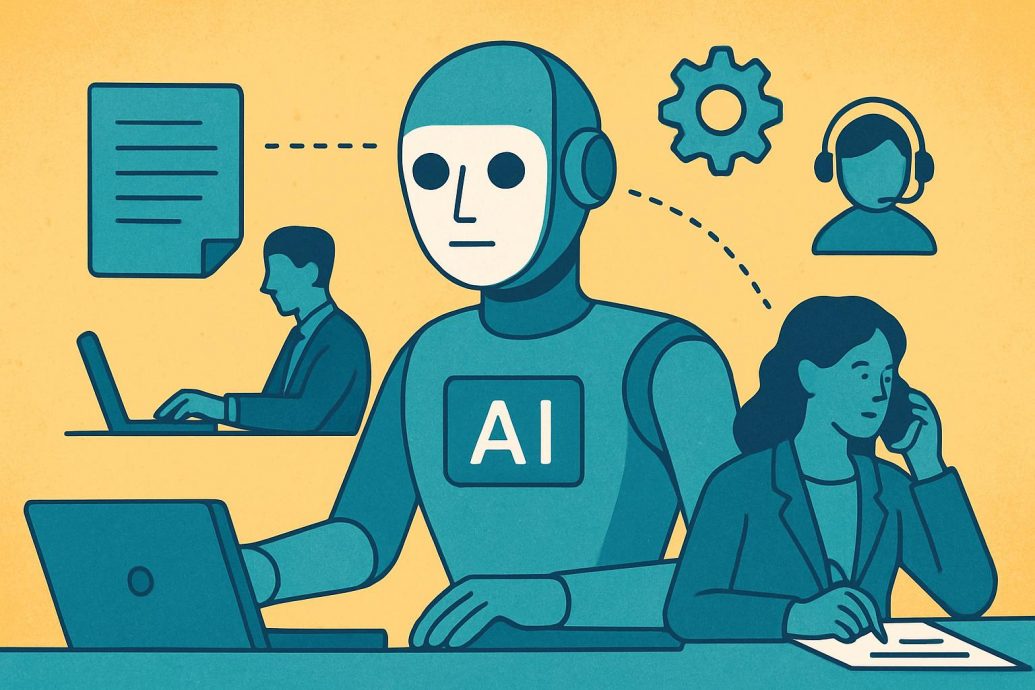
AI to Automate Key Office Roles is no longer a forecast found in futuristic think pieces. It is a developing reality that is actively transforming white-collar work. As AI becomes smarter, faster, and more intuitive, tools like Perplexity AI are reshaping how businesses handle tasks once assigned to research assistants and customer support teams. The CEO of Perplexity, Aravind Srinivas, predicts that by 2026, AI will fully automate these two job categories. But what does automation really mean in this context? Is it a total replacement or a shift in function? This article answers those questions with data-backed insights and expert perspectives, offering a grounded look at how AI will alter, not erase, some of the most common office roles.
Key Takeaways
- By 2025, AI is expected to fully automate entry-level research and customer support roles.
- Tools like Perplexity AI define a new generation of “answer engines” that outperform traditional search tools.
- AI automation in the workplace will shift job functions rather than eliminate them outright.
- Businesses are rapidly adopting AI browsers as part of enterprise digital transformation.
Expert Forecasts: What CEOs and Economists Are Saying
In early 2024, Perplexity AI’s CEO Aravind Srinivas made headlines by predicting the full automation of two office roles (entry-level research and customer support) by 2025. According to Srinivas, advancements in answer engines, particularly those grounded in generative AI, are reaching the point where they can deliver structured, accurate, and interpretable responses to complex questions much faster than a human assistant.
This prediction is in line with broader economic shifts. A 2023 analysis by Goldman Sachs estimated that AI could automate the equivalent of 300 million full-time jobs globally. The report indicated that 25 percent of total work in advanced economies may be handed off to machines, especially in white-collar sectors relying on predictable task structures.
Recent data from McKinsey & Company (2024) supports this direction. Their survey of over 1,000 companies showed that 38 percent are currently using generative AI for task-level automation in support or research departments, nearly double the rate from 18 months earlier.
The Roles at Risk: Entry-Level Research and Customer Support
Both entry-level research and customer support roles involve a high volume of repetitive, information-driven tasks. These characteristics make them ideal candidates for AI automation.
Entry-Level Research
This category includes roles such as research assistants, data analysts, and junior content writers. Typical responsibilities include summarizing academic articles, pulling data from databases, generating reports, and conducting comparative analysis. These functions are being handled more frequently by AI models that use retrieval-augmented generation, real-time search integration, and synthesis capabilities.
Customer Support
Jobs in this area involve fielding questions, resolving account issues, processing returns, and answering FAQs. With the rise of AI-powered chatbots and virtual agents, many of these activities are now managed through natural language understanding paired with prompt engineering tools.
How AI Automates These Jobs: A Task-Level Breakdown
AI automation in the workplace does not necessarily lead to job elimination. Instead, it typically reduces task-level workloads, allowing employees to focus on strategic or complex problem-solving. Here is how it works in practice:
- Information Retrieval: Perplexity AI can search academic databases and return verified, summarized answers sourced in real time. This eliminates hours of manual research labor.
- Email Response Drafting: AI writing assistants can prepopulate replies to common customer service queries. Human agents review and adapt these drafts before sending them.
- Live Chat Assistance: NLP-based chatbots now handle up to 80 percent of routine inquiries. They transfer complex ones to human agents and improve their accuracy over time.
- Document Generation: AI models like GPT-4 can create reports, data summaries, and press releases based on brief prompts and contextual information.
Meet the Tools: Perplexity AI and the Evolution of Answer Engines
Perplexity AI’s browser goes beyond mimicking search engines. It provides direct, reliable answers, combining real-time search results with advanced language models. Unlike Google, Perplexity offers full source citation for transparency and is tailored for professionals in research, legal, and customer service functions.
How Perplexity Compares to Traditional Search
| Feature | Perplexity AI | Google Search |
|---|---|---|
| Response Format | Direct, summarized, cited answers | List of links to external sites |
| Use Case Optimization | Enterprise research and workflows | General-purpose searching |
| AI Integration | Built-in language model with RAG pipeline | Primarily keyword-based search |
| Trust Metrics | Source attribution and verification | Search rank driven by SEO and ads |
Why This Shift Is Happening Now
Several factors are accelerating white-collar automation:
- Cost Efficiency: Replacing or supplementing junior roles with AI reduces salary, training, and overhead costs.
- Labor Shortage: Many entry-level roles are difficult to fill due to high turnover and burnout.
- Technological Maturity: AI tools such as GPT-4, Gemini, and Perplexity now offer enterprise-grade performance with real business applications.
- Pandemic Legacy: Remote and hybrid work models have increased the need to automate repeatable tasks for better scalability.
The Future of Human + AI Collaboration
While automation reduces the need for performing routine tasks, it increases the demand for roles focused on managing and fine-tuning AI. Workforce development is shifting, and platforms like Coursera and EdX are supporting up-skilling in AI literacy as part of this ongoing transition to digital labor.
Transformation, Not Termination
Human researchers and support agents are not disappearing. Their roles are evolving. In customer service, employees will shift to handling escalations, teaching customers about products, and resolving non-standard issues. In research, professionals will focus on framing effective questions, validating AI-generated content, and interpreting trends. Real-world examples of human-machine collaboration show how this new model is already in motion.
FAQs
What office jobs are most at risk from AI?
Entry-level research and customer support positions are the most at risk. These roles involve highly repetitive and structured tasks that AI systems can complete with speed and precision.
How is AI affecting customer support roles?
AI tools are automating many routine activities such as replying to standard queries or managing accounts. Employees are focusing more on service design and human-centered interactions. Industry cases, like the Klarna CEO replacing support roles with AI, illustrate how quickly these changes are occurring.
What does Perplexity AI do differently than Google?
Perplexity AI delivers direct answers that are sourced and summarized, rather than listing website links. It is especially designed for professionals who need speed, accuracy, and transparency in their information workflow.
Will AI fully replace human researchers?
No. AI will take on repetitive research tasks, but human input is still vital for designing methodologies, interpreting outcomes, and applying insights with context-specific understanding. AI tools will assist researchers, not displace them entirely.
Conclusion
AI automation in the workplace is advancing rapidly, particularly in low-complexity white-collar jobs such as support services and entry-level research. Rather than wiping out careers, AI is reshaping workspaces and redistributing responsibilities.