
Introduction
The idea of a robot making your morning coffee once sounded like a novelty, but Cafe X Technologies has spent nearly a decade turning that concept into a commercially viable, AI-powered robotic coffee bar system that serves hundreds of thousands of customers across high-traffic locations like airports and transit hubs. Founded in 2014 by Henry Hu and Sebastian Gomez Puerto in San Francisco, Cafe X launched its first robotic barista in January 2017, becoming one of the earliest companies to deploy an industrial robotic arm for consumer beverage service. The robotic cafe market is valued at approximately USD 2.18 billion in 2026 and is growing at a 16.8 percent CAGR, driven by persistent labor shortages and consumer demand for contactless, 24/7 service solutions. Cafe X’s robot, affectionately named Ella, uses a Mitsubishi 6-axis industrial arm to craft specialty coffee drinks including lattes, cappuccinos, cold brews, and nitrogen-infused beverages in under a minute, serving up to 600 orders per day from a single unit. The system partners with premium roasters including Onyx Coffee Lab, Ritual Coffee, Equator Coffees, and Intelligentsia Coffee, ensuring that automation enhances rather than compromises the quality of the coffee experience. This article explores how Cafe X works, the journey from downtown San Francisco prototype to airport deployment, the AI and software platform powering its operations, and what its story reveals about the future of robotic food service. After closing three downtown locations in 2020 and pivoting to airports, Cafe X’s evolution offers valuable lessons about where robotic food service succeeds, where it struggles, and what comes next.
Key Questions On Cafe X
What is Cafe X?
Cafe X is a robotic coffee bar system developed by Cafe X Technologies that uses an AI-powered industrial robotic arm named Ella to prepare specialty coffee drinks autonomously, serving up to 600 orders per day with premium beans from roasters like Onyx Coffee Lab and Intelligentsia Coffee.
How does the Cafe X robot make coffee?
The Cafe X robot uses a 6-axis industrial arm to pick up cups, position them under integrated WMF 5000S+ espresso machines, dispense coffee and milk, add toppings, and deliver finished drinks to pickup windows, producing up to three drinks in under one minute with consistent quality.
Where is Cafe X located?
Cafe X currently operates robotic coffee bars at airport locations including San Francisco International Airport (SFO Terminal 3) and San Jose International Airport (SJC), after closing three downtown San Francisco locations in January 2020 and pivoting to high-traffic transit environments.
Key Takeaways
- The Robotic Coffee Bar features two WMF 5000S+ coffee machines, a built-in nitrogen generator, nitro infusion system, and precision ice dispensing with weight sensors for consistent quality.
- Cafe X’s Ella robot produces up to three drinks in under one minute and serves up to 600 orders per day, using premium beans from roasters including Onyx Coffee Lab and Intelligentsia Coffee.
- The company raised approximately USD 9.42 million in Series A funding and has operated for nearly a decade, accumulating real-world data that powers its machine learning and operational software.
- Cafe X pivoted from downtown San Francisco storefronts to airport deployments in 2020, learning that robotic coffee bars thrive in high-traffic transit environments where speed, consistency, and extended hours matter most.
Table of contents
- Introduction
- Key Questions On Cafe X
- Key Takeaways
- Understanding What Cafe X Is
- The Origin Story: From Airport Frustration to Robotic Barista
- How the Cafe X Robotic Coffee Bar Works
- The AI and Software Platform Behind Cafe X
- The Pivot from Storefronts to Airports
- The Coffee Quality Proposition
- Workforce Implications and Human-Robot Collaboration
- Real-World Examples of Robotic Coffee Service
- Case Studies in Robotic Coffee Deployment
- Challenges and What Cafe X’s Journey Reveals
- What the Future Holds for Cafe X and Robotic Coffee
- Key Insights
- Frequently Asked Questions
Understanding What Cafe X Is
Cafe X is a fully autonomous robotic coffee bar system that uses a 6-axis industrial robotic arm, dual commercial espresso machines, AI-driven ordering software, and machine learning-based personalization to prepare and serve specialty coffee drinks without human barista intervention in airports, corporate offices, and high-traffic commercial environments.
Cafe X Robotic Barista Simulator
Model the throughput, revenue, and operational economics of a Cafe X Robotic Coffee Bar across different deployment scenarios. Adjust parameters to see how location type and demand affect performance.
Deployment Profile
Configure your deployment to model Cafe X robotic barista performance.
The Origin Story: From Airport Frustration to Robotic Barista
Cafe X was born from a moment of frustration that most travelers have experienced: waiting over 30 minutes for coffee at an airport while watching baristas spend the majority of their time moving cups around rather than crafting drinks. Henry Hu, a Hong Kong-born entrepreneur, recognized that the mechanical aspects of espresso drink preparation, moving cups between machines, dispensing milk, adding toppings, were perfectly suited for robotic automation, while the coffee itself could still come from premium specialty roasters. The company was co-founded with Sebastian Gomez Puerto in 2014 and spent three years developing the technology before opening its first location in San Francisco's Metreon shopping center in January 2017. The launch generated worldwide media attention, with publications from TechCrunch to the BBC covering the spectacle of a gleaming white industrial robotic arm dancing to hip-hop beats while crafting lattes and cappuccinos for fascinated customers. Food robotics transforming the industry was still a niche concept in 2017, and Cafe X helped define the public imagination of what automated food service could look like. Cafe X's founding insight was deceptively simple: the bottleneck in coffee service is not the quality of the beans or the complexity of the recipe but the physical logistics of moving cups, dispensing ingredients, and managing the queue, all tasks perfectly suited for a robotic arm.
Cafe X raised approximately USD 9.42 million in Series A funding in August 2018, with total funding nearing USD 15 million, reflecting investor confidence in the commercial potential of robotic coffee service. The company expanded to three downtown San Francisco locations that served as prototype testing environments, where Cafe X refined its hardware, software, and customer experience through hundreds of thousands of real-world transactions. Robotics and manufacturing principles from industrial automation were adapted for the food-grade environment, with Ammunition, a prestigious San Francisco design firm, creating the industrial design and user experience for the Robotic Coffee Bar 2.0. The Mitsubishi 6-axis arm was selected for its precision, reliability, and the smooth movement characteristics that give Ella the dancing personality that became central to Cafe X's brand identity. Each location attracted 50 to 60 percent repeat customers daily, validating that robotic coffee service could build the habitual engagement that traditional coffee shops depend on.
How the Cafe X Robotic Coffee Bar Works
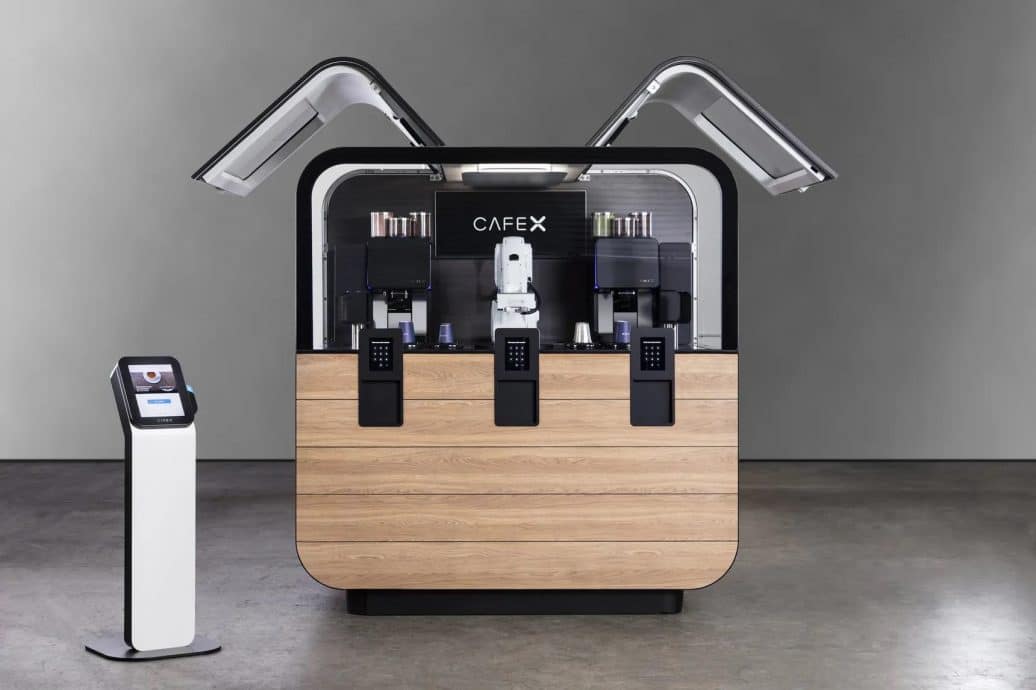
The Cafe X Robotic Coffee Bar is a self-contained system that integrates premium commercial espresso equipment, robotic automation, and AI-powered software into a compact footprint that can be installed in locations where a traditional coffee shop would be impractical or uneconomical. Two WMF 5000S+ coffee machines form the brewing core, featuring Dynamic Milk systems for perfectly textured foam, multiple individually adjustable coffee hoppers and grinders that accommodate different bean varieties simultaneously, and peristaltic pump systems for precise syrup and concentrate dispensing. Ella, the 6-axis robotic arm, operates at the center of the system, picking up cups, positioning them under the appropriate machine, managing the brewing process, adding milk, ice, or toppings, and delivering the finished drink to the customer's designated pickup window. Computer vision applications and sensor technology enable Ella to track cup positions, verify fill levels, and ensure that each drink meets quality specifications before delivery. A built-in nitrogen generator and individually adjustable in-line nitro infusion system connect to a four-product stainless steel tap tower, enabling nitrogen-infused cold brews and other nitro beverages that are among the most popular items on the menu. The Robotic Coffee Bar transforms the complexity of specialty coffee preparation into a choreographed mechanical performance where every movement is optimized for speed, consistency, and the entertaining visual spectacle that draws customers in and keeps them watching.
The ice dispensing system demonstrates the precision engineering that distinguishes Cafe X from simpler automated coffee machines: each iced beverage is checked by a weight sensor to ensure an accurate number of premium one-inch full cube ice cubes, with ice volume adjustable per drink and support for nearly all ice shapes. A powerful cooling system extracts steam from each pickup window, providing a clean experience even in high-demand environments where multiple drinks are being prepared simultaneously. AI-enabled smart kitchens share architectural similarities with Cafe X's approach, where connected sensors, automated equipment, and centralized software create an integrated production environment that operates with minimal human oversight. The custom gripper designed in collaboration with Ammunition handles 8-ounce hot cups, 12-ounce hot cups, and 12-ounce cold cups, with the robotic arm tilting cups slightly during transport to prevent spillage while maintaining the speed that commercial service demands. The entire system fits through standard double doors for installation, reflecting the practical design considerations that determine whether robotic food service can actually deploy in the diverse range of locations where demand exists.
The AI and Software Platform Behind Cafe X
The hardware spectacle of Ella is powered by a sophisticated software platform that manages ordering, payment processing, machine learning-based personalization, operational analytics, and remote system management across all deployed Cafe X locations. Customers order through QR code-activated mobile interfaces or tablet kiosks at the unit, with Stripe-integrated global payment processing that supports the international traveler demographic that airport locations primarily serve. Machine learning algorithms within the platform learn individual customer preferences over time, suggesting favorite drinks, remembering customization choices, and optimizing the ordering experience for repeat visitors who represent the majority of daily traffic. The platform provides a comprehensive business management suite that handles menu configuration, pricing, inventory tracking, and performance analytics, giving operators the tools needed to run a next-generation foodservice operation from a single dashboard. IoT in the retail industry demonstrates the broader trend of connected commercial equipment, and Cafe X's software platform exemplifies how IoT connectivity transforms standalone machines into networked, data-generating business assets. Cafe X's software platform transforms the Robotic Coffee Bar from a standalone automated machine into a connected, intelligent node in a managed foodservice network where every transaction generates data that improves personalization, optimizes operations, and informs strategic decisions.
Nearly a decade of real-world operating data has given Cafe X a significant advantage in understanding the patterns, preferences, and operational dynamics of robotic coffee service across different environments and customer segments. Henry Hu described 2025 as the year of "Physical AI" for Cafe X, signaling a strategic emphasis on deepening the intelligence capabilities of the robotic system beyond simple automation into adaptive behavior that responds to real-time conditions. Predictive analytics capabilities within the platform anticipate demand patterns based on flight schedules, time of day, weather, and historical traffic data, enabling proactive preparation that minimizes customer wait times during peak periods. The software platform's customizability allows operators to brand the ordering experience, configure menus, and adjust pricing for their specific market, making the Robotic Coffee Bar a white-label solution that can serve different brands and concepts from identical hardware.
The Pivot from Storefronts to Airports
Cafe X's most significant strategic decision was the January 2020 closure of its three downtown San Francisco locations and pivot to airport-focused deployment, a transition that revealed fundamental truths about where robotic food service creates the most value. The downtown locations served as invaluable prototype environments where Cafe X tested hardware iterations, refined customer interactions, and collected the operational data that informed the Robotic Coffee Bar's commercial design. CEO Henry Hu described the downtown locations as "prototype machines designed to help the company better understand customer behaviors," framing the closures not as failures but as the natural conclusion of a testing phase. The airport environment proved ideal for robotic coffee service because travelers prioritize speed and consistency over the ambiance and personal connection that traditional coffee shops offer, the high foot traffic generates volume that maximizes the return on hardware investment, and the extended operating hours leverage Cafe X's ability to serve 24/7 without staffing constraints. The future of hospitality with AI is being shaped by this kind of strategic segmentation, where operators match automation intensity to environments where its advantages are most valued. Cafe X's pivot demonstrates a critical lesson for the food robotics industry: the success of robotic food service depends not just on the quality of the technology but on deploying it in environments where the specific advantages of automation, speed, consistency, and 24/7 availability, align with what customers in that environment actually want.
The San Jose International Airport installation, launched in December 2019, featured the all-new Robotic Coffee Bar designed with insights from three years of prototype operation and hundreds of thousands of customer interactions in San Francisco. Airport director John Aitken noted that coffee was the most-requested concession in the terminal area, validating the demand signal that justified the investment. The SFO Terminal 3 location, which reopened in January 2021 after a pandemic-related closure, continued operations as air travel recovered. Automation in incremental steps describes the broader pattern that Cafe X's evolution illustrates: starting with ambitious deployments, learning from what works, and refining the strategy toward the specific use cases where the technology delivers the clearest value. The pivot also reflected a business model evolution, as airport locations can operate as NSF-certified vending machines that run 24 hours a day with or without a human attendant, dramatically improving the unit economics compared to staffed downtown locations.
The Coffee Quality Proposition
One of the most common criticisms of robotic coffee is the assumption that automation inherently compromises quality, but Cafe X addresses this directly through partnerships with specialty roasters that represent the premium end of the coffee market. Current partnerships with Onyx Coffee Lab, a celebrated specialty roaster, ensure that the beans feeding Cafe X's WMF machines represent genuine third-wave coffee quality rather than the commodity-grade coffee that vending machines typically offer. Historical partnerships with Ritual Coffee, Equator Coffees, and Intelligentsia Coffee further established Cafe X's credibility within the specialty coffee community, where bean provenance and roasting quality are taken seriously. House-made 72-hour infused syrups and 24-hour extracted cold brews demonstrate that Cafe X invests in ingredient preparation that goes well beyond what automated coffee machines typically offer. AI and recipes represent a growing intersection of technology and culinary development, and Cafe X's approach of pairing robotic precision with premium ingredients illustrates how automation can elevate rather than diminish food quality. Cafe X's quality strategy rests on a clear division: the robot handles the mechanical execution with precision that human baristas cannot consistently match across hundreds of daily drinks, while premium roasters and carefully developed recipes ensure that the coffee itself meets specialty standards.
The consistency advantage is particularly valuable in airport environments where travelers have limited options and limited time, making reliability more important than the artisanal variability that specialty coffee enthusiasts sometimes prize. Every latte pulled by Ella uses the same grind size, extraction time, milk temperature, and pour volume, eliminating the human variability that means your morning coffee tastes slightly different depending on which barista makes it. Premium add-on options including Japanese matcha, Oatly Swedish oat milk, and organic milk from Clover Sonoma expand the menu beyond basic coffee into the specialty beverage territory that higher-spending customers demand. The inclusion of Instagram-famous pastries from Third Culture Bakery, creators of the Mochi Muffin and Butter Mochi Donuts, demonstrates that Cafe X views its offering as a complete specialty cafe experience rather than just automated coffee dispensing.
Workforce Implications and Human-Robot Collaboration
Cafe X's approach to the workforce question differs from fully autonomous systems like Pazzi by maintaining human attendants at its locations who provide customer service, product education, and the personal touch that pure automation cannot deliver. Henry Hu has consistently argued that Cafe X creates more interesting, less stressful, and less physically demanding jobs for retail workers while building a company that employs programmers, robot experts, designers, and manufacturing specialists. The company grew to more than 40 employees during its expansion phase, demonstrating that robotic food service creates upstream employment in technology roles even as it reduces the number of positions at individual service points. Impact of robotics on the workplace extends beyond simple displacement to encompass the redistribution of labor from mechanical tasks to roles requiring judgment, creativity, and interpersonal skills. Whether robots will take our jobs is a question Cafe X answers by pointing to the quality-of-life improvements for workers who transition from repetitive manual tasks to roles that leverage uniquely human capabilities. Cafe X's workforce model demonstrates that the most effective robotic food service deployments are not those that eliminate humans entirely but those that redistribute human effort toward the high-value activities, customer connection, quality assurance, and operational management, that robots cannot perform.
Real-World Examples of Robotic Coffee Service
Cafe X's San Jose International Airport deployment represents the most commercially mature implementation of robotic barista technology in a high-traffic transit environment, designed and engineered with operational insights from three years of prototype testing. The installation featured the all-new Robotic Coffee Bar with premium coffee from specialty roasters, a dancing robot personality with hip-hop beats, and modern user interfaces that create a distinctive experience for travelers. The measurable outcome includes hundreds of thousands of customers served, 50 to 60 percent daily repeat customer rates, and validated demand for quality robotic coffee in airport concession environments. The limitation is that the single-arm robot format restricts throughput during extreme peak periods, and the premium ingredient strategy creates supply chain dependencies that require careful management. Source: VentureBeat and Vending Times
Richtech Robotics' ADAM platform, integrating NVIDIA-powered vision AI for real-time quality control, demonstrates how competing robotic barista systems are advancing through computer vision and AI-driven monitoring that goes beyond simple automated dispensing. The system uses cameras and AI to verify drink quality, detect anomalies, and ensure consistency across high-volume operations in coffee shops, corporate lobbies, and retail environments. The measurable outcome includes 20 to 25 percent reduction in labor costs per location and consistent quality verification that human observation cannot maintain during peak service. The limitation is the high capital expenditure of USD 15,000 to USD 60,000 or more per unit, which creates significant financial barriers for smaller operators. Source: Accio robotic cafe market report
Rozum Cafe, a Belarusian robotic coffee system, represents the global expansion of robotic barista technology beyond the U.S. market, offering an off-the-shelf robotic coffee point that operates 24/7 with a single robotic arm. The system targets commercial installations in malls, offices, and transit locations with a compact form factor that requires minimal floor space and no specialized infrastructure beyond power and water connections. The measurable outcome is a commercially available, franchise-ready robotic cafe solution that has expanded across multiple international markets. The limitation is that Rozum Cafe's more standardized approach lacks the premium specialty coffee partnerships and custom design language that distinguish Cafe X's offering in the premium segment. Source: Rozum Robotics
Case Studies in Robotic Coffee Deployment
The Prototype Phase and Downtown San Francisco
Cafe X's three downtown San Francisco locations, operational from January 2017 to January 2020, represent the most extensively documented prototype phase in robotic coffee history, providing the operational data and customer behavior insights that shaped the commercial product. The problem was that no commercial robotic coffee system had been tested at scale in real urban environments, leaving fundamental questions unanswered about consumer acceptance, operational reliability, maintenance requirements, and the business model viability of robotic coffee service. The solution deployed three locations across downtown San Francisco, including the Metreon shopping center, using prototype hardware that evolved through multiple iterations as the team learned from daily operations and customer interactions. The measurable impact includes hundreds of thousands of customers served, achievement of 50 to 60 percent daily repeat customer rates, and the accumulation of the operational dataset that informed every subsequent design decision for the commercial Robotic Coffee Bar. The limitation is that the downtown locations ultimately proved commercially unsustainable as standalone businesses, with the cost structure of staffed urban retail locations offsetting the labor savings that the robotic system provided. The case demonstrates that successful food robotics deployment requires matching the technology to environments where its specific advantages create the greatest value, a lesson that directly informed Cafe X's pivot to airports. Source: TechCrunch and The Spoon
Airport Deployment and the Vending Model
Cafe X's transition to airport locations at San Jose International and SFO addressed the commercial challenges of the downtown model by deploying in environments where the unit economics of robotic coffee service are most favorable. The problem was that downtown coffee shops compete primarily on ambiance, personal service, and community, dimensions where robotic systems cannot match the warmth of human-staffed cafes, while also bearing high urban rent and staffing costs. The solution repositioned Cafe X in airport terminals where travelers prioritize speed, consistency, and availability over ambiance, and where NSF certification enables 24/7 operation as a vending machine with minimal human staffing. The measurable impact includes continued service to hundreds of thousands of travelers, validated 24/7 operational capability, and proven demand for premium robotic coffee in transit environments where traditional staffing is most challenging. The limitation is that airport concession agreements involve complex revenue-sharing arrangements and regulatory requirements that add operational complexity beyond the technology itself. The case illustrates how food robotics companies must iterate their business models as aggressively as their technology, finding the deployment contexts where automation's advantages are most valued by the specific customer base. Source: Comunicaffe and Cafe X official
Eight Years of Real-World Data and Physical AI
Cafe X's nearly decade-long operational history represents one of the longest continuous datasets in robotic food service, providing machine learning models with the training data needed to optimize every aspect of autonomous coffee preparation. The problem was that early robotic food systems operated without the real-world data needed to predict demand patterns, optimize maintenance schedules, personalize customer experiences, and adapt to the variable conditions of commercial food service environments. The solution was eight years of continuous data collection across multiple locations, customer segments, and operating environments, feeding machine learning models that progressively improved operational efficiency, reduced downtime, and enhanced the customer experience. The measurable impact is a software platform built on real-world operational intelligence rather than simulated scenarios, enabling predictions about demand patterns, equipment maintenance needs, and customer preferences that theoretical models cannot match. The limitation is that the dataset is primarily concentrated in San Francisco and its airports, and expansion to diverse geographic and cultural markets will require model adaptation that the current data may not fully support. Henry Hu's declaration that "Physical AI is our 2025" signals the strategic pivot toward leveraging this accumulated intelligence for more adaptive, autonomous behavior. Source: Cafe X Technologies official
Challenges and What Cafe X's Journey Reveals
Cafe X's evolution from buzzy startup to commercially focused airport operator reveals the practical challenges that every food robotics company must navigate to achieve sustainable commercial success. Consumer acceptance varies dramatically by context: downtown San Francisco customers with abundant coffee options showed interest but did not switch their habits at the rates needed for standalone commercial viability, while airport travelers embraced the speed and novelty more readily. The capital cost of robotic hardware, combined with urban rents and the need for human attendants, created a cost structure in downtown locations that was not sufficiently different from traditional coffee shops to justify the complexity. Automation versus AI is a relevant distinction: Cafe X combines mechanical automation of physical tasks with AI-driven personalization and operational optimization, but the technology must be deployed where each component adds value that customers recognize and pay for. Maintenance and reliability, though improved through years of iteration, remain ongoing challenges for any system involving moving mechanical parts in a food-grade environment subject to daily cleaning and continuous operation. Cafe X's journey reveals that the critical success factor for robotic food service is not the sophistication of the technology but the strategic alignment between what the robot does well, speed, consistency, and availability, and what customers in a specific environment actually value.
The competitive landscape has also intensified since Cafe X's 2017 launch, with well-funded competitors like Richtech Robotics, Rozum Cafe, and COFE+ entering the market with systems that range from lower-cost standardized units to AI-enhanced platforms that match or exceed Cafe X's capabilities. The role of AI in boosting automation continues to advance, and Cafe X must maintain its technology edge while competing against companies with access to lower manufacturing costs and aggressive expansion strategies.
What the Future Holds for Cafe X and Robotic Coffee
The trajectory of Cafe X points toward deeper AI integration, expanded deployment through commercial sales and partnerships, and a strategic identity centered on the "Physical AI" concept that Henry Hu has articulated as the company's defining direction for 2025 and beyond. The commercial software platform, built on nearly a decade of operational experience, positions Cafe X not just as a robotic coffee bar manufacturer but as a foodservice technology provider whose software tools enable businesses to run autonomous food operations with the analytics and management capabilities they need. Future trends in AI business applications include the kind of Physical AI that Cafe X is pursuing, where robotic systems become increasingly intelligent, adaptive, and capable of operating with the autonomy that truly unmanned 24/7 service requires. The acceptance of an investment round on Republic, a crowdfunding platform, signals an openness to broadening the investor base and building community engagement around the brand. Corporate offices, hotels, hospitals, and university campuses represent expansion opportunities where the speed, consistency, and 24/7 availability of robotic coffee service match the needs of captive audiences with limited alternatives. The future of Cafe X is defined by the convergence of Physical AI capabilities, proven commercial software, and strategic deployment in environments where robotic coffee service delivers a better experience than human-staffed alternatives, not everywhere, but precisely where it matters most.
Emerging jobs in AI within robotic food service include robotic barista technicians, AI-driven menu optimization specialists, and foodservice platform operators who manage fleets of autonomous units across multiple locations. The coming years will determine whether Cafe X evolves from a pioneering single-company operation into a platform that powers robotic coffee service for operators worldwide, leveraging its unmatched dataset and software capabilities to become the operating system for autonomous coffee bars globally.
Key Insights
- Henry Hu declared "Physical AI is our 2025", signaling a strategic emphasis on deepening the intelligence and autonomy of the Cafe X platform beyond simple robotic automation.
- Cafe X's Ella robot produces up to three drinks in under one minute and serves up to 600 orders per day from a single Robotic Coffee Bar unit featuring dual WMF 5000S+ espresso machines.
- The company raised approximately USD 9.42 million in Series A funding and has operated for nearly a decade, accumulating one of the longest continuous datasets in robotic food service.
- Cafe X achieved 50 to 60 percent daily repeat customer rates at its San Francisco locations, demonstrating that robotic coffee service can build habitual customer engagement comparable to traditional cafes.
- The robotic cafe market is valued at approximately USD 2.18 billion in 2026 with a 16.8 percent CAGR, with robotic systems reporting 20 to 25 percent reduction in labor costs per location.
- The closure of three downtown locations and pivot to airports in January 2020 revealed that robotic coffee thrives in high-traffic transit environments where speed and 24/7 availability matter most.
- Cafe X partners with premium specialty roasters including Onyx Coffee Lab and Intelligentsia Coffee, positioning its robotic offering in the specialty coffee segment rather than commodity vending.
| Dimension | Traditional Airport Coffee | Cafe X Robotic Coffee Bar |
|---|---|---|
| Service Speed | 3-8 minutes per drink during peak periods, longer during rushes | Up to 3 drinks in under one minute, 600 orders per day capacity |
| Consistency | Varies by barista skill, fatigue, and shift conditions | Identical preparation parameters for every drink, verified by weight sensors |
| Operating Hours | Limited by staffing, typically 14-18 hours per day | 24/7 capability with NSF certification for unmanned vending operation |
| Labor Model | 3-5 staff per shift with high turnover and scheduling challenges | Single attendant for customer service; robotic arm handles all preparation |
| Coffee Quality | Varies by staff training and chain standards | Premium specialty beans from Onyx Coffee Lab, Intelligentsia, and Ritual |
| Customer Data | Limited point-of-sale data with minimal personalization | Machine learning-powered preferences, QR ordering, and Stripe-integrated payments |
| Entertainment Value | Standard counter service without visual engagement | Dancing robot with hip-hop beats creating social media-worthy spectacle |
| Space Requirements | 400-1,200 sq ft with kitchen, seating, and storage | Compact footprint that fits through standard double doors |
Frequently Asked Questions
Cafe X is a robotic coffee bar system developed by Cafe X Technologies that uses an AI-powered 6-axis industrial robotic arm named Ella to autonomously prepare specialty coffee drinks. Founded in 2014 by Henry Hu and Sebastian Gomez Puerto in San Francisco, the company has operated for nearly a decade across multiple locations. The system serves up to 600 orders per day with premium beans from specialty roasters.
Cafe X makes coffee through an automated process where the Ella robotic arm picks up cups, positions them under dual WMF 5000S+ espresso machines, manages the brewing and milk preparation, adds toppings or syrups, and delivers the finished drink to a pickup window. Each drink is produced in under one minute with consistent grind size, extraction time, and pour volume. A built-in nitrogen generator enables nitro-infused cold brews and specialty beverages.
Cafe X currently operates at airport locations including San Francisco International Airport Terminal 3 and San Jose International Airport, after closing three downtown San Francisco prototype locations in January 2020. The company has focused on high-traffic transit environments where speed, consistency, and 24/7 availability deliver the greatest customer value. Corporate offices, hotels, and campuses represent potential expansion targets.
Cafe X Technologies raised approximately USD 9.42 million in a Series A round in August 2018, with total funding nearing USD 15 million across all rounds. The company has also accepted investments through Republic, a crowdfunding platform, to broaden its investor base. The funding supported hardware development, software platform creation, and deployment across multiple locations.
Cafe X closed its three downtown San Francisco locations in January 2020, pivoting to airport deployments where the economics and customer behavior better suited robotic coffee service. CEO Henry Hu described the downtown locations as prototype machines designed to understand customer behaviors. The lessons learned from three years of downtown operation directly informed the commercial Robotic Coffee Bar design.
Cafe X partners with premium specialty roasters including Onyx Coffee Lab, and has previously featured beans from Ritual Coffee, Equator Coffees, and Intelligentsia Coffee. The menu includes house-made 72-hour infused syrups and 24-hour extracted cold brews that go beyond standard automated coffee offerings. Premium add-ons include Japanese matcha, Oatly oat milk, and organic milk from Clover Sonoma.
Cafe X is in the process of achieving full NSF certification to operate as a vending machine, which enables 24/7 operation without a human attendant present. Airport locations can already operate during extended hours, though current operations may include attendants for customer service. The 24/7 capability is one of the strongest value propositions for airport and transit deployments.
Ella is Cafe X's 6-axis Mitsubishi industrial robotic arm that serves as the barista, handling all physical tasks from cup placement to drink delivery with a custom-designed gripper that handles multiple cup sizes. The robot features a dancing personality set to hip-hop music that creates an entertaining spectacle for customers. Ella represents nearly a decade of iterative hardware development informed by real-world operational data.
Cafe X uses machine learning to personalize customer recommendations, predict demand patterns, optimize maintenance schedules, and manage ordering and inventory across deployed locations. The platform learns individual preferences over time, suggesting favorite drinks for repeat customers. Henry Hu has described "Physical AI" as the company's strategic direction for 2025 and beyond.
The Robotic Coffee Bar can produce up to three drinks in under one minute, translating to a theoretical maximum of over 180 drinks per hour, though real-world throughput depends on drink complexity and order patterns. The system serves up to 600 orders per day from a single unit. Multiple cup sizes and both hot and cold beverages can be prepared without workflow changes.
Cafe X's primary competitors include Richtech Robotics (ADAM platform), Rozum Cafe, COFE+ by Hi-Dolphin, Crown Digital, and Doosan Robotics, each approaching robotic coffee service with different hardware, pricing, and deployment strategies. The robotic cafe market includes both fully automated and semi-automated systems. Cafe X differentiates through its premium coffee partnerships, decade of operational data, and entertainment-focused brand personality.
Cafe X offers its Robotic Coffee Bar as a commercial product with supporting software that enables operators to configure menus, branding, and pricing for their specific markets. The system functions as a platform that operators can deploy under their own brands or as a Cafe X-branded experience. The investment opportunity on Republic suggests the company is exploring multiple models for scaling deployment.
Cafe X uses premium specialty beans rather than commodity-grade pre-ground coffee, features a robotic arm that performs the same physical movements as a human barista, offers customizable drinks with fresh-prepared ingredients including house-made syrups, and creates an entertaining visual experience. Weight sensors verify ice accuracy, Dynamic Milk systems create properly textured foam, and nitrogen generators enable draft-style cold beverages. The system bridges the gap between vending convenience and specialty cafe quality.
Physical AI is the strategic direction Henry Hu articulated for 2025 and beyond, describing the evolution of Cafe X's robotic system from simple mechanical automation to adaptive, intelligent behavior that responds to real-world conditions in real time. This includes demand prediction, equipment self-monitoring, and personalized customer interaction that goes beyond pre-programmed sequences. The concept positions Cafe X at the intersection of robotics and artificial intelligence.
Cafe X's future centers on expanding deployment through commercial sales and partnerships, deepening AI capabilities through Physical AI integration, and leveraging its nearly decade-long operational dataset to become a foodservice technology platform. Target markets include airports, corporate offices, hospitals, hotels, and university campuses. The company's commercial software platform positions it to power robotic coffee operations for operators worldwide.