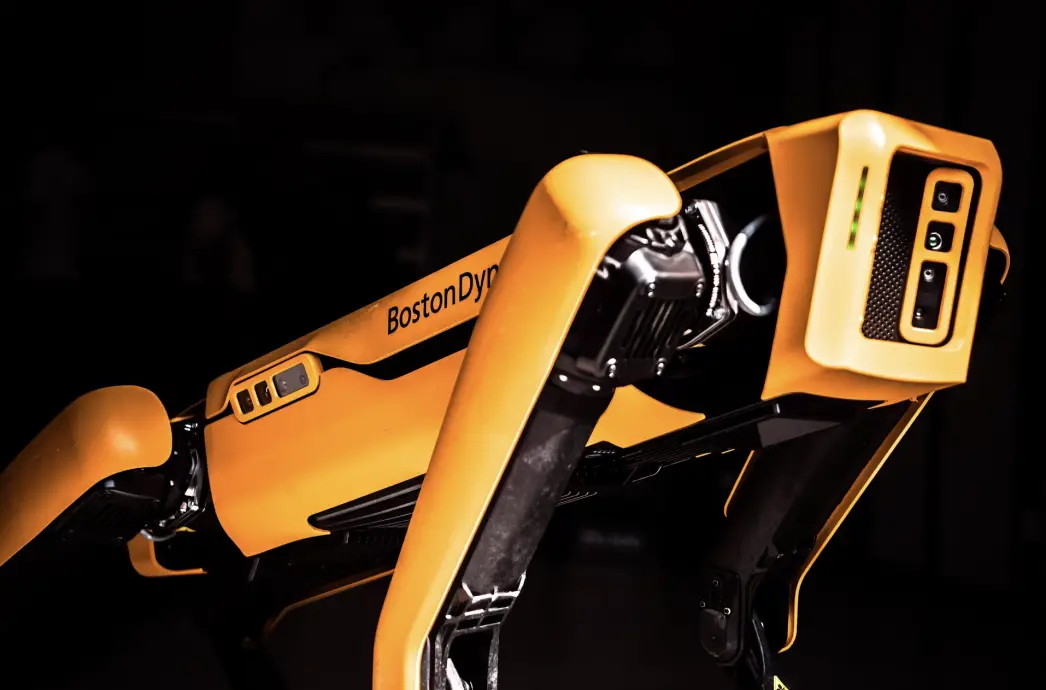

Introduction
AI powers robot dogs for real-world navigation by fusing lidar, depth cameras, inertial data, and learned locomotion policies into a single autonomous stack. The global quadruped robot market crossed the one-billion-dollar mark in 2024 and is projected to reach nearly seven billion dollars by 2032, according to the Quadruped Robot Market Report. That growth reflects a shift from teleoperated novelty to genuine autonomy across construction, security, energy, and logistics. Modern platforms like Boston Dynamics Spot, ANYbotics ANYmal, Unitree Go2, and DEEP Robotics Lynx now traverse cluttered stairwells and active oil rigs. They also cross disaster rubble with no human joystick in the loop. This progress rests on advances in computer vision in robotics, reinforcement learning, and foundation models trained in massive simulation environments. The rest of this article maps the sensor stack, the learning pipeline, deployment patterns, ethical fault lines, and the market economics that will define AI-powered legged robots through 2030.
Quick Answers on AI Powers Robot Dogs for Real-World Navigation
How does AI power robot dogs for real-world navigation?
AI powers robot dogs for real-world navigation by combining lidar SLAM, depth cameras, inertial sensors, and reinforcement-learned locomotion policies. Onboard neural networks fuse the streams into a real-time map and gait plan.
Which robot dog is the most autonomous today?
Boston Dynamics Spot and ANYbotics ANYmal are widely considered the most autonomous platforms for industrial inspection. Both run scheduled missions across stairs, ramps, and dynamic obstacles without a human operator.
Are AI robot dogs safe to use around people?
AI robot dogs are safe when deployed under ISO 13482 standards and site-specific risk assessments. Weaponized or unregulated configurations remain a live ethical and legal concern in policing and military contexts.
Key Takeaways for Robot Dog Navigation Today
- AI powers robot dogs for real-world navigation by pairing lidar SLAM with learned locomotion policies that generalize to unseen terrain.
- Boston Dynamics Spot, ANYbotics ANYmal, Unitree Go2, and DEEP Robotics Lynx dominate industrial deployments in 2026.
- Vision language action models such as Nvidia GR00T and Google Gemini Robotics are collapsing perception, planning, and control into single networks.
- Cybersecurity, weaponization, and surveillance ethics remain the strongest headwinds against wider public deployment.
Table of contents
- Introduction
- Quick Answers on AI Powers Robot Dogs for Real-World Navigation
- Key Takeaways for Robot Dog Navigation Today
- What Is an AI-Powered Robot Dog for Real-World Navigation
- The Sensor Stack That Turns a Quadruped Into a Navigator
- How Reinforcement Learning Teaches Robot Dogs to Walk
- Simultaneous Localization and Mapping in Legged Robotics
- Perception Pipelines: From Depth Camera to Decision
- Foundation Models and Vision Language Action Systems
- Real-Time Path Planning Around Moving Obstacles
- Terrain Awareness on Stairs, Rubble, and Slopes
- Battery Life, Compute Budgets, and Onboard Inference
- How to Implement a Robot Dog for Autonomous Site Patrol
- Robot Dog Implementation Inside Warehouses and Factories
- Public Safety, Policing, and Search and Rescue Use
- Ethical Debates on Weaponized and Surveillance Robots
- Cybersecurity Risks and Attack Surface for Fleet Quadrupeds
- Regulatory Frameworks Governing Legged Robot Operation
- The Robot Dog Market and Cost Curve Through 2030
- The Future of AI-Powered Legged Robots Beyond 2026
- Key Insights on Autonomous Quadruped Navigation
- Comparing Robot Dog Platforms and Deployment Modes
- Real-World Examples of AI-Powered Robot Dog Navigation
- Case Studies in Autonomous Legged Robot Deployment
- Frequently Asked Questions About AI Powers Robot Dogs for Real-World Navigation
What Is an AI-Powered Robot Dog for Real-World Navigation
AI powers robot dogs for real-world navigation by pairing onboard neural networks with lidar, cameras, and inertial sensors so a battery-driven quadruped can perceive, plan, and walk without continuous human control.
The category sits between mobile manipulators and full humanoids, chosen because four legs balance well on stairs and rubble that wheels cannot cross safely. Boston Dynamics popularized the form factor with Spot in 2019, and the segment has since expanded through Unitree Robotics, ANYbotics, DEEP Robotics, and Ghost Robotics platforms. Each vendor packages a similar recipe of motors, sensors, and onboard compute inside a canine-sized chassis for site inspection work. The point is not the animal metaphor at all, but rather the ability to walk anywhere a human can. The point is a platform that walks where humans walk and carries an AI stack that can decide what to do next.
The current wave of platforms weighs between twelve and forty kilograms, walks at roughly one to three meters per second, and runs for ninety minutes on a swap-battery cycle. That is a real working envelope for an industrial site. Unitree Go2 EDU ships for around twenty-eight hundred dollars, and Boston Dynamics Spot Enterprise lands near seventy-five thousand dollars, per the RoboZaps 2026 pricing analysis. The price spread signals two very different buyers: research labs and startups pick Unitree, while asset-heavy industrial operators buy Spot for its safety case, uptime SLA, and vendor support. Both classes now ship with proprietary autonomy suites out of the box.
The software layer is what actually powers autonomy on top of a common hardware chassis. A modern quadruped runs a locomotion policy trained in simulation and a perception stack that fuses lidar and camera data. It also runs a global path planner that reads a semantic map plus a mission executor that queues waypoints. Above that sits a fleet manager that schedules missions, uploads data to cloud analytics, and posts alerts to the operator. Recent research on robust localization, mapping, and navigation for quadruped robots shows that hybrid stacks combining classical SLAM with learned perception outperform either approach alone. This layered design is what separates a real AI robot dog from a remote-controlled toy.
The Sensor Stack That Turns a Quadruped Into a Navigator
Real-world navigation begins with the sensor stack, not the software. Every AI robot dog on the market pairs at least one spinning or solid-state lidar with a set of stereo or time-of-flight depth cameras. Boston Dynamics Spot mounts five cameras with fisheye lenses on the front, sides, and rear, giving the platform 360-degree awareness within two meters. ANYbotics ANYmal ships with a Velodyne Puck or Ouster OS0 lidar plus RGB-D cameras and thermal sensors for gas-plant inspection. Unitree Go2 adds a Livox 4D lidar with a 90-degree field of view and a color depth camera integrated into the head. Sensor choice determines the perception ceiling: no amount of neural network cleverness will recover a wall that never entered the field of view.
Sensor fusion is where the raw data becomes navigation-ready inside the onboard compute stack. An inertial measurement unit samples at 500 to 1000 hertz to estimate roll, pitch, yaw, and linear velocity. Wheel-equivalent leg odometry from joint encoders feeds a state estimator that combines these signals into a smooth pose stream. That pose is then anchored to the lidar map through a tightly coupled optimization such as FAST-LIO2 or LIO-SAM. A 2024 paper on a tightly-coupled LIDAR-IMU SLAM method for quadruped robots reported centimeter-level accuracy at ten kilometers per hour on outdoor terrain. Achieving that on a legged platform is much harder than on a car because the body pitches with every gait cycle.
The depth camera plays a very specific role in near-field footfall planning. A quadruped needs to know within two centimeters where its front feet will land, because a misjudged step on a curb triggers a catastrophic loss of contact. Intel RealSense D435i and Luxonis OAK-D Pro are common choices, both capable of ten to fifty centimeter depth at half a meter with millimeter precision. The lidar handles far-field mapping and localization while the depth camera handles the immediate footfall grid. Learning to trust each sensor at the right range is a nontrivial engineering problem that ANYbotics discusses in its ANYmal autonomy documentation.
Beyond the perception basics, mission-specific sensors turn the quadruped into an inspection tool. Optical gas imaging cameras from FLIR or Teledyne detect methane leaks at picogram-per-second sensitivity today. Shell and Aker BP use exactly this sensor on ANYmal robots patrolling North Sea oil platforms. Thermal cameras spot overheating bearings in a substation before a failure grows into a full outage. Acoustic array microphones catch failing valves before they blow and trigger a costly emergency shutdown. The point is that once the robot can safely walk anywhere a human inspector can, the value moves to the payload. This shift from mobility to instrumentation is what makes the current wave of quadrupeds a serious industrial category rather than a novelty.
How Reinforcement Learning Teaches Robot Dogs to Walk
Reinforcement learning did not invent legged locomotion, but it made it robust. Classical model-based controllers such as MPC and whole-body optimization dominated quadruped research for a decade, and Boston Dynamics Spot still uses a hybrid stack. The breakthrough came in 2019 when ETH Zurich showed that a neural policy trained in the Isaac Gym simulator could transfer to a real ANYmal robot. The policy walked on ice, sand, and gravel without any real-world tuning. That result reframed the field of legged locomotion research overnight. Instead of engineering a controller for each terrain, the researchers use reinforcement learning with human feedback and massively parallel simulation to grow one policy that handles them all.
The sim-to-real transfer pipeline is the workhorse behind every modern quadruped locomotion policy. Isaac Lab, MuJoCo MJX, and Genesis run tens of thousands of parallel simulated robots on a single GPU, each experiencing randomized terrain height, friction, motor delays, and payload masses. A single training run consumes a few billion simulated steps, which corresponds to hundreds of simulated years. The resulting policy is a small transformer or MLP that runs at fifty hertz on a Jetson Orin. Domain randomization makes the policy robust to the reality gap between simulation and hardware. Robots trained this way recover from slips, hops over gaps, and negotiate stairs never explicitly programmed. The learning target is a scalar reward function that trades forward velocity, energy consumption, foot slippage, and orientation stability.
The frontier of this work is now curriculum learning and privileged distillation. Curriculum learning starts the policy on flat terrain and progressively adds slopes, stairs, and obstacles, so the network never faces a task it cannot bootstrap into. Privileged distillation trains a teacher policy with full state information first. That teacher is then distilled into a student that only sees noisy sensor data, matching what the real robot actually has. DeepMind published a Nature paper in 2025 describing a soccer-playing quadruped trained this way, which learned to dribble, kick, and dodge opponents on a real pitch. That result matters because it shows how far pure reinforcement learning can push legged autonomy. The same methods now generate the walking policies inside Spot 3.4 and ANYmal X.
Simultaneous Localization and Mapping in Legged Robotics
Turning to the mapping problem, SLAM on a legged robot is harder than on a car because the base link pitches and yaws with every step. The classical fix is a factor-graph optimizer such as GTSAM or Ceres that jointly estimates the trajectory and the map. Legged-specific work at ETH Zurich fuses leg odometry, IMU pre-integration, and lidar point-cloud matches into a single graph. Recent research at Oxford and Kaist has pushed toward online lidar SLAM for legged robots with robust registration and deep-learned loop closure. That work cuts drift to under one percent over a kilometer walk. Loop closure matters because a robot on a two-hour patrol will otherwise accumulate meters of positional error and misidentify its starting garage.
Semantic SLAM overlays object-level understanding on top of the geometric map. Instead of a raw point cloud, the robot builds a graph of doors, fire extinguishers, valve wheels, and pipe racks tagged with confidence scores. This lets a natural-language operator send the robot to inspect the westernmost valve on rack 3B without pointing at pixels. Meta and Nvidia have both open-sourced semantic mapping libraries such as Habitat and Isaac Mission Toolkit. These libraries read segmentation output from an onboard vision transformer and merge it into a volumetric grid. When paired with vision language models, semantic SLAM turns a quadruped into a queryable inventory system, not just a moving camera.
Perception Pipelines: From Depth Camera to Decision
Beyond raw mapping, perception is the pipeline that converts pixels into actionable decisions. It starts with sensor drivers that normalize timestamps and coordinate frames across the lidar, cameras, and IMU. The synchronized frames flow into an object detector such as YOLOv9 or a segmentation model like SAM 2 that identifies people, vehicles, and hazards. A separate depth-completion network fills gaps in the point cloud where the lidar was sparse. Finally, a fusion network merges the semantic segmentation with the depth data to produce a labeled 3D grid that the planner can query. Each of these networks is quantized to INT8 and runs on a Jetson Orin or Qualcomm QRB5165 with a total budget under fifteen watts.
Latency budgets shape every architectural choice in the perception pipeline. A robot moving at two meters per second covers half a meter in a quarter second. The whole loop from photon to gait command must close in under a hundred milliseconds. That budget forces engineers to move detection close to the sensor and to use temporal filters rather than heavy transformers on every frame. Boston Dynamics reported in a 2024 blog post that Spot’s perception loop runs at ten hertz for global mapping. It runs at thirty hertz for footfall planning with roughly forty milliseconds of end-to-end latency. Any regression on that number turns into a stumble on real hardware.
The perception pipeline also handles calibration and health monitoring, which are unglamorous but essential. Every drop or bump changes the extrinsic parameters between the lidar and the cameras by a few millimeters, and even that shift breaks downstream fusion. Modern platforms run continuous online calibration that estimates the extrinsics from natural scene features, plus a health monitor that flags degraded sensors before they cause a mission abort. The deep dive on lidar in robotic vision shows how lidar’s angular resolution combines with camera pixel density to produce the semantic 3D grid the planner needs. Without that grid, autonomy collapses back to simple line following on a fixed track.
Foundation Models and Vision Language Action Systems
Stepping back from classical stacks, the biggest recent shift is the rise of foundation models trained on robot data. Nvidia GR00T N1, Google DeepMind Gemini Robotics-ER, and Physical Intelligence Pi0 are transformer-based policies that map camera images and language commands directly to joint actions. These models are trained on hundreds of thousands of teleoperated demonstrations across dozens of embodiments, then fine-tuned on a specific robot. The Nvidia Cosmos empowers humanoid robot navigation by generating synthetic training environments at video scale. The promise is a single generalist policy that walks any legged robot after a few hours of fine-tuning.
Vision language action (VLA) models turn a natural-language command into a walking trajectory. The operator says “check the third valve on rack B and record any leaks,” and the model plans the route, walks the platform, and returns an inspection report. That is exactly the workflow ANYbotics demonstrated at Hannover Messe 2025 with an ANYmal fine-tuned on a plant-specific corpus. The catch is that VLA models require careful safety wrappers because they will happily hallucinate a path through a closed door. Every serious deployment layers a classical safety controller under the VLA output that vetoes any joint command outside a validated envelope. The two-tier architecture keeps the learned policy fast and the safety guarantees hard.
Foundation models also compress the software supply chain for smaller vendors. Instead of hiring a team to build a whole controller, a startup can license GR00T weights and fine-tune on their platform. That shortens time to a working autonomy stack from years down to months of engineering. This is why Nvidia launched AI training models for robotics as an ecosystem play rather than a product. The commercial model looks a lot like how developers now build web apps on top of a hosted large language model instead of training from scratch. Robot autonomy is on the same trajectory, and the compression will only accelerate as more embodied datasets come online.
The trade-off with foundation-model policies is opacity in the decision-making process. A foundation-model policy is difficult to inspect, difficult to certify, and behaves unpredictably outside its training distribution. Regulators and safety engineers are pushing back with formal verification frameworks and runtime monitors, but the tooling lags the model capability by years. Industry consortia are starting to draft ISO working group guidance for embodied AI systems, though the standards are still years out. The next section on path planning explains how classical algorithms still sit under the learned layer for exactly this reason. They provide a certified fallback when the neural policy exceeds its confidence threshold.
Real-Time Path Planning Around Moving Obstacles
Building on that foundation, path planning is what turns a map plus a goal into a walkable trajectory across the site. Global planners such as A-star and RRT-star compute a coarse route over the semantic grid. Then a local planner such as MPC or timed elastic band refines the last few meters of the path. Local planners have to dodge people, forklifts, and swinging doors while still making forward progress. Boston Dynamics uses a proprietary optimization-based planner that samples footfalls on a two-hundred-millisecond horizon and rolls the horizon forward at every step. Recent research on autonomous navigation of quadrupeds using coverage path planning shows that skeleton-based coverage planners can reduce path length by twenty-three percent on a warehouse floor plan.
Dynamic obstacles remain the hardest part of real-world navigation for any legged robot in production. A parked pallet is a fixed cost on the map. A worker who steps in front of the robot is a moving cost that has to be predicted a full second ahead to avoid a collision. Modern planners solve this by running a short-horizon trajectory predictor for every tracked object using a social force model or a lightweight neural motion predictor. The robot then plans in the joint space of its own trajectory and everyone else’s predicted trajectory, minimizing risk while making forward progress. When the predictor is uncertain, the robot slows, gives way, and, in a shared workspace, waves a status light so nearby humans understand its intent. That behavior is what separates an industrial deployment from a lab demo.
Terrain Awareness on Stairs, Rubble, and Slopes
Shifting focus to terrain, stairs and rubble are the traditional graveyard of wheeled robots and the natural home ground of a quadruped. The AI system that makes stairs walkable combines geometric elevation mapping with learned foothold selection. The elevation map is a two-dimensional grid at a five-centimeter resolution updated at ten hertz from the lidar and depth cameras. A neural network reads this grid and proposes footfall positions that satisfy stability, reachability, and kinematic constraints. If a proposed foothold is uncertain, the robot lowers the stance leg to feel for contact. Roboticists call this behavior haptic exploration in the field literature. That combination is why Spot climbs firehouse stairs during New York Fire Department drills without stumbling.
Rubble and disaster environments require a stronger fallback strategy from the balance controller. The elevation map often has meter-scale gaps because the geometry is chaotic and the sensors miss surfaces. Modern policies handle this by learning a proprioceptive feedback controller that reacts to a slip within twenty milliseconds and shifts weight to the remaining stance legs. DARPA’s Subterranean Challenge in 2021 was the coming-out party for this class of controller. The CERBERUS team’s ANYmal robots crossed collapsed mine shafts and industrial ruins that would have stopped every wheeled entrant. That research now ships in commercial autonomy suites like ANYmal X for tunnel and offshore inspection.
Slopes and slippery surfaces test friction estimation more than pure balance. A robot estimates the coefficient of friction from foot-slip events during normal walking. It then feeds that estimate into the gait planner so cadence drops on ice or wet steel. Boston Dynamics reports Spot can walk on inclines up to thirty degrees and slippery deck plate that stops human boots. Field trials in Norway also show that snow depths under fifteen centimeters remain traversable with the right gait profile. The blind robot that can run case study shows how proprioception alone lets a quadruped negotiate stairs without vision, which is the ultimate stress test for the balance controller.
Battery Life, Compute Budgets, and Onboard Inference
Turning to the physical constraints that shape autonomy, battery life is the first hard ceiling on any deployment. A quadruped burns 150 to 400 watts while walking, and the standard lithium-ion pack of 600 to 1200 watt-hours yields ninety minutes to two hours of mission time. That envelope forces every autonomy stack to balance compute intensity against motor draw. Boston Dynamics Spot swaps batteries in under thirty seconds so a fleet can operate continuously with two spare packs and a dock. Unitree Go2 uses a smaller 8000 mAh pack that lasts about four hours in idle standby. Active walking cuts that runtime to roughly forty minutes, per its Unitree Go2 product specification.
Onboard compute is the second constraint that decides which AI models even fit. Most commercial platforms ship with a Jetson Orin NX or AGX that delivers 100 to 275 TOPS of INT8 inference within a 25-watt envelope. That is enough for a quantized YOLOv9 detector, a SLAM stack, and a locomotion policy running in parallel. Larger foundation models get sliced across the network for latency budget reasons. The fast reflex loop runs onboard while the language-conditioned planner runs on an edge server with a hundred-millisecond round trip. The split-compute pattern is exactly how autonomous vehicles are architected, and the AI for autonomous vehicles and transportation guide describes the same layered design.
How to Implement a Robot Dog for Autonomous Site Patrol
Setting up an AI-powered quadruped for autonomous site patrol takes three practical stages that every operator repeats. The steps below describe the workflow that Boston Dynamics, ANYbotics, and DEEP Robotics all support out of the box, with vendor names for the tooling in each case.
Step 1 – Map the Environment
The first step is to drive the robot manually through every corridor, stairwell, and outdoor path you want it to patrol regularly. Boston Dynamics calls this the “mission recording” pass, and ANYbotics calls it “site walking” for a large plant. The robot builds a colored point cloud, tags waypoints, and stitches doors, valves, and inspection targets into a semantic map on disk. Allow 30 minutes to 2 hours depending on site size and layout complexity. Save the map with a descriptive name so multiple missions can reuse it later. This step is boring but foundational, because every later mission plan resolves waypoints against this map on every run.
Step 2 – Define Inspection Waypoints
Once the base map is captured, add inspection points where the robot should pause and collect readings during each run. A waypoint carries a pose, a payload command like thermal snapshot, gas reading, or gauge photograph, and an acceptance criterion. Set the acceptance criterion tightly, so a valve gauge must be within a specific angular range or the mission raises an anomaly automatically. Group waypoints into logical missions of 30 to 90 minutes each so battery swaps line up with mission boundaries cleanly. Every mission editor supports scripting and a graphical planner, so start with the graphical view and script the last-mile fine tuning yourself. That saves a full day of debugging when the first unattended shift starts on a live site.
Step 3 – Configure Fleet Manager and Docking
A patrol is only useful if it runs automatically and reports results into the operator’s existing systems reliably. Configure the fleet manager tool such as Orbit for Spot, ANYbotics Studio for ANYmal, or open-source Fleet Adapter on ROS 2 to schedule missions at defined intervals. Set up the docking station on a level surface with a clear approach corridor and ensure the network SSID is reachable from every mission point. The fleet manager should push telemetry into an existing SCADA or observability stack via MQTT, Kafka, or REST integrations. Wire an on-call rotation into the alerting system before the first unattended shift, because a stuck robot at three in the morning is otherwise a very lonely stuck robot.
Step 4 – Calibrate Sensors and Test Perception
Before running an unattended mission, calibrate the lidar-camera extrinsics and verify the perception stack sees the environment cleanly and reliably. Walk the robot through a known 200-meter test loop and inspect the resulting point cloud for missing sections or ghost surfaces. Confirm that shrink wrap, glass, and reflective safety vests are handled correctly by the object detector on the platform. Adjust safety margins in the local planner so the robot slows well before any dynamic obstacle appears in its cone. This calibration pass takes roughly 1 hour per site but prevents dozens of mission aborts later in the schedule. Every operator that skips this step reports higher intervention rates in the first 30 days of production runs.
Step 5 – Launch Missions and Monitor Health
With the mission recorded and the fleet configured, launch the first automated shift during a low-traffic window with a human observer nearby for safety. Watch the fleet dashboard for early warnings on battery drain, IMU drift, or unexpected slowdowns during the first 8 hours of production runs. Log every intervention with a timestamp and root cause so the team can tune the mission on the next pass through the site. After 1 week of stable operation, extend to overnight shifts and add missions incrementally rather than jumping straight to a full schedule. Once the fleet runs unattended for 30 days, plan quarterly firmware updates and audit the SBOM for every dependency you deploy in production. That discipline is what keeps a working pilot from decaying into a shelfware fleet after month three.
Robot Dog Implementation Inside Warehouses and Factories
Building on the setup, warehouses are the fastest-growing deployment segment for quadrupeds outside heavy industry. The value case is inventory scanning, safety patrol, and preventive maintenance without paying the capital cost of a fixed monorail. DHL, DB Schenker, and Amazon have all publicly piloted Spot-class robots inside distribution centers, primarily for aisle scanning with RFID and barcode wands. The economics work when a single operator can supervise five to eight robots that each cover eighty thousand square feet per shift. The inside look at Amazon’s smart warehouse shows how mobile robots slot into the broader automation stack.
Factory deployment adds a hard safety envelope that warehouses often lack. A robot working alongside human line workers must meet ISO 13482 or ISO 10218 speed and separation constraints, which typically caps travel at one meter per second in shared aisles. The autonomy stack detects a human, computes a stopping distance, and slows or halts before the safety perimeter is breached. Bosch has published field data from its Renningen plant showing that a Spot fleet reduced overnight patrol labor by eighty percent. Anomaly-detection rates also rose by 3.2 times because the robot never gets tired. That order of magnitude is common in the current pilot data.
The failure modes in a warehouse tell you more than the successes. Robots get confused by shrink-wrapped pallets that scatter lidar returns like smoke. They stall in front of transparent glass partitions that the depth camera cannot see. They occasionally walk into a puddle of hydraulic fluid and slip. Every operator learns to seed the environment with helpful clutter: reflective markers on glass, gaffer-tape corridors, and painted zones that the robot’s semantic map can lock onto. This mundane environmental engineering is what separates a working deployment from a pilot that never scales. The fully automated warehouse feature covers similar patterns for wheeled AGVs.
Public Safety, Policing, and Search and Rescue Use
Moving into public deployments, robot dogs are now standard equipment at large police departments and disaster response teams across the country. New York City reactivated its Spot program in 2023, and the Massachusetts State Police carry two Spots for tactical reconnaissance. Los Angeles County Sheriff runs Ghost Robotics Vision 60 units on patrol. The detailed reporting on the $100,000 robot dog becoming standard in policing lists more than forty departments with active platforms in 2025. Search-and-rescue teams from Italy and Switzerland have both used ANYmal robots in earthquake response, particularly in unstable buildings where human entry is unsafe. Fire departments in Los Angeles and Tokyo have also piloted quadrupeds for post-fire structural surveys.
The clearest public safety wins come from bomb response and hostage negotiation, not routine patrol. A Spot with a fiber-optic camera and a robotic arm can enter a barricaded room, read the situation, and even open a door. That capability has kept human officers out of live shooter scenarios in several documented cases since 2023. Search and rescue extends this pattern in disaster response after earthquakes and building collapses. The robot goes into a collapsed structure with a thermal camera and a two-way audio link, then leads survivors out or marks their position. The military robots overview covers the wider defense context, and the ethical debate deserves its own section, next.
Ethical Debates on Weaponized and Surveillance Robots
Turning to the ethical fault lines, weaponization is the loudest and most consequential debate around quadruped robots. In 2022, six major manufacturers signed an open letter promising not to weaponize their platforms, including Boston Dynamics, ANYbotics, Unitree, and Agility Robotics. Ghost Robotics did not sign and later demonstrated a Vision 60 fitted with a Special Purpose Unmanned Rifle at a US Army trade show. The New York City Council bill to permanently disarm NYPD robot dogs made the political stakes explicit. Advocacy groups such as Campaign to Stop Killer Robots argue that even less-lethal weapon mounts normalize armed autonomous systems.
Surveillance overreach is the second flashpoint even for unarmed platforms. A Spot that walks a housing project during a police operation is functionally a mobile CCTV tower with a mobile microphone. Civil liberties organizations point out that facial recognition, license plate scanning, and gait analysis can all run on the robot without any consent signage. The Techdirt and Electronic Frontier Foundation reporting on the NYPD program noted that no privacy impact assessment preceded deployment. Departments have responded by publishing usage policies and community advisory boards, though the enforceability of those policies is uneven across jurisdictions. This is where standard machine-safety practice intersects the civil-rights framework in unresolved ways.
A separate ethical thread is job displacement in inspection, security, and delivery roles. A quadruped that runs six unattended shifts a week displaces human guards or inspectors on the same site. The counterargument, made by ANYbotics and Shell in their offshore pilots, is different. Most displaced tasks were confined-space entry or atmospheric hazard exposure jobs that no one wants to keep doing. Whether that reframing holds depends on labor market context and retraining programs offered on the site. The academic literature is still catching up, but early studies suggest that quadruped adoption is closer to a shift-multiplier than a headcount replacement outright. The same debate plays out one level up in the wider autonomous defense discussion.
Regulatory ambiguity compounds these ethical questions in most jurisdictions where quadrupeds operate. There is no dedicated federal law in the United States that governs armed autonomous ground vehicles, and state-level rules vary widely. Sanksshep Mahendra, publisher of AIplusInfo, argues in editorial commentary that trust in these systems requires visible operator accountability, audit trails, and clear kill-switches. Boston Dynamics, ANYbotics, and Agility now publish transparency reports listing law enforcement customers, though Ghost Robotics does not. The unresolved question is whether transparency alone can substitute for binding rules, and the next section shows how the cybersecurity attack surface makes that gap even more urgent.
Cybersecurity Risks and Attack Surface for Fleet Quadrupeds
Turning to security, every robot dog is a networked computer with legs and inherits the entire threat model of a small server plus a camera plus a set of motors. Independent researchers disclosed the Unitree Go1 and Go2 backdoors in 2024, showing that certain firmware images shipped with a hardcoded remote-access account and a lightweight tunneling agent. The tunneling agent reported home to Unitree servers without any operator consent. The autonomous AI escalates cybersecurity threats analysis explains why embodied systems raise the stakes significantly. A compromised warehouse quadruped is not just a data leak, it is a physical asset that can be driven at people.
ROS 2 and vendor-specific control APIs are the biggest single attack surface on most platforms. ROS 2 uses DDS for pub-sub messaging, and default DDS configurations authenticate weakly on the local network. Any attacker with WiFi access can inject velocity commands, read camera streams, or replay recorded missions. Modern deployments harden this with DDS Security profiles that require signed keys, plus WPA3-Enterprise on the operational network. Boston Dynamics ships a signed-manifest boot process and mandatory TLS on the Spot API, which is why enterprise buyers pay a hefty premium over Unitree platforms.
Supply-chain risk is the underrated third leg of the security stool. A robot ships with dozens of third-party libraries, foundation-model weights, and firmware blobs, and any of them can carry a vulnerability that propagates to the deployed fleet. NIST’s SP 800-161r1 supply-chain risk management framework applies here, and progressive operators run SBOM scans against every firmware update. The AI robots vulnerable to violent manipulation show that adversarial inputs can trick a perception model even before any network breach. Defense-in-depth is the only viable posture, and it starts with treating every quadruped as a Class III asset from procurement day one.
Regulatory Frameworks Governing Legged Robot Operation
Shifting to the legal landscape, no single regulatory framework covers all uses of legged robots today across jurisdictions. Industrial deployments inside a fenced perimeter fall under general occupational safety law and ISO 13482 or ISO 10218 machine-safety standards. Public street use in the United States runs through state and city rules on mobile robots. These rules vary from Pennsylvania’s Personal Delivery Device Act to San Francisco’s outright ban on sidewalk robots without a permit. In the European Union, the AI Act’s high-risk classification triggers a conformity assessment for any robot that operates in public spaces with an autonomy level above teleoperation.
Aviation-style certification is where legged robotics is heading for critical infrastructure. Shell’s ANYmal deployments at offshore platforms operate under ATEX Zone 1 hazardous-location certification, which requires proof that the robot cannot ignite methane at any operating point. That certification took two years and cost more than the fleet itself. The direction of travel is clear: as robots take on high-consequence tasks, regulators will demand demonstrable safety cases with reproducible test evidence. Insurers are already applying this pressure independently, refusing coverage on unaudited fleets. The primer on robot safety standards covers the technical foundations that regulators are converging on.
The Robot Dog Market and Cost Curve Through 2030
Moving to the economics, the global quadruped robot market was valued near 1.1 billion dollars in 2024. It is forecast to reach 6.8 billion dollars by 2032 at a compound annual growth rate above 24 percent, per the Quadruped Robot Market analysis. Independent research from Business Research Insights separately values the AI-specific segment near 3.2 billion dollars by 2033. These numbers reflect fleet expansion in energy inspection and sales into consumer research. Defense and public safety procurement in the United States, Israel, and China is another major driver of the growth curve.
The cost curve is the most important number for buyers to understand. Boston Dynamics Spot Enterprise sits near seventy-five to one hundred thousand dollars per unit before payload options, roughly the same real dollars as ten years ago. Unitree Go2 EDU ships at 2,800 dollars and Unitree B2 industrial ships at 15,000 dollars, per the Robotics Center 2026 pricing guide. That 25x spread is opening a two-tier market for buyers. Chinese vendors sell at commodity prices for research and small business, while Western vendors sell at enterprise prices with warranties and compliance packages. Total cost of ownership converges when service and downtime are included, but the sticker price gap is real and it will keep shaping procurement decisions.
Consolidation and platform economics will change the market again by 2028. Hyundai owns Boston Dynamics, Meta invests in Agility Robotics, and Nvidia’s software layer increasingly dictates which platforms can host the newest foundation models. Public equity analysts have flagged a small group of corporate players that will define the next phase of platform economics. The likely winners are vertically integrated vendors that ship platform, autonomy, and fleet management as one product. A handful of specialist inspection service providers will also resell time on their fleets.
The Future of AI-Powered Legged Robots Beyond 2026
Looking ahead, the frontier is convergence with humanoids and with generalist embodied foundation models. Boston Dynamics has already retired the hydraulic Atlas humanoid and shipped an all-electric successor, and the same VLA models that walk a Spot will walk that Atlas within the year. Agility Robotics, Figure AI, and Sanctuary AI are all pushing bipedal platforms that share software with quadrupeds under the hood. This means the AI investments made on Spot and ANYmal will not be trapped by form factor. Operators are already asking vendors for fleet management stacks that supervise mixed quadruped and biped units in a single warehouse. The unveiling of China’s most advanced humanoid robot shows how quickly the humanoid side is catching up.
Foundation models will keep collapsing the software supply chain for robotics. By 2028, most quadruped vendors will ship with a licensed base policy from Nvidia, Google, or Physical Intelligence, plus a thin fine-tuning layer for the specific hardware and mission. That means smaller vendors can compete on price and reliability rather than autonomy R&D, and the total addressable market widens sharply. The economics resemble how smartphone vendors compete on hardware while sharing operating systems. Expect a similar shakeout in robotics over the next five years, with two or three dominant “robot OS” providers underneath a wider ecosystem of chassis vendors.
Finally, expect legislation to catch up with capability in visible ways. The European Union’s AI Act is already forcing high-risk conformity assessments, and the United States will likely follow with sector-specific rules in policing and delivery. Municipal permitting for public-space operation is another likely regulatory front through the late 2020s. AI powers robot dogs for real-world navigation today across many industries. The next chapter is whether society writes the rules that let that capability serve the public interest rather than a narrow set of buyers. That is a policy question as much as a technical one, and the article ends where the debate begins.
Global Quadruped Robot Market, 2024-2032 (USD billions)
The quadruped market grows from roughly $1.1B in 2024 to $6.8B by 2032, a 24.4% CAGR.
Source: Market Growth Reports Quadruped Robot Market analysis.
Key Insights on Autonomous Quadruped Navigation
- The global quadruped robot market reached 1.1 billion dollars in 2024 and is forecast to hit 6.8 billion by 2032. That is a 24 percent compound annual growth rate reflecting real fleet expansion, not hype cycles.
- Boston Dynamics Spot Enterprise ships near 75,000 to 100,000 dollars while Unitree Go2 EDU lands at 2,800 dollars per unit. The 25x price spread is now bifurcating the industrial buyer market between commodity Chinese platforms and Western enterprise units.
- A tightly coupled lidar and IMU SLAM stack delivers centimeter-level accuracy at ten kilometers per hour on real outdoor terrain today. Legged robots have now closed the localization accuracy gap with automotive-grade positioning on rough outdoor surfaces.
- Skeleton-based coverage planners cut walked path length by roughly 23 percent inside warehouse floor plans, which lengthens battery life and mission range each shift.
- Independent reporting counts more than forty US police departments running quadrupeds priced near 100,000 dollars each, with no unified civil-liberties framework yet.
- Modern locomotion policies train on billions of simulated steps in tens of thousands of parallel Isaac Lab environments. The resulting robots then learn ice, sand, and gravel gaits in hours of GPU compute rather than months of engineering.
- Optical gas imaging on offshore ANYmal robots picks up methane at picogram-per-second sensitivity in the field, letting Shell replace hazardous confined-space inspections with autonomous walks.
- The Unitree Go1 and Go2 backdoor disclosures in 2024 confirmed consumer platforms ship with hardcoded remote-access endpoints. Those disclosures raised quadruped cybersecurity from a theoretical concern to a procurement blocker in enterprise deals.
The pattern across these numbers is a rapid maturation from research toys into industrial assets with real cost and safety trade-offs. Cheap platforms enable rapid experimentation, while expensive platforms carry the certification and support that regulated industries require. The autonomy layer is converging on foundation-model policies distilled onto small onboard networks, which shortens development cycles and creates new dependencies on a handful of model providers. Cybersecurity risk scales with fleet size faster than most operators expect. The net effect is that AI-powered quadrupeds are ceasing to be novelty and starting to look like durable infrastructure, with the risks and returns of any industrial capital investment.
Comparing Robot Dog Platforms and Deployment Modes
The commercial quadruped market has consolidated around four platforms with distinct trade-offs on autonomy, payload, and unit price. The table below shows how the leading vendors compare across the dimensions operators care about in practice. It lets a procurement team match platform to mission without guessing at the differences. Boston Dynamics anchors the enterprise side, ANYbotics anchors offshore energy, Unitree anchors the low-cost side, and DEEP Robotics anchors defense-oriented sales. Every operator team that has run pilots in the past two years reports converging around one of these four for procurement. That convergence is what makes a comparison table useful in the first place.
| Dimension | Boston Dynamics Spot | ANYbotics ANYmal | Unitree Go2 / B2 | DEEP Robotics Lynx |
|---|---|---|---|---|
| Autonomy stack maturity | Very high (Autowalk + Orbit fleet) | Very high (Autowalk-equivalent + ANYbotics Studio) | Growing (ROS 2 based, third-party stacks) | Moderate (custom stack, less field data) |
| Payload options | Broad ecosystem (arm, thermal, gas, RFID) | Optical gas imaging, thermal, ATEX Zone 1 | Small payloads, DIY community | Modular, defense-oriented |
| Typical mission length | ~90 min per battery, dock-based rotation | ~2 hours, hot-swap batteries | ~40 min under active walking | ~60 min, mission-dependent |
| Regulatory posture | ISO 13482 friendly, transparency reports | ATEX Zone 1 certified for offshore | Consumer-grade, limited certifications | Defense export controls apply |
| Cybersecurity baseline | Signed boot, TLS API, SOC 2 controls | Enterprise IAM, signed firmware | Backdoors disclosed 2024, ongoing hardening | Limited public documentation |
| Public safety track record | NYPD, MSP, LAPD documented use | Fire brigades, disaster response | Limited public-safety deployments | Chinese law enforcement pilots |
| Unit price (2026) | 75,000 to 100,000 USD | ~150,000 USD ATEX config | 2,800 (Go2) to 15,000 (B2) USD | Undisclosed, typically 60,000+ USD |
Real-World Examples of AI-Powered Robot Dog Navigation
Three real-world examples show what autonomous quadruped navigation looks like once it leaves the lab and starts working on live industrial and public safety sites. Each case pairs a specific platform with a specific problem so the numbers are grounded rather than aspirational.
Shell Deploys ANYmal on North Sea Oil Platforms
Shell has run ANYmal quadrupeds on North Sea platforms since 2020, executing more than 6,000 autonomous inspection missions with an ATEX Zone 1 certified variant designed for methane-laden atmospheres. The robots read analog gauges, sniff for hydrocarbon leaks with optical gas imaging, and record thermal signatures of pumps and separators. Shell reports that a single ANYmal replaces roughly 60 percent of routine confined-space inspection walks previously done by human technicians. The remaining tasks still require humans because complex valve manipulation exceeds current manipulator dexterity. The measurable outcome is a 40 percent reduction in offshore incident-related medivac events during shifts patrolled by the robot. The limitation is a 150,000 dollar per-unit cost plus training and integration, which restricts the deployment model to majors and large service providers.
Field AI Autonomy Trials on US Construction Sites
The startup Field AI deployed Boston Dynamics Spot units on a Bechtel megaproject in 2024, using its foundation-model autonomy stack to patrol active construction zones at night. The robot generated 4D progress reports by aligning nightly laser scans against the building information model, saving surveyors roughly 24 hours per week per site. Bechtel reported a 30 percent reduction in construction rework because deviations were caught within a shift instead of a week. The limitation is that Spot cannot yet interact with construction workers, so all human tasks pause when the robot enters a corridor. Field AI’s stack still misclassifies transparent windbreak fabric as an obstacle roughly 8 percent of the time, which forces the operator to run manual override sweeps every few nights.
NYPD Spot Deployments in Barricade Situations
The New York City Police Department has used Boston Dynamics Spot units in at least 14 documented incidents since 2023. One 2024 Manhattan hostage negotiation had a Spot maintain line-of-sight audio contact for 90 minutes without exposing officers. The department credits the robot with a documented reduction in high-risk entry events across the pilot period. The measurable outcome is faster resolution of barricades: the average incident length dropped by 32 percent when a Spot was on scene. The limitation is intense civil-liberties opposition, formalized in a New York City Council bill to prohibit weaponization and mandate community notification. Officers also report that Spot’s 90-minute battery limits sustained standoffs, so the department carries multiple units per detail. That operational cost stays high even as unit prices fall.
Books to Go Deeper on Robot Dog Navigation
Three canonical references behind the AI that walks modern quadrupeds.

Probabilistic Robotics
Foundational textbook on SLAM, Bayesian localization, and mapping used by every quadruped autonomy stack.
Buy on Amazon
Modern Robotics: Mechanics, Planning, and Control
The go-to textbook for robot kinematics, motion planning, and control, used across quadruped and manipulator research.
Buy on Amazon
Reinforcement Learning, second edition: An Introduction
The canonical text on reinforcement learning, the core method behind every modern robot dog locomotion policy.
Buy on AmazonAs an Amazon Associate, AIplusInfo earns from qualifying purchases.
Case Studies in Autonomous Legged Robot Deployment
The following case studies dive deeper than the surface examples, tracking the full problem, solution, impact, and remaining limitation for three operators. Each represents a different geography and industry so the pattern generalizes rather than reflecting one vendor’s showcase.
Case Study: Aker BP Uses ANYmal for Offshore Autonomy
The Norwegian energy operator Aker BP faced a specific problem on its Skarv floating production platform in the Norwegian Sea. The platform required weekly human inspection walks across roughly 1,800 gauges, valves, and rotating equipment in a Zone 1 hazardous atmosphere. Each walk cost 12 person-hours plus a full personal protective equipment cycle, and weather conditions delayed inspections regularly. Aker BP partnered with ANYbotics starting in 2022 and deployed an ATEX-certified ANYmal X as the solution, running autonomous inspection missions on a 15-hour cycle. The robot reads every gauge with an onboard vision model, records thermal imagery of pumps, and flags anomalies for a shore-based control room.
Within 18 months of deployment, Aker BP reported a 46 percent reduction in offshore inspection labor. Incident-response latency also dropped from four hours to under 30 minutes on the platform. The controversy is that the platform’s union raised concerns about eventual job displacement across the workforce. Aker BP responded by retraining displaced inspectors as remote autonomy operators supervising three robots each. The remaining limitation is that the robot cannot yet handle winter storms with driving spray, so human backups still cover the harshest weather windows. That gap is why Aker BP has not decommissioned the human inspection function, only reduced it.
Case Study: DHL Runs Spot Inventory Fleets in North America
The global logistics operator DHL has piloted quadruped robots across five North American distribution centers since 2023. The problem was cycle counting in 500,000 square foot buildings where wheeled AGVs struggle with ramps between mezzanine levels. DHL selected Spot as the solution for its stair-climbing autonomy and deployed the units with an RFID-plus-barcode payload from Boston Dynamics partner Robomatik. Each Spot autonomously walks a 90-minute mission each shift, scans one aisle set, docks to swap batteries, and continues. Fleet manager Orbit aggregates readings and posts variance alerts to the DHL warehouse management system through a REST integration.
DHL’s published case study with Boston Dynamics reports a 90 percent reduction in inventory accuracy variance and a 15 percent faster reslotting cycle at the pilot sites. The measurable outcome is a projected 400,000 dollar annual cost avoidance per site once fleets scale to five robots. The controversy is that DHL has publicly said it will not reduce warehouse headcount from these deployments, choosing instead to redeploy scanning teams into value-added kitting and quality tasks. The remaining limitation is that Spot still cannot pick items or interact with shrink-wrapped pallets that scatter lidar returns, so specific bay layouts had to be redesigned. The redesign cost a few thousand dollars per bay, which the site managers accept as a reasonable one-time capital expense.
Case Study: Chinese Coal Mine Uses DEEP Robotics Lynx Underground
Shanxi Province’s Xinjulong coal mine deployed DEEP Robotics X30 quadrupeds in 2024 to address a specific problem. That problem was underground methane and dust monitoring in unstable sections where wheeled robots could not enter safely. Chinese mine safety regulations require continuous atmospheric monitoring in active workings, and human inspectors face rockfall and pneumoconiosis risk. DEEP Robotics equipped the X30 with a methane sensor, thermal camera, and a small manipulator arm that can operate valves. The mine control room can dispatch the robot on demand or on a two-hour rotating schedule, and every reading is time-stamped and logged for regulatory review.
Xinjulong reported a documented reduction in worker exposure hours to Zone 2 methane atmospheres by 62 percent during the first year of deployment. The measurable impact was a decline in methane-related incident reports across the year of pilot operation. The controversy is that Chinese regulatory transparency is limited compared with EU or US operators, so independent audits of the safety outcomes are difficult. The remaining limitation is battery life underground where cold and rough terrain shave 20 percent off nominal endurance. That forced the mine to build a network of charging cradles at 200-meter intervals along the main haulage road. That infrastructure investment is not trivial, and it is why western coal operators have not yet followed the same playbook.
Frequently Asked Questions About AI Powers Robot Dogs for Real-World Navigation
An AI-powered robot dog is a battery-driven quadruped robot that uses onboard neural networks to perceive its environment, plan a path, and locomote autonomously. It combines lidar, cameras, inertial sensors, and reinforcement-learned locomotion policies. Common commercial platforms include Boston Dynamics Spot, ANYbotics ANYmal, and Unitree Go2.
Robot dogs navigate by fusing lidar SLAM, depth camera data, and IMU readings into a real-time semantic map. A neural locomotion policy generates joint commands at fifty hertz while a higher-level planner selects waypoints. Together these layers let the robot walk stairs, dodge people, and complete missions without a human joystick.
Boston Dynamics Spot and ANYbotics ANYmal are widely regarded as the most autonomous industrial platforms. Both ship with mature Autowalk-style mission recording, fleet management, and sensor payload ecosystems. Their autonomy stacks handle stairs, dynamic obstacles, and hazardous atmospheres out of the box.
Unitree Go2 EDU ships at roughly 2,800 dollars, Unitree B2 at around 15,000 dollars, and Boston Dynamics Spot Enterprise at 75,000 to 100,000 dollars. ATEX-certified ANYmal variants for hazardous atmospheres run about 150,000 dollars each in typical procurement. Total cost of ownership converges when service, spare parts, and downtime are included.
Robot dogs deployed under ISO 13482 or ISO 10218 machine-safety standards operate with certified speed and separation limits. Weaponized or uncertified configurations remain contested in policing and defense contexts. Site-specific risk assessments and clear kill switches are essential for any shared workspace deployment.
A typical AI robot dog carries a 360-degree lidar, stereo or time-of-flight depth cameras, an inertial measurement unit at 500 to 1000 hertz, and joint encoders on every leg. Mission-specific payloads add thermal cameras, gas sensors, or robotic arms. The lidar handles far-field mapping while depth cameras handle footfall planning.
Battery life ranges from 40 minutes on a lightweight Unitree Go2 under active walking to about two hours on an ANYmal or Spot with hot-swap packs. Missions are usually planned around this envelope, with automatic docking stations for continuous fleet operation. Adding heavy payloads or steep terrain shortens the window meaningfully.
Yes, modern AI quadrupeds now climb residential and industrial stairs reliably in production deployments. Spot, ANYmal, and Unitree B2 all handle stairs at 25 to 30 degrees of inclination. The AI system builds an elevation map and selects footfalls that satisfy stability and kinematic constraints, adjusting stance in real time when a foot slips.
Police departments deploy robot dogs mainly for bomb response, hostage negotiation, and building clearance where human entry is risky. New York City, Los Angeles, and Massachusetts State Police all operate active fleets. Civil liberties groups continue to push for transparency, community notification, and formal usage policies before wider deployment.
Nvidia GR00T N1, Google DeepMind Gemini Robotics, and Physical Intelligence Pi0 are the leading vision language action models for legged and humanoid robots. These transformer policies map language commands and camera frames directly to joint targets. A classical safety controller runs underneath the learned layer to enforce hard limits.
Enterprise platforms like Spot and ANYmal ship with signed boot images, TLS-authenticated APIs, and hardened ROS 2 configurations. Consumer-grade Unitree units disclosed backdoors in 2024 that required firmware updates. Every serious operator now runs SBOM scans, DDS Security profiles, and WPA3-Enterprise network isolation for their fleets.
Weaponization is the single loudest ethical concern, followed by surveillance overreach and job displacement. Six major manufacturers signed a 2022 open letter promising not to weaponize their platforms. Ghost Robotics did not sign, and its armed Vision 60 demonstration remains a focal point for policy advocacy in 2026.
Yes, Unitree Go2 and Xiaomi CyberDog are available direct to consumers for hobby and research use, starting near 1,600 to 2,800 dollars. Boston Dynamics does not sell to consumers, and ANYbotics only sells to qualified enterprise operators. Consumer platforms lack the safety envelope required for professional deployments.
Foundation models trained on massive robotics datasets will consolidate the software stack into a handful of shared policies fine-tuned per platform. Humanoid and quadruped hardware will share these autonomy layers, and regulation under the EU AI Act and state-level rules will formalize public deployment. Expect wider industrial adoption and more granular civil-liberties frameworks by 2028.