

Introduction
Artificial intelligence in payment technology is transforming how digital transactions are processed, secured, and optimized. AI in payments enables real time fraud detection, improves approval rates, and powers intelligent payment systems across fintech platforms. As digital payment systems AI adoption accelerates, financial institutions are replacing traditional rule based systems with adaptive machine learning models.
Digital payments have become essential infrastructure for modern commerce, yet the systems behind them face increasing pressure. Consumers expect transactions to be instant, secure, and invisible, even as fraud grows more sophisticated each year. According to PwC, nearly 47 percent of organizations report fraud incidents, many tied directly to payment systems. This statistic reveals a widening gap between traditional payment infrastructure and current expectations. The role of artificial intelligence in payment technology has emerged as a response to this imbalance, reshaping how transactions are evaluated and executed. Financial institutions now rely on intelligent systems to detect risk, optimize approvals, and improve user experience in real time. The urgency is clear, as both competition and customer expectations continue to rise. Organizations that fail to adapt risk losing both revenue and trust in an increasingly digital economy. Here is my take on it.
This article was last reviewed and updated in March 2026 to reflect current AI adoption in payments, updated case studies from Stripe, Visa, Mastercard, and PayPal, and the evolving regulatory environment around fraud detection and responsible AI in financial services.
Key Takeaways
- The future of payments will rely on adaptive, self-learning systems integrated into core infrastructure.
- Artificial intelligence enables real-time fraud detection and transaction optimization at scale.
- AI-driven systems improve approval rates while reducing false declines and operational friction.
- Leading companies use AI to personalize payment experiences and strengthen customer trust.
Table of contents
- Introduction
- Key Takeaways
- Role of artificial intelligence in payment technology definition
- Key Statistics on AI in Payments
- Understanding the Role of Artificial Intelligence in Payment Technology
- Core Applications Across the Payment Ecosystem
- Real-World Examples of AI in Payment Technology
- Case Study: Stripe’s AI-Driven Payment Optimization
- How to Implement AI in Payment Systems
- The 5-Step AI Payment Implementation Model
- Strategic Implications for Businesses
- Risks and Limitations
- AI vs Traditional Payment Systems
- Future Outlook of AI in Payment Technology
- Conclusion
- References .
Role of artificial intelligence in payment technology definition
The role of artificial intelligence in payment technology refers to the application of machine learning, predictive analytics, and automation to improve payment processing, fraud detection, and transaction optimization. These systems analyze large volumes of transactional and behavioral data in real time, enabling faster and more accurate decisions. The objective is to reduce risk, improve efficiency, and create seamless user experiences across digital payment ecosystems. Unlike traditional systems, AI-driven models adapt continuously as new data becomes available. Over time, they improve both accuracy and operational performance without requiring manual updates. This capability forms the foundation of modern AI in payments and supports the evolution of intelligent financial infrastructure.
Key Statistics on AI in Payments
Artificial intelligence is reshaping payment systems at scale, and the impact is reflected in measurable industry data.
| Metric | Insight |
|---|---|
| Global Fraud Losses | Expected to exceed $40 billion by 2027 |
| False Decline Reduction | AI reduces false declines by up to 50 percent |
| Decision Speed | AI evaluates transactions within milliseconds |
| Data Processing | Hundreds of variables analyzed per transaction |
| Industry Adoption | Over 70 percent of financial institutions investing in AI |
| Payment Growth | Digital payments continue to grow rapidly year over year |
Understanding the Role of Artificial Intelligence in Payment Technology
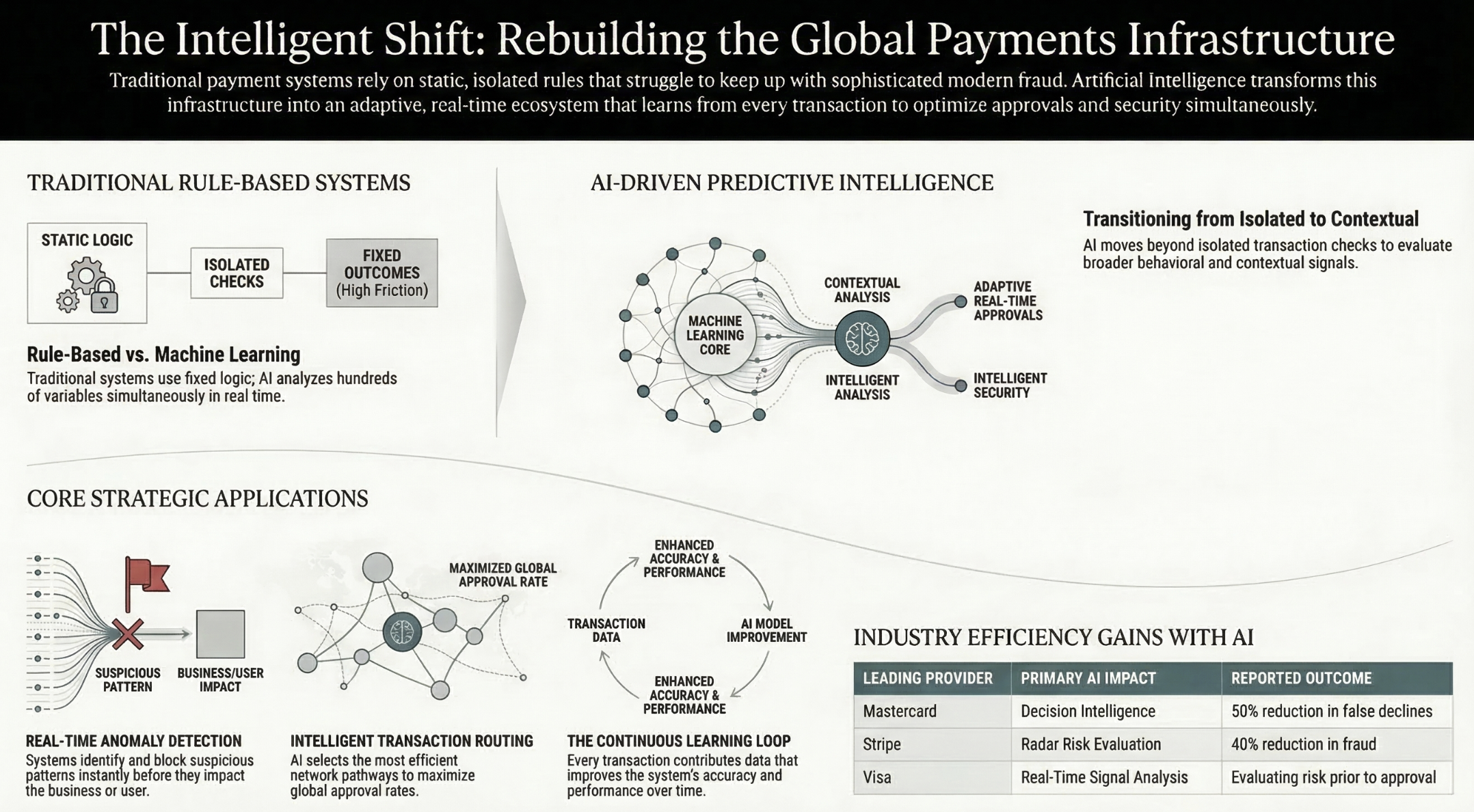
For decades, payment systems relied on rule-based logic that evaluated transactions using fixed conditions. These systems were predictable but struggled to adapt as fraud patterns became more complex. A transaction was assessed in isolation, without considering broader behavioral or contextual signals. This limitation created vulnerabilities that fraudsters could exploit with increasing sophistication. As digital transactions scaled globally, these weaknesses became more pronounced. Financial institutions needed systems that could evolve alongside emerging threats. That need led to the adoption of artificial intelligence as a core capability.
Artificial intelligence introduced a new operating model based on learning rather than static rules. Instead of predefined logic, AI models analyze patterns across millions of transactions in real time. The integration of machine learning allows systems to process hundreds of variables simultaneously. Decisions that once required manual review now occur within milliseconds. This shift has reduced false positives while improving fraud detection accuracy. Payment systems now operate with intelligence that was previously unattainable. This transformation reflects broader changes within automation in fintech.
As systems continue to evolve, each transaction contributes to a continuous learning loop. Data from past interactions informs future decisions, improving both efficiency and accuracy over time. Payment infrastructure becomes more resilient as it adapts to new patterns and behaviors. This shift marks a transition from reactive systems to predictive intelligence. It also highlights why AI in fintech has become a central focus for innovation. Organizations that embrace this model gain a significant operational advantage. Those that do not face increasing difficulty managing risk at scale.
Core Applications Across the Payment Ecosystem
Artificial intelligence operates across multiple layers of the payment ecosystem, influencing how transactions are processed and optimized. Fraud detection remains the most visible application, where AI systems analyze transaction patterns to identify suspicious activity in real time. This proactive approach prevents fraud before it impacts users or businesses. The ability to detect anomalies instantly has significantly reduced financial losses across the industry. It has also improved trust in digital payment systems.
Beyond fraud detection, AI enhances transaction routing by selecting optimal pathways across payment networks. This optimization increases approval rates while reducing latency and operational friction. Payment platforms also use recommendation systems to personalize payment options based on user behavior. Customer support has evolved through natural language processing, enabling faster and more accurate issue resolution. These capabilities improve both efficiency and user satisfaction. Together, they define how AI in payments enhances the overall transaction experience.
These applications are interconnected and reinforce each other through shared data. Improvements in one area often lead to gains in others, creating a compounding effect. As systems process more transactions, they become increasingly accurate and efficient. This continuous feedback loop is central to the value of AI in payment technology. It enables systems to scale without sacrificing performance. Over time, the gap between AI-driven systems and traditional systems continues to widen.
Real-World Examples of AI in Payment Technology
Leading financial technology companies have embedded artificial intelligence deeply into their payment infrastructure. Visa uses AI to analyze transaction signals in real time, evaluating risk before approval decisions are made. Mastercard applies decision intelligence systems that have reduced false declines by up to 50 percent in certain markets. PayPal leverages machine learning models trained on billions of transactions to detect complex fraud patterns. These implementations demonstrate how AI operates effectively at massive scale.
Stripe focuses on optimizing payment routing, improving authorization rates across global markets. Block Inc. uses AI to assess merchant risk and streamline onboarding processes. These companies illustrate how AI can improve both security and efficiency simultaneously. Their success highlights the importance of integrating intelligent systems into core infrastructure. It also reflects the broader shift toward data-driven decision making in financial services.
Case Study: Stripe’s AI-Driven Payment Optimization
Stripe’s Radar system provides a clear example of how artificial intelligence transforms payment performance. The system analyzes billions of data points, including transaction behavior and device-level signals, to evaluate risk in real time. Businesses using Radar have reported fraud reductions of up to 40 percent while maintaining high approval rates. This demonstrates how AI can balance security and user experience effectively.
The system also improves transaction routing by selecting the most efficient pathways across payment networks. This optimization reduces unnecessary declines and increases successful transactions. Traditional systems often require tradeoffs between fraud prevention and approval rates. AI removes much of that constraint by adapting dynamically to changing conditions. Stripe’s implementation highlights the strategic value of embedding AI into payment infrastructure. It also shows how digital payment systems AI can directly impact revenue and customer satisfaction.
How to Implement AI in Payment Systems
Implementing artificial intelligence in payment systems requires a structured approach that aligns technology with business objectives. Organizations must build strong data infrastructure and ensure cross-functional collaboration across teams. AI should be treated as a core capability rather than an isolated feature.
- Ensure compliance with regulatory and data privacy standards
- Assess current payment infrastructure and identify inefficiencies or risk areas
- Build centralized data pipelines for transactional and behavioral data
- Develop machine learning models for fraud detection and optimization
- Integrate AI into real-time payment workflows
- Continuously monitor and retrain models using updated data
The 5-Step AI Payment Implementation Model
Governance: Ensure compliance, transparency, and ethical use of AI
Data Foundation: Establish reliable data pipelines to support accurate model training
Model Development: Build machine learning systems tailored to payment use cases
Real-Time Integration: Embed AI into workflows for instant decision making
Feedback Loop: Continuously improve models using transaction outcomes
Strategic Implications for Businesses
The adoption of artificial intelligence in payment technology represents a strategic shift in how organizations compete. Payments are no longer a backend function but a critical component of customer experience and revenue generation. AI enables businesses to reduce fraud while improving transaction success rates. This dual advantage creates meaningful differentiation in competitive markets.
Insights generated from payment data can inform broader AI business strategy decisions. Companies gain deeper visibility into customer behavior, enabling more informed product and pricing strategies. This integration strengthens long-term growth and retention efforts. Organizations that delay adoption risk falling behind competitors with more adaptive systems. As digital transactions increase, intelligent payment infrastructure becomes essential.
Risks and Limitations
Despite its advantages, artificial intelligence introduces several challenges that organizations must address carefully. Bias in training data can lead to unfair outcomes in fraud detection systems. Model transparency remains a concern, particularly in regulated industries. Data privacy is another critical issue due to the sensitive nature of financial information.
Overreliance on automation can reduce human oversight and increase systemic risk. Cybersecurity threats continue to evolve alongside AI capabilities. Organizations must adopt frameworks such as responsible AI to manage these risks. Investments in AI in cybersecurity are also essential. Addressing these challenges ensures sustainable adoption.
AI vs Traditional Payment Systems
Traditional payment systems were built on predefined rules that evaluate transactions based on fixed criteria. These systems operate effectively in stable environments but struggle to adapt to rapidly evolving fraud patterns. Because they assess transactions in isolation, they often generate high false decline rates and miss subtle fraud signals. This rigidity creates inefficiencies that impact both businesses and customers. As transaction volumes grow, these limitations become increasingly difficult to manage.
AI-powered systems take a fundamentally different approach by learning continuously from transactional and behavioral data. Instead of relying on static rules, intelligent payment systems analyze patterns across millions of transactions in real time. This enables more accurate fraud detection and significantly improves approval rates. AI in payments also optimizes transaction routing, ensuring that payments are processed through the most efficient pathways. These systems evolve automatically as new data becomes available, reducing the need for manual intervention. The transition from traditional systems to AI-driven infrastructure represents a shift from reactive processing to predictive intelligence, which defines the future of AI in fintech.
Future Outlook of AI in Payment Technology
The future of payment technology will be shaped by systems that operate with increasing autonomy and intelligence. Artificial intelligence will enable transactions that adapt dynamically based on context and behavior. Payment experiences will become more personalized, reducing friction and improving satisfaction.
Embedded finance will expand, integrating payments into a wide range of digital platforms. Advances in AI-driven security will strengthen defenses against increasingly sophisticated fraud attempts. Generative models may simulate threats, improving system resilience over time. The continued growth of AI in fintech will drive innovation across the financial ecosystem. Organizations that invest early will lead this transformation.
AI in payments uses machine learning models to analyze transaction data in real time. These systems detect fraud, optimize routing, and improve approval rates by identifying patterns across large datasets.
Artificial intelligence is used to detect fraud, score transaction risk, optimize payment routing, and personalize user experiences. It operates in real time, enabling faster and more accurate decision making.
AI significantly reduces fraud but cannot eliminate it entirely. Fraud tactics evolve constantly, so AI systems must continuously learn and adapt to new patterns and threats.
AI improves approval rates by intelligently routing transactions through the most efficient networks. It also reduces false declines by distinguishing between legitimate and suspicious behavior more accurately.
AI improves fraud detection, reduces operational costs, increases transaction success rates, and enhances customer experience. It also enables scalable systems that adapt to growing transaction volumes.
Traditional systems rely on fixed rules, while AI-based systems learn from data and adapt continuously. This makes AI systems more accurate, faster, and better at detecting complex fraud patterns.
Companies such as Visa, Mastercard, PayPal, Stripe, and Block are leading in AI-driven payment innovation. They use AI to improve fraud detection, routing, and overall transaction efficiency.
AI enhances payment security by detecting anomalies in real time. However, it requires strong governance, data protection measures, and regular monitoring to remain effective and trustworthy.
Banks use AI to detect fraud, monitor transactions, assess risk, and automate compliance processes. These systems help improve both security and operational efficiency.
The future of AI in payments includes autonomous systems that optimize transactions in real time, personalized payment experiences, and deeper integration with embedded finance platforms.
Some of the best AI fraud detection tools include Stripe Radar, Visa Advanced Authorization, Mastercard Decision Intelligence, and Feedzai. These platforms use machine learning to analyze transaction behavior in real time and prevent fraud before it occurs.
Real-world examples include Stripe Radar detecting suspicious transactions using behavioral signals, PayPal identifying fraud patterns across billions of transactions, and Visa using AI to score transaction risk in milliseconds. These systems reduce fraud while maintaining high approval rates.
Banks use AI to monitor transactions, detect anomalies, and assign risk scores in real time. These systems analyze customer behavior, location data, and transaction history to identify suspicious activity before it leads to financial loss.
AI systems can achieve very high accuracy, often detecting fraud within milliseconds. Many platforms report significant reductions in false positives and improved fraud detection rates compared to traditional rule-based systems.
Machine learning enables systems to learn from historical transaction data and identify patterns associated with fraud. This allows payment systems to adapt continuously and improve detection accuracy over time.
AI reduces false declines by distinguishing between legitimate and suspicious behavior more effectively. It evaluates multiple variables in real time, allowing genuine transactions to be approved while still blocking fraudulent activity.
Conclusion
The role of artificial intelligence in payment technology reflects a broader transformation in how financial systems operate. AI has moved beyond fraud detection to become a foundational component of payment infrastructure. It enables systems to learn, adapt, and improve continuously over time. Organizations that embrace this shift gain both operational efficiency and strategic advantage. As digital commerce expands, intelligent payment systems will define the next phase of innovation. The opportunity is significant, but the window for leadership is narrowing.
The rapid evolution of financial infrastructure has positioned AI as a central force in modern transaction systems. AI in payments is no longer a niche capability but a foundational layer that supports speed, security, and scalability. As transaction volumes increase, AI in fintech enables systems to process complex data streams without compromising performance. These advancements are shaping intelligent payment systems that adapt dynamically to user behavior and emerging risks. Instead of relying on static rules, these systems learn continuously from transactional data and improve over time. This shift allows organizations to move from reactive decision making to predictive intelligence. The result is a payment ecosystem that is faster, more secure, and significantly more resilient under pressure.
References.
Herd, Michael. “Payments Industry News & Analysis.” American Banker, 25 May 2021, https://www.paymentssource.com/list/7-uses-of-ai-in-payments. Accessed 3 June 2023.
moccia. “The Critical Role of Artificial Intelligence in Payments Tech.” Fintech News, 27 May 2019, https://www.fintechnews.org/the-crirital-role-of-artificial-inteliigence-in-payments-tech/. Accessed 3 June 2023.
Rykun, Erika. “AI for Payment Optimization: Current Practices and Use Cases.” PaymentsJournal, 25 Feb. 2020, https://www.paymentsjournal.com/ai-for-payment-optimization-current-practices-and-use-cases/. Accessed 3 June 2023.
McKinsey and Company. The Future of Payments: Accelerating Digital Transformation. McKinsey and Company, https://www.mckinsey.com/industries/financial-services/our-insights/the-future-of-payments.
Visa Inc. Visa Advanced Authorization: Real-Time Fraud Detection Using AI. Visa, https://usa.visa.com/run-your-business/small-business-tools/payment-security/advanced-authorization.html.
Federal Reserve System. FraudClassifier Model Overview. Federal Reserve, https://www.federalreserve.gov/paymentsystems/frraudclassifier-about.htm.
Stripe, Inc. Radar: Machine Learning for Fraud Detection. Stripe, https://stripe.com/radar.