
Introduction
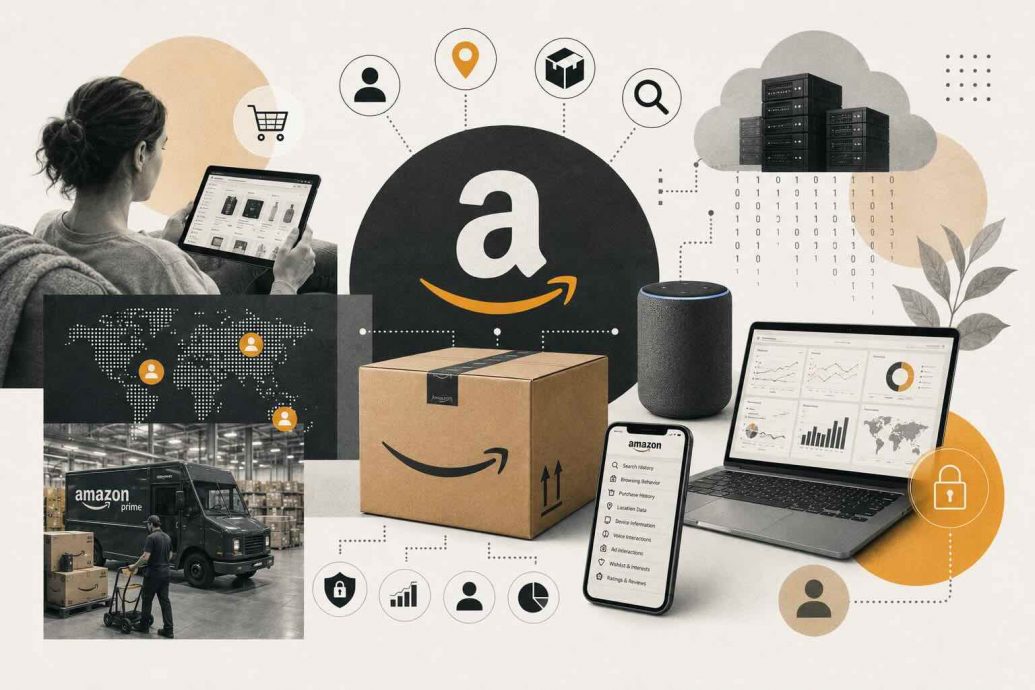
Amazon has grown from an online bookstore into one of the most powerful data-driven companies on the planet, touching nearly every aspect of digital life. Its ecosystem now spans e-commerce, cloud computing, voice assistants, home security cameras, grocery stores, and streaming entertainment. Each of these touchpoints generates massive volumes of user data that feed predictive algorithms and targeted advertising engines. According to the FTC, Amazon was ordered to pay over $30 million in 2023 to settle privacy violations involving Alexa and Ring alone. The scale of this data collection raises critical questions about consumer consent, regulatory enforcement, and corporate accountability in the digital age. Understanding how Amazon gathers, stores, and uses personal information is no longer optional for consumers who value their privacy. This article provides a comprehensive examination of Amazon’s data practices, the risks they create, and the steps individuals can take to protect themselves.
What Does Amazon Know About You?
What data does Amazon collect from users?
Amazon collects purchase history, browsing behavior, voice recordings from Alexa, video footage from Ring cameras, location data, payment information, and device usage patterns across its entire product ecosystem.
Has Amazon been fined for data privacy violations?
Yes, Amazon has faced multiple fines including an $887 million GDPR penalty from Luxembourg in 2021, a $30.8 million FTC settlement in 2023, and a $2.5 billion FTC settlement in 2025 over deceptive Prime enrollment practices.
Can you stop Amazon from collecting your data?
Users can limit data collection by adjusting Alexa privacy settings, disabling ad personalization, reviewing Ring camera sharing preferences, and requesting copies of their stored data, though complete prevention requires deleting your Amazon account entirely.
Key Takeaways
- The intersection of Amazon’s AI ambitions and its data collection infrastructure creates escalating concerns about surveillance capitalism, particularly as Alexa and Ring devices expand into health monitoring and facial recognition.
- Amazon collects data across more than 15 product categories including shopping, streaming, voice commands, home surveillance, cloud services, and grocery purchases, creating one of the most detailed consumer profiles in the tech industry.
- Regulatory bodies worldwide have imposed billions of dollars in fines on Amazon for privacy violations, yet critics argue these penalties remain too small relative to the company’s revenue to drive meaningful behavioral change.
- Consumers retain limited but meaningful control over their Amazon data through privacy dashboards, deletion requests, and advertising preference adjustments, though opting out of all tracking requires abandoning the Amazon ecosystem entirely.
Table of contents
- Introduction
- What Does Amazon Know About You?
- Key Takeaways
- Defining Amazon’s Data Collection Practices
- The Scope of Amazon’s Data Ecosystem
- How Alexa Listens and Learns
- Ring Cameras and the Surveillance Debate
- Shopping Data and Predictive Analytics
- How Amazon Uses Data for Advertising
- AWS and Enterprise Data Handling
- Children’s Privacy and Parental Consent
- Location Tracking Through Mobile Applications
- Biometric Data and Palm Recognition
- Regulatory Responses Across the Globe
- Consumer Control and Opt-Out Mechanisms
- The Ethical Dimensions of Data Monetization
- Amazon’s AI Ambitions and Training Data
- Third-Party Data Sharing and the Advertising Ecosystem
- Data Breaches and Security Vulnerabilities
- Competitive Implications of Data Dominance
- The Future of Amazon’s Data Practices
- Steps Consumers Can Take to Protect Their Data
- Key Insights on Amazon and Data Collection
- Real-World Examples of Amazon Data Collection Impact
- Case Studies in Amazon Data Collection Governance
- Frequently Asked Questions About Amazon and Data Collection
Defining Amazon’s Data Collection Practices
Amazon’s data collection refers to the systematic gathering, storage, and processing of personal information from customers across its retail platform, cloud infrastructure, smart devices, and subsidiary services including Ring, Alexa, Whole Foods, Twitch, and Audible to power personalization, advertising, and AI development.
Amazon Data Collection Explorer
Select an Amazon service to see collected data, privacy risk, and regulatory actions.
The Scope of Amazon’s Data Ecosystem
Amazon operates one of the most expansive data collection networks in the history of consumer technology, spanning dozens of interconnected services. Every product search, every voice command to Alexa, and every Ring doorbell activation generates data points that flow into Amazon’s centralized infrastructure. The company maintains data centers on six continents through Amazon Web Services, with Northern Virginia alone hosting more than seventy facilities dedicated to storage and processing. This sprawling infrastructure means that Amazon can track individual consumer behavior from the moment they wake up and speak to Alexa until they fall asleep watching Prime Video. The breadth of this ecosystem distinguishes Amazon from competitors who operate in fewer product categories. Shopping habits, entertainment preferences, home security footage, and even grocery purchases through Whole Foods contribute to a single unified consumer profile. Understanding the full scope of this network is essential for anyone concerned about digital privacy risks in the modern era.
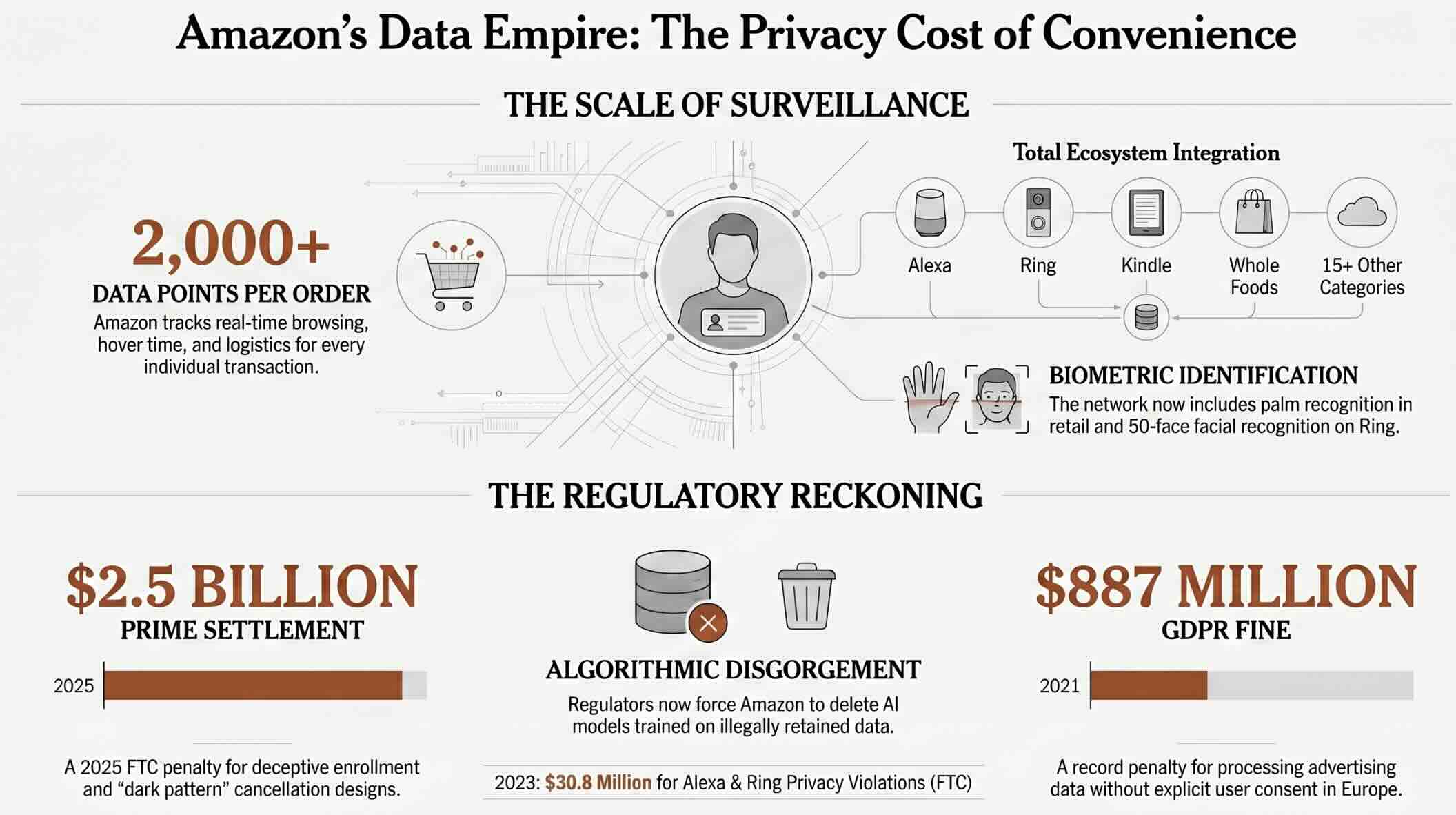
Amazon’s data collection extends far beyond what most users realize when they place an order or ask Alexa for the weather forecast. The company tracks more than 2,000 real-time and historical data points per order, according to industry estimates, encompassing delivery logistics, browsing timestamps, and payment behavior. Subsidiaries like Ring, Twitch, IMDb, Audible, and Whole Foods each maintain their own data pipelines that ultimately feed the larger Amazon profile. Voice recordings from Alexa-enabled devices are stored and analyzed by both automated systems and human reviewers who help train machine learning models. Location data harvested through mobile applications and the Amazon Ads SDK can pinpoint user movements with startling precision. Even devices like Kindle track reading speed, highlights, and bookmarks, feeding behavioral data back to recommendation engines. The cumulative effect is a consumer profile more detailed than what any single government agency could compile about an ordinary citizen.
How Alexa Listens and Learns
Alexa represents one of the most intimate data collection channels Amazon operates, sitting inside millions of bedrooms, kitchens, and living rooms worldwide. Amazon designed Alexa-enabled devices to activate upon detecting a specific wake word, but the company has acknowledged that accidental activations occur regularly. Once triggered, audio recordings stream to Amazon’s cloud servers, where they are processed, transcribed, and stored for varying durations. The FTC found that Amazon retained children’s voice recordings and geolocation data even after parents explicitly requested deletion, a practice that violated the Children’s Online Privacy Protection Act. Alexa also monitors connected smart home devices, tracking everything from thermostat adjustments to when lights are turned on and off. This behavioral data helps Amazon build detailed profiles of daily routines, household compositions, and personal preferences that extend well beyond shopping. For those interested in how Alexa works as an AI system, the privacy implications become even more striking when paired with Amazon’s commercial interests.
The human review component of Alexa’s data pipeline has drawn particular scrutiny from privacy advocates and regulatory bodies. Amazon employs thousands of workers globally to listen to and annotate voice recordings, a process the company describes as essential for improving natural language understanding. Users were not initially informed that real people might hear their private conversations, medical inquiries, or household arguments captured by Alexa. Amazon eventually introduced an opt-out option for human review, but privacy advocates note that the default setting still permits data retention. Alexa’s integration with third-party skills and applications creates additional data-sharing channels that most consumers neither understand nor consent to meaningfully. The convenience of voice-activated shopping, music playback, and smart home control comes at a cost measured in surrendered personal information. These concerns about AI privacy implications in personal devices are amplified by the sheer number of Alexa units deployed worldwide.
Amazon has taken steps to address some Alexa privacy concerns, including introducing the ability to automatically delete voice recordings after three or eighteen months. The company also launched an Alexa Privacy Hub that explains how recordings are used and provides controls for managing stored data. Users can now say “Alexa, delete everything I said today” to remove recordings from their account. These measures, while meaningful, still leave Amazon with substantial discretion over how aggregated and anonymized data derived from voice interactions is utilized. The tension between improving AI accuracy and respecting user privacy remains a core challenge for Amazon’s voice assistant business.
Ring Cameras and the Surveillance Debate
Ring, the home security subsidiary Amazon acquired in 2018 for approximately one billion dollars, has become a lightning rod in debates about consumer surveillance and corporate data practices. Millions of households rely on Ring doorbells and cameras for security, uploading continuous video streams to Amazon’s cloud servers for storage and review. The FTC accused Ring of allowing employees and contractors to access customer video feeds, including footage from bedrooms and bathrooms, without meaningful oversight or consumer knowledge. Hackers also exploited weak security measures to access live video streams, in some cases speaking to children and threatening families through the camera’s two-way audio feature. Amazon settled the resulting FTC complaint by agreeing to pay $5.8 million and delete certain customer data collected before 2018. Ring’s Familiar Faces feature, which launched in late 2025 and uses facial recognition to catalog up to fifty faces, has reignited concerns about mass surveillance potential. The balance between security convenience and data exploitation risks remains deeply contested among consumers and privacy advocates.
Ring’s relationship with law enforcement agencies has generated additional controversy that extends beyond individual privacy into questions of community surveillance. The company previously operated a program that allowed police departments to request doorbell footage directly from Ring users. Although Amazon discontinued direct police access in 2024, a proposed partnership with Flock Safety in October 2025 would have reintroduced a similar capability through automated license plate recognition integration. The partnership was canceled in early 2026 following significant consumer backlash, with customers reportedly returning Ring cameras and receiving full refunds from Amazon. Privacy organizations like the Electronic Frontier Foundation have argued that Ring’s infrastructure creates a distributed surveillance network that law enforcement can access with minimal judicial oversight. These dynamics demonstrate how AI and data are redefining security and surveillance in residential neighborhoods across the country.
Shopping Data and Predictive Analytics
While Ring and Alexa capture headlines, Amazon’s original data collection engine remains its e-commerce platform, which processes billions of transactions annually and feeds one of the most sophisticated recommendation systems in retail. Amazon tracks every product viewed, every search query entered, every item added to a cart, and every purchase completed, building a continuously updated model of consumer preferences and purchasing patterns. This data powers the recommendation algorithms that reportedly drive more than thirty percent of Amazon’s total revenue through personalized suggestions. The company’s predictive analytics capabilities are so advanced that internal systems can anticipate what a customer is likely to buy before they begin searching. Browsing behavior on Amazon’s website and mobile application is logged with millisecond precision, including hover time, scroll depth, and click patterns that reveal intent beyond explicit searches. Purchase history combined with demographic data and browsing patterns creates buyer profiles that inform pricing strategies, inventory management, and advertising placement. The convergence of shopping data with information from Alexa, Ring, and Prime Video amplifies the depth and commercial value of each individual consumer profile.
Beyond individual recommendations, Amazon leverages shopping data to gain competitive advantages that extend across the broader retail landscape. Third-party sellers on Amazon’s marketplace generate transaction data that Amazon can analyze to identify trending products, optimal price points, and underserved market segments. Critics and regulatory bodies have accused Amazon of using this third-party seller data to develop competing private-label products, a practice investigated by both European and American antitrust authorities. The advertising division, which generated over $46 billion in revenue in 2023, uses shopping behavior data to power a targeted advertising platform that rivals Google and Meta in precision. Whole Foods acquisition in 2017 added physical grocery purchasing data to Amazon’s digital profile, bridging the gap between online and offline consumer behavior tracking. These layers of data collection illustrate why Amazon’s business model is fundamentally built on extracting maximum informational value from every customer interaction.
How Amazon Uses Data for Advertising
Moving from transactional data to its monetization reveals the commercial engine driving Amazon’s data appetite, particularly through its rapidly growing advertising division. Amazon’s advertising platform has evolved from simple sponsored product listings into a sophisticated system that leverages behavioral data across the entire Amazon ecosystem. The company states that it uses advertising identifiers rather than personal names when sharing data with advertising partners, employing cookies, device identifiers, and cryptographic codes derived from email addresses. Interest-based advertising preferences can be adjusted through Amazon’s advertising dashboard, though the default settings enable broad data sharing with third-party ad networks. The integration of shopping behavior, streaming habits, voice queries, and browsing patterns gives Amazon’s advertising platform a cross-channel data advantage that few competitors can match. Advertisers can target consumers based on what they bought last week, what show they watched last night, and what question they asked Alexa this morning. This advertising ecosystem represents a primary financial incentive for Amazon to continue expanding its data collection infrastructure across new product categories and services.
The European Union’s landmark GDPR fine of €746 million against Amazon in 2021 specifically targeted the company’s advertising data practices, alleging that Amazon processed personal data for ad personalization without obtaining valid user consent. Luxembourg’s data protection authority found that Amazon bundled consent for targeted advertising into its general terms of service rather than seeking explicit, separate permission as required under European law. Amazon appealed the decision, arguing that the interpretation was subjective and the fine disproportionate, but the case highlighted how advertising revenue incentives can conflict with privacy regulations. French privacy group La Quadrature du Net, which filed the original complaint on behalf of ten thousand individuals, described Amazon’s advertising model as economic domination built on exploiting privacy and free will. The case established a precedent that may reshape how large technology companies structure consent mechanisms for advertising data collection across Europe and beyond.
AWS and Enterprise Data Handling
The advertising controversy connects directly to Amazon’s broader data infrastructure, where Amazon Web Services operates as both a revenue powerhouse and a custodian of enterprise-level data for millions of organizations worldwide. AWS hosts data for government agencies, healthcare institutions, financial services firms, and countless startups, processing workloads that range from machine learning training to real-time transaction systems. While AWS operates under separate privacy frameworks from Amazon’s consumer products, the company’s dual role as both data collector and data infrastructure provider creates unique conflicts of interest. Organizations storing sensitive data on AWS must trust that Amazon’s infrastructure team maintains strict separation between consumer insights and enterprise client information. AWS publishes detailed privacy notices and complies with international data protection frameworks including the EU-US Data Privacy Framework, but critics argue that centralized control of both consumer and enterprise data amplifies systemic risk. The company employs thousands of security professionals dedicated to protecting client information, and AWS has earned numerous compliance certifications including SOC, ISO, and FedRAMP authorizations. Businesses evaluating cloud providers must weigh AWS’s technical capabilities against the broader implications of concentrating data within a company that also operates the world’s largest consumer data collection network.
Amazon’s expansion into healthcare through AWS health data solutions, Amazon Pharmacy, and wearable health monitoring introduces particularly sensitive categories of personal information into its data ecosystem. The company’s Consumer Health Data Privacy Disclosure, updated in July 2025, acknowledges collecting health insurance information, biometric data such as palm scans, and information related to medical conditions and purchases. Washington state’s My Health My Data Act, enacted in March 2024, prompted a class action lawsuit in February 2025 alleging that Amazon unlawfully tracked location data that could reveal consumers’ attempts to access health services. These developments highlight how Amazon’s data practices intersect with some of the most sensitive categories of personal information, creating data privacy and security challenges that extend well beyond shopping preferences. The healthcare data frontier represents an area where regulatory scrutiny is likely to intensify as Amazon’s health ambitions grow.
Children’s Privacy and Parental Consent
Amazon’s handling of children’s data brings the healthcare discussion into an even more protected legal territory, where federal regulations impose strict requirements on how companies collect and retain information from minors. The FTC’s $25 million settlement with Amazon in 2023 centered on violations of the Children’s Online Privacy Protection Act, which requires verifiable parental consent before collecting data from children under thirteen. Regulators found that Amazon retained children’s voice recordings and transcripts through Alexa even after parents submitted deletion requests, using this data to train machine learning algorithms. The FTC specifically prohibited Amazon from using previously collected children’s data to improve its algorithms, a rare restriction that acknowledged the lasting harm of unauthorized data retention. Amazon Kids, the company’s child-oriented service, has since implemented additional parental controls and data management features, but the underlying tension between AI training needs and children’s privacy rights persists. These protections for minors reflect broader societal concerns about AI ethics and privacy laws in an era of pervasive data collection.
Beyond Alexa, Amazon’s children’s data practices extend to Kindle devices, Fire tablets configured for children, and content consumption patterns on Prime Video Kids profiles. Each of these services generates behavioral data about minors that can reveal reading levels, entertainment preferences, and developmental interests. Amazon states that children and teens under eighteen are opted out of cross-context behavioral advertising by default, a policy aligned with California Privacy Rights Act requirements. Parents can request deletion of their children’s data through Amazon’s Data Privacy Queries portal, though the process requires navigating multiple settings across different Amazon services. The complexity of managing children’s privacy across Amazon’s fragmented ecosystem places a significant burden on parents who must actively monitor and restrict data sharing across devices and platforms.
Location Tracking Through Mobile Applications
Shifting from children’s data to the physical world, Amazon’s location tracking capabilities reveal another dimension of its surveillance infrastructure that operates largely invisible to most users. A class action lawsuit filed in February 2025 alleged that Amazon’s Ads SDK, embedded in numerous third-party mobile applications, collected cell phone users’ location data without express consent. The complaint described how the SDK operates silently in the background of applications that have no apparent connection to Amazon, harvesting precise geolocation data that can then be used for targeted advertising. This practice means that Amazon may track your physical movements through apps you never associated with the company, creating location histories that reveal patterns of daily life. The Amazon Shopping app itself requests location permissions that enable geo-targeted recommendations, local delivery estimates, and store-specific promotions through Whole Foods and Amazon Fresh. Combined with Ring doorbell footage that captures the movements of anyone approaching a subscriber’s home, Amazon’s location data capabilities form a comprehensive spatial tracking network. The implications for personal privacy in the AI era are particularly stark when location data is cross-referenced with purchasing behavior and voice assistant queries.
Amazon’s state-specific privacy disclosures acknowledge collecting geolocation data and classify it as sensitive personal information under the California Privacy Rights Act. The company offers data rights including access, correction, and deletion for consumers covered by state privacy laws, but exercising these rights requires navigating Amazon’s Data Privacy Queries portal and verifying identity through existing account information. Amazon states that it does not sell personal information, including location data, to third parties, though it does share data with service providers and advertising partners under terms that critics argue amount to a functional equivalent of selling. The Federal Trade Commission has signaled increased attention to location data practices, and Amazon’s settlement agreements already include specific provisions requiring the company to implement privacy programs for geolocation information.
Biometric Data and Palm Recognition
Location tracking feeds into an even more personal frontier of data collection as Amazon expands into biometric identification through its Amazon One palm scanning technology, deployed in Whole Foods stores and other physical retail locations. Amazon One allows customers to pay for purchases, verify identity, and enter venues by hovering their palm over a sensor, creating a biometric profile linked to their Amazon account. The company’s privacy disclosures acknowledge that palm scans constitute biometric data and may be classified as consumer health data under certain state laws. Unlike passwords or credit card numbers, biometric identifiers cannot be changed if compromised, making palm scan data uniquely sensitive from a security perspective. Amazon states that palm images are encrypted and stored in a dedicated, highly controlled area of the AWS cloud, separate from other customer data. Washington state’s My Health My Data Act explicitly covers biometric data in its protections, and Amazon’s palm recognition program has drawn scrutiny under these provisions. The expansion of Amazon’s biometric collection into physical retail environments represents a significant escalation in the intimacy of data the company captures from its customers.
Ring’s Familiar Faces feature adds facial recognition to Amazon’s growing biometric data portfolio, allowing doorbell cameras to identify and catalog visitors based on their facial features. Launched to most US users in December 2025, the feature stores facial templates for up to fifty individuals and delivers personalized notifications when recognized faces appear at the door. Privacy advocates have warned that facial recognition at the front door normalizes biometric surveillance in residential settings, creating databases of faces that could be subpoenaed by law enforcement or compromised in data breaches. Several states including Illinois, Texas, and Washington have biometric privacy laws that require informed consent before collecting facial geometry data, creating a patchwork of legal obligations Amazon must navigate. The combination of palm recognition in stores and facial recognition at front doors means Amazon is building biometric profiles that track both commercial and residential activities.
Regulatory Responses Across the Globe
The biometric data expansion underscores why regulatory bodies across the globe have intensified enforcement actions against Amazon’s data practices, imposing record penalties that signal growing governmental concern. The European Union’s GDPR fine of €746 million in 2021 remains one of the largest privacy penalties ever levied against a single company, targeting Amazon’s failure to obtain valid consent for advertising data processing. In the United States, the FTC’s combined $30.8 million settlement in 2023 addressed violations spanning Alexa’s retention of children’s data and Ring employees’ unauthorized access to customer video feeds. The FTC followed this with a historic $2.5 billion settlement in September 2025 over deceptive Prime enrollment practices, requiring Amazon to pay $1 billion in civil penalties and $1.5 billion in consumer refunds. Despite these substantial penalties, critics note that even the $2.5 billion Prime settlement amounts to roughly 0.1 percent of Amazon’s market capitalization, raising questions about whether financial penalties alone can deter data misuse by the world’s largest companies. State-level regulations including the California Privacy Rights Act, Washington’s My Health My Data Act, and Illinois’ Biometric Information Privacy Act are creating additional compliance obligations that vary by jurisdiction. The evolving regulatory landscape reflects a global recognition that Amazon’s data collection practices require external checks beyond voluntary corporate commitments, aligning with broader conversations about AI governance and regulatory trends.
International regulatory responses extend beyond fines to structural requirements that fundamentally alter how Amazon can use collected data. The FTC’s 2023 settlement prohibited Amazon from using children’s voice recordings and geolocation data to train algorithms, establishing a precedent that data deletion must extend to derived insights, not just raw recordings. European regulators have required Amazon to revise its consent mechanisms for advertising data, moving away from bundled terms-of-service agreements toward explicit, granular consent choices. Brazil’s General Data Protection Law, India’s Digital Personal Data Protection Act, and similar frameworks across Asia and Latin America are imposing additional obligations on Amazon’s global operations. The proliferation of privacy regulations means Amazon must maintain multiple compliance frameworks simultaneously, a challenge that smaller companies would struggle to manage but that Amazon’s scale makes feasible if costly.
Consumer Control and Opt-Out Mechanisms
While regulatory enforcement provides external pressure, the practical tools available to individual consumers for managing their Amazon data footprint remain limited in scope and often difficult to navigate. Amazon allows users to request a copy of their collected data through the “Your Data” section of their account, though the resulting download can be enormous and requires technical literacy to interpret. The company provides advertising preference controls that let users opt out of interest-based ads, though opting out does not stop Amazon from collecting the underlying behavioral data. Alexa users can review and delete individual voice recordings, enable automatic deletion after three or eighteen months, and opt out of human review of their recordings through the Alexa Privacy Hub. Ring camera owners can adjust video sharing settings, disable community features, and manage motion detection zones to limit the scope of footage captured and stored. Amazon’s state-specific privacy portals offer data deletion request mechanisms for consumers in jurisdictions with applicable laws, though processing times and verification requirements create friction that may discourage all but the most determined users. The asymmetry between the ease of data collection and the difficulty of data deletion reflects a structural advantage that favors corporate data accumulation over individual privacy management.
Independent privacy experts recommend a layered approach to reducing Amazon’s data collection that goes beyond the company’s own privacy tools. Using a virtual private network can obscure browsing behavior from Amazon’s tracking systems, particularly when shopping outside the Amazon app. Disabling Alexa’s continuous listening by muting the microphone when not actively using the device prevents accidental voice recordings. Regularly clearing browsing and search history through Amazon’s account settings reduces the data available for recommendation algorithms. Using Amazon’s services without logging into an account where possible limits cross-service data linking. For users who want comprehensive guidance on protecting their data, resources about VPN technology and its importance provide valuable context for building a personal privacy strategy.
The Ethical Dimensions of Data Monetization
Consumer opt-out tools address symptoms rather than root causes, which brings the conversation to the deeper ethical questions surrounding Amazon’s data monetization model and its implications for digital autonomy. Amazon’s business model fundamentally depends on converting personal information into commercial value, whether through targeted advertising, product recommendations, or AI model training. The concept of informed consent becomes strained when privacy policies span thousands of words and consent is effectively bundled with service access, leaving consumers with a binary choice between surrendering data or abandoning widely used services. Critics describe this dynamic as surveillance capitalism, a system in which human experience is claimed as free raw material for translation into behavioral data that drives prediction products sold to business customers. Amazon’s defenders argue that data collection enables genuine consumer benefits including faster delivery, better product discovery, and smarter home automation that improve quality of life. The ethical tension between these perspectives resists easy resolution, as the benefits and harms of pervasive data collection distribute unevenly across populations defined by wealth, digital literacy, and geographic location. Understanding ethical implications of advanced AI is essential for navigating this debate with nuance rather than simplistic judgment.
The ethics of Amazon’s data practices intersect with questions of power concentration that extend beyond individual privacy into societal governance concerns. Amazon’s data advantages create barriers to entry for competitors who cannot match the breadth and depth of consumer insights the company commands. This data concentration enables Amazon to influence consumer behavior at a scale that raises questions about market fairness and democratic accountability. Workers within Amazon’s supply chain, delivery network, and warehouse operations are also subject to intensive data-driven surveillance through productivity tracking systems and algorithmic management tools. The company’s lobbying efforts to shape data privacy legislation add another layer of ethical complexity, as Amazon simultaneously operates as a regulated entity and an active participant in defining the regulatory frameworks that govern its behavior.
Amazon’s AI Ambitions and Training Data
Ethical considerations become even more urgent when examining how Amazon’s collected data fuels its rapidly expanding artificial intelligence and machine learning operations. Every Alexa interaction, every product search, and every Ring video contributes to training datasets that improve Amazon’s AI models, from natural language processing to computer vision. Amazon’s investment of over $110 million in AI research underscores the strategic importance of proprietary data in developing competitive AI capabilities. The FTC’s prohibition on using previously collected children’s data for algorithm training established an important principle that data used for AI development must comply with the consent terms under which it was originally gathered. Amazon’s Bedrock platform on AWS allows enterprise customers to build AI applications using foundation models, raising questions about whether consumer data collected through Amazon’s retail and device ecosystems indirectly benefits these commercial AI offerings. The relationship between consumer data collection and AI training creates feedback loops where more data improves AI performance, which drives more product usage, which generates more data. Exploring how AI learns from datasets illuminates the direct connection between Amazon’s data practices and its technological capabilities.
Amazon’s generative AI push, including the development of custom AI chips and its $4 billion investment in Anthropic, signals that the company views its data assets as foundational to competing in the next generation of AI technology. The company’s proprietary datasets spanning consumer behavior, voice interactions, visual data from Ring cameras, and enterprise workloads on AWS provide training material that open-source AI developers cannot easily replicate. This data moat reinforces Amazon’s competitive position in AI development while simultaneously raising the stakes of its data collection practices. If the data feeding these AI systems was collected without adequate consent or retained in violation of privacy laws, the resulting AI models carry what privacy scholars describe as a fundamental legitimacy deficit.
Third-Party Data Sharing and the Advertising Ecosystem
The AI training dimension connects to a broader network of data flows as Amazon shares collected information with a web of third-party partners that extends the reach of user data far beyond Amazon’s own systems. Amazon’s privacy notice acknowledges sharing personal information with third-party advertising partners, service providers who perform functions on Amazon’s behalf, and business partners involved in co-branded offerings. The company states that it provides advertising identifiers rather than directly identifying information to ad partners, though privacy researchers have demonstrated that device identifiers and behavioral profiles can be reverse-engineered to identify individuals in many cases. Amazon’s Ads SDK embedded in third-party mobile applications creates a particularly opaque data-sharing channel where users interact with Amazon’s data collection infrastructure without any visible Amazon branding. The company participates in real-time bidding systems for digital advertising where user profile data is broadcast to dozens of potential advertisers within milliseconds of a page load. Each link in this data-sharing chain introduces additional security risks and reduces the consumer’s ability to track or control how their information is ultimately used. These third-party data flows represent one of the least visible but most consequential aspects of Amazon’s broader data practices, connecting to concerns about how AI chooses the ads users see.
Amazon’s marketplace ecosystem creates additional data-sharing dynamics between the company, third-party sellers, and their respective technology providers. Sellers on Amazon’s platform must share product information, pricing data, and customer service metrics with Amazon, which aggregates this information across millions of listings. Amazon’s Brand Analytics tools provide sellers with aggregated customer search and purchase data, but the underlying individual-level data remains exclusively under Amazon’s control. The company’s recent push into advertising technology has expanded the categories of data shared with external partners, as retailers and brands seek to leverage Amazon’s consumer insights for campaigns that extend beyond Amazon’s own properties. This expanding advertising ecosystem means that data collected through a simple Amazon purchase may ultimately influence the ads a consumer sees on entirely unrelated websites and applications.
Data Breaches and Security Vulnerabilities
Third-party data sharing amplifies the impact of security vulnerabilities, making data breach risks a critical component of evaluating Amazon’s data collection practices and their real-world consequences. Ring’s security failures provide the most documented examples, including the 2019 incidents where hackers accessed live camera feeds through compromised passwords and spoke directly to residents, including children, through two-way audio features. The FTC documented that Ring did not implement mandatory multi-factor authentication until 2019, years after security researchers identified credential-stuffing vulnerabilities in the platform. Suspicious login activities in May 2025 triggered widespread concern among Ring users, though the company characterized the incident as a technical glitch rather than a security breach. AWS has maintained a stronger security record for its enterprise cloud services, though the sheer volume of data stored across its infrastructure makes it a high-value target for sophisticated threat actors including nation-state hackers. Amazon’s investment in security includes thousands of dedicated professionals and compliance with major industry certifications, but no system is immune to vulnerability. The concentration of diverse data types within a single corporate entity means that a single successful breach could expose shopping habits, voice recordings, home security footage, and health data simultaneously, making understanding AI and cybersecurity challenges essential for informed consumers.
Amazon’s response to security incidents has evolved over time, with the company implementing more robust notification procedures and mandatory security features following regulatory settlements. Ring now requires two-factor authentication for all new accounts and provides end-to-end encryption options for stored video. Alexa’s security framework includes encryption of voice recordings in transit and at rest, along with access controls that limit which employees can review customer data. Amazon’s bug bounty program incentivizes external security researchers to identify vulnerabilities before malicious actors can exploit them. These improvements, while meaningful, address individual attack vectors rather than the systemic risk created by collecting and centralizing vast quantities of sensitive personal data across interconnected services.
Competitive Implications of Data Dominance
Security concerns become strategic issues when viewed through the lens of competition, as Amazon’s data dominance creates market advantages that affect competitors, consumers, and the broader structure of digital commerce. Amazon’s unmatched breadth of consumer data allows it to optimize every aspect of its operations, from predicting demand and positioning inventory in regional warehouses to personalizing pricing and timing promotional offers for maximum conversion. Competitors lacking access to equivalent data must rely on less precise signals, creating an information asymmetry that compounds over time as Amazon’s data advantage grows with each additional customer interaction. European and American antitrust investigations have examined whether Amazon uses third-party seller data to identify successful products and launch competing private-label alternatives, a practice that would convert merchant data into direct competitive ammunition. The company’s advertising platform benefits from data integration that Google and Meta cannot fully replicate, as Amazon knows both what consumers search for and what they actually purchase. This data-driven competitive moat extends to logistics, where Amazon’s delivery network optimization relies on predictive models trained on billions of historical shipment records. The implications for market competition raise fundamental questions about whether data concentration at Amazon’s scale is compatible with healthy market dynamics, connecting to broader discussions about using AI for competitive advantage.
Smaller retailers and independent merchants operating on Amazon’s platform face a particular disadvantage, as they must share operational data with Amazon as a condition of marketplace participation while competing against Amazon’s own retail operations. This structural dynamic has prompted calls for data portability requirements that would allow merchants to transfer their customer relationship data to alternative platforms. The European Union’s Digital Markets Act includes provisions designed to address data-driven market dominance by requiring large platforms to share certain categories of data with competitors under fair terms. Whether these regulatory interventions can effectively counterbalance Amazon’s accumulated data advantages remains an open question that will shape the future of digital commerce competition globally.
The Future of Amazon’s Data Practices
Competitive dynamics feed directly into predictions about Amazon’s future data strategies, as emerging technologies and evolving regulations will reshape the boundaries of what the company collects and how it can use personal information. Amazon’s investment in ambient computing through Alexa, drone delivery, cashier-less retail stores, and autonomous vehicle technology suggests that future data collection will extend deeper into physical spaces and daily routines. The company’s healthcare ambitions, including Amazon Pharmacy, Amazon Clinic, and health monitoring through wearable devices, will introduce medical data into its ecosystem at scale. The convergence of biometric identification, voice intelligence, computer vision, and location tracking points toward a future where Amazon’s data infrastructure could construct a near-continuous digital record of a customer’s daily life. Generative AI capabilities will enable Amazon to extract more nuanced insights from existing data, potentially identifying emotional states, health conditions, and life events from behavioral patterns that current systems cannot detect. Regulatory frameworks will need to evolve in parallel with these technological capabilities, as existing privacy laws were largely designed for an era of simpler data collection models. The trajectory of artificial intelligence’s future is inseparable from the data practices of companies like Amazon that provide both the fuel and the infrastructure for AI advancement.
Consumer attitudes toward data privacy are also shifting, with surveys consistently showing growing discomfort with the scope of corporate data collection even as convenience-driven adoption of smart devices continues to accelerate. This paradox suggests that future market dynamics may favor companies that can demonstrate genuine data minimization while still delivering personalized experiences. Amazon’s response to this evolving landscape will likely involve enhanced privacy dashboards, more granular consent mechanisms, and increased transparency about data usage, balanced against the company’s commercial need to maintain the data flows that power its most profitable business lines. The tension between privacy and personalization will define the next chapter of Amazon’s relationship with its billions of customers worldwide.
Steps Consumers Can Take to Protect Their Data
Future concerns bring the conversation back to present-day actions, as consumers navigating Amazon’s ecosystem today have concrete steps they can take to reduce their data exposure without completely abandoning the platform’s services. Reviewing and adjusting Alexa privacy settings through the Alexa app or Amazon’s website is the most impactful single action, allowing users to disable human review, enable automatic deletion, and review stored voice recordings. Adjusting advertising preferences through Amazon’s Ad Preferences page reduces the scope of targeted advertising without affecting core shopping functionality. Requesting a copy of your Amazon data through the “Request Your Personal Information” page reveals the full extent of what Amazon has collected, often surprising users with the breadth and detail of stored information. Limiting Ring camera footage storage by reducing clip length, adjusting motion sensitivity, and disabling community sharing features reduces the volume of video data flowing to Amazon’s servers. Using browser privacy extensions and clearing cookies regularly disrupts cross-site tracking that feeds Amazon’s advertising profile. Reviewing and revoking third-party app permissions connected to your Amazon account closes data-sharing channels that many users have forgotten they authorized. These practical steps, while not eliminating Amazon’s data collection entirely, meaningfully reduce the personal information available for commercial exploitation and provide a foundation for addressing privacy challenges in the AI era.
Consumers who want to go further can explore Amazon’s data deletion request process available under applicable state privacy laws, contact Amazon customer service to inquire about specific data retention practices, and consider whether each Amazon service they use provides enough value to justify the associated data sharing. Parents should regularly audit the privacy settings on children’s devices, enable Amazon Kids parental controls, and verify that deletion requests have been processed for minor children’s data. Staying informed about evolving privacy regulations and Amazon’s changing policies ensures that consumers can exercise their rights as new protections become available. The most effective privacy strategy combines technical controls with informed decision-making about which Amazon services to use and which to avoid.
Key Insights on Amazon and Data Collection
- Amazon’s Consumer Health Data Privacy Disclosure acknowledges collecting biometric data including palm scans and health insurance information, expanding the company’s data collection into categories with heightened legal protections and personal sensitivity.
- Amazon processes over 2,000 data points per order, making it one of the most data-intensive retail operations, and this granular tracking enables same-day delivery logistics and demand forecasting that competitors struggle to match.
- The FTC’s $30.8 million combined settlement in 2023 covered both Alexa children’s data violations and Ring employee surveillance abuses, demonstrating that privacy failures span Amazon’s entire device ecosystem rather than isolated product lines.
- Luxembourg’s €746 million GDPR fine targeted Amazon’s consent mechanisms for advertising data personalization, establishing that bundling advertising consent into general terms of service violates European privacy law regardless of the company’s market position.
- The September 2025 FTC settlement of $2.5 billion over deceptive Prime enrollment marked the second-highest consumer restitution award in FTC history, with 35 million consumers receiving refunds.
- Ring’s Familiar Faces facial recognition feature, launched in late 2025, allows cameras to catalog up to 50 faces, raising concerns that residential doorbell cameras are evolving into distributed biometric surveillance networks.
- A February 2025 class action lawsuit alleged that Amazon’s Ads SDK collected location data from mobile apps without consent, revealing that Amazon’s tracking extends into third-party applications where users have no expectation of Amazon involvement.
| Dimension | Amazon E-Commerce | Alexa Voice Assistant | Ring Security Cameras | AWS Cloud Services |
|---|---|---|---|---|
| Transparency | Privacy notice available but lengthy; browsing and purchase tracking disclosed in general terms | Privacy Hub launched after FTC action; users initially unaware of human review of recordings | Security practices questioned after employee surveillance revelations; Familiar Faces introduced with opt-in consent | Detailed compliance documentation; separate privacy framework from consumer products |
| User Participation | Users can view purchase history and manage recommendations; limited control over derived insights | Users can delete recordings and opt out of human review; automatic deletion options available | Users control camera placement and sharing; community features are optional but default to enabled | Enterprise clients manage their own data; AWS provides tools but does not control client data practices |
| Trust Level | Generally trusted for transactions; declining trust for advertising data use | Trust damaged by children’s data violations and undisclosed human review; rebuilding through transparency tools | Significantly damaged by employee spying, hacking incidents, and law enforcement partnerships | High trust among enterprise clients based on compliance certifications and security track record |
| Data Types Collected | Purchase history, browsing behavior, search queries, payment data, delivery addresses | Voice recordings, smart home device status, music preferences, routine patterns | Video footage, motion detection events, facial recognition templates, visitor patterns | Client-defined data; AWS processes but does not own enterprise customer data |
| Misinformation Risk | Product recommendations may amplify misleading seller claims or sponsored content | Alexa responses may surface inaccurate information; AI-generated answers lack editorial oversight | Neighborhood alert features can amplify bias-driven security concerns | Low direct risk; enterprise clients responsible for their own content accuracy |
| Service Delivery Impact | Data enables faster delivery, better recommendations, competitive pricing | Data improves voice recognition accuracy, smart home automation, and contextual responses | Data enables person-specific notifications, activity zones, and security analytics | Data enables cloud optimization, cost management, and performance improvements |
| Accountability | Subject to FTC enforcement, state privacy laws, and GDPR; $2.5B Prime settlement in 2025 | $25M FTC settlement for COPPA violations; algorithm training restrictions imposed | $5.8M FTC settlement; mandatory security improvements including two-factor authentication | Governed by enterprise contracts, compliance certifications, and international data frameworks |
Real-World Examples of Amazon Data Collection Impact
Ring Employee Surveillance and FTC Enforcement
Between 2017 and 2019, Ring employees and contractors accessed customer video feeds from indoor cameras placed in private spaces including bedrooms and bathrooms without authorization or customer knowledge. The FTC’s investigation revealed that Ring’s access control systems gave employees unrestricted ability to view, download, and share customer recordings, which one employee exploited for months to surveil female customers. Amazon settled the resulting complaint by paying $5.8 million and agreeing to delete pre-2018 customer data, implement multi-factor authentication, and establish a comprehensive security program subject to FTC oversight. The settlement exposed fundamental weaknesses in Ring’s internal access controls that persisted for years after the company became an Amazon subsidiary. Critics noted that the $5.8 million penalty represented a trivial cost for a company of Amazon’s size and questioned whether the settlement would meaningfully deter future privacy violations. The case established an important regulatory precedent that home security companies bear responsibility for preventing insider threats to customer data, not just external hacking attempts.
GDPR Fine and European Advertising Data Practices
Luxembourg’s national data protection authority imposed a €746 million fine on Amazon in July 2021 after investigating a complaint filed by French privacy organization La Quadrature du Net on behalf of ten thousand individuals. The investigation found that Amazon’s European operations processed personal data for advertising personalization based on consent mechanisms embedded within general terms of service rather than through separate, explicit consent as required by GDPR. Amazon contested the decision in Luxembourg administrative court in January 2024, with its lawyers arguing that the regulatory interpretation was subjective and unprecedented. The record-setting fine demonstrated that European regulators were willing to impose proportionate penalties on the world’s largest technology companies. The case highlighted the importance of consent architecture in data collection, showing that even technically sophisticated companies can violate privacy laws through overly broad terms-of-service agreements. Whether Amazon’s appeal succeeds may determine how strictly GDPR consent requirements are enforced across the European technology sector.
Alexa Children’s Data Retention Violations
The FTC’s 2023 investigation into Amazon’s Alexa practices revealed that the company retained voice recordings, transcripts, and geolocation data from children even after parents submitted explicit deletion requests through Amazon’s platform. Regulators found that Amazon used this retained data, including recordings from children under thirteen, to train machine learning algorithms that improved Alexa’s natural language processing capabilities. The resulting $25 million settlement included a rare requirement that Amazon delete not only the raw recordings but also any derived data products or models trained on the improperly retained information. Amazon was further required to overhaul its data deletion infrastructure and implement safeguards preventing future retention of children’s data beyond the periods specified in its privacy policies. The case revealed that data deletion in AI systems is more complex than simply removing files, as training data becomes embedded in model weights and behavioral patterns that persist even after source data is destroyed. This enforcement action set a precedent that companies using consumer data for AI training must maintain verifiable deletion capabilities that extend to algorithmic derivatives.
Case Studies in Amazon Data Collection Governance
Washington State’s My Health My Data Act and Amazon
Washington state enacted the My Health My Data Act in March 2024, creating one of the most comprehensive state-level health data privacy frameworks in the United States, with direct implications for Amazon’s expanding health and biometric data collection. The law prohibits collection of biometric data and precise location information that could indicate a consumer’s attempt to access health services without explicit consent. In February 2025, a class action lawsuit filed in the Western District of Washington alleged that Amazon violated this law by collecting mobile users’ location data through its Ads SDK without express consent. The complaint marked the first litigation under the My Health My Data Act and tested whether Amazon’s ambient data collection practices could constitute health data collection when combined with location information near medical facilities. Amazon denied the allegations, but the case highlighted how broadly worded health privacy statutes could constrain Amazon’s location tracking activities beyond the healthcare context. The lawsuit’s outcome may establish precedent for how state health data laws apply to general-purpose technology companies whose data collection incidentally captures health-related information. Detailed reporting from legal analysts suggests that a ruling against Amazon could trigger similar suits under comparable laws in other states. The limitation of this case lies in its narrow geographic scope, as Washington state law does not directly affect Amazon’s data practices in states without equivalent legislation.
Ring’s Abandoned Flock Safety Partnership
In October 2025, Amazon’s Ring division announced a planned integration with Flock Safety, a company specializing in automated license plate recognition and video surveillance analytics used by thousands of law enforcement agencies. The partnership would have enabled police departments to send footage requests to Ring camera owners through a streamlined community safety interface. Consumer backlash was immediate and severe, with Ring owners citing concerns that the integration would effectively transform their personal security cameras into nodes in a law enforcement surveillance network accessible to federal agencies. Customers began returning Ring devices to Amazon, reportedly receiving full refunds upon citing the proposed partnership as a breach of Ring’s terms of service. In February 2026, Ring and Flock Safety jointly announced cancellation of the integration, citing resource and timeline considerations rather than acknowledging the privacy concerns that drove the decision. The episode, covered extensively by technology journalists, demonstrated that consumer market pressure can effectively constrain Amazon’s data-sharing ambitions even absent regulatory action. The case illustrates the limits of consumer pressure as a governance mechanism, since Ring’s existing data collection infrastructure and law enforcement cooperation channels remain intact despite the specific partnership’s cancellation.
Amazon’s $2.5 Billion Prime Enrollment Settlement
The FTC filed suit against Amazon in June 2023 alleging that the company used dark pattern design techniques to trick tens of millions of consumers into enrolling in Prime subscriptions and deliberately complicated cancellation processes. Investigators documented that Amazon collected credit card information before disclosing Prime’s material subscription terms and failed to obtain express informed consent from consumers. The September 2025 settlement required Amazon to pay $1 billion in civil penalties and $1.5 billion in consumer refunds, providing full relief to an estimated 35 million affected customers. The FTC described the settlement as the second-highest consumer restitution award in the agency’s history, and the case personally named three senior Amazon executives as defendants. The settlement required Amazon to cease unlawful enrollment and cancellation practices and engage a third-party supervisor to monitor compliance, establishing a structural oversight mechanism beyond simple financial penalties. Despite its record-setting size, the $2.5 billion total represents approximately 0.1 percent of Amazon’s market capitalization, prompting debate about whether even the largest possible fines can meaningfully deter privacy-invasive practices by the world’s most valuable companies.
Frequently Asked Questions About Amazon and Data Collection
You can request your personal data by logging into your Amazon account and navigating to the “Request Your Personal Information” page under Privacy Settings. Amazon provides a dropdown menu with fifteen different data categories you can request separately or together. After submitting and confirming your request via email, expect to wait several days while the data package is compiled. The resulting download can be very large and includes files covering browsing history, purchase records, Alexa interactions, and device usage data.
Amazon’s privacy notice states that the company does not sell customers’ personal information to others, including under the California Privacy Rights Act’s definition of selling. The company does share data with advertising partners using anonymized identifiers rather than direct personal information. Privacy advocates argue that sharing behavioral profiles through advertising identifiers constitutes a functional equivalent of data selling even if it falls outside strict legal definitions.
Amazon collects palm scan biometric data through its Amazon One payment system deployed in Whole Foods and other retail locations. Ring’s Familiar Faces feature stores facial recognition templates from doorbell camera footage for up to fifty individuals. Amazon’s privacy disclosures classify both palm scans and certain facial geometry data as biometric information subject to heightened legal protections in states with biometric privacy laws.
By default, Amazon retains Alexa voice recordings until users manually delete them through the Alexa app or account settings. Users can configure automatic deletion to remove recordings after three months or eighteen months, reducing long-term data accumulation. Even after recordings are deleted, Amazon may retain associated text transcripts and aggregated analytical data derived from the original recordings.
The FTC documented that Ring employees and contractors had unrestricted access to customer video feeds between 2017 and 2019, including footage from cameras placed in bedrooms and bathrooms. At least one employee exploited this access for months to surveil female customers without their knowledge. Amazon settled the resulting FTC complaint by paying $5.8 million and implementing mandatory access controls and multi-factor authentication requirements.
Amazon discontinued Ring’s Neighbors Public Safety Service in 2024, which had allowed police departments to request footage directly from Ring users through the app. Law enforcement can still obtain Ring footage through valid legal process such as subpoenas and search warrants directed at Amazon. Ring’s planned partnership with Flock Safety, which would have reintroduced police access capabilities, was canceled in February 2026 following consumer backlash.
The largest privacy-specific fine was the €746 million GDPR penalty imposed by Luxembourg’s data protection authority in July 2021 for processing personal data for advertising without valid consent. Amazon’s overall largest regulatory penalty was the $2.5 billion FTC settlement in September 2025 related to deceptive Prime enrollment practices. Both cases remain significant precedents for technology company accountability under privacy regulations.
Amazon uses customer interaction data, including Alexa voice recordings and product search behavior, to train and improve its machine learning algorithms. The company employs human reviewers to annotate Alexa recordings as part of this training process, though users can opt out of human review through privacy settings. The FTC’s 2023 settlement specifically prohibited Amazon from using improperly retained children’s data for algorithm training going forward.
Amazon’s data collection is distinctive because it spans both digital and physical domains, combining online shopping behavior with voice recordings, home surveillance footage, grocery purchases, and biometric identifiers. Google and Meta collect more data through search and social media respectively, but Amazon uniquely captures purchasing intent alongside consumption behavior. This cross-domain data integration gives Amazon advertising and recommendation capabilities that are difficult for single-domain competitors to replicate.
European consumers have rights under the GDPR including access to their personal data, correction of inaccurate information, deletion of stored data, restriction of processing, data portability, and the right to object to data processing including direct marketing. Amazon’s European headquarters in Luxembourg subjects the company to oversight by Luxembourg’s data protection authority as its lead supervisory authority. European consumers can exercise these rights through Amazon’s privacy portal or by contacting customer service directly.
Amazon collects comprehensive data from third-party marketplace transactions including product information, pricing, sales volume, customer reviews, return rates, and shipping performance metrics. The company uses this aggregated data for marketplace analytics, search ranking algorithms, and potentially for identifying product categories where Amazon might launch competing private-label offerings. Third-party sellers must accept Amazon’s data collection practices as a condition of marketplace participation.
Parents should enable Amazon Kids parental controls on all child-accessible devices, configure Alexa to automatically delete voice recordings, and regularly review stored recordings through the Alexa app. Amazon provides a dedicated data deletion process for children’s information through its Data Privacy Queries portal. Parents should also verify that children’s profiles are opted out of cross-context behavioral advertising, which is the default setting but should be confirmed periodically.
A VPN can mask your IP address and encrypt traffic from Amazon’s network-level tracking, but it does not prevent data collection once you log into your Amazon account. Amazon tracks behavior through account-level identifiers including cookies and device fingerprints that operate independently of IP address. Using a VPN alongside browser privacy extensions, cookie management, and limiting logged-in browsing provides more comprehensive protection against Amazon’s tracking infrastructure.
Following FTC settlements, Amazon implemented mandatory multi-factor authentication for Ring accounts, introduced automatic voice recording deletion options for Alexa, prohibited use of children’s data for algorithm training, and established enhanced data deletion verification procedures. The company also launched consumer-facing privacy dashboards including the Alexa Privacy Hub and advertising preference management tools. These changes represent meaningful improvements but do not fundamentally alter Amazon’s underlying business model of collecting extensive consumer data to power recommendations, advertising, and AI development.