
Introduction
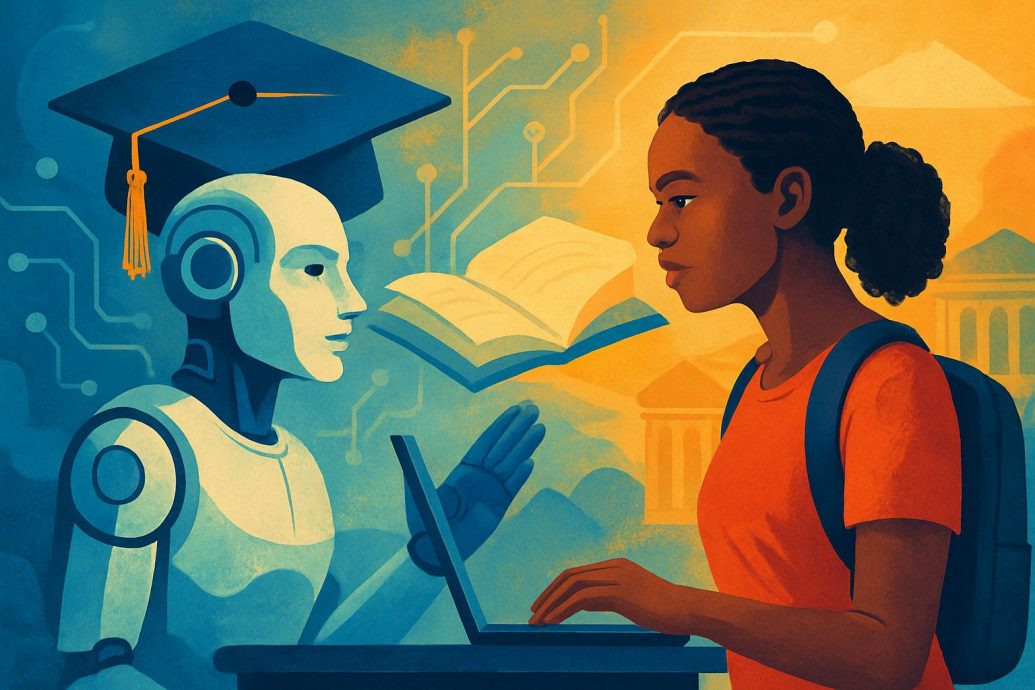
AI and the Future of Higher Education is no longer a distant possibility. It is already reshaping how universities teach, how students learn, and how institutions function. As artificial intelligence continues to advance, higher education stands at a defining moment. On one side, AI presents powerful tools for personalized learning, efficient administration, and facilitated research. On the other, it introduces ethical challenges concerning academic integrity, mentorship, and the fundamental principles of a liberal education. This article examines real-world applications, pressing issues, and philosophical debates surrounding AI in higher education while highlighting key considerations for responsible implementation.
Key Takeaways
- AI adoption is growing, with more than 50 percent of colleges and universities integrating it into teaching or administrative systems.
- Personalized education, automated grading, and adaptive coursework provide clear advantages. At the same time, academic fairness and student equality are major concerns.
- Experts agree that AI must support human interaction and not diminish the relationships at the core of liberal education.
- Ethical leadership, transparency, and inclusion are critical as institutions undergo this technological transition.
AI Adoption Rates in Higher Education: What the Data Shows
The 2023 EDUCAUSE Horizon Report found that over 55 percent of global higher education institutions are already using or piloting AI tools in advising, grading, instruction, or student services. The most rapidly advancing areas include:
- Learning analytics: Used by 61 percent of institutions to track and enhance student outcomes.
- Chatbots and virtual assistants: Implemented by 48 percent for basic student support and inquiries.
- Automated grading: Adopted by 36 percent to manage assessments more efficiently.
- Adaptive course delivery: Used by 29 percent for customized learning paths.
In the United States, the National Center for Education Statistics (NCES) recorded a 37 percent increase in funding for educational AI research from 2021 to 2022. Universities in Asia and Europe are also embracing AI partnerships with education technology firms, developing modular, AI-enhanced courses in both STEM and liberal arts. For a detailed explanation of this trend, see how AI is being used to change higher education.
The Benefits of AI in the University Setting
When carefully designed and implemented, educational AI systems provide a range of benefits tailored to meet the needs of an evolving academic environment:
- Individualized learning support: Tools such as Carnegie Learning and CogBooks tailor instruction in real time, improving student engagement and success.
- Administrative efficiency: Routine processes like transcript handling and admissions document review are automated, freeing up faculty and staff.
- Predictive academic advising: Institutions use analytics to identify students who may need support, improving retention and graduation rates.
- Enhanced accessibility: Language tools and real-time captioning improve access for multilingual and neurodiverse students.
According to McKinsey’s 2023 education forecast, AI could help higher education institutions save over $15 billion per year by improving operational efficiency and academic outcomes. These findings align with the goals explored in the role of artificial intelligence in education.
Risks and Ethical Concerns: Navigating Uncharted Terrain
AI brings significant promise, but not without risks that demand serious attention:
- Academic dishonesty: Generative tools such as ChatGPT can facilitate plagiarism if guidelines are not enforced.
- Reduced interpersonal interaction: Automated systems may replace valuable dialogue and mentorship in classroom settings.
- Bias and discrimination: If trained on skewed datasets, AI may reinforce existing disparities in admissions, grading, or financial aid decisions.
- Student privacy: Proctoring technologies that monitor test-taking behavior have raised concerns about surveillance and data handling.
A 2022 UNESCO report advised that institutions embedding AI into teaching and learning must prioritize ethical safeguards, student empowerment, and a commitment to institutional transparency.
Can AI Coexist with the Values of Liberal Education?
One of the most persistent issues in this discussion is whether AI can support the goals of a liberal arts education that emphasizes critical thinking, empathy, creativity, and civic responsibility.
Dr. Audrey Watters, a noted critic of edtech, argues that teaching students to analyze and critique AI is as vital as using it. “A university that embraces AI without challenging its assumptions or teaching students to do so is falling short,” she states.
Liberal arts colleges are experimenting with approaches such as:
- Using AI platforms to generate debate topics or structure collaborative work, not simply deliver answers.
- Embedding ethics discussions into STEM and humanities courses where AI integration occurs.
- Involving students in designing and evaluating AI systems as part of their academic research.
These methods help embed AI within a wider context of human-centered learning, a concept explored further in revolutionizing education with AI.
Student Perspectives: How Do Learners Experience AI in Classrooms?
While administrators determine policies, students offer firsthand experiences that reveal the actual impact of AI innovations:
- 66 percent use tools such as Grammarly, ChatGPT, or Jasper to support their coursework.
- 42 percent feel AI improves their understanding of difficult subjects.
- 29 percent worry it reduces their ability to think independently.
- Only 8 percent report receiving any formal education on ethical or effective AI use.
Focus group interviews reveal that most students value AI input when combined with faculty feedback. The key lies in balance, not in total automation.
Institutional Case Studies: Practical AI Applications Across Campuses
Stanford University: The institution’s Human-Centered AI initiative developed tools that assist with writing, offering real-time guidance on tone and structure without replacing authentic student work.
University of Singapore: AI-driven data analytics flag struggling engineering students early. These students receive peer mentorship, resulting in a 9 percent improvement in retention.
University of Edinburgh: Introduced interactive AI tutors in introductory mathematics courses. Student feedback improved significantly, with academic results holding steady.
Successful implementation often relies on interdisciplinary collaboration among educators, technologists, ethicists, and students. An approach like this reflects trends in how institutions are transforming education with AI technologies.
Diversity and Equity Considerations in AI Adoption
The advantages of AI may not be equitably distributed. Schools with limited resources struggle with older technology, insufficient training, or software that lacks inclusivity in its design.
The World Bank’s 2023 findings indicate that over 70 percent of AI advancements in education are taking place in high-income regions. This leaves behind communities that lack reliable internet access or representation in training data. Surveillance tools, in particular, have raised red flags about inequality and biased discipline.
To avoid deepening the digital divide, institutions should:
- Run equity reviews before launching new AI initiatives.
- Create transparent, open-source AI systems whenever possible.
- Make digital ethics and AI literacy part of the general curriculum.
- Engage with local communities to craft inclusive higher education policies.
Guidance for Educators: Evaluating AI Tools Responsibly
When deciding whether to use an AI tool, faculty and administrators should reflect on the following questions:
- Is this AI solution addressing a specific instructional or operational challenge?
- Has the tool been audited for bias, and does it reflect the populations we serve?
- Will this supplement relationships between teachers and students or replace them?
- Does this tool support our broader academic goals and mission?
Faculty can also explore the implications covered in AI in education shaping future classrooms to better understand the broader impact of these tools.
FAQs
What is the role of AI in higher education?
AI in higher education supports personalized learning, automated grading, student advising, research assistance, and administrative efficiency. Universities use AI tools to analyze student performance data, identify at-risk learners, and improve academic outcomes.
How will AI change universities in the future?
AI will reshape universities by automating administrative tasks, enhancing online learning platforms, and integrating adaptive learning systems. Institutions are also redesigning curricula to include AI literacy and emerging technology skills.
Can AI replace professors?
AI cannot replace professors because teaching requires mentorship, critical thinking guidance, and human interaction. AI can assist with grading, tutoring, and content generation, but human educators remain central to academic development.
How does AI personalize student learning?
AI systems analyze student performance, engagement patterns, and learning behaviors to deliver customized content and recommendations. Adaptive learning platforms adjust difficulty levels and resources based on individual progress.
Is AI being used for grading in universities?
Yes, AI tools are increasingly used to grade objective assignments, detect plagiarism, and provide feedback on written work. However, final evaluation and complex assessments typically involve human oversight.
How is AI impacting academic research?
AI accelerates research by analyzing large datasets, identifying patterns, generating hypotheses, and automating literature reviews. It supports disciplines ranging from medicine and engineering to social sciences and humanities.
What are the risks of AI in higher education?
Risks include academic integrity concerns, data privacy issues, algorithmic bias, and over-reliance on automated systems. Universities must establish governance policies and ethical guidelines to manage these challenges.
Will AI increase or decrease tuition costs?
AI may reduce operational costs through automation, but tuition outcomes depend on institutional policies, infrastructure investment, and market demand. Cost savings are not automatically passed on to students.
How does AI affect academic integrity?
AI tools can both challenge and support academic integrity. While generative AI may facilitate plagiarism, detection systems and revised assessment strategies are evolving to maintain standards.
Are universities teaching students how to use AI responsibly?
Many universities are integrating AI ethics, responsible use policies, and digital literacy programs into curricula. Institutions aim to prepare students for AI-driven workplaces while addressing ethical implications.
What skills will students need in an AI-driven workforce?
Students will need analytical thinking, digital literacy, adaptability, creativity, and the ability to collaborate with AI systems. Technical fluency combined with critical reasoning will be highly valued.
Is AI widening educational inequality?
AI can either widen or reduce inequality depending on access. Institutions with advanced infrastructure may gain advantages, while limited access to AI tools can deepen gaps unless equitable deployment strategies are implemented.
How are universities protecting student data when using AI?
Universities implement data governance frameworks, encryption standards, and compliance measures to protect student information. Many institutions review vendor contracts carefully to ensure privacy protections.
Will AI transform online education?
Yes, AI is enhancing online education through adaptive learning systems, real-time feedback, virtual tutoring, and intelligent course design. These innovations improve engagement and completion rates.
What is the future of AI in higher education?
The future of AI in higher education involves deeper integration into teaching, research, and administration. Universities will likely adopt hybrid models that combine human expertise with intelligent automation to enhance learning outcomes and operational efficiency.