
Introduction
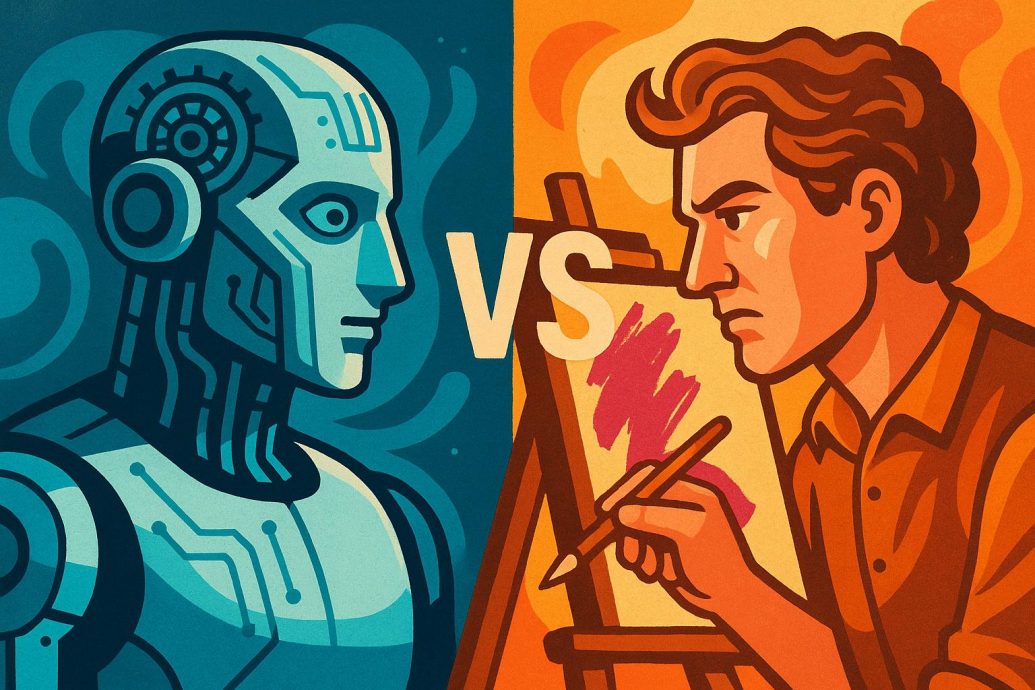
AI vs. Human Creativity: Who Leads? This pivotal question sits at the center of a rapidly evolving debate involving artists, technologists, and ethicists. As AI models like GPT-4, DALL·E, and MusicLM redefine content creation, claims from robotics firms are stirring both excitement and skepticism. Are machines on the verge of toppling human artistry? Or is true creativity rooted in emotion, lived experience, and cultural context, remaining irreplaceably human? This article provides a critical and nuanced exploration of AI-generated art, music, and literature, compared to the depth and originality of human expression.
Key Takeaways
- Generative AI can replicate creative patterns but lacks emotion, intention, and context necessary for true originality.
- Human creativity is grounded in life experience, emotional depth, and cultural memory, which AI does not possess.
- Current AI models are assistive tools that can enhance, but not replace, human-driven artistic innovation.
- Experts and research point to collaboration, not replacement, as the future of AI in creative industries.
AI’s Creative Capabilities: What Are Machines Actually Doing?
Recent excitement surrounding AI’s creative potential stems largely from its impressive and sometimes surprising outputs. OpenAI’s DALL·E creates striking visual designs from simple text inputs. Google’s MusicLM generates music compositions based on emotional tone or style. GPT-4 crafts stories, scripts, and essays quickly and convincingly. These tools have rapidly entered the workflows of designers, advertisers, and content creators, changing how ideas take shape.
Despite these breakthroughs, AI tools do not generate ideas from internal insight. They are trained on enormous collections of existing text, images, and sounds. From this training, AI identifies patterns and rearranges elements to produce new content. What appears imaginative is really a sophisticated form of pattern recognition and reconstruction.
This is a critical distinction. While AI generates outputs that can mimic human styles, it does not understand the emotions or intentions that underlie them. A digital painting from DALL·E might mirror the style of Van Gogh, but it lacks the pain, nostalgia, or joy a human might embed. For true art, connection arises not from polish but from raw human experience and authenticity.
Headlines vs. Reality: AI’s Place in Creative Dominance
In 2023, humanoid robots appeared at a United Nations AI summit and confidently stated they could outperform humans in creativity. Developers praised these remarks to illustrate progress in natural language processing and symbolic reasoning. Still, scientists and researchers responded with criticism and caution.
Marcus du Sautoy, author of The Creativity Code, explains that while AI can simulate structure and form, it lacks a self-aware origin for new ideas. Neuroscientist Dr. Anil Seth adds that human creativity emerges from consciousness, senses, and memory. Machines cannot replicate this internal reality.
Bold claims about AI overtaking human creativity often serve media attention or funding growth. These statements overlook the intense personal, cultural, and psychological elements in human-made art. They promote capabilities that do not yet reflect the deeper dimensions of expression and meaning.
AI vs Human Creativity: A Comparative Breakdown
| Creative Field | AI Capabilities | Human Capabilities |
|---|---|---|
| Visual Art | Image generation based on text or style prompts using models like DALL·E | Expression derived from training, intuition, life experiences, and emotional response |
| Music | Generates new audio based on learned genre models (e.g., MusicLM) | Composes from cultural influence, emotion, improvisation, and social feedback |
| Literature | Language generation tools produce poems, articles, fiction using GPT-4-style modeling | Writes based on perspective, lived memory, morals, cultural history |
What AI Lacks: Emotion, Context, and Self-Awareness
Generative AI tools, regardless of complexity, do not have personal identities. They do not feel trauma, celebrate justice, or contemplate beauty. Their outputs can seem clever or relevant, but they are created without knowledge of meaning or significance. AI acts on instructions and data, not on introspection.
Human creativity thrives on growth, contradiction, memory, and identity. It allows artists to evolve through pain, reflect on change, and speak to social movements. AI outputs are technically pleasing replicas, but they lack the inner tension or awareness that defines landmark work in every creative field.
For example, a poem written by ChatGPT in the style of Sylvia Plath may replicate tone and format, but it cannot convey the intricacies of mental anguish or empowerment that shaped Plath’s voice. The absence of experience always affects the output, regardless of statistical fluency.
Humans Using AI: A New Creative Partnership
While AI does not originate creativity, it offers value when integrated thoughtfully into the creative process. Many creators now use it as a brainstorming or drafting companion. Writers use language models to explore structure or phrasing. Visual artists use models like Midjourney to explore early concepts or textures before beginning manual refinement.
Digital artist Sofia Crespo creates intricate biological forms with AI, treating the model like an algorithmic sketchbook. Composer Holly Herndon blends her voice with machine learning techniques, yielding hybrid musical expressions. These practices show how AI can act as a collaborator, not a replacement.
As explored in this analysis of challenging AI and embracing human creativity, the key lies in humans retaining control over creative choices, while still gaining efficiency and new inspiration through machine tools.
Ethics, Ownership, and the Future of Creative Professions
The rise of generative AI introduces major ethical challenges. When a model is trained on thousands of copyrighted images or stories, questions of authorship, theft, and fairness emerge. Who receives credit for a digital painting influenced by unknown artists? Who legally owns a song created using AI voices and samples?
Currently, the U.S. Copyright Office does not recognize machine-generated works as eligible for protection. Human involvement, even minimal, is required for legal safeguard. This standard reinforces the idea that authorship remains a human function, not a machine one.
Creative industries are also shifting. Entry-level roles like junior illustrators and media editors are increasingly automated. At the same time, new careers such as AI creative directors, machine learning interpreters, and digital protection advocates are emerging as crucial contributors.
As discussed in an analysis of AI’s threat to artists, these changes reflect both opportunity and risk. It is a pivotal moment to redefine how art is made and shared, while ensuring ethics and fairness guide innovation.
FAQs
Can AI truly be creative or is it just mimicking human output?
AI mimics human creativity by reproducing patterns found in its training data. It does not invent from experience or intent. Therefore, its “creativity” is derivative, not original in emotional or cultural terms.
What makes human creativity different from artificial intelligence?
Human creativity connects emotion, context, memory, and self-reflection. AI lacks personal experience or emotional reasoning, making its creative processes limited to imitation grounded in statistical modeling.
Which creative fields are most affected by AI?
Design, writing, music production, and video editing are integrating AI rapidly. Still, storytelling, political satire, and emotionally dense art forms heavily rely on human intuition and are less susceptible to full automation.
Are machines capable of producing original art, music, or stories?
What seems original from AI is statistically novel but not emotionally or consciously crafted. True originality, as typically defined by legal and artistic standards, requires awareness, experience, and purpose.
Conclusion: Augmentation, Not Elimination
AI is not replacing human creativity. It is transforming how we imagine and execute ideas. Machine learning models do not independently feel or think. Instead, they enhance workflows and challenge traditional methods by offering new perspectives and tools.
Still, people remain the source of meaning and vision. From personal stories to collective struggles, human creativity reflects something irreplaceable. As discussed in this piece on redefining art with generative AI, the most promising path forward is collaboration, not competition.