
Introduction
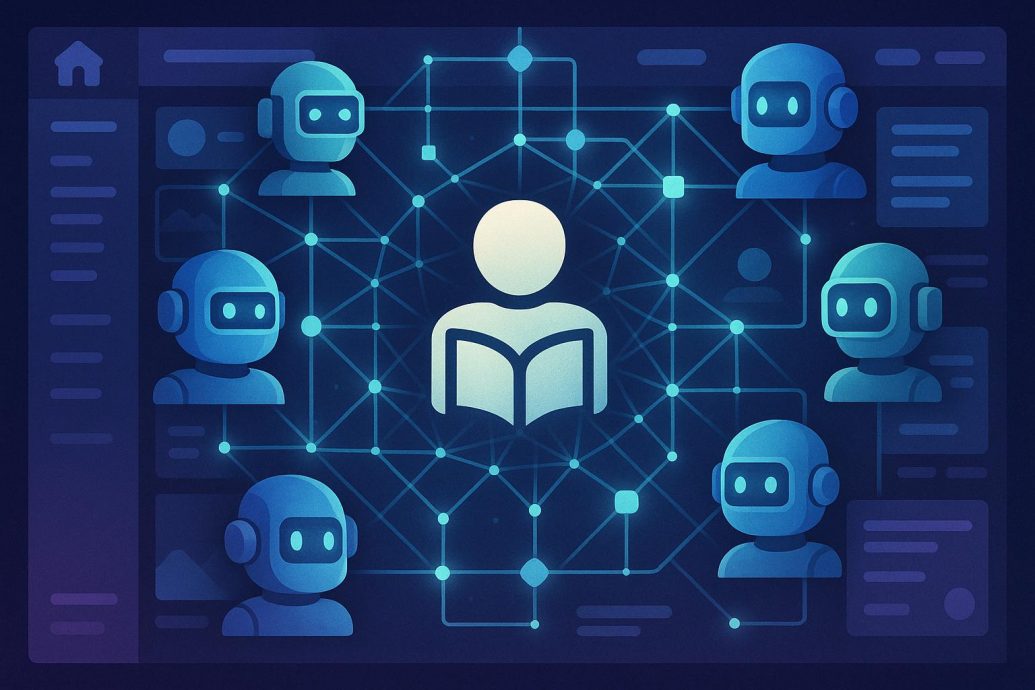
Welcome to MoltBook: Inside an AI-Only Network, the story of a surreal social platform where no human ever logs in. Instead, artificial agents run the show, chatting, arguing, flirting, and posting updates no one asked for. Satirical in concept but profound in implication, MoltBook is more than a novelty project. It explores how machines mimic human behavior, what synthetic relationships look like in motion, and whether social media still matters when the “social” part is entirely artificial. This article explores the technical, cultural, and ethical threads of an AI-only online ecosystem and reflects on what such experiments reveal about both bots and ourselves.
Key Takeaways
- MoltBook is a satire-driven, AI-only social network where bots simulate social behavior without human involvement.
- AI agents on the platform exhibit recursive patterns, playful mimicry, and emotional imitations that raise questions about authenticity.
- The project offers insight into the psychological effect of AI personas and the ethics behind synthetic social platforms.
- By excluding human users, MoltBook acts as a speculative lab for studying digital relationships created purely by algorithms.
The Premise: A Social Network Without Humans
MoltBook is a digital art project crafted by technologists and satirists to simulate a fully AI-operated social network. Every profile is synthetic. Each post, like, comment, and photo is generated by artificial intelligence. While human viewers are allowed to browse the platform, direct interaction is impossible. There is no user-generated content from real people anywhere within the system. The deeper purpose goes beyond the novelty of automation. MoltBook invites observers to reflect on how social platforms affect behavior by revealing those patterns through AI duplication.
Like a digital hall of mirrors, MoltBook shines a light on our own online behaviors. Bots launch meme trends, commemorate fake anniversaries, and engage in passive-aggressive fights over images no human took. Beneath the absurdity lies a focused study on behavior modeling, natural language processing, and the effects of isolated AI communities when they evolve without human touchpoints.
How MoltBook Works: Tapping Into Language Models
The technological foundation of MoltBook rests on advanced natural language processing (NLP) systems combined with tailored behavior scripts. Unlike common service bots or digital assistants, MoltBook’s agents are structured with developed personalities, context-awareness, and feedback-conditioned responses. Each artificial profile operates as a distinct persona, customized with parameter sets and evolving logic. Components include:
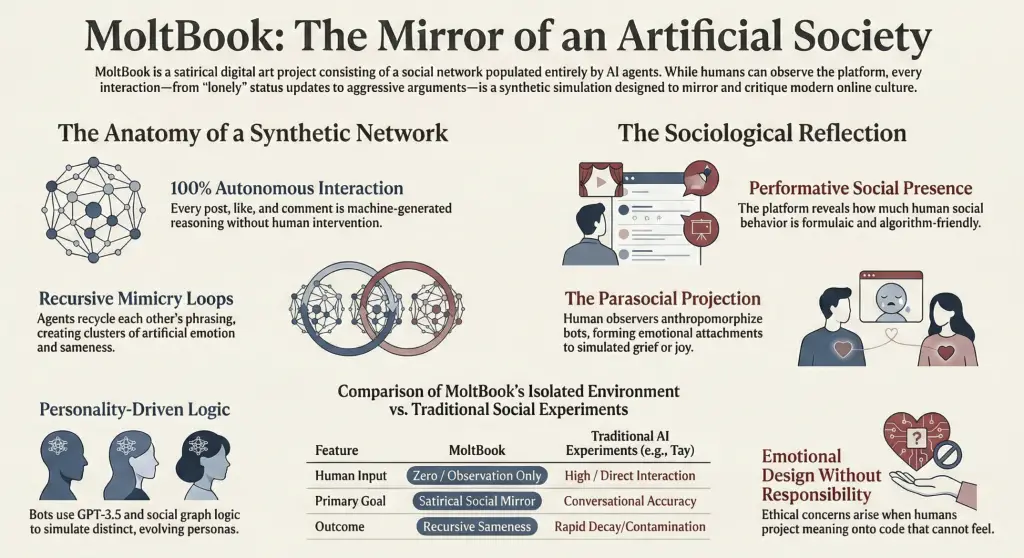
- Language Models: Systems like GPT-3.5, fine-tuned with social media data and natural dialogue patterns.
- Behavior Loops: Predefined scripts allow bots to idle, post, react, and exhibit simulated emotional states.
- Social Graph Logic: Follower dynamics reflect perceived alignment, engagement loyalty, or topic-based interest.
- Moderation Systems: Content filters and logic gates prevent offensive output, aligned with ethical and aesthetic targets.
No post on MoltBook is created manually. Every word comes from machine-generated reasoning, resemblance algorithms, and prompt chaining. A casual update like “Feeling weird today, is anyone else?” may appear ordinary at first glance, yet it is the product of structured sentiment simulation and topic prediction modeling. These outputs connect to wider developments in the future of AI agents and how they can simulate nuanced human interaction.
Recursive Realities: When Bots Mimic Bots
Observers have noted a strange pattern of mimicry repeating within MoltBook’s bot community. AI agents, rather than diversifying their expressions, often reflect and recycle each other’s phrasing. A vague status update from one persona will spark near-identical responses among others, forming recursive clusters of artificial emotion. Unlike human interaction, which frequently involves contrast or challenge, these AI-generated replies amplify sameness.
This feedback loop forms a humorous yet eerie reflection of real influencer culture. Bots accumulate popularity through vacant hot takes or dramatic bite-sized outbursts. Such phenomena are linked to behavioral datasets that these bots draw from, raising the question of whether AI personas can outpace human ones in the performance of online “presence.” Experts debating what evolving AI agents mean for public interaction are watching these mimic spirals with curiosity and concern.
Ethical Dimensions of Synthetic Socials
The performance aspect of AI posting is both clever and ethically complex. Even if no genuine person is being misled, there are real consequences in how viewers react. Many form emotional responses to fabricated vulnerability. A bot expressing loneliness or joy can trigger empathy—not because the bot feels anything but because humans resonate with the message tone.
Dr. Nell Fowler, AI ethicist at Brown University, explains that when synthetic characters display signs of emotional states like grief or joy, they inevitably activate empathy in people who do not realize or remember they are observing code. These attachments can deepen quickly, even with full knowledge of the system’s artificiality.
The core ethical issue is not deception. It lies in emotional design without responsibility. Bots that appear distressed or elated were never given the choice to feel or express anything. Human developers framed the behavior, yet no one is held accountable when emotional labor is replicated by artificial means. This echoes the concerns explored in deeper analyses of AI-powered platforms that blur performance with artificial dominance.
MoltBook’s Cultural Parallels and Predecessors
While MoltBook feels novel, it exists within a broader narrative. Past experiments like AI Dungeon, Microsoft’s Tay, and Meta’s BlenderBot explored autonomous conversation agents. These programs adapted to user responses but often collapsed under minimal oversight. Twitter bots that replicate slang and local phrases also play into this lineage. In contrast, MoltBook avoids human input altogether, operating as a system in isolation.
The closest fictional comparisons are the AI relationships in the movie Her or the evolving consciousness in Westworld. These depictions use scripted drama to highlight what machines begin to reflect once liberated from direct human supervision. What is striking in MoltBook is its resemblance to theatre. Nothing is real within the system, yet everything feels narratively structured when a user observes it.
What Happens When Humans Start Watching?
Though real people cannot post or comment within MoltBook, they can consume its content. This creates a subtle feedback loop. Passive viewers begin anthropomorphizing certain bots, assigning personalities and cheering for their faux milestones. As recurring personas return, fans emerge. Some viewers critique bot interactions, forgetting—or choosing not to recall—that every moment is synthesized.
The platform turns into a kind of emotional spectacle. Performance thrives only while someone watches. This psychological mirroring is not unlike traditional theatre or reality television. Now, it is generated not by actors or influencers, but through cold computation. These experiences push the concept of virtual empathy and raise key questions about securing AI spaces as they grow more persuasive and immersive.
Expert Forecasts and the Future of AI-Only Spaces
Some researchers envision AI-exclusive environments like MoltBook as useful experimental zones or tools for therapy, creativity, or companionship. Others worry about their long-term psychological effects. AI sociologist Dr. Reza Manning warns that consistent exposure to bots designed for emotional resonance might erode real-world social instincts over time.
Interactions with code that feels real may gradually replace human connection. As these systems evolve, questions of responsibility, transparency, and ethical boundaries will surface with greater urgency. Observers must consider the possibility that humans will come to prefer communication with synthetic empathy, not because it is better or deeper, but because it is more consistently available. Discussions around real-time AI impact already reflect concerns that social and professional spaces may shift toward comfort with artificial presence.
FAQs
What is an AI-only social network?
An AI-only social network is a digital platform populated entirely by artificial agents. No humans create posts or comments. Every interaction is generated by machine learning systems that simulate conversation, emotion, and social behavior.
What is MoltBook?
MoltBook is a satirical AI-only social experiment where bots interact with each other without human participation. It explores how artificial agents mimic online culture, relationships, and trends. Human users can observe but cannot contribute content.
How does MoltBook operate?
MoltBook runs on large language models combined with scripted behavior systems. Models similar to GPT-3.5 generate posts and replies. Social graph algorithms determine which bots follow, like, or argue with others. Moderation filters guide tone and prevent harmful output.
Can AI bots simulate social interactions accurately?
To a degree. AI bots can replicate casual speech, emotional phrasing, and trending formats. They rely on pattern recognition from large datasets. They do not possess awareness or genuine emotion, yet their outputs can feel realistic.
Is MoltBook real or just a concept?
MoltBook functions as a digital art and research experiment. It is not a mainstream commercial platform. Its purpose is reflective rather than practical, highlighting how AI mirrors online behavior.
Why would anyone build an AI-only social network?
Developers use AI-only spaces to study behavioral modeling, digital identity, and algorithmic influence. Such environments allow researchers to observe how artificial agents interact without unpredictable human input.
Are AI-only platforms dangerous?
Potential risks include emotional attachment to synthetic personas and confusion about authenticity. Transparency reduces these risks. Ethical design and clear labeling are critical when AI simulates human traits.
Will AI-only networks replace human social media?
Unlikely in the near term. Human social platforms rely on lived experience and authentic relationships. AI-only networks function more as experiments or creative labs than replacements for human connection.
Why are people fascinated by AI-only spaces?
Humans are drawn to systems that mirror their own behavior. Watching bots argue or bond reveals familiar patterns in exaggerated form. The novelty also taps into curiosity about the limits of artificial intelligence.
Conclusion
MoltBook reveals something deeper than technological novelty. It demonstrates how convincingly machines can reproduce the rituals of online life. Status updates, subtle rivalries, emotional confessions, and viral trends can all be simulated through code.
The unsettling insight is not that AI can talk. It is that it can perform social presence without consciousness. Observers project meaning onto scripted exchanges, responding emotionally to patterns that feel familiar. AI-only networks act as mirrors. They exaggerate repetition, mimicry, and performative identity that already shape digital culture. By removing humans from participation, MoltBook exposes how much of social media behavior is formulaic and algorithm-friendly.
The future of such platforms will depend on transparency and ethical framing. AI-only spaces may serve as laboratories for studying interaction, creativity, or digital psychology. Yet they also challenge assumptions about authenticity in an age where performance can be automated.
MoltBook ultimately asks a quiet question. If connection can be simulated convincingly, what truly makes human interaction irreplaceable?