
Introduction
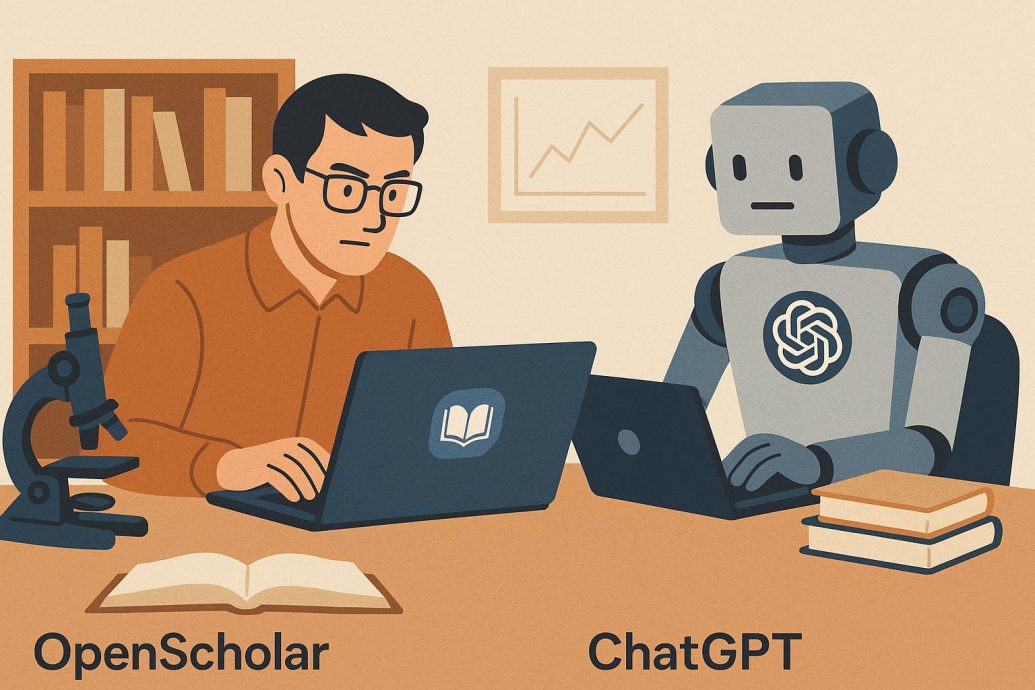
OpenScholar outperforms ChatGPT in research, and this success is not just a matter of perception. As scientific publishing accelerates at an unmatched pace, researchers are under pressure to find accurate and relevant literature quickly. Artificial intelligence is now central to how experts collect, summarize, and interpret knowledge. Within this landscape, OpenScholar stands out as a dedicated research assistant designed for high performance in academic tasks. Unlike general models such as ChatGPT, OpenScholar offers greater accuracy, depth, and subject-matter understanding. This contrasts with the broader, less focused capabilities of general-purpose AI models that often fall short in technical domains.
Key Takeaways
- OpenScholar is a specialized AI tool built for scientific literature search, especially in biomedical contexts.
- It was tested with 30 targeted queries and outperformed ChatGPT and five other language models in accuracy, completeness, and relevance.
- The system uses Retrieval-Augmented Generation and includes access to peer-reviewed content.
- It simplifies academic workflows by saving time on literature reviews, summarization, and citation searches.
What Is OpenScholar?
OpenScholar is an AI-driven assistant developed to support researchers, scientists, and healthcare professionals in finding reliable academic literature. Unlike models trained on broad datasets, this tool is designed to operate within technical and specialized fields, particularly biology and medicine.
Its core architecture uses Retrieval-Augmented Generation (RAG). This method allows it to first identify relevant documents from trusted databases like PubMed, Semantic Scholar, and arXiv. It then crafts responses based on the content of those credible sources. Each output includes citations, so users can verify the material being presented.
The training set is almost entirely based on peer-reviewed articles. This increases the scientific quality and detail of the model’s answers. In contrast, more generalized tools like ChatGPT rely on data that include less reliable content.
The Evaluation Study: AI vs Human Judgment in Scientific Search
Researchers conducted a comparison between OpenScholar and other AI tools to measure performance in academic literature search. The test involved 30 unique scientific questions that required detailed answers backed by citations. These questions covered a wide range of biomedical topics meant to challenge each model’s scientific reasoning.
Human evaluators with domain expertise judged the output of each model. The evaluation focused on three areas:
- Accuracy: Did the response provide correct and fact-based information?
- Relevance: Did the answer stay focused on the main topic of the query?
- Completeness: Were major findings and perspectives included in the response?
OpenScholar consistently received the highest scores. ChatGPT often included vague explanations and incorrect or fabricated sources. Tools like Elicit and Galactica did better on technical queries but were less consistent. These results align with broader trends discussed in the role of AI in scientific research, where specialized tools outperform general models in high-stakes environments.
Why OpenScholar Outperforms General-Purpose LLMs
The success of OpenScholar stems from its focused development and architecture. Many large language models, including ChatGPT, are trained on open internet data, which includes both useful and low-integrity sources. OpenScholar avoids this issue by focusing only on scientific literature.
Three specific advantages set OpenScholar apart:
- Expert training data: It uses validated, peer-reviewed sources for learning rather than general internet content.
- Integrated document retrieval: Before generating text, the system surveys academic databases and selects the most relevant materials.
- Citation-based output: Responses include linked references, giving users confidence in verification and further reading.
These design choices allow the model to meet the expectations of academic users with greater accuracy and trustworthiness. This level of domain-fit is why some call OpenScholar the AI platform that outshines OpenAI in research work.
How It Compares to Other Tools
Here is how OpenScholar performs against other commonly used language models for research:
| Tool | Precision | Recall | Coverage of Sources | Citation Support | User Interface |
|---|---|---|---|---|---|
| OpenScholar | High | High | Peer-reviewed only | Yes | Designed for researchers |
| ChatGPT | Medium | Medium | Web-scale, general | No (or inaccurate) | General-purpose |
| Elicit | Medium | Medium | Academic databases | Partial | Research-friendly |
| Perplexity | Low | Low | Mixed | No | Web chat interface |
| Galactica | Medium | Medium | Science-focused | Unreliable | Experimental |
Use Cases for OpenScholar
OpenScholar helps streamline multiple aspects of academic research. Examples include:
Improved Literature Review
It allows users to quickly gather summaries and highlights from large volumes of articles for framing hypotheses or establishing background information.
Meta-Analysis and Reviews
Researchers conducting systematic reviews can benefit from credible and organized data extracts supported by citations.
Academic Writing Assistance
OpenScholar contributes to writing processes by offering precise and sourced content blocks for use in various parts of scientific papers.
Support for Grant Proposals
The tool simplifies the preparation of funding applications by presenting field-specific summaries and reference lists aligned with research goals.
Compared to more generalized tools, OpenScholar provides focused assistance. Its advantages build on the foundation seen in systems like OpenAI’s science-focused AI models, with coverage and precision essential for peer-reviewed environments.
Drawbacks & Limitations
OpenScholar’s design makes it highly capable in science-based contexts, but it is not without restrictions:
- Field-specific scope: Its output is strong in medical and life sciences but less robust in other disciplines such as humanities or law.
- Limited public access: During its beta phase, availability is restricted to selected academic groups.
- Database reach: Some niche or less commonly indexed journals may fall outside its coverage.
- Bias concern: Historical coverage patterns may introduce bias into the model’s training data, an issue shared across most AI tools.
What This Means for Researchers
For students, academics, and professionals, accuracy and transparency remain vital in publishing and applied research. General AI tools such as ChatGPT do not consistently meet these requirements. OpenScholar brings academic workflows new tools shaped specifically for science-driven environments. Its preference for citations and authority-based training offers a robust alternative.
Institutions looking to scale research output may achieve higher productivity by implementing such focused AI. These trends are also visible in cases where OpenAI integrates search tools into ChatGPT to compete with models like OpenScholar. As AI continues to evolve, the distinction between a capable human researcher and AI assistant continues to narrow, provided that transparency and trust are built into the system.