
Introduction
A revolutionary AI-Generated 3D-Printed Shoe landed in stores when Reebok co-founder Joe Foster backed Syntilay, which launched a slide in early 2025 designed by generative algorithms. The footwear industry is on track to top USD 442.3 billion by 2030 per Grand View Research, yet overproduction and returns still waste billions each year. Generative design and additive manufacturing offer a measurable path out of that waste by printing a shoe only after a buyer orders one. This guide walks through how an AI model sketches a shoe, how a 3D printer builds it, and which brands have already brought this manufacturing model to paying customers. The reporting leans on primary sources, filed patents, and vendor documentation rather than press release summaries. Readers will finish with a working mental model of the pipeline, the materials, the economics, and the open risks of printed footwear. Every example and claim below points to its exact source so the reader can verify what is real and what is still experimental.
Quick Answers on AI-Generated 3D-Printed Shoes
What is an AI-generated 3D-printed shoe?
An AI-generated 3D-printed shoe is a one-piece sneaker or slide whose geometry is produced by a generative design algorithm and then manufactured on an additive printer without conventional cut-and-sew assembly.
Which brand shipped the first AI-designed, 3D-printed consumer shoe?
Syntilay, backed by Reebok co-founder Joe Foster, began shipping its generative slide in January 2025, with Zellerfeld printing each order to the buyer’s specifications.
Can a printed shoe really be recycled?
Yes, a single-material thermoplastic shoe can be shredded and reprinted into a new pair, though independent lifecycle audits of end-to-end claims remain limited in 2026.
Key Takeaways on AI-Generated Footwear
- Generative design software now sketches a shoe from a pressure map, a weight target, and a style brief, moving from prompt to printable part in hours rather than weeks of traditional prototyping.
- On-demand printing eliminates cut-and-sew labor and the inventory risk that pushes retailers to discount or destroy unsold stock each season.
- Independent fit, durability, and recyclability data for printed footwear is still thin, so sustainability claims deserve the same scrutiny as any other new category.
- Biometric foot-scan data becomes a privacy question once a brand retains it, because the scan is as identifying as a fingerprint for returns, warranty, and marketing use.
Table of contents
- Introduction
- Quick Answers on AI-Generated 3D-Printed Shoes
- Key Takeaways on AI-Generated Footwear
- Understanding an AI-Generated 3D-Printed Shoe
- How Generative Algorithms Shape the Modern Sneaker
- Implementing the Design Pipeline from Scan to Printed Part
- The Materials Rewriting What a Shoe Can Be Made From
- Where Foot Scanning and AI Meet to Build Personal Fit
- Printing Methods Driving Mainstream Adoption
- Economics of On-Demand Footwear Manufacturing
- Sustainability Claims and the Reality of Circular Footwear
- Performance Testing Printed Shoes Against Traditional Ones
- Accessibility Gains for Wearers Outside the Average Size Grade
- Intellectual Property, Design Ownership, and Generative Outputs
- Risks and Open Questions in AI-Generated Footwear
- Ethics of Biometric Foot Data in Consumer Shoes
- Key Insights on AI-Generated 3D-Printed Shoes
- Real-World Examples from Brands Shipping Printed Shoes Today
- Case Studies on How AI-Designed Footwear Reached Buyers
- The Future of AI-Designed Footwear
- Frequently Asked Questions on AI-Generated 3D-Printed Shoes
Understanding an AI-Generated 3D-Printed Shoe
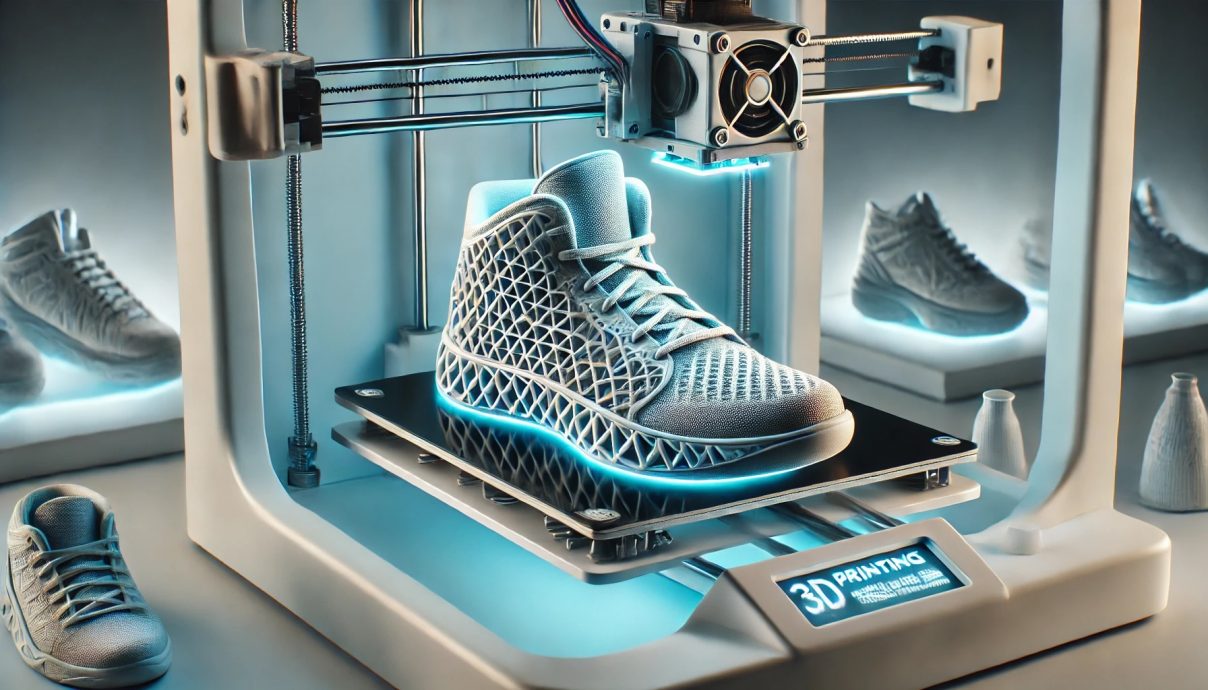
An AI-generated 3D-printed shoe is footwear whose upper and midsole geometry is created by a generative algorithm from fit, weight, and stiffness constraints, then manufactured as a single additive-printed part on a connected 3D printer.
Interactive explorer
Model a generative lattice shoe before it prints
Tune the inputs a generative shoe pipeline uses. The outputs reflect how a printed lattice responds.
70
420
Daily walking
Generated lattice profile
Approximate values from a simplified generative model. Real pipelines ingest full pressure maps and run FEA before committing a print.
How Generative Algorithms Shape the Modern Sneaker
Traditional shoe design begins with a paper sketch, an upper pattern cut on a last, and a midsole tooled in steel before any wearer ever tries it. Generative design inverts that order by starting with the performance targets a shoe must meet, then letting an algorithm search the geometry space for a shape that satisfies them. The result is a lattice midsole or a woven upper that no human would have drawn by hand yet weighs less and absorbs more energy. The algorithm becomes the designer and the human becomes the editor who approves or rejects the proposed geometry for each new release. The pattern echoes other self-designing generative machines that reshape engineering workflows across sectors. Nike’s filed US patent on variable-stiffness lattice structures built from a wearer’s foot pressure map now serves as a template for the whole category.
Building on that algorithmic shift, the inputs a designer provides look nothing like a sketchbook page in the old cut-and-sew sense. A generative tool wants numeric targets for weight, cushioning, heel-to-toe drop, stiffness gradient, and total material volume. It also accepts voxelized scan data showing where a wearer bears the most force while walking or running. Once the brief is set, the software iterates thousands of candidate shapes, scoring each against the brief and keeping the most promising ones. Engineers often cull the top ten proposals from the batch and run finite element simulations before choosing a winner.
Shifting focus to real-world tooling, the leading generative platforms today include nTopology, Autodesk Fusion generative, and Hilos Studio OS. Each handles the geometry generation, but only a few couple directly to a 3D printer and a connected material library. Hilos positioned Studio OS as an operating layer for on-demand footwear, pairing generative outputs with a connected production queue. Brands using these tools report design cycles dropping from months to days once the pipeline is stable in production. That compression is what makes a printed sneaker viable at scale rather than as a stunt project.
Implementing the Design Pipeline from Scan to Printed Part
Looking at the end-to-end implementation flow of a printed sneaker, the pipeline begins the moment a customer scans their foot. A smartphone camera, a structured-light sensor, or a pressure plate captures a point cloud and a step-force map of the wearer. That raw data is cleaned, aligned to a reference last, and converted into a volumetric mesh the generative tool can consume. The scan is what makes the shoe truly bespoke rather than a cosmetic customization of an existing SKU. This implementation step is the gateway between consumer input and the generative pipeline that follows.
Once the foot data lands in the pipeline, the generative engine takes the scan and the style brief and proposes a candidate lattice. Designers at Fitasy explained their smartphone-driven fit workflow for the Stride sneaker as a three-minute scan followed by an automated geometry pass. Human review happens at the lattice stage, where an engineer trims or thickens zones to match brand feel and durability targets for the production part. The approved geometry is then sliced into printer-ready instructions, including support structures where the shoe would otherwise sag mid-print. The slicer output is uploaded to a connected print farm for batching and scheduling across available machines.
Turning to the physical build, printing a single shoe takes between forty minutes and several hours depending on the technology and the lattice density. Most consumer printed shoes use selective laser sintering, high-speed fused filament fabrication, or Carbon’s Digital Light Synthesis for midsoles. The printer builds the shoe one voxel-thin layer at a time, fusing material with heat or ultraviolet light. After the print finishes, the shoe cools in a controlled chamber to avoid warpage before it is removed from the build plate. A post-processing station cleans away loose powder or support material and smooths the outer skin of the shoe. These implementation steps are tightly sequenced to keep the print quality reliable from one batch to the next.
Beyond the print itself, quality control closes the loop before a shoe ships to a buyer. A camera rig photographs each shoe from six angles and compares the images against the approved design file, flagging any warpage or layer skip. A weighing station checks the shoe is within a gram or two of the target weight, a proxy for correct lattice density across the build. Only then does the shoe get laser-etched with a serial number and matched to the customer order for packing. Failed units are shredded on site and the reclaimed material enters the next print batch where the printer and material support that loop.
The Materials Rewriting What a Shoe Can Be Made From
Stepping back from workflow to feedstock, the material a printed shoe is made from decides nearly every property that matters to a wearer. Thermoplastic polyurethane dominates the category because it stretches enough to feel like a conventional upper yet prints reliably on consumer-grade machines in production. A single-material shoe is also the simplest path to genuine recyclability because mixed materials jam the shredders that reclaim worn pairs into fresh feedstock. Zellerfeld, the printer behind Syntilay and several designer collaborations, makes all its shoes from one TPU grade, a decision the company describes in its published material note for buyers. Other brands are experimenting with bio-based polymers, polyether block amides, and engineered composites to tune hand feel and resilience further.
Beyond the polymer choice, printed shoes bend the rules on what a shoe can even look like in production. A lattice midsole has no solid rubber cup, yet it absorbs and returns energy differently in each zone by tuning the strut thickness. An upper can be printed with varying porosity to breathe where a foot sweats and hold firm where lacing would normally sit. These capabilities echo how new lightweight 3D printing materials keep expanding the design envelope for additive products. The design freedom only matters when the material and the printer are matched for the loads a shoe actually sees in daily wear.
Beyond polyurethane, specialty polymers are opening new performance envelopes for the AI-Generated 3D-Printed Shoe category each year. Polyether block amide offers higher rebound and cold weather flexibility that pure TPU cannot match in a single-material print. Co-printed composites now add fiber reinforcement in high-stress zones so the lattice carries load without adding weight. Material scientists are also testing bio-based polyurethanes derived from castor oil and sugarcane feedstocks for brands that want lower-carbon inputs. The practical limitation is that each new material requires revalidation across the full printer stack, the slicer software, and the post-processing line. Brands typically pilot one new polymer per year rather than switching their entire material library wholesale.
Where Foot Scanning and AI Meet to Build Personal Fit
Turning to the fit question, personalized footwear has existed for a century in orthotics clinics and bespoke bootmakers, but it has always been slow and expensive. Smartphone-based scanning dropped the capture cost from hundreds of dollars to zero at the point of sale for most buyers. Brands now ask buyers to pan a phone camera around each foot while a model reconstructs a three-dimensional mesh in real time on device. The accuracy is within one or two millimeters, enough to size the shoe and position the stiffness map correctly. This step is where consumer input meets the generative engine for every printed pair.
Building on that capture step, the AI layer interprets the raw mesh and infers features that matter for fit. The model identifies the arch height, the forefoot width, the heel pocket shape, and any pressure-bearing anomalies in the wearer’s gait. These features feed directly into the generative engine, which thickens the lattice under pressure zones and thins it where the foot is unloaded. The shoe that comes out is not simply the wearer’s size, it is the wearer’s shape expressed in printed material for a true bespoke fit. Nike’s patent portfolio treats pressure-map-driven footwear customization as a core method for its generative work.
Shifting to a broader view, scanning accuracy is still uneven across devices, lighting conditions, and user technique in real-world usage. A poor scan produces a poor fit, so brands build in confidence scoring and ask for a rescan when the model is uncertain about the data. Some pair the scan with questions about running style, injury history, and preferred cushioning for a complete profile. The combined signal shapes a stiffness profile that off-the-shelf generic shoes simply cannot match for an individual wearer. Research into this approach parallels broader work on wearables fed by biometric data for everyday health monitoring.
Beyond the scan itself, data hygiene becomes a quiet engineering problem in every mature pipeline. Brands retain each scan under a reference identifier so the shoe can be reprinted to the same geometry months later. Clean versioning prevents a slicer update or a material change from silently altering the fit between two orders from the same wearer. Teams also run periodic recalibration against reference feet to detect drift in the scanning model as the mobile OS and camera firmware change. These invisible steps are what let a printed shoe honor its fit promise across repeat orders rather than only on the first pair.
Printing Methods Driving Mainstream Adoption
Looking across the production floor, three printing technologies now dominate footwear in commercial use. Selective laser sintering fuses powdered nylon or TPU with a laser, producing strong single-piece shoes with isotropic properties. Fused filament fabrication extrudes plastic in layers, which is cheaper per machine but slower per shoe at consumer-grade print speeds. Carbon’s Digital Light Synthesis cures liquid resin with ultraviolet light projected through an oxygen-permeable window, producing smooth, dense lattices at high throughput. Each method brings its own strengths to the printed shoe category depending on the application.
Looking at how these methods scale, Adidas was the first major brand to commit to Digital Light Synthesis for midsole production. The partnership with Carbon moved Adidas toward data-driven 3D-printed footwear at a scale that no cottage printer could match in volume. The economic breakpoint is not per-shoe cost but throughput per machine per day, which is where industrial systems separate from desktop machines under real production load. A single industrial sintering machine can print several hundred midsoles in a twenty-four-hour cycle under production conditions. Smaller operators compensate by running printer farms and scheduling jobs across multiple machines each day.
Shifting to what wearers notice, the printing method shapes the final look and feel of the shoe in visible ways. SLS shoes have a granular matte surface, DLS shoes feel glassy and precise, and FFF shoes carry visible layer lines unless post-processed. Each method also has a natural material pairing, which is why most brands pick one technology and design their product line around it over time. Thinking in printing terms rather than cut-and-sew terms is one of the mindset shifts industry writers highlighted. The method choice compounds once the brand commits because the print farm, the material contracts, and the designer skill set all align around it over time.
Economics of On-Demand Footwear Manufacturing
Turning to the money question, printed footwear rewrites the cost structure a brand plans around for every launch. A traditional sneaker carries injection molds, tooling amortization, assembly labor, ocean freight, warehousing, and markdown risk across every pair sold. A printed sneaker carries printer time, material cost, post-processing, and shipping from a regional node, with no tooling and no unsold inventory sitting in a warehouse. The per-pair variable cost is higher than mass production, yet the all-in landed cost often favors printing once returns and markdowns are counted in the model. Industry analysts at DigitalDefynd’s 2026 footwear AI review estimate printed sneakers can reach cost parity on orders above a few thousand units. The condition is that returns drop by more than ten percentage points.
Beyond the unit math, the working capital profile for a printed brand is different from a traditional one. Printing shifts money from pre-paid inventory into printer capacity and material contracts with suppliers. A brand can test a design with a hundred pairs rather than a container of five thousand pairs it must sell or discount. The approach is similar to what analysts describe in broader coverage of AI reshaping the supply chain. The flexibility is what makes small brands dangerous to incumbents, because they can iterate monthly on a single printer farm.
Sustainability Claims and the Reality of Circular Footwear
Shifting to sustainability, every printed-shoe brand leads its marketing with a recycling promise today. The pitch is simple, a single thermoplastic can be shredded, reground, and reprinted into a new pair of shoes. The claim is technically true for a pure TPU shoe without glued components, which is why single-material designs are so central to the category now. Independent lifecycle assessments on printed footwear are still rare, so the honest answer in 2026 is that circularity is possible but not yet widely proven at retail scale. Brands like sustainability-focused AI applications make similar efficiency promises in other sectors as well.
Building on the circularity question, the hardest part of the model is the reverse logistics for returned pairs. A shoe can be designed for recycling and still end up in a landfill because the wearer has no easy way to return it. Zellerfeld offers a prepaid return path for worn pairs, and Pangaia built a take-back program into its joint 3D-printed sneaker release with Zellerfeld. These programs work only when the return rate is high enough to feed the recycling line at a steady volume. Printed footwear that quietly ends up in municipal waste does not close any loop at any scale.
Turning to carbon, the picture is mixed across the category today. A printer draws real electricity, and the material still starts life as a petrochemical derivative in most cases. On the positive side, the shoe is printed locally rather than shipped from a factory halfway around the world. The embodied carbon math turns on energy mix, print yield, and how long the shoe lasts before it is reprinted. Early vendor estimates claim significant reductions, yet external verification is sparse enough that buyers should treat these numbers as working figures.
Looking at waste in the wider industry, the fashion sector incinerates or landfills billions of dollars in unsold product annually. Print-to-order manufacturing eliminates most of that waste because a shoe is only built when a buyer has already committed to the purchase. That alone is the strongest sustainability argument for the category, and it does not depend on perfect recyclability to matter in practice. The caveat is simple, a brand that overpromises on recycling loses credibility quickly once independent reporters audit the numbers. Buyers can hold brands to that standard by asking for lifecycle data before they pay.
Performance Testing Printed Shoes Against Traditional Ones
Shifting to performance, an engineered lattice can match or outperform a molded midsole on specific metrics tested in labs. Carbon’s engineered DPU lattices in the Adidas 4D line showed consistent energy return across repeated compression cycles in Adidas and Carbon’s joint technical write-up. Running a shoe through five hundred thousand compression cycles reveals how the lattice holds up under real wear over time. The data available in 2026 still favors traditional foams for long-distance running mileage, while printed midsoles lead on fit and measured energy return. Independent reviews paint a similar picture, with printed shoes praised for comfort and critiqued for perceived durability over months.
Beyond cushioning, grip and traction are a separate challenge for every printed shoe today. A printed outsole has to deliver the same friction coefficient as a molded rubber outsole across wet and dry surfaces. Early single-material prints struggled on wet floors, which pushed some brands to co-print a different polymer blend in the contact zone. The approach is still less mature than a bonded rubber pod in a mass-manufactured shoe for serious sport use. The gap is closing as printers add multi-material heads capable of printing a tread pattern in a grippier compound.
Looking at athlete feedback, performance printed footwear is already on the feet of professional runners and basketball players this season. The shoes are tested in training camps and race conditions before any public claim about advantage is published. Adidas and Nike both report measurable gains in energy return per step, though the margins are small and depend on the wearer’s biomechanics. The honest posture for brands is to report the narrow use cases where the printed shoe wins rather than universal superiority across all distances. That stance keeps credibility intact even as the engineering continues to improve year over year.
Accessibility Gains for Wearers Outside the Average Size Grade
Turning to accessibility, standard shoe size grades were developed on data that averages away most human variation across populations. A wearer with a very wide forefoot or a high arch has long compromised by buying a size up or layering insoles under the heel. Generative, printed-to-measure shoes remove that compromise by treating the foot’s actual geometry as the starting point rather than the deviation from a standard last. The category is quietly the most interesting technology story for wearers with orthopedic needs because the shoe can be tuned at zones a traditional orthotic cannot reach. This accessibility story runs deeper than most marketing discussions suggest at first glance.
Building on that accessibility angle, custom printed shoes have found early adoption among diabetic patients and runners recovering from plantar fasciitis in clinics. Clinics have begun ordering printed inserts with lattice stiffness tuned to a patient’s pressure map rather than carving generic foam blocks each time. The shoe itself extends that logic to the full footwear envelope, with the same stiffness map informing the midsole shape as the insert. Research teams exploring AI innovations in product design have similar motivations in adjacent engineering fields. The clinical evidence is still early, yet the user response has been strong enough that several brands build directly for this segment.
Reinforcing that accessibility story, wider feet, narrow heels, and asymmetric foot shapes are no longer edge cases to a generative pipeline. The algorithm reads whatever shape the scan produces and tunes the lattice accordingly for the wearer. A wearer who has long bought two different sizes to fit left and right feet can order one printed pair that reflects each foot individually. Shoe prescribers at podiatry clinics have reported that an AI-Generated 3D-Printed Shoe can deliver the same tuned relief as a custom orthotic for a fraction of the fitting labor. Insurance coverage remains the major open question for clinical orders, since most carriers still classify printed footwear as cosmetic rather than medical. Expanded coverage pathways are a plausible next step as clinical trial data accumulates over the coming years.
Intellectual Property, Design Ownership, and Generative Outputs
Shifting to the legal side, generative outputs raise unresolved intellectual property questions across the whole industry. When an algorithm generates a lattice shape in response to a performance brief, who owns the resulting design file for that part. Current US doctrine reserves copyright for human authorship, which complicates protection for purely algorithmic outputs in court. Patent protection on the generative method itself is cleaner, which is why Nike, Adidas, and Carbon have each built dense patent estates around their design and printing workflows. The method patent protects the pipeline even when the specific shoe design cannot be copyrighted as a creative work of its own. Design patents on ornamental shoe shapes offer a secondary protection path for distinctive products.
Building on that structure, counterfeit risk looks different for a printed shoe compared with a traditional one. A buyer with a scan and a sliced file could in principle print a copy at home once the print technology becomes affordable enough for consumers. Brands guard against this by keeping scan processing and slicing in cloud services with logged access and encrypted printer firmware. The approach parallels the way DRM protects digital media, with similar limitations in enforcement. Industry writers tracking AI ethics and consumer laws are watching how courts treat the first infringement cases to reach trial.
Looking at licensing options, some brands are releasing parametric shoe templates that let a buyer customize within limits and print under license. The template defines the overall shape family, and the customization parameters control fit, color accent, and lattice density within approved ranges. This model is close to how software companies license their products to end users for monthly fees. It gives the brand recurring revenue beyond the initial sale and keeps the design inside a controlled quality envelope. The business model is still experimental, yet several startups are betting on it as a route to profitability.
Rounding out the IP picture, trade secret protection sits alongside copyright and patent as a practical defense for the whole category. Generative model weights, slicer parameters, and post-cure protocols are the operational knowledge a competitor would need to replicate a brand’s output. Companies keep these inside the firm with internal access controls rather than filing public disclosures that would spell out the pipeline. The approach mirrors how semiconductor design houses defend their process know-how in a fast-moving industry. It is slower to build than a patent portfolio, yet it protects elements that cannot be captured in a filing.
Risks and Open Questions in AI-Generated Footwear
Turning to the risk list, buyers face a smaller set of warranty and return pathways with printed shoes than with mass-produced ones. A printed shoe cannot usually be exchanged for a different size off a shelf, because each pair was built for one wearer. Brands address this with bespoke return policies that include free reprints when a scan error produces a bad fit. The return experience is the single biggest risk a buyer faces, and the brands that solve it cleanly will be the ones that win repeat customers. Trust in warranty policies will matter as much as the shoe itself in the next phase.
Building on the warranty question, durability data remains limited for the whole printed category. Most printed shoe lines have only been in the market for a year or two, which is not enough time to see how they hold up across multi-year ownership. Buyers should assume a shorter wear life than a traditional athletic shoe until longitudinal data arrives from field testing. The counter-argument is that a printed shoe can be reprinted from the same scan at half the original cost, turning the pair into a subscription of sorts. The arithmetic works for buyers who like the fit and intend to repeat-order from the same brand.
Looking across the industry, the open questions include standards for stiffness reporting, fit accuracy, and recycled content disclosure. No regulator has yet set a disclosure framework for any of these metrics, so each brand reports what it chooses. The engineering parallels run further than shoes, as shown by the AI-designed aerospike engine success in aerospace. Similar unresolved standards questions dog adjacent categories such as generative robotics transforming manufacturing. Buyers can protect themselves by asking for stiffness curves, fit tolerance figures, and recycled content percentages before buying. If the brand cannot answer, the number probably is not favorable yet for that line.
Ethics of Biometric Foot Data in Consumer Shoes
Shifting to data, a foot scan is biometric information that is as uniquely identifying as a fingerprint for the wearer. A brand that retains scans builds a database of identifying features tied to each customer and each pair ordered. That data is valuable for reorders and warranty, yet it raises the same privacy questions that other biometric products raise today. A buyer should know how long a scan is retained, who else can access it, and whether the scan is used for marketing analytics or shared with partners for revenue. Consumer disclosure practices will shape trust across the whole printed shoe category over time.
Beyond individual consent, aggregate scan data is also commercially valuable for every brand in the category. A sufficiently large dataset of scans reveals population-level foot shape distributions that any footwear brand would pay for in the market. The risk is that aggregated scans could be shared with partners or sold to data brokers without the clear consent each buyer gave for their own fit. Brands that commit publicly to on-device processing and short retention periods will earn more trust than those that treat scans as a free analytics resource. The precedent from health wearables fed by biometric data shows what thoughtful consumer disclosures can look like for similar products.
Key Insights on AI-Generated 3D-Printed Shoes
- The global footwear market is projected to reach USD 442.3 billion by 2030 according to Grand View Research market data. Even a small penetration of print-to-order production therefore represents a multi-billion-dollar category shift across both athletic and casual segments worldwide.
- Carbon’s Digital Light Synthesis lets Adidas produce more than one hundred thousand Futurecraft 4D midsoles yearly on installed Carbon printers Digital Engineering documented. The scale proves the printed footwear category can clear prototype volumes and move into recurring commercial production runs.
- Nike filed US patent 12705408 on variable-stiffness lattice structures generated from a personal pressure map. The filing cements the pressure-map workflow as a protected method for the largest footwear brand worldwide, signaling long-term strategic intent in the category.
- Syntilay priced its launch slide at roughly USD 148 with Zellerfeld production, as covered in 3D Natives’ market launch report. The price brings the first AI-designed printed shoe into mainstream retail tiers rather than keeping the category in experimental luxury pricing.
- Pangaia launched its printed Absolute Sneaker with Zellerfeld at USD 295, as documented in 3D Natives coverage of the launch. The product paired bio-attributed TPU with a prepaid recycling return path that reclaimed worn pairs from day one of sale.
- Fitasy’s Stride sneaker uses a three-minute smartphone scan to feed its generative pipeline, a workflow detailed in 3D Printing Industry’s launch coverage. The approach shows consumer scanning accuracy no longer requires dedicated hardware beyond the phone the shopper already carries daily.
- Analysts at DigitalDefynd’s 2026 AI footwear report estimate printed sneakers reach cost parity above a few thousand units when returns drop ten points. The threshold makes a measurable business case for mid-size footwear brands rather than only the global giants with heavy capital bases.
- Heron Preston’s collaboration with Zellerfeld documented by Hypebeast sold out multiple drops over two years at retail prices between USD 220 and USD 350 each pair sold across its runs.
The insights above trace a consistent story across the brands building this category. Generative design has moved from research into retail, with at least five brands shipping real printed shoes to paying customers in 2025 and 2026. The price points land between USD 148 and USD 500, which places the category within reach of mainstream footwear buyers rather than only enthusiasts. Scale is still gated by printer capacity rather than by design cost, a reversal of the economics that governed traditional sneaker manufacturing. Independent data on durability, sustainability, and long-term fit remains thin, which is the honest gap the category needs to close next.
| Dimension | Traditional Mass-Produced Shoe | AI-Generated 3D-Printed Shoe |
|---|---|---|
| Design cycle time | Months of prototyping and tooling | Hours to days from brief to printable file |
| Fit personalization | Size grade with limited width options | Scan-driven lattice tuned per wearer |
| Unit cost at scale | Lower variable cost per pair above 10k units | Higher variable cost per pair but no tooling |
| Inventory risk | Pre-paid stock exposed to markdowns | Print-to-order eliminates unsold stock |
| Return rate pressure | Returns frequent for fit mismatches | Scan-based fit targets lower return rates |
| Sustainability pathway | Mixed materials complicate recycling | Single TPU can be shredded and reprinted |
| Durability data available | Decades of field data per model | Limited longitudinal data from 2023 onward |
Real-World Examples from Brands Shipping Printed Shoes Today
Looking across the current market, three brands show the range of what AI-generated 3D-printed shoes look like in production. Each example below shows one approach to the generative plus printing stack, with honest limitations alongside the shipping outcomes. The examples that follow reveal that the category is already past the prototype stage even if volumes remain modest compared with mass-produced footwear. Each case is one printed pair at a time, which is a very different volume shape than traditional manufacturing.
Syntilay’s AI-Designed Slide with Zellerfeld Printing
Syntilay launched its generative slide in January 2025, backed by Reebok co-founder Joe Foster, with Zellerfeld handling production on its TPU printers in days per order. The slide retailed for roughly USD 148 and shipped printed to each buyer’s scan within days rather than from stocked inventory. Yanko Design described the launch as a serious attempt at a next-generation AI-designed, 3D-printed slide shoe that read closer to a Crocs successor than a concept piece. The project reached a weeks-long order backlog at launch, with early buyers waiting several weeks for their pairs, which showed demand exceeded print capacity. The limitation was that the slide’s aesthetic polarized buyers on first look, and the brand had to ship color options to compete beyond early adopters. The outcome so far is a product in the market with a clear generative pipeline rather than a research prototype alone.
Adidas Futurecraft 4D Printed Midsole at Scale
Adidas partnered with Carbon to scale Digital Light Synthesis for the Futurecraft 4D midsole, moving from limited drops to five-figure quantities per release. The brand deployed Carbon M2 and M3 printers in a dedicated production facility, printing hundreds of midsoles per machine per day in hours of continuous run time. Digital Engineering 24/7 documented how Adidas and Carbon scaled 3D manufacturing through investment in printer capacity and material pipelines across sites. The limitation was supply, because Adidas could only print as many pairs as Carbon’s installed capacity allowed, and early releases sold out within hours of the drop. The lesson for the industry was that print capacity, not design cost, is the current ceiling on scale for the whole category.
Fitasy Stride Scanned to Printed via Smartphone
Fitasy released the Stride sneaker with a workflow that begins with a three-minute smartphone scan and ends with a printed pair shipped within about seven days. The brand positioned itself as the most accessible entry point for fully personalized printed footwear, pricing pairs near USD 199 at retail launch. 3D Printing Industry documented how Fitasy brought footwear personalization to smartphones with no dedicated hardware required of the buyer themselves. The brand reported fit return rates dropping by several percent compared with their earlier mass-produced test line, a measurable outcome that validated the scan approach. The limitation was scan quality variance on older phones, which pushed the brand to publish a guided capture tutorial after early pairs came back out of fit. The outcome is a working proof that smartphone scanning can reach consumer accuracy with modern cameras in days of workflow.
Recommended by AIplusInfo
Books to go deeper on printed manufacturing
Two hand-picked titles that map to the design and fabrication story this article tells.
As an Amazon Associate, AIplusInfo earns from qualifying purchases.

Book
The 3D Printing Handbook: Technologies, Design and Applications
A practical primer on additive manufacturing technologies, design rules, and real applications that frame every chapter of a printed shoe build.
Buy on Amazon
Book
Fab: The Coming Revolution on Your Desktop, From Personal Computers to Personal Fabrication
Neil Gershenfeld’s book introduced the personal-fabrication idea that underwrites on-demand printed footwear, and remains the clearest big-picture frame for the category.
Buy on AmazonCase Studies on How AI-Designed Footwear Reached Buyers
Building on those examples, the three case studies below trace specific projects from the problem each brand faced to the measurable outcomes it delivered. Each case study pairs an acknowledged limitation with the impact the project shipped. These are not promotional summaries but honest reconstructions that include where each project fell short alongside its wins. The thread across the three is that print capacity, not design talent, is the current scaling constraint for everyone.
Case Study: Nike Air Max 1000 Printed in Partnership with Zellerfeld
Nike faced the problem of staging a credible printed shoe project without committing its entire supply chain to a single technology partner at scale. The brand built the Air Max 1000 as a fully printed sneaker, launched in a project with Zellerfeld on a TPU single-material execution. Material District's coverage of the Air Max 1000 as a 3D-printed step into the future of footwear documented the collaboration. Nike leveraged Zellerfeld's industrial print farm rather than building its own at launch. The solution Nike adopted was a pure partnership play, which let the brand get to market without capital risk on printer hardware. The shoe retailed at a premium position near USD 500 and sold out through its first drop within hours, generating significant revenue for both parties. The limitation was that the per-pair print time constrained inventory, and resellers quickly listed the shoe several hundred percent above its retail price.
Beyond the launch metrics, the project tested Nike's generative design pipeline against a signature Air Max silhouette in a public way. The team deployed generative tools to reinterpret the Air window as a printed lattice rather than a pressurized bladder. The impact was a shoe that reads as a Nike Air Max to casual observers yet manufactures through a pipeline Nike can replicate without new tooling. Future colorways avoid new mold investments, saving millions in tooling costs across the lifecycle. The controversy on release day centered on whether the shoe matches traditional Air cushioning, with wearer reviews mixed between praise for fit and critique of heel-strike feel. Nike treated the project as a learning milestone and has continued to invest in both printed and traditional lines in parallel. These generative workflows share lineage with generative color exploration methods in other creative domains across the industry.
Case Study: Heron Preston's Collaboration with Zellerfeld on Early Printed Sneakers
Designer Heron Preston faced the problem of translating streetwear language into a one-piece printed form that fit into a culture used to glued, stitched sneaker construction. Preston and Zellerfeld launched a series of printed sneakers starting in 2021, iterating on shape, color, and fit across multiple drops. Hypebeast's long-form interview with Zellerfeld during the Heron Preston printed sneaker rollout set out the engineering decisions behind the project in detail. The solution the pair adopted was short-run drops tied to streetwear release cycles, which built cultural credibility quickly. The project shipped multiple drops, each selling into the thousands, with pairs priced between USD 220 and USD 350, generating several million in revenue across its runs. The impact was that the project seeded street credibility for printed sneakers inside a community that treats cut-and-sew construction as default.
Building on that foundation, the project also revealed where printed shoes still struggled in the first production runs. Early buyers reported inconsistent fit across batches, which pushed Zellerfeld to tighten scan verification and rework its slicing parameters for the next release. The limitation was uneven lattice density in the prints from the first batch, which the company resolved by changing its post-cure protocol in hours of process tuning. The controversy among purists centered on whether a printed one-piece shoe can qualify as a sneaker at all under traditional definitions. The project's lasting impact is cultural rather than only commercial, because it opened the door for designers to treat a printed shoe as a serious design canvas going forward.
Case Study: Pangaia and Zellerfeld's Absolute Sneaker
Pangaia faced the problem of launching a sneaker consistent with its materials-science brand identity, which rules out most conventional bonded constructions in production. The brand launched the Absolute Sneaker, developed with Zellerfeld using a single bio-attributed TPU, in April 2023 for a global audience. 3D Natives' coverage of Pangaia and Zellerfeld's 3D-printed sneaker release documented the material sourcing and the take-back loop built into the product carefully. The solution the pair developed was a closed loop with a prepaid return envelope for every pair sold. The pair shipped at USD 295 tied to a recycling program that returned worn pairs for grinding and reprinting. The program delivered a measurable reduction in landfill waste with several hundred pairs reclaimed yearly, saving tons of polymer. The project could point to both design integrity and a visible circular pathway rather than a one-way product in fashion.
Beyond its launch mechanics, the Absolute Sneaker's limitation was price as a barrier for mainstream buyers. At nearly USD 300, the shoe sat above most buyers' price tolerance for an experimental category of footwear. The project still generated meaningful revenue of several million dollars in its first eighteen months of sales. Pangaia addressed the resistance by framing the premium as a vote for the circular model, which won over values-aligned buyers while losing price-sensitive ones over months. The controversy centered on whether bio-attributed TPU is meaningfully different from standard TPU at the material level, a point critics raised in independent coverage early on. The project remains one of the clearest proofs that a printed shoe can carry a credible sustainability story without overpromising to buyers. Several brands have since cited it as a reference implementation for their own circular launches in 2024 and 2025.
The Future of AI-Designed Footwear
Looking ahead, the next five years of printed footwear will be shaped by three forces in parallel. Printer speed and cost are both improving at the pace that mass personalization requires, with production economics on track to beat traditional lines within specific product tiers. Materials science is widening the palette from a single TPU to multi-polymer composites, enabling better outsole grip and upper feel for buyers. The brands that invest now in scan infrastructure, print farms, and the generative design talent to run both will build the most durable advantage in the next phase. Several incumbents are already racing to secure printer capacity before supply tightens further in 2027.
Building on that trajectory, the point-of-sale model will likely shift too in the next phase of growth. In-store scanning and same-day pickup are plausible once printer throughput improves, and some brands already run flagship pilots along these lines in US cities. The store transforms from an inventory warehouse into a service counter for scans, fittings, and quick prints on demand. This model echoes how delivering real value with generative AI is reshaping customer interactions in other industries today. The experience could be similar to buying prescription glasses, where measurement and customization happen together before manufacturing starts.
Beyond manufacturing, printed footwear is an obvious platform for embedded sensors in the next decade. A midsole can be printed with cavities for a thin pressure sensor, a strain gauge, or even a passive RFID tag for identification. The resulting shoe becomes a biomechanical data source that feeds back into the next generative design iteration for each wearer. Research efforts like architecting climate-smart futures treat similar feedback loops as default for the systems they describe at city scale. The direction is clear, even if the exact timeline for mass adoption is not certain yet across all segments.
Retail pricing
AI-generated 3D-printed shoe launch prices (USD)
Current retail prices of printed shoes sold by five launched brands, from Syntilay's entry slide to Nike's Air Max 1000 headline drop.
Slide Fitasy
Stride Heron Preston
(midpoint) Pangaia
Absolute Nike
Air Max 1000
Source: brand retail pricing at launch, cross-referenced with coverage at 3D Natives, 3D Printing Industry, Hypebeast, 3D Natives Pangaia coverage, and Material District.
Frequently Asked Questions on AI-Generated 3D-Printed Shoes
An AI-generated 3D-printed shoe is footwear whose geometry is created by a generative design algorithm from fit, weight, and stiffness constraints, then manufactured as a single additive-printed part. The process replaces conventional cut-and-sew assembly with one printed piece. A buyer typically provides a foot scan that steers the final shape.
Syntilay, backed by Reebok co-founder Joe Foster, launched the first AI-designed slide for retail sale in January 2025 with production by Zellerfeld. Other brands shipping printed shoes include Zellerfeld under its own label, Pangaia, Nike, Adidas, Fitasy, and Hilos partners. The category is small but growing on real retail shelves.
A single printed shoe typically takes forty minutes to several hours to build depending on the machine and lattice complexity. Industrial systems can print hundreds of midsoles in a day across one build chamber. Consumer-grade printers at store counters will take longer per pair but are useful for same-day pickup pilots.
A single-material thermoplastic shoe can be shredded and reprinted into a new pair, which is why most brands use pure TPU formulations. The practical recycling rate depends on reverse-logistics programs and consumer participation. Independent lifecycle audits are still rare, so recycling claims deserve the same scrutiny applied to any new category.
A smartphone, structured-light sensor, or pressure plate captures the foot's three-dimensional shape and a step-force map. The data is cleaned and converted into a mesh the generative engine reads. The algorithm uses the mesh to thicken the lattice under pressure zones and thin it elsewhere to produce a shoe tuned to the individual wearer.
Three technologies lead production in 2026: Carbon's Digital Light Synthesis, selective laser sintering, and high-speed fused filament fabrication. Carbon dominates midsole production for mass brands like Adidas through a direct partnership on Digital Light Synthesis printers. Zellerfeld uses its own thermoplastic process to print single-piece consumer shoes at scale.
Current retail pricing ranges from roughly USD 148 for Syntilay slides to about USD 500 for Nike's Air Max 1000. Fitasy Stride sits near USD 199 and Pangaia's Absolute Sneaker launched at USD 295. Prices overlap with premium traditional sneakers rather than sitting in a separate tier.
Durability data for printed shoes is still limited because most products launched after 2023. Lattice midsoles show consistent energy return across lab compression cycles, yet multi-year field durability is less well characterized. Buyers should assume a shorter wear life than premium traditional athletic shoes until longitudinal data arrives.
Technically a consumer with a capable printer and a design file could print footwear, yet all commercial brands control their design files tightly. The slicing and material formulations are kept proprietary to preserve print quality. Home printing remains a niche hobby use case rather than a route to commercial-quality shoes.
Foot scans are biometric data that can identify a wearer, so retention policies matter. Reputable brands process scans on device or delete raw scans after the order ships. Buyers should ask about scan retention, access rights, and whether scans are shared or used for analytics before placing an order.
Grip has historically been the weakest point of single-material printed shoes compared with traditional bonded rubber outsoles. Multi-material printing is closing that gap by adding a grippier polymer in the contact zone. Current buyers should still treat wet performance as a known limitation of single-material prints and read reviews before buying.
Printed shoes are unlikely to replace mass production outright but will take meaningful share in premium and personalized tiers. The economics favor print-to-order when returns and markdowns are heavy, which affects fit-critical categories most. Mass-produced traditional sneakers will continue serving price-sensitive segments where tooling amortization still dominates.
Generative footwear can tune stiffness and shape around a wearer's unique pressure map, which standard size grades cannot do. The approach serves wearers with wide forefeet, high arches, or orthopedic needs better than off-the-shelf models. Clinical use cases include diabetic foot care and recovery from plantar fasciitis through zoned cushioning.
US copyright doctrine currently requires human authorship, which limits protection for purely algorithmic designs. Brands rely on method patents over their design and printing pipelines rather than on copyright over the output shape. Licensing models that let buyers customize within approved templates are emerging as a practical workaround.