
Introduction
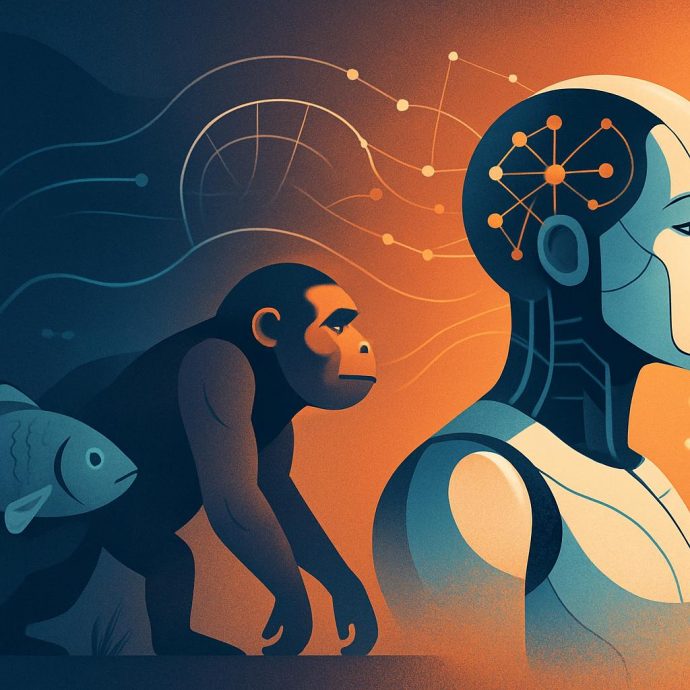
The article “Sakana AI Redefines Evolutionary AI” introduces a paradigm-shifting approach by Sakana AI, an AI startup co-founded by ex-Google Brain researchers David Ha and Llion Jones. Drawing inspiration from the principles of ecology and evolution, Sakana AI is developing a modular and emergent artificial intelligence system that counters the traditional monolithic transformer paradigm. Instead of scaling through increased computational resources, Sakana advocates for AI models that evolve through survival-of-the-fittest mechanisms like mutation, crossover, and natural selection. This bold vision could redefine how intelligent systems are built and deployed, offering a sustainable and adaptable alternative to large language models like GPT-4.
Key Takeaways
- Sakana AI applies principles from biology, specifically evolution and ecology, to construct adaptive and modular AI systems.
- Unlike monolithic transformer models, Sakana’s architecture emphasizes emergence through mutation, crossover, and fitness-based selection.
- This approach could lead to decentralized, scalable, and resilient AI that evolves over time rather than requiring massive retraining or compute.
- The lab’s Tokyo base represents a deliberate alignment with nature-centric philosophies and a diverse innovation ecosystem.
Founders and Vision: From Google Brain to Tokyo
Sakana AI was founded in 2023 by two influential figures in the AI research world: David Ha, formerly the head of research at Stability AI and an ex-Google Brain scientist well-known for neurally inspired model visualization, and Llion Jones, one of the original co-authors of the groundbreaking 2017 paper “Attention is All You Need,” which introduced the transformer architecture. Their combined experience bridges symbolic reasoning, neural network optimization, and deep learning infrastructure at scale.
Locating Sakana AI in Tokyo is both symbolic and strategic. “Sakana,” meaning “fish” in Japanese, reflects the company’s core philosophy. It highlights adapting to complex environments through diversity and resilience. The selection of Tokyo aligns with the city’s architectural contrast, cultural richness, and its unique balance between high-tech urbanism and ecological harmony. This balance aligns with the laboratory’s approach to creating adaptable, complex AI systems through simulated ecological processes.
What Makes Sakana AI’s Approach Evolutionary?
Sakana AI departs from the current trend of scaling up monolithic models like GPT and PaLM. Instead, their AI systems evolve, much like biological organisms adapt over generations. Inspired by techniques found in evolutionary computing, Sakana AI implements several core biological mechanisms:
- Mutation: Random changes are introduced into the parameters or architecture of candidate models. These changes expose the AI to performance variability under different conditions.
- Crossover: Components of high-performing AI “agents” are recombined to form even more effective offspring models, similar to DNA recombination in species evolution.
- Selection: Only those AI structures and agents that perform best in specified tasks or environments are selected for further training or deployment.
This is not merely a heuristic tuning of neural nets. The entire architectural landscape can shift through granular evolutionary steps. This produces AI agents that are inherently modular, flexible, and robust against single-point failures.
Comparing Evolutionary AI to Transformer-Based LLMs
| Feature | Transformer Models (e.g., GPT-4) | Evolutionary AI (Sakana AI) |
|---|---|---|
| Development Paradigm | Single monolithic models trained on massive datasets | Swarm of evolving agents selected through biological processes |
| Scalability | Data and compute intensive scaling | Distributed, small-scale agents adapting over time |
| Adaptability | Limited to training-time data | Dynamically adaptable via continuous evolution |
| Architecture Resilience | Vulnerable to training bias and catastrophic forgetting | Redundant and modular agents with fault tolerance |
Underlying Algorithms and Technical Infrastructure
Sakana AI borrows from decades of established neuroevolution research, including algorithms like NEAT (NeuroEvolution of Augmenting Topologies) and novelty search frameworks. Where classical evolution emphasized genetic diversity, Sakana introduces a dynamically adjustable fitness landscape. This allows AI agents to be optimized not just for accuracy but also for diversity, generalizability, or speed.
Algorithmically, the lab employs:
- Population-Based Training (PBT): Evolving multiple agents simultaneously under varying learning rates and loss functions.
- Fitness Shaping: Rewarding agents not only for performance but how well they explore untested states and regions in the task space.
- Recombination Pipelines: Modular swapping of working components such as attention heads, embeddings, or reasoning loops across agents.
This produces highly specialized AI systems optimized for specific tasks or environments. Instead of general-purpose agents that try to cover everything, Sakana agents focus on narrower targets with higher precision.
This approach aligns with broader principles discussed in how AI learns from datasets and data processing, where diversity and task-specific learning are becoming central to innovation.
Challenges and Third-Party Voices
While the scientific premise is strong, real-world viability still needs validation. Most evolutionary AI models historically struggled with convergence time and computational overhead. Sakana claims that their micro-agent strategy compensates for this. Experts from academic labs such as Mila and DeepMind have noted that smaller innovations via evolution could supplement transformer architectures. Still, no benchmark studies equating evolved models’ performance with LLMs like GPT-4 have been released as of now.
Dr. Jürgen Schmidhuber, a pioneer in neural network research, remarked in a recent panel, “If Sakana’s agents can co-evolve and communicate like neurons in the brain, there could be a compelling neuro-mimetic path ahead.” Despite the current lack of peer-reviewed comparison papers, interest in such decentralized systems is growing. Related themes are addressed in self-taught AI research, which explores autonomy and adaptability outside traditional training constraints.
Use Cases and Future Implications of Modular AI
Sakana’s models, due to their organic modularity, are suited for complex adaptive challenges such as real-time simulation, multi-agent coordination, or personalized learning systems. For instance, in autonomous drones or edge devices with limited compute power, a slimmed-down, self-evolving agent might outperform a frozen LLM constrained by hardware.
In sectors like finance or cybersecurity, evolutionary agents could continuously monitor for novel threats and adapt on the fly. This is more flexible than updating a rigid model through periodic retraining. In dynamic areas like environmental modeling, these systems could co-evolve with incoming data to maintain sensitivity to complex ecosystem shifts.
The idea reflects ongoing interests covered in the evolution of generative AI models, particularly as models transition from static to adaptive learning systems.
In order for Sakana’s modular agents to match or exceed transformers for mainstream usage, they must meet strong benchmarks across NLP, vision, and reasoning tasks. The company has hinted at open-source toolkits releases and experimentation labs by late 2024 to foster broader engagement.
FAQs About Sakana AI
What is Sakana AI and how does it work?
Sakana AI is a Tokyo-based AI startup developing modular and ecological AI systems inspired by biological evolution. Instead of building single monolithic models, Sakana uses evolutionary algorithms that simulate mutation, crossover, and natural selection to generate adaptive AI agents suited for specific tasks.
Who founded Sakana AI?
Sakana AI was founded by David Ha and Llion Jones, both ex-Google Brain researchers. David Ha is known for his work on generative AI and model visualization. Llion Jones was a co-author of the transformer architecture that transformed natural language processing.
What makes Sakana AI different from other AI companies?
Sakana AI focuses on swarm intelligence and evolutionary algorithms instead of scaling single massive models. Its approach combines multiple smaller models that collaborate and compete, inspired by natural selection and biological ecosystems.
What is evolutionary AI?
Evolutionary AI is a method that improves models through iterative selection and recombination, similar to biological evolution. Models that perform better are retained and combined, while weaker variants are discarded.
What is swarm intelligence in AI?
Swarm intelligence refers to multiple smaller AI models working together to solve complex problems. Instead of relying on one large system, collective behavior improves performance and adaptability.
Why is Sakana AI considered innovative?
Sakana AI is considered innovative because it challenges the dominant trend of scaling single large language models. Its research explores decentralized intelligence systems that may be more efficient and flexible.
Is Sakana AI building large language models?
Sakana AI works with language models but focuses on combining and evolving models rather than simply increasing parameter size. Its strategy emphasizes optimization and collaboration among models.
How is Sakana AI funded?
Sakana AI has raised funding from venture capital firms and technology investors interested in next-generation AI architectures. Funding details evolve as the company scales research and development.
What industries could benefit from Sakana AI’s approach?
Industries such as robotics, scientific research, financial modeling, and large-scale data analysis may benefit from adaptive, swarm-based AI systems that require flexibility and efficiency.
Is Sakana AI competing with OpenAI or Anthropic?
Sakana AI operates in the broader AI ecosystem but follows a different architectural philosophy. While companies like OpenAI and Anthropic focus heavily on large centralized models, Sakana AI emphasizes distributed intelligence.
What does “Sakana” mean?
“Sakana” means “fish” in Japanese. The name reflects the company’s inspiration from natural collective behavior, similar to schools of fish coordinating movement.
Can Sakana AI reduce AI training costs?
The company’s approach aims to improve efficiency by evolving and recombining smaller models instead of training massive models from scratch, which may reduce compute and energy costs.
What is the long-term goal of Sakana AI?
Sakana AI aims to develop adaptable, decentralized AI systems that mirror biological intelligence, potentially creating more resilient and scalable artificial intelligence architectures.