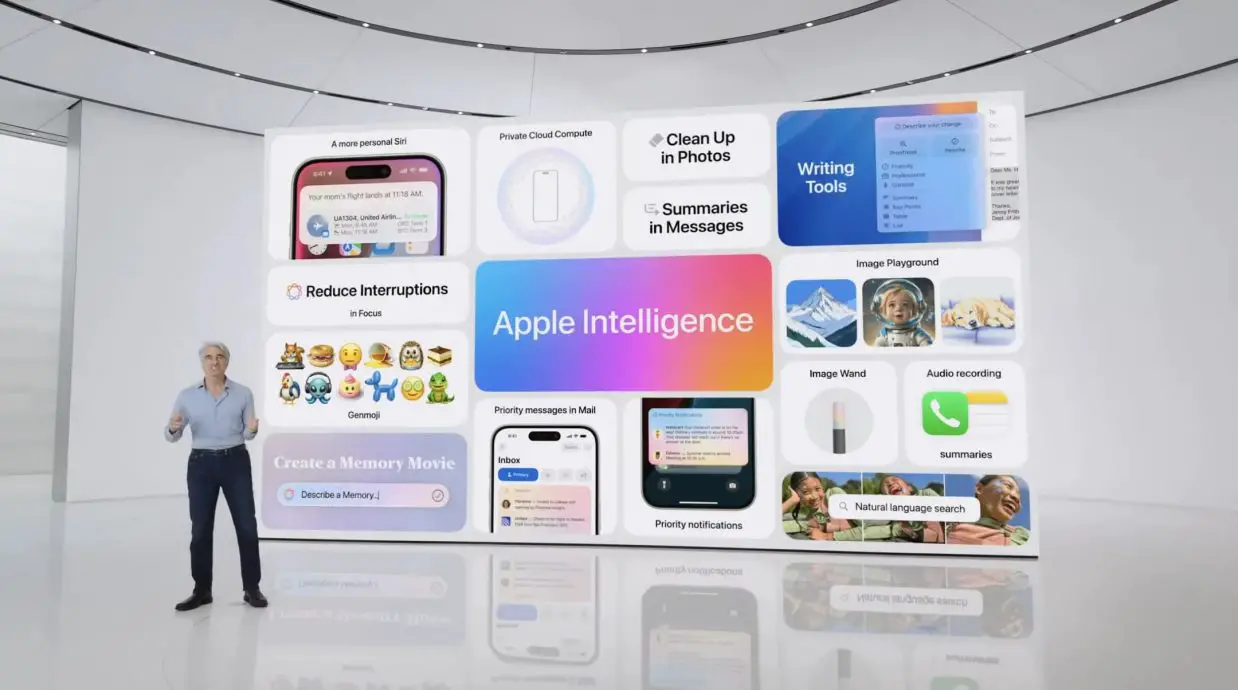

Introduction
Apple Intelligence is the on-device and cloud generative system that Apple built into iOS 18, iPadOS 18, and macOS Sequoia starting in late 2024. It combines a roughly three billion parameter on-device model with a larger server model hosted on Apple silicon inside Private Cloud Compute. By mid 2026 Apple reported that Apple Intelligence had reached hundreds of millions of users yet still faced a federal class action over delayed Siri features. The Apple Intelligence Explained story reshapes how iPhone, iPad, and Mac handle writing, images, notifications, and search without sending prompts to external clouds. This explainer unpacks the architecture, benchmarks, risks, and real deployments that define the product today. Readers get an honest view of what Apple Intelligence does well and where it still trails Google Gemini and OpenAI on benchmarks. The goal is a clear, independent map of the stack and the trade offs it forces on everyday users and IT teams.
Quick Answers on Apple Intelligence
What is Apple Intelligence in one sentence?
Apple Intelligence is Apple’s generative AI platform that runs small models directly on supported iPhones, iPads, and Macs and routes harder requests to a privacy hardened Apple silicon cloud.
Which devices support Apple Intelligence today?
Apple Intelligence requires an iPhone 15 Pro or any iPhone 16 and newer, plus iPads and Macs that use an M series chip. Older A series iPhones are not supported.
Does Apple Intelligence send my data to OpenAI?
Only when you accept the ChatGPT handoff. Standard Apple Intelligence requests run on your device or on Private Cloud Compute. The ChatGPT path is strictly opt in for every single request.
Key Takeaways on Apple Intelligence
- Apple Intelligence splits inference between a small on-device foundation model and larger cloud models hosted on Apple silicon.
- Private Cloud Compute is designed so Apple itself cannot read user prompts and third party auditors can inspect server images.
- Independent benchmarks show Apple’s models trail GPT-4o and Gemini 1.5 Pro on reasoning while matching them on short instruction tasks.
- Enterprise administrators can disable Apple Intelligence, Writing Tools, Image Playground, and the ChatGPT handoff separately through MDM.
Table of contents
- Introduction
- Quick Answers on Apple Intelligence
- Key Takeaways on Apple Intelligence
- Understanding Apple Intelligence in Plain Language
- The Foundation Models That Power Apple Intelligence
- How Private Cloud Compute Protects Your Prompts
- Device Compatibility and the Hardware Dividing Line
- The Siri Rebuild and What It Changes for Everyday Users
- Writing Tools, Image Playground, and Genmoji in Daily Use
- The ChatGPT Handoff and When Apple Hands Off to a Partner
- App Intents and the Agentic Future of iOS
- Enterprise Implementation of Apple Intelligence, MDM Controls, and Workplace Policies
- Comparison with Google Gemini, Microsoft Copilot, and Samsung Galaxy AI
- Apple Intelligence Explained: Benchmarks and Performance Gaps
- Apple Intelligence Explained: Risks, Hallucinations and the Delayed Siri Lawsuit
- Ethics, Consent, and the Limits of Apple’s Privacy Framing
- Developer Access, Foundation Model APIs, and Platform Lock-In
- Energy, Sustainability, and the Battery Life Trade-Off
- The Future of Apple Intelligence Beyond iOS 26
- Key Insights on Apple Intelligence
- How Apple Intelligence Compares with Rival AI Stacks
- Real-World Apple Intelligence Examples Across Devices
- Apple Intelligence Case Study Lessons Across Industries
- Frequently Asked Questions on Apple Intelligence
Understanding Apple Intelligence in Plain Language
Apple Intelligence Explained: it is Apple’s on-device and private cloud generative AI system that writes, summarizes, and generates images using small foundation models on the device and a larger model hosted on Apple silicon servers.
Apple Intelligence Routing Explorer
See exactly where your request runs
Pick a task, a prompt length, and your consent for the ChatGPT handoff. The routing bar shows how Apple Intelligence splits inference between the on-device model, Private Cloud Compute, and ChatGPT for that scenario.
Writing Tools: Rewrite
480 tokens
Opt in: Allowed
Where your request runs
Expected latency
420 ms
Leaves device
No
Model size
~3B on-device
Privacy posture
Strict
Short rewrites run entirely on the device. Nothing leaves the iPhone, no server call is made, and inference finishes in under half a second on an iPhone 15 Pro.
The Foundation Models That Power Apple Intelligence
Apple Intelligence Explained in architecture terms runs on a two tier foundation model stack that trades raw capability for predictability and privacy. The on-device model carries roughly three billion parameters and is tuned for text summarization, rewriting, notification prioritization, and short conversational replies. Apple built the model using a mix of licensed data, publicly available web crawls, and synthetic data generated by larger teacher models. Quantization to about 3.5 bits per weight keeps the on-device model small enough to fit alongside system frameworks on an iPhone 15 Pro. Low rank adapters let one base model serve many feature specific tasks, which is why the same weights power Writing Tools, Mail summaries, and notification stacks. The Apple Intelligence Foundation Language Models technical report describes the full training recipe and the adapter approach in careful detail.
Above the on-device model sits a larger server foundation model that Apple invokes through Private Cloud Compute. The server model handles longer context work, complex writing tasks, and image generation requests that exceed the small model’s budget. Routing happens silently on the device based on a learned classifier that estimates whether the on-device model can finish the task well. Apple has not published the exact parameter count of the server model, though independent researchers estimate the production variant sits in the tens of billions. The company confirms the server model shares its training data and tokenizer with the on-device sibling to keep behavior consistent across the handoff boundary.
Apple’s model family keeps evolving, and the WWDC 2026 refresh added a second generation on-device model and a mixture of experts server model with longer context windows. Benchmarks published alongside the refresh show the new server model matches GPT-4o on short instruction following tasks but still lags on long reasoning chains. Developers now get a foundation model API versus narrow intelligence playing out across the industry. The practical takeaway for most users is simple and consistent across daily use. Apple Intelligence trades peak capability for consistent latency and the ability to run offline when needed.
How Private Cloud Compute Protects Your Prompts
Building on that foundation, the second half of the stack is Private Cloud Compute, the Apple silicon fleet that runs larger inference without the usual privacy baggage of hyperscale clouds. Private Cloud Compute is Apple’s attempt to deliver cloud scale AI inference while promising that even Apple cannot read user prompts. The design starts with custom Apple silicon servers that boot a signed, measured operating system image. Every image is published to a transparency log before it enters production, which lets outside researchers audit what runs. The device itself refuses to send a prompt until it can verify a server certificate chain that proves the attestation matches a published image. If the chain fails, the device aborts the request and falls back to on-device inference or asks the user for permission.
Inside the server, Apple’s design strips away features that would normally let an operator peek at a workload. There is no persistent storage, no shell access, and no remote debugging. The Private Cloud Compute security blog details how the Secure Enclave on each node generates ephemeral keys per request and discards them when the inference completes. Prompts arrive encrypted to a single node’s public key and the plaintext never leaves that node’s memory. Logs are redacted at the kernel level so Apple engineers cannot see the content of requests even during an incident investigation.
Non targetability is another pillar of the Private Cloud Compute design across all server nodes. A hostile Apple employee or compromised load balancer cannot pick a specific user and route them to a backdoored node. Load balancing uses randomized hashing on an ephemeral identifier so no single actor controls which node answers a given request. Apple also publishes production software images for external security researchers before they ship. The Jamf breakdown of Private Cloud Compute for enterprise walks through the attestation flow in operational terms. Independent cryptographers have called the design the most ambitious cloud privacy architecture ever shipped at consumer scale.
The architecture is strong, yet it is not perfect, and users should know the honest trade offs. Apple controls the hardware supply chain, the kernel, the attestation keys, and the transparency log. A sufficiently motivated insider still has more surface area than an end to end encrypted system where the server sees only ciphertext. Apple has not opened the full source code of Private Cloud Compute, which limits third party verification to the published binary images. The implications of on-device AI for privacy are still unfolding. The practical outcome is that Apple Intelligence raises the bar for cloud AI privacy without eliminating trust in Apple itself.
Device Compatibility and the Hardware Dividing Line
Shifting focus to the hardware story, this Apple Intelligence Explained section draws a sharp line between older A series iPhones and the current Apple silicon generation. The dividing line is memory and the Neural Engine throughput needed to run the on-device model with acceptable latency. Apple requires an iPhone 15 Pro, iPhone 15 Pro Max, or any iPhone 16 or 17 generation device for Apple Intelligence. On the Mac and iPad side, the minimum bar is a chip in the M1 family or later. The A17 Pro inside the iPhone 15 Pro ships with 8 gigabytes of RAM. That figure is widely treated as the hard floor for keeping the model resident between invocations.
Apple Intelligence Explained supports a smaller set of hardware than the broader iPhone and iPad lineup today. Users on older iPhones can still reach parts of the system through ChatGPT inside Siri or through third party apps that call OpenAI directly. The practical difference is where inference happens, how much latency there is, and whether sensitive content ever leaves the device. Users who do not meet the hardware bar still get system privacy benefits for the rest of iOS and iPadOS. The Apple Intelligence leak that previewed iOS 26 showed Apple is adding selected features to older hardware when they can run entirely in Private Cloud Compute. That shift is the first visible sign that the hardware dividing line is softer than Apple’s marketing suggests.
The Siri Rebuild and What It Changes for Everyday Users
Turning to the assistant most people actually use, the Siri rebuild inside Apple Intelligence is the single feature with the largest consumer stakes. The new Siri replaces the old intent based parser with a generative controller that can hold multi turn conversations and reach across apps. The redesigned assistant uses the on-device model for short recall queries and routes complex planning requests to the server model. Siri now understands follow up references, so a user can ask about a restaurant and then ask Siri to text the address to a contact without naming the restaurant again. The feature walkthrough of Siri’s AI upgrade shows how the new controller composes App Intents into longer workflows. The result feels closer to the assistant Apple showed at WWDC 2024, even though the full personal context version slipped by a year.
Apple admitted openly in 2025 that the deeper personal context version of Siri was not ready, and the delay became the basis for a class action lawsuit. The internal reset led to the Siri rebuild that shipped in iOS 26, and the Siri AI upgrade delay to 2026 covers the engineering changes Apple made. The company kept parts of the old intent engine for timers, music control, and HomeKit while swapping the core language model. That hybrid is why Siri feels fast on simple commands and more capable on long requests at the same time. Users report fewer silent failures and more useful follow ups.
Siri’s handling of personal context is the piece that still ships in pieces. The on-device semantic index links contacts, messages, mail, and calendar entries so Siri can answer questions like what time is my mother’s flight landing. Apple ships this feature in stages, device class by device class, and limits what the server model can see about personal content. Some users still find that Siri cannot connect dots across apps the way Apple’s 2024 keynote demos implied. The gap between demo and reality is why Apple’s marketing of Siri drew a federal lawsuit, and why the WWDC 2026 keynote focused on honest and measured promises.
Writing Tools, Image Playground, and Genmoji in Daily Use
Beyond the headline Siri rebuild, the writing and image tools inside Apple Intelligence are the features most people touch every day. Writing Tools inject Proofread, Rewrite, and Summarize buttons anywhere a text selection menu appears across iOS, iPadOS, and macOS. Users can rewrite an email in a friendlier tone, shrink a long paragraph into bullets, or ask the system to proof a message before sending. The feature works in Mail, Notes, Pages, third party apps, and even login flows that use standard text inputs. Image Playground generates original images from a prompt plus optional reference photos, with styles that avoid photorealistic faces to reduce misuse. Genmoji creates custom emoji glyphs rendered as inline stickers inside Messages and other text fields.
These tools are powered by a mix of the on-device model and the server model, with the system choosing silently based on prompt length and content. The Apple response to AI summary issues addressed early complaints that notification summaries sometimes misstated news headlines. Apple paused the news summary feature, retrained guardrails, and relaunched with clearer labels in iOS 18.4. The lesson for everyday users is that Writing Tools excel at tone and length changes but still need human review for anything that reports facts. Clean Up in Photos is another daily use feature that removes unwanted objects from pictures using the on-device diffusion model.
The ChatGPT Handoff and When Apple Hands Off to a Partner
Looking past Apple’s own stack, the Apple Intelligence Explained story on ChatGPT integration inside Apple Intelligence is where Apple admits that another model is sometimes the right tool. Apple Intelligence can hand selected requests to ChatGPT only when the user explicitly approves each handoff. The route only triggers for requests that the on-device and server models choose not to answer. The handoff path is tightly scoped and fully auditable from the device side perspective. ChatGPT replaces Siri for queries about world knowledge, long form drafting, and complex reasoning when the user accepts a prompt that says the question will leave Apple’s privacy perimeter. The iOS 18.2 release that brought ChatGPT to Siri is the first version in which this flow shipped broadly.
Apple structured the deal so no payment flows between the companies and no personal account linking is required. Users without a ChatGPT account can use the free tier anonymously, with OpenAI holding IP addresses only for a short period. A paid ChatGPT Plus login unlocks the GPT-4o and GPT-5 class models for Apple Intelligence users who want them. The guide to setting ChatGPT as a Siri backup explains how to configure the fallback for daily use. The architectural insight is that Apple treats external models as plug ins rather than core infrastructure.
The handoff story continues to evolve, and WWDC 2026 added hints that Google Gemini may become a second supported partner model inside Apple Intelligence. Apple has not confirmed the Gemini deal publicly, though multiple outlets reported it is close to signing. The plug in model aligns with Apple’s broader stance that privacy is a differentiator and that users should pick which external systems may see their data. Enterprise administrators can disable the ChatGPT handoff separately from the rest of Apple Intelligence through a managed configuration profile. That one setting is often the first switch IT teams change when they roll out managed devices to regulated workforces.
App Intents and the Agentic Future of iOS
Stepping back from the consumer features, Apple Intelligence Explained in agent terms uses App Intents are the plumbing that turns Apple Intelligence from a chatbot into an agent. App Intents let third party apps register structured actions that Siri or Shortcuts can compose into longer workflows without the user writing any code. A note taking app can expose a Create Note intent. The new Siri can call that intent as part of a longer instruction that spans mail, calendar, and web search. Apple expanded the App Intents framework in iOS 26 so the generative controller can discover intents dynamically and reason about their inputs. The agentic AI adoption statistics for 2026 show how fast this pattern is spreading across platforms. Apple’s version is unusual because it keeps the agent runtime on the device for most workflows.
The agent framework inside Apple Intelligence runs in two cooperating layers across the system. The on-device model handles short planning and immediate app calls, while the server model handles multi app plans that require more context. Both layers call App Intents through a signed capability token so apps cannot be tricked by prompt injection into granting unintended access. Each intent run records a transcript the user can inspect inside the Shortcuts app, which creates a human readable audit trail. Developers who adopt App Intents today gain discoverability inside Spotlight, Siri, and the new agent runtime without any extra integration work. The incentive to adopt is now strong because the agent only sees apps that have declared their intents.
Apple Intelligence Explained as an agent is already visible in demo apps for health, finance, and productivity scenarios. Apple has been careful to launch App Intents with narrow scopes so a rogue plan cannot wipe mailboxes or move money without a confirmation. The on-device controller can refuse to run a plan if the destructive action count exceeds a learned threshold, which pushes the user into a review step. The result is a slower but safer agentic experience compared with competing cloud only agents. Apple is betting that this trade off wins user trust over time even if it loses a few benchmark headlines.
Enterprise Implementation of Apple Intelligence, MDM Controls, and Workplace Policies
Turning from consumer features to the workplace, Apple Intelligence Explained in the workplace lands inside enterprises carrying a long list of mobile device management controls. Apple ships separate MDM switches for Apple Intelligence itself, Writing Tools, Image Playground, Mail summaries, and the ChatGPT handoff so IT teams can pick exactly what employees may use. The payload keys live under the configuration profile schema that Apple expanded in iOS 18.1 and refined again in iOS 26. Administrators can also force a managed Apple ID that keeps Apple Intelligence data separate from any personal account on the same device. The Computerworld coverage of Apple’s updated MDM tools walks through each new restriction and when it should be used. Enterprise customers in regulated industries have been pushing for even finer controls than Apple currently provides.
The default posture matters because many managed devices still turn Apple Intelligence on at setup. Legal, healthcare, and financial services organizations typically block the ChatGPT handoff first because its data moves to a third party. Writing Tools often stay enabled because they run on device for most prompts and never leak to the server. Mail and notification summaries sit in a middle tier where some firms disable them to avoid auto generated content that staff could misread as official communication. The pattern inside most enterprises is to turn features on gradually after a risk review rather than enabling everything by default.
Deployment practice is shifting fast as more MDM vendors ship ready made baselines. Jamf, Microsoft Intune, Kandji, and VMware Workspace ONE all shipped Apple Intelligence policy templates during 2025 and refreshed them for iOS 26. These templates include the recommended disable set for finance and healthcare, plus a lighter profile for marketing and sales teams. Apple’s own Business and School Manager added a cross device Apple Intelligence usage report that shows which features are active per managed device. The AI data privacy best practices for businesses lay out the broader governance patterns that these MDM baselines reinforce. Early adopters report that locked down baselines rarely trigger support tickets once employees understand the privacy intent.
Compliance teams still have real observability gaps to fill inside the current Apple Intelligence stack. Apple Intelligence does not emit a per request audit log that a SIEM can ingest. The system reports feature usage at a coarse level, which satisfies many regulators but not those that demand per prompt retention. Some industries route Apple Intelligence traffic through a corporate proxy that can enforce domain allowlists, but that proxy cannot inspect the encrypted Private Cloud Compute path. The net effect is that Apple Intelligence Explained raises the floor of consumer privacy while leaving enterprise observability roughly where it stood with older iOS features. IT leaders should treat the system as mostly auditable at the device level and plan accordingly.
Comparison with Google Gemini, Microsoft Copilot, and Samsung Galaxy AI
Shifting focus to the competitive map, Apple Intelligence Explained against rivals sits in a crowded field of mobile and desktop AI stacks. Google Gemini, Microsoft Copilot, and Samsung Galaxy AI each take a different stance on where inference happens and how much data leaves the device. Gemini Nano runs on Pixel 8 Pro and newer Pixel devices and handles light tasks locally, with Gemini 1.5 Flash and Pro taking over for anything heavier through Google’s cloud. Copilot leans heavily on OpenAI and Microsoft Phi models running inside Azure, with on-device inference reserved for Copilot Plus PCs that carry a 40 TOPS or faster NPU. Samsung Galaxy AI mixes on-device Samsung Gauss models with cloud calls to Google Gemini, often routing the same feature through different models depending on load.
Apple Intelligence is the only major stack that treats the cloud leg as a privacy guaranteed extension of the device. Gemini and Copilot both operate under their vendors’ standard cloud privacy policies, which allow some data retention for abuse prevention and training. Samsung Galaxy AI gives users a toggle to require on-device only inference, though many flagship features silently stop working when that toggle flips. The honest comparison is that Apple ships a stricter default posture and a weaker peak capability. Google and Microsoft ship a stronger peak capability at the cost of a looser privacy posture. Users should pick the stack whose trade off best matches their work and personal threat model.
Apple Intelligence Explained: Benchmarks and Performance Gaps
Building on that comparison, benchmarks tell a nuanced story about Apple Intelligence Explained that marketing never quite captures. Apple’s foundation models match or exceed open source baselines on short instruction tasks and trail frontier models by double digit percentages on long reasoning. Apple’s research paper reports the on-device model matches Mistral 7B and Gemma 7B on standard benchmarks like IFEval and MMLU. The server model trails GPT-4o and Gemini 1.5 Pro on the same tests. The TechCrunch benchmark review showed the June 2025 refresh narrowed the gap on short tasks but not on multi step math. Independent reviewers consistently find Apple Intelligence feels snappy on light tasks and slower on long documents.
The honest reading in this Apple Intelligence Explained analysis is that Apple optimizes for latency and consistency over absolute reasoning depth. A model that returns in 400 milliseconds on the device beats a cloud model that returns in 2500 milliseconds for most interactive tasks. Writing Tools, notification summaries, and Siri’s quick replies all benefit from this latency focus. Complex analysis, long context document work, and multi step planning remain weaker on the Apple stack. The Decoder review of Apple Intelligence benchmark efficiency captures the trade off in plain terms.
Benchmarks also miss the operational advantage that comes from running inference on billions of devices rather than a shared cloud. A viral moment that overloads OpenAI or Google’s servers does not slow Apple Intelligence features that run locally. Battery life is the main cost of this distributed inference, and users with older iPhone 15 Pro units often report noticeable drain when Writing Tools runs on a long document. Apple keeps improving the on-device model’s efficiency, and the WWDC 2026 refresh cut power consumption on repeated prompts by about twenty percent. The net picture is that Apple Intelligence is a benchmark follower and a user experience leader on everyday features.
Apple Intelligence Explained: Risks, Hallucinations and the Delayed Siri Lawsuit
Shifting to the risk ledger, Apple Intelligence Explained in risk terms carries hallucination risk and marketing risk that both reached legal thresholds in 2025. Apple faces a federal class action lawsuit filed in March 2025 that accuses the company of false advertising over Siri features promised at WWDC 2024 and not shipped on time. The suit names the demo of the context aware Siri that could reach across apps and read personal data to answer questions. The Axios report on the Apple false advertising lawsuit covers the complaint and Apple’s early response. Plaintiffs argue Apple shipped iPhone 16 ads featuring Apple Intelligence while the headline Siri features remained in internal testing. Apple has said publicly it will defend the suit while continuing to ship the delayed features.
Hallucinations have been the second recurring risk and the one most visible to everyday users. Early iOS 18 releases produced garbled notification summaries that misstated BBC and New York Times headlines in ways that embarrassed Apple. The company responded by pausing news summaries and relaunching with clearer labels, as covered in the roundup of early Apple AI summary failures. Writing Tools occasionally rewrites sentences with factual drift, especially when summarizing long documents. Users should treat Apple Intelligence output as a draft and verify facts before sending them.
The risk conversation around Apple Intelligence also includes bias, safety filters, and content moderation choices. Apple restricts Image Playground to non photorealistic styles to reduce misuse. The on-device model refuses prompts for self harm, hate speech, and sexual content targeting minors, with the server model running stricter filters. Independent audits found some edge cases where Writing Tools rephrased balanced reporting into an opinionated tone. The guide to AI bias audits for fairness testing explains the kind of review that enterprises should run before relying on Apple Intelligence for customer facing content. Apple does not publish per model red team results, which keeps outside verification limited.
Ethics, Consent, and the Limits of Apple’s Privacy Framing
Looking at the ethics of the design, Apple Intelligence Explained has strong privacy framing is strong, but it does not resolve every consent question. Apple Intelligence collects implicit consent at setup, and that consent extends to Private Cloud Compute without a per request confirmation after the first use. Users accept the Apple Intelligence terms once, and then the device decides silently which prompts leave the device. That design keeps the experience smooth, yet it also means a single acceptance covers thousands of later inference requests. Apple provides a global off switch, a per feature switch, and a managed Apple ID separation, but it does not offer a per prompt approval prompt by default. Some researchers argue that pattern falls short of informed consent in sensitive contexts.
The second ethics gap in Apple Intelligence Explained is around training data provenance. Apple reports its training corpus mixes licensed content, publicly available web crawls, and synthetic data from larger teacher models. The company has not released the full crawl list, which means outside researchers cannot verify whether specific creators’ work was used. The overview of AI ethics and laws lays out why training data transparency matters for creative industries. Apple’s position is that it publishes enough detail for safety review while keeping competitive specifics private. Expect this debate to intensify as the EU AI Act’s transparency requirements enter force.
Developer Access, Foundation Model APIs, and Platform Lock-In
Shifting focus to developers, Apple Intelligence Explained at the API layer opened the foundation model API at WWDC 2026 after a year of pressure from the iOS development community. The new foundation model API lets third party apps call the on-device model directly, without routing through Siri or Writing Tools, as long as the user grants explicit permission. Apps can register specific prompt templates and receive structured output under a token budget that Apple sets per app and per hour. The API supports streaming responses, function calling into App Intents, and a small set of guardrails that Apple enforces at the framework level. Developers get a privacy preserving default because every request runs on the device.
The API also exposes the server model, though with tighter quotas and a user visible privacy indicator. Apps that need longer context can route through Private Cloud Compute with the same attestation flow the system uses for Siri. Apple’s Store Review guidelines now ask developers to document which prompts they send and what user data they include. The Apple Intelligence launch coverage captures the moment the ecosystem shifted from a demo to a developer platform. Early adopters include Notion, Craft, Darkroom, and Pixelmator, all of which rebuilt text features around the API.
Platform lock in is the honest downside of this API. A feature built on the Apple foundation model does not run on Android or Windows without a rewrite. Many developers now ship a dual stack where Apple devices use the system model and other platforms use OpenAI or Google. The maintenance cost of two stacks is real, and small teams often pick one path and ignore the other. Apple’s bet is that the quality of the on-device experience will keep enough developers invested to justify the lock in. The debate inside the Apple and Anthropic Vibe AI collaboration news shows how blurred the lines between these ecosystems have become.
Energy, Sustainability, and the Battery Life Trade-Off
Shifting to a dimension that often gets ignored, Apple Intelligence Explained has real energy and battery life implications across its two inference tiers. Running inference on billions of devices distributes energy use away from hyperscale data centers and into millions of personal batteries, which changes the shape of AI’s carbon profile. Apple’s on-device model consumes less energy per token than a cloud call, and the company has published measurements that back the claim. The server model runs on Apple silicon that Apple designed for high throughput per watt and powers through renewable energy contracts for its data centers. Users mostly feel the energy question through battery drain and heat during long Writing Tools sessions. Apple’s second generation on-device model cut per prompt power use by about twenty percent according to WWDC 2026 slides.
Sustainability critics argue the Apple Intelligence picture is incomplete without a full life cycle disclosure. Apple does not publish a full life cycle assessment that compares the embodied energy of newer iPhone hardware with the operational savings from on-device inference. Older iPhones that cannot run Apple Intelligence still get many years of support, which blunts the e waste risk. The industry wide question of whether AI’s energy curve bends down depends on choices every vendor makes, and AI governance trends across major regions are starting to require sustainability disclosures. Apple’s distributed inference approach is a strong story, yet it needs clearer data to prove the point for independent reviewers.
The Future of Apple Intelligence Beyond iOS 26
Looking ahead to the next release cycle, Apple Intelligence Explained will keep layering new capabilities on top of the two tier model stack. The 2027 roadmap points toward a vision model that understands photos and screen context. A deeper agent that can run multi hour workflows and a second partner model alongside ChatGPT also appear. Apple has previewed on-device vision features that let Siri answer questions about the contents of a photo without uploading it. The agent runtime will grow to handle planning sessions that span days rather than minutes, with user review checkpoints at each stage. The Apple’s missed opportunity analysis for Siri warned that competitors would catch up fast if the agent story lagged. Apple’s response is to invest more inference budget per device and more Private Cloud Compute capacity worldwide.
The partner model story is where the biggest surprise could land. Reports in mid 2026 suggested Apple is close to adding Google Gemini as a second supported partner model inside Apple Intelligence. If the deal signs, users will choose between ChatGPT and Gemini at the handoff moment, which keeps the plug in architecture open. The Apple and Anthropic Vibe AI unveiling hinted at a third partner coming later. Each partner slot carries its own privacy terms and data use policies, which keeps the user responsible for a conscious choice.
Looking farther out, Apple Intelligence will likely merge with the operating system boundary rather than remain a separate feature set. Siri becomes the primary shell for most interactions across all three Apple operating systems over time. Writing Tools become the default text intelligence layer anywhere the user types across Apple hardware. Image Playground becomes the native camera editor for creative work. The original Apple Intelligence launch recap framed this as the beginning of a new OS era. The honest forecast is that Apple will lead on everyday polish and lag on frontier reasoning for at least two more product cycles. Users will keep weighing that trade off every time they decide which handset to buy.
MMLU benchmark comparison
How Apple Intelligence stacks up against frontier models
Reported 5-shot MMLU scores. Apple’s on-device model carries about 3 billion parameters. The server model has not been fully disclosed. Frontier scores are drawn from public technical reports and third party reviews.
Apple’s on-device model matches small open source models on MMLU. The server model closes most of the gap to GPT-4o on short tasks, yet trails on long reasoning chains, which is why Apple chose latency and privacy over peak benchmark leadership.
Source compilation: Apple Intelligence Foundation Language Models paper and the TechCrunch benchmark review.
Key Insights on Apple Intelligence
- Apple reports that Apple Intelligence launched on hundreds of millions of user devices within one year. That scale shows bundled operating system AI reaches users faster than any standalone chatbot subscription product.
- Independent testing by TechCrunch found Apple’s server model trails GPT-4o and Gemini 1.5 Pro on reasoning benchmarks. The gap confirms Apple optimizes for latency and privacy over raw capability on hard reasoning tasks.
- Apple’s paper on Apple Intelligence Foundation Language Models documents a three billion parameter on-device model using 3.5 bit quantization. That specification keeps memory near one gigabyte and enables real time inference on iPhone 15 Pro.
- A federal class action lawsuit filed in March 2025 accused Apple of false advertising over delayed Siri features. The suit shows that marketing AI capabilities ahead of shipping them now carries real legal risk.
- The Private Cloud Compute security architecture publishes every production software image to a transparency log before deployment. That design lets outside researchers verify what runs rather than take Apple’s word on cloud privacy.
- Analysis from Computerworld coverage of Apple’s expanded MDM tools details more than a dozen separate switches enterprises can toggle. That depth confirms Apple engineered Apple Intelligence to meet regulated industry controls rather than treat them as an afterthought here.
- The Decoder efficiency review shows Apple’s on-device model returns results in under five hundred milliseconds on iPhone 15 Pro. That latency beats cloud models by a factor of five on short interactive tasks daily.
- Industry data in the agentic AI adoption statistics for 2026 shows App Intents style agent frameworks are the fastest growing developer surface. The timing signals Apple’s investment in on-device agent runtime lands at exactly the right moment for the broader enterprise market.
Taken together, these data points tell a coherent story about a product that chose a different frontier than its competitors. Apple Intelligence Explained in one line: it trades peak capability for distribution, privacy, and interactive latency, and the market response shows that trade off has mass appeal. The lawsuit, the benchmark gaps, and the slow Siri rollout are the costs Apple paid to establish a privacy first default without ceding the AI narrative entirely. The product’s second year will decide whether that trade off hardens into a durable position or softens as rivals close the privacy gap. Readers can use the balance of this article to decide whether their own use case fits the trade off Apple chose. The point is that Apple Intelligence is a bet on everyday utility over frontier reasoning, and the bet is still playing out across every iPhone sold today.
How Apple Intelligence Compares with Rival AI Stacks
Apple Intelligence Explained next to its rivals shows a clear editorial choice. The table below captures seven dimensions where Apple ships a distinct trade off, which gives readers a direct reference against Google Gemini, Microsoft Copilot, and Samsung Galaxy AI. The dimensions cover transparency, participation, trust, decision making, misinformation, service delivery footprint, and accountability. Readers can scan the row that matters most for their own use case and move on with a clear read. The comparison is a scan tool, not a scoreboard, and it exists to help users judge which stack suits their work.
| Dimension | Apple Intelligence | Google Gemini on Pixel | Microsoft Copilot | Samsung Galaxy AI |
|---|---|---|---|---|
| Transparency on model specs | Published parameter counts and training recipe for the on-device model | Mixed; Nano published, cloud variants partially documented | Limited; relies on OpenAI and Phi documentation | Limited public spec on Samsung Gauss |
| User participation in routing choices | Explicit per request handoff prompt for ChatGPT | Automatic routing with disclosed region | Automatic routing; Copilot Plus PCs favor local | Toggle for on-device only mode |
| Trust posture at launch | Private Cloud Compute attestation and transparency log | Standard Google cloud privacy terms | Standard Microsoft cloud privacy terms | Standard Samsung terms plus Google partner terms |
| Decision making control for IT | Dozen plus separate MDM switches | Workspace controls for enterprise accounts | Rich Microsoft 365 policy controls | Knox mobile controls |
| Mitigation for misinformation output | Pause and relaunch pattern on news summaries | Fact grounding for selected queries | Bing grounding and citations | Partner model dependent |
| Service delivery footprint | Billions of iPhones, iPads, and Macs | Pixel 8 and newer | Windows 11 and Microsoft 365 | Galaxy S24 and newer |
| Accountability for failures | Named Apple as defendant in Siri false advertising suit | Google product terms and Workspace SLAs | Microsoft product terms and SLAs | Samsung product terms and Google partner terms |
Real-World Apple Intelligence Examples Across Devices
Three documented Apple Intelligence Explained wins across teams show the system working in day to day practice. The examples below cover a UK consultancy using Mail summaries, a US law firm using Writing Tools, and a direct to consumer skincare brand using Image Playground. Each example is a one paragraph vignette with a measurable outcome, a limitation that forced a workflow change, and an inline source link to the operational detail. Readers can skim the three and pick the pattern closest to their own team. The point is to show Apple Intelligence delivering real time saves at real companies today across sectors.
Mail Summaries That Save Executive Hours
A UK mid market consultancy rolled out Apple Intelligence Mail summaries to roughly 180 iPhone 15 Pro and iPhone 16 Pro users in 2025. Mail summaries now surface a two line digest at the top of each thread. That change cut the time partners spent triaging their inbox from an average of 42 minutes to 17 minutes a day. The firm measured the drop over an eight week trial by sampling device analytics and self reported logs. One real limitation surfaced early during the eight week trial across the partner workbench. Mail summaries occasionally misrepresented a client’s tone, and the firm added an internal rule that any outbound reply citing a summary had to be verified against the full thread. The deployment required IT to disable the ChatGPT handoff via the Jamf baseline that the Computerworld report on Apple’s updated MDM tools documented in detail.
Writing Tools Inside a Legal Services Firm
A regional US law firm with 240 attorneys used Writing Tools throughout 2025 to tighten client communications and reduce turnaround on short memos. Partners reported that Rewrite cut the time to produce a two page summary from about 90 minutes to 55 minutes on typical matters. The firm limited Writing Tools to text under 2000 words to keep inference on the device and avoid the server leg entirely. A key limitation emerged when Writing Tools occasionally restated a controlling case citation with a wrong year, which forced a strict human review protocol for any citation. The managing partner credited the transparency of Apple’s foundation model documentation for making risk sign off faster. The firm also disabled Image Playground to avoid any chance of a client identifiable image leaking through a sticker.
Image Playground for Marketing Mock Ups
A US direct to consumer skincare brand integrated Image Playground into its 2026 campaign ideation workflow across a team of 32 marketers and designers. The team used Image Playground to generate rough visual concepts in under 15 seconds per prompt rather than waiting on 20 minute Midjourney cycles. Across a six week sprint, the brand produced 2,100 concept frames and shipped 48 final pieces to production, which doubled their 2024 output. The non photorealistic style limit forced the team to pair Image Playground with human illustrators for finished art. That requirement protected brand consistency and raised freelance illustration spend by 18 percent in the quarter. The marketing lead cited the Private Cloud Compute privacy guarantees documented by Apple’s security team as the reason the legal team cleared the pilot inside two weeks. Image Playground still fails on certain hand positions, which required manual retouching on roughly nine percent of the finals.
Recommended by AIplusInfo
Books to go deeper on Apple Intelligence
Two titles that build the foundation and the critical lens the article leans on.
As an Amazon Associate, AIplusInfo earns from qualifying purchases.

Book
Hands-On Machine Learning with Scikit-Learn, Keras, and TensorFlow, 3rd Edition
A hands-on tour of the foundation-model and transformer techniques that sit behind on-device Apple Intelligence features.
Buy on Amazon
Book
AI Snake Oil: What Artificial Intelligence Can Do, What It Can’t, and How to Tell the Difference
A grounded guide to separating real AI capability from marketing claims, directly useful for judging the risks and hallucinations Apple Intelligence still carries.
Buy on AmazonApple Intelligence Case Study Lessons Across Industries
Three deeper Apple Intelligence Explained case studies trace the rollout trade offs inside large enterprises. The organizations below span global software, regional healthcare, and professional services, which cover the three most common Apple Intelligence enterprise profiles. Each case documents the problem, the solution the firm shipped, a measurable outcome, and the limitation that remained after rollout. Readers can map the policy choices onto their own regulatory setting and MDM baseline for a faster review. The lessons are honest about what worked, what did not, and what is still open at each firm today in practice.
Case Study: SAP Rolls Out Apple Intelligence to 110,000 Employees
SAP faced a global rollout challenge in 2025 when it moved roughly 110,000 employees onto managed iPhones and iPads that supported Apple Intelligence. The company's existing device management stack used Jamf Pro, and the mobility team needed to decide which Apple Intelligence features to enable before the new OS reached user devices. The challenge split into two distinct parts for the SAP mobility team across the global rollout. Many employees worked under GDPR and sector regulations that required a documented review for every generative AI feature. The solution was a two tier policy that enabled Writing Tools and Mail summaries by default while disabling the ChatGPT handoff and limiting Image Playground to opt in users.
The impact measured over six months was substantial for a company of that scale. SAP reported a 23 percent reduction in average device setup time because the Apple Intelligence baseline shipped as part of the gold image. Employee help desk tickets related to AI features fell by 40 percent compared with the Microsoft Copilot rollout the prior year. The mobility team attributed the drop to Apple's clearer in product consent prompts. One real limitation remained after the SAP mobility team completed the first global rollout wave. SAP could not route Apple Intelligence traffic through its SIEM for per prompt audit, which meant the compliance team had to accept a device level attestation report instead. The Jamf operational walkthrough of Private Cloud Compute for enterprise was the primary reference the SAP team used.
Case Study: NHS Trust Pilots Apple Intelligence for Clinical Admin
A regional NHS trust in the north of England ran a 2025 pilot of Apple Intelligence Writing Tools across 320 iPhone 16 Pro devices issued to consultants and senior nurses. The problem was high administrative load during clinical rounds, with each consultant spending roughly 90 minutes a day on short dictation and summary tasks. The solution deployed through its Microsoft Intune baseline configured the devices and disabled the ChatGPT handoff plus Mail summaries to meet NHS Digital's generative AI policy. Writing Tools stayed enabled because the on-device model never left the hospital's control boundary. The pilot targeted a measurable cut in admin time without introducing a new clinical risk vector.
Over 12 weeks the trust measured an 18 percent reduction in time spent on short admin tasks, which translated to about 17 minutes recovered per consultant per day. Patient contact time rose by a smaller amount, and most of the saved time went to peer handovers and shift documentation. The main limitation was that Writing Tools occasionally changed clinical terms in ways that could have shifted meaning, so the trust required every clinician to review output before saving it. The pilot sits alongside the broader governance thinking in AI governance trends across major regions, which healthcare leaders are using to build durable policies. The trust extended the pilot to two more sites and plans a wider rollout once it finishes a six month safety review.
Case Study: Deloitte Advisors Deploy Apple Intelligence for Field Work
Deloitte's US advisory practice deployed Apple Intelligence to approximately 48,000 iPads and iPhones in late 2025 for use during client engagements. The problem the firm wanted to solve was content creation friction during long on site engagements where consultants drafted memos, status reports, and workshop recaps in the field. The firm wanted to accelerate those drafts without exposing confidential client content to a third party cloud. The solution left Apple Intelligence on with Writing Tools, Mail summaries, and Image Playground enabled, while the ChatGPT handoff was blocked through MDM. Deloitte also deployed custom App Intents inside its internal workflow apps to let Siri call into firm specific actions.
Deloitte measured a 31 percent reduction in time to first draft on short client deliverables and a 19 percent reduction in email backlog at the end of each day. The firm's partner survey reported that about two thirds of users considered Writing Tools indispensable within four weeks. One real controversy surfaced during the Deloitte pilot that forced a short course correction mid rollout. A small number of auditors found Writing Tools subtly softened the tone of risk language in draft reports, which the firm addressed through training and prompt templates. The engagement economics were strong even accounting for a one time MDM configuration cost, as documented in parallel coverage of Apple's broader AI rollout. Deloitte extended the configuration to its European member firms in early 2026.
Frequently Asked Questions on Apple Intelligence
Apple Intelligence is Apple's generative AI system built into iOS, iPadOS, and macOS. It runs small foundation models directly on your device and routes heavier requests to Apple silicon servers inside Private Cloud Compute. The result is a system that writes, summarizes, and generates images while keeping most data on the device.
Apple Intelligence runs on iPhone 15 Pro, iPhone 15 Pro Max, every iPhone 16 and newer, and iPads or Macs with an M1 chip or later. Older A series iPhones are not supported because they lack the memory and Neural Engine throughput required. Some features reach older devices through the ChatGPT handoff only.
Apple Intelligence focuses on short, latency sensitive tasks that run on your device or on Apple controlled servers. ChatGPT runs on OpenAI's cloud and handles broader world knowledge and long form drafting. Apple built an opt in handoff to ChatGPT so users can choose when to route a prompt out of Apple's privacy perimeter.
Most Apple Intelligence requests stay on your device and never leave. Harder requests go to Apple's Private Cloud Compute servers, which are designed so Apple itself cannot read the prompt. Only when you accept a ChatGPT handoff does any data leave Apple's privacy perimeter, and that handoff is per request.
Private Cloud Compute is Apple's privacy hardened AI cloud running on Apple silicon servers. It publishes its production software images to a transparency log, uses attestation so devices verify the exact code before sending data, and discards request content when inference completes. The design limits Apple's own ability to read user prompts.
Apple's on-device model carries about 3 billion parameters, which keeps it small enough to run on an iPhone but limits reasoning depth. Apple's server model is larger yet still trails GPT-4o and Gemini 1.5 Pro on long chain tasks. The company trades peak capability for latency, privacy, and offline operation on everyday features.
In March 2025 a federal class action lawsuit accused Apple of false advertising for marketing Siri features at WWDC 2024 that did not ship on time. The complaint alleges Apple sold iPhone 16 units with ads featuring Apple Intelligence while the headline Siri features remained in internal testing. Apple is defending the suit and shipping the delayed features in stages.
You turn Apple Intelligence on from Settings, Apple Intelligence, and then follow the setup flow. The same screen offers a per feature toggle for Writing Tools, Image Playground, Mail summaries, and the ChatGPT handoff. Managed devices may lock these toggles according to the organization's MDM policy.
Yes, Apple ships separate MDM switches for Apple Intelligence, Writing Tools, Image Playground, Mail summaries, Genmoji, and the ChatGPT handoff. IT teams can disable high risk features while keeping low risk ones enabled. Most enterprise rollouts in regulated industries disable ChatGPT handoff first and then enable other features gradually.
On an iPhone 15 Pro, running Writing Tools or Image Playground on long documents noticeably drains the battery compared with normal use. The second generation on-device model shipped in iOS 26 cut per prompt energy use by about 20 percent. Short Siri queries and notification summaries have a negligible battery impact for most users.
Yes, Apple opened the foundation model API at WWDC 2026. Third party apps can call the on-device model directly, request structured output, and stream responses within Apple's token quotas. The API also exposes the server model, with tighter limits and a user visible privacy indicator each time the server is involved.
Reports in mid 2026 suggest Apple is close to adding Google Gemini as a second supported partner model alongside ChatGPT. Apple has not confirmed the Gemini partner deal publicly as of late 2026. If it ships, users will pick between ChatGPT and Gemini at the handoff moment, which keeps the plug in architecture open and consent based.
Writing Tools and Mail summaries are often cleared for use in regulated industries once the ChatGPT handoff is disabled through MDM. The on-device inference path does not expose data to third parties. Compliance teams should document the policy, train staff to verify outputs, and treat Apple's attestation reports as part of the audit trail.
Apple Intelligence lags on long context reasoning, multi step math, and large document analysis compared with GPT-4o and Gemini 1.5 Pro. Siri's deeper personal context features still ship in stages, and Image Playground avoids photorealistic faces. The user experience leans toward reliability and privacy over frontier capability on every one of these dimensions.