
Introduction
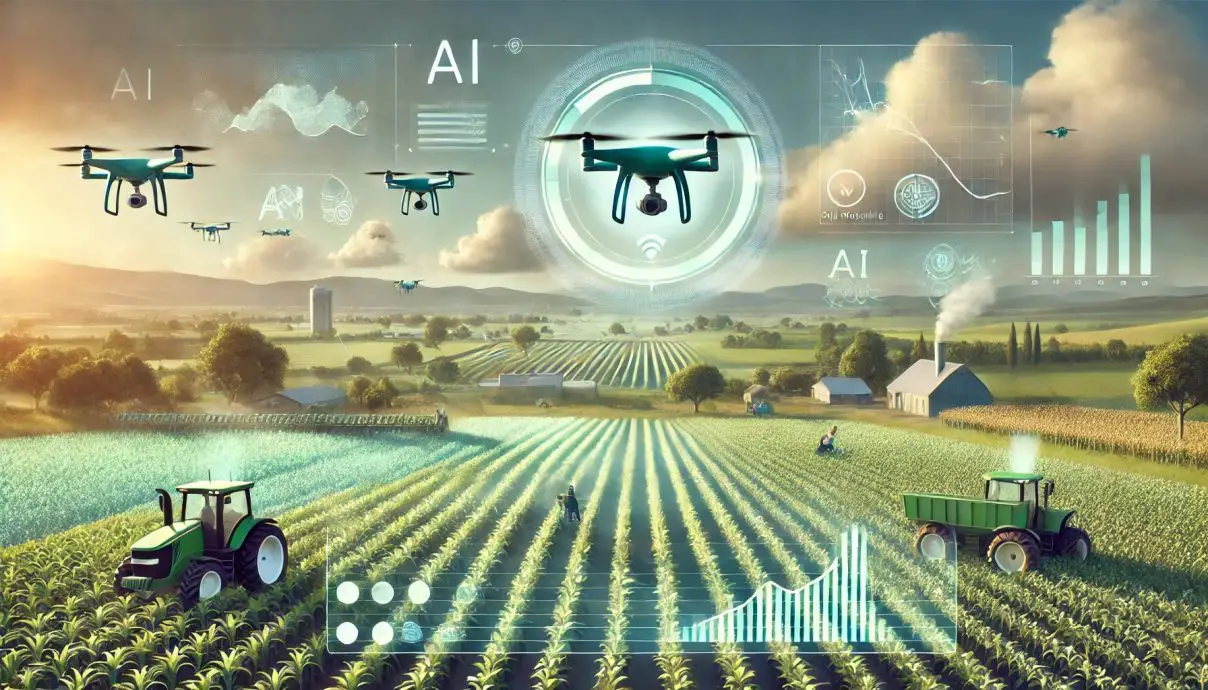
AI for Sustainable Farming Practices is quietly reshaping how we grow food on a warming planet. A McKinsey farm technology survey finds that nearly four in ten United States row-crop farmers were piloting at least one artificial intelligence tool during the 2026 growing season. Water scarcity, soil depletion, and extreme weather have made every tractor pass a sustainability decision that leans on data. Machine learning now stitches together drone imagery, soil sensors, weather feeds, and satellite data into field-level guidance. The practical payoff is clearer than it was five years ago, with measurable cuts to water, nitrogen, and diesel at scale. This article walks through what that looks like on real farms, what still goes wrong, and where the technology is heading next.
Quick Answers on AI Driven Farming
What is AI for sustainable farming practices in one sentence?
AI for sustainable farming practices is the use of machine learning across sensors, imagery, and farm software to grow more food with less water, fertilizer, pesticide, and emissions.
Does AI really cut water and fertilizer use on working farms?
Yes, documented sustainable farming trials cut water withdrawals by 20 to 40 percent and synthetic nitrogen by up to 30 percent, while holding yield steady.
Who benefits most from AI in agriculture today?
Mid-sized commercial farms with cellular coverage benefit most now, while smallholder farmers reach parity through shared cooperatives, cheap mobile advisors, and public-interest models trained on regional data sets.
Key Takeaways on AI Driven Farming
- AI models now translate drone, satellite, and soil sensor data into field-level actions that cut water and fertilizer waste by double digits.
- Regenerative AI pilots across five million acres cut synthetic fertilizer up to 30 percent while holding yield steady or lifting it.
- Smallholder farmers in the Global South gain access through mobile advisors, voice chat tools, and cooperative data platforms rather than six-figure hardware.
- Risks around data ownership, model bias, cybersecurity, and compute energy intensity are real and demand policy guardrails, not simple vendor trust.
Table of contents
- Introduction
- Quick Answers on AI Driven Farming
- Key Takeaways on AI Driven Farming
- What Is AI for Sustainable Farming Practices
- How AI Reads a Field Through Sensors and Imagery
- Precision Irrigation and Water Stewardship Through AI
- AI Driven Nutrient Management and Fertilizer Reduction
- Soil Health, Carbon Capture, and the Rise of the AI Soil Copilot
- AI Guided Pest and Disease Surveillance
- Climate Resilient Crop Planning With Predictive AI Models
- Implementing Autonomous Robots, Tractors, and Field Operations
- AI for Livestock Welfare and Methane Reduction
- AI in Smallholder Farming and the Global South
- Supply Chain, Traceability, and Food Loss Reduction With AI
- Energy, Compute, and the Environmental Cost of AI Itself
- Data Ownership, Farmer Rights, and the Fairness Problem
- Policy, Regulation, and Public Investment in Agricultural AI
- Risks, Ethics, and the Boundaries of Algorithmic Agronomy
- Future of AI for Sustainable Farming Practices Through 2030
- Key Insights From the Front Lines of AI for Sustainable Farming Practices
- Comparing Conventional Farming With AI Enabled Sustainable Farming
- Working Examples of AI in Sustainable Agriculture
- Deep Case Studies in AI Driven Agriculture
- Common Questions About AI Driven Farming
What Is AI for Sustainable Farming Practices
AI for Sustainable Farming Practices is the use of machine learning on sensor, imagery, and weather data to help farmers grow more food while cutting water, synthetic inputs, soil loss, and greenhouse gas emissions across each production cycle.
AI Sustainable Farming Calculator
Estimate the water, nitrogen fertilizer, and CO2 equivalent emissions a working farm can save by adopting the AI tools described in this article. Move the sliders to match your operation.
Farm size (acres)
1000
Crop system
Corn and soybeans
AI adoption depth
Full stack
Baseline water use (acre-inches)
16
Water saved per year
0 million gallons
0% reduction vs baseline
Nitrogen fertilizer saved
0 tonnes
0% reduction vs baseline
CO2e emissions avoided
0 tonnes
0% reduction vs baseline
Model draws on field savings documented by World Economic Forum regenerative agriculture AI coverage and Notebookcheck review of AI optimizing agriculture. Estimates are directional, not precise forecasts.
How AI Reads a Field Through Sensors and Imagery
Building on that definition, the first job of any farm model is to see the field in high resolution. Modern AI systems fuse soil moisture probes, in-row sap sensors, drone multispectral images, and satellite feeds into a single living map of the farm. A convolutional vision model classifies vegetation stress at the plant level, while a time-series model learns how that stress responds to rain, heat waves, and irrigation events over weeks. This fusion is how we move from average field decisions to within-field prescriptions that assign a different nitrogen rate or watering schedule to each hectare. Our team at AIplusInfo has traced this evolution in detail across agri drones and remote sensing coverage, which shows how airborne vision has become the backbone of farm telemetry. The outputs reach a farmer either as a tablet dashboard, a tractor display, or an automated signal that drives a sprayer or pivot. In short, the model becomes the field agronomist that never sleeps and never forgets what happened last August.
The hardware stack behind this process has become dramatically cheaper. A compact LoRaWAN soil probe now costs under forty dollars at bulk, and a quadcopter equipped with a multispectral camera clears field data in under thirty minutes per hundred acres. Satellite providers such as Planet Labs and the European Space Agency Sentinel program publish three-meter and ten-meter imagery that lands in farm dashboards within a day of capture. Edge computers mounted on tractors run small vision models in real time without pinging the cloud, which matters where cellular coverage is thin. Even weather downscaling has shifted onto farms, with hyperlocal AI forecasts that read mesoscale models at the hectare level. The combined effect is that a working family farm can field a sensing stack that would have cost half a million dollars in 2019.
None of this works without careful calibration against ground truth agronomy. Models that look sharp in a training field often lose accuracy in a new climate band, so cooperative extension services and university researchers still perform periodic in-row validation. The best deployments publish their model confidence alongside the recommendation, giving farmers an honest signal of when to override the algorithm. Field-level AI is strongest when the farmer treats it as a trusted colleague rather than a boss. That stance also keeps liability where it belongs, with the human operator who signs the agronomic plan.
Precision Irrigation and Water Stewardship Through AI
Shifting focus to water, AI-driven irrigation is one of the clearest wins the technology has produced on real farms. Agricultural withdrawals account for roughly seventy percent of global freshwater use, and most of that water is applied through flood irrigation and uniform sprinkler passes. Variable-rate irrigation systems paired with soil moisture AI learn how each zone drains, infiltrates, and transpires over a season. A pivot controller then adjusts nozzle output every few meters as it travels around the field, delivering water only where models predict stress will develop next. Published trials from California almond growers show that this approach can cut applied water by 20 to 40 percent without any yield penalty. Similar results appear in Indian rice paddies and Australian cotton, suggesting the gains are broad rather than crop-specific.
Water stewardship is not just about reducing withdrawals, it is also about returning cleaner water to the watershed below. AI drainage models predict when a tile outlet will carry heavy nitrate loads downstream and can trigger controlled holdbacks that let soil microbes process the excess. In California and the Netherlands, model-driven managed aquifer recharge now times winter floods onto fields so that aquifers rise during wet months. Downstream, remote sensing of return flows measures the actual quality improvement, which closes the feedback loop into the next planting season. Our team has mapped how these feedback systems connect to broader climate resilient agriculture strategies in a related piece.
Smallholder farmers in low-income regions reach similar benefits through much simpler tools. A mobile phone chat bot that reads a local weather forecast and asks three questions about recent rainfall can save hours of hand-watering during a dry spell. The International Water Management Institute has demonstrated such tools across Bangladesh and Kenya, with field trials showing water savings between 15 and 30 percent. The cost per farmer is a fraction of what a Western pivot controller costs, which matters when margins are measured in dimes rather than dollars. These lightweight tools now reach millions of smallholder farmers through nongovernmental agencies and development programs that distribute them widely.
Edge cases around AI driven irrigation still appear and matter directly for farm policy conversations today. A model that saves water in a drought year can over correct in a wet year, delivering too little moisture at a critical pollination window. Robust systems therefore blend seasonal climate forecasts, soil memory from previous years, and real-time weather radar before changing a schedule. The best deployments publish a confidence interval alongside their recommendation and allow farmers to override. That design choice separates reliable water stewardship from brittle automation that saves water on paper but creates stress in the field.
AI Driven Nutrient Management and Fertilizer Reduction
Turning from water to nutrients, fertilizer is the other half of the sustainability equation on most farms. Synthetic nitrogen use accounts for roughly four percent of global greenhouse gas emissions through production, transport, and nitrous oxide loss. AI prescription maps generated from soil samples, yield history, and seasonal imagery can shift nitrogen application from a single annual dose to a dynamic schedule. A tractor sidedresser then follows that map and varies output within a single pass, cutting total nitrogen use by 15 to 30 percent in commercial corn and wheat trials. The gains stack even higher when controlled-release coatings are paired with model-driven timing recommendations.
Phosphorus and potassium require a different modeling approach because they move more slowly through the soil column. AI nutrient models combine multi-year soil tests with crop uptake curves to build a nutrient budget that respects both legacy stocks and current need. Growers who adopt this budgeting approach see less runoff into surface water, which protects downstream drinking supplies. The United States Environmental Protection Agency has pointed to nutrient management AI as a key lever for shrinking the hypoxic zone in the Gulf of Mexico. For readers tracking the broader technology stack, we cover related tooling in AI revolutionizes farming with AWS tools.
Nutrient management AI also lowers input costs, which matters to farm economics. A typical United States corn producer spends roughly 180 dollars per acre on fertilizer, and a 20 percent reduction returns real money against a very thin margin. European reports suggest similar savings for rapeseed and winter wheat, where nitrogen prices are even more volatile. The economics make nutrient AI an easier adoption pitch than almost any other sustainability intervention, because the farmer sees both environmental benefit and a clean financial return. That alignment of ecological and economic incentives is rare in agriculture and deserves protection as public policy evolves.
Soil Health, Carbon Capture, and the Rise of the AI Soil Copilot
Beyond water and fertilizer, soil is the slow-moving asset that AI has only recently started to read well. Soil organic carbon is the single most important indicator of long-term farm resilience, and it changes on timescales measured in years. Johns Hopkins researchers introduced the idea of a soil carbon copilot in a peer-reviewed 2024 arXiv paper on enabling regenerative agriculture through soil carbon copilots. Their model fuses lab assay data, climate rasters, management history, and vegetation imagery to forecast soil organic carbon within eight percent of ground truth. For a farmer, that accuracy is enough to decide whether a cover crop rotation actually earns a verified carbon credit.
A soil carbon copilot is less about predicting a number and more about guiding management choices that keep carbon in the ground year after year. The copilot answers practical switching questions such as whether moving from conventional till to strip till will raise soil carbon measurably over five years. It also warns when a field is drifting toward carbon loss through late tillage, bare winter soil, or heavy residue removal. Pilots across Iowa, Illinois, and Minnesota have paired copilots with carbon market registries to produce audit trails that stand up to third-party verification. The combination of model, registry, and audit is what finally turns soil carbon from a lab line item into a tradable farm asset.
Microbial AI is the next frontier under the soil surface. Startups and university labs are sequencing field microbiomes and feeding the data into graph neural networks that predict which microbes drive carbon stabilization. The outputs include tailored inoculants and management advice, which may raise sequestration rates meaningfully above the baseline. Skepticism is still warranted because microbial communities are complex and context-dependent, but early trials in no-till wheat and perennial pasture are encouraging. If this line of research pays off, the soil itself becomes an active carbon accounting partner rather than a passive stock to measure once a decade.
AI Guided Pest and Disease Surveillance
Turning to pests and disease, computer vision has become the quiet engine behind lower pesticide use. Camera-equipped sprayers now identify weeds in a corn or soybean row at tractor speed and release herbicide only on the weed, cutting chemical volumes by 60 to 90 percent. Our team covered one of the most prominent commercial deployments in CNH launches AI sprayer for smarter farming. The savings matter because herbicide drift and residue affect pollinators, drinking water, and farm worker health. Insect surveillance follows a similar logic, with yellow sticky traps now carrying tiny cameras that count target pests and warn growers before a spray threshold is reached. A model that holds the trigger finger for even one unnecessary pass pays for itself in a season.
Disease vision models work by learning from thousands of annotated plant leaves, with recent additions covering wheat rust, cassava mosaic, and tomato late blight. Smartphone apps from the United Nations Food and Agriculture Organization now let smallholder farmers in East Africa diagnose cassava disease from a phone photo with better than eighty percent accuracy. Early detection is often worth more than any treatment, because it enables rogueing before an outbreak sweeps a village or region. The limitation is that image data is still skewed toward large-crop systems, so minor crops and local varieties receive less reliable coverage. Closing that gap requires open data partnerships rather than solo vendor efforts.
Climate Resilient Crop Planning With Predictive AI Models
Stepping back from in-season tactics, long-range AI models now shape what farmers plant in the first place. Seasonal climate forecasts generated by foundation models trained on decades of weather reanalysis data can anticipate drought, heat waves, and heavy rain with usable skill up to six months out. A grower in Iowa can use that signal to shift planting dates, switch to a shorter-season hybrid, or add rye cover ahead of a wet spring. For broader context on how climate shapes agricultural decision-making, we have published a related explainer on AI in climate change and environmental management. These tools are not perfect, and no model will tell a farmer with certainty what next March will bring. They can still move the odds enough to protect yield and reduce stranded inputs during a stressed year.
Crop variety selection is another emerging AI frontier that merits attention from growers and plant breeders alike. Breeding companies run genomic prediction models that match a hybrid or cultivar to the climate envelope expected on a specific farm over the next five years. Public plant breeding programs at CGIAR centers follow a similar approach for rice, millet, and cassava across smallholder regions. These programs lean heavily on open genomic data and farmer-reported performance across diverse environments. The result is faster movement from seed catalog to the farm plot that fits the climate the farmer is actually facing.
Risk management on sustainable farms also runs on these predictive models and now ties farmer solvency to algorithmic triggers. Crop insurance providers now underwrite index based policies using satellite derived vegetation health signals, replacing slow in person claims with automated payouts. The approach has reached millions of smallholder farmers across sub-Saharan Africa, who historically had no viable insurance product. Automation shortens the gap between crop failure and farmer relief from months to days, which keeps families and whole villages solvent. It also redistributes risk from the public purse to private reinsurance markets, which carries its own policy implications worth tracking.
Implementing Autonomous Robots, Tractors, and Field Operations
Building on predictive crop planning, autonomous field machinery is where AI starts to leave the dashboard and move dirt. John Deere, CNH, Monarch, and a dozen startups now sell tractors that drive themselves across a field, aware of row structure, obstacles, and operator intent. The sustainability angle is subtle but powerful because autonomous tractors enable light machinery, smaller passes, and lower-compaction field operations than diesel giants built for human comfort. Soil compaction causes measurable yield losses, so a swarm of smaller robots can lift season-long productivity by five to fifteen percent in field trials. Our team has explored these ideas in a wider view of agricultural robots and in a deep look at the pioneering Ladybird farming robot.
Robot sprayers now represent the single biggest commercial opportunity in autonomous farm equipment across the United States and Europe. Weed seeing systems from Blue River and Carbon Robotics identify a target plant and either apply a tiny herbicide dose or zap the weed with a laser. Field reports indicate herbicide savings of 60 to 90 percent on broadacre crops, which translates to lower chemical runoff into waterways. Even operators who prefer organic systems benefit because mechanical weed robots like the Farmwise and Naio platforms can replace hand hoeing in high-value vegetable rows. The labor shortage in agriculture has made these systems economically viable far faster than many analysts predicted.
Harvest robots are the hardest category because the job demands dexterity, judgment, and speed. Robotic strawberry harvesters now reach commercial throughput in California and Spain, and apple-picking arms are entering trials in Washington State. Energy use per picked kilogram is still higher than for human labor, which complicates the sustainability math. If future versions use lighter actuators and run on solar-charged batteries, that calculus could flip within five years. Progress is also uneven across crops, and leafy greens remain the fastest payoff while vine fruits lag.
Autonomous machines also create new risks that demand attention from operators, insurers, and regulators across every market segment. A rogue tractor is a serious hazard, so safe shutdowns, operator overrides, and physical fencing of autonomous zones all matter. Cybersecurity threats shift from paper to steel, meaning a hack could stop an entire fleet during a critical planting window. Policy makers and farm insurers are still catching up on who bears liability when an autonomous machine damages a neighbor’s crop. The technology is ready, but the social contract that governs it is still a work in progress.
AI for Livestock Welfare and Methane Reduction
Shifting focus to livestock, AI is making the barn and the pasture smarter in parallel to the field. Computer vision models now identify individual cattle, pigs, and poultry in real time, scoring body condition, gait, feeding behavior, and heat stress indicators that used to require trained human observation. Dairy farms using these tools cut vet visits by 20 to 30 percent and lift milk yield through earlier detection of mastitis. Methane monitoring is the second major opportunity because cattle burps account for roughly 14 percent of global agricultural emissions. Our deeper coverage of these themes lives in AI in livestock management and in a case-driven piece on revolutionizing livestock farming with AI technology.
Feed additive trials guided by AI feed intake tracking show that red seaweed, bromoform-free formulations, and 3-NOP can cut enteric methane by 20 to 80 percent depending on the diet. The sustainability math only works if the additive does not harm the animal, the milk, or the farmer’s margin. AI monitoring provides the daily feedback loop that keeps those variables in bounds. Rotational grazing optimization is another lever, with GPS collars and pasture vision models now timing paddock moves to protect root biomass and build soil carbon. The gains compound when a dairy or beef operation layers these tools over several seasons.
AI in Smallholder Farming and the Global South
Shifting focus from large commercial operations, smallholder farmers grow about one third of the world’s food on plots under two hectares. These farmers face different constraints than their commercial peers, with lower capital, uncertain land tenure, limited road access, and intermittent cellular coverage. AI tools that work for them look nothing like a hundred-thousand-dollar sprayer, and they often arrive through a feature phone or an inexpensive Android device. Voice chat tools in local languages let farmers ask questions and receive agronomic answers tuned to their region. Groups like Digital Green, Precision Development, and the CGIAR system have shown measurable yield and income gains when such tools are paired with human extension agents.
Cooperative data platforms are the second lever that makes AI accessible to smallholder farmers. Many small farmers do not generate enough data on their own to train useful local models, so pooled data under a trusted governance structure fills the gap. Projects in East Africa, India, and Vietnam show that when farmers co-own the model, trust rises and adoption follows. Research funded by Australia’s CSIRO has mapped these dynamics in a joint CSIRO Aus4Innovation study of Australia and Vietnam collaboration on inclusive agriculture AI. The governance detail matters as much as the model accuracy, because the alternative is extractive data flows that benefit a distant platform rather than the farmer at the field edge.
Mobile money and index insurance are the quiet complements to AI advisory tools. A farmer who receives an alert to plant on a different date needs a loan to buy improved seed, and a satellite-triggered insurance payout if the forecast fails. The ecosystem works best when AI, mobile finance, extension services, and farmer organizations align around a shared outcome. When any single piece is missing, the model’s benefit evaporates in practice. That holistic framing has emerged as the lesson of a decade of smallholder AI pilots, and it is what distinguishes successful programs from well-intentioned prototypes.
Supply Chain, Traceability, and Food Loss Reduction With AI
Shifting focus to downstream operations, AI is now reshaping the long path from farm gate to grocery shelf. Vision-based grading at packhouses sorts produce by quality within milliseconds, cutting rejection, waste, and arbitrary visual bias that used to drop usable food. Traceability platforms layered with AI predict where a shipment is most likely to spoil, which allows cold chain operators to reroute or discount product before loss. Our broader coverage of this stack sits in AI for supply chain. The United Nations Environment Programme estimates roughly one billion tonnes of food reach waste streams every year, and AI-driven supply chains could cut that figure meaningfully with existing tools.
Blockchain and AI pair well in traceability because the blockchain holds a tamper-evident record while AI reads the sensor streams that feed it. Walmart, Nestle, and Carrefour have run production trials that trace mangoes, infant formula, and pork from farm to shelf within seconds instead of days. Our team has explored these dynamics in blockchain and AI for food traceability. The sustainability benefit lands in two places, with less waste and faster recall when something goes wrong. These systems only reach their potential when retailers, growers, and transporters all participate honestly, which keeps the governance question central.
Energy, Compute, and the Environmental Cost of AI Itself
Shifting from farm benefits to a quieter cost, AI itself consumes energy and water in data centers that live far from the field. Large model training rounds burn megawatt hours of electricity and consume millions of liters of cooling water, and inference across millions of farmer sessions adds a steady load. The sustainability case for farm AI only closes when the compute footprint is small relative to the water, fertilizer, and emissions it displaces in the field. Thankfully, agricultural models are usually tiny compared with web-scale language models, with training compute running in GPU hours rather than months. Still, the industry needs honest accounting of farm AI compute footprints across every tier of the hardware supply chain.
Edge computing shrinks the data center footprint dramatically for farm specific AI deployments across both commercial and smallholder settings. A sprayer running a weed detection model does not need to call a hyperscale cloud for each row, which cuts network energy use and improves response time. Model distillation lets a tiny edge model match larger model accuracy on a narrow task, which is exactly what agriculture needs. Battery-electric tractors paired with solar panels on packing sheds can run both the compute and the field work with on-site renewable power. These design choices make the sustainability math decisively positive on real farms.
Water use by data centers deserves specific attention in agricultural regions. A hyperscale center sited in a water-stressed basin can consume millions of liters per day while nearby farms struggle to irrigate. Transparent reporting on water usage effectiveness, siting rules that favor non-potable sources, and model portability to cooler climates are all tools regulators can use. The agriculture industry has a direct stake in these policy choices because its own water budget depends on them. That alignment of interests is helping drive new transparency standards from data center sustainability frameworks.
Data Ownership, Farmer Rights, and the Fairness Problem
Beyond compute, the thorniest issue in farm AI is who owns the data. Every tractor pass, drone flight, and soil scan generates data the farmer did not create alone, yet the farmer bears all the risk if that data leaks. Vendors frequently claim broad license over data in dense service agreements, which creates a mismatch between data origin and data control. Groups like the American Farm Bureau and European farmer unions have pushed for cleaner contract language and data cooperatives that return control to producers. The debate echoes the broader fight over user data in consumer tech, with higher stakes because food systems depend on trust and continuity.
Model fairness is the second edge of this problem and shows up most clearly in every tropical smallholder deployment at scale. Training data skews heavily toward large commercial operations in temperate climates, which leaves tropical smallholder systems with less accurate models. Researchers at the Wageningen University and the Alan Turing Institute have documented measurable bias in disease detection models that were trained in European trials and then deployed in African fields. Fairness fixes include targeted data collection, local fine-tuning, and public benchmarks that force vendors to publish accuracy by region and crop. Our team maintains ongoing coverage of these themes in AI bias and fairness metrics explained.
Cybersecurity ties the data rights and model fairness arguments together under one urgent operational heading for farm managers. A connected sprayer, pivot, or robot represents a soft target for ransomware and sabotage from motivated adversaries. A disrupted irrigation schedule during a heat wave can turn into a crop failure within days, and the ability to attack a food system is a real geopolitical concern. Insurers, agencies, and farm cooperatives are developing playbooks that treat farm AI with the same seriousness as hospital or utility networks. The problem is not theoretical, with documented attacks in 2024 and 2025 that halted entire grain-handling operations for days. Farmers need the same cyber hygiene budget that any serious industrial operator maintains.
Policy, Regulation, and Public Investment in Agricultural AI
Shifting focus to the public sphere, agriculture receives more public money than almost any other sector, and that spending is now shaping AI adoption. Governments in the European Union, United States, Canada, and India have announced new programs that condition subsidy payments on measurable sustainability outcomes, which AI tools can verify at scale. The United States Department of Agriculture has committed over three billion dollars to climate-smart commodities since 2022, including AI monitoring, verification, and extension support. Similar efforts in the European Common Agricultural Policy tie direct payments to practices that AI can audit through satellite imagery. Together these policies make AI verification a condition for public money, which steers farm investment toward sustainable practices faster than voluntary programs ever did.
Open data policies make or break the pace of adoption. Where governments publish free satellite imagery, free weather station data, and open soil maps, AI developers build useful tools faster and more cheaply. Where that data sits behind paywalls or vendor contracts, innovation slows and the benefits concentrate with large players. The United States Landsat program, the European Copernicus program, and the United Nations Food and Agriculture Organization open data commitments are quiet infrastructure wins that deserve more public attention. Our team has analyzed how these policy dynamics shape adoption in AI governance trends and regulations.
Risks, Ethics, and the Boundaries of Algorithmic Agronomy
Beyond policy mechanics into deeper ethics, algorithmic agronomy has limits worth stating plainly. Any system that optimizes a measurable outcome will underweight outcomes that are hard to measure, so biodiversity, wild pollinator populations, and non-crop species often drop out of the optimization function. That blind spot can turn a water-saving farm into a biodiversity desert if the model is not corrected explicitly. Ethical frameworks developed by the United Nations Food and Agriculture Organization now ask vendors to publish the loss function, the training population, and the known failure modes. Our broader perspective lives in AI ethics and laws and in the pollinator-aware section of our regenerative coverage.
Market concentration is the other systemic risk that policy makers watch closely across every maturing agricultural technology stack. A small number of agribusiness firms already control significant shares of seed, fertilizer, and farm equipment markets. If those same firms become the gatekeepers of farm AI, the result could be a tightly coupled system where farmers lose practical autonomy. Independent farmer-owned platforms, open source models, and public breeding programs offer a counterweight. Policy makers in the European Union have signaled through the Agricultural Data Act that they take this risk seriously. The outcome will shape rural economies and food system resilience for decades.
Finally, there is a cultural question that no model can answer. Farming is a vocation grounded in generations of place-based knowledge, and that knowledge is encoded in bodies and routines rather than in training data. The best AI deployments treat that embodied knowledge as the first draft of the model, not an obsolete artifact. When AI is layered onto farmer knowledge rather than against it, both improve. That stance is quietly reshaping extension services, agricultural colleges, and even seed catalogs across the world.
Future of AI for Sustainable Farming Practices Through 2030
Looking ahead to 2030, five developments are already visible in research pipelines. Agricultural foundation models trained on multi-decade satellite, soil, weather, and genomic data will replace today’s narrow single-task models with general-purpose assistants that handle anything a farmer asks. Autonomous swarms of small robots will handle planting, weeding, scouting, and harvesting on small plots that current big machines cannot serve. Verified carbon and biodiversity credits backed by AI monitoring will become routine income streams for farms that adopt regenerative practice. Smallholder farmers will enter these markets through cooperatives using the same tools, closing part of the gap with commercial peers. For context on these broader trends, our team has mapped the full landscape in harnessing AI for a sustainable energy future.
The quiet reorganization under all these futures is one where food systems become legible to policy in ways they never have been. Satellite imagery, farm telemetry, and verified ledgers can produce a shared picture of how each hectare performs. That transparency is uncomfortable for some actors, and it will likely drive new regulatory fights over farmer rights, data access, and public money. The farmers who thrive will be the ones who learn to work with AI as a partner rather than a boss. That partnership, maintained carefully, is the sustainable farming practice that AI makes possible in the decade ahead.
Chart From AIplusInfo
Documented resource savings from AI tools on working farms
Field-trial reductions versus conventional practice, by resource. Toggle switches between water and nitrogen use cases.
Source: Field-trial values compiled from Notebookcheck review of AI optimizing agriculture and World Economic Forum regenerative agriculture AI coverage.
Key Insights From the Front Lines of AI for Sustainable Farming Practices
- Nearly four in ten United States row-crop farmers were piloting AI in 2026 according to the Bloomberg Government summary of the McKinsey farm technology survey. Adoption now outpaces every prior farm technology by a wide margin, which analysts call unprecedented in modern farming history.
- Regenerative pilots documented in a World Economic Forum feature on regenerative agriculture AI cut synthetic fertilizer by up to 30 percent across five million acres. The pilots also held or lifted yield across the regenerative acreage, which proves the sustainability trade off is weaker than critics claimed.
- AI variable rate irrigation cuts water withdrawals by 20 to 40 percent in field trials spanning California almond groves, as summarized in a Notebookcheck review of farm AI. Yields stayed steady or improved slightly, which has made this the easiest adoption pitch across water stressed regions.
- AI potato yield modeling in Scotland lifted yield 10 percent while cutting carbon intensity 15 percent, per the Scottish Farmer potato program coverage. The result shows yield gains and emission cuts can coexist when AI directs irrigation, nitrogen, and harvest timing together.
- Johns Hopkins researchers in an arXiv soil carbon copilot paper describe an AI system that predicts soil organic carbon within eight percent of lab assays. The accuracy is close enough to underwrite verified carbon credit markets at commercial scale across the United States corn belt.
- The United Nations ITU AI for Good feature on Brahmworks describes an AI advisor that lifted farmer income by 20 percent. The same program also cut fertilizer use by one quarter across 400,000 Indian smallholder farms in just three operating years.
- Research in the CSIRO Aus4Innovation collaboration on inclusive agriculture AI shows farmer co owned platforms triple adoption versus vendor only tools. The gap suggests governance design matters as much as model accuracy for scaling smallholder AI.
Synthesizing these findings, the picture is one of a technology that has moved from laboratory curiosity to measurable commercial impact. The gains are uneven, and smallholder farmers reach parity only through intentional governance, open data, and public investment that match private spending. Water savings, fertilizer cuts, and verified carbon are the three outcomes most likely to anchor policy over the next decade. Energy and water consumed by AI compute still trail field savings by orders of magnitude, yet transparency on that footprint remains essential. The adoption curve looks less like hype and more like the quiet professional arrival of GPS guidance across the farm sector.
Comparing Conventional Farming With AI Enabled Sustainable Farming
The contrast between conventional practice and AI enabled sustainable farming now shows up across eight concrete dimensions. Water, nutrients, pesticide, soil carbon, verification, decision cadence, information flow, and accountability all look different when a model enters the field. The table below pairs each dimension with its old and new state so growers and policy makers can see the gap at a glance. The gaps favor AI enabled operations in every row, though cost sharing and data governance remain active debates. The table also doubles as a quick reference for extension agents and policy makers who need to brief newcomers on the shift under way.
| Dimension | Conventional Farming | AI Enabled Sustainable Farming |
|---|---|---|
| Water Use | Uniform irrigation, 70 percent of global freshwater withdrawals | Zone level variable rate schedules, 20 to 40 percent reduction |
| Fertilizer Use | Blanket applications timed by calendar | Prescription maps, 15 to 30 percent reduction with equal or higher yield |
| Pesticide Use | Broadcast spraying at scheduled intervals | Vision guided spot spraying, 60 to 90 percent reduction |
| Soil Carbon Measurement | Lab assays every three to five years | AI soil copilot predictions within eight percent of lab, monthly updates |
| Transparency and Verification | Paper records and in person audits | Satellite verified ledgers with third party audit trails |
| Decision Making Cadence | Weekly or monthly, driven by scouting | Daily or sub daily with real time model recommendations |
| Information Flow and Participation | One way from supplier to farmer | Two way with cooperative data governance and farmer owned platforms |
| Accountability for Externalities | Shared diffusely across supply chain | Field level accounting of water, carbon, biodiversity, and nutrient loss |
| Service Delivery to Smallholders | Limited by distance and cost | Mobile phone advisors, voice tools, and co op platforms reach millions |
Working Examples of AI in Sustainable Agriculture
Three working deployments show how AI shifts the field economics of sustainable agriculture in very different settings today. The See and Spray platform on United States soybeans, the Branston potato program in Scotland, and the Pula insurance network reach vastly different farmer populations. Each system demonstrates a distinct and measurable path to sustainability gains across water, carbon, and fertilizer use. These are commercial deployments at scale, not pilots, which makes them useful anchors for anyone sizing up adoption. Each one also carries limitations that help calibrate expectations for similar rollouts.
John Deere See and Spray on United States Soybeans
John Deere See and Spray Ultimate pairs a vision model with per nozzle control on a conventional sprayer. The system is implemented and deployed across more than 1 million acres on United States Midwest soybean farms. Early commercial reports gathered by a detailed Farmonaut analysis of agriculture technology trends show roughly two thirds herbicide reduction while matching the weed control of a broadcast pass. The system is still limited in high residue fields and in minor crops where training data remains thin, which forces farmer judgment and periodic retraining. Deere also controls the data pipeline and the subscription model, which raises the data ownership concerns described earlier in this article. The economic payback is roughly eighteen months for a mid sized operation, which has sped broader adoption. Growers now piloting the system report cleaner herbicide inventories and simpler compliance reporting across their operations.
AI Driven Potato Carbon and Yield Program in Scotland
Branston Potatoes partnered with B hive Innovations to roll out an integrated AI stack that was deployed across more than 20,000 hectares of Scottish grower land. Published results in a Scottish Farmer feature on potato growers cutting carbon and lifting yields show roughly 10 percent yield gains and 15 percent carbon intensity reductions on trial fields. The platform guides irrigation, nitrogen application, and harvest timing with daily recommendations that farmers can override through a dedicated mobile app. The limitation at scale is cost sharing, since full stack adoption remains out of reach for very small growers who lack a data history. Branston addresses this gap by subsidizing the technology stack across its grower network, which blunts the inequity but does not eliminate it. Independent growers who sell on the open market still face full sticker prices for the full stack.
Satellite Index Insurance for Smallholders in Kenya and Senegal
Pula Advisors runs a satellite driven crop insurance program that was deployed across Kenya, Senegal, Nigeria, and twelve other African nations starting in 2015. The program has enrolled over fifteen million smallholder farmers and processed over fifty million dollars in payouts. The deployment pattern is documented in a United Nations ITU AI for Good writeup of regional AI startups. Automated payouts land in farmer mobile money accounts within two weeks of a drought trigger, which replaces slow in person claims. The main limitation is basis risk, since the satellite index does not perfectly match actual farm damage during localized events like hail. Pula addresses basis risk by layering ground truthing calls and farmer surveys, though the speed versus accuracy trade still exists. Still, the deployment stands as the largest working example of climate risk insurance operating profitably at smallholder scale.
Recommended Reading on AI and Sustainable Farming
Three curated books that complement this guide and go deeper into the agronomy, policy, and food system context behind AI driven sustainable agriculture.

The One-Straw Revolution: An Introduction to Natural Farming
Foundational text behind regenerative farming, essential context for AI systems guiding low-input methods.
Buy on Amazon
The Omnivore’s Dilemma: A Natural History of Four Meals
Michael Pollan’s landmark investigation of food systems makes the problems AI now tries to solve legible.
Buy on Amazon
Climate Smart Agriculture: Building Resilience to Climate Change
Springer research volume that forms the scientific backbone for most AI deployment programs today.
Buy on AmazonAs an Amazon Associate, AIplusInfo earns from qualifying purchases.
Deep Case Studies in AI Driven Agriculture
Three deeper case studies trace the structural journey of AI sustainable farming across three very different farming worlds. The cases span smallholder India, mid scale European contract farming, and African smallholder insurance networks at commercial scale. Each case has a documented problem, a technology solution, a measurable impact, and a stated limitation worth noting. Together they show that AI driven farming works in very different institutional settings when policy, finance, and farmer organizations align. They also show where the system still falls short, which is where policy attention should flow next.
Case Study: Brahmworks and the Decarbonization of Indian Smallholder Farming
Brahmworks is an Indian startup profiled by the United Nations ITU AI for Good feature on Brahmworks decarbonizing Indian agriculture. The company faced a stubborn problem that national policy had struggled to solve, which was fragmented soil health data and heavy overuse of synthetic nitrogen. Brahmworks built a mobile first advisor as the solution, deployed across seven Indian states and reaching roughly 400,000 smallholder farmers. The platform fuses satellite imagery, remote sensing, and farmer reported practices to generate soil carbon and nutrient prescriptions. Reported impact includes average farmer income gains of 20 percent and fertilizer reductions near 25 percent per season.
The limitation set is instructive and worth stating openly for other operators to learn from today. Model accuracy still falls on minor crops like millets where training data lags, and smartphone penetration still limits reach into the very poorest villages. Carbon credit revenue has arrived more slowly than projected because registry backlogs stretch twelve to eighteen months on average. Brahmworks addresses these problems with targeted data collection, a voice first interface, and pre financing agreements with carbon buyers. The impact at 400,000 farmers represents one of the largest smallholder AI deployments ever recorded in a single country. The combination of agronomic, policy, and finance work shows how AI for sustainable farming scales in a dense smallholder setting.
Case Study: Branston Potatoes and the Scottish Carbon Yield Program
Branston Potatoes supplies major United Kingdom supermarket chains with roughly 500,000 tonnes of potatoes annually and faced a specific problem. Retailer demand for lower carbon produce ran into grower margin pressure from rising input costs across the Scottish potato belt. Branston deployed an integrated AI solution with B hive Innovations and university researchers that covers yield, carbon, water, and nitrogen. The Scottish Farmer feature on potato growers cutting carbon documents 10 percent yield gains and 15 percent carbon intensity reductions. The program covers more than 20,000 hectares of trial fields across Scotland. The system includes a mobile app for daily recommendations that growers can override, which keeps human judgment at the center of every decision.
Cost sharing between buyer and grower is the limitation that still constrains full industry scale across the United Kingdom. Branston subsidizes the stack for its own network, but independent growers who sell on the open market face full sticker prices without buyer support. Supermarket retailers capture most of the carbon reputation benefit without directly funding grower adoption of the solution. Branston addresses this through long term contracts and premium pricing for low carbon potatoes, which does not scale automatically to small growers. Over 20,000 hectares with verified yield and carbon gains still represents one of the largest working deployments of AI in regenerative agriculture today. The pattern suggests that vertically integrated buyers can accelerate adoption of AI driven sustainable farming faster than individual farms alone can manage.
Case Study: Pula Advisors and Climate Risk Insurance in Sub Saharan Africa
Pula Advisors runs the largest satellite driven crop insurance program for smallholder farmers across seventeen African nations as of 2026. The company faced a stubborn structural problem, which was that in person claims adjustment is uneconomic on plots of under two hectares each. Pula built a satellite derived solution that interprets vegetation health indices to detect drought and flood stress at village level and triggers automated mobile money payouts within two weeks. The ITU AI for Good feature on Brahmworks and African AI startups situates Pula alongside similar examples reaching farmers most exposed to climate risk globally. Cumulative payouts have exceeded fifty million dollars since the 2015 launch, keeping families and whole villages financially solvent through climate shocks.
The main limitation is basis risk, meaning the satellite index does not perfectly match on farm damage during localized hail storms or pest outbreaks. Pula layers ground truthing calls and farmer surveys to reduce false negatives, and it adjusts triggers over time with each new data vintage. Policy risk is a second concern because many African governments subsidize insurance premiums and could pull back funding during fiscal stress. Pula addresses this through reinsurance from international partners and by diversifying its product mix across many crops and nations. Impact at fifteen million enrolled farmers is enough to shift the macro picture, giving smallholder agriculture a form of climate resilience it previously lacked.
Common Questions About AI Driven Farming
AI for sustainable farming practices applies machine learning across sensors, imagery, weather data, and farm software. The goal is to grow more food with less water, lower fertilizer use, lower pesticide volumes, and reduced greenhouse gas emissions. These tools now reach commercial farmers and smallholder farmers in parallel across every major agricultural region.
Documented commercial trials cut applied water by 20 to 40 percent in almond groves, cotton fields, and rice paddies across three continents. The savings come from zone-level scheduling that only waters where next-day plant stress is predicted by the model. Yield stays constant or improves slightly in most settings, which has made this one of the easier adoption pitches for growers.
Yes, variable-rate nitrogen programs guided by AI prescription maps reduce total synthetic nitrogen by 15 to 30 percent in commercial trials. The approach pairs soil samples, yield history, and seasonal imagery to time applications precisely across each hectare of a working farm. Growers who adopt the model also report lower nitrate runoff into surface water, which supports downstream drinking water quality.
Smallholder farmers reach these tools through mobile phone advisors, voice chat bots in local languages, farmer cooperatives, and public breeding programs. Platforms such as Pula Advisors and Brahmworks already serve millions of smallholder farmers at per-user costs measured in a few dollars per season. Public investment and farmer-owned data cooperatives have been the biggest levers that make this reach economically viable.
A soil carbon copilot is an AI tool that forecasts soil organic carbon changes under different management scenarios on a specific farm. It helps growers decide whether a cover crop rotation or no-till program will raise carbon enough to earn verified carbon credit revenue. The best copilots now predict within eight percent of lab assay results, which is close enough to underwrite independent third-party verification.
Computer vision models identify weeds in a row at tractor speed and release herbicide only on the target plant, cutting chemical volumes by 60 to 90 percent. Similar models diagnose plant disease from smartphone photos with better than eighty percent accuracy for major crops like cassava, wheat, and tomato. Early detection is often worth more than any treatment because it enables action before an outbreak sweeps a region.
Agricultural models are small compared with web-scale language models and typically train in GPU hours rather than months of compute time. Edge computing further shrinks the data center footprint, so the compute energy use is tiny next to the fertilizer and fuel savings AI delivers in the field. Honest industry accounting of this footprint remains essential as the sector scales further.
Ownership depends on the service contract, and many vendors claim broad license over farm data in dense agreements farmers sign. Growers can push for data cooperatives, cleaner contract terms, and open standards that keep practical control at the farm level. Farm unions and policy makers are active on this question across the European Union, United States, and India.
Modern autonomous tractors include multiple obstacle sensors, safety overrides, and virtual geofencing that reduce workplace injury risk. Smaller, lighter autonomous machines are often safer than large diesel tractors and cause less soil compaction over the growing season. Cybersecurity remains the newer and underappreciated risk vector that insurers and farm associations are only starting to address.
Yes, when combined with feed additives, rotational grazing optimization, and vision-based health monitoring, AI tools support enteric methane cuts between 20 and 80 percent. The real-world performance depends on diet, breed, and management practice at each operation. Honest trials and transparent reporting are essential because the industry has a long history of overclaimed emission reductions.
Routine tasks like scouting, weed spraying, and harvest will shift toward machines over the next decade across most high-value crop systems. Skilled roles in agronomy, data interpretation, and robot maintenance will grow in parallel and demand new training pathways. Transition programs for farm workers are now a central policy question across the sector in every major agricultural economy.
In mature deployments, AI yield forecasts match in-season agronomic estimates within three to seven percent, and sometimes beat them. Accuracy drops in untested climates or in minor crops where training data remains thin, so results come with confidence intervals attached to each prediction. Growers who treat the forecast as a decision aid, not a certainty, see the best outcomes.
Governments publish satellite imagery, weather station data, and open soil maps that AI developers rely on to build useful farm tools. Programs like the United States climate-smart commodities initiative and the European Common Agricultural Policy tie subsidy payments to AI-verifiable sustainability outcomes. Open data commitments remain the quiet infrastructure win that keeps innovation accessible to small developers.
The biggest systemic risk is concentration of control over farm data and models within a few agribusiness firms that already dominate seed and fertilizer markets. That outcome could reduce farmer autonomy and lock producers into vendor platforms for a generation. Open data, farmer cooperatives, and strong public breeding programs offer the clearest counterweight to this concentration risk.