
Introduction
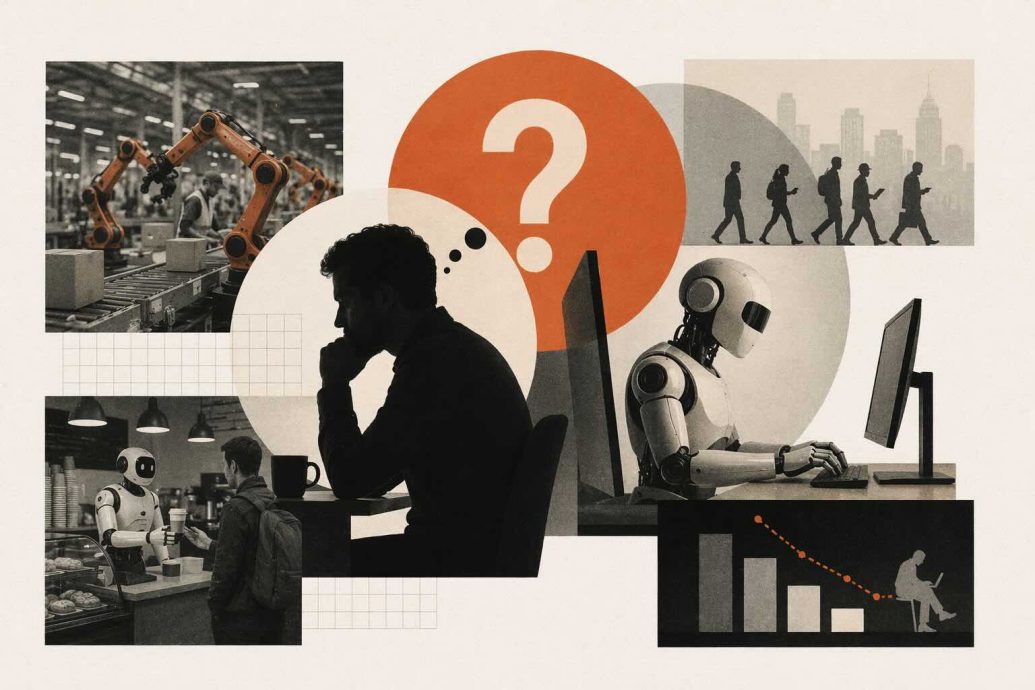
The sixth episode of The Age of A.I. walks viewers onto a quiet rural highway where driverless trucks hum past darkened diners. Robert Downey Jr. narrates as truckers, cashiers, and warehouse workers describe jobs slipping away to machines faster than many expected. The World Economic Forum estimates that by 2030, global automation could displace 92 million roles while creating 170 million new ones, according to its Future of Jobs analysis. That forecast sits uneasily beside the worn boots and quiet dread shown on screen in the episode. The filmmakers refuse easy optimism, letting workers voice anger, grief, and even cautious curiosity about automation. Experts including Kai-Fu Lee and labor economists appear to reframe the conversation around human augmentation. This guide unpacks every major argument, character, and statistic the documentary places in front of viewers.
Featured Snippets
What is the Age of A.I. Season 1 Episode 6 about?
The Age of A.I. Season 1 Episode 6, titled Will a Robot Take My Job, examines how automation reshapes trucking, warehouses, offices, and creative work, featuring Kai-Fu Lee and displaced workers telling their own stories.
Who hosts the automation episode of The Age of A.I.?
Robert Downey Jr. hosts The Age of A.I., interviewing Kai-Fu Lee, labor economists, truckers, and retrained workers across the episode, framing automation as a shared social challenge rather than an isolated workforce problem.
Will a robot take my job according to experts in the documentary?
Experts in the episode argue most jobs face task-level automation rather than full replacement, with augmentation reshaping skills, wages, and career paths more than eliminating occupations outright across the next decade.
Key Takeaways
- The episode reframes automation as task-level disruption rather than whole-job replacement across most industries featured on screen.
- Kai-Fu Lee argues empathy, creativity, and care work remain durable human strengths that AI systems cannot replicate at scale.
- Small-town economies face disproportionate automation pain, since single-employer job losses cascade into schools, hospitals, and retail districts.
- Re-skilling programs help some workers transition, though coordination gaps between employers, schools, and agencies weaken their overall effectiveness.
Table of contents
- Introduction
- Featured Snippets
- Key Takeaways
- Definition
- Inside the Episode That Rattled Every Office Worker
- Meet Kai-Fu Lee, the Voice Behind Automation’s Warning
- The Truck Stop Where Automation Arrived Overnight
- Workers Telling Their Own Displacement Stories
- The Economist Who Pushed Back Against the Panic
- Re-skilling Programs Promising a Soft Landing
- How Machine Learning Actually Replaces Human Tasks
- The Difference Between Augmentation and Replacement
- Small-Town Economies Caught in the Algorithm’s Path
- Real Case Studies Pulled From the Labor Data
- The Creative Professions Nobody Thought Would Face AI
- Ethical Lines Few Employers Are Willing to Draw
- Policy Tools Governments Are Already Testing
- Social Safety Nets and the Universal Basic Income Question
- What the Next Decade of Work Could Actually Look Like
- How the Episode Changed Everyday Conversations About AI
- Key Insights
- Real-World Examples
- Case Studies
- FAQs
Definition
Job automation is the process of using machines, software, or AI systems to perform tasks previously completed by human workers, reshaping occupations through replacement, augmentation, or task redesign within existing workflows rather than wholesale elimination.
Inside the Episode That Rattled Every Office Worker
Episode six opens with Robert Downey Jr. behind the wheel of a self-driving truck humming along a test track. The camera cuts to a family dinner where a veteran trucker explains what automation could mean for his house. Viewers quickly realize the episode targets white-collar anxieties as much as blue-collar hardships across every featured workplace. Producers interlace automation anxiety with optimistic voices who argue technology has historically created more jobs than it erased. This tonal balance defines the hour and keeps the audience engaged without tipping into nihilism or techno-utopianism.
What sets this installment apart is the filmmakers’ refusal to treat automation as either an inevitable villain or benevolent savior. Robert Downey Jr. keeps pushing interviewees past easy soundbites into messier territory about retraining, dignity, and time. Producers cut between engineers in Silicon Valley labs and truck drivers debating futures at late-night diner booths. That editorial balance echoes a wider cultural conversation about how robots are taking our jobs across modern sectors. Viewers walk away questioning their own employment more deeply than most news coverage of automation usually allows.
Meet Kai-Fu Lee, the Voice Behind Automation’s Warning
Kai-Fu Lee anchors many of the episode’s most quoted moments with calm, engineer-trained clarity about where AI excels and fails. The former Google China chief now runs Sinovation Ventures, investing in AI startups across Beijing, Shanghai, and Silicon Valley. His book AI Superpowers frames a near future where routine cognitive work faces displacement on a global industrial scale. Lee argues that empathy, creativity, and social nuance remain difficult for machines to simulate at meaningful commercial depths. The show uses his expertise to ground speculative claims in investor-tested data rather than relying on pure punditry alone.
Lee’s authority comes partly from a cancer diagnosis that reshaped his perspective on productivity, ambition, and the meaning of useful work. He tells producers that his illness forced a genuine reckoning with how much of his own output was routine. The confession lands harder because it comes from a technology investor rather than a humanities professor critiquing capitalism. Producers use his reflection as a pivot toward the episode’s later sections on human-machine collaboration patterns emerging across industries. This confessional moment gives the documentary emotional grounding that statistics alone could never quite supply on camera.
The Truck Stop Where Automation Arrived Overnight
Truck driving employs roughly 3.5 million Americans, making it one of the largest blue-collar occupations across the country. Episode six visits a highway corridor where pilot autonomous trucks already move freight between test hubs with limited human oversight. The drivers interviewed speak candidly about mortgages, children in college, and the specialized skills that still matter on rural routes. Producers capture the emotional weight of watching an industry shift without clear retraining pathways or policy protection. The American Trucking Associations publishes updated labor data on the ATA economics and industry page for reference. Some drivers express hope that autonomy stays stuck on highways, leaving pickups, repairs, and local deliveries to humans. This qualified optimism coexists uneasily with deeper fears about mid-career displacement and insurance coverage gaps widening.
Truck stops, diners, motels, and mechanics depend heavily on drivers stopping for coffee, beds, repairs, and conversation. When trucks stop stopping, these businesses lose foot traffic, which cascades into tax revenue shortfalls for small municipal governments. Some towns have begun planning economic diversification, while others remain focused on short-term survival rather than long-term pivots. Analysts warn that automation’s economic ripples often extend several occupations beyond the primary displaced workers themselves. Freight logistics shapes rural America beyond trucking alone, touching restaurants, gas stations, and roadside service industries across many states. Readers tracking these ripples can review AI disrupting the trucking industry for ongoing sector updates.
What makes this truck stop story universal is that it previews disruption patterns now appearing in warehouses, call centers, and office parks. Automation rarely arrives gradually across an industry, instead hitting specific tasks, shifts, and routes with sudden operational precision. Workers describe feeling blindsided, even when trade publications had been forecasting these transitions for years in advance. Producers capture one driver’s wife asking quiet questions about retirement, health insurance, and the children’s tuition plans next year. The scene refuses cheap sentiment, instead letting the family work through real financial math on camera without interruption.
Workers Telling Their Own Displacement Stories
A transition from macroeconomic data to personal stories gives the episode its most memorable scenes across the hour. Workers speak directly to the camera, describing the exact moment they realized automation had arrived inside their workplaces. A warehouse supervisor recounts watching robots arrive on pallets labeled with cheerful logos promising efficiency gains for the facility. A fast food manager notes how self-order kiosks now handle tasks her cashiers used to complete with human warmth. Each story avoids caricature, capturing ambivalence rather than simple villainy from employers deploying these new automated systems. Producers let the silences breathe, refusing to underscore emotions with heavy-handed music or leading interview questions.
Several interviewees insist that losing work is not the same as losing identity, though the two overlap uncomfortably for many. One laid-off journalist describes how AI summarization tools compressed his beat into a weekend assignment for a single freelancer. Another, a legal document reviewer, lost her position when software started classifying contracts overnight with near-perfect accuracy. Both workers emphasize that nobody asked their input on the new systems or the transition timeline for their roles. This absence of worker voice in automation rollouts becomes a recurring criticism throughout the remainder of the episode.
Not all interviewees express defeat, with some finding unexpected new directions after initial displacement felt like an ending. A truck driver retrains as a fleet logistics coordinator, leveraging his operational knowledge for the same company that replaced him. A warehouse worker transitions into maintaining the robots that now handle her former picking duties across three warehouses. These success stories receive honest framing, including the luck, timing, and employer investment required for each transition. Producers do not universalize these outcomes, instead reminding viewers that many workers never receive similar second chances for meaningful reinvention. Further context on similar transitions appears in pieces like working with AI real stories from the wider web.
The Economist Who Pushed Back Against the Panic
A transition from individual testimony to academic counterweight introduces economists who challenge the episode’s more alarming predictions about jobs. MIT labor economist David Autor appears briefly, arguing that automation historically creates more jobs than it eliminates overall. His research documents how bank tellers actually grew in number after ATMs arrived, because branches became cheaper to operate widely. Autor cautions against assuming this pattern repeats automatically, since specific task automation matters more than aggregate forecasts suggest. His published research archive sits on the MIT Economics faculty page for David Autor for deeper reading. The episode uses his voice to balance Kai-Fu Lee’s more cautionary framing without dismissing either perspective outright.
Autor’s pushback matters because it reminds viewers that economic history complicates simple narratives about machines replacing humans in linear patterns. Workers historically shifted from farms to factories, from factories to offices, and from offices to service and knowledge roles. Each transition caused real pain concentrated in specific regions, while aggregate employment eventually recovered and often expanded across decades. The current wave of AI may follow similar contours, though the speed and breadth of change could differ significantly. Producers give Autor enough time to make his case without letting optimism dilute the earlier emotional weight of displaced workers.
Other economists featured caution that aggregate optimism masks concentrated suffering in specific communities often stranded without retraining resources. The disruption tends to hit workers over forty hardest, since retraining investments rarely match the time and effort required. Women, minorities, and rural workers face compounded hurdles, including childcare access, transportation gaps, and network disadvantages during transitions. Producers lean on this nuance to complicate any reading of Autor’s views as blanket reassurance for the audience. This evenhanded framing strengthens the episode’s credibility and aligns with broader analyses of AI and the future of work online. Viewers leave understanding that macroeconomic trends and personal outcomes rarely align as cleanly as data visualizations suggest.
Re-skilling Programs Promising a Soft Landing
A transition from diagnosis to prescription shifts the episode toward re-skilling programs now piloted across industries, unions, and states. Community colleges have expanded evening credentials in data analytics, logistics coordination, renewable energy installation, and allied health technician roles. Some employers subsidize tuition, while others offer paid release time, and a few prefer to simply hire external replacements instead. Workers interviewed express cautious appreciation for these programs, though they warn that program quality varies enormously across regions. Coordination between employers, schools, and public agencies remains a persistent weakness that slows meaningful worker transitions across geographies.
Re-skilling alone will never rescue everyone, a point the episode makes by following workers whose programs never matched local job openings. Producers visit a retrained coal miner pursuing solar installation certifications, only to find local demand still insufficient for full-time work. His story captures a systemic gap between retraining supply and actual labor market demand in many affected communities. Policymakers featured argue for deeper coordination between workforce development boards, employers, and regional economic planning agencies across states. The scene refuses easy redemption arcs, honoring the complexity real workers navigate when retraining fails to deliver promised outcomes.
Automation Anxiety Across Industries Featured On Screen
A transition from trucking to broader industries shows how automation anxiety crosses sectors most viewers assumed were relatively safe. Radiologists appear briefly, discussing AI image analysis tools now capable of flagging tumors with accuracy rivaling senior physicians. Paralegals describe contract review platforms that now process documents in minutes, replacing tasks that once filled entire billable afternoons. Call center agents walk viewers through voice recognition systems handling routine inquiries faster than most human agents manage. Each vignette lasts only a few minutes, yet together they reframe automation as a white-collar issue beyond factory floors.
The breadth of exposure surprises viewers who assumed higher education guaranteed some protection against automation-driven job disruption. Episodes cover graphic designers, junior accountants, and even entry-level software developers facing generative AI tools that handle common tasks. Producers use the montage strategically, signaling that no single industry or education level offers complete immunity from transition pressures. Readers curious about which fields face the greatest risk can consult jobs most protected from AI for detailed rankings. The section closes with one senior manager admitting his own role may disappear within the next decade.
How Machine Learning Actually Replaces Human Tasks
A transition from anxiety to mechanics explains how machine learning actually ingests tasks previously requiring human judgment across industries. Systems train on historical data, identifying patterns that allow automated tools to replicate decisions, outputs, and actions at scale. Supervised learning suits well-bounded tasks with clear examples, such as email classification, image tagging, or fraud detection alerts. Reinforcement learning fits decision sequences, where software gets feedback signals over thousands of simulated iterations for each new challenge. Generative models now handle unstructured outputs like text, images, and even code, expanding automation beyond clearly structured tasks.
Every automation story begins with a specific task being mapped, measured, and modeled, not a job being entirely erased at once. Jobs bundle many tasks, some routine, some creative, some relational, with machines rarely handling the full bundle effectively. Automation therefore tends to reshape jobs rather than eliminate them, unless the bundle collapses to a single automatable task. That framing matters because it shifts the strategic question from job loss to task redesign inside existing roles. Producers reinforce this point through engineer interviews, where practitioners describe modeling individual workflows before deploying automation software solutions.
Not every workflow fits neatly into automation tooling, since some tasks depend heavily on social judgment, improvisation, and trust. Machine learning struggles in environments with limited training data, shifting rules, or high-stakes edge cases requiring human accountability. These limits explain why full job replacement remains rarer than task-level automation across nearly every industry currently tracked carefully. Engineers interviewed openly discuss their own uncertainty about which tasks survive and which disappear across the next ten years. The automation vs AI distinction helps frame these conversations for readers new to the topic. Clear vocabulary ultimately shapes clearer policy discussions among affected workers, employers, and regulators trying to manage transitions.
The Difference Between Augmentation and Replacement
A transition from mechanics to strategy introduces augmentation, where AI enhances workers rather than simply replacing them across industries. Augmentation shows up wherever software handles routine subtasks while workers focus on judgment, relationships, or creative problem-solving activities. Surgeons use robotic arms for precision while retaining full responsibility for clinical decisions during complex operating room procedures. Writers draft with AI tools while keeping editorial voice, sourcing, and fact-checking as irreducibly human responsibilities across publications. The episode frames augmentation as the realistic middle path between dystopian replacement fears and naively utopian human-AI partnerships.
Augmentation does not eliminate displacement anxiety, since it still changes skill demands, wage structures, and career paths inside affected occupations. A worker once paid for producing outputs now gets paid for reviewing, editing, and directing machine-generated work at scale. This shift rewards employees comfortable with software oversight while penalizing those whose strength was raw production volume or manual skill. Employers often fail to adjust compensation, expectations, or workloads during augmentation rollouts across previously stable departments within companies. That failure turns augmentation into displacement over time, even when companies insist that no human jobs have been cut yet.
Cobots offer a visible example of augmentation, with collaborative robots operating alongside humans on assembly lines in many factories. These robots handle heavy lifting, repetitive motions, and precision tasks while humans manage problem-solving, inspection, and workflow coordination duties. Manufacturers report higher productivity and fewer injuries, though union representatives raise legitimate concerns about pace pressure and oversight creep. Readers interested in this pattern can consult coverage of cobots and the future of teamwork for context. The episode treats cobots respectfully, showing workers comfortable with machine coworkers without glossing over the real workplace adjustments required. Viewers leave understanding that augmentation is neither painless nor automatic, but it remains a genuine alternative to full replacement.
Small-Town Economies Caught in the Algorithm’s Path
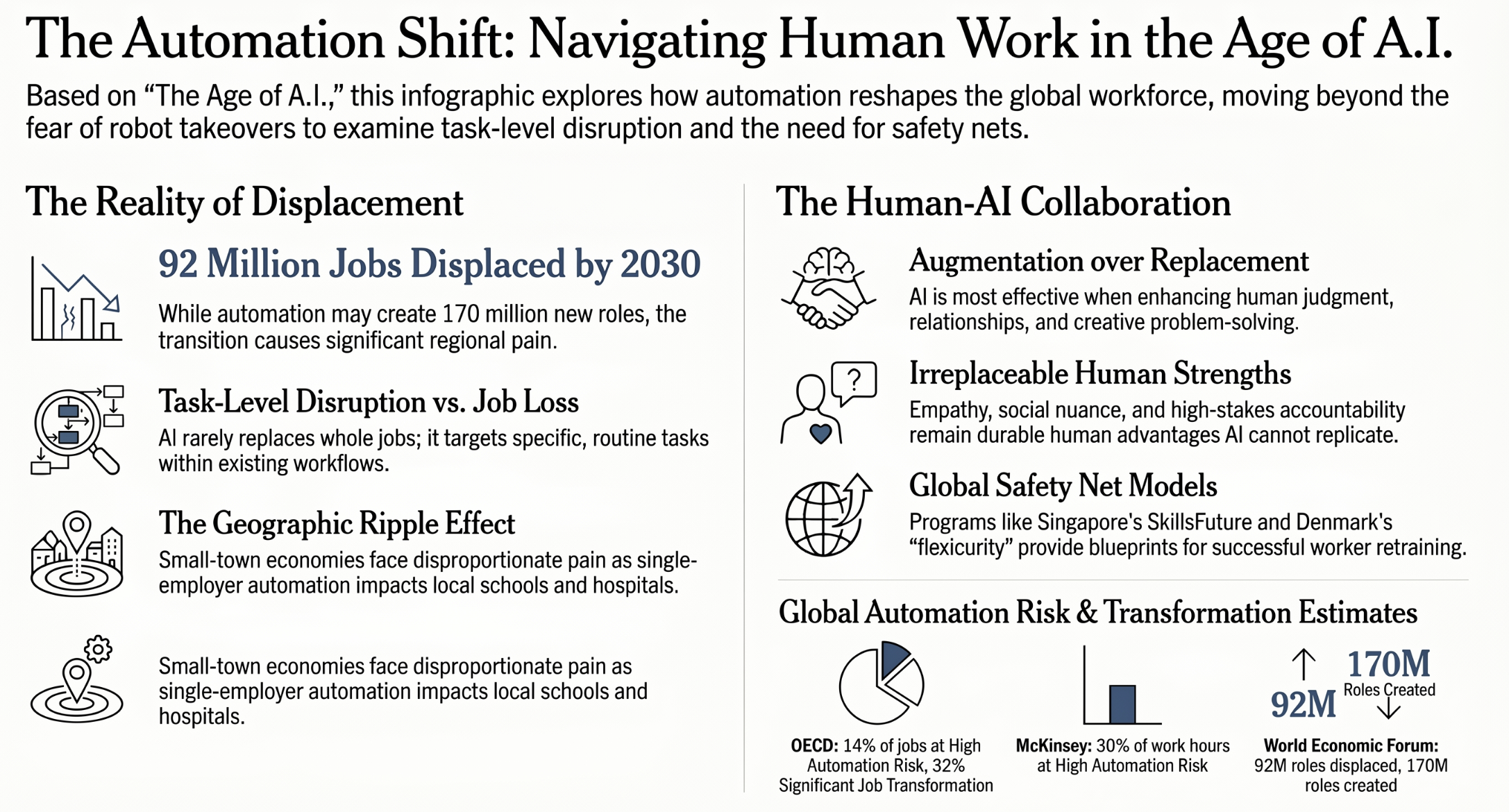
A transition from occupational patterns to geographic impacts reveals how small-town economies bear disproportionate costs during automation-driven industry transitions. Many rural and mid-sized communities built their tax bases around single employers like meatpacking plants, call centers, or distribution hubs. When those employers automate, layoffs cluster locally, producing cascading effects on schools, hospitals, retail stores, and civic services. Housing prices fall, young workers leave, and older residents face declining services as municipal revenues shrink with each departure. Brookings Institution research on regional automation exposure sits on the Brookings Metropolitan Policy Program page for further context. Policy solutions exist, yet small towns rarely have the political influence to secure the interventions they urgently need.
Producers spend meaningful screen time inside one Midwestern town facing a large distribution center automation rollout next year. Business owners interviewed describe contingency plans ranging from diversification to relocation to simply hoping things stabilize naturally somehow. Local leaders pursue grants, partnerships, and marketing campaigns aimed at attracting new industries to replace the departing employer. Skeptics among residents question whether these efforts will move fast enough to prevent meaningful population loss this decade. Producers honor these competing perspectives without implying that any single local strategy will guarantee a successful recovery.
The most sobering scenes come not from the factory gates but from conversations inside schools, hospitals, and churches facing quieter declines. A high school principal describes class sizes shrinking as families move away in search of stable employment elsewhere. A small hospital administrator explains staffing challenges as nurses follow their spouses to larger regional employment centers. A pastor describes declining attendance and aging congregations unable to fund the programs younger families traditionally needed and expected. These institutional stresses often outlast the initial automation shock, leaving wounds that take a decade or more to heal.
Federal and state programs exist to cushion transitions, though implementation varies dramatically across political geography and administrative capacity. Some states deploy rapid response teams, retraining vouchers, and small business grants to affected communities within weeks of announcements. Others leave towns largely on their own, relying on market adjustments that move much slower than family timelines allow. This uneven safety net amplifies existing inequality, punishing communities already struggling before automation entered the picture at all. Policy makers featured argue for pre-emptive regional investment rather than reactive crisis response after layoffs become unavoidable.
Real Case Studies Pulled From the Labor Data
A transition from classrooms to case studies grounds the episode in measurable labor data that shapes current policy debates. The Bureau of Labor Statistics projects cashier employment declining 10 percent through 2033, driven by self-checkout and mobile payment adoption. Projection details appear on the BLS Occupational Outlook Handbook page for readers seeking specific occupational forecasts and methodology. Truck driver growth has slowed, though exact autonomous displacement remains difficult to forecast without firmer deployment timelines across freight corridors. Producers weave these numbers into personal narratives without letting statistics drown out the human stories they help explain.
McKinsey Global Institute analysis estimates that up to 30 percent of worldwide work hours could be automated by 2030. Their published methodology sits on the McKinsey automation research page for policymakers and researchers tracking the numbers. Producers contextualize the figure, noting that automation rarely reaches projected totals because of technical, cultural, and regulatory friction factors. Workforce adaptation also absorbs significant portions of displaced hours through new roles, task redesigns, and augmented productivity shifts overall. This layered framing avoids sensationalism while still signaling the scale of ongoing labor market reorganization across major economies.
Global comparisons matter because automation plays differently across economies with distinct labor markets, regulations, and workforce demographics today. Germany’s strong apprenticeship system has cushioned manufacturing automation, producing smoother transitions compared with more fragmented American training systems. Japan’s aging workforce actually creates labor shortages that make automation more welcome among employers and policymakers there overall. China’s massive industrial automation rollout has displaced millions while creating new roles in logistics, services, and technology sectors. These national differences remind viewers that automation outcomes depend heavily on policy choices rather than technology trajectories alone.
OECD publishes annual employment outlook reports that aggregate automation exposure estimates across its member economies for comparison purposes. Its methodology, available on the OECD Employment Outlook page, estimates that 14 percent of jobs face high automation risk. Another 32 percent face significant transformation, even when full automation remains unlikely within current technological capabilities today across sectors. Producers cite these figures carefully, avoiding the trap of treating model outputs as certainties rather than scenario-dependent estimates. Data literacy therefore becomes a prerequisite for serious civic conversation about automation, retraining funding, and safety net redesign priorities.
The Creative Professions Nobody Thought Would Face AI
A transition from quantitative data to creative professions surfaces one of the episode’s most surprising threads about generative AI tools. Writers, illustrators, composers, and photographers describe generative systems producing outputs that rival professional work in many everyday commercial contexts. Stock photo companies have already integrated AI image generation into their platforms, reducing demand for some categories of human work. Freelance marketplaces report declining rates for generic copywriting, logo design, and basic illustration since generative tools became mainstream products. Producers interview working creatives openly wrestling with pricing, positioning, and career identity amid this unexpected competitive wave.
The creative sector’s surprise reflects a widespread assumption that automation would target only routine or physical work, leaving originality protected from machines. That assumption collapsed when diffusion models and large language models produced outputs compelling enough to fool casual viewers regularly. Established creatives argue that clients still value originality, distinctive voice, and accountable human judgment for high-stakes creative work. Entry-level creatives face the hardest squeeze, since commodified work moves first, and career ladders depend on early-stage paid practice. Producers capture this generational tension through contrasting interviews with senior creatives and recently displaced emerging professionals across industries.
Legal disputes now shape how generative AI training data gets licensed, credited, and compensated across creative industries worldwide today. Writers and artists have filed lawsuits against major AI companies, alleging unauthorized use of copyrighted work in training datasets. Courts have begun issuing rulings that could reshape licensing economics, though appeals and jurisdiction variation complicate the near-term picture. Creative unions negotiate contracts that explicitly address AI use, royalty protection, and disclosure requirements for studios using generative tools. Readers curious about deeper context can explore could AI replace humans for complementary analysis. The documentary closes this strand optimistically, suggesting creative work evolves rather than disappears as new tools reshape the field.
Ethical Lines Few Employers Are Willing to Draw
A transition from creative industries to workplace ethics raises uncomfortable questions about how employers deploy automation technologies at scale. Few companies publish clear policies on when automation will displace employees versus augment their existing workflows and responsibilities across teams. Workers often learn about automation decisions through rumor, leaked memos, or sudden departmental restructurings with minimal advance notice given. Ethical frameworks proposed by researchers recommend transparency, worker consultation, and structured transition support for affected employees during rollouts. Most firms interviewed prefer flexibility over formal commitments, since labor markets shift faster than policy processes can respond reliably.
Silence about automation plans breeds distrust, yet disclosure carries legal, competitive, and morale risks that executives actively weigh against openness. Disclosing planned automation can accelerate departures of skilled workers the company needs during implementation, creating operational headaches later. It can also trigger media scrutiny, union pressure, and investor questions that complicate deployment timelines in unpredictable ways consistently. Executives interviewed acknowledge these tensions candidly, describing real tradeoffs between loyalty, transparency, and competitive timing pressures each quarter. The episode does not resolve the dilemma, instead letting viewers sit with the complexity faced by ethically serious leaders.
Some companies experiment with formal labor-management automation committees that include worker representatives alongside engineering and operations leaders consistently. These committees review proposed automation projects, surface worker concerns, and sometimes delay rollouts until transition plans meet agreed standards. Early evidence suggests such structures reduce turnover, litigation risk, and public relations damage during major technological transitions inside firms. Critics note that committees can become performative if workers lack real veto power over deployment decisions and timelines. Readers interested in workplace transformation dynamics can explore robotics impacting the workplace for related analysis. Employers genuinely committed to ethical automation treat worker voice as operational input, not public relations cosmetic dressing.
Policy Tools Governments Are Already Testing
A transition from corporate ethics to public policy shows how governments have begun testing specific tools against automation pressures. Wage insurance programs guarantee partial income replacement when displaced workers accept new jobs at lower starting salaries temporarily. Portable benefits systems decouple healthcare, retirement, and leave protections from individual employers, supporting workers across multiple gigs. Tax credits for human labor, modeled on the Earned Income Tax Credit, adjust incentives favoring automation over hiring decisions. Training vouchers give workers agency to choose retraining providers rather than limiting them to employer-directed programs each year.
Policy experiments show promise but rarely scale fast enough to match the pace of technological and labor market change overall. Singapore’s SkillsFuture program provides every citizen a periodic training credit, covering approved courses across hundreds of approved providers nationally. Program details appear on the SkillsFuture Singapore official page for readers interested in implementation specifics beyond the documentary. Danish flexicurity combines flexible hiring with generous unemployment benefits and strong retraining support, producing relatively smooth labor transitions. Producers suggest the United States lacks a coherent national framework, relying instead on fragmented state and private sector improvisation.
Social Safety Nets and the Universal Basic Income Question
A transition from targeted programs to broader social structure introduces universal basic income as a contested automation response proposal. UBI advocates argue that a minimum income floor would decouple survival from employment, freeing workers from automation’s worst displacement effects. Critics counter that UBI is expensive, potentially inflationary, and may discourage the re-skilling and mobility workers actually need. Pilots in Finland, Kenya, Stockton California, and Ontario Canada have produced mixed but informative results across different economic contexts. The GiveDirectly Kenya basic income study runs long-term research accessible at the GiveDirectly basic income research page for reference.
Kai-Fu Lee floats a related proposal called a social investment stipend, paying people to perform care work, volunteering, and community service. His reasoning frames care and community roles as increasingly valuable precisely because they remain beyond algorithmic capabilities today commercially. Producers feature his proposal briefly, contrasting it with purer UBI frameworks and traditional workfare-style employment programs seen historically. Skeptics argue that monetizing care work could distort its meaning, substituting transactional incentives for intrinsic motivation in relationships. Supporters counter that paid care acknowledges societal value already created by caregivers whose work remains invisible inside national economic accounts.
Existing safety nets also matter, though many were designed for industrial-era employment patterns that automation increasingly disrupts across countries. Unemployment insurance typically excludes gig workers, contractors, and self-employed professionals, leaving many automation-affected workers without meaningful coverage. Healthcare tied to employment creates additional risk during transitions, trapping workers in specific jobs or industries for insurance access. Portable benefits systems, automatic enrollment, and simplified eligibility reforms could meaningfully soften these gaps during the next decade ahead. Producers conclude this section by noting that safety net redesign is a political rather than technical question facing every democracy.
What the Next Decade of Work Could Actually Look Like
A transition from policy instruments to near-term forecasts invites grounded speculation rather than unbounded techno-optimism or apocalyptic warnings. The next decade likely brings continued task-level automation rather than widespread full-job elimination across most industries and occupations globally. Workers increasingly collaborate with AI tools as a matter of routine, shifting wage pressures toward oversight, judgment, and integration skills. Entry-level roles face the sharpest squeeze, since commoditizable tasks move first, disrupting traditional career ladders across many professions. Mid-career workers face retraining pressures, while senior roles often persist longer because accumulated judgment remains difficult for machines.
Work itself may become more fluid, fragmented, and project-based rather than anchored to single employers offering lifetime careers in traditional structures. Gig platforms, freelance marketplaces, and contract arrangements already account for growing shares of total employment in advanced economies today. AI tools accelerate this trend by letting individuals handle tasks once requiring entire teams inside larger organizations and corporations. Portfolio careers, multiple income streams, and continuous learning become normal expectations rather than exceptions reserved for creative professions. This shift rewards workers comfortable with ambiguity while punishing those whose identity depends on stable, linear employment trajectories.
Employers will increasingly compete for workers with scarce skills while automating away routine roles previously serving as career entry points. Wage polarization likely deepens, with high-skill technical and caring roles commanding premiums while commodified middle-skill work faces compression. Geography continues mattering, with dynamic metropolitan regions absorbing displaced workers more successfully than struggling rural or single-industry towns. The AI to automate key office roles coverage tracks these shifts across the white-collar spectrum. Producers end this section with measured realism, acknowledging uncertainty while warning against assuming markets alone will smooth all transitions. Deliberate policy, employer commitment, and individual adaptation together determine whether the decade delivers widely shared prosperity or deepening inequality.
How the Episode Changed Everyday Conversations About AI
A transition from forecasts to reception tracks how the episode reshaped public conversation after streaming freely on YouTube Originals. Comment sections filled with workers sharing their own displacement stories, mirroring the on-screen testimonies in unexpected volume each week. Educators used clips in career counseling sessions, workforce training orientations, and economics classroom discussions about technological change and society. Journalists cited the episode repeatedly when covering layoffs, retraining investments, and broader automation policy debates across publications nationally. The documentary’s willingness to present worker voices at length set a template many subsequent productions have openly followed since release.
The lasting legacy may be helping audiences see automation as a shared social question rather than an isolated individual misfortune inflicted randomly. Viewers left thinking about their own employers, coworkers, family members, and communities rather than only the workers on screen. Robert Downey Jr.’s casual framing invited ordinary audiences into what was once largely a technical conversation among economists and engineers. Readers curious about continuing the series can explore the next Age of A.I. algorithms episode. The episode succeeds not because it answers every automation question but because it insists audiences must ask these questions seriously.
Key Insights
- Brookings analysis shows small and mid-sized cities face disproportionate automation exposure compared to large metros, per the Brookings Metropolitan Policy Program page.
- The US Bureau of Labor Statistics projects cashier jobs declining 10 percent through 2033 as self-checkout spreads, per the BLS cashier occupational outlook page.
- McKinsey Global Institute estimates up to 30 percent of worldwide work hours could be automated by 2030 per the McKinsey future of work research report.
- OECD analysis finds 14 percent of jobs face high automation risk and another 32 percent face significant transformation, per the OECD Employment Outlook publication page.
- The World Economic Forum projects automation could displace 92 million roles but create 170 million new ones by 2030, per the WEF Future of Jobs Report 2025.
- MIT economist David Autor documents that bank teller employment grew after ATMs arrived because branch costs fell, in work archived on his MIT faculty page.
- Singapore’s SkillsFuture program offers every citizen recurring training credits, detailed on the SkillsFuture Singapore official page.
- GiveDirectly’s Kenya basic income experiment is the largest long-term UBI study ever conducted, per the GiveDirectly basic income research page.
| Dimension | Pre-Automation Workplace | AI-Augmented Workplace |
|---|---|---|
| Transparency | Union contracts, job postings, public wage bands for many occupations | Opaque automation rollouts, shifting task bundles, unclear disclosure norms for deployment |
| Participation | Workers, managers, unions, regulators, industry associations, public agencies | Engineers, vendors, executives, occasionally worker committees, rarely displaced employees themselves |
| Trust | Built through tenure, certifications, institutional reputation, collective bargaining agreements | Built through performance metrics, vendor assurances, inconsistent worker consultation practices |
| Decision Making | Hierarchical approvals, bargained changes, regulatory oversight, gradual process adjustments | Fast executive decisions, vendor-led deployment, limited regulatory touchpoints, shorter deliberation windows |
| Misinformation | Misleading job ads, exaggerated productivity claims, recruiter spin | Exaggerated automation capability claims, vendor marketing hype, conflicting displacement forecasts |
| Service Delivery | Physical presence, human judgment, relationship continuity, slower adaptation | Mixed human-machine delivery, faster iteration, reduced relational continuity in many interactions |
| Accountability | OSHA, NLRB, EEOC, union grievances, professional liability, tort law | Emerging AI governance, limited worker protections, fragmented regulatory authority across jurisdictions |
Real-World Examples
Klarna, the Swedish buy-now-pay-later firm, replaced roughly 700 customer service agents with an AI chatbot in 2024, then reversed course partially after quality issues emerged. Executives reported significant cost savings initially, though customers and employees documented declining service quality during the rollout period. The company later announced hiring some human agents back, demonstrating the limits of aggressive pure-automation strategies in customer-facing work. Limitations include unclear long-term metrics, contested reporting, and vendor incentives that may inflate positive automation narratives during deployments. Details appear on the Klarna press release on AI assistant performance.
Starsky Robotics developed fully autonomous long-haul trucks that completed a driverless seven-mile highway test in 2019 before the company folded in 2020. The startup ran real freight on public highways, then shut down after raising $20 million because funding dried up amid longer-than-expected commercialization timelines. Founder Stefan Seltz-Axmacher wrote publicly about why autonomy in trucking remains harder than investors hoped, slowing industry transitions. Limitations include lack of peer-reviewed safety data and Seltz-Axmacher’s own conflict of interest in analyzing the market exit. His reflection appears on the Stefan Seltz-Axmacher Medium post about Starsky Robotics.
Amazon deployed roughly 750,000 mobile robots across its fulfillment network by 2023 while simultaneously hiring hundreds of thousands of human workers. The company publicly frames this pattern as augmentation rather than replacement, with robots handling routine movement while humans manage judgment-dependent tasks. Independent observers note warehouse injury rates and worker pace pressure remain controversial, complicating the augmentation narrative promoted by corporate communications. Limitations include Amazon’s strong influence over its own data releases and limited independent access to verify productivity claims. Details on the robotic fleet appear on the Amazon robotics deployment announcement.
Case Studies
Case Study 1 — Singapore SkillsFuture National Retraining Program (2015–present)
Singapore’s government identified a structural risk that automation, globalization, and aging demographics would hollow out middle-skill employment across the economy. Policymakers launched SkillsFuture in 2015, providing every citizen aged 25 and above a training credit usable at hundreds of approved education providers. Measurable impact includes millions of training sessions completed, with regularly updated outcomes published by the program on its official channels. Limitations include persistent criticism that voucher amounts remain modest relative to retraining needs, and that uptake concentrates among already-advantaged workers. Program documentation and uptake statistics appear on the SkillsFuture Singapore program overview page. The program remains a global reference case for national-scale reskilling efforts tied explicitly to automation policy.
Case Study 2 — Stockton SEED Basic Income Experiment, California (2019–2021)
Stockton faced concentrated poverty, wage stagnation, and automation exposure inside a mid-sized California city with limited social services. Mayor Michael Tubbs launched the Stockton Economic Empowerment Demonstration, giving 125 randomly selected residents $500 monthly unconditionally for 24 months straight. Measurable impact included increased full-time employment among recipients, improved emotional health, and reduced income volatility during the experimental period. Limitations include small sample size, privately funded budget, and difficulty generalizing results to national UBI policy debates directly. Published evaluation results appear on the Stockton SEED program evaluation page. The experiment reshaped UBI discourse, moving it from theoretical speculation toward measurable behavioral data grounded in lived conditions.
Case Study 3 — Denmark Flexicurity Labor Model (1990s–present)
Denmark faced stagnant employment, high unemployment, and pressures from globalization and automation through the late 20th century. Policymakers restructured labor policy into flexicurity, combining flexible hiring and firing with generous unemployment benefits and robust retraining infrastructure nationally. Measurable impact includes one of Europe’s lower long-term unemployment rates, smoother occupational transitions, and higher worker mobility across sectors. Limitations include high public spending requirements, cultural specificity that complicates transplant to larger federal democracies, and persistent criticism of benefit durations. Program documentation appears on the Danish Ministry of Employment flexicurity overview page. Flexicurity remains the most studied national automation-adjacent labor policy, shaping debates in many advanced economies.
FAQs
The sixth episode of The Age of A.I., titled Will a Robot Take My Job, explores how automation reshapes trucking, warehouses, offices, and creative work. Robert Downey Jr. hosts interviews with workers, engineers, economists, and investor Kai-Fu Lee. The episode refuses easy answers, letting displaced employees and optimistic experts share the screen throughout.
Kai-Fu Lee is a former Google China executive who now runs Sinovation Ventures, investing in AI startups globally. He appears because his book AI Superpowers frames near-term automation and because his cancer diagnosis reshaped his views on productive work. His investor perspective balances displacement warnings with proposals for paid care work and social investment.
The episode covers trucking, warehousing, fast food, call centers, radiology, journalism, legal work, graphic design, and entry-level software development. Each vignette lasts several minutes, accumulating into a portrait of automation crossing blue-collar and white-collar boundaries. Producers intentionally avoid suggesting any occupation remains completely immune to transition pressures.
Experts disagree sharply, with Kai-Fu Lee warning about routine cognitive work while MIT’s David Autor documents historical job creation patterns. Producers present both views without forcing resolution, letting viewers weigh evidence themselves. The episode acknowledges concentrated regional pain even when aggregate employment indicators look optimistic at the national level.
Most workers face task-level automation rather than full job replacement across the next decade, according to experts featured. Your role will likely change significantly, with AI tools handling routine subtasks while humans manage judgment, relationships, and coordination. Industries vary, and entry-level positions face more pressure than senior roles requiring accumulated expertise.
Machine learning trains on historical data to identify patterns, then applies those patterns to new inputs automatically. Supervised learning handles well-bounded tasks, reinforcement learning handles sequences, and generative models create text, images, or code. Each technology targets specific tasks, not entire jobs, meaning most roles experience reshaping rather than elimination.
Augmentation means AI handles routine subtasks while humans focus on judgment, creativity, or relational work within the same job. Replacement means automation fully substitutes for a worker’s role, eliminating the position entirely. Most current deployments fall closer to augmentation, though augmentation often evolves into displacement without deliberate employer planning.
Cashiers, data entry workers, basic bookkeepers, telemarketers, routine writers, and some driving roles face high automation risk based on current research. Creative, care-based, skilled-trade, and judgment-heavy roles face lower risk, though generative AI has expanded creative exposure recently. Local labor market conditions also shape how risk translates into actual displacement outcomes.
Schools now integrate data literacy, computational thinking, and collaborative problem-solving alongside traditional subjects nationwide. Community colleges partner with employers on apprenticeships that combine classroom learning with paid workplace experience. Districts also update counseling programs to help parents and students weigh college ROI against shorter-term credentials targeting specific growing occupations.
Universal basic income is an unconditional periodic payment to all residents, designed to decouple survival from employment status. The episode discusses UBI because advocates propose it as a safety net against automation-driven displacement. Pilots in Finland, Kenya, Stockton, and Ontario produced mixed results that inform ongoing policy debates globally.
Governments now test wage insurance, portable benefits, training vouchers, apprenticeship subsidies, and tax credits adjusting incentives between automation and hiring. Singapore’s SkillsFuture and Denmark’s flexicurity represent ambitious national frameworks that combine flexibility with worker support. The United States relies more on fragmented state and private sector improvisation compared with peer economies.
The series originally streamed free on YouTube Originals and remains accessible through the official series channel archive today. Viewers can also find clips, discussion threads, and episode analyses on forums dedicated to AI, economics, and technology documentaries. Many public libraries and educational platforms reference the episode in curricula covering automation and workforce topics.
The episode offers both, warning about displacement pain while featuring workers who successfully transitioned into new roles after retraining. Producers frame automation as a policy choice rather than inevitable fate, emphasizing worker voice and safety net redesign. The overall tone encourages civic engagement rather than resignation or uncritical technological optimism about the future.