

Introduction
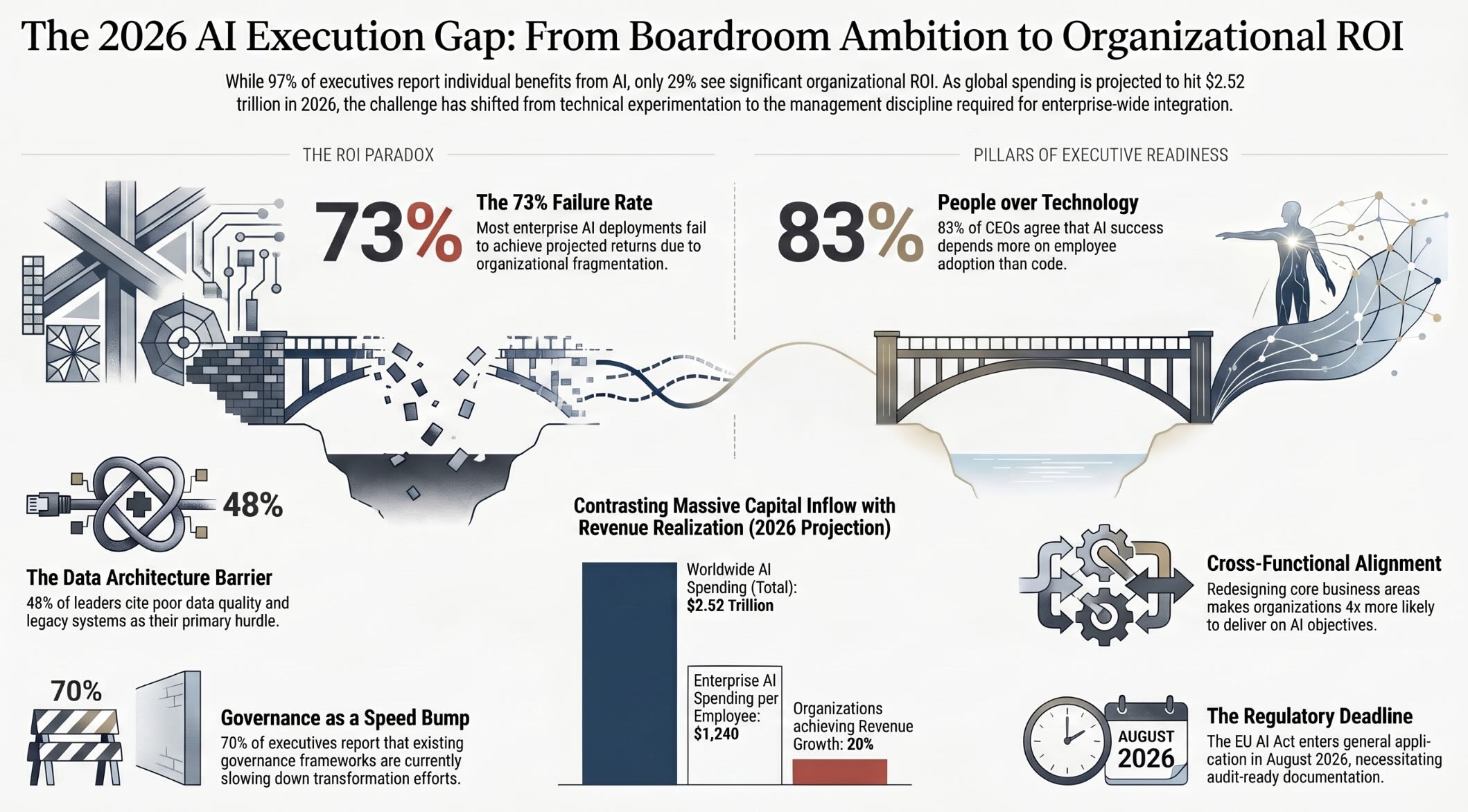
The distance between boardroom ambition and operational reality has never been wider in enterprise technology. According to a 2026 survey by Writer and Workplace Intelligence, 97% of executives report benefiting from AI, yet only 29% see significant organizational return on investment. That gap tells you everything about where AI stands in 2026: the technology works, but the management discipline around it remains immature. C-suite leaders are no longer asking whether artificial intelligence matters to their organizations. They are asking how to scale it without breaking budgets, alienating employees, or running afoul of a rapidly expanding regulatory environment. This article breaks down what senior executives need to understand about AI strategy, governance, workforce transformation, and risk management right now. The insights here draw from the latest research by IBM, Deloitte, McKinsey, Salesforce, and other global authorities tracking enterprise AI adoption in real time.
Essential AI Questions Every Executive Should Answer
What does the C-suite need to know about AI in 2026?
Executives must understand that AI has shifted from isolated pilots to an enterprise-wide operating capability that touches strategy, workforce planning, compliance, and competitive positioning.
Is AI delivering real business value for enterprises?
AI is producing measurable gains in productivity and efficiency, with 66% of organizations reporting improvements, but revenue growth remains aspirational for most, with only 20% achieving it so far.
What is the biggest risk of enterprise AI in 2026?
The greatest risk is organizational fragmentation, where different C-suite roles pursue competing AI priorities without a unified strategy, governance framework, or measurement discipline.
Key Takeaways for Executive Leaders
- AI success depends more on people, culture, and cross-functional alignment than on the sophistication of the technology itself.
- Enterprise AI spending is projected to exceed $300 billion globally in 2026, making governance and ROI measurement non-negotiable for every leadership team.
- Agentic AI is moving from concept to deployment at scale, with Gartner predicting 40% of enterprise applications will include task-specific AI agents by end of 2026.
- The regulatory environment is tightening on multiple fronts, including the EU AI Act’s general application in August 2026 and new U.S. state laws already in effect.
Table of contents
- Introduction
- Essential AI Questions Every Executive Should Answer
- Key Takeaways for Executive Leaders
- Defining AI Readiness at the Executive Level
- Why AI Has Become a Boardroom Priority
- The Shift from Experimentation to Enterprise Integration
- Agentic AI and the Rise of Digital Labor
- Who Owns AI in the Organization
- Measuring ROI When the Metrics Keep Changing
- The Talent Equation: Reskilling, Upskilling, and the Generalist Advantage
- AI Governance as a Competitive Differentiator
- Navigating the Global Regulatory Landscape
- Cybersecurity Risks in an AI-Driven Enterprise
- Data Architecture: The Foundation Executives Overlook
- Responsible AI: Ethics Beyond Compliance
- AI and the Customer Experience Transformation
- Industry-Specific Adoption Patterns
- The CFO Perspective: Budgeting for Uncertainty
- Building a Cross-Functional AI Operating Model
- What Separates AI Leaders from AI Laggards
- The Road Ahead: AI Strategy Beyond 2026
- Key Insights
- Real-World Examples
- Case Studies
- Frequently Asked Questions on AI for the C-Suite
Defining AI Readiness at the Executive Level
AI readiness for the C-suite means the ability to make informed investment decisions, manage risk, and build in-house capabilities rather than delegating everything to technical teams. It encompasses strategic vision, digital fluency, ethical judgment, and the organizational design skills required to embed artificial intelligence across business functions. This is not about learning to write code or fine-tune models; it is about understanding what AI can and cannot do, where it creates value, and where it introduces exposure. A responsible AI framework gives leaders the vocabulary and mental models they need to participate meaningfully in decisions that will shape their companies for the next decade.
The definition matters because the stakes are structural, not just technical. According to IBM’s 2026 CEO Study, 83% of CEOs surveyed say AI success depends more on people’s adoption than on the underlying technology. That statistic reframes the entire conversation away from procurement and toward leadership capability. Executives who treat AI as a technology purchase rather than a management discipline will consistently underperform those who approach it as an organizational transformation. Every board meeting that skips over workforce readiness, data architecture, and governance is a board meeting that fails to address the real constraints on AI value.
AI C-Suite Readiness Assessment
Rate your organization across six dimensions to see your readiness score, identify gaps, and compare against 2026 enterprise benchmarks.
Priority Action
Adjust the sliders above to see a personalized recommendation based on your organization’s AI readiness profile.
2026 Enterprise Benchmarks
Why AI Has Become a Boardroom Priority
The trajectory from experimental side project to strategic imperative happened faster than most executives anticipated. Nearly 43% of respondents to The Conference Board's 2026 C-Suite Outlook Survey named AI and technology as their top investment priority, outpacing product innovation and customer experience enhancements. That positioning reflects a fundamental change in how leadership teams think about competitive advantage. AI is no longer something the technology department experiments with; it is something the CEO is accountable for.
Part of what accelerated this shift is the sheer volume of capital flowing into AI infrastructure. Gartner forecasts worldwide AI spending of $2.52 trillion in 2026, a 44% increase year over year, with infrastructure alone accounting for more than half of that total. When investment reaches that magnitude, it stops being a departmental budget item and becomes a board-level capital allocation question. The organizations that treat AI spending with the same financial rigor as any other major capital expenditure are the ones generating measurable returns. Every dollar spent without a clear value hypothesis and post-deployment measurement discipline is a dollar that erodes executive credibility.
The competitive pressure is also intensifying across geographies and sectors. North American executives are especially aggressive, with 48% planning to increase AI budgets by 10% or more in 2026. Financial services, retail, healthcare, and telecommunications are leading adoption, while knowledge-intensive industries report the highest anxiety about AI-driven disruption. Regional differences matter as well: U.S. CEOs most commonly identified AI itself as an external factor that could negatively impact their business, while Asian leaders are more concerned about shifting consumer behaviors. These variations mean that global enterprises cannot rely on a single AI playbook; they must calibrate strategy, timelines, and risk management to local conditions.
The Shift from Experimentation to Enterprise Integration
Moving beyond the pilot phase remains the defining challenge for most organizations tackling AI adoption in business. Deloitte's 2026 State of AI in the Enterprise report found that worker access to AI rose by 50% in 2025, and the number of companies with 40% or more of their AI projects in production is expected to double within six months. Those numbers suggest that the experimental phase is winding down. What is replacing it is an execution-focused model where AI becomes embedded in daily business operations rather than isolated in innovation labs.
The transition is not smooth for everyone, and the gap between aspiration and execution remains wide. A McKinsey Global AI Survey pegs the ROI failure rate at 73%, a figure that has stayed stubbornly consistent despite improvements in tooling and model capabilities. The causes are rarely technical in nature; they are organizational. Projects fail because of unclear ownership, insufficient data quality, lack of change management, and governance structures that were never designed for autonomous decision-making systems. Companies that have successfully scaled AI share a common trait: they treat implementation as a change management project first and a technology project second.
The pattern emerging across industries is instructive for any C-suite leader trying to close the gap. Customer support has seen the most consistent productivity gains, with efficiency improvements as high as 50% in some implementations. Other departments typically see 15-20% improvements, and those gains often take six to eight months to materialize. Average SaaS companies attempted three to seven major new AI product capabilities in 2025, but customers often demanded AI features regardless of whether those features delivered genuine value. The lesson for executives is to prioritize use cases where AI creates defensible, measurable impact rather than chasing feature parity with competitors.
Agentic AI and the Rise of Digital Labor
The emergence of agentic AI represents the most significant paradigm shift since generative AI entered the mainstream. Unlike earlier models that responded to individual prompts, agentic systems can reason, plan, and execute multi-step workflows with minimal human supervision. Gartner predicts that 40% of enterprise applications will include task-specific AI agents by end of 2026, up from less than 5% in 2025. That projection signals a structural change in how work gets organized, not just a feature upgrade to existing software.
IBM survey data from Think 2026 reveals that most large-scale enterprises will deploy a digital workforce of over 1,600 AI agents by the end of this year. With that scale comes structural strain, as seven in ten executives surveyed say their existing AI governance frameworks are slowing down transformation efforts. The speed at which agents move from ideation to deployment makes it difficult to maintain the oversight and organizational alignment that enterprise environments require. Agentic AI does not just automate tasks; it introduces a new category of worker that needs to be managed, monitored, and governed with the same rigor applied to human employees.
Salesforce research underscores how deeply this shift is penetrating C-suite thinking about enterprise strategy and hyperautomation. Full AI implementation among CIOs jumped from 11% to 42% year-over-year, a 282% increase, and 30% of AI budgets are now dedicated specifically to agentic AI capabilities. CFOs have shifted dramatically as well, with the share reporting a conservative AI strategy falling from 70% in 2020 to just 4% today. Two-thirds of CEOs say implementing agents is critical to competing in the current economic climate, and 65% say they expect agents to transform their business model entirely.
The practical reality on the ground remains more complicated than the enthusiasm suggests. Many organizations that deployed AI agents in 2025 paid more than anticipated with questionable returns on investment. Legacy systems were not designed for agentic interactions, and most enterprise data architectures create friction for agent deployment. Deloitte warns that over 40% of agentic AI projects will fail by 2027 because legacy systems cannot support modern AI execution demands. Executives should approach agentic AI with disciplined pilot programs, clear success metrics, and realistic timelines rather than treating it as a revolutionary silver bullet that will deliver immediate transformation.
Who Owns AI in the Organization
The question of AI ownership has become one of the most contentious leadership debates in the modern enterprise. A vivid example reported by Harvard Business Review describes a Fortune 500 insurance company where the CIO, COO, CFO, Chief Risk Officer, CHRO, and Chief Data Officer all made compelling cases for why AI governance should roll up to their function. The CIO argued that AI systems are technology infrastructure. The COO countered that an agentic workforce is fundamentally an operations question. The CFO noted that AI was already making underwriting decisions with direct profit-and-loss impact. Each perspective was valid, which is precisely why the ownership question cannot be solved by defaulting to any single executive.
The rise of the Chief AI Officer (CAIO) represents one organizational response to this fragmentation. The CAIO role has moved from a niche technology position to a central pillar of the C-suite, often carrying influence comparable to the CFO. IBM's 2026 CEO Study shows that 77% of respondents say talent and technology leadership roles are converging, suggesting tighter integration between talent strategy, technology decisions, and enterprise execution. The most effective approach is not to assign AI to one executive but to build a cross-functional operating model where accountability is distributed and aligned to specific business outcomes. Organizations that redesigned five core business areas, including technology, finance, HR, operations, and cross-functional collaboration, are four times more likely to have delivered on their business objectives.
Measuring ROI When the Metrics Keep Changing
The ROI challenge in enterprise AI is not a technology problem but a measurement and governance problem that demands executive attention. Global enterprise AI spending is projected to reach $665 billion in 2026, yet 73% of deployments fail to achieve their projected return on investment, according to the McKinsey Global AI Survey. A significant contributor to this gap is that 61% of enterprise AI projects were approved on the basis of projected value that was never formally measured after deployment. Executives approved investments based on compelling business cases, then moved on without building the measurement infrastructure needed to verify whether the investment actually delivered.
The difficulty of quantifying AI benefits compounds the problem for executives trying to build credible business cases. Improved productivity can be a subjective measurement for knowledge workers, and the indirect benefits of AI, such as faster decision-making or improved customer satisfaction, resist simple financial quantification. NVIDIA's 2026 State of AI report found that 30% of respondents cited lack of clarity on AI's ROI as one of their top challenges, even as 86% said their AI budgets would increase. Treating AI investments with the same capital expenditure discipline applied to manufacturing equipment or real estate acquisitions is the single most impactful change a CFO can make to improve AI outcomes.
Consumption-based pricing models make AI budgets uniquely volatile compared to traditional technology spending. Unlike cloud computing, where costs became somewhat predictable over time, AI spend remains unpredictable because model costs change constantly, usage patterns are difficult to forecast, and most organizations lack the financial discipline to track AI-specific costs across departments. The invisible tax of AI extends beyond direct spending: AI coding tools may deliver 15-20% velocity improvements, but engineering teams often spend equivalent time correcting errors in AI-generated output. Executives must build financial models that account for total cost of ownership, including the hidden costs of quality assurance, change management, and ongoing model maintenance.
The Talent Equation: Reskilling, Upskilling, and the Generalist Advantage
The workforce implications of AI are among the most urgent and least well-managed dimensions of the entire enterprise AI agenda. Between 2026 and 2028, IBM's CEO Study projects that 29% of employees will require reskilling for a different role, while 53% will need upskilling to perform their current role more effectively. Those numbers represent an unprecedented scale of workforce transformation that touches every level of the organization. CEOs highlighted workforce readiness as the key constraint in successfully leveraging AI, ranking it alongside technology investment as a top strategic priority.
PwC's 2026 analysis describes this transformation as the rise of the generalist, a shift toward broader, outcome-focused roles that replace the deep specialization many organizations have built over decades. AI agents can now take on multi-step, high-skill tasks, allowing experienced employees to do more and early-career workers to ramp up more quickly. The traditional organizational pyramid, with its tall hierarchies and narrow role definitions, is giving way to flatter structures where AI handles the predictable and humans focus on judgment, strategy, and creativity. This transition requires deliberate choices about how roles are designed, teams are structured, and talent is developed.
The cultural dimension of workforce transformation is often underestimated by executive teams focused on technology deployment. A striking statistic from the Writer survey reveals that 92% of C-suite executives are actively cultivating "AI elite" employees, while 60% plan layoffs for non-adopters. That approach creates a two-tier workforce that can fracture organizational trust and undermine the very collaboration needed to scale AI successfully. Leaders who build inclusive upskilling programs and reward experimentation across all levels of the organization will capture far more AI value than those who concentrate expertise in a narrow elite. The risks of a punitive approach to AI adoption extend beyond morale; they include talent flight, institutional knowledge loss, and the erosion of the organizational culture that supports innovation.
CHROs face a particularly complex challenge in managing this transformation. Salesforce research shows that CHROs plan to reassign employees to technical roles like data scientists and technical architects in the near term. Creating explicit "AI collaboration profiles" for critical roles, defining how AI should be used, what should remain human, and which skills matter most, offers a practical framework for integrating AI-driven workforce planning into broader talent strategy. Cross-functional standards for AI responsibilities will become a strategic imperative as AI-enabled generalists spread across departments. The investment in people is not separate from the investment in technology; it is the foundation on which technology value is built.
The competitive landscape for AI talent adds another layer of pressure to this already complex equation. A shortage of AI experts and data scientists was cited as the second most prominent challenge by respondents to NVIDIA's 2026 State of AI surveys, with 38% identifying it as a critical barrier. Organizations that move early to build internal capability through structured learning programs, partnerships with universities, and rotation assignments into AI projects will develop a sustainable advantage over those competing purely on salary. Talent development must be treated as a strategic investment with measurable outcomes, not a line item in the HR budget.
AI Governance as a Competitive Differentiator
Governance has quietly become the single most important capability separating AI leaders from AI laggards in the enterprise landscape. Organizations that approach AI governance as a strategic discipline rather than a compliance checkbox gain measurable advantages in speed, trust, and scalability. Seven in ten executives surveyed by IBM say their existing governance frameworks are slowing AI transformation, revealing that most companies built their oversight structures for a previous era of technology deployment. The challenge is not too much governance but the wrong kind: bureaucratic processes designed for static systems that cannot keep pace with autonomous, learning agents.
The business case for governance is compelling when framed in terms of risk reduction and operational efficiency rather than regulatory compliance alone. Enterprises that invest in audit-ready documentation, transparent decision-making frameworks, and clear accountability structures reduce their exposure to regulatory penalties, customer trust erosion, and cascading system failures. A Deloitte finding that organizations redesigning five core areas are four times more likely to deliver on business objectives validates the strategic value of getting governance right. Companies that build governance into how they develop and deploy AI gain a competitive edge that compounds over time, reducing regulatory exposure while accelerating responsible innovation.
The structural requirements of effective AI governance extend well beyond writing policies. Modern AI governance demands technical controls for data lineage and model monitoring, clear decision rights for when AI recommendations can be acted upon without human review, incident response procedures for when autonomous systems make errors at scale, and continuous audit trails that can satisfy regulators, customers, and board-level oversight. These are not aspirational goals; they are operational necessities that demand dedicated resources, executive sponsorship, and integration with existing risk management and compliance programs.
Navigating the Global Regulatory Landscape
The regulatory environment for AI is becoming more complex and more consequential with each passing quarter. The EU AI Act enters general application on August 2, 2026, imposing enforceable requirements on high-risk AI systems that touch everything from hiring and credit decisions to critical infrastructure management. Colorado's AI Act takes effect on June 30, 2026. California's generative AI transparency requirements are already active. For enterprises operating across multiple jurisdictions, this patchwork of regulations creates a compliance challenge that rivals the complexity of global data privacy laws like GDPR.
In the United States, the regulatory picture is evolving rapidly at both the federal and state levels. The White House released a National Policy Framework for Artificial Intelligence on March 20, 2026, outlining legislative recommendations that emphasize national uniformity and caution against fragmented state regulation. Congressional proposals like the TRUMP AMERICA AI Act span 291 pages and attempt to codify governance requirements across 17 titles. At the same time, the SEC has displaced cryptocurrency with AI and cybersecurity concerns as its dominant risk focus, recommending enhanced disclosures about how boards oversee AI-related cybersecurity risks. Insurance carriers are introducing "AI Security Riders" that require documented evidence of adversarial testing and model-level risk assessments as prerequisites for underwriting.
Executives who treat AI compliance as a downstream legal task rather than a design requirement will face escalating costs and exposure. The regulatory trajectory across every major jurisdiction points in the same direction: organizations must be able to demonstrate what data enters their AI systems, the legal basis for using it, and the controls applied throughout the lifecycle. Proactive compliance programs that document bias testing, maintain records of algorithmic audits, and train relevant personnel on state-specific obligations will reduce both regulatory risk and the cost of adapting to new requirements as they emerge. Waiting for regulatory certainty before acting is the riskiest strategy available.
The international dimension of AI regulation adds another layer of complexity for multinational enterprises operating across diverse legal systems. The EU prioritizes protecting fundamental rights and prohibiting certain high-risk use cases like social scoring. The United States is pursuing an innovation-focused approach through a mix of executive actions, agency guidance, and state laws. China emphasizes state control and strategic development. These divergent philosophical approaches mean that compliance infrastructure must be flexible enough to accommodate fundamentally different regulatory models. Organizations that build modular governance frameworks capable of adapting to jurisdiction-specific requirements will manage this complexity more effectively than those attempting to apply a single global compliance standard.
Cybersecurity Risks in an AI-Driven Enterprise
The intersection of AI and cybersecurity presents a dual challenge that demands attention from every member of the C-suite. AI systems introduce new attack surfaces that traditional security architectures were not designed to protect. Model memorization, where large language models inadvertently retain and reveal sensitive training data, represents a novel category of data breach that many organizations have not yet incorporated into their threat models. Prompt leakage, where employees routinely input confidential business information into AI tools, compounds the exposure by creating data flows that bypass established security controls.
The scale of the cybersecurity risk is significant enough to have reshaped regulatory priorities at the federal level. Two-thirds of CFOs surveyed by Salesforce identify security and privacy threats as their top AI concern, reflecting a recognition that AI-related vulnerabilities can translate directly into financial liability. Sixty-seven percent of executives in the Writer survey believe their company has already suffered a data breach due to unapproved AI tools, a figure that underscores how quickly shadow AI can outpace even well-resourced security programs. Building a cybersecurity posture that accounts for AI-specific risks, including adversarial attacks, data poisoning, and unauthorized model access, is no longer a future planning exercise; it is a current operational requirement.
Data Architecture: The Foundation Executives Overlook
Data quality and architecture remain the most underappreciated constraint on AI value creation in the enterprise environment. Having sufficient data and other data-related issues were cited as the top challenge in NVIDIA's 2026 State of AI surveys, with 48% of respondents identifying it as their primary barrier to AI success. The problem is structural: most organizational data architectures were built around extract-transform-load processes and data warehouses that create friction for AI agents needing real-time access to business context. Executives who invest heavily in AI models while underinvesting in the data infrastructure those models depend on are building on a foundation that cannot support scale.
The gap between data ambition and data reality is particularly acute for organizations attempting to deploy agentic AI systems across functions. Agentic AI requires data that is not just clean and organized but contextually rich, permissioned appropriately, and available in real time for autonomous decision-making. Legacy systems lack the modern APIs, modular architectures, and secure identity management needed for true agentic integration. Salesforce's Chief Data Officer framed the issue directly: the organizations treating data and AI as an integrated strategy are the ones that will successfully move from pilots to execution and see AI deliver significant impact.
Every dollar invested in data architecture improvements generates a higher return than an equivalent dollar spent on acquiring new AI capabilities without fixing the underlying data foundation. The Deloitte survey identifies the AI skills gap as the biggest barrier to integration, but the data gap runs a close second because it affects every use case, every deployment, and every attempt to scale. Organizations that prioritize data governance, invest in real-time data pipelines, and build data teams that work alongside AI teams will unlock value that competitors with better models but worse data cannot match.
Responsible AI: Ethics Beyond Compliance
The conversation around responsible AI has evolved from theoretical debate to an operational requirement that directly affects trust, brand reputation, and market access. Ethical AI practices encompass transparency in how models make decisions, fairness in how algorithms treat different populations, accountability when systems produce harmful or biased outcomes, and sustainability in how compute-intensive AI workloads affect environmental commitments. These are not abstract concerns; they are the dimensions on which customers, employees, regulators, and investors increasingly evaluate corporate behavior.
The risk of getting ethics wrong is tangible and growing more consequential each year in the enterprise landscape. Algorithmic bias in hiring, lending, healthcare, and criminal justice has generated regulatory action, litigation, and public backlash that damaged corporate reputations in measurable ways. The dangers of AI bias and discrimination extend beyond legal liability to include talent attrition, customer defection, and the erosion of stakeholder trust that takes years to rebuild. Italy fined OpenAI 15 million euros for GDPR violations in training data processing, establishing a precedent that regulators will enforce data protection requirements against AI companies with the same rigor applied to any other data processor.
Organizations that embed ethical review into the AI development lifecycle, rather than treating it as a post-deployment audit, will build more trustworthy systems and encounter fewer costly corrections. The most effective approach integrates ethics into product design, model training, deployment decisions, and ongoing monitoring rather than relying on a standalone ethics committee that reviews decisions after they have already been made. Training relevant personnel on ethical dilemmas unique to AI must become part of the standard professional development curriculum for anyone involved in building, deploying, or managing AI systems across the enterprise.
AI and the Customer Experience Transformation
Customer-facing applications represent one of the most mature and productive areas of enterprise AI deployment in the current landscape. CIOs report that nearly two-thirds are working more closely with their customer service organizations as a direct result of agentic AI capabilities. Customer support has consistently shown the strongest productivity gains across departments, with efficiency improvements reaching 50% in the best implementations. AI agents handling initial customer interactions, gathering information, providing basic solutions, and routing complex issues to human specialists have become the default model for organizations seeking to improve service quality while managing costs.
The transformation extends well beyond customer service into marketing, sales, and product personalization across the entire customer journey. CEOs who are fully prepared for AI identify marketing and operations as the functions most highly impacted by digital labor. AI-powered systems can now deliver hyper-personalized experiences at scale, adjusting recommendations, pricing, and communication in real time based on individual customer behavior and preferences. The future of chatbot development is increasingly agentic, with bots that do not just answer questions but complete transactions, resolve disputes, and proactively identify customer needs before they are expressed.
The caution for executives is that AI-enhanced customer experience requires genuine integration across data, systems, and organizational silos to deliver on its promise. A disjointed implementation where the AI chatbot cannot access order history, the recommendation engine does not reflect recent purchases, and the marketing automation platform targets customers with irrelevant promotions creates frustration rather than delight. Building a seamless customer experience powered by AI demands the same cross-functional alignment and data architecture investment discussed throughout this article. The technology is ready; the organizational readiness often is not.
Industry-Specific Adoption Patterns
AI adoption is not uniform across sectors, and understanding the differences matters for executives benchmarking their organizations against peers. Financial services, retail and consumer packaged goods, and healthcare and life sciences showed the strongest adoption and ROI results in NVIDIA's 2026 surveys. Logistics executives identified expanding AI as a top supply chain priority more frequently than any other priority, at 37%. Marketing executives selected AI applications as their leading priority at 40%, outranking even increasing revenue. These patterns reveal that AI value creation concentrates in areas with high data density, repetitive decision-making, and direct customer interaction.
Knowledge-intensive industries like software, communications, and professional services report the highest anxiety about AI disruption, even as they are among the most aggressive adopters. Companies in these sectors are more likely to view AI as a potentially negative business factor and more concerned about automation as a human capital challenge. In manufacturing, automotive supplier Valeo has completed a large-scale deployment of Google Cloud's Gemini models across its 100,000 employees, with approximately 35% of its code now generated or optimized by AI. These industry-specific patterns suggest that the competitive dynamics of AI adoption vary significantly by sector, and executives should look to their specific industry's leading practices rather than applying generic benchmarks.
The CFO Perspective: Budgeting for Uncertainty
CFOs occupy a uniquely challenging position in the C-suite AI conversation because they must balance investment ambition against financial discipline. The shift from conservative to committed has been dramatic: the share of CFOs reporting a conservative AI strategy fell from 70% in 2020 to just 4% today, according to Salesforce research. CFOs now allocate 25% of their total AI budget specifically to AI agents, reflecting confidence that agentic capabilities will deliver returns. This rapid pivot from caution to commitment raises legitimate questions about whether financial oversight has kept pace with spending acceleration.
The biggest financial risk in enterprise AI is not overspending on technology but underspending on the measurement, governance, and change management infrastructure needed to generate returns from that technology. Enterprise AI spending per employee averages $1,240 annually across companies with 500 or more workers. When multiplied across large organizations, these figures represent significant capital commitments that demand the same pre-deployment value hypotheses, post-deployment measurement, and formal ROI reporting applied to any other major investment. CFOs who build AI-specific financial models that account for consumption-based pricing volatility, hidden quality assurance costs, and the time lag between deployment and productivity gains will make better allocation decisions than those relying on vendor-provided ROI projections.
Building a Cross-Functional AI Operating Model
The organizational design required to scale AI successfully differs fundamentally from the functional silos that define most enterprises today. IBM's 2026 CEO Study found that 79% of executives are decentralizing decision-making, distributing accountability as AI plays a more significant role across the enterprise. This is not a minor structural adjustment but a redesign of how authority flows, how performance is measured, and how teams collaborate across traditional functional boundaries. The shift demands new operating models that align AI investments with business outcomes rather than departmental budgets.
The convergence of talent and technology leadership is one of the clearest signals of this organizational evolution. Seventy-seven percent of respondents to the IBM survey say talent and technology leadership roles are converging, suggesting that the traditional separation between the CIO's domain and the CHRO's domain is dissolving. Leaders who can bridge the gap between AI systems and human capabilities will define the next generation of enterprise management. Organizations that create cross-functional AI steering committees, establish shared metrics that span departments, and invest in communication protocols between human and digital workers will outperform those maintaining legacy organizational structures.
The most successful AI transformations are led by CEOs who personally own the AI agenda rather than delegating it to a single functional leader. BCG research shows that 75% of CEOs are now their organization's primary decision-maker on AI strategy, and companies expect to double AI spending from an average of 0.8% of revenue to about 1.7%. This level of CEO involvement signals that AI has moved from a technology initiative to a business strategy, and the organizational model must reflect that shift. Building execution mechanisms, incentive structures, and operating models focused on driving AI outcomes across the enterprise is the management challenge of 2026.
What Separates AI Leaders from AI Laggards
The distinguishing characteristics of organizations that generate outsized value from AI are neither technical nor financial in nature. Deloitte reports that twice as many leaders as last year are reporting transformative impact from AI, but only 34% are truly reimagining their business models rather than simply automating existing processes. The difference between incremental efficiency gains and genuine transformation lies in the willingness to redesign workflows, restructure teams, and rethink how value is created. AI leaders view the technology as a catalyst for organizational reinvention, not a faster way to do what they have always done.
Alignment at the executive leadership team level emerges consistently as the strongest predictor of AI success across multiple research sources. Top-down initiatives consistently outperform bottom-up experiments because they provide the strategic coherence, resource allocation, and cross-functional coordination that distributed efforts lack. The most common pattern of failure occurs when each executive views AI through their functional lens: sales wants deal acceleration, product wants feature development, finance wants cost reduction. This fragmented approach dilutes outcomes and creates competing priorities that waste resources. Where the executive team is cohesive and aligned around shared AI objectives, results accelerate significantly.
Organizations that stack learnings from both successes and failures build compounding AI capabilities that create durable competitive advantage over time. The insight that even the most successful AI companies experienced numerous failures before achieving scale underscores the importance of organizational learning. Companies that design their AI programs for continuous improvement rather than one-time delivery capture value that depreciates rapidly in competitors who deploy without iterating. The competitive advantage from AI comes not from a single deployment but from the compounding learning that occurs over multiple cycles of experimentation, measurement, and refinement.
The Road Ahead: AI Strategy Beyond 2026
Gartner positions AI in the Trough of Disillusionment throughout 2026, a phase where early enthusiasm fades and the hard work of scaling begins to define which organizations will emerge as leaders. This characterization should not discourage investment but should calibrate expectations. The companies that win in this environment are not those spending the most or moving the fastest; they are the ones treating AI as a disciplined operational capability with clear guardrails. The hype cycle will pass, but the structural advantages built during this phase will compound through the rest of the decade.
The convergence of agentic AI, regulatory maturation, and workforce transformation creates a unique strategic window for the future of AI in the enterprise. Revenue growth from AI remains largely aspirational today, with only 20% of organizations currently achieving it, but 74% report hoping to grow revenue through AI in the future. The organizations that bridge that gap between aspiration and execution will be those that have invested in the unglamorous foundations: data architecture, governance frameworks, talent development, and cross-functional operating models. These are not exciting announcements for earnings calls, but they are the capabilities that will determine which companies thrive in an AI-native economy.
The question for every C-suite leader is not whether to invest in AI but whether the organization has the systems, culture, and leadership discipline to compound the value of each investment. The $665 billion global enterprise AI spending figure projected for 2026 will generate very different returns across organizations, and the variable that explains the difference is not technology but management. CEOs who treat 2026 as the year to build rigorous AI operating models, invest in their people, and hold their teams accountable for measurable outcomes will position their organizations to capture the full potential of artificial intelligence through the rest of the decade and beyond.
Key Insights
- IBM survey data from Think 2026 reveals that most large enterprises will deploy over 1,600 AI agents by year-end, and seven in ten executives say current governance frameworks are inadequate for this scale.
- According to IBM's 2026 CEO Study, 83% of CEOs say AI success depends more on people's adoption than technology, highlighting that workforce readiness is the primary constraint on enterprise AI value.
- Gartner forecasts worldwide AI spending of $2.52 trillion in 2026, with infrastructure accounting for more than half, signaling that enterprises are building foundational capacity before optimizing returns.
- A Writer and Workplace Intelligence survey found that 54% of C-suite executives admit AI adoption is tearing their company apart, revealing the cultural and organizational strain of rapid deployment.
- NVIDIA's 2026 State of AI report shows 86% of respondents plan to increase AI budgets, yet 48% cite data quality as their top barrier, underscoring the gap between investment ambition and operational readiness.
- Deloitte's enterprise AI research finds that only 34% of organizations are truly reimagining their business with AI, even as twice as many leaders report transformative impact compared to the prior year.
- According to Salesforce's C-suite research, full AI implementation among CIOs jumped from 11% to 42% year-over-year, and CFOs now allocate 25% of their AI budgets to agentic AI specifically.
- The McKinsey Global AI Survey reports a 73% ROI failure rate for enterprise AI deployments, a figure that has remained consistent despite improvements in model capabilities and tooling.
The collective weight of these data points paints a picture of an enterprise AI landscape defined by paradox. Investment is accelerating faster than any technology cycle in history, yet organizational readiness lags behind ambition. The enterprises that resolve this paradox will do so not through bigger technology bets but through better management. Leadership alignment, governance maturity, data architecture, and workforce development are the capabilities that convert AI spending into business value. The gap between the 97% who report individual AI benefits and the 29% who see organizational ROI is a management gap, and closing it is the defining executive challenge of 2026.
| Dimension | AI-Leading Organizations | AI-Lagging Organizations |
|---|---|---|
| Transparency | Maintain audit-ready documentation with clear model explainability and decision trails accessible to stakeholders at all levels | Rely on ad-hoc explanations after incidents; AI decision-making processes remain opaque to most of the organization |
| Participation | Cross-functional AI steering committees include representation from technology, finance, HR, legal, and business operations | AI decisions concentrated within IT or innovation teams with limited input from other functions or business units |
| Trust | Invest in bias testing, fairness audits, and proactive communication about AI limitations, building stakeholder confidence over time | Deploy AI systems without adequate testing for bias; trust erodes when errors surface publicly or through regulatory scrutiny |
| Decision Making | Distribute AI decision authority based on risk level, with clear escalation paths and human override protocols for high-stakes decisions | Either over-centralize all AI decisions in a single executive or allow fragmented decision-making without coordination |
| Misinformation | Implement content authentication, AI-generated content labeling, and fact-checking protocols within customer-facing AI systems | Deploy customer-facing AI without adequate safeguards against hallucination or misinformation, creating liability exposure |
| Service Delivery | Integrate AI across the full customer journey with unified data access, enabling consistent, personalized, and proactive service | Deploy isolated AI point solutions that create inconsistent customer experiences and frustrate rather than delight users |
| Accountability | Assign clear ownership for AI outcomes at both the functional and enterprise level, with measurable performance metrics and regular reporting | Lack defined accountability for AI results; successes are claimed broadly while failures are attributed to technical complexity |
Real-World Examples
Valeo's Enterprise-Wide AI Integration
Automotive supplier Valeo completed a large-scale deployment of Google Cloud's Gemini models across its global operations, integrating AI into workflows for all 100,000 employees. Approximately 35% of the company's code is now generated or optimized by AI, fundamentally redefining engineering productivity and development speed. The deployment represents one of the largest cross-functional AI integrations in the manufacturing sector, moving beyond pilot programs to full production use. As reported by Domain-b's analysis of the agentic enterprise transition, the project demonstrates that scale is achievable when organizational commitment matches technical capability. Critics note that the long-term implications for workforce skill development and job displacement remain unresolved, particularly for the engineering roles most affected by AI-generated code.
IBM's Internal AI Agent Deployment
IBM deployed its AI assistant Bob across over 80,000 employees, representing more than a quarter of its total global workforce, achieving a 45% average gain in productivity. The system was designed to be robust enough for software engineers yet intuitive enough for business leaders and finance teams, enabling organization-wide adoption across functions rather than siloed use within technical departments. According to IBM's Think 2026 recap, external companies like Nexar leveraged the same platform to build customer-facing agent capabilities around their data pipelines. The measured productivity gain provides a concrete benchmark for other enterprises, though the transferability of results to organizations with different technology stacks and corporate cultures remains an open question.
Salesforce CIO Adoption Acceleration
Salesforce's research documented a dramatic acceleration in AI implementation among CIOs, with full deployment jumping from 11% to 42% year-over-year, representing a 282% increase. AI budgets nearly doubled across the CIO community, with 30% of total AI budget now dedicated to agentic AI capabilities specifically. According to Salesforce's C-suite research findings, this shift was accompanied by growing alignment between CIOs and customer service organizations, as 65% of CIOs reported working more closely with service teams as a direct result of agentic AI. The limitation is that deployment speed does not guarantee value delivery, and the survey data does not distinguish between organizations achieving genuine transformation and those simply increasing the volume of AI tools in use.
Case Studies
The Conference Board: C-Suite Strategic Realignment Around AI
The Conference Board's 2026 C-Suite Outlook Survey captured a pivotal moment in how executive leadership teams are restructuring priorities around artificial intelligence. The challenge was clear: AI had moved from an experimental initiative to a strategic capability, but most leadership teams lacked a unified framework for integrating it across functions. The survey of global executives revealed that 43% named AI and technology as their top investment priority, surpassing product innovation and customer experience for the first time. As documented in The Conference Board's 2026 policy backgrounder, this shift reflected a structural change in how boards allocate capital and evaluate competitive positioning. CEOs highlighted workforce readiness as a key constraint, and marketing executives ranked AI applications above revenue growth as a priority. The limitation of the study is its reliance on self-reported executive sentiment, which may overstate the organizational maturity of AI integration on the ground.
Writer Enterprise AI Adoption Survey: The Cultural Fracture
Writer's 2026 enterprise AI adoption survey, conducted with Workplace Intelligence, uncovered a defining tension in how organizations are navigating the largest technological shift in a generation. The problem was that AI deployment had become nearly universal, with 97% of executives reporting company-deployed AI agents in the past year, but the organizational impact was deeply uneven. The survey of 1,200 non-technical employees and 1,200 C-suite executives found that individual productivity gains of up to 5x were common, yet only 29% of organizations saw significant organizational ROI. As reported in Writer's enterprise AI adoption analysis, the root causes fell into five distinct failure patterns: shadow AI proliferating security risks, fragmented tool adoption diluting returns, measurement gaps obscuring actual value, talent polarization creating cultural division, and governance frameworks failing to scale with deployment speed. The study's limitation is that it surveys companies already actively using AI, potentially excluding organizations at earlier stages of adoption whose experiences might differ.
Deloitte State of AI: The Scale Imperative
Deloitte's annual State of AI in the Enterprise research series, surveying 3,235 leaders, identified a critical inflection point in enterprise AI maturity. The challenge facing most organizations was the gap between AI ambition and AI activation, where investments were rising rapidly but genuine business model reinvention remained rare. The survey found that worker access to AI rose by 50% in 2025, and 66% of organizations reported productivity and efficiency gains as their top achieved benefit. As documented in Deloitte's 2026 enterprise AI report, the revenue story was far less developed: 74% of organizations hoped to grow revenue through AI, but only 20% had actually achieved it. The research highlighted that only 34% of organizations were truly reimagining their business, even as more leaders reported transformative impact. The limitation is that the survey focused on organizations at the leading edge of AI adoption, which may not reflect the full spectrum of enterprise experience.
Frequently Asked Questions on AI for the C-Suite
The most critical insight for executive leaders is that AI value creation depends more on organizational readiness than on technology selection. IBM research shows 83% of CEOs agree that people's adoption matters more than the technology itself. Leadership alignment, governance maturity, and workforce development are the capabilities that determine whether AI investments produce measurable returns or accumulate as expensive technical debt.
Global enterprise AI spending is projected to reach $301 billion in 2026, according to IDC, with Gartner projecting total worldwide AI spending including infrastructure at $2.52 trillion. Enterprise AI spending per employee averages $1,240 annually across companies with 500 or more workers. The majority of these budgets are shifting from experimental pilots to operational line items integrated into core business functions.
The McKinsey Global AI Survey reports a 73% ROI failure rate for enterprise AI deployments, driven primarily by organizational rather than technical factors. Common causes include unclear ownership, insufficient data quality, absent change management, and governance structures that were never designed for autonomous decision-making. A significant contributor is that 61% of projects are approved based on projected value that is never formally measured after deployment.
Agentic AI refers to systems that can reason, plan, and execute multi-step workflows with minimal human supervision, moving beyond the prompt-and-response model of earlier AI tools. Gartner predicts 40% of enterprise applications will include task-specific agents by end of 2026. For executives, this means rethinking workforce design, governance, and operational processes to accommodate a new category of digital worker.
There is no single correct answer because AI touches every function, from technology and operations to finance, risk, and human resources. The most effective approach distributes accountability across a cross-functional operating model while maintaining CEO-level ownership of the overall strategy. IBM research shows organizations that redesigned five core business areas are four times more likely to deliver on AI objectives.
The regulatory landscape is tightening on multiple fronts simultaneously. The EU AI Act reaches general application in August 2026, Colorado's AI Act takes effect in June 2026, and California's transparency requirements are already active. At the federal level, the White House released a National Policy Framework for AI in March 2026. Enterprises must prepare for multi-jurisdictional compliance with divergent requirements across regions.
Enterprise AI introduces novel attack surfaces including model memorization of sensitive training data, prompt leakage from employees inputting confidential information into AI tools, and adversarial manipulation of autonomous systems. Two-thirds of CFOs identify security and privacy threats as their top AI concern. Organizations need AI-specific security controls that go beyond traditional cybersecurity architectures.
IBM projects that 29% of employees will require reskilling for different roles between 2026 and 2028, while 53% will need upskilling for current roles. The most effective approach builds inclusive learning programs, creates explicit AI collaboration profiles for critical roles, and rewards experimentation across all organizational levels rather than concentrating expertise in a narrow elite.
Data quality and architecture remain the most underappreciated constraint on AI value creation, with 48% of NVIDIA survey respondents citing it as their primary barrier. Most enterprise data architectures were built for batch processing and cannot support the real-time, contextually rich data access that agentic AI systems require. Investing in data foundations generates higher returns than acquiring new AI capabilities without fixing underlying infrastructure.
Consumption-based pricing makes AI spend uniquely unpredictable compared to traditional technology costs. CFOs should build financial models that account for total cost of ownership, including hidden costs of quality assurance, change management, and ongoing model maintenance. Treating AI investments with the same capital expenditure discipline applied to other major business investments is the most impactful change a CFO can make.
The distinguishing factor is not technical sophistication or spending level but organizational alignment and management discipline. AI leaders treat the technology as a catalyst for business model reinvention rather than a faster way to do existing work. They stack learnings from both successes and failures, build compounding capabilities, and maintain executive team alignment around shared objectives.
Gartner positions AI in the Trough of Disillusionment throughout 2026, meaning early enthusiasm has faded as organizations confront the difficulty of scaling. This characterization reflects the gap between AI hype and AI reality but should not discourage investment. The organizations that build disciplined foundations during this phase will emerge with durable competitive advantages that compound through the rest of the decade.
Boards should require the same level of reporting and accountability for AI investments as they do for other major capital allocation decisions. The SEC has recommended enhanced disclosures about how boards oversee AI governance as part of managing material risks. Effective board oversight includes regular reporting on AI ROI, governance framework maturity, regulatory compliance posture, and workforce readiness metrics.
Financial services, retail and consumer packaged goods, and healthcare and life sciences show the strongest adoption and ROI results in major surveys. Knowledge-intensive industries like software and professional services report the highest adoption rates but also the greatest anxiety about disruption. Manufacturing is seeing dramatic adoption in code generation and process optimization, as demonstrated by companies like Valeo.