
Introduction
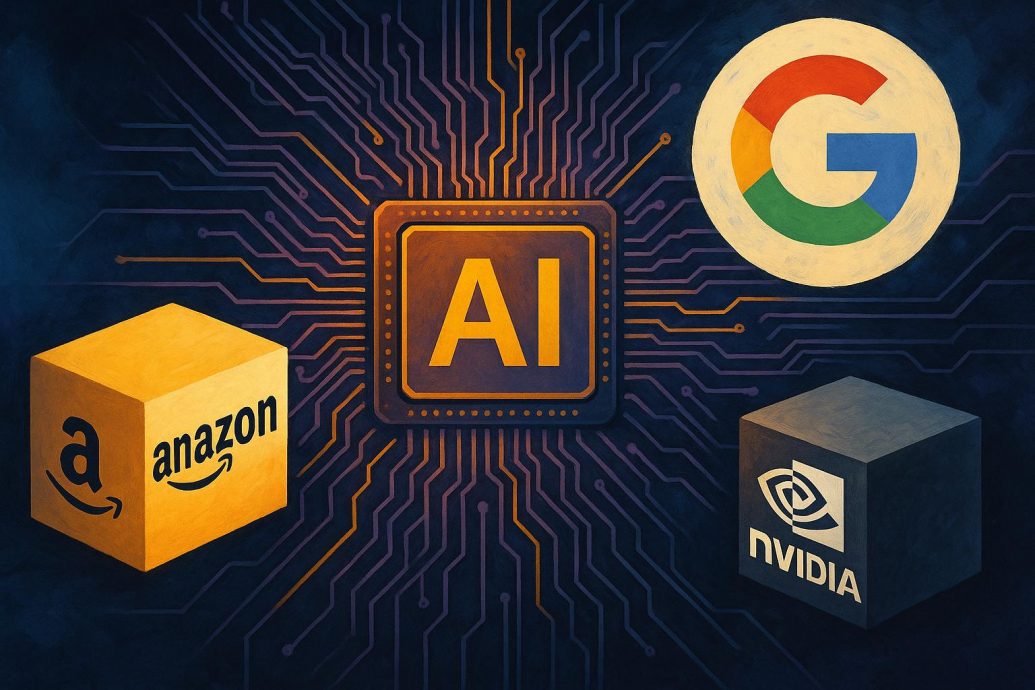
The AI chip wars featuring Amazon, Google, and Nvidia have officially ignited a race that is reshaping cloud infrastructure and artificial intelligence capabilities. As demand for AI models grows rapidly, these tech leaders are building and deploying their own custom chips to power everything from generative AI to recommendation engines. Nvidia’s GPUs have served as the gold standard for years. Now, Amazon and Google are advancing their unique architectures, Trainium and TPUs, aiming to gain control over performance, cost-efficiency, and scalability. This article explores the technologies behind these chips, including performance data, cost analysis, and their implications for the future of AI computing.
Key Takeaways
- Amazon, Google, and Nvidia are competing to lead in AI hardware by developing custom chips designed for cloud-scale AI.
- Each company focuses on distinct architectural strategies to optimize efficiency, performance, and cost.
- Nvidia’s H100 still leads in performance, but competitors like Google’s TPU v5p and Amazon’s Trainium are narrowing the gap.
- Custom accelerators are transforming cloud-based AI infrastructure, especially for large models and generative AI applications.
1. Dominance of Nvidia and the Power of the H100
Nvidia has remained at the forefront of AI hardware for more than a decade. Its GPUs, particularly the H100 “Hopper,” power the majority of today’s generative AI systems. Designed with advanced tensor cores and support for FP8 precision, the H100 is highly optimized for deep learning tasks. Major cloud services, including AWS, Google Cloud, and Azure, rely heavily on Nvidia hardware. As a result, Nvidia holds an estimated 80 percent of the AI accelerator market share.
The H100 delivers up to 700 teraflops of compute power. With NVLink interconnects, it allows high-speed GPU clustering, essential for training large-scale transformer models. Developers favor Nvidia for its mature CUDA software ecosystem. One major drawback is cost, with each unit often priced at over $30,000. This high cost has motivated providers to invest in alternatives such as in-house chips or third-party solutions. For further insights into how Nvidia continues to lead, read more about Nvidia’s dominance in the AI chip market.
2. Google TPU Architecture: Scalable, Specialized AI Silicon
Google launched its first TPUs (Tensor Processing Units) in 2016 and has continuously evolved its architecture. The latest TPU version, v5p, is now active in Google data centers and supports large-scale AI training. These processors are instrumental in powering Google’s internal services such as Bard and Search.
Unlike GPUs, TPUs are application-specific integrated circuits designed for matrix-heavy operations common in machine learning. They excel in power efficiency and are built for high-throughput training. TPU v5p can scale across more than 250,000 interconnected units, offering over 100 exaflops of peak performance.
Google develops TPUs in conjunction with its cloud ecosystem. Tight coupling with JAX and TensorFlow enables improved optimization and seamless deployment. Although these chips are not commercially available for purchase, they can be accessed through managed services on Google Cloud.
3. Amazon’s Trainium Strategy: Efficiency and Economies of Scale
Amazon Web Services has introduced its own processors through the Inferentia (for inference) and Trainium (for training) chip families. Built by its subsidiary Annapurna Labs, Trainium focuses on optimizing performance while reducing the cost of large-scale deployments. The chips are designed for deep integration within the AWS cloud ecosystem.
Trainium aims to outpace traditional GPUs in cost-efficiency. AWS reports that Trainium-based instances offer 50 percent better price-to-performance than those using Nvidia chips. These chips are compatible with popular ML frameworks like PyTorch and TensorFlow through the Neuron SDK. When used alongside Inferentia2, AWS users gain access to a full-stack solution for both AI training and serving.
Amazon’s approach emphasizes ownership across the entire hardware lifecycle. This allows optimization for thermal management, power usage, and specific AI workloads. Trainium is central to EC2 Trn1 instances, enabling large-scale training workloads across AWS infrastructure. Learn more about how Amazon is accelerating its AI chip development efforts.
4. Amazon Trainium vs Nvidia H100: Benchmark Analysis
| Feature | Nvidia H100 | Amazon Trainium |
|---|---|---|
| Training Throughput (TFLOPS) | 700+ (FP8) | Up to 800 (Bfloat16) |
| Memory Bandwidth | 3.35 TB/s | Custom interconnect (undisclosed) |
| Power Efficiency (W/TFLOP) | ~0.5 W/TFLOP | ~0.35 W/TFLOP |
| Estimated Cost | $30,000+ | Lower TCO in EC2 |
| Cloud Availability | Most major cloud providers | Exclusive to AWS |
While both chips achieve similar performance on paper, Trainium delivers noticeable gains in energy and cost efficiency. Nvidia holds an advantage with a refined developer ecosystem. These trade-offs are critical in choosing the right chip for specific workloads.
5. Industry Trends and Forecasts: Custom Chips Take the Lead
According to IDC, AI-specific chip revenue is projected to surpass $89 billion by 2027. Gartner also expects that by 2026, more than 60 percent of AI training in large-scale cloud infrastructures will rely on custom silicon. These forecasts help explain why Amazon and Google are aggressively investing in chip research and development.
Vertical integration around AI hardware enables providers to fine-tune performance and reduce reliance on Nvidia’s supply channels. It also improves cost per token for inference workloads, which directly impacts the economics of delivering generative AI services. Amazon is especially focused in this direction with investments such as its $4 billion deal with Anthropic to advance AI innovation on AWS.
With demand surging for large language models, AI for real-time applications, and recommendation engines, companies are beginning to treat chip design as a core differentiator. Proprietary accelerators offer a path to more efficient scaling and faster development cycles.
6. Expert Insights: Where the Market Is Going
Dr. Anita Sharma, a semiconductor analyst at Forrester, explains, “The AI compute stack is becoming vertically integrated, much like how Apple manages both hardware and software. This approach drastically improves execution speed and operational efficiency.”
Raj Patel, a hardware engineer at a cloud startup, adds, “Developer tools are still better on Nvidia, but chips like Trainium and TPU provide practical advantages in production. Power efficiency and total cost matter more than raw benchmarks for many companies.”
These expert views highlight the broader trend of cloud providers betting heavily on custom silicon. While Nvidia continues to lead, alternatives are gaining fast. For more insights on this shift, explore how emerging chip makers are challenging Nvidia’s position.
7. Frequently Asked Questions
What is the difference between a TPU and a GPU in AI processing?
TPUs are specialized for matrix operations essential in neural networks. This makes them more efficient for tasks like large-model training. GPUs are versatile and can support a broad range of compute needs but may be less efficient for specific AI jobs at scale.
Why are tech companies building their own AI chips?
Custom AI chips reduce costs, improve control, and optimize performance for targeted use cases. Companies also gain independence from third-party hardware suppliers and can design chips better suited to their infrastructure and application needs.
How does Amazon’s Trainium compare with Nvidia’s GPUs?
Trainium achieves similar performance at a better cost-to-efficiency ratio within AWS infrastructure. Nvidia H100, though stronger in software tools and flexibility, comes at a higher price, which may not suit all deployment scales.
Conclusion
The AI chip wars mark a defining chapter in the evolution of artificial intelligence. NVIDIA currently dominates the high-performance GPU market, powering large language models and generative AI systems worldwide. Its CUDA ecosystem and hardware performance give it a powerful moat in training and inference workloads.
At the same time, Amazon and Google are accelerating custom silicon development. Amazon’s Trainium and Inferentia chips aim to reduce dependence on external GPU suppliers. Google’s TPUs continue to evolve as tightly integrated accelerators for its cloud and AI research ecosystem.
This competition is not only about speed. It is about vertical integration, cost control, and long-term platform dominance. Whoever controls the chips controls the economics of AI at scale. Custom silicon allows cloud providers to optimize performance, lower energy consumption, and increase margins.
The next phase will likely center on efficiency and specialization. Training massive foundation models requires immense compute. Inference at global scale demands lower latency and lower cost. Companies that solve both problems will shape the future AI stack.
The outcome will not be winner take all. NVIDIA may retain leadership in cutting-edge performance. Amazon and Google may capture share through cloud-native optimization. What is clear is this. AI infrastructure has become strategic territory, and semiconductor innovation now defines the balance of power in artificial intelligence.