
Introduction
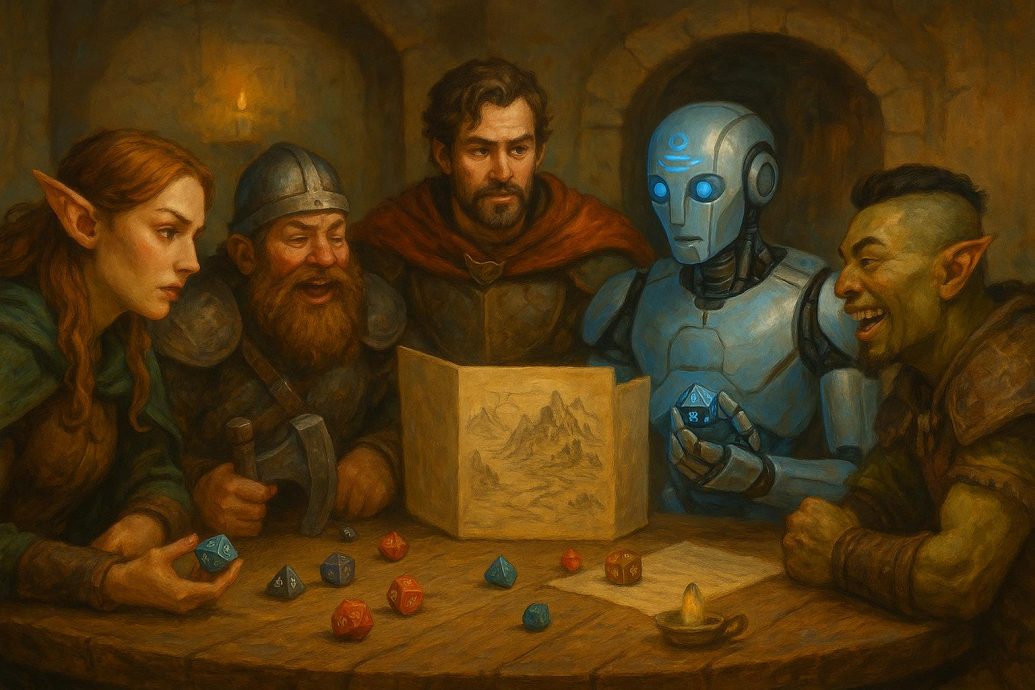
AI Joins the Party in D&D by stepping into the chaotic, imaginative world of tabletop gaming not just as a data engine but as a potential co-narrator, teammate, and strategic collaborator. As researchers experiment with embedding artificial intelligence into Dungeons & Dragons sessions, we are seeing the boundaries of technological collaboration tested in real-time, character-driven storytelling. This initiative shows how AI can support, not replace, humans in creative decision-making. It points to a future where artificial intelligence enhances our thinking and social interaction. Let’s explore how this shift may redefine cooperative storytelling, education, and interactive design.
Key Takeaways
- AI is being integrated into Dungeons & Dragons to explore human-AI collaboration and interactive storytelling.
- These studies examine how AI enhances creativity and shared narrative control during gameplay.
- Researchers reinforce that AI functions as an assistive tool within co-creative environments.
- The findings may influence education, design processes, and strategic planning sessions.
AI in Dungeons & Dragons: A Complex Collaboration Test
Artificial intelligence has moved well beyond simple rules-based computing. Dungeons & Dragons (D&D), with its limitless narrative paths, offers a unique and complex challenge for AI developers. Unlike games that follow strict rule sets such as chess or Go, D&D requires spontaneous creativity, emotional responsiveness, ongoing memory, and dynamic storytelling. In this setting, AI must do more than recognize speech or patterns. It needs to grasp nuanced dialogue, understand team interactions, and follow the logic of a fictional world.
Researchers are asking a critical question. How well can AI share in creative storytelling with humans? Answers are emerging through the combined efforts of cognitive psychology, computer science, and interactive design experts.
Inside the Lab: How AI Participates in D&D Campaigns
Teams from institutions like MIT and Georgia Tech are actively testing the role of AI in real-life D&D sessions. One example is Project DisCo (Dialogue-based Interactive Co-creation) from MIT. In this effort, AI systems function either as characters or support staff for Dungeon Masters (DMs). These AI tools, which include fine-tuned narrative models, bring the following capabilities to the table:
- Engaging in consistent dialogue through in-game characters
- Proposing directions the player or story might take
- Picking up on player cues and updating the story context on the fly
- Creating descriptions or triggering in-world events with human DM approval
Using natural language processing and advanced neural networks, these systems produce spontaneous responses adapted to diverse player actions. This represents a major shift compared to the linear strategies used in traditional game AI.
Sample Scenario: An AI-Human Interaction in Gameplay
Picture this example from a collaborative D&D session:
Human Player: “I sneak into the shadowy corridor to investigate the source of the eerie whispering.”
AI Character: “You tread carefully, your boots silent against the stone. Suddenly, a voice hisses from the darkness, ‘Who dares disturb the Echovault?’”
DM: “Roll for perception.”
Player: *rolls 17*
AI Character: “You notice faint sigils glowing on the walls, hinting at ancient protective wards—weak, but still active.”
This exchange shows that the AI contributes rich narrative elements while responding to dice rolls and player innovation. The system complements human input without overshadowing it.
How AI Processes Unpredictable Narrative Logic
Most AI systems perform best in structured environments. D&D breaks from this model. It creates a “sandbox” where player choices often steer the story in unpredictable ways. To maintain smooth storytelling, AI must grasp intent, anticipate consequences, and keep its output coherent. This process involves:
- Contextual language models: These help the AI follow conversation, character goals, and unfolding events.
- Story logic graphs: These tools map out character connections, events, and objects to track consistency through scenes.
- Natural language feedback loops: These enable the AI to respond in real time to players and adapt quickly.
The outcome is an AI that feels like a real co-player. It blends memory access, narrative composition, and logic within a shared world, preserving story integrity while building on human creativity.
Implications for Education, Design, and Strategic Planning
The research around D&D and AI crosses into several other sectors. Tabletop games create environments that mirror real-life group decisions and imagination. As a result, these experiments offer promise in the following areas:
- Classroom learning: AI could act as a character or guide in scenario-based history or ethics lessons, prompting discussion and reflection.
- Design workflows: AI might suggest creative prompts or simulate customer personas during product design phases.
- Public safety simulations: AI-driven characters could make emergency drills more lifelike and unpredictable.
Advancements in AI storytelling demonstrate that once task-specific tools can now operate as active teammates, including in emotionally complex fields. This supports new types of socially and cognitively aware AI systems.
Ethical Limits: What AI Cannot (and Should Not) Do
Even though AI offers valuable help in storytelling, experts are clear about its boundaries. Many warn against assuming AI can think or feel like a person. Dr. Anna Morgenstern, a researcher in cognitive AI at Stanford, puts it clearly. “AI is operating based on statistical likelihood, not intent. It produces what sounds right, not necessarily what is right.”
Safeguards must remain in place. Creators need to ensure that human writers retain credit and control. AI should act as a helpful assistant, not take over as the main creative force. Transparency and bias awareness are also critical to keeping these tools safe and respectful.
Comparing AI Collaboration Across Game Formats
| Game Format | AI Function | Complexity | Degree of Human-AI Collaboration |
|---|---|---|---|
| Chess | Opponent Play | Low (Deterministic) | Competitive Only |
| Go | Strategic Opponent | Medium (Pattern-Based) | Minimal Cooperation |
| Dungeons & Dragons | Narrative Co-player | High (Nonlinear, Creative) | Fully Collaborative |
| Esports (MOBA/FPS) | Tactical Buddy or Coach | Medium-High | Moderate Collaboration |
FAQs
How does AI participate in Dungeons & Dragons?
AI may assist during D&D campaigns by playing characters, enriching narratives, or helping Dungeon Masters. It listens to dialogue, processes context, and generates fitting in-game content.
Can artificial intelligence be a Dungeon Master?
In experimental forms, yes. Some models can run basic encounters and describe scenes. Still, they lack judgment, emotional depth, and creative intent, making human DMs indispensable.
What is the purpose of testing AI in role-playing games?
Testing AI in games like D&D shows how well it can support creativity and teamwork. These settings help evaluate empathy, narrative adaptability, and other skills that matter in fields like design or education.
How do AI and humans collaborate in creative tasks?
In co-creation, AI contributes ideas, context, or character actions. Meanwhile, humans make moral decisions and drive themes. The process enhances imagination without replacing it.