
Introduction
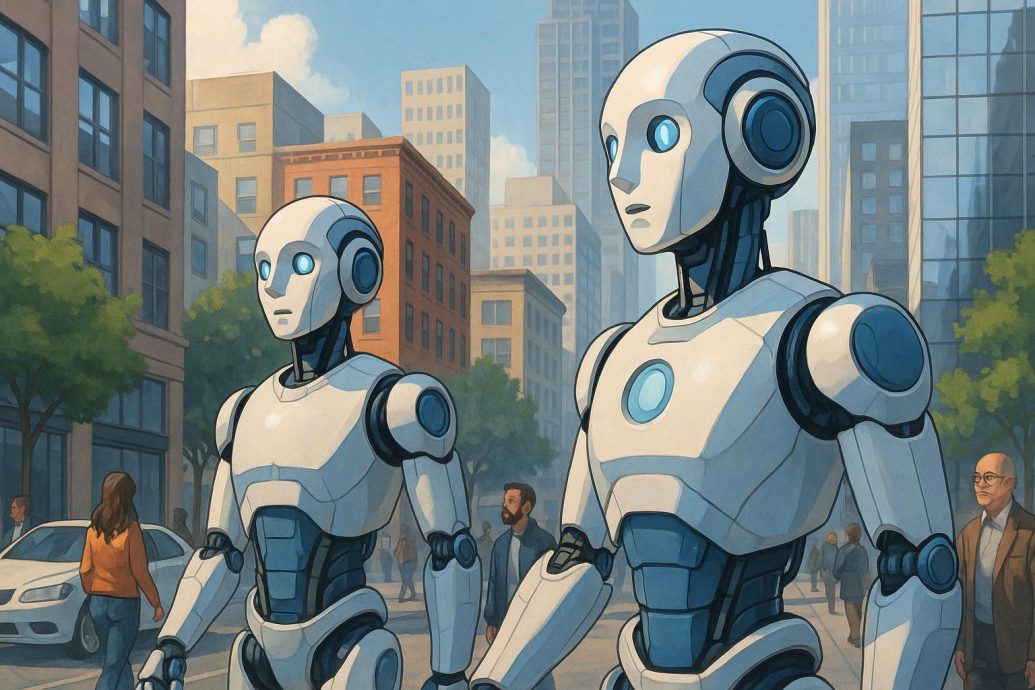
AI robots enter the real world is now a reality. What used to be the subject of science fiction is now happening across warehouses, hospitals, farms, and even our homes. Advances in artificial intelligence, edge computing, and sensor technology are helping robots move beyond virtual models and controlled labs into the physical environments where people live and work. From the Tesla Optimus robot and Boston Dynamics’ agile machines to autonomous delivery bots and assistive robotic caregivers, real-world AI applications are quickly scaling. This article explores how AI in robotics is reshaping industries, the key players driving innovation, the challenges to overcome, and what it means for the future of work and ethics in public tech deployment.
Key Takeaways
- AI-powered robots are now operating across multiple industries including logistics, healthcare, agriculture, and retail.
- Leading technologies include Tesla’s Optimus, Boston Dynamics’ Spot, and Nvidia’s Isaac Sim.
- Challenges remain in perception, power, training data, and ethical regulation of robots in public spaces.
- The global AI robotics market is forecasted to surpass $80 billion by 2030, driven by real-world deployment and automation demand.
The Expansion of AI Robots into Real-World Environments
AI robots in the real world represent a pivotal shift in both robotics and computing. Once limited to simulations or structured factory lines, machines powered by artificial intelligence are now capable of navigating dynamic and unpredictable environments. Technologies such as computer vision, natural language processing, and edge AI computation are transforming robots from fixed tools into semi-autonomous agents.
For example, Amazon has deployed over 750,000 mobile robots in fulfillment centers globally, where they integrate with human pickers using machine learning algorithms to optimize flow and safety. Companies such as Nuro use AI-powered autonomous pods for local deliveries. In healthcare, startups like Diligent Robotics provide nurse-assisting robots that can interact with hospital staff while performing tasks like transporting supplies.
Key Technologies and Companies Leading the Way
Several companies and academic labs are at the forefront of deploying AI robots outside controlled environments. Below are notable leaders shaping this landscape.
- Tesla Optimus Robot: Tesla is leveraging its experience in AI from autonomous driving to develop a general-purpose humanoid robot. The Optimus prototype has demonstrated basic locomotion and object manipulation in early factory tests.
- Boston Dynamics: Spot and Atlas use advanced locomotion algorithms and sensors to navigate complex terrains. Their robots are deployed in environments like construction sites and disaster recovery zones. Learn how robot dogs apply AI in navigation.
- Figure AI: A startup building fully autonomous, bipedal humanoid robots designed for labor-intensive roles. Figure recently secured industry partnerships to test pilots in logistics and manufacturing lines.
- Nvidia Isaac Sim: A simulation environment that enables training and testing of AI robots in realistic virtual settings. This accelerates development lifecycles for warehouse and industrial robotics.
Niche startups are also innovating in specific sectors. Aigen’s solar-powered autonomous tractors use AI for precision agriculture without relying on fossil fuels. In Japan, Cyberdyne’s robotic exoskeletons assist patients with movement impairments, blending medical science with robotics for real-world healthcare applications. Explore how robots are transforming agriculture with full autonomy on active farms.
Use Cases Across Major Sectors
Real-world AI applications extend across several high-impact sectors.
Logistics and Warehousing
Companies like Amazon, FedEx, and JD.com actively use autonomous mobile robots for inventory transport and real-time sorting. AI algorithms help these robots avoid obstacles, adjust paths, and communicate with workers to assist in high-volume packaging environments.
Healthcare
Robots such as Diligent’s Moxi assist with hospital workflows by delivering medications, carrying lab samples, and freeing up time for human staff to focus on patient care. These robots use AI to interpret voice commands and navigate crowded hospital corridors.
Retail and Delivery
Nuro’s autonomous delivery vehicles are already transporting groceries and pizza in select U.S. cities. AI helps these compact robots understand traffic patterns, manage intersections, and complete last-mile delivery in suburban neighborhoods. You can also discover other robotics applications that are emerging today.
Agriculture
Autonomous robots equipped with AI are transforming modern farming. AI-enabled drones monitor crop health using computer vision. Ground-based bots complete tasks like weeding and planting without human input. These innovations reduce manual labor and improve sustainability.
Home and Elder Care
Robots are now addressing demographics such as elderly care. AI-powered assistants offer reminders, perform simple tasks, and provide companionship. Companies like Intuition Robotics build empathetic AI assistants that interact with seniors using natural language and contextual awareness.
Technical Limitations and Development Challenges
Despite innovation, integrating AI robots in the real world brings several technical hurdles.
- Perception and Localization: AI robots must understand visual and spatial data in real time. This is still limited in unstructured or constantly changing environments.
- Training Data: Deep learning models require large, diverse datasets that reflect variations found in physical environments. Sim-to-real transfer remains a key challenge.
- Power Efficiency: Many robots need long-lasting energy solutions to function autonomously for hours. Battery limitations still restrict performance in remote or mobile deployments.
- Edge AI Deployment: Processing data locally (on-device) is essential to make split-second decisions without cloud latency. Compact, high-performance chips like Nvidia Jetson are addressing this need. The technology continues to evolve.
Ethics, Labor, and Regulation: Challenges Beyond Code
While the technology evolves, ethical and societal concerns are growing.
- Labor Displacement: As robots begin to take on jobs historically occupied by humans, concerns over employment arise. A report from Oxford Economics estimates that up to 20 million manufacturing jobs could be replaced by robots by 2030.
- Privacy and Surveillance: Robots equipped with cameras and sensors can inadvertently collect personal data. Regulations must ensure compliance with laws like GDPR and CCPA.
- Bias and Transparency: AI systems can reflect biased data if not properly curated. Ethical frameworks like IEEE’s “Ethically Aligned Design” aim to ensure fairness and auditability.
- Need for Regulation: The upcoming EU AI Act includes clauses concerning AI robot deployments in public areas. Coordinated global regulation is necessary to guarantee safety and respect for human rights.
Academic leaders such as the MIT CSAIL research group emphasize that ethics should not be an afterthought. Diverse voices, including those outside the tech industry, must be involved in shaping the future of AI robotics. Learn more about the integration of AI in robotics and its next phase.
Market Forecast and Growth Projections
The AI robotics industry is on track for significant expansion. According to Fortune Business Insights, the global AI robotics market was valued at $17.2 billion in 2022. It is projected to reach $83.3 billion by 2030, growing at a CAGR of 21.3 percent.
This growth is driven by demand for automation in repetitive labor, the need for healthcare solutions for aging populations, and progress in chip-based edge computing. Investment is surging into companies like Figure AI, Agility Robotics, and Covariant. Each one is working to develop specialized autonomous systems.
Collaboration and the Human Factor
For AI robots to thrive in daily environments, collaboration among engineers, policy developers, ethicists, and sociologists is critical. Standard-setting and inclusive design will ensure technology benefits broader society. Public transparency and engagement will also alleviate fears around surveillance or job automation.
Public-private partnerships already demonstrate the benefits of such unity. For instance, the U.S. Department of Agriculture uses AI robots for environmental monitoring. These types of programs show that practical technology can also uphold community values and social goals. Read about how AI is entering even more surprising domains like aerial systems.
FAQ’s
What does it mean when AI robots enter the real world?
When AI robots enter the real world, it means autonomous machines powered by artificial intelligence are operating outside labs and factories in everyday environments. These robots can navigate physical spaces, interact with humans, and perform real-world tasks such as delivery, manufacturing, healthcare support, and logistics.
How do AI robots work in real-world environments?
AI robots use sensors, cameras, machine learning models, and control systems to perceive surroundings, make decisions, and execute actions. They combine computer vision, motion planning, and reinforcement learning to adapt to unpredictable physical environments.
What industries are using AI robots right now?
Industries actively using AI robots include manufacturing, warehousing, logistics, healthcare, agriculture, retail, and hospitality. Companies deploy robots for automation, inspection, delivery, surgical assistance, and inventory management.
Are AI robots fully autonomous?
Most AI robots operate with partial autonomy. They can perform specific tasks independently but still require human supervision for safety, maintenance, or complex decision-making. Fully autonomous general-purpose robots remain under development.
Will AI robots replace human jobs?
AI robots may replace repetitive, manual, or hazardous roles. However, they also create new jobs in robotics engineering, maintenance, AI training, and system oversight. The long-term impact depends on workforce adaptation and policy decisions.
What is the difference between industrial robots and AI robots?
Industrial robots follow pre-programmed instructions in controlled environments. AI robots use machine learning and real-time perception to adapt to changing conditions, making them more flexible in dynamic, real-world settings.
Are AI robots safe to operate around humans?
AI robots are designed with safety mechanisms such as collision detection, real-time sensors, and controlled force limits. Regulatory standards and testing protocols help ensure safe human-robot interaction in shared environments.
What technologies power AI robots?
AI robots are powered by deep learning, computer vision, natural language processing, reinforcement learning, advanced actuators, and edge computing hardware. These technologies enable perception, reasoning, and motion control.
Can AI robots learn from experience?
Yes, AI robots can improve performance through machine learning and reinforcement learning. They analyze data from previous tasks to refine decision-making and optimize movement efficiency over time.
How soon will AI robots become common in daily life?
AI robots are already common in warehouses and factories. Broader household and public adoption depends on cost reduction, reliability improvements, regulatory approval, and public acceptance.
What are the risks of AI robots in the real world?
Risks include system malfunctions, cybersecurity vulnerabilities, privacy concerns, and unintended decision errors. Responsible deployment requires governance frameworks, safety testing, and human oversight.
Conclusion
AI robots entering the real world represent a major shift from controlled automation to adaptive physical intelligence. Powered by advanced AI models and real-time perception systems, these machines are expanding beyond factories into healthcare, logistics, retail, and public environments. While they promise efficiency and productivity gains, successful integration depends on safety standards, workforce transition planning, and ethical oversight. The real-world deployment of AI robots signals the beginning of a new phase in automation, where digital intelligence increasingly shapes physical environments.