
Introduction
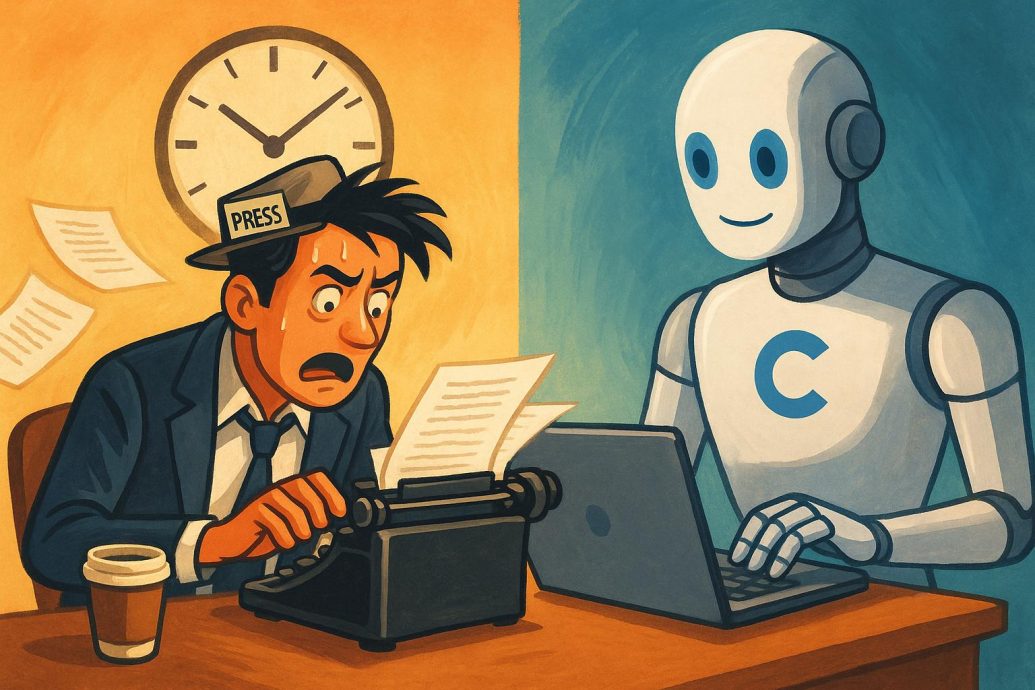
Claude AI outwrites journalists on deadline. This stunning development in AI in journalism has sparked conversations across newsrooms and tech circles. When Anthropic’s Claude AI beat professional journalists to publish a reliable and well-structured report on the Reddit API protest, it demonstrated a striking shift in how breaking news could be reported. As newsrooms consider automation, the rise of AI-generated news offers both exciting possibilities and daunting ethical dilemmas. From workflow enhancement to questions of accuracy and trust, the story of Claude is more than a tale of tech agility. It is a window into the evolving future of journalism.
Key Takeaways
- Claude AI generated a publishable news report on the Reddit API protest before any major outlet broke the story.
- AI in journalism is gaining traction, with tools like ChatGPT, Bing AI, and Claude showing differing capabilities.
- While fast and efficient, AI tools still lack contextual judgment, ethical discernment, and human editorial sense.
- Experts emphasize that AI should augment journalistic workflows, not replace human reporters.
The Event That Put Claude AI in the Spotlight
In early 2023, Reddit faced widespread backlash against its API pricing changes. Thousands of subreddits went dark in protest, prompting online debates and widespread concern. While mainstream media was still piecing together a narrative, Claude AI independently compiled a breaking news story that summarized key developments, stakeholder viewpoints, and public reactions.
Claude’s synthesis was not obtained through exclusive access or leaks. Instead, the AI scraped publicly available forum posts, statements, and timelines, then structured these into a digestible, balanced report. By the time traditional outlets published their write-ups, Claude’s version had been accessible for hours.
How Claude AI Delivered Breaking News First
Created by Anthropic, Claude is designed for transparent, safe language processing. Trained on a mix of supervised and unsupervised data, its natural language capability allows it to summarize vast online chatter, identify newsworthy trends, and generate articles consistent with journalistic style guides. In this case, Claude used Reddit discussions, public user statements, and update logs to build a full contextual narrative.
Unlike conventional news teams, which require editorial triage, fact-checking layers, and layout approval, the AI was able to parse, structure, and publish almost instantaneously. This bypass of internal gatekeeping protocols gave it the speed advantage but also raised alarms regarding oversight and accountability.
How Does Claude Compare to ChatGPT, Bing AI, and Bard?
When comparing Claude AI with industry peers such as ChatGPT from OpenAI, Bing AI from Microsoft, and Google Bard, several differences stand out, especially in journalism use cases:
- Claude AI: Prioritizes constitutional AI principles, reducing hallucinations and improving interpretability. Suitable for summarizing social narratives with better alignment checks.
- ChatGPT: Known for creativity and dialogue while relying on well-structured prompts. When fine-tuned, it performs well in journalistic formats but may require close monitoring to avoid fictionalized output.
- Bing AI: Pulls directly from search engine results and excels at real-time data extraction. Less effective at creating smooth narrative structures.
- Google Bard: Strength lies in quick information access through Google Search integration. It still struggles with cohesive formatting for long-form journalism.
Among these options, Claude appears most aligned with editorial standards while minimizing misinformation. Its clarity and structure made it a notable case of early AI-led reporting success.
AI in Journalism: Adoption and Impact
AI-generated news is already reshaping media. According to the Reuters Institute’s 2023 report, more than 54 percent of global newsrooms use AI for content suggestions, SEO automation, and summarization. Bloomberg uses AI for generating market recaps, while the Associated Press automates sports and earnings briefs. This is just one example of how artificial intelligence is transforming journalism.
The case of Claude illustrates a potential shift from assistive roles to full compositional output in breaking coverage. While this boosts speed and output during high-pressure periods, it also forces media organizations to reevaluate staffing, ethics, and editorial protocols.
Current AI integration strategies in media include:
- Automating summaries from press releases and government filings
- Scanning social media to detect emerging topics
- Tagging and organizing metadata for SEO optimization
- Assisting fact-checking teams by sourcing citation links
- Creating first drafts or outlines for editors to later finalize
Despite these innovations, full automation carries risks and thus requires careful implementation and oversight.
The Ethical Dilemma: Trust, Accuracy, and Accountability
Claude’s case raises pressing ethical concerns. Although it operates efficiently, it lacks human judgment, contextual awareness, and editorial reasoning. AI cannot understand off-the-record policies or the nuances of privacy for sources and subjects.
Dr. Emily Bell, Director of the Tow Center for Digital Journalism, explains, “Speed does not equal journalism. Context, intent, and verification define editorial trust. These are qualities machines have yet to learn.”
When AI produces factual errors, no legal obligation binds the software or developers. The burden of accountability shifts to the publisher. This creates liability risks if the automated report misleads audiences or spreads falsehoods.
Bias is another issue. A machine trained on skewed datasets may appear objective but still echo entrenched prejudices. As one controversial AI reporter firing case revealed, public trust can deteriorate quickly when ethical boundaries are crossed.
For accountability and transparency, AI-generated stories still require human validation, especially in volatile or sensitive contexts.
What’s Next: Human-AI Editorial Collaboration
Forward-thinking news organizations are testing hybrid editorial workflows, combining AI detection with human insight. Reuters uses prompt-driven alerts to notify journalists about emerging stories. Reporters then build verified narratives. The Washington Post employs AI to draft internal reports, which editors later polish into publishable content.
Some promising models for AI-human collaboration include:
- AI scans breaking signals from social media chatter
- Reporters confirm facts, conduct interviews, and develop perspectives
- Editors shape story hierarchy and apply ethical standards
- AI optimizes formatting, metadata, and headline testing
Claude and similar tools may evolve into newsroom partners that boost efficiency while upholding journalistic integrity. As described in this analysis of how AI is changing content production, productivity gains are real when balanced with human judgment.
FAQs
How is AI used in journalism today?
AI assists with tasks like summarizing press releases, detecting trends, generating financial reports, optimizing content structure, and drafting initial story formats. It reduces manual workload without replacing in-depth reporting or editorial decision-making.
What is Claude AI and how does it compare to ChatGPT?
Claude AI is Anthropic’s large language model, built with adherence to safe communication and transparency principles. It provides accurate and measured outputs with fewer hallucinations. In contrast, ChatGPT performs well in conversational and creative contexts but may require tailored prompts for journalistic reliability.
Could AI replace journalists in the future?
It is unlikely, since human roles in investigation, analysis, and verification remain essential. AI can complement reporting functions, but editorial credibility still depends on human oversight.
What are the ethical concerns of AI-generated news?
Main concerns include information accuracy, legal accountability, and data bias. Machines cannot interpret sensitive material or apply editorial ethics. Thus, human involvement in publication remains necessary.
Conclusion: Supplement, Not Substitute
Claude AI’s early and accurate report on the Reddit API protest revealed the real-time capabilities of artificial intelligence in journalism. More importantly, it showed the need for balanced collaboration between machines and journalists. AI can support fast-moving newsrooms, but it cannot replace the contextual intelligence humans bring to the job.
The shift is not about eliminating reporters. Instead, it focuses on enabling editorial teams to do more with trusted digital assistance. As emphasized in studies exploring how AI is making publishing more efficient, sustainability in modern media depends on this synergy.