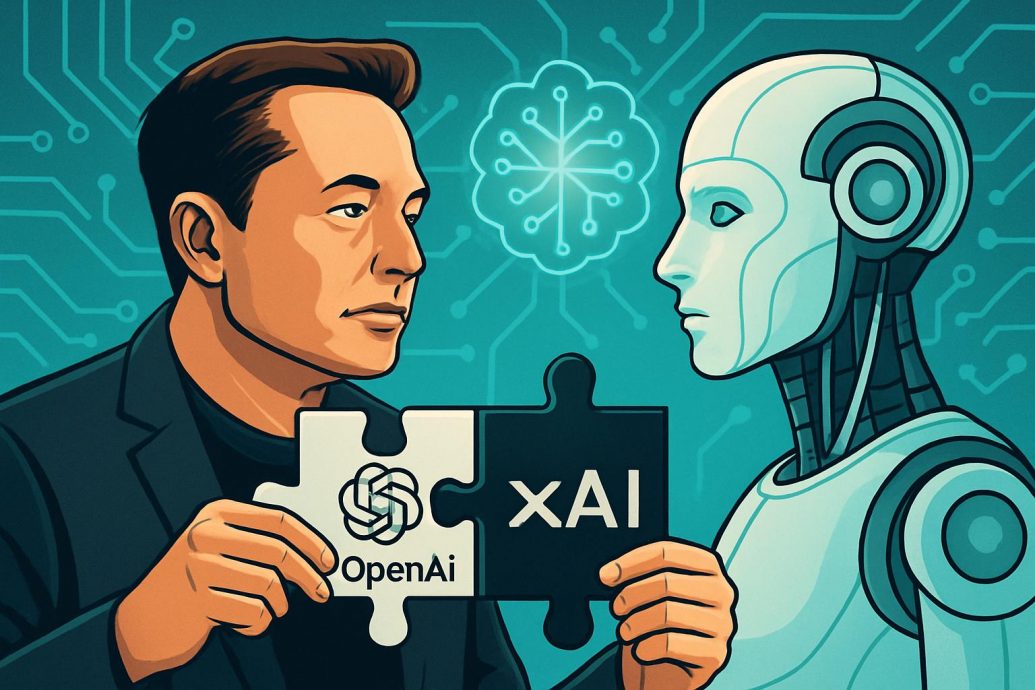

Musk Unifies AI Efforts for AGI
In a bold realignment of his companies’ resources, Elon Musk unifies AI efforts for AGI, linking Tesla, SpaceX, and his newest venture, xAI. The move aims to leapfrog current artificial intelligence players by combining real-world data, massive compute infrastructure, and centralized strategy to accelerate the development of artificial general intelligence (AGI). This consolidation challenges the dominance of OpenAI, DeepMind, and Anthropic, and could shift how the world approaches AI research, commercial application, and governance. For shareholders, regulators, and technologists, the implications span market economics, data ethics, and competitive advantage.
Key Takeaways
- Musk combines Tesla’s AI Dojo supercomputer, SpaceX’s operational data, and xAI’s research team to accelerate AGI development.
- The alliance directly challenges AI giants like OpenAI and Google DeepMind by emphasizing real-world data and proprietary computing scale.
- Dojo’s high-performance architecture plays a central role in reducing training time and energy expenditure for large AI models.
- Regulators and shareholders are closely watching the implications of this resource reallocation across Musk’s private and public enterprises.
Strategic Integration: Musk’s AGI Playbook
Musk’s approach to AGI is distinct from rivals relying heavily on curated datasets and cloud-based infrastructures. By combining Tesla’s autonomous vehicle data, SpaceX’s aerospace telemetry, and xAI’s foundational models, Musk builds a vertically integrated AGI pipeline. This pipeline fuses data ingestion, model training, and deployment under a single strategic framework backed by compute-intensive resources like Dojo.
This integration accelerates model feedback loops. Tesla provides data from billions of miles of real-world driving scenarios, while SpaceX offers edge-case datasets not typically available in commercial AI training, such as real-time spaceflight diagnostics and navigation telemetry. These sources allow xAI to develop systems with greater generalization potential across unfamiliar contexts.
Dojo Supercomputer: The Technological Lever
At the heart of Musk’s AGI strategy lies Dojo, Tesla’s custom-built supercomputer. Unlike general-purpose cloud clusters used by many companies, Dojo is purpose-optimized for neural network training and inference throughput. It is built with an in-house chip architecture known as D1, enabling scalable matrix operations across thousands of nodes.
According to Tesla engineers, a full Dojo training tile features 25 D1 chips, with each tile capable of 9 PFLOPs. The company plans to scale to over 300 Dojo tiles, outpacing public GPU cluster infrastructure in terms of raw bandwidth and latency optimization. This system cuts down training costs while increasing precision, directly supporting xAI’s large-scale foundational models.
Enterprise Impacts: Data Governance, Value Allocation, and Shareholder Risk
Musk’s consolidation raises critical questions surrounding internal resource allocation between a public company (Tesla), a privately held firm (SpaceX), and a startup venture (xAI). Shareholder advocates have begun voicing concern about the cross-pollination of proprietary datasets and compute infrastructures without formal licensing structures or revenue sharing models.
Regulatory interest may grow around transparency and disclosures. The U.S. Securities and Exchange Commission (SEC) could examine whether Tesla’s shareholder value is at risk through unmonetized contributions to private ventures. The Federal Trade Commission (FTC) might also scrutinize competitive advantage dynamics under fair market use of shared datasets.
These developments also coincide with the announcement that Musk’s xAI secured $6 billion in funding, suggesting capital is in place to drive aggressive AGI ambitions.
AI Governance: How xAI Compares to OpenAI and DeepMind
| Company | Core Focus | Compute | Data Source | Governance Model |
|---|---|---|---|---|
| xAI | General AI aligned with human values | Dojo supercomputer (proprietary) | Tesla AV data, SpaceX telemetry | Private ownership under Musk |
| OpenAI | AGI for broad benefit | Azure GPU clusters | Web-scale corpora, RLHF from users | Capped-profit hybrid nonprofit |
| DeepMind (Alphabet) | Scientific-leaning AGI | TPU clusters (Google Cloud) | Research datasets, AlphaFold, games | Corporate division with ethics oversight |
xAI positions itself as an agent of transparent innovation. Critics point out that unlike OpenAI’s capped-profit structure or DeepMind’s internal ethics board, xAI operates without formal external oversight. Musk’s prior emphasis on profit-driven models, as seen in his vision for a for-profit OpenAI, reinforces concerns about how priorities may shift as xAI grows.
Corporate Strategy and Market Implications
From an investment strategy viewpoint, xAI’s access to Tesla and SpaceX infrastructure reduces R&D costs significantly. This enables quicker product rollouts that may disrupt competitors relying on third-party services and generalized datasets. A key question remains whether this value creation will be equitably reflected in Tesla or SpaceX share performance or whether it primarily benefits xAI as a separate entity.
The alignment of these companies highlights how SpaceX is increasingly linked with Musk’s AI startup, deepening operational synergies that are likely to continue expanding without traditional corporate separations.
xAI’s recruitment drive is ongoing, targeting senior engineers and model architects from companies like Meta and Google. Reports suggest salaries and stock incentives are structured to outperform industry benchmarks. While still privately financed, speculation grows that xAI will pursue external funding to scale operations further.
Regulatory Radar: What Watchdogs Are Monitoring
- SEC Watchpoints: Shareholders may demand greater disclosure regarding Tesla’s AI infrastructure used by xAI. Lack of visibility into internal cost-sharing could suggest shareholder dilution or misallocated capital.
- FTC Concerns: Vertically integrated data and compute reuse across Musk’s companies may trigger antitrust interest. Such integration can offer xAI a competitive edge not available to firms without similar access.
- Global Governance Risks: Regulatory agencies in Europe and Asia are expected to evaluate whether xAI’s training methods comply with data privacy and sovereignty laws. This is particularly sensitive for Tesla’s globally distributed sensor data.
Public focus is also sharpening as other companies respond to Musk’s AI ambitions. In fact, OpenAI recently responded to legal action initiated by Musk, adding tension to the already competitive atmosphere surrounding AGI development.
FAQs Related to Elon Musk’s Unified AI Strategy
What is Elon Musk’s xAI?
xAI is an artificial intelligence company founded by Elon Musk with the mission of understanding the true nature of the universe. It focuses on building AGI that aligns with human values and works collaboratively with humans. The company operates independently but is deeply connected to Tesla and SpaceX through shared data and compute resources.
How does Dojo enable AI development?
Dojo is a custom-built supercomputer designed by Tesla for training neural networks more efficiently. It uses a proprietary chip architecture (D1) that delivers higher floating-point operations per second (FLOPs) and lower interconnect latency. Dojo enables faster training on vast datasets from Tesla’s autonomous vehicles, shortening model iteration cycles and reducing energy consumption.
What is artificial general intelligence (AGI)?
AGI refers to machines that possess the ability to learn and apply knowledge across a wide range of tasks, mirroring or exceeding human capabilities. Unlike narrow AI, which specializes in single tasks (e.g., image recognition), AGI can reason, plan, and generalize solutions in unfamiliar domains.