
Introduction
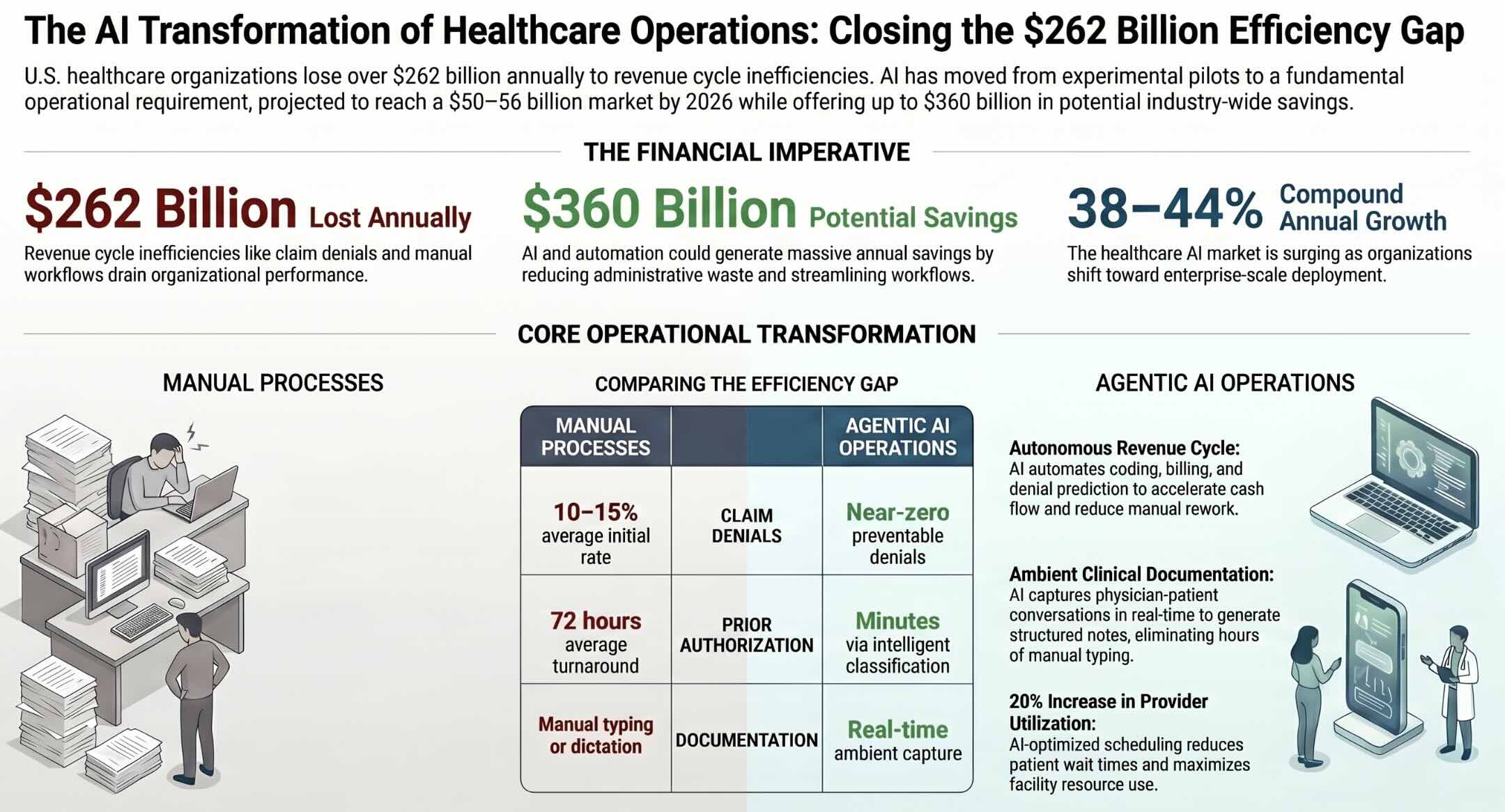
Healthcare organizations face relentless pressure to reduce costs, improve patient outcomes, and manage growing administrative complexity, and artificial intelligence is emerging as the most powerful tool for transforming business processes across the entire industry. The global AI in healthcare market is projected to reach between USD 50 and 56 billion in 2026, up from approximately 39 billion dollars in 2025, growing at a compound annual growth rate of 38 to 44 percent as organizations shift from pilot projects to enterprise-scale deployment. U.S. healthcare organizations lose over 262 billion dollars annually due to revenue cycle inefficiencies alone, including claim denials, undercoding, delayed follow-ups, and manual workflows that drain financial performance. Health systems collectively spend more than 140 billion dollars annually on revenue cycle management, with manual processes, fragmented vendor landscapes, and outdated technologies contributing to high costs, delays, and errors. AI in healthcare business process improvement has moved beyond experimental pilots into a fundamental operational requirement, delivering measurable ROI that is transforming how hospitals, health systems, and payers manage their financial and administrative operations. AI and automation in the revenue cycle alone could generate up to 360 billion dollars in annual savings by reducing waste, streamlining workflows, and enhancing decision-making according to the National Bureau of Economic Research. This guide explores how AI transforms every major healthcare business process from revenue cycle management through clinical documentation to patient access and supply chain operations.
Key Questions
How does AI improve healthcare business processes?
AI automates billing, coding, claims processing, prior authorization, clinical documentation, scheduling, and supply chain management, reducing errors, accelerating workflows, and freeing staff to focus on patient care and complex exception handling.
What is AI revenue cycle management in healthcare?
AI revenue cycle management uses machine learning and natural language processing to automate coding, billing, denial prediction, claims submission, and payment posting, reducing manual effort while improving accuracy and cash flow.
How much can AI save in healthcare operations?
AI and automation in healthcare could generate up to USD 360 billion in annual savings through reduced administrative waste, fewer claim denials, faster reimbursement, and streamlined workflows across revenue cycle, documentation, and patient access functions.
Key Takeaways
- Agentic AI represents the next evolution, enabling autonomous end-to-end process execution across claims, scheduling, and documentation with human oversight for exceptions only.
- The AI in healthcare market reaches USD 50–56 billion in 2026, with administrative and revenue cycle applications delivering the fastest measurable ROI across the industry.
- U.S. healthcare organizations lose over USD 262 billion annually to revenue cycle inefficiencies that AI automation directly addresses through coding, billing, and denial prevention.
- AI could generate up to USD 360 billion in annual healthcare savings by reducing administrative waste, streamlining workflows, and enhancing clinical documentation accuracy.
Table of contents
- Introduction
- Key Questions
- Key Takeaways
- What Healthcare Business Process Improvement Through AI Means
- Why Healthcare Business Processes Need AI Now
- Revenue Cycle Management Transformed by AI
- Clinical Documentation and Ambient AI
- Patient Access and Scheduling Optimization
- Supply Chain and Inventory Management
- Compliance, Audit, and Regulatory Automation
- Agentic AI and the Autonomous Healthcare Back Office
- Workforce Transformation in AI-Augmented Healthcare Operations
- Data Privacy, Security, and Shadow AI Challenges
- Measuring ROI and Performance of Healthcare AI
- The Future of AI-Driven Healthcare Operations
- Key Insights
- Real-World Examples
- Case Studies
- Frequently Asked Questions
- References
What Healthcare Business Process Improvement Through AI Means
Healthcare business process improvement through AI refers to the systematic application of machine learning, natural language processing, robotic process automation, and predictive analytics to redesign, automate, and optimize the administrative, financial, and operational workflows that support clinical care delivery. These technologies address the structural inefficiencies that consume resources, create delays, and generate errors across revenue cycle management, clinical documentation, patient access, supply chain operations, and regulatory compliance functions. The goal is not merely automating existing broken processes but fundamentally reimagining how healthcare organizations operate to reduce costs, improve accuracy, and enhance the experience for patients, clinicians, and administrative staff simultaneously.
Why Healthcare Business Processes Need AI Now
The healthcare industry operates under financial and operational pressures that traditional process improvement methods can no longer address at the speed and scale the system demands. U.S. healthcare represents a 4.9 trillion dollar sector, roughly one-fifth of national GDP, yet has historically spent far less on software and automation than its economic size would suggest. Documentation and administrative work consume nearly twice as much time as direct patient care for physicians, creating burnout that contributes to the workforce shortage affecting every specialty. Chronic clinician shortages, post-pandemic exhaustion, revenue squeezed by administrative overhead, and patients expecting digital convenience create a system that cannot push harder on human effort alone. Healthcare is the last major industry where trillion-dollar administrative processes still depend primarily on manual workflows, making it the sector with the most to gain from AI-driven business process transformation. Increasing claim denials cost hospitals over twenty billion dollars annually, while manual processes lead to an average twenty-five dollar rework cost per denied claim that compounds across millions of transactions. Understanding the fundamental difference between automation and AI clarifies why healthcare needs intelligent systems that adapt and learn rather than simple robotic process automation that follows static rules.
Revenue collection rates dropped by 8.3 percent year-over-year across the industry, squeezing margins for organizations already operating on thin financial foundations after years of pandemic-related disruption. One in three hospitals report bad debt levels exceeding ten million dollars, a clear signal that payment collection issues create serious revenue leakage that threatens institutional viability. Staff turnover in revenue cycle roles remains persistently high because repetitive, frustrating administrative tasks drive employees to seek positions in less burdensome environments. Prior authorization processes delay patient access to care while consuming significant clinical and administrative staff time for each approval request submitted to insurance companies. The convergence of financial pressure, workforce challenges, and technological maturity creates the conditions for AI adoption to accelerate faster in healthcare than in any previous technology cycle. Organizations that delay AI implementation risk falling behind competitors that capture efficiency gains, retain staff through reduced administrative burden, and improve patient satisfaction through streamlined experiences.
Revenue Cycle Management Transformed by AI
The urgency for process improvement manifests most clearly in revenue cycle management, where AI delivers the most immediate and measurable financial returns across healthcare business operations. AI-powered coding systems analyze clinical documentation and automatically assign appropriate medical codes, reducing errors that cause claim denials and accelerating the billing cycle from documentation to payment. Denial prediction algorithms identify claims at high risk of rejection before submission, enabling staff to correct documentation gaps, missing authorizations, and coding mismatches proactively rather than chasing denials retroactively. Claims processing automation handles eligibility verification, benefit determination, claims submission, and payment posting with minimal human intervention for straightforward cases. If a largely agentic AI revenue cycle solution could reduce cost-to-collect by one to two percentage points, a health system with six billion dollars in patient revenue would save sixty to one hundred twenty million dollars annually. Waystar’s AI platform has prevented 15.5 billion dollars in denials while reducing time spent on denial appeals and recovery by ninety percent through automated workflows. Exploring how RPA boosts business operations reveals the foundational automation capabilities that AI-enhanced revenue cycle systems build upon.
Prior authorization automation represents one of the highest-impact AI applications, converting a process that takes seventy-two hours into one completed in minutes through intelligent document classification and smart forms. Clinical documentation integrity programs use AI to review physician notes, identify documentation gaps that affect coding accuracy, and suggest improvements before bills are generated. Payment posting automation matches remittance data to patient accounts, identifies discrepancies, and routes exceptions to staff with the context needed for rapid resolution rather than manual research. Accounts receivable management uses predictive analytics to prioritize collection efforts on claims most likely to be recovered, optimizing staff time allocation across aging accounts. Understanding how automation impacts healthcare operations provides concrete examples of process improvements that generate measurable financial and operational returns. The revenue cycle represents the most mature domain for healthcare AI because data is abundant, processes are measurable, the need is urgent, and the potential ROI is significant.
Clinical Documentation and Ambient AI
Revenue cycle improvements depend on documentation quality, and AI is transforming how clinical notes are created, validated, and utilized across healthcare organizations. Ambient documentation technology uses AI to listen to physician-patient conversations and automatically generate structured clinical notes in real time without requiring manual dictation or typing. These systems capture the full clinical encounter, extracting diagnoses, medications, procedures, and patient instructions from natural conversation and formatting them according to institutional documentation standards. Evidence is accumulating that ambient documentation technology reduces clinician burnout and improves wellbeing by eliminating the hours of after-hours documentation that physicians call “pajama time.” Ambient AI documentation represents the single largest opportunity to return physician time to patient care, addressing the root cause of burnout that drives hundreds of thousands of clinicians to consider leaving medicine. The AI produces the first draft of clinical work including notes, summaries, and orders while clinicians concentrate on validation, interpretation, and decision-making that requires human judgment. Learning about the role of AI in healthcare documentation reveals how intelligent documentation systems improve both clinical accuracy and administrative efficiency simultaneously.
Computer-assisted coding translates physician documentation into accurate billing codes by understanding clinical language, terminology variations, and specialty-specific documentation patterns. Natural language processing extracts structured data from unstructured clinical narratives, enabling analytics, quality reporting, and population health management from information previously locked in free-text notes. Clinical decision support systems surface relevant evidence, drug interactions, and guideline recommendations within the documentation workflow, improving care quality without interrupting clinical thinking. Quality measure abstraction automates the extraction of performance data from clinical records, reducing the manual chart review burden that quality departments face during regulatory reporting cycles. Understanding how NLP powers healthcare AI helps healthcare leaders evaluate which documentation AI tools genuinely use advanced language understanding versus simpler keyword-matching approaches. These documentation improvements ripple across the entire organization because accurate, complete clinical records drive better coding, fewer denials, improved quality scores, and more reliable data for population health management.
Patient Access and Scheduling Optimization
Documentation quality feeds into patient access systems, where AI optimizes the front door of healthcare delivery through intelligent scheduling, registration, and communication processes. AI-powered scheduling algorithms match patient needs with provider availability, appointment duration estimates, and facility resources to maximize utilization while minimizing patient wait times across departments. Predictive no-show models identify appointments at high cancellation risk, enabling proactive outreach through automated reminders, transportation assistance, or schedule adjustments that reduce empty slots. Digital patient intake systems use AI to pre-populate registration forms, verify insurance eligibility, estimate patient financial responsibility, and identify prior authorization requirements before the patient arrives. AI-optimized scheduling can increase provider utilization by fifteen to twenty percent while simultaneously reducing patient wait times, addressing both the financial and satisfaction dimensions of healthcare access. GenAI-augmented call centers reduce wait times and improve first-call resolution rates, allowing human agents to handle complex cases while AI manages routine appointment scheduling, prescription refill requests, and general inquiries. Examining how voice AI transforms contact centers demonstrates the conversational AI technology that healthcare organizations are deploying for patient communication at scale.
Capacity management algorithms predict patient volume patterns using historical data, seasonal trends, community health indicators, and even local event schedules to optimize staffing and resource allocation dynamically. Emergency department flow optimization uses AI to predict patient arrivals, estimate acuity levels, and recommend staffing adjustments that reduce overcrowding during peak periods. Referral management systems track referral completion, identify patients who fail to schedule recommended follow-up care, and trigger automated outreach that closes gaps in care coordination. Patient matching algorithms improve the accuracy of linking patient records across different systems, reducing duplicate records that cause billing errors and clinical safety risks. These patient access improvements create measurable value because every unfilled appointment represents lost revenue, every registration error creates downstream billing problems, and every missed referral represents a patient whose health outcomes may suffer.
Supply Chain and Inventory Management
Patient access connects to supply chain operations, where AI optimizes the procurement, storage, and distribution of medical supplies, pharmaceuticals, and equipment across healthcare organizations. Demand forecasting algorithms predict supply consumption patterns based on scheduled procedures, seasonal illness trends, patient census projections, and historical utilization data across departments. Automated inventory management systems track stock levels in real time, generate purchase orders when supplies approach reorder thresholds, and redistribute inventory across facilities to prevent both stockouts and excess waste. Pharmaceutical supply chain AI monitors drug expiration dates, manages formulary compliance, tracks cold chain temperature requirements, and identifies potential supply disruptions before they affect patient care. Healthcare supply chain costs represent approximately thirty to forty percent of hospital operating expenses, making AI-driven optimization one of the largest opportunities for margin improvement outside revenue cycle management. Contract compliance monitoring uses AI to verify that purchasing decisions align with negotiated pricing agreements, group purchasing organization contracts, and formulary requirements that maximize cost savings. Understanding how predictive analytics drives operational efficiency reveals the same forecasting principles that healthcare supply chains use to optimize inventory levels.
Medical device tracking systems use AI to monitor equipment utilization, schedule preventive maintenance, predict failure patterns, and optimize capital allocation across facility equipment fleets. Surgical supply chain coordination uses AI to predict procedure-specific supply needs, pre-pick case carts, and ensure operating room readiness that prevents costly surgical delays caused by missing materials. Waste reduction algorithms identify patterns of overordering, expired product losses, and preference card inconsistencies that contribute to millions of dollars in preventable supply chain waste annually. Vendor performance analytics evaluate supplier delivery reliability, quality metrics, pricing competitiveness, and service responsiveness to inform procurement decisions and contract negotiations objectively. These supply chain AI applications deliver compounding returns because reduced waste, optimized inventory, and better purchasing decisions improve margins continuously rather than providing one-time savings.
Compliance, Audit, and Regulatory Automation
Supply chain governance connects to broader compliance requirements, where AI automates the monitoring, documentation, and reporting obligations that consume significant healthcare administrative resources. Regulatory change monitoring uses AI to scan new legislation, payer policy updates, and accreditation requirement changes, alerting compliance teams to obligations that affect their specific organization and services. Automated coding audit systems review submitted claims against documentation, identifying potential compliance risks before external auditors discover issues that could trigger penalties or investigations. HIPAA compliance monitoring uses AI to detect unauthorized access patterns, identify potential data breaches, and ensure that workforce access to patient information follows minimum necessary standards continuously. Compliance automation reduces the risk of regulatory penalties while simultaneously freeing compliance staff to focus on complex interpretation and organizational education rather than manual monitoring and documentation review. Fraud detection algorithms analyze billing patterns, referral relationships, and utilization statistics to identify potential fraud, waste, and abuse that manual review processes miss across large claim volumes. Exploring responsible AI governance in business provides frameworks essential for healthcare organizations deploying AI within heavily regulated environments.
Quality reporting automation extracts performance measures from clinical records, calculates metrics, and generates submissions for CMS quality programs, reducing the manual abstraction burden that quality departments face during reporting cycles. Payer contract compliance monitoring tracks reimbursement rates against negotiated terms, identifying underpayments that can be appealed and contract terms that should be renegotiated during renewal periods. Clinical trial compliance uses AI to monitor protocol adherence, track adverse events, and ensure documentation completeness that regulatory agencies require for study validity. Credentialing verification automates the review of provider qualifications, license status, malpractice history, and peer references that healthcare organizations must verify before granting clinical privileges. These compliance applications demonstrate that AI does not merely reduce costs but actively reduces organizational risk by maintaining continuous monitoring that episodic manual reviews cannot sustain.
Agentic AI and the Autonomous Healthcare Back Office
Compliance automation leads naturally to agentic AI, which represents the next evolutionary step where AI systems autonomously execute complete business processes rather than merely assisting human workers with individual tasks. Agentic AI in healthcare makes decisions and executes complex end-to-end processes autonomously, functioning more like a coworker than a tool according to McKinsey’s analysis of revenue cycle transformation. More than thirty percent of providers prioritized implementation of AI and automation for seven specific revenue cycle use cases in 2025, compared with four to five use cases in the previous two years. The vision of a fully autonomous revenue cycle where claims flow from documentation through coding, submission, and payment without human touch for routine cases is approaching reality through integrated agentic platforms. Agentic AI transforms healthcare administrative roles from transaction processing to exception handling, quality assurance, and continuous improvement, elevating the value of human contribution within automated workflows. Over seventy-five percent of U.S. health systems plan to expand AI-driven revenue cycle automation by 2026, with autonomous workflows across coding, billing, and denials ranking as top priorities according to Black Book Research. Understanding what hyperautomation means for healthcare reveals how multiple AI technologies integrate into the comprehensive automation platforms that agentic healthcare systems require.
Contact centers and patient access functions shift to AI-augmented service where fewer routine calls require human handling while complex cases receive escalation to staff equipped with better context and tools. Revenue cycle roles evolve from processing to exception handling, with administrative teams supervising automated drafting, sorting, and routing of claims, documentation, and correspondence. Clinical documentation improvement functions lean more heavily on AI assistance and embedded guidance tools as health systems push for accuracy and completeness at scale across all providers. AI-focused workforce capability building is becoming formalized through collaboration with human resources leadership, establishing baseline AI literacy across privacy, transparency, monitoring, and human-in-the-loop expectations. Exploring the power and promise of AI agents reveals both the transformative potential and the governance challenges that autonomous healthcare AI systems create. The responsible deployment of agentic AI in healthcare requires new operating models where human judgment governs strategy, exceptions, and ethics while AI handles volume, speed, and consistency.
Workforce Transformation in AI-Augmented Healthcare Operations
Agentic systems directly reshape workforce requirements, creating new roles while transforming existing positions across healthcare administrative and operational functions. Administrative teams transition from manual data entry and transaction processing toward exception management, quality oversight, and AI system governance that require higher-level analytical and judgment skills. Medical coders evolve from manual code assignment toward AI validation, audit oversight, and handling complex cases that automated systems flag for human review and expertise. Contact center staff shift from scripted responses and routine inquiries toward managing complex patient situations, insurance disputes, and escalated concerns that require empathy and problem-solving. The AI transformation of healthcare operations does not simply eliminate positions but elevates the skill requirements, creating roles that are more intellectually engaging and less repetitive than the manual workflows they replace. New positions including AI trainers, automation architects, clinical informatics specialists, and AI governance officers emerge as healthcare organizations scale their intelligent automation programs. Understanding which careers AI cannot easily replace helps healthcare workers identify how their roles will evolve and what skills investments will protect their career trajectories.
Baseline AI literacy training is becoming a standard requirement across healthcare organizations, covering privacy, transparency, monitoring capabilities, and human-in-the-loop expectations for all staff. Retraining programs help displaced administrative workers transition into AI-adjacent roles where their healthcare domain knowledge provides valuable context for training, validating, and improving AI systems. Burnout reduction through AI-assisted workflows improves staff retention by eliminating the most tedious aspects of healthcare administration that drive high turnover in revenue cycle and documentation roles. The American Association of Medical Colleges’ responsible-use principles emphasize human-centered AI deployment, transparency, privacy protection, and ongoing evaluation that will increasingly appear in role expectations across healthcare. Exploring how AI is boosting automation across industries provides broader context for the workforce transformation patterns that healthcare is experiencing alongside other sectors.
Data Privacy, Security, and Shadow AI Challenges
Workforce changes intersect with data governance challenges, because AI systems processing protected health information create new privacy, security, and compliance obligations that healthcare organizations must address proactively. Shadow AI surged across healthcare organizations in 2025 as staff sought ways to improve efficiency amid persistent burnout and staffing shortages, using unauthorized AI tools that may not meet HIPAA requirements. Healthcare leaders in 2026 are forced to rethink AI governance models and implement formalized organization-wide frameworks ensuring responsible use that includes proper training and appropriate guardrails. Forward-thinking organizations are creating AI safe zones, controlled environments where providers and administrative staff can experiment with approved AI tools and datasets that maintain compliance standards. Shadow AI in healthcare poses a unique risk because unauthorized AI tools processing patient data outside institutional governance create HIPAA violations that carry penalties up to 1.5 million dollars per violation category annually. The EU AI Act’s high-risk obligations for AI-enabled medical devices take effect from August 2026, requiring comprehensive technical documentation, risk management systems, and transparency provisions from manufacturers and deployers. Understanding AI and cybersecurity best practices reveals the security architecture essential for protecting healthcare AI systems from both external threats and internal misuse.
Data quality challenges affect AI performance because healthcare data is fragmented across systems, inconsistent in formatting, incomplete in documentation, and affected by coding variations that reduce model accuracy. Interoperability standards through FHIR and HL7 facilitate AI data access but do not resolve the underlying data quality issues that require organizational data governance programs alongside technology deployment. Patient consent for AI processing of their health data remains an evolving area where regulations differ across jurisdictions and where consumer expectations about data use are shifting rapidly. Vendor evaluation frameworks must assess how third-party AI tools handle, store, and process protected health information before deployment, examining BAA compliance, data residency, and breach notification capabilities. These privacy and security challenges ensure that healthcare AI adoption proceeds more cautiously than in less regulated industries, requiring governance maturity alongside technical capability for sustainable deployment.
Measuring ROI and Performance of Healthcare AI
Privacy governance enables the data infrastructure needed for measuring AI performance, which is essential for justifying continued investment and identifying deployments that deliver genuine value versus those that underperform. AI ROI in healthcare is no longer theoretical but a proven driver of growth, efficiency, and innovation, with organizations significantly increasing their AI budgets in 2026 based on demonstrated returns. Cost-to-collect reduction measures the percentage of revenue consumed by billing and collection processes, with AI automation targeting one to two percentage point improvements that translate into millions of dollars for large systems. Denial rate reduction tracks the percentage of claims rejected on first submission, with AI-powered pre-submission checking reducing initial denial rates that currently average between ten and fifteen percent industry-wide. Healthcare organizations that successfully integrate AI are those that explicitly fund and prioritize evaluation as a core operational function, ensuring AI delivers measurable improvements in safety, quality, and efficiency over time. Days in accounts receivable measures how quickly organizations convert services into cash, with AI acceleration of claims processing, denial management, and payment posting shortening this critical metric measurably. Exploring how RPA specifically helps healthcare operations demonstrates practical ROI measurements that organizations use to justify automation investments.
Staff productivity metrics evaluate how AI changes the volume and quality of work per employee, measuring whether automation enables staff to handle more accounts, resolve more exceptions, or produce more accurate work than manual approaches. Patient satisfaction scores track whether AI-driven improvements in scheduling, communication, billing transparency, and wait times translate into measurable experience improvements from the patient perspective. Quality metric performance measures whether AI-assisted documentation, coding, and clinical decision support improve the accuracy and completeness scores that determine regulatory program payments. Total cost of ownership calculations must include implementation costs, integration expenses, ongoing licensing, model retraining, infrastructure requirements, and governance overhead alongside the benefits AI delivers. Balanced measurement frameworks that combine financial metrics, operational efficiency indicators, staff satisfaction data, and patient experience scores provide the comprehensive view needed to evaluate AI investments accurately.
Healthcare AI Impact Diagnostic
Find your highest-impact AI automation opportunity
Answer a few workflow questions to estimate automation potential, cost reduction, and implementation complexity.
Estimated result
The Future of AI-Driven Healthcare Operations
Measurement maturity prepares organizations for a future where AI capabilities expand dramatically, enabling operational models that current technology cannot yet support at the required reliability and scale. Smaller, domain-specific AI models will replace general-purpose large language models for many healthcare applications, balancing efficiency with the precision and compliance requirements that healthcare demands. Traditional business process management and middleware solutions will increasingly be replaced by generative AI-driven orchestration that adapts workflows dynamically based on real-time conditions. AI orchestration systems will function as intelligent operating platforms that manage workflows, deliver insights, and handle complex tasks across entire healthcare organizations simultaneously. The future of healthcare operations lies in AI-native organizations where intelligent systems manage the continuous flow of administrative, financial, and operational processes while humans focus on strategy, ethics, and the irreplaceable aspects of patient care. Real-time claims adjudication powered by AI will bring the healthcare industry closer to instant payment determination, eliminating the weeks and months of processing delays that currently characterize the reimbursement cycle. Understanding the broader impact of AI in the healthcare sector reveals how business process improvement connects to clinical transformation as AI capabilities mature.
Interoperability advances through standardized APIs and AI-mediated data exchange will enable seamless information flow between providers, payers, pharmacies, and patients that current fragmented systems prevent. Population health management will use AI to identify care gaps, predict health risks, and coordinate interventions across patient populations using data aggregated from clinical, claims, and social determinant sources. Value-based care models will rely on AI to track quality metrics, manage financial risk, and optimize care delivery pathways that align provider incentives with patient outcomes rather than service volume. Consumer-facing AI will give patients unprecedented transparency into costs, quality, and treatment options, transforming the healthcare marketplace from provider-centric to patient-centric decision-making. Exploring what generative AI means for healthcare reveals the foundational technology powering the next generation of intelligent healthcare systems that will automate, predict, and personalize across every operational dimension.
Key Insights
- Mayo Clinic is mapping out more than USD 1 billion in AI investments across 200-plus projects spanning operations and direct patient care.
- The global AI in healthcare market is projected to reach USD 50–56 billion in 2026, up from approximately USD 39 billion in 2025, with administrative applications delivering the fastest ROI.
- U.S. healthcare organizations lose over USD 262 billion annually due to revenue cycle inefficiencies including denials, undercoding, delayed follow-ups, and manual workflows.
- AI and automation in the revenue cycle could generate up to USD 360 billion in annual savings by reducing waste, streamlining workflows, and enhancing decision-making.
- Health systems collectively spend more than USD 140 billion annually on revenue cycle management, with AI automation targeting one to two percentage point cost-to-collect reductions.
- Waystar’s AI platform has prevented USD 15.5 billion in denials while reducing denial appeal and recovery time by ninety percent.
- Over 75 percent of U.S. health systems plan to expand AI-driven revenue cycle automation by 2026, with autonomous workflows as top priority.
- U.S. healthcare AI adoption jumped from 3 to 22 percent in just two years, with health systems at 27 percent leading outpatient providers at 18 percent.
| Dimension | Manual Healthcare Processes | Basic RPA Automation | AI-Enhanced Automation | Agentic AI Operations |
|---|---|---|---|---|
| Coding Accuracy | Variable, dependent on individual coder expertise | Template-based, limited to structured inputs | AI-assisted with NLP document understanding | Autonomous coding with human exception review |
| Denial Rate | 10–15% average initial denial rate | Marginal improvement through structured workflows | Predictive denial prevention before submission | Near-zero preventable denials through pre-bill AI |
| Prior Authorization | 72 hours average turnaround manually | Partially automated form completion | Minutes through intelligent document classification | Autonomous end-to-end without human touch |
| Documentation | Physician typing or dictation after visits | Basic transcription and template filling | Ambient AI capturing natural conversation | Real-time documentation with integrated CDS |
| Staff Requirement | Large teams for volume processing | Reduced headcount for routine tasks | Fewer staff focused on exceptions and quality | Minimal staff governing autonomous workflows |
| Claims Processing Speed | Days to weeks per claim cycle | Hours for structured standard claims | Minutes with AI pre-validation | Real-time adjudication approaching instant |
| Data Requirements | Minimal technology infrastructure | Structured data in standard formats | Structured and unstructured data processing | Multi-source data fusion across systems |
| ROI Timeline | Not applicable as baseline | 6–12 months for measurable returns | 3–6 months for high-volume use cases | Compounding returns across integrated processes |
Real-World Examples
Waystar’s AI-Powered Revenue Cycle Platform
Waystar built an AI-powered payment ecosystem spanning over 7.5 billion annual transactions and one in three U.S. hospital claims, creating the largest dataset for training healthcare-specific AI models across the revenue cycle. The platform’s AltitudeAI capabilities use agentic AI to automate denial prevention, claims submission, payment posting, and appeal generation across the full revenue cycle workflow. The system prevented 15.5 billion dollars in denials and reduced time spent on denial appeals and recovery by ninety percent through automated identification, prioritization, and resolution workflows. A new recoupment matching solution reduced reconciliation time by eighty percent and, for one early adopter health system, identified 32 million dollars in revenue risk equivalent to approximately thirteen full-time employees. Limitations include the complexity of implementing enterprise-wide AI across organizations with legacy EHR systems and the ongoing need for human oversight of AI decisions in complex clinical-financial edge cases. Waystar’s platform innovations are documented through their innovation showcase.
R1 RCM’s Phare Operating System
R1 developed the Phare operating system that treats the entire revenue cycle as an integrated AI-driven platform rather than a collection of disconnected point solutions addressing individual workflow steps. The system deploys AI across clinical documentation integrity, coding, claims validation, and denial management as a unified intelligence layer that maintains consistent logic across the entire revenue-to-cash process. The platform approach surfaces documentation gaps and coding-evidence mismatches during pre-bill processing, resolving issues before claims are submitted rather than reacting to denials after the fact. Measurable outcomes include improved first-pass claim yield, reduced denial rates, lower rework costs, and accelerated cash collections compared to organizations using fragmented point solutions. Limitations include the significant organizational change management required to transition from established point-solution workflows to an integrated platform approach across large health systems. R1’s revenue cycle approach is documented through STAT News coverage.
Mayo Clinic’s Billion-Dollar AI Investment Program
Mayo Clinic committed to more than one billion dollars in AI investments across over two hundred projects spanning both clinical operations and administrative processes throughout the health system. The investment covers ambient documentation, revenue cycle optimization, clinical decision support, population health analytics, and operational efficiency improvements across all Mayo facilities. The program reflects a multi-year planning horizon where AI is treated as core operational infrastructure rather than a series of disconnected innovation experiments or pilot projects. Mayo’s approach includes dedicated AI governance structures, clinical validation protocols, and workforce development programs that address both the technical and human dimensions of enterprise-scale AI deployment. Limitations include the challenge of demonstrating ROI across such a broad portfolio, where some investments may take years to mature while others deliver immediate returns. Mayo Clinic’s technology strategy is documented through their research and innovation portal.
Case Studies
Prior Authorization Automation at an Illinois Health System
An Illinois health system faced severe bottlenecks in its prior authorization process, where insurance approval requests required manual data extraction, clinical documentation review, and multi-step submission workflows that averaged seventy-two hours per request. The administrative burden consumed significant clinical staff time, delayed patient access to necessary treatments, and contributed to staff burnout across departments handling hundreds of daily authorization requests from multiple insurance carriers. The system implemented AI-powered automation integrating intelligent document classification, natural language extraction from clinical notes, and automated submission through insurance portals using smart forms. The automated pipeline matched clinical documentation to insurance criteria, assembled required supporting evidence, and submitted authorization requests through appropriate channels without manual data entry at any step. Turnaround time dropped from seventy-two hours to six minutes per request, dramatically improving patient access to approved treatments and freeing clinical staff for direct patient care activities. The limitation was that complex or unusual authorization requests still required human clinical judgment, and the system occasionally misclassified documentation requiring manual correction cycles. Insurance companies with non-standardized submission requirements created edge cases where automation accuracy decreased, requiring ongoing model retraining for specific payer portals and policy changes. This case is documented through healthcare automation industry reports.
MUSC Health Digital Strategy Transformation
The Medical University of South Carolina Health faced mounting administrative costs, staffing challenges, and increasing claim complexity that traditional revenue cycle approaches could not address efficiently enough to maintain financial sustainability. Leadership shifted their fundamental question from “how do we hire more people to do these tasks?” to “how can we leverage technology to change what is possible?” recognizing that human scaling could not solve structural process problems. MUSC deployed AI and automation across revenue cycle functions including coding, billing, denial management, and patient access, treating these as an integrated digital strategy rather than isolated technology implementations. The organization invested in change management and workforce development alongside technology deployment, ensuring that staff understood their evolving roles and developed skills to work alongside AI systems effectively. Measurable outcomes included improved claim acceptance rates, faster processing cycles, reduced administrative costs, and improved staff satisfaction as employees transitioned from tedious manual tasks toward more meaningful work. The limitation was that transformation required sustained executive commitment over multiple budget cycles, with some AI deployments requiring iteration and adjustment before achieving target performance levels. Questions remained about scalability to academic medical centers with highly complex case mixes where AI training data from community hospitals may not transfer effectively. MUSC’s digital strategy approach is referenced in healthcare AI trend analyses.
AI-Driven Denial Prevention at a Multi-Hospital System
A multi-hospital health system faced escalating denial rates that consumed increasing administrative resources for appeals while delaying revenue and creating cash flow pressures that affected operational planning across the organization. Denial management required large teams manually reviewing rejected claims, identifying root causes, preparing appeal documentation, and tracking resubmissions across thousands of monthly denials from dozens of insurance companies. The system implemented AI-powered denial prediction and prevention that analyzed historical denial patterns, payer-specific rejection criteria, and documentation characteristics to identify claims at risk before initial submission. The AI model scored each claim’s denial probability, flagged specific risk factors, and triggered automated pre-submission reviews that corrected issues before claims entered the adjudication pipeline where corrections become exponentially more expensive. Measurable impact included significant reductions in initial denial rates, decreased appeal volumes, faster cash collection cycles, and reduced staffing requirements for denial management teams across the system. The limitation was that payer behavior changes, including new denial strategies and evolving coverage criteria, required continuous model retraining to maintain prediction accuracy as insurance company policies shifted. The system required integration across multiple EHR instances, billing systems, and clearinghouses that each had different data formats and update cycles, creating technical complexity. Healthcare denial management approaches are documented through McKinsey’s revenue cycle analysis.
Frequently Asked Questions
AI automates coding, billing, claims processing, documentation, scheduling, and supply chain management while reducing errors, accelerating workflows, and freeing staff to focus on complex tasks requiring human judgment. Machine learning models predict denial risks before claims submission, extract clinical data from unstructured notes, and optimize resource allocation across departments. The result is lower administrative costs, faster revenue collection, improved accuracy, and better experiences for both patients and staff.
AI revenue cycle management uses machine learning, natural language processing, and robotic process automation to automate the financial processes spanning patient registration through final payment collection. The technology handles coding, billing, eligibility verification, prior authorization, claims submission, denial management, and payment posting with minimal human intervention for routine transactions. Organizations using AI RCM report reduced denial rates, faster cash collection, and lower cost-to-collect ratios compared to manual processes.
AI and automation in healthcare could generate up to 360 billion dollars in annual savings across the industry through reduced administrative waste, fewer claim denials, and streamlined workflows. Individual health systems with six billion dollars in patient revenue could save sixty to one hundred twenty million dollars through AI revenue cycle optimization alone. Savings accumulate across coding accuracy, denial prevention, staff efficiency, supply chain optimization, and reduced compliance penalties.
Ambient AI documentation uses artificial intelligence to listen to physician-patient conversations and automatically generate structured clinical notes without requiring manual dictation or after-hours typing. The technology captures diagnoses, medications, procedures, and patient instructions from natural conversation and formats them according to institutional documentation standards. Studies show ambient documentation reduces clinician burnout while maintaining or improving documentation accuracy and completeness.
Agentic AI in healthcare refers to autonomous systems that make decisions and execute complete business processes independently, functioning like a coworker rather than a tool requiring constant human direction. These systems can handle end-to-end revenue cycle workflows from documentation through coding, claims submission, and denial resolution for routine cases without human intervention. Over seventy-five percent of U.S. health systems plan to expand agentic AI automation by 2026.
The primary barriers include legacy system integration, data quality and interoperability challenges, regulatory uncertainty, workforce resistance, and the complexity of validating AI in healthcare’s heavily regulated environment. Shadow AI creates compliance risks when staff use unauthorized tools without proper governance and HIPAA protections. Cost management challenges arise when pilot projects exceed budgets during enterprise scaling.
AI reduces denials by analyzing historical rejection patterns, payer-specific criteria, and documentation characteristics to identify claims at risk before initial submission. Pre-submission AI checking corrects coding errors, documentation gaps, and authorization deficiencies that cause preventable denials. Waystar’s platform has prevented 15.5 billion dollars in denials while reducing appeal processing time by ninety percent.
AI is transforming healthcare administrative roles rather than eliminating them entirely, shifting responsibilities from manual transaction processing toward exception management, quality oversight, and AI system governance. Workers transition from routine data entry and coding toward higher-value analytical and judgment-based tasks that require healthcare domain expertise. New roles including AI trainers, automation architects, and clinical informatics specialists are emerging.
Shadow AI refers to unauthorized AI tools used by healthcare staff without organizational approval, governance, or HIPAA compliance verification. The practice surged as workers sought efficiency improvements amid burnout and staffing shortages. Healthcare organizations are responding by creating AI safe zones and formalized governance frameworks that provide approved alternatives.
Healthcare organizations measure AI ROI through cost-to-collect reduction, denial rate improvement, days in accounts receivable, staff productivity changes, patient satisfaction scores, and quality metric performance. Balanced measurement includes both financial returns and operational efficiency indicators alongside staff satisfaction and patient experience data. Less than half of organizations have mature AI measurement frameworks despite increasing investment levels.
AI automates prior authorization by classifying documentation, extracting clinical information through NLP, matching it to insurance criteria, and submitting requests through payer portals automatically. This reduces turnaround from an average of seventy-two hours to minutes for routine authorization requests. Complex cases still require human clinical judgment, but AI handles the majority of straightforward authorizations autonomously.
Natural language processing enables AI to read, understand, and extract structured data from the unstructured clinical narratives that constitute the majority of healthcare documentation. NLP powers ambient documentation, computer-assisted coding, clinical decision support, and quality measure abstraction from free-text physician notes. The technology bridges the gap between how clinicians naturally document care and how billing, quality, and analytics systems require structured data.
The global AI in healthcare market is projected to reach fifty to fifty-six billion dollars in 2026, growing from approximately thirty-nine billion in 2025 at a compound annual growth rate of 38 to 44 percent. The AI in healthcare revenue cycle management segment alone is projected to reach 180 billion dollars by 2034. North America accounts for nearly fifty percent of the global healthcare AI
Healthcare leaders should prioritize revenue cycle management, clinical documentation, and patient access as initial AI deployments because these areas offer measurable ROI with abundant data and clear performance metrics. Building data governance, AI literacy, and change management capabilities alongside technology deployment ensures sustainable adoption. Starting with high-impact, lower-risk processes builds organizational confidence before expanding to more complex clinical applications.
AI creates new cybersecurity challenges because AI systems processing protected health information expand the attack surface and introduce new vulnerability types including model manipulation, data poisoning, and adversarial inputs. Simultaneously, AI strengthens security through anomaly detection, threat prediction, and automated incident response that identify breaches faster than manual monitoring. Healthcare organizations must address both the security risks AI introduces and the security capabilities AI provides.
References
Bohr, Adam, and Kaveh Memarzadeh. Artificial Intelligence in Healthcare. Academic Press, 2020.
Panesar, Arjun. Machine Learning and AI for Healthcare: Big Data for Improved Health Outcomes. Apress, 2019.
Dey, Nilanjan, et al. Big Data Analytics for Intelligent Healthcare Management. Academic Press, 2019.