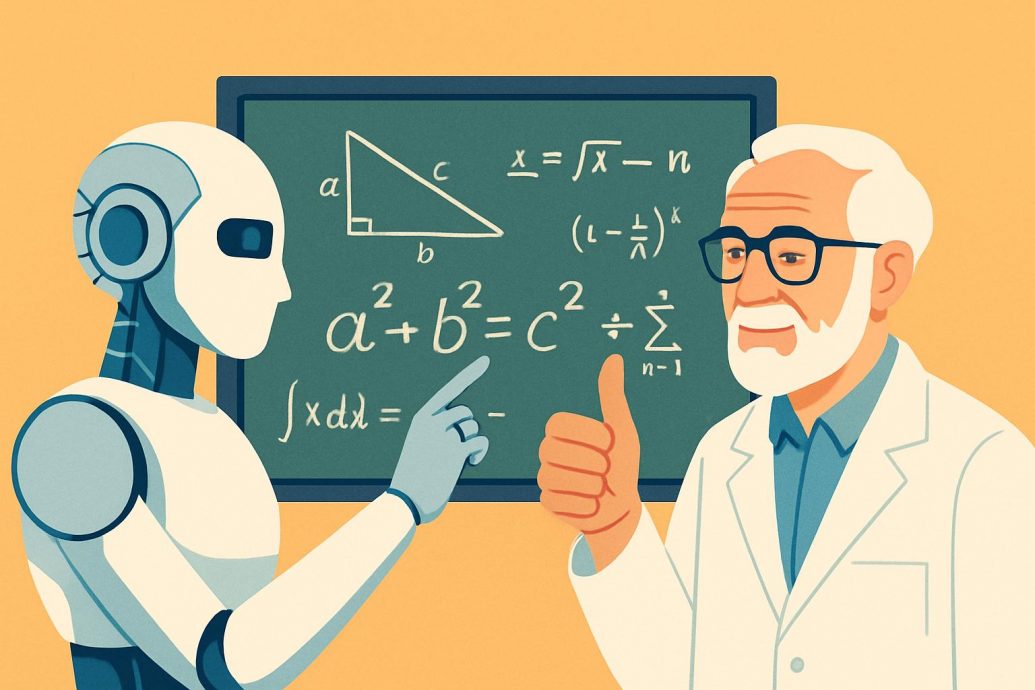

AI Cracks Theorem, Expert Confirms
AI Cracks Theorem, Expert Confirms is more than a headline. It marks a pivotal moment in the collaboration between artificial intelligence and pure mathematics. For the first time, an AI system functioning as a formal reasoning agent has independently produced and validated a mathematical theorem, which Fields Medalist Martin Hairer confirmed to be correct. This development does more than showcase computational prowess. It signals a transformation in how theoretical knowledge might grow through interaction between human and machine. The consequences could influence not only mathematical discovery but also broader scientific exploration.
Key Takeaways
- The AI system works through symbolic logic instead of using empirical data, separating it from conventional machine learning models.
- Martin Hairer, a Fields Medal recipient, has reviewed and validated the AI’s theorem, providing academic endorsement.
- This event surpasses past computer-assisted proofs by granting the AI a more independent logical role.
- The AI’s formal reasoning capabilities could streamline and amplify future mathematical innovation.
What Just Happened? AI Proves a Theorem on Its Own
An unprecedented event in mathematics has occurred: an AI system has autonomously derived and verified a complex theorem through formal logic. Unlike machine learning algorithms that rely on pattern recognition, this AI functions as a symbolic theorem prover. It is built on formal systems such as Lean or Coq, which use logic rather than statistical inference.
Martin Hairer, one of the world’s leading mathematicians, examined the result and found the logic to be sound. His confirmation strengthens the significance of the proof and validates the method the AI used. This achievement represents more than speed. It reflects a new kind of logical processing, carried out by technology designed to follow deductive steps similar to human reasoning.
The Technology Behind the AI Theorem Prover
This AI system is not typical of what many people associate with artificial intelligence. It is not a neural network trained on large datasets. Instead, it operates under a formal verification framework, such as HOL Light, Coq, or Lean. These environments allow precise, step-by-step proof construction and checking.
By relying on symbolic logic instead of probability, the AI handles abstraction with high accuracy. Each conclusion stems from definable steps, much like a human mathematician would provide, but without mental fatigue and with far fewer errors. Some systems enhance this process by using machine learning models to guide the logical search, but the proof construction remains grounded in rule-based logic.
This combination enables the system to work through vast logical possibilities methodically and output fully verifiable findings that align comfortably with formal mathematical standards. Explorations like these have inspired further development as seen in OpenAI’s advanced math AI systems, which continue to push these boundaries.
Hairer’s Confirmation: Why It Matters
The review and verification by Martin Hairer carry high significance. Known for pioneering work in stochastic partial differential equations, Hairer’s input brings authority to the AI’s result. His careful examination confirms both the rigor and the correctness of the proof.
Hairer concluded that the proof was logically consistent. This confirmation ensures that the AI’s logical pathway is not just formally sound but also acceptably clear within mathematical standards. Human approval bridges the current gap between machine precision and academic trust.
Beyond the Four Color Theorem: How This Achievement Compares
The use of computers to assist with mathematical problems is not new. The Four Color Theorem, solved in 1976, was one of the first prominent examples and required a brute-force check of over a thousand configurations. While effective, it lacked interpretability and sparked debate over the nature of mathematical understanding.
In comparison, the current AI theorem prover carries out structured reasoning. It sets and proves lemmas, constructs full arguments, and does so without manual enumeration or predefined answers. The result aligns with the idea of machine partners rather than assistants. Readers interested in how AI has approached long-standing mathematical puzzles may explore cases where AI cracked centuries-old math problems.
Broader Impacts on Mathematical Research
AIs that perform formal reasoning could change more than individual theorem solving. They introduce a way to rethink how math is developed. Researchers often encounter limitations in managing layers of abstract reasoning. Formal AI assistants can automate those layers, freeing experts to focus on conceptual advancement.
This support holds potential across specialties such as number theory, quantum mechanics, and algebraic structures. AI systems may even help verify connections between existing results within expansive theoretical networks. While human imagination still drives inquiry, automated tools can handle repetitive and structurally complex tasks.
As these systems learn to trace deeper symbolic relationships, they may also begin suggesting conjectures or exploring new directions humans had not predicted. This is a prospect explored in works such as AI attempting to solve seemingly unsolvable problems.
Expert Perspectives
Hairer is not the only expert offering insights into AI’s place in pure mathematics. Terence Tao, among the most respected mathematicians today, has spoken publicly about the enormous potential of symbolic AI systems. He noted their promise lies in autonomous logical formulation, not just proof verification.
Tao has emphasized that the real challenge is generating creative proofs independently, not just following a path once laid out. The growing complexity and capability of modern provers open doors to this level of functioning. Teams at DeepMind and other organizations are also working toward similar goals. The trajectory of these developments, including the setbacks, can be better understood through an analysis of AI’s difficulties in tackling mathematics.
AI Milestones in Mathematics: How Far We’ve Come
| Year | Milestone | AI System | Human Involvement |
|---|---|---|---|
| 1976 | Four Color Theorem proved | Custom program | High (Brute-force assisted) |
| 2005 | Proof of Robbins Conjecture | EQP System | Moderate (Guided automation) |
| 2012 | Formal proof of Kepler Conjecture | HOL/Isabelle | High (Manual formalization) |
| 2024 | Autonomous theorem proven | Logic-based theorem prover | Minimal (Human verification only) |
FAQ: Understanding AI in Theoretical Math
Can AI solve mathematical theorems?
Yes. Formal theorem provers use strict logical methods to derive and validate mathematical theorems. Their outputs are machine-checkable and increasingly accepted within academic research.
How does AI theorem proving work?
It uses formal languages and symbolic logic. Systems like Lean and Coq enable AI to build proofs from foundational principles. Some versions integrate machine learning to guide decision-making, but the proofs themselves remain based on deductive logic.
Was the Four Color Theorem proven using a computer?
Yes. In 1976, a custom program verified configurations to conclusively prove the theorem. While foundational, that proof involved data-intensive processes rather than self-derived logic used by modern systems.
What role do human experts play in verifying AI-generated proofs?
Experts review outputs for completeness and relevance. While systems can validate their own logic, humans assess whether the proofs account for all assumptions and fit accepted mathematical frameworks.
Is AI just brute-force guessing?
No. Modern formal theorem provers apply structured logic. They do not rely on exhaustive search but instead follow mathematical rules to reach valid conclusions.
Why can’t AI do all math now?
Many areas of mathematics involve abstract concepts and creative reasoning that current AI cannot fully capture. While automation helps with formal logic, intuition and insight are still necessary for many problems.