
Introduction
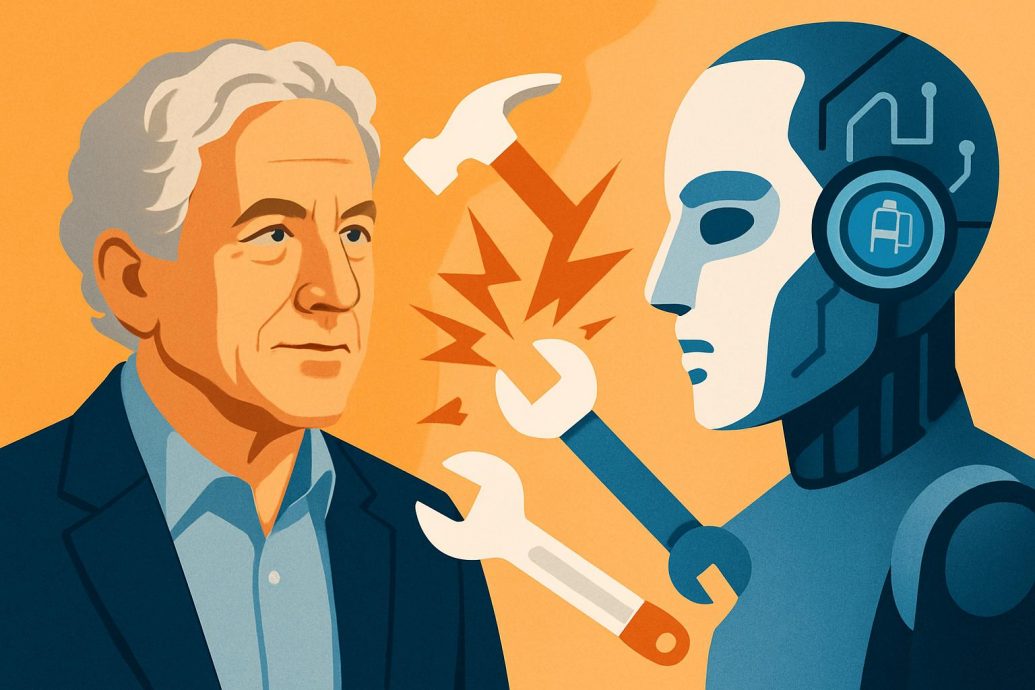
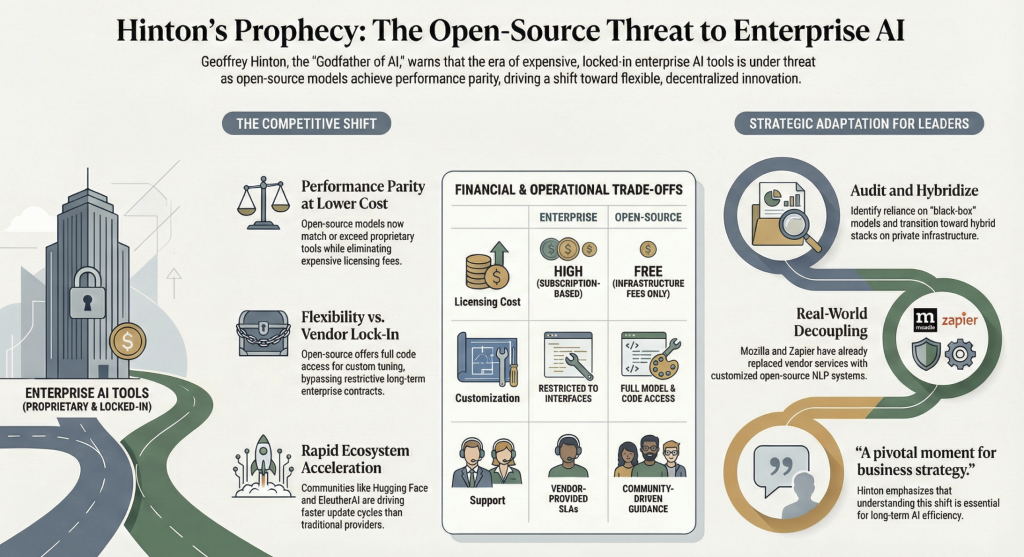
AI Legend Predicts Enterprise Tool Disruption is a critical signal from Geoffrey Hinton, often referred to as the “Godfather of AI.” He has expressed concern that costly enterprise AI tools may soon be outpaced by open alternatives. This prediction arrives at a pivotal moment as businesses increase their AI investments. Hinton believes that advanced open-source AI models are reaching, and sometimes exceeding, the capabilities of commercial tools. In a market that favors efficiency and flexibility, understanding this shift is essential for business leaders planning long-term strategies.
Key Takeaways
- Geoffrey Hinton believes enterprise AI tools are at risk due to high-performing open-source competitors.
- Organizations must reassess cost, flexibility, and performance factors before choosing AI platforms.
- The rising popularity of open-source AI indicates a shift toward decentralized innovation models.
- Leaders should build flexible decision frameworks that adapt to the evolving AI landscape.
Who Is Geoffrey Hinton and Why His AI Predictions Matter
Geoffrey Hinton has played a foundational role in shaping artificial intelligence. He co-developed backpropagation, a key algorithm behind neural networks, and helped initiate the deep learning revolution. This innovation powers many of today’s top-performing AI systems. Hinton worked as a VP and Engineering Fellow at Google, contributing to numerous AI advancements. In 2023, he left the company to speak more openly about AI’s ethical and societal implications. His predictions carry weight because of his expertise and his influence on both research and policy discussions.
Enterprise AI Tools Under Pressure
Major providers like IBM, Google Cloud, and Microsoft have developed AI platforms that offer security, compliance, and large-scale deployment capabilities. These tools are often embedded in corporate workflows and are typically procured through long-term licensing contracts that include service-level agreements and technical support.
These attributes made enterprise tools attractive for use cases such as human resources automation, supply chain management, and risk analysis. Despite this, Hinton warns that these advantages may not last. Rapid growth in the open-source ecosystem is leveling the playing field. More companies may refuse to pay premium prices once open models meet or exceed enterprise tool performance at significantly lower costs.
The Rise of Open-Source AI
Communities like Hugging Face, EleutherAI, and Stability AI are accelerating innovation in applications such as text generation, image synthesis, and multilingual modeling. Models like Falcon, Mistral, and LLaMA are demonstrating strong results across enterprise domains without the limitations of vendor control.
Key strengths of open-source AI include:
- Reduced ownership cost: No licensing fees and minimal infrastructure costs, with support often coming from thriving developer communities.
- Improved flexibility: Developers gain access to model code, enabling domain-specific tuning and full deployment control.
- Accelerated updates: Open collaborations allow faster release cycles and customized improvements relevant to specific industries.
This shift parallels earlier IT disruptions where open-source tools outpaced commercial solutions in areas like operating systems and database management. As described in this breakdown on enterprise tool disruption, the AI industry may now face a similar trajectory.
Performance and Cost Comparison: Enterprise vs Open-Source AI Tools
| Criteria | Enterprise AI Tools | Open-Source AI Models |
|---|---|---|
| Licensing Cost | High (subscription or usage-based) | Free (minimal infrastructure or hosting fees) |
| Performance | Generally fast but often less customizable | High and improving quickly, with opportunities for optimization |
| Customization | Restricted to platform interfaces | Full model access allows tailored optimization |
| Vendor Lock-In | Significant | Minimal to none |
| Support | Comprehensive but expensive | Community-driven guidance and documentation |
For many organizations, open-source AI tools are not only viable but often superior when measured by cost, customization, and control. With integrations like OpenChatKit and tinyGrad, businesses are embedding these models into their operations efficiently. Teams that focus on AI automation and workflow streamlining are already seeing clear advantages.
Real-World Examples of Disruption
Several companies have adjusted their AI strategy to reflect this growing open-source potential:
- Mozilla implemented its own content moderation systems using customized open-source NLP models.
- Zapier deployed open-source large language models for task automation, gaining better data control and privacy.
- Salesforce developed an internal language model that reduces reliance on external providers by offering a competitive alternative.
These transitions show a shift from consuming vendor services to owning and managing AI assets directly. This autonomy offers better control over data privacy, deployment speed, and model effectiveness.
How Enterprises Should Adapt: Strategy Checklist
Organizations must prepare for this potential turning point. The following checklist outlines preparation steps for decision-makers:
- Audit current AI usage to identify reliance on expensive vendor licenses or black-box models.
- Compare AI models directly under enterprise-specific requirements, such as latency and output accuracy.
- Create a hybrid deployment strategy that blends internal security with the flexibility of open tools hosted on private infrastructure.
- Invest in training programs for engineers and analysts to build mastery in using, adapting, and scaling open-source tools.
- Engage in community forums where collaborative AI development and governance are guided, as explored in this dual-path AI strategy piece.
FAQs
What did Geoffrey Hinton say about enterprise AI tools?
He warned that legacy enterprise tools with high license fees might be replaced as low-cost open-source models improve and become more efficient. This could make proprietary AI tools hard to justify financially for many organizations.
Are open-source AI tools better than commercial alternatives?
In many applications, they now match or exceed the performance of closed systems. While they may require more internal expertise, the long-term savings and adaptability are often worth it.
Is enterprise AI becoming obsolete?
Not yet. It remains useful in many structured corporate settings. Still, the business case for high-priced tools is weakening, especially where open options can deliver similar results for less.
How are businesses adapting to AI disruption?
Companies are embracing hybrid stacks. Some shift toward internal tools, while others mix open and commercial components. The focus is shifting toward more efficient and flexible search and knowledge workflows powered by adaptable AI.