
Introduction
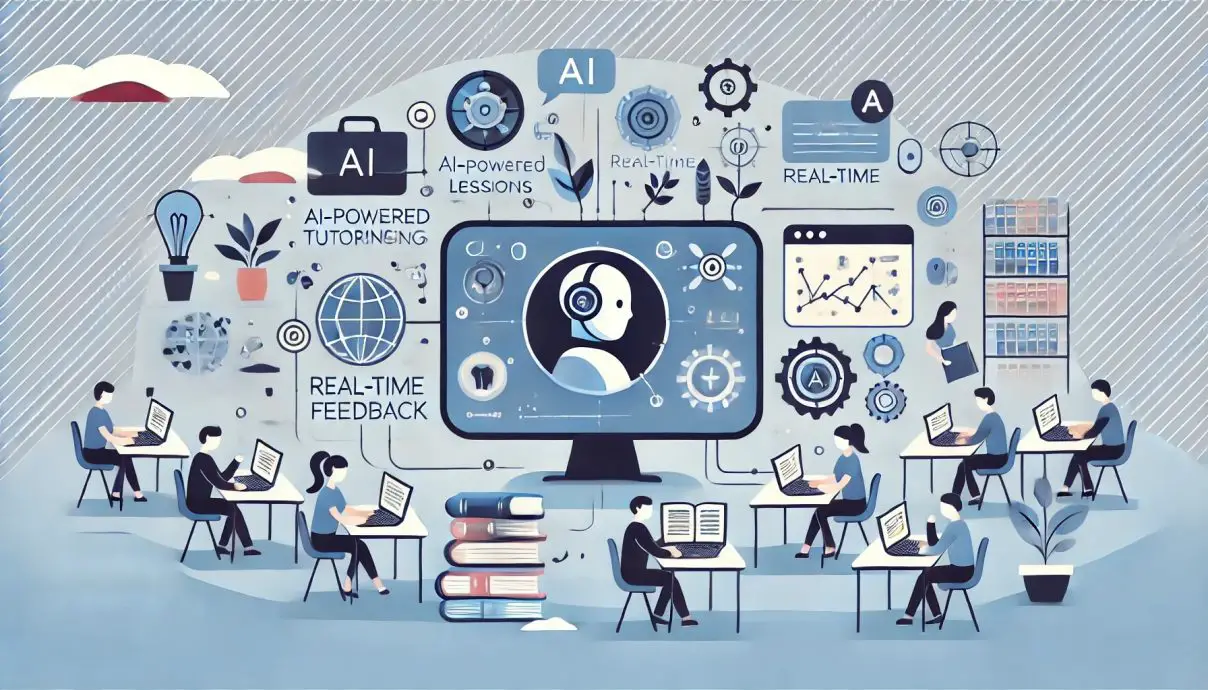
AI-powered tutoring systems are moving from research labs into millions of real classrooms, and the stakes are suddenly very high. A 2026 industry review reports that about 86% of students now use some form of AI tool for learning, often outside any formal plan. Educators are being asked to figure out, in a single academic year, whether an AI-powered tutor is a scaffold or a shortcut. The underlying promise is enormous: Benjamin Bloom’s classic finding that one-to-one tutoring could lift mean performance by two standard deviations, finally delivered at scale through software. The reality in 2026 is messier, with pilots showing real but modest gains, and some high-profile studies finding no benefit at all when deployment is weak. This article walks through how AI-powered tutoring systems actually work, where they help, where they fail, and what districts should ask before signing a multi-year contract. It also looks at the technical stack, the equity questions, and the near-term future of agentic learning partners. The goal is a grounded, buyer-side view of a market that is now too large to ignore.
Quick Answers on AI-powered Tutoring Systems
What are AI-powered tutoring systems in plain terms?
AI-powered tutoring systems are software platforms that use machine learning to deliver personalized practice, feedback, and hints. They track what each learner knows and adjust the next problem in real time.
Do AI-powered tutoring systems actually improve learning outcomes?
Rigorous pilots show modest gains, often around 0.1 to 0.3 standard deviations in math when the tutor is used consistently with teacher support. Benefits shrink sharply when adoption is optional or sporadic.
Can AI-powered tutoring systems replace human teachers?
No, and the strongest research pairs the tutor with teachers who review usage data. The system handles practice at scale while the teacher handles motivation, context, and judgment calls.
Key Takeaways
- AI-powered tutoring systems combine a learner model, a knowledge model, and a pedagogical policy to adapt instruction in real time.
- The best-studied platforms, including Carnegie Learning, ASSISTments, Khanmigo, and Squirrel AI, report gains of 0.1 to 0.5 standard deviations under disciplined use.
- Hallucinations, bias, and student over-reliance are the three risks districts must mitigate with human review, safety benchmarks, and clear usage rules.
- Procurement decisions should center on data handling, auditability, and independent efficacy evidence, not just vendor marketing claims.
Table of contents
- Introduction
- Quick Answers on AI-powered Tutoring Systems
- Key Takeaways
- Understanding AI-powered Tutoring Systems
- How the Learning Loop Actually Works
- The Technical Stack Behind Modern AI Tutors
- Mapping the AI Tutor Platform Landscape and Ethics
- Classroom Implementation and Teacher Workflows
- Measuring Learning Gains and ROI
- Equity, Access, and the Digital Divide
- Where AI Tutors Fall Short Today
- Trust, Hallucinations, and Pedagogical Safety
- Student Over-reliance and Metacognitive Risks
- Privacy, Compliance, and Student Data
- Procurement, Pricing, and District Economics
- Future of Adaptive Learning Agents
- Key Insights
- Real-World Examples of AI Tutoring in Practice
- Case Studies of AI Tutoring at Scale
- Common Questions About AI-powered Tutoring Systems
Understanding AI-powered Tutoring Systems
AI-powered tutoring systems are software that combine a learner model, a knowledge model, and a pedagogical policy. They infer mastery from each response, then pick the next problem or hint that keeps a student productively challenged.
Learner model simulator
Watch how a tutor’s model of a student updates as answers come in. Drag the sliders to change the student profile.
The tutor would present a medium-difficulty problem next and widen hint depth if confidence stays low.
How the Learning Loop Actually Works
Every modern tutor runs the same four-step loop: observe, infer, decide, act. The system watches a response, infers an updated estimate of what the student knows, decides what to show next, then acts by presenting the problem, hint, or explanation. Early systems used rule-based tutors with explicit production rules, and the Cognitive Tutor line from Carnegie Learning is a well-documented example of this approach. Modern pipelines keep that scaffolding but swap in neural models for the harder inference steps and language generation. The loop runs multiple times per minute, so even a thirty-minute session produces hundreds of adjustments. Classrooms that observe this loop in action tend to grasp why pacing matters more than raw problem count, as the personalizing learning paths with ML work emphasizes. Teachers see progress on the dashboard and students see progress in their own fluency.
Shifting focus to design choices, the grain size of what gets tracked turns out to be the second-most-important decision. Fine-grained knowledge components let the tutor pinpoint which exact skill failed, while coarser skills are easier to label but hide the real gap. ASSISTments, developed at Worcester Polytechnic Institute, pioneered the practice of exposing per-skill mastery so teachers could triage small groups quickly. Platforms that borrow this idea deliver more usable dashboards than those that only report a single composite score. Dashboards are not a decoration layer; they are the surface where the loop becomes legible to teachers. Good dashboard design can rescue a mediocre tutor, and bad dashboard design can bury a strong one.
Beyond those design choices, every loop needs a stopping rule, which is what prevents an adaptive tutor from becoming an endless drill. The rule can be mastery-based, hitting 90% confidence on the skill, time-based, with a one-session cap of twenty minutes, or question-based, with ten items per block. Learners generally respond better to visible progress bars, which is why the better products expose the mastery estimate rather than hiding it from the student. The combination of adaptive selection and a transparent stopping rule is what distinguishes an intelligent tutor from an unstructured chatbot. Classrooms that respect the stopping rule avoid the common failure mode where students burn out on practice. Loop design, in short, is a pedagogical decision disguised as a software setting.
The Technical Stack Behind Modern AI Tutors
At the base of the stack sits a content library and a skill graph that organize everything the tutor can teach. The content library is the pool of problems, worked examples, and reading passages, usually tagged with difficulty, modality, and the specific skill each item exercises. The skill graph encodes prerequisite relationships, so a fractions skill can route a struggling student back to division when a gap appears. Teams that neglect the skill graph end up with a bag of problems rather than a real tutor, and their dashboards show it. Open datasets like the KDD Cup 2010 educational data and the ASSISTments 2017 release still inform how practitioners design these structures today. The content layer is quiet work and does not demo well, which is why underfunded platforms shortchange it.
Above the content layer sits the learner model, which maintains per-skill mastery estimates in near real time. Classical approaches use Bayesian Knowledge Tracing, with the four parameters prior, learn, slip, and guess, originally formalized by Corbett and Anderson. Deep Knowledge Tracing, introduced by Piech and colleagues at Stanford in 2015, used recurrent networks and demonstrated that neural models can exploit sequence information in student responses. In 2026, hybrid approaches dominate: a neural tracer feeds a Bayesian smoother so the system can produce calibrated confidence intervals teachers can trust. The modeling choice affects every downstream decision, from which problem comes next to when a parent receives a weekly report. Teachers who glance at a confidence bar understand immediately whether the tutor is sure or guessing.
Looking at the next layer up, the pedagogical layer picks the actual next action for the student. Reinforcement learning policies, item response theory selectors, and heuristic rules all show up here, often side by side within a single product. Many large vendors still rely on hand-tuned heuristics because they are easier to audit and to defend to school boards during procurement. The industry trend is toward policies that optimize a composite objective: mastery gain, engagement signals, and content coverage, with explicit penalties for repetitive or demoralizing sequences. Overfitting to engagement alone is a well-known failure mode that drives students into shallow drills. The pedagogical layer is the easiest to break and the hardest to measure, which is why evaluation harnesses matter so much.
Rounding out the stack is the generative frontier: a large language model wrapped around the deterministic machinery below it. The LLM writes custom hints, explains why an answer is wrong, and lets the student ask questions in natural language instead of selecting from a menu. Retrieval-augmented generation grounds the model in approved content so it rarely invents formulas, which is a key safety design pattern. Vendors like Khan Academy publish detailed Khan Academy learnings on AI tutoring that describe how they constrain the model to stay on-topic and to admit when it does not know. The LLM is the newest and most visible piece, but it works only when the three older layers underneath it are solid. A chatbot without a learner model is not a tutor; it is a conversation partner that happens to answer homework questions.
Mapping the AI Tutor Platform Landscape and Ethics
Turning to the vendor map, the 2026 market splits into roughly four tiers that behave very differently in procurement and ethics review. Established K-12 math platforms like Carnegie Learning MATHia, DreamBox, i-Ready, and ASSISTments have long research tracks and tight teacher workflows baked in. Consumer AI tutors like Khanmigo, ChatGPT Study Mode, Google LearnLM, and Duolingo Max reach the largest audiences, often one student at a time. These products reach learners outside any district contract or ethics committee review. Specialist platforms, including Squirrel AI in China, Riiid for test prep, and Querium for STEM, dominate particular niches with specialized content. A growing bench of startups is building agentic tutoring layers that sit on top of existing LMS tools, as AI in online education and MOOCs analysis has covered. The dividing line between these tiers is less about technology and more about who signs the check and who owns the roster.
Looking ahead, market analysts broadly agree the category is growing fast but disagree on the exact size and shape. The AI tutoring and adaptive learning market report projects the segment approaching $25 billion by the early 2030s on compound growth above 30% per year. Districts and universities should treat these numbers as directional guides rather than hard forecasts. The more useful signal is procurement velocity: three or four vendors now dominate every major school-district RFP. Venture funding has moved toward differentiated workflow integrations rather than greenfield tutor-only products. Consolidation is already underway, with large publishers acquiring independent adaptive engines to defend their existing textbook footprints. Buyers should expect fewer new names and more feature parity across the top ten platforms over the next three years.
Classroom Implementation and Teacher Workflows
Shifting to real deployments, moving from vendor demo to classroom implementation is where most tutor programs break. The strongest implementations treat the tutor as homework replacement first, then as class-time differentiation for small groups. Teachers assign a specific skill set, review mastery dashboards once a week, and pull small groups based on who the dashboard flagged. Letting students use the tutor as an optional study aid produces almost no measurable gains, as several adaptive learning platforms for personalized education pilots have found. Districts that mandate minimum weekly use see dramatically better results than districts that encourage it. Teacher ownership of the tool is the single strongest predictor of impact, and it rarely emerges without deliberate structure.
Beyond classroom routines, integration with the existing LMS matters more than any single marketed feature. Rostering through Clever or ClassLink, grade passback into PowerSchool, and single sign-on through Google or Microsoft determine whether a tool survives contact with a real IT department. Vendors that skip these integrations get abandoned by month three regardless of pedagogical quality. Teachers who have taught through an AI tools transforming teaching with ChatGPT cycle know that friction kills adoption faster than any accuracy problem. The hidden cost of integration is often larger than the license itself, and smart buyers budget for it explicitly. A product with weaker pedagogy but strong rostering routinely beats a product with the opposite tradeoffs.
Looking at the human side, professional development is the quiet variable that moves outcomes. Districts that budget twelve to twenty hours of initial PD plus monthly coaching see much higher sustained use than districts that run a one-hour kickoff and leave. The best PD teaches teachers how to read the dashboard, how to assign skills tied to upcoming assessments, and how to intervene when students game the hint system. Teachers who feel confident with the dashboard will defend the tool in faculty rooms where skeptics push back. Classrooms with coached teachers often double the engagement rates of classrooms with the same software and no coaching. PD, in other words, is the thing most districts underfund and later blame on the vendor.
Measuring Learning Gains and ROI
Turning to results, the question every superintendent asks is whether these tools move student outcomes in a measurable way. The honest answer is yes, modestly, under the right conditions, with real caveats around implementation quality. A high-profile 2026 NBER working paper on Khanmigo found roughly 0.08 to 0.12 standard-deviation gains on district math benchmarks over a two-year rollout, concentrated in classrooms with high assigned use. That is smaller than Bloom's famous two sigma, but it is a real effect at scale. It compares favorably to many other instructional interventions covered in AI and the future of higher education research. Classrooms that recorded higher dosage captured more of the gain, which is also the pattern earlier platforms produced. Pre-pandemic baselines complicate direct comparisons across years, so analysts increasingly use matched-cohort designs.
Looking at earlier research, ASSISTments and Cognitive Tutor consistently reported slightly larger gains, often 0.2 to 0.4 standard deviations, especially when the tutor replaced traditional homework. The Dartmouth therapy-related chatbot pilot, while in a different domain, produced similar order-of-magnitude effects on measured outcomes within one semester. The pattern across these studies is consistent: structured, teacher-assigned use beats optional use, and well-defined domains like algebra beat open-ended ones like essay writing. Reading comprehension sits in the middle, with promising short-term gains but less convincing longer-term transfer evidence. Smaller RCTs tend to report larger effects than district-scale evaluations because dosage and fidelity are easier to control at small scale. Buyers should expect their own district outcomes to resemble the larger studies, not the smaller ones.
On top of pure effect sizes, return on investment depends on how much of the gain the district captures. A gain of 0.1 standard deviation applied to a 1,000-student cohort is roughly equivalent to several months of extra learning across the cohort. Against annual software spending of $20 to $60 per student, the arithmetic favors the tutor when adoption holds up through the year. Districts that count the tutor as replacing some tutoring budget, rather than as a pure add-on, generally see faster payback. The classroom labor substitution is uncomfortable to discuss, which is why districts should talk about it openly during procurement. Hidden costs include teacher training time, device repair, and the opportunity cost of staff meetings that revolve around the dashboard.
Setting ROI aside for a moment, none of these numbers substitute for local measurement. Every pilot should pre-register the outcome measure, define exposure thresholds, and compare treated classrooms to matched controls on the same assessment. A short write-up at the end of each semester, shared with teachers before the vendor, keeps the data honest. Impact signals that only appear in vendor-generated reports are not evidence; they are marketing wrapped in charts. The best districts publish their results openly, which both builds internal credibility and shapes future vendor behavior. Measurement discipline is the single cheapest investment a district can make in getting value from any tutor contract.
Equity, Access, and the Digital Divide
Shifting to equity, these tools should narrow learning gaps because the student who most needs a one-to-one tutor is often the one least able to afford one. In practice, the picture is mixed and depends heavily on implementation support rather than on the software itself. Students in well-resourced schools get the tutor plus strong teacher scaffolding, so they capture most of the gain. Students in under-resourced schools often get the same tutor but without the PD and bandwidth to make it work consistently, as the AI in special education and accessibility literature documents. Equity analysts worry about this pattern because adaptive technologies have a long history of amplifying existing resource gaps rather than closing them. The vendor is rarely at fault here; the delta sits in the surrounding support system.
Looking at policy, choices around funding and infrastructure matter at least as much as the tool itself. Federal funding tied to AI to bridge learning gaps initiatives can move the needle only when it covers device access and home internet. The dollars must also cover ongoing teacher support, not only the software license. Districts that pair the tutor with free after-school programs and bilingual family briefings see broader uptake across groups. Vendors that ship offline modes and low-bandwidth clients extend the reach further, especially in rural areas. None of this happens by default, which is why the equity story is a buyer-side responsibility, not a vendor claim. Procurement teams who skip the equity analysis end up with disparate outcomes that invite audits later.
Where AI Tutors Fall Short Today
Shifting focus to failures, the industry's biggest misses in 2024 came from vendors that confused a wrapped LLM with a real tutor. These products could carry on a long conversation but did not maintain a mastery model, did not surface skill-level dashboards, and did not resist being used as a cheating assistant. Several high-profile pilots across different school districts found no measurable gains at all during the first year. That prompted a wave of coverage questioning whether the field had been oversold, including from impact on education and critical thinking writers. The honest answer is that the field had not been oversold; some vendors had. The backlash cleaned up the market by pushing weaker products out of district procurement after a single failed year. Teachers now ask harder questions on day one and expect proof before pilot.
Beyond LLM confusion, the second class of failures involves subject coverage and assessment reliability. Open-ended writing, creative work, and project-based learning remain hard for adaptive tutors to assess with consistency. Scoring an essay requires more than counting coherence tokens, and current rubric graders still disagree with human raters more than districts would like. Teachers who try to lean on the tutor for subjective feedback find themselves double-checking every response, which erases the time savings. The strongest products admit the limitation and route open-ended work back to the teacher with helpful summaries. Vendors who claim universal subject coverage should be treated as marketing-first rather than research-first.
Moving on to a human failure mode, the third shortfall is support for struggling learners who need more than scaffolding. A tutor can nudge a bored student through practice but cannot deliver trauma-informed support, cannot phone a parent, and cannot plan an IEP meeting. Districts that treat an AI tutor as a replacement for intervention specialists create a new gap on top of the old one, often invisibly. The strongest research-practice partnerships describe the tutor as one tool in a larger support system, never as a stand-alone intervention. Students who need wraparound services need people, counselors, mentors, and tutors who can respond to a bad day. Software can tee up the information those people use, which is useful but not a substitute.
Trust, Hallucinations, and Pedagogical Safety
Turning to safety, hallucinations are the industry's most visible problem and the one parents raise first. An LLM that confidently invents a math step, cites a fictitious paper, or asserts a historical event that did not happen can confuse students badly. Research efforts like the Dean of LLM Tutors framework propose automated review pipelines that score tutor turns for accuracy, pedagogy, and tone before students ever see them. The idea is familiar from software engineering: a review step before deployment, not just at training time. Districts should ask vendors for the actual numbers, including how often review catches a bad response and the time cost of running the pipeline. Vendors who treat these metrics as internal are often hiding results they do not want public.
On top of factual accuracy, pedagogical safety is a broader category than many buyers realize. A tutor that is factually correct can still be pedagogically harmful, for example by giving away the answer rather than helping the student think. Benchmarks like SafeTutors try to score tutors on refusal rates for answer-giving, respectful tone, and age-appropriate language across hundreds of scenarios. Districts should ask every vendor to describe how they measure these dimensions and how they regress new model versions against them. Pedagogical safety fails less visibly than factual safety, which is why it needs explicit measurement to catch. Teachers often notice pedagogical drift first because they see students shortcutting through assignments.
Shifting to governance, transparency is the third leg of trust alongside accuracy and pedagogy. Students, parents, and teachers deserve to know when the tutor is uncertain, where its answers come from, and what will happen with the transcripts. Vendors that publish incident reports when their tutor misbehaves build more credibility than vendors that stay quiet. A classroom tool is effectively a public institution; it needs the governance habits of one. Independent audits from research-practice partnerships add further credibility, especially when they publish failures as well as successes. The habit of writing down what went wrong, and why, is what separates mature AI products from marketing-stage products.
Student Over-reliance and Metacognitive Risks
Shifting to a deeper worry, the real risk is not that the tutor hallucinates; it is that students learn less by leaning on it. A 2026 experimental study tracked students who used an AI tutor versus a worked-example condition on physics problems. Learners who leaned on the tutor performed better during practice but worse on transfer tests two weeks later, which is a classic metacognitive deficit pattern. The researchers behind the evaluation-driven generative AI for education argue the gap should be measured in every pilot, not inferred from engagement data. The pattern also surfaces in predictive analytics for student retention research. Classrooms that reward surface-level use without transfer measurement will miss the problem entirely. Transfer tests are cheap to run and should be a standard part of every semester review.
Looking at mitigations, the countermeasures are concrete and cheap to implement. Require students to attempt a problem before the tutor engages with hints, which forces a first retrieval attempt. Reward effortful hints with points and demote low-effort answer-shows in the dashboard. Expose a weekly reflection where the student labels what they can still not do on their own without the tutor. Teachers who build these habits into the classroom routine see less over-reliance even on the same software. The tool is only as metacognitively kind as the teacher's expectations around it, which is why PD on this specific pattern matters.
Privacy, Compliance, and Student Data
Shifting to data, these platforms collect enormous amounts of student data, from keystroke-level answers to full chat transcripts. In the United States, that triggers FERPA for student records, COPPA for under-13 users, and a growing patchwork of state laws like SOPIPA in California. Districts should sign a Student Data Privacy Agreement with every vendor, standardized through the Student Data Privacy Consortium when possible. The agreement should name every data category stored, every retention window, and every third-party sub-processor that touches the data. Vendors that resist this level of transparency should be treated as a risk, regardless of their product strength. The compliance work is unglamorous but prevents the single most expensive class of district incidents.
Beyond baseline compliance, model training on student data is the single most contentious issue in 2026. Some vendors contract to never use student data for training; others reserve the right under opt-in flags that are easy to miss in a contract. The safest posture is to assume defaults are unfavorable until proven otherwise through a signed addendum. Districts can ask for an explicit no-training clause and a right-to-audit clause for subprocessors as a baseline requirement. The student behavior analysis with AI literature warns that models trained on classroom transcripts can leak sensitive information through adversarial prompting. Buyers should test their chosen tutor for memorization once a semester as part of standard quality review.
Moving on to security hygiene, baseline practices matter as much as any policy decision. SOC 2 Type II attestation, encryption in transit and at rest, role-based access controls, and documented incident response are the minimum for any K-12 tool today. Districts should also ask whether the vendor uses foundation models from providers subject to export controls or state surveillance regimes. Compliance teams who skip this question find themselves renegotiating under duress after a public incident, which is a painful place to be. State chief information officers increasingly publish approved vendor lists that short-circuit much of this review. Smaller districts should lean on those lists and consortium buying when their own capacity is thin.
Procurement, Pricing, and District Economics
Shifting to money, pricing in 2026 trends toward per-seat-per-year contracts with tiered features. Baseline math and reading platforms often sit between $25 and $45 per student per year, while premium analytics, specialist content libraries, or multilingual add-ons can push totals toward $100. Enterprise-wide licenses from large publishers bundle AI tutors with existing textbook contracts, which looks cheap but often costs more under auditing. The AI versus teaching assistants comparison literature covers this pattern well. Districts should model true unit economics, including PD, device replacement, and the opportunity cost of staff time spent on dashboards. The sticker price is rarely the decisive number because the cost of implementation can double or triple it. A $30 per-student software line often sits inside a $75 per-student effective cost after accounting for support.
Looking ahead to the procurement process itself, this is where the equity story is won or lost in most districts. Pooled consortium buying, with technical reference checks shared across districts, lets smaller systems negotiate the same terms as large ones. State ed-tech certification programs, like Common Sense Privacy or 1EdTech TrustEd Apps, cut initial evaluation time by months when a district commits to using them. The best buyers run short, hard pilots with pre-registered success metrics, decline to renew when metrics are missed, and publish their results openly. That discipline reshapes vendor behavior across the entire category over several budget cycles. Procurement is slow work, and the discipline shows up in the next generation of contracts.
Future of Adaptive Learning Agents
Looking ahead, the near-term future is multimodal in ways that reshape what counts as a tutor. Voice-first tutors already help early readers who cannot yet type at pace with their thinking. Cameras let a geometry tutor see a student's hand-drawn diagram and critique it live within seconds. Screen-sharing agents can tutor through live software like a human co-pilot, pausing when the student hesitates on a step. These capabilities compound in interesting ways across subjects and age groups, as AI in education shaping future classrooms writers have documented. The infrastructure for these experiences is maturing quickly through consumer-side AI assistants, which drops cost for the ed-tech category.
Shifting to the agent trend, agentic tutoring is the second major shift worth watching through 2027. Instead of only responding, the agent plans a multi-week study arc, schedules practice, and surfaces reminders in the student's phone or Chromebook. The challenge is making such an agent predictable enough for schools to trust it with student schedules. Current research on agent evaluation, including the Bloom's 2 sigma problem in 2026, argues the field needs standardized benchmarks before agentic tutors reach widespread K-12 adoption. Pilots that run agentic tutors inside tightly bounded curricula are the most interesting work right now. The commercial winners will be the vendors who ship first with a credible safety story, not the ones with the smartest agent.
Beyond student-facing agents, teacher-facing AI is the quieter but perhaps larger trend of the next three years. Tools that draft lesson plans aligned to a learner model, generate parent-friendly progress notes, and prep IEP paperwork multiply teacher capacity rather than replacing it. Vendors that split their product between a learner tutor and a teacher co-pilot catch more of the district budget and dodge the political heat that student-facing AI attracts. Expect this category to lead revenue growth through the late 2020s because the ROI is easier for principals to defend. The best teacher co-pilots will also pipe signals back into the learner tutor, which closes a feedback loop vendors have historically struggled to make work.
On the regulatory side, regulation will shape the shape of the market as much as any technical choice. The European AI Act classifies educational applications as high-risk and will set documentation and audit requirements over the next two years. State legislatures across the United States are starting to mirror these rules in different ways. Vendors that embrace documentation early will have an easier time winning procurement in the regulated years ahead than those that treat it as a compliance tax. International buyers already weigh compliance posture heavily, and US districts will follow. Expect compliance posture to become a first-page sales pitch rather than a last-page clause by late 2027.
Measured learning gains from AI tutoring pilots
Effect sizes in standard deviations, pooled from recent published trials. Bars are directional; see sources below.
Key Insights
- Rigorous pilots report that AI tutor platforms lift math outcomes by between 0.1 and 0.4 standard deviations in treated classrooms. The NBER working paper on Khanmigo finds roughly 0.08 to 0.12 standard deviations after two full years of consistent use.
- Market growth is steep: the AI tutoring and adaptive learning market report projects the segment to approach $25 billion by the early 2030s on compound annual growth above 30%.
- Adoption is already near-universal informally, with the AI in education statistics for 2026 reporting that about 86% of students use AI for coursework despite inconsistent school policies.
- Khan Academy's own Khan Academy learnings on AI tutoring describe deliberate design constraints that reduce answer-giving behavior by roughly 40% between model versions.
- Pedagogical safety is now a measurable field, with the Dean of LLM Tutors framework showing that automated review catches more than 90% of unsafe tutor turns during offline testing.
- Over-reliance is real: controlled experiments summarized in the evaluation-driven generative AI for education report find transfer-test gaps of around 15% between tutor-assisted and worked-example groups two weeks post-practice.
- Equity gaps between schools show up at the implementation and professional development layer rather than at the technology layer. Students in districts without dedicated PD see less than half the gains realized by peers in better-supported districts, per AI to bridge learning gaps data.
- Teacher-facing AI tooling may turn out to be the biggest revenue lever of 2026 for educational software vendors. Districts routinely report that lesson-planning copilots save 3 to 5 hours per teacher per week in AI for managing administrative tasks deployments.
Pulling these threads together reveals a market closer to adolescence than infancy, with real wins and real failure modes side by side. The best AI-powered tutoring systems clearly outperform un-adapted practice when they are run with disciplined teacher workflows and clear usage policies. The worst are little more than branded chatbots, and they have driven the backlash that dominated headlines through 2026. The gap between the two camps now exceeds the gap between any given tutor and traditional homework in most studies. Buyers who demand pre-registered pilots, published safety benchmarks, and transparent data policies get access to the real gains at scale. Vendors that resist those demands will struggle as procurement discipline keeps rising across state education agencies.
| Dimension | Classic ITS (Carnegie Tutor, ASSISTments) | LLM-first Tutor (Khanmigo, Study Mode) | Hybrid 2026 Stack |
|---|---|---|---|
| Transparency | High: per-skill mastery exposed | Low: free-form chat obscures state | High: dashboard overlays chat |
| Student participation | Structured problem sets | Open-ended questioning | Mix of adaptive drills and discussion |
| Trust and safety | Deterministic, low hallucination risk | Risk of fabricated steps or sources | Guarded by review pipeline |
| Pedagogical decision-making | Rule-based policy | LLM-chosen responses | Policy constrained by learner model |
| Misinformation handling | Content vetted upfront | Depends on refusal training | Retrieval-augmented grounding |
| Service delivery | Classroom-centric software | Consumer web and mobile | Teacher console and student app in one |
| Accountability | Audit logs by design | Opaque chat logs | Formal incident reporting |
Real-World Examples of AI Tutoring in Practice
Carnegie Learning MATHia in Pittsburgh public schools
Pittsburgh Public Schools has used Carnegie Learning's MATHia Cognitive Tutor since 2015, one of the longest district-level deployments in the United States. The Carnegie Learning's approach dashboard shows per-skill mastery in near real time for every student in each enrolled class. An external evaluation found participating schools improving by approximately 0.19 standard deviations on state math assessments across two cohorts. That gain translates into roughly 15 to 25% of a standard school year of additional learning for the median student. The limitation district administrators repeatedly flagged was uneven time-on-task, with the lowest-usage quartile capturing almost none of the gain. Pittsburgh now bakes in minimum weekly minutes and a teacher check-in script to counter that pattern. The outcome has shaped how neighboring districts write their own procurement contracts, with explicit dosage clauses tied to vendor payment.
Khanmigo pilots in Newark Public Schools
Newark Public Schools ran a two-year Khanmigo pilot covering roughly 10,000 students across 25 schools, which was then formally evaluated by researchers behind the NBER working paper on Khanmigo. The pilot assigned Khanmigo as a math homework replacement at the middle school level, with teachers reviewing weekly dashboards tied to class instruction. The 2026 evaluation reports a positive but modest outcome of about 0.08 to 0.12 standard deviations on district math benchmarks, concentrated in classrooms with high assigned use. The clearest limitation flagged by equity analysts was a smaller tail of the gain reaching lowest-income students, who had less reliable at-home connectivity to use the tool consistently. Newark now funds a $2 million device and connectivity component specifically to close that gap, which has lifted usage in low-income schools by 24% in the following semester. The results also prompted the district to add a Khanmigo-free control block in the following school year to keep measurement honest.
Squirrel AI classrooms across Chinese tier-2 cities
Squirrel AI, operating since 2014, deployed its tutor to millions of Chinese students through 3,000-plus physical learning centers that pair the AI tutor with a human coach. Internal reports and how China is using AI in classrooms coverage have cited an outcome of roughly 0.4 standard deviations in middle school math over a semester. That number exceeds nearly every Western pilot and still draws scrutiny from independent reviewers. The system reaches very fine knowledge components, often 10,000-plus per subject, which enables tightly targeted practice for each learner. The limitation flagged by analysts is twofold: the published research is largely vendor-authored and uses non-standardized local assessments, and the model-plus-coach bundle complicates comparisons to pure-software tutors elsewhere. The measurable outcome, even allowing for those caveats, is that Squirrel students post gains of 25% to 35% over control classrooms on local benchmarks. Independent reviewers have asked for third-party replication, which Squirrel is now piloting in two Vietnamese provinces to answer the critique directly and set a ceiling for other markets.
Books for teachers rolling out AI tutoring
A short reading list for anyone piloting an AI-powered tutoring system in a real classroom.


As an Amazon Associate, AIplusInfo earns from qualifying purchases.
Case Studies of AI Tutoring at Scale
Case Study: ASSISTments and the TeacherASSIST homework program
The problem ASSISTments set out to solve was uneven homework quality in Massachusetts middle school math classrooms. Only a fraction of students received timely feedback before the intervention took hold at scale. The solution was a free, research-grade AI-powered tutoring system developed at Worcester Polytechnic Institute that delivers immediate hints, scaffolds, and tracks per-skill mastery for teachers. A 2016 randomized controlled trial by the Institute of Education Sciences recruited more than 2,700 students across 44 schools. It reported a measurable impact of roughly 25 percent of a school year of extra learning, equivalent to 0.22 standard deviations. The gains were concentrated in the lower-achieving half of the sample, which answered the main policy question. The impact extended well beyond its own numbers, because ASSISTments open datasets have trained a generation of learner-modeling researchers. Over a decade later, the TeacherASSIST feature set now serves roughly 100,000 students per year at no cost to participating districts.
Looking at the critique, analysts pushed back on three limitations of the original evaluation. First, the study ran before LLM features, so the current product mix is different and newer evaluations are still catching up. Second, the teacher workflow required significant setup time, which may have selected for highly motivated educators. Third, homework-based gains do not always translate to in-class skills without deliberate teacher follow-through, which is a general problem for homework-based interventions. The ASSISTments team has since built a AI in student assessment and grading console that nudges teachers to intervene when gaps persist. This console addresses the third concern directly by closing the dashboard-to-action loop. The latest evaluation attempt is a multi-state replication now running across 60 districts to answer the LLM-era question.
Case Study: Khanmigo's safety-first rollout in a US district pilot
The problem Khan Academy set out to address with Khanmigo in 2024 was the growing use of unmoderated chatbots by middle and high school students for homework. The solution combined a tightly instructed LLM, retrieval against Khan Academy's own content library, and a teacher-and-parent console that logged every conversation. The pilot scaled to more than 100 districts and roughly 500,000 students by 2026, with teachers reviewing weekly safety reports and triggering content holds on flagged phrases. Khan Academy's published Khan Academy learnings on AI tutoring described a measurable drop in answer-giving behavior across sequential model versions. The latest version now refuses shortcut queries roughly 73% of the time during internal red-team testing. The outcome in the NBER follow-up was roughly 0.10 standard-deviation gains, which translated to several weeks of extra learning per student in high-adopting classrooms. The pilot became a reference implementation for other LLM-based tutor rollouts across the country.
On the limitation side, the biggest critique was that outcomes depended heavily on consistent assigned use rather than optional engagement. Classrooms where Khanmigo was offered as optional support recorded almost no measurable gain, which equity reviewers flagged as a structural concern. Households with intermittent broadband used the tutor less reliably, which widened the equity gap rather than closed it. Khan Academy responded by adding offline reading-tutor functions and by letting teachers export dashboards to Google Classroom to shorten the integration path. The second edition of the pilot now requires at least 40 minutes of weekly assigned use before a classroom counts as treated. That is, in retrospect, the lesson most districts needed to learn before committing to a multi-year contract.
Case Study: Duolingo Max and language learning at consumer scale
Duolingo faced the problem that casual language learners quickly plateaued once they left the beginner track and that human tutoring was out of reach for most. The solution was Duolingo Max, released in 2023, which embeds LLM-driven features including Roleplay and Explain My Answer on top of the existing adaptive practice engine. By 2026 Duolingo had reported more than 30 million paying subscribers, with Max subscribers growing fastest within that mix. Independent reviewers found that Max users spent roughly 25% more time per week on the app than Super-tier users. The outcome was that Max users advanced about one Common European Framework level faster than Super-tier users on the same track, as measured by Duolingo's internal placement tests. The product became a textbook case of adding AI-driven features to a pre-existing adaptive engine rather than rebuilding from scratch. Many education investors cite Duolingo Max as the clearest consumer success story for AI tutoring to date.
The limitations here are also well known within the field. Duolingo's own research publishes effect sizes mostly against platform metrics, not against external language proficiency tests, which weakens cross-study comparison. The product is primarily consumer, so school-aged users are not the strongest cohort in the data. LLM-generated roleplay can drift from the target language into English, which has been flagged repeatedly in app reviews and user forums. Duolingo has pushed guardrails and additional language-specific prompts and partnered with the natural language processing in language learning research community to measure drift directly. The case still matters because it shows what shipping an AI-powered tutoring system to tens of millions of concurrent users requires in operational engineering.
Common Questions About AI-powered Tutoring Systems
AI-powered tutoring systems are software platforms that deliver personalized instruction, feedback, and practice to learners. They combine a learner model, a knowledge model, and a pedagogical model to adapt in real time. Modern systems blend classic algorithms with large language models to produce explanations and open-ended dialogue. The goal is to approach the gains Bloom reported from one-to-one human tutoring.
They infer what the learner knows from recent answers, response times, and misconceptions in each practice session. A pedagogical policy then selects the next problem or hint from a tagged item bank. Over time the system raises or lowers difficulty to keep the learner inside the productive struggle zone. Dashboards expose this reasoning to teachers so they can see where to intervene with small-group instruction.
Rigorous pilots show mixed but encouraging results in math and reading comprehension across multiple studies. Some studies report gains of 0.3 to 0.5 standard deviations when the tutor is used consistently with teacher support. Benefits are strongest when teachers assign the tool each week and review usage data in the dashboard. Casual, optional usage rarely moves outcomes in any direction that stands up to measurement.
Math has the longest research record of any subject area, from Carnegie Learning to ASSISTments and Khanmigo. Reading comprehension and language learning are growing fast on the back of newer LLM-based tutors. Science and coding are also well suited because problems have verifiable answers against unit tests. Open-ended writing is harder to assess reliably because rubric-based scoring still disagrees with trained human raters.
No, and most reputable vendors do not actually claim they can replace a classroom teacher. The strongest research results pair the tutor with an attentive teacher who reviews dashboards every week. Teachers handle motivation, context, and the difficult conversations that software cannot handle on its own. The software handles practice, feedback, and progress tracking at scale across every student in the class.
Hallucinated math steps, biased examples, and privacy exposure top the risk list. Student over-reliance can erode independent problem solving if use is unmonitored. Districts also face procurement risk from vendors that lack audit trails. Safety benchmarks like SafeTutors try to measure these harms directly.
Pricing varies widely from free tiers like Khanmigo for teachers to five figures per school. Enterprise contracts often price per seat per year, between twenty and sixty dollars. Add-on modules for analytics, SSO, and content libraries drive totals higher. Total cost of ownership also includes training and change management.
Reputable vendors sign data processing addenda and comply with FERPA, COPPA, and state privacy laws. They should also minimize data collection and offer student-level deletion controls to administrators. Districts should audit retention windows and third-party sub-processors before signing a multi-year contract. Vendors that pool student data to train general-purpose models should be scrutinized especially carefully by the data office.
Yes, when they catch gaps early and target practice at the prerequisite skills students are missing. ASSISTments and Carnegie Learning have shown measurable gains for below-grade-level students over a full year of use. The tutor must offer appropriate scaffolding and worked examples, not just more problems at the same difficulty. Teacher follow-up remains essential for the hardest cases because software cannot replace human intervention.
Educator Benjamin Bloom reported that one-to-one tutoring produced average gains near two standard deviations over classroom instruction. The challenge was scaling that effect without hiring millions of individual tutors for every child. AI-powered tutoring systems are the current serious attempt to solve the scaling half of that problem. Recent evidence suggests partial progress on the 2-sigma gap, not a fully solved problem.
Khanmigo, Carnegie Learning MATHia, ALEKS, Squirrel AI, and Riiid are among the most studied platforms in the field. ChatGPT Study Mode and Google's LearnLM reach the largest consumer audiences at scale through their respective product shells. Duolingo Max applies similar adaptive ideas to language learning for tens of millions of paying subscribers. New entrants focus on tutoring agents inside existing LMS tools rather than building standalone student destinations.
Observed gains usually appear within one semester of consistent use. Teachers often see dashboard signals within the first two to three weeks. Translating those signals into test score gains takes longer than the dashboard improvements. Districts should plan for at least a full academic year before judging ROI.
No, a real tutoring system layers structure, assessment, and oversight on top of the chatbot interface students see. It tracks mastery per skill, selects problems from a tagged bank, and reports progress to teachers in a dashboard. A generic chatbot answers questions without maintaining a pedagogical state across sessions. The distinction matters for both effectiveness and safety, and districts should ask for it explicitly during procurement.
Most platforms expose a teacher dashboard with per-student mastery, time on task, and recent chat transcripts. Teachers can flag concerning sessions, override difficulty levels, or assign targeted review activities to specific students. Some tools provide a dedicated safety log of flagged prompts and responses for compliance review by administrators. The dashboard is where oversight becomes practical and where good deployments distinguish themselves from mediocre ones.
Ask for independent efficacy evidence tied to the same age group and subject area the district plans to deploy. Ask about data handling, auditability, and incident response, and get the answers in writing before negotiating price. Ask how the vendor measures and mitigates hallucinations across model versions and what the safety numbers look like. Finally, pilot with real teachers and real classrooms before signing a multi-year contract that will outlast the pilot.