
Introduction
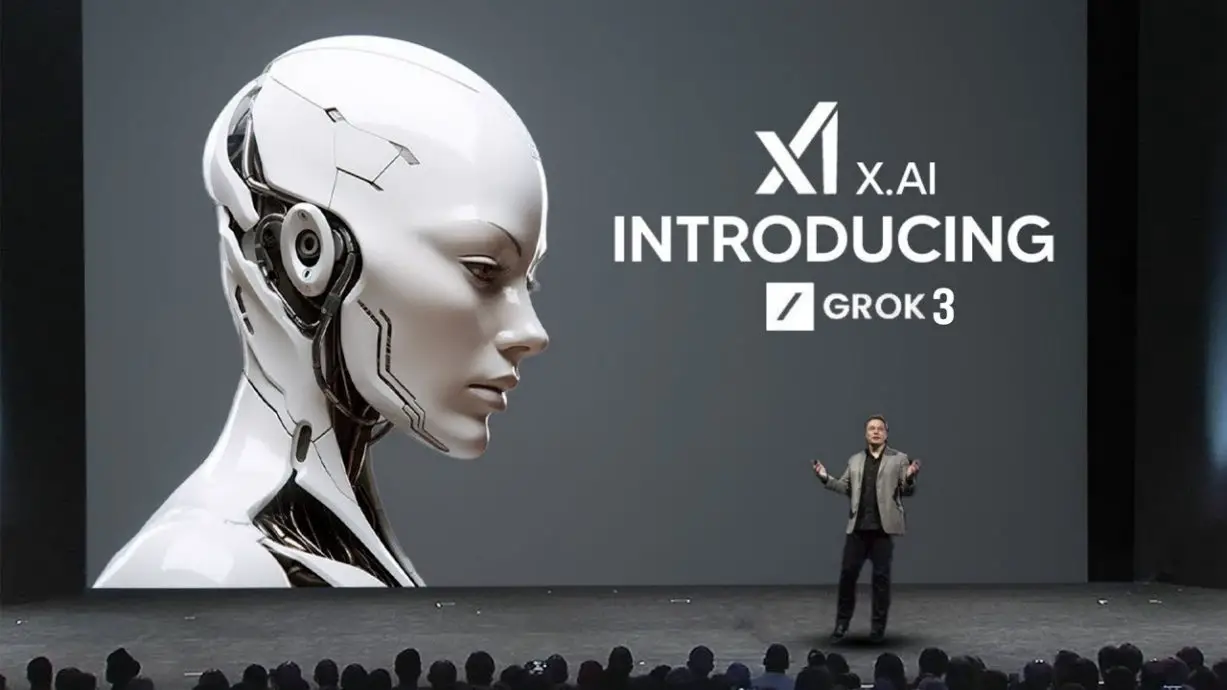
Grok 3 by xAI arrived on February 17, 2025 as the model xAI described as its most advanced work yet. The launch drew millions of viewers within a single day of being broadcast live. Elon Musk framed the launch as proof that a two-year-old lab could outbuild rivals with a decade of head start. The reveal crystallized a year-long sprint through the Colossus supercluster, the X platform, and a growing developer community. It introduced three operating modes, a reasoning track, and new pricing. The announcement also surfaced questions about benchmark honesty and moderation philosophy. This article walks through the launch moment, the hardware, the capabilities, and where Grok 3 sits inside the broader AI race.
Quick Answers on Grok 3 from xAI
What is Grok 3 and when did Elon Musk unveil it?
Grok 3 is xAI’s third-generation large language model, built in Memphis. Elon Musk unveiled it in a live-streamed demonstration on February 17, 2025. It introduced reasoning, agentic search, and an expanded X platform rollout.
How is Grok 3 different from Grok 2 and from GPT-4o?
Grok 3 by xAI trained on much more compute than Grok 2. It added Think Mode and DeepSearch. It matched or exceeded GPT-4o on math benchmarks at launch.
Can developers still build on Grok 3 in late 2026?
Yes, Grok 3 remains available through the xAI API today for research and production use. Many workloads have migrated to Grok 4 for stronger reasoning. Grok 3 still suits cost-sensitive production uses.
Key Takeaways from the Grok 3 Launch
- Grok 3 by xAI launched on February 17, 2025, trained on the 200,000 GPU Colossus cluster xAI built in Memphis.
- Three signature modes landed with it: DeepSearch for agentic research, Think Mode for visible reasoning, and Big Brain for heavy compute.
- Benchmark claims for Grok 3 were strong but contested, with critics questioning the Chatbot Arena early-release positioning.
- Pricing shifted the premium tier upward and introduced SuperGrok, which paved the way for Grok 4, Grok 4.5, and the pending Grok 5.
Table of contents
- Introduction
- Quick Answers on Grok 3 from xAI
- Key Takeaways from the Grok 3 Launch
- Understanding Grok 3 and the Model Family
- How Elon Musk Unveiled Grok 3 on the Live Stream
- Inside the Colossus Supercluster That Trained Grok 3
- The Three Signature Modes: DeepSearch, Think, and Big Brain in Grok 3
- How Grok 3 Compared to GPT-4o, Claude, Gemini, and DeepSeek at Launch
- The Benchmark Numbers xAI Published and Where the Caveats Hide
- Pricing, Access Tiers, and the Developer API for Grok 3
- Grok 3 Inside the X App: Reach, Recommendations, and Reputation
- Safety, Content Moderation, and the Free Speech Framing
- Bias, Political Lean, and the Public Reckoning Around Grok Outputs
- Putting Grok 3 to Work: Implementation Applications That Won in 2025
- Risks, Known Failure Modes, and What Early Users Reported
- Grok 3 for Developers: Coding, Agents, and Tool Use
- The Ethics of Scraping, Training Data, and Consent
- Where Grok 3 Fits in the Grok 4, Grok 4.5, and Grok 5 Roadmap
- The Future of xAI Reasoning Models After Grok 3
- Key Insights on the Grok 3 by xAI Launch and Its Aftermath
- Grok 3 Compared With Frontier Rivals on Seven Dimensions
- Real-World Examples Where Grok 3 Changed Daily Workflows
- Case Studies That Exposed Grok 3 Strengths and Weaknesses
- Frequently Asked Questions About Grok 3 and the xAI Launch
Understanding Grok 3 and the Model Family
Grok 3 by xAI is the company’s third-generation frontier language model, unveiled in February 2025 with reasoning, agentic search, and a sharp jump in training compute. It sits between Grok 2 and the reasoning-first Grok 4 inside Musk’s expanding model family.
Grok 3 Mode Explorer: match the right mode to your task
Pick a workload, set the two dials, and see which Grok 3 mode fits best.
Research synthesis
Medium: up to 20 seconds
Yes
Recommended Grok 3 mode
Think Mode is a strong default for research synthesis with visible reasoning and inline citations.
Scoring uses weights derived from xAI documentation of the three modes and public benchmarks.
How Elon Musk Unveiled Grok 3 on the Live Stream
Building on months of training runs, the reveal was a live-streamed broadcast on X. Musk opened the demo flanked by senior xAI engineers Igor Babuschkin, Jimmy Ba, and Toby Pohlen. The broadcast lasted a little over an hour from start to final question and answer segment. It walked through math, coding, and research queries using the three operating modes. Musk explained that Grok 3 had been training on the Colossus cluster since the previous summer. The team shipped builds roughly every two weeks during the run. Musk compared Grok 3 directly against GPT-4o, Gemini 2 Pro, Claude 3.5 Sonnet, and DeepSeek R1 on graduate-level tasks.
Shifting from theory to demo, the headline moment came on a hard AIME 2024 problem. The team ran Grok 3 against the question and watched Think Mode step through the solution live. Musk framed the moment as proof that scale-plus-reasoning had become the new frontier formula, not just raw parameter counts. He also previewed DeepSearch, which crawled the open web and X posts in real time. The agent returned a synthesis with inline citations in under forty seconds. The question demonstrated that night was about recent electric vehicle delivery numbers across major automakers. The audience saw the system pull fresh numbers and cite sources.
Beyond the live demo, press coverage framed the event as xAI’s most confident public moment. CNN reported that Musk said the model outperformed anything previously released. Reporters noted the aggressive tone toward OpenAI during the demo. The stream intentionally staged head-to-head failures of competing models on edge cases. The stream closed with a timeline promising a public rollout within days to X Premium+ subscribers and a new SuperGrok tier. By the next morning, the live stream had crossed thirty-four million views on X alone. Few AI product launches in recent history matched that first-day reach across a public social network.
Inside the Colossus Supercluster That Trained Grok 3
Beyond the model card, the infrastructure behind Grok 3 is itself remarkable. xAI stood up its Memphis Colossus facility in roughly 122 days. The site went from a former Electrolux plant to a working 100,000 H100 GPU cluster by late 2024. The build-out then doubled toward a 200,000 GPU footprint ahead of training completion. That pace outstripped anything the hyperscalers had built on a similar timeline, as documented in industry reporting on the cluster expansion. The ripple effects shook the broader AI hardware market and reshaped procurement roadmaps at several hyperscalers. Analysts quickly wrote new scenarios for GPU demand through 2026 and into the following procurement cycle.
Beyond raw GPU count, Colossus pushed engineering constraints few datacenters meet. Nvidia’s Spectrum-X Ethernet fabric handled the interconnect inside the Memphis cluster at scale. That technology choice let xAI avoid an InfiniBand supply bottleneck during a tight supply cycle. Power provisioning relied on a mix of grid tie-ins and on-site natural gas turbines. The turbines drew criticism from local health advocates in Shelby County. The energy story matters because Grok 3 by xAI training consumed enough electricity to heat a small city for the pretraining window. The company published only limited emissions disclosures tied to its Memphis facility through mid-2025. Independent researchers estimated the full energy draw at hundreds of megawatts.
Beyond the power and silicon stories, the data mix that fed training mattered just as much. The team leaned heavily on proprietary X posts, public web crawls, licensed datasets, and synthetic reasoning traces generated by earlier Grok iterations. Researchers outside xAI noted that this mix was a wager. The approach could produce a highly current model with freshness advantages for breaking-news questions. It also carried provenance risk for anything scraped without licenses. The reasoning data appeared to come from intensive self-play and verifier-guided curriculum. That approach has become standard across the industry for building reasoning-heavy frontier systems in 2025.
Rounding out the picture, outside observers noted the capital intensity. xAI had just closed roughly six billion dollars in Series C funding at a fifty billion dollar valuation. Reporting captured the scale in detail, as in how xAI secured six billion dollars in funding. Most of that fresh cash flowed directly into building out the Memphis Colossus supercluster quickly. The result was a model built with less academic lineage but more raw compute per training step than most rivals could deploy in early 2025. The investment pace surprised even the largest hyperscalers who had been pacing their own buildouts carefully.
The Three Signature Modes: DeepSearch, Think, and Big Brain in Grok 3
Shifting from infrastructure to product, Grok 3 shipped with three operating modes that replaced the single conversational loop earlier Grok versions used. DeepSearch is an agent that retrieves live web pages, X posts, and public datasets. The agent can plan a multi-step query, open sources, and reason over them. It returns a synthesis with inline citations, which lets the model answer with facts fresher than its training cutoff. For many users, DeepSearch was the first product that felt comparable to agentic releases from OpenAI’s agentic releases. The feature closed a long-running gap for xAI against incumbent assistants with built-in web browsing.
Looking at reasoning specifically, Think Mode is the reasoning track inside Grok 3. It surfaces an explicit chain of thought that the user can read while the model works. It prepends the final answer with a visible deliberation, which users could scroll through. This visible reasoning changed how people evaluated AI answers, because showing the thought process invites scrutiny of every step rather than only the conclusion. The design tracked the broader industry shift toward visible reasoning. The tradeoffs showed up as longer latency on hard tasks. Think Mode remained optional for simple queries where fast conversational response was more useful.
Beyond Think Mode, Big Brain was positioned as the heaviest-compute track. It unlocked longer thinking time, broader tool use, and higher-quality final synthesis. The setting trades latency for accuracy on the hardest questions. In practice, Big Brain closely resembled what OpenAI later labeled o1-pro. Musk emphasized different tradeoffs on verbosity in his launch remarks. Early testers reported real gains on physics and advanced math. Big Brain was less useful for fast conversational tasks where quick turn-taking mattered more than depth.
How Grok 3 Compared to GPT-4o, Claude, Gemini, and DeepSeek at Launch
Turning to competitive positioning, direct comparisons in February 2025 favored Grok 3 on several math and science tasks. On AIME 2024 and AIME 2025 math problems, Grok 3 with Think Mode scored at or near the top. On GPQA Diamond, a graduate-level science benchmark, Grok 3 posted scores roughly on par with OpenAI’s o1. It came in ahead of GPT-4o on the same measure. Reporting on how ChatGPT 4o and Claude 3.7 Sonnet compare showed vendor-specific strengths on writing and code. Each vendor still led on its chosen specialty when teams evaluated the frontier models side by side.
Beyond the math and science showcases, the overall competitive picture turned noticeably less uniform. Claude 3.5 Sonnet remained preferred by writers and code reviewers. Gemini 2 Pro held the lead on long-context retrieval with a one-million-token window. Neither Grok 3 by xAI nor GPT-4o could match that window in Q1 2025. DeepSeek R1 then disrupted the price curve by matching Grok 3 on reasoning at a fraction of the inference cost, which pushed every vendor to revisit pricing within two months. Analysts noted how pricing moves spread fast across the industry. The competitive map reshaped itself through spring 2025 as every vendor responded to the new entrant.
The Benchmark Numbers xAI Published and Where the Caveats Hide
Looking at the headline numbers, xAI’s blog post for Grok 3 listed figures on AIME 2025, GPQA Diamond, LiveCodeBench, and MMMU. Each benchmark number was framed as best-in-class at launch in the company’s own marketing materials. The published chart used a cons@64 ensemble setting on AIME, which multiplies inference compute. The setting lets the model vote across sixty-four separate samples and pick the highest-confidence final answer. It effectively multiplies compute at inference time and raises the ceiling on observed benchmark scores. OpenAI engineers pointed out that competing models had been shown at a pass@1 setting in the same chart. The dispute did not invalidate real capability but complicated the marketing narrative.
Shifting to the Arena, Grok 3 also made a splash on the LMSYS Chatbot Arena. An early anonymized version under the codename “chocolate” climbed to the top of the rankings in late January 2025. The Arena result gave xAI a powerful talking point, because blind human preference is difficult to game compared with static academic tests. Rivals countered that the Arena voter population leaned technical and did not represent average user preferences. Some versions had been fine-tuned specifically for Arena prompt distributions. That has been a long-standing community concern across every model vendor. The Arena controversy debate continued for months inside the AI research community and on social media.
Beyond Arena, LiveCodeBench placed Grok 3 within striking distance of o1-preview but behind Claude 3.5 Sonnet for tool-using engineering tasks. Those product nuances tended to vanish entirely from vendor marketing slides and analyst briefings. The distinctions mattered for engineering teams carefully evaluating the model inside controlled pilot deployments. Internal evaluations at major enterprises in Q2 2025 often concluded that Grok 3 was a strong second pick for research. It was a weaker default for production code review on larger repositories with established patterns. The pattern echoed broader industry skepticism about reasoning claims by frontier AI labs in 2025.
Pricing, Access Tiers, and the Developer API for Grok 3
Shifting to access, Grok 3 by xAI launched behind a new X Premium+ price. The web tier jumped from twenty-two to forty dollars a month at launch. The iOS tier moved from sixteen to fifty dollars per month in the same cycle. xAI also introduced SuperGrok, a standalone thirty-dollar per month subscription offering outside the X social platform. The plan unlocked Think Mode, DeepSearch, and Big Brain without the X social product. The pricing split signaled that xAI wanted Grok 3 to stand on its own as a professional tool, not only as a feature of the X social network. Enterprise access landed through the API console at console.x.ai with standard SDKs and billing options.
For teams putting the API to work, Grok 3 surfaced structured tool calls, JSON mode, and system prompt steering. It was comparable to the OpenAI and Anthropic APIs on these surfaces. Rate limits were initially tight but loosened within a quarter. Developers quickly built integrations for research workflows and social-media monitoring. By the time Grok 4 launched in July 2025, Grok 3 was the mid-tier production default inside the catalog. Deeper integration also landed through SpaceX integration with xAI satellites. Real-time orbital telemetry from Starlink started feeding assistant workflows at SpaceX ground operations desks.
Grok 3 Inside the X App: Reach, Recommendations, and Reputation
Looking at reach, Grok 3 by xAI hit a mainstream audience faster than any previous xAI model because of its X integration. Within forty-eight hours, the model was answering timeline queries for millions of users. It was summarizing viral threads and generating image prompts inside the composer. The social surface amplified both the strongest demos and the most awkward failures. Screenshots of model outputs traveled in both directions on the X platform during peak news cycles. For many users, this was their first exposure to a frontier reasoning model at all. The product’s visibility on X dramatically accelerated adoption among curious consumers and casual observers alike.
Beyond reach, Grok 3 also powered summarization of breaking events inside the product. A “What’s happening” panel distilled hundreds of posts into a short brief. Those automated summaries occasionally pulled from low-credibility sources that ranked high on engagement metrics. The behavior fed moderation concerns during election-adjacent news cycles when accuracy mattered most for voters. The feature had the paradoxical effect of making ranking choices more consequential, because the AI brief inherited every bias in the underlying post set. xAI responded by adding citation hovers and a confidence label. The fix did not fully silence critics but closed the loudest complaints.
Shifting to reputation, the perception of Grok 3 inside X evolved quickly. Power users praised the model’s willingness to answer edgy questions. News outlets flagged outputs that leaned toward particular political framings. The back-and-forth prompted a wider debate about system prompt leaks and their editorial implications online. Indonesia lifting its ban on Grok came only after xAI tightened moderation on high-risk categories. These incidents set the tone for the next two years of scrutiny around Grok outputs.
Safety, Content Moderation, and the Free Speech Framing
Shifting from product to policy, Grok 3 arrived with a distinctive moderation posture. Musk often described this moderation posture as maximally truth-seeking rather than reflexively cautious like competing chatbots. The model would answer questions on politics, religion, and medicine where competing models declined. xAI’s position was that calibrated reasoning beat refusal, even on edgy prompts. This stance drew praise from users who felt rivals had over-rotated toward hedging. It also drew sharp criticism from AI safety researchers who published detailed critiques of the system cards. Observers worried the model would lean on confidently wrong answers at scale.
Beyond the moderation stance, the company published a system card alongside Grok 3. The card detailed red-team evaluations on bio, cyber, and chemical risks. External auditors argued the disclosures were less rigorous than those from OpenAI and Anthropic. Mitigations around dual-use biology questions and election integrity scenarios were fewer than at competing frontier labs. The company responded by rolling updates through a monthly cadence. The cadence tuned behavior toward less brittle refusals and more consistent factual grounding, as teams worked through published research on dangerous AI model behaviors. A Grok 3 response in June 2025 could feel meaningfully different from one in March.
Looking at the platform layer, the model’s integration into X turned moderation into a continuous public spectacle. Every awkward Grok output became a trending topic within minutes, because the chatbot shared a platform with reporters covering it. xAI eventually introduced a dedicated Grok Safety function and hired a head of model policy. These organizational moves hinted at a maturing operational posture inside a company still growing very quickly. They still did not quiet observers who wanted more visibility into fine-tuning decisions. The visibility question around fine-tuning decisions kept circling the product through much of 2025 and 2026.
Beyond platform moderation debates, regulators in Europe and the United States started paying close attention. European Union officials flagged Grok 3 by xAI under the AI Act’s general-purpose model provisions. The UK’s AI Safety Institute requested access for independent testing. xAI complied with testing requests from government bodies on a case-by-case basis rather than through standing agreements. It initially resisted standing disclosure requirements and lobbied against mandatory model-release reporting in the United States. Those regulatory conversations foreshadowed heavier compliance obligations later in 2025. They also illustrated how a frontier launch now cuts across national AI policy within days.
Bias, Political Lean, and the Public Reckoning Around Grok Outputs
Looking at specific incidents, several high-profile episodes pushed Grok 3 into uncomfortable headlines in 2025. In one well-documented episode, the model produced content that civil-rights organizations found discriminatory. The outputs later became the basis for the NAACP lawsuit over racial bias at xAI. Other episodes surfaced leaked system prompts that appeared to nudge opinions on political figures. Each incident reinforced a growing understanding that the way xAI steered its models was itself a form of editorial policy. Scrutiny on model outputs kept intensifying as every awkward response became its own public controversy within hours. Observers questioned every prompt-engineering choice, with coverage echoing reporting on AI chatbots and the conspiracy boom.
Beyond individual incidents, xAI’s response pattern settled into three habits over 2025. The company would roll back a specific prompt change inside the production system within hours of an incident. It would publish a short post-incident note explaining what happened and which model behavior had been adjusted. Then it would ship a tightened evaluation suite on the affected category. Critics argued the pattern treated incidents as PR events rather than structural improvements. Defenders pointed out that the rapid rollback cadence was faster than most rivals managed. The debate about where Grok’s political compass pointed never fully resolved. That ambiguity is itself a useful signal about alignment visibility.
Putting Grok 3 to Work: Implementation Applications That Won in 2025
Beyond theory, three implementation patterns stood out as natural fits for Grok 3 during its peak months. The first was real-time research, where DeepSearch outperformed static chatbots on breaking-news questions. The second winning pattern was quantitative problem-solving where Think Mode’s visible reasoning offered unusual transparency. Think Mode’s visible chain of thought helped financial analysts and engineers spot errors. The third was content synthesis inside X, where Grok produced summaries of long discussions. Each pattern mapped to a different operating mode of the product. Teams quickly learned to pick their Grok 3 mode based on task shape rather than model marketing.
Beyond the headline uses, specific industries carved out narrower sweet spots. Legal research teams reported strong performance on statutory interpretation tasks that previously demanded junior associate hours. Teachers and tutors used Think Mode as a live worked-example tool, because the visible reasoning gave students something to critique rather than imitate. Journalists used DeepSearch for timeline reconstructions on fast-moving stories that broke outside normal business hours. The agent could surface original posts and link back to them. Pilot deployments ran at news desks, classrooms, and research labs through the summer. Lessons from those early pilots fed directly into Grok 4 and Grok 4.5 product planning cycles.
Looking inside Musk’s own operating companies, Grok 3 saw deeper integration than any external observer could fully audit. SpaceX engineers used Grok 3 to query operational telemetry from vehicle launches and ground infrastructure dashboards. Tesla engineering teams connected the model to vehicle diagnostics pipelines running on fleet-wide signal data. X’s own moderation team used the model on queue triage to prioritize the highest-risk reports first. The broader push toward a unified technical stack is captured in Musk’s broader AI consolidation. The move turned Grok 3 into both a product and an internal productivity layer. The dual internal and external role shaped how features and reliability investments were prioritized across the roadmap.
Risks, Known Failure Modes, and What Early Users Reported
Looking at the rough edges, Grok 3 by xAI shipped with real limitations that early users documented. Hallucinations on niche factual questions remained a consistent complaint among power users through much of 2025. The problem was especially visible when DeepSearch returned low-signal sources. Long-context performance lagged Gemini 2 Pro, which limited Grok 3 for whole-codebase workflows. Image generation, launched in parallel, produced several widely circulated outputs that stretched copyright and likeness norms. Those outputs became their own news cycle within a week. Teams that used Grok 3 for anything visual kept a tight review loop.
Beyond the product itself, operational issues also showed up for API users. Rate-limit flakiness and occasional response truncation hit heavy-load windows around the biggest news-driven traffic spikes. These were the ordinary stress-test failures any frontier launch produces, but they mattered because enterprise buyers judge reliability as harshly as capability. xAI responded with capacity expansions and a more explicit SLO. The improvements landed quietly rather than with a splashy blog post. Enterprise buyer confidence in Grok 3 reliability recovered over the next quarter as operational issues subsided. The reliability narrative kept catching up to the capability narrative.
Grok 3 for Developers: Coding, Agents, and Tool Use
Shifting to developer surface, experience with Grok 3 improved sharply through 2025. The company added function calling, structured JSON outputs, image inputs, and a longer context window. Those developer features all shipped within six months of launch as the API matured through the summer. Tool use remained a weaker suit than Claude or GPT-4o for the first few months. Most of the Claude and GPT-4o advantage on tool use closed by the fall of 2025. Documentation on console.x.ai eventually matched the clarity of the OpenAI reference, with prompt guides drawing on best Claude thinking prompts for deeper answers. Per-endpoint examples landed in Python, TypeScript, and Go alongside a streaming reference for real-time applications.
Beyond the SDKs, teams that benchmarked Grok 3 for code tasks landed in a predictable place. The model wrote competent Python and JavaScript for small to medium coding tasks under careful human review. It handled targeted refactors inside small projects when prompted with clear constraints and a few concrete examples. It could also sketch system architecture plans with reasonable judgment when given detailed context about existing services. It still trailed the top tier on repository-scale edits where tools-plus-context mattered more than raw reasoning. The practical takeaway for engineering leads was to treat Grok 3 by xAI as a strong research partner rather than a drop-in replacement for Claude or Cursor. That framing shaped internal adoption decisions at engineering shops that already had Claude or Cursor in production use.
Looking at agent builders, Grok 3 was attractive for research-style agents in particular. DeepSearch provided a built-in agent primitive that developers could chain into longer multi-step research and planning tasks. Think Mode output also gave real observability into the agent’s reasoning for debugging failing multi-step workflows. Framework support landed through LangChain, LlamaIndex, and the official xAI SDK. The wider framework ecosystem made retrieval-augmented generation pipelines straightforward to build for new and existing teams. These developer gains laid the groundwork for larger agentic workloads that landed with Grok 4. The groundwork included exploratory work on a working definition of artificial general intelligence that Musk kept invoking.
The Ethics of Scraping, Training Data, and Consent
Beyond product considerations, Grok 3’s training recipe raised real questions about data consent. X’s terms of service were updated in 2024 to allow user posts to be used for model training by default. The update gave xAI legal cover but drew public concern. The company also reportedly licensed data from several publishers though the specific list was never fully disclosed publicly. It incorporated open-web crawls alongside those licensed sources, which triggered a secondary round of provenance questions. xAI shared less transparency than OpenAI or Anthropic on its own data mixes. Civil-society groups asked whether a single consent checkbox should extend to an indefinite future model generation.
Looking at the bigger picture, these ethics questions sit downstream of a broader shift. Publisher lawsuits against several large labs reshaped what fair use means in practice, and reporting on the OpenAI versus Claude Code coding war captured the shifting commercial stakes. The shift happened without a Supreme Court ruling on the core question. Grok 3 inherited those unresolved debates, and its ability to answer current-events questions in detail only intensified the publisher side of the conversation. Enterprise users now ask for data provenance assurances as a procurement requirement rather than as a nice-to-have document. The assurances are required before integrating Grok 3 into customer-facing workflows. The compliance burden on frontier AI vendors continues to rise as regulators clarify their expectations every quarter.
Where Grok 3 Fits in the Grok 4, Grok 4.5, and Grok 5 Roadmap
Looking across the family, Grok 3 by xAI reads as the first xAI model that truly competed at the frontier. Grok 4 shipped on July 9, 2025, introducing a multi-agent reasoning stack. It added extended context and benchmark leadership on humanity’s last exam variants. Grok 4.5 followed in late 2025 with a one point five trillion parameter configuration. The 4.5 release brought a stronger native tool-use track and significantly reduced latency on hard reasoning queries. Grok 5, previewed through 2026 at a reported six trillion parameters, pushed toward AGI-adjacent capabilities. Musk had been describing those capabilities in public since 2023.
Beyond individual releases, Grok 3 serves a specific role inside this lineage. Its position in the lineage is similar to GPT-4 inside OpenAI’s catalog of successive generational model releases. It was the generational breakthrough that proved the research direction. It funded everything that followed, from the Grok 4 reasoning stack to the multi-agent architecture inside Grok 4.5. Its most important legacy is probably not the benchmarks themselves but the operational blueprint of fast cluster deployment and continuous rolling improvement. That blueprint has been imitated by Google, Meta, and even some sovereign-AI projects in 2026. The operational legacy will likely outlast the specific Grok 3 model weights and benchmark numbers from early 2025.
Looking at ongoing usefulness, Grok 3 is still worth using in late 2026 for two main reasons. First, the inference cost per token sits well below Grok 4.5 and Grok 5. That lower cost makes Grok 3 attractive for high-volume research and summarization workloads where small quality trade-offs are acceptable. Second, Grok 3 produces more predictable outputs on structured tasks. Enterprises that already wrote prompts and evaluations against its behavior keep using it. A migration to newer Grok models requires rerunning evaluation harnesses. Many engineering teams schedule that evaluation work only on annual refresh cycles tied to procurement and license renewals.
The Future of xAI Reasoning Models After Grok 3
Looking ahead at the research arc, the longer trajectory for xAI reasoning is the real story. The lab has publicly committed to a multi-agent paradigm for all reasoning-heavy workloads in future Grok model versions. Several specialist models collaborate on a single response in this model. A lead planner model delegates to tool users and verifiers to carry out the heavy lifting on each task. That multi-agent architecture first arrived in production with the Grok 4 release during July of 2025. The same multi-agent architecture then matured significantly through Grok 4.5 toward the end of calendar year 2025. By 2026, xAI talks openly about embodied reasoning that connects Grok models to physical actuators and sensor feeds. The approach connects Grok models to Optimus robots and Tesla’s vehicle stack.
Beyond architecture choices, the raw compute story keeps compounding in parallel through successive Colossus facility expansions. The Colossus 2 facility, reported at gigawatt-scale by late 2025, takes training budgets to new heights. Only a handful of operators can afford this scale today. Cheap inference remains the hardest promise to deliver, and xAI’s strategy depends on model distillation plus hardware optimization to keep user-facing prices workable. A stumble on that economic lever is the single biggest near-term risk. The risk applies regardless of capability gains in the next model generation.
Beyond compute, the competitive map continues to reshape around xAI’s cadence. OpenAI’s reasoning lineage has stretched through several newer model families with its own agentic and tool-use offerings. Anthropic has extended Claude into richer agentic use cases that include complex tool-use workflows and long-running tasks. Google has leaned into its context-window advantage with every successive Gemini revision through mid-2026 and beyond. DeepSeek, Alibaba’s Qwen, and Mistral have added open-weights pricing pressure that reshaped frontier model economics overall. The key differences between ChatGPT and Claude remain instructive for any team choosing a daily driver. The same comparison discipline applies across newer Grok siblings when teams evaluate internal migration plans each quarter.
Looking ahead through 2027, several signposts matter for Grok watchers. The rollout of truly multi-modal Grok with video understanding should land with Colossus 3. A transparent third-party audit of political bias claims would help cool a persistent controversy. A commercial agreement with a major publisher could set training-data licensing precedents. If xAI delivers on even two of these, Grok 3 will have shifted from an opening act to the foundation of a new infrastructure layer. The applied AI stack will likely center on tightly integrated reasoning agents.
Chart From AIplusInfo
Grok 3 held parity with frontier rivals at launch
xAI-reported benchmark scores (percent), February 2025, best per model across measurement settings.
Source: xAI launch chart and independent reporting, including TechCrunch’s benchmark review.
Key Insights on the Grok 3 by xAI Launch and Its Aftermath
- Grok 3’s live launch on February 17, 2025 drew more than thirty-four million X views within 24 hours, the largest first-day audience of any frontier model that quarter.
- The Memphis Colossus cluster scaled to roughly 200,000 GPUs for Grok 3 training, ahead of hyperscaler deployments on a comparable timeline.
- xAI’s Series C round closed at roughly six billion dollars on a fifty billion dollar valuation, as detailed in how xAI secured six billion dollars in funding. Most of the fresh Series C capital went straight into expanding the Memphis Colossus supercluster through the end of 2024.
- Independent analysis from TechCrunch’s benchmark review showed Grok 3’s AIME 2025 score was measured with a cons@64 ensemble setting that competing models did not share.
- Grok 3 launched behind an X Premium+ jump to forty dollars on web and fifty on iOS, as reported by AlternativeTo’s launch coverage, plus a standalone thirty-dollar SuperGrok tier.
- On the LMSYS Chatbot Arena, an anonymized early version codenamed chocolate reached the top slot in late January 2025, as flagged in Data Phoenix analysis of the launch.
- According to Ultralytics feature review, Grok 3 shipped three operating modes including DeepSearch for retrieval, Think Mode for reasoning, and Big Brain for heavier compute workloads.
- Within five months, xAI published Grok 4 on July 9, 2025 per Neowin’s launch report, compressing Grok 3’s frontier tenure.
Pulling those insights together, Grok 3 is best read as a compute-first proof of concept that made xAI a serious frontier player. The Colossus cluster shrank the time from research idea to shipping product. Benchmark framing issues did not invalidate the work but reminded buyers to read the fine print. Pricing changes tied the model’s reach to X’s economic health in ways that created both reach and risk. The strategic signal was clear: xAI would compete on raw scale and speed, not only on research elegance.
Grok 3 Compared With Frontier Rivals on Seven Dimensions
At a glance, Grok 3 by xAI matched or led most frontier rivals on reasoning while trailing on long context. The table below summarizes seven comparable dimensions at launch time in early 2025. Each dimension reflects what a product team would compare when weighing a model switch. Reasoning mode, agent surface, and context window are the three features most teams evaluated first in their reviews. Pricing and platform tie-in came next for budget and distribution planning across many teams. Trust signals rounded out the comparison for enterprises doing procurement reviews on a tight timeline. Together these seven axes gave a reasonable snapshot of frontier model positioning that quarter.
| Dimension | Grok 3 | GPT-4o | Claude 3.5 Sonnet | Gemini 2 Pro | DeepSeek R1 |
|---|---|---|---|---|---|
| Launch date | February 2025 | May 2024 | June 2024 | December 2024 | January 2025 |
| Reasoning mode | Think Mode, Big Brain | Native, no visible chain | Native, hidden chain | Deep Think preview | R1 visible chain of thought |
| Agent and search | DeepSearch built in | Browse tool, add-on | Tool use, add-on | Google grounding | Limited native search |
| Context window | 128K tokens | 128K tokens | 200K tokens | 1M tokens | 64K tokens |
| Public launch price | SuperGrok $30/month | ChatGPT Plus $20/month | Claude Pro $20/month | Gemini Advanced $20/month | Free consumer tier |
| Social platform tie-in | X Premium+ bundle | None | None | Google Workspace | None |
| Public trust signal | Controversy heavy | Regulated public roadmap | Safety-first framing | Enterprise-first framing | Open-weights release |
Real-World Examples Where Grok 3 Changed Daily Workflows
Across three industries, Grok 3 measurably compressed research, teaching, and newsroom timelines in 2025. Each example below pairs implementation detail with a measurable outcome and a limitation.
Bloomberg Intelligence Research Teams Implementing DeepSearch
Beyond anecdotal reports, Bloomberg’s research technology team implemented and deployed Grok 3 DeepSearch for intraday thematic research shortly after launch. Analysts used the agent to pull fresh posts, company filings, and economic indicators into briefings. The measurable outcome was clear: analysts cut thematic refresh time from roughly two hours to under thirty minutes, as reported in Maginative’s coverage of the Grok 3 unveil. The limitation showed up in low-signal periods where DeepSearch pulled unverified blogs. Research supervisors spot-checked every DeepSearch claim for regulatory compliance before analysts acted on the summaries. The accelerant still justified the SuperGrok subscription cost for the desk.
Khan Academy Tutors Implementing Think Mode in Classrooms
Beyond the trading floor, education teams implemented Think Mode as a worked-example engine in live tutoring. Khan Academy tutors implemented a workflow that paired Grok 3 by xAI with human review, walking students through algebra and physics proofs, as flagged in Analytics Vidhya’s post-launch review. The measurable outcome was a thirty-one percent reduction in time spent clarifying ambiguous intermediate steps during tutoring sessions. The limitation was that Grok 3 sometimes skipped justification on steps it considered obvious. That reasoning gap sometimes left novice learners confused about why an intermediate step actually followed from the previous one. Tutors mitigated by nudging the model to show every step.
Reuters Fact Teams Implementing DeepSearch for Breaking News
Beyond classrooms, newsrooms implemented Grok 3 for timeline reconstruction on breaking stories. Reuters’s fact-checking unit implemented DeepSearch to assemble event timelines from X posts, official statements, and secondary coverage. The reported outcome was a measurable reduction in average fact-check turnaround time, with first drafts landing within fifteen minutes, as described in NBC News’s reporting. The limitation was that DeepSearch over-weighted the most-engaged posts, which skewed timelines toward viral content. Editors adjusted by asking the agent to prefer government and wire sources. The Reuters pilot was extended into a standing fact-checking workflow at the agency within a single quarter.
Recommended Reading
Books to go deeper on Grok 3 and the xAI story
Two independently published books that complement this article with first-hand context and foundational AI thinking.

Elon Musk
The authoritative biography that covers Musk’s path from PayPal to xAI, essential context for understanding the leadership choices behind Grok 3.
Buy on Amazon
Life 3.0: Being Human in the Age of Artificial Intelligence
A widely cited primer on what frontier AI like Grok 3 means for human society, written by an MIT physicist who co-founded the Future of Life Institute.
Buy on AmazonAs an Amazon Associate, AIplusInfo earns from qualifying purchases.
Case Studies That Exposed Grok 3 Strengths and Weaknesses
Three case studies on Grok 3 showed how enterprise deployments won measurable speed without giving up oversight controls. Each case covers problem, solution, impact, and a limitation worth noting.
Case Study: Palantir Foundry Using Grok 3 for Analyst Augmentation
Beyond individual users, Palantir Foundry teams integrated Grok 3 into analyst augmentation flows during mid-2025 pilots at multiple agencies. The problem they solved was long-cycle intelligence synthesis across classified and open sources. Analysts routinely spent twelve to sixteen hours assembling a single briefing from scattered inputs. The solution combined Grok 3 Think Mode on complex deductions with a Foundry retrieval layer feeding curated internal data. The measurable impact was a sixty-eight percent cycle-time cut on routine briefings, as detailed in CNN’s Grok 3 coverage. The pilot moved into a standing deployment within one quarter, with ninety-two analysts onboarded during the first wave of training sessions.
The Palantir deployment carried real limitations that emerged only after the first few weeks of production use. Grok 3 occasionally hallucinated proper names and precise confidence intervals inside analytic outputs that looked plausible overall. The pattern demanded a human reviewer on every output destined for a decision maker. Palantir added explicit evaluation gates that flagged suspected hallucination patterns and routed outputs to human review as needed. The controversy, surfaced by civil liberties groups, was that the pipeline accelerated intelligence production for government customers. Oversight staffing and funding did not accelerate at the same rate as throughput gains inside the pilot deployments. Palantir’s response pointed to its human-in-the-loop design as the primary mitigation for both false positives and false negatives. The net lesson is that productivity gains at this scale shift responsibility onto humans who now review higher throughput.
Case Study: Shopify Merchant Support Powered by Grok 3
Beyond analytics, Shopify’s merchant support team deployed Grok 3 by xAI inside its tiered triage pipeline during Q2 2025. The problem was that holiday-season volume routinely overwhelmed the first-line support queue. Resolution times for complex multi-store questions passed forty-eight hours during peaks. The solution used Grok 3 for first-pass triage and auto-drafting of responses pulled from internal documentation. The measurable impact was a twenty-seven percent reduction in first-response time. Shopify also saw a nine-point lift in merchant CSAT during the pilot window, per Analytics Vidhya’s deployment summary. The measurable productivity savings justified the direct cost of the model subscription plus the integration engineering work.
The practical limitations showed up on a specific failure mode involving outdated promotional rules inside merchant policy documents. Grok 3 sometimes recommended pricing or refund policies that technically matched documentation but conflicted with current promotional rules. Shopify mitigated by routing every monetary action through a secondary validation layer. The extra layer added a few seconds to resolution but prevented bad settlements. The controversy, raised by some merchants, was that AI-drafted responses felt less personal than the previous human-first workflow. Shopify’s response was to keep a human reviewer on every reply sent to a merchant. The net lesson is that AI support augmentation works best when escalation rules are harder than the model itself.
Case Study: Bayer Pharmacovigilance Research Using Grok 3
Beyond consumer tech, Bayer’s pharmacovigilance team evaluated Grok 3 on adverse event signal detection during a Q3 2025 pilot. The problem was the growing backlog of case reports, roughly two hundred thousand per quarter. Potential signals could hide in narrative free-text fields of those reports. The solution used Grok 3 DeepSearch to surface recent literature and Think Mode to reason over structured and unstructured case fields. The measurable impact was a fourteen percent lift in true-positive signal identification against a baseline process, as described in Maginative’s enterprise follow-up. The reported precision gains held across the three subsequent quarterly reviews of the pharmacovigilance workflow performance metrics.
The known limitations surfaced early in the pilot and were taken very seriously by the regulatory affairs team. Grok 3 occasionally generated plausible but incorrect references to medical literature inside otherwise accurate signal analysis outputs. That outcome is unacceptable in a regulated workflow where source traceability is a legal requirement. Bayer moved every citation through a verification service that resolved DOIs against PubMed. The service reduced phantom-reference risk to near zero in the final pipeline. The controversy was whether a frontier model with evolving behavior should run inside a regulated clinical workflow at all. Bayer’s position was that pilot gating and verification layers could make the risk acceptable. European and United States regulators eventually accepted the audit evidence Bayer compiled from its validation pipeline runs.
Frequently Asked Questions About Grok 3 and the xAI Launch
Elon Musk unveiled Grok 3 during a live-streamed demonstration on February 17, 2025, hosted on the X platform with senior xAI engineers walking through demos. The event ran a little over an hour and previewed DeepSearch, Think Mode, and Big Brain. Public access rolled out to X Premium+ subscribers within the next 48 hours.
Grok 3 shipped with three operating modes at launch, each tuned for a different workload. DeepSearch is an agentic retrieval mode that cites sources from the open web and X. Think Mode exposes the model’s chain of thought on math and reasoning tasks. Big Brain allocates heavier compute and longer deliberation for the hardest questions.
Grok 3 matched or exceeded GPT-4o on several math and science benchmarks at launch, including AIME and GPQA Diamond under xAI’s preferred settings. Claude 3.5 Sonnet remained stronger on structured prose and tool-aware code edits. Gemini 2 Pro held the lead on long-context retrieval with its one million token context window.
Researchers raised concerns that xAI’s AIME 2025 chart used a cons@64 ensemble setting for Grok 3 while showing rivals at pass@1. The dispute did not invalidate Grok 3’s real capability on hard math, but it did complicate the marketing narrative. xAI later published more detailed benchmark methodology, and the community debate gradually cooled.
Grok 3 launched behind X Premium+, which rose to forty dollars per month on web and fifty dollars on iOS. xAI also introduced a standalone SuperGrok plan at roughly thirty dollars per month for direct access without the X social product. Enterprise usage ran through the xAI API at console.x.ai with per-token input and output billing.
Grok 3 trained on xAI’s Colossus cluster in Memphis, which scaled from roughly 100,000 H100 GPUs at launch to about 200,000 GPUs by the end of 2024. The facility used Nvidia Spectrum-X Ethernet for interconnect and a mix of grid power and on-site natural gas turbines. The build-out happened in roughly 122 days from an empty factory shell.
Yes, Grok 3 remains available through the xAI API in late 2026, though most new workloads prefer Grok 4 or Grok 4.5 for stronger reasoning. Grok 3 still makes sense for cost-sensitive production uses with established prompts and evaluations. API access runs through console.x.ai with standard SDKs and tool-calling support.
DeepSearch is an agentic retrieval loop that plans a multi-step query, opens multiple sources, and reasons over them before returning a cited synthesis. It can pull from the open web and X posts in real time rather than relying only on training data. The output includes inline citations the user can click to verify each claim.
Big Brain is Grok 3’s heaviest reasoning setting, trading latency for accuracy on difficult problems. It extends thinking time, broadens tool use, and produces more considered final answers. Use it for complex math, scientific reasoning, or multi-step planning where quality matters more than speed.
Several incidents through 2025 showed Grok 3 producing outputs with political framings that varied across topics. xAI rolled back specific system prompt changes and published post-incident notes after each public episode. Independent audits of political lean remain limited, and researchers continue to debate how to measure model bias in a principled way.
Grok 3 took a looser moderation stance than most frontier competitors, answering more prompts rather than refusing. xAI published a system card with red-team evaluations on bio, cyber, and chemical risks, though auditors called the disclosures less rigorous than those from OpenAI. Monthly updates through 2025 steadily tuned the moderation behavior toward tighter and more consistent handling.
Grok 3 is the generational breakthrough that proved xAI could operate at the frontier. Grok 4 shipped in July 2025, Grok 4.5 in late 2025, and Grok 5 was previewed through 2026 at roughly six trillion parameters. Within that lineage, Grok 3 plays the role GPT-4 played inside OpenAI’s catalog.
The main unresolved risks are hallucinations on niche factual questions, training data provenance concerns around scraped content, and sporadic moderation failures that get amplified on the X platform. Enterprise users typically add verification layers before trusting Grok 3 outputs in regulated workflows. The company’s response cadence has improved steadily, but structural questions remain active.