
Introduction
Embedded AI in Enterprise Software: What It Changes is the question every IT leader is now asking as vendors quietly rebuild their core platforms around it. According to research covered by Security Middle East Magazine, fifty-six percent of organizations already use embedded AI capabilities inside the vendor tools they already own. That number is expected to climb quickly as Gartner projects forty percent of enterprise applications will carry a task-specific AI agent by the end of 2026. This article explains where embedded AI actually lives inside familiar software, how it changes daily work, and why governance teams are struggling to keep pace. It also covers the architecture behind these features, the risks that come with AI hiding inside tools employees already trust, and where the technology is headed next. Every claim here is grounded in named research, real vendor documentation, or a named case study, not a general impression of where the market is going.
Quick Answers on Embedded AI in Enterprise Software
What is embedded AI in enterprise software?
Embedded AI in Enterprise Software: What It Changes describes AI capability built directly into applications like a CRM or ERP, rather than a separate standalone tool employees have to open.
How is embedded AI different from a standalone AI tool?
Embedded AI runs inside software an employee already uses, while a standalone tool requires a separate login, a new habit, and manual copying of data between systems.
Why does embedded AI create new governance risks?
Because it hides inside already-trusted software, fifty-six percent of organizations now use embedded AI without a formal inventory of where those models actually touch data.
Key Takeaways
- Embedded AI now lives inside the CRM, ERP, and inbox employees already use, not in a separate standalone tool.
- Fifty-six percent of organizations use embedded AI capabilities, yet most lack a formal inventory of where those models touch data.
- Task-specific agents are replacing passive AI assistants, with Gartner projecting forty percent of enterprise apps carrying one by 2026.
- Governance, identity, and permission design now matter as much as model accuracy when evaluating any embedded AI feature.
Table of contents
- Introduction
- Quick Answers on Embedded AI in Enterprise Software
- Key Takeaways
- Understanding Embedded AI in Enterprise Software
- Where Embedded AI Actually Lives Inside Modern Software
- Why Vendors Are Building AI Into the Application Layer Instead of Selling It Separately
- The Architecture Behind an Embedded AI Feature
- From AI Assistants to Task-Specific Agents Inside Everyday Tools
- How Embedded AI Changes the CRM, the ERP, and the Inbox
- Data Readiness: What Embedded AI Actually Needs From Your Systems
- Implementing Embedded AI Without Breaking Existing Workflows
- Permissions, Identity, and Access Control for AI That Lives Inside Your Stack
- The Governance Blind Spot: When Employees Don’t Know They’re Using AI
- Shadow AI, Data Leakage, and the New Shape of Enterprise Risk
- Ethical Questions Embedded AI Raises for Accountability and Consent
- Measuring Whether Embedded AI Is Actually Working
- Cost, Licensing, and the Economics of Paying for AI You Didn’t Ask For
- What Changes for the People Doing the Work
- The Future of Embedded AI as Vendors Race Toward Autonomous Agents
- Building an Internal Playbook for Embedded AI Governance
- Key Insights
- Embedded AI in Practice: Three Deployments Worth Studying
- What Three Case Studies Reveal About Embedded AI at Scale
- Frequently Asked Questions About Embedded AI in Enterprise Software
Understanding Embedded AI in Enterprise Software
Embedded AI in Enterprise Software: What It Changes refers to AI capability built directly into applications like a CRM, ERP, or productivity suite, rather than a separate standalone tool, letting models act on live data without a new login or workflow.
An Interactive From AIplusInfo
Embedded AI Governance Readiness Score
Answer four questions about your software stack to see a governance readiness score benchmarked against Optro’s 2026 embedded AI research.
Partial
40%
40
Predictive scoring
Governance Readiness Score
54 / 100
Moderate readiness. Ownership and inventory both need work before expanding agent autonomy.
Recommended Next Step
Build a complete inventory of embedded AI features before enabling any new task-specific agent.
Benchmarked against Optro’s finding that only 34% of organizations maintain a formal AI model inventory and 31% have AI incident response procedures.
Where Embedded AI Actually Lives Inside Modern Software
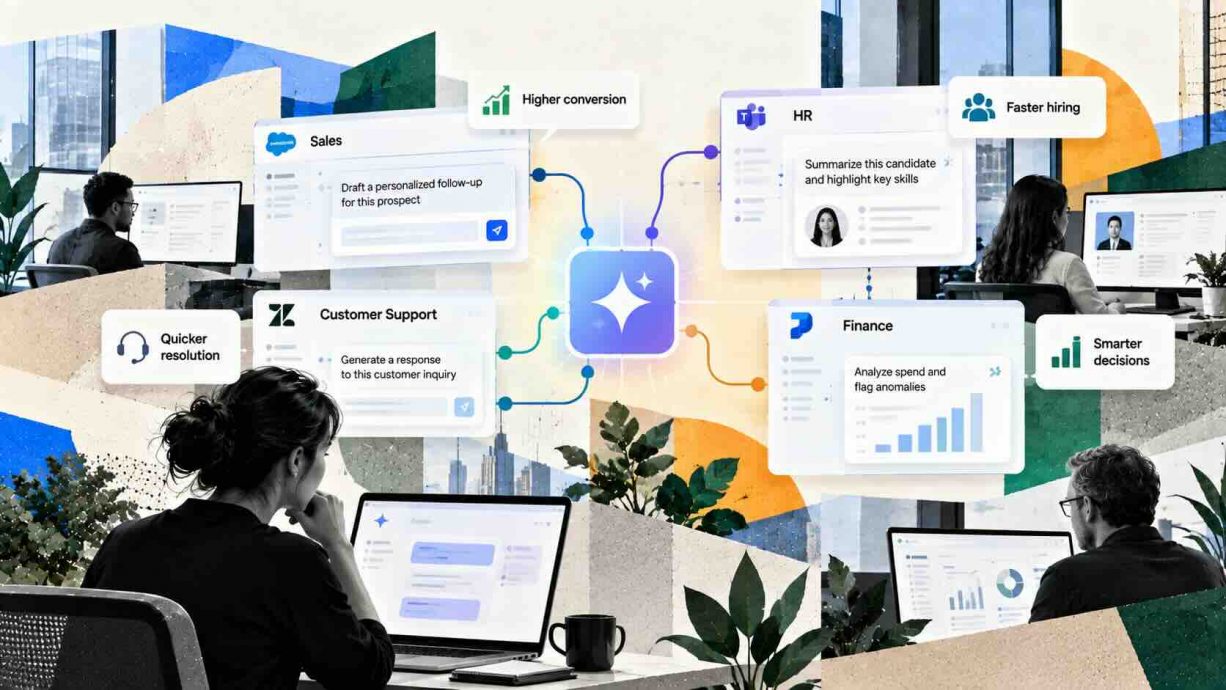
Embedded AI in enterprise software describes a specific shift, not a marketing label attached to any product with a chat window. The AI capability sits inside the CRM, the ERP, the help desk, or the spreadsheet the employee already opens every morning. No separate login exists, no new app icon appears on the desktop, and no procurement cycle is required to turn it on. A sales rep drafting a follow-up email inside Salesforce is using embedded AI the moment a suggested reply appears in the compose box. That is fundamentally different from opening a standalone chatbot in another tab and pasting the same email thread into it. Understanding this distinction matters because it changes who approves the tool, who audits its output, and who gets blamed when it fails.
The term gained urgency in 2026 because vendors stopped treating AI as an add-on module sold at a premium tier. SAP, Salesforce, Microsoft, and Oracle each rebuilt core workflows so that a model runs inline with the existing screen, not beside it. Reading about how AI agents differ from the AI tools that came before them clarifies why this distinction keeps resurfacing in vendor roadmaps. A field that once required a manual lookup now auto-populates from a model call the user never explicitly requested. That invisibility is the entire point from a product design perspective, since friction is what kills adoption of any new feature. It is also the entire source of the governance problem this article spends several sections unpacking in detail.
Three categories of embedded AI now exist inside enterprise software, and conflating them causes most of the confusion in buying conversations. The first category is generative assistance, where a model drafts text, summarizes a record, or suggests a next step for a human to approve. The second category is predictive scoring, where a model ranks leads, flags anomalies, or forecasts a number without generating any visible text. The third and newest category is the task-specific agent, which can execute a multi-step action inside the application without a human clicking every button. Most software a large enterprise licenses today contains at least the first two categories somewhere in its feature set. The third category is the one growing fastest and the one this article returns to when it covers governance and the future outlook. Readers who want more detail can turn to how AI agents differ from earlier AI tools.
Why Vendors Are Building AI Into the Application Layer Instead of Selling It Separately
Vendors have a straightforward commercial reason to embed AI rather than sell it as a separate product line. A standalone AI tool competes for budget against every other software purchase request an IT department receives that quarter. An AI feature bundled into a renewal, by contrast, rides along with a contract the company has already signed and already trusts. Reviewing the practical differences between Agentforce and Microsoft Copilot shows how two dominant vendors chose the same embedding strategy from different starting points. Salesforce built agent capability on top of its existing CRM data model, while Microsoft built it on top of the Office productivity graph. Both approaches skip the step where a buyer has to justify a brand-new line item to a finance committee. The primary source for this specific data point is SAP frames embedded AI as intelligence built into the application layer itself.
SAP frames embedded AI as intelligence built into the application layer itself, distinct from a bolt-on chatbot layered over old software. That framing is not just marketing language, since it reflects a real architectural choice about where inference happens in the software stack. An application-layer model has direct access to live transactional data without an export, an API call, or a data warehouse in between. That access is what lets an embedded feature act on current records instead of a stale snapshot pulled the night before. It is also why enterprises now evaluate embedded AI features during the vendor selection stage rather than bolting on AI after the fact. A closely related piece on this site covers the practical differences between Agentforce and Microsoft Copilot.
The Architecture Behind an Embedded AI Feature
An embedded AI feature is built from four layers that a buyer rarely sees but should understand before signing a contract. The first layer is the data layer, which exposes the application’s own records to a model through an internal API rather than a file export. The second layer is the retrieval layer, which pulls only the specific records relevant to the task at hand instead of the entire database. The third layer is the model layer, where a general-purpose or fine-tuned model generates text, a score, or a proposed action. The fourth layer is the orchestration layer, which decides whether that output gets shown to a human for approval or executed automatically. Understanding what it actually takes to build custom AI agents for workflow automation makes this four-layer split easier to recognize in any vendor’s product.
Most 2024-era embedded features stopped at the model layer, producing a suggestion and leaving execution entirely to a human. Newer embedded features push further into the orchestration layer, letting the system update a record or send a message without a manual click. That shift is exactly what separates a passive AI assistant from an active task-specific agent inside the same piece of software. The orchestration layer is also where most governance controls need to live, since it is the layer that decides what actually happens. A poorly designed orchestration layer can let a model act on bad retrieval results without any checkpoint catching the error in time.
Identity plays a quieter but equally important architectural role, since an embedded agent typically acts under a service account rather than a named employee. That service account often carries broader permissions than any single human user would normally hold, because it needs to touch many records at once. Security teams increasingly flag this as the single largest architectural risk in embedded AI, more significant than the model’s accuracy itself. A model that occasionally drafts an awkward sentence is an annoyance, but a service account with excessive write access is a genuine exposure. Enterprises now request a permissions map from vendors before deployment, listing exactly what data and actions each embedded feature can touch. That request was rare in 2023 and is close to standard procurement practice by the middle of 2026.
Latency and cost also shape architecture in ways that are invisible to the end user but visible on the finance team’s monthly invoice. A feature that calls a large model on every keystroke burns through inference budget far faster than one that batches requests intelligently. Vendors increasingly route simple tasks to smaller, cheaper models and reserve the largest model for genuinely complex reasoning steps. This routing decision, sometimes called a model cascade, is invisible in the product interface but shows up directly in subscription pricing tiers. Buyers evaluating two similar-looking embedded AI features should ask which routing strategy sits behind the interface before comparing sticker prices. For further background, a related article examines building custom AI agents for workflow automation.
From AI Assistants to Task-Specific Agents Inside Everyday Tools
Building on that architectural foundation, the industry is now moving through a visible transition from passive assistants to active agents. Gartner’s research on task-specific agents in enterprise applications puts a hard number on how fast that transition is happening. Fewer than five percent of enterprise applications carried a task-specific agent in 2025, a figure the firm expects to reach forty percent by the end of 2026. That is not a gradual curve; it is closer to an inflection point compressed into a single budget cycle for most software buyers. Learning how enterprises are mastering agentic AI for smarter workflows is one of the fastest ways to see this shift already happening in production. The distinction Gartner draws between an assistant and an agent is the same distinction that matters for governance planning inside any enterprise. This exact point is documented at length in Gartner’s research on task-specific agents in enterprise applications.
An assistant waits for a human to ask a question or approve a draft before anything changes in the underlying system of record. An agent can look at a trigger condition, decide on a course of action, and carry it out across multiple steps without waiting for approval. A procurement agent, for example, can notice a low inventory threshold, generate a purchase order, and route it to the correct approver automatically. The human role shifts from performing the task to defining the boundaries within which the agent is allowed to operate. That boundary-setting work is new, unfamiliar to most operations teams, and currently under-resourced relative to how fast agent deployment is scaling.
Vendors describe this shift using different language depending on their product history and their existing customer base. Microsoft talks about agents inside the Copilot ecosystem, while Salesforce uses the term Agentforce for the same underlying concept. SAP has folded similar capability into its Joule assistant, extending it from answering questions to executing transactions inside finance and supply chain modules. The branding varies, but the underlying architectural pattern described in the previous section stays consistent across all three vendors. Enterprises evaluating any of these platforms should ask the same governance questions regardless of which brand name sits on the feature. Related coverage worth reading here explores mastering agentic AI for smarter workflows.
How Embedded AI Changes the CRM, the ERP, and the Inbox
Turning to the three systems most employees touch daily, the CRM, the ERP, and the inbox show the clearest before-and-after picture of embedded AI. Inside a CRM, a rep used to spend the first ten minutes of a call reviewing notes scattered across several past interactions. An embedded summary feature now compresses that history into a few sentences the moment the record opens on screen. Inside an ERP, a finance analyst used to manually reconcile line items between two reports before flagging a discrepancy for review. An embedded anomaly detector now flags the mismatch automatically and suggests the most likely cause based on similar past discrepancies. The latest Microsoft 365 Copilot feature update shows the same pattern reaching the inbox, where drafting and summarizing threads now happens inline.
The common thread across all three tools is that the AI step happens exactly where the work already happens, not in a separate window. That placement is what makes adoption numbers for embedded features so much higher than adoption numbers for standalone AI chat tools inside the same company. An employee does not need to remember a new tool exists, form a new habit, or context-switch away from their primary task. The feature simply appears at the moment it is useful, which is the single biggest lever product teams have for driving real usage. Vendors track this placement advantage closely, since a feature buried two menus deep gets ignored no matter how capable the underlying model actually is. The lesson for enterprises evaluating new embedded features is to test not just accuracy but also how naturally the suggestion surfaces inside daily work. A useful companion article on this topic covers the latest Microsoft 365 Copilot feature update.
Data Readiness: What Embedded AI Actually Needs From Your Systems
Stepping back from the interface, embedded AI features only work as well as the data sitting underneath the application they live inside. A CRM with inconsistent field names, duplicate contact records, or years of unlabeled free-text notes gives a model poor material to summarize. The output in that case is not a model failure so much as a mirror held up to years of accumulated data debt. Enterprises that invested early in data cleanup are now seeing sharper, more reliable results from the exact same embedded features as competitors who did not. That gap is becoming a genuine competitive differentiator rather than a back-office housekeeping concern nobody outside IT cared about before.
Reading about how enterprise search and large language models are changing knowledge management helps explain why retrieval quality matters as much as model quality. An embedded agent typically retrieves a handful of relevant records before generating any response, and a weak retrieval step produces a confidently wrong answer. Search relevance, permission boundaries, and document freshness all feed directly into what an embedded feature can safely see and use. Many enterprises discover during pilot testing that their internal search index has not been properly maintained in years. Fixing that index turns out to be a prerequisite for embedded AI rather than an optional nice-to-have improvement.
Data readiness also covers something less technical: consistent labeling of what counts as sensitive, restricted, or public information inside a given system. An embedded feature that can read every field a human user can read will surface sensitive fields unless someone has already flagged them. Most legacy systems were built before this kind of fine-grained sensitivity tagging was a standard practice during initial implementation. Retrofitting that tagging onto a decade-old ERP instance is unglamorous work, but it is the work that determines whether embedded AI is safe to enable broadly. Skipping this step is the single most common reason a pilot that looked great in a demo causes problems once rolled out company-wide. That single fact captures Embedded AI in Enterprise Software: What It Changes long before any governance policy catches up. For a deeper dive on this point, see enterprise search and large language models.
Implementing Embedded AI Without Breaking Existing Workflows
Turning to rollout itself, the biggest implementation mistake enterprises make is switching an embedded feature on for every user at once. A phased rollout starting with a single team lets IT catch data quality problems and workflow mismatches before they reach the entire company. Reviewing effective AI integration strategies for businesses consistently surfaces the same pattern: start narrow, measure carefully, and expand only after real evidence of value. A pilot team of twenty to fifty users generates enough usage data to spot patterns without generating a support ticket flood if something breaks. That scale also gives change management teams time to build training material based on real questions instead of guessed ones.
Change management for embedded AI looks different from change management for a brand-new standalone tool, because the interface itself barely changes. Employees do not need to learn a new screen, but they do need to learn when to trust a suggestion and when to override it. That distinction, trusting selectively rather than trusting completely, is the actual skill gap most rollout plans underestimate at the start. Training that only covers button locations misses the harder and more important lesson about calibrating appropriate trust in the tool’s output. Teams that build override practice into early training sessions report fewer downstream errors once the feature reaches full deployment.
Feedback loops matter more for embedded features than for standalone tools, because a bad suggestion inside a live workflow can cause immediate business harm. A standalone chatbot’s bad answer wastes a few minutes; an embedded agent’s bad suggestion inside a live CRM record can misinform a customer directly. Enterprises rolling out embedded AI successfully build a visible flagging mechanism so users can report a wrong or unhelpful suggestion in one click. That flagged data becomes the fastest way to catch a systematic problem with retrieval or model behavior before it spreads across the user base. Without that mechanism, problems tend to surface only when a frustrated employee escalates directly to a manager, which is a much slower signal.
Rollout timing relative to other organizational change also matters more than most project plans account for in advance. Introducing an embedded AI feature during the same quarter as an unrelated system migration or a major reorganization tends to produce lower adoption and more confusion. Employees dealing with one significant change absorb a second one poorly, regardless of how well designed that second change actually is. Sequencing embedded AI rollout to land during a stable operational period, rather than a turbulent one, consistently improves both adoption and satisfaction scores. This is a scheduling decision more than a technical one, and it belongs on the project plan next to the training calendar. One related piece worth reading next explores effective AI integration strategies for businesses.
Permissions, Identity, and Access Control for AI That Lives Inside Your Stack
Among the technical safeguards enterprises now demand, identity and permission scoping sit at the top of nearly every vendor evaluation checklist. Looking at how Microsoft Agent 365 approaches enterprise agent governance illustrates a broader industry pattern: agents now get their own managed identity, distinct from any human user. That identity carries its own permission scope, its own audit log, and its own lifecycle separate from the employee who configured it. Treating an agent identity the same way a company already treats an employee identity is quickly becoming the accepted best practice. That practice includes onboarding checklists, periodic access reviews, and an offboarding step when an agent is retired or replaced by a newer version.
The alternative, letting an agent inherit the full permission set of whichever employee happens to configure it, has already caused real incidents. A configuration mistake in that model can let an agent read or modify records the configuring employee could see but was never meant to automate. Least-privilege design, a decades-old security principle, applies directly to embedded agents even though the concept predates generative AI by a long margin. An agent should hold only the specific permissions its task genuinely requires, not the broader access convenience would otherwise grant it. IT security teams increasingly own the sign-off on agent permission scopes, a responsibility that used to sit entirely with application administrators. For a broader view of this shift, see how Microsoft Agent 365 approaches enterprise agent governance.
The Governance Blind Spot: When Employees Don’t Know They’re Using AI
Shifting focus to governance, the central risk of embedded AI is not the technology itself but the fact that it hides in plain sight. Research covering embedded AI governance blind spots across enterprises found that fifty-six percent of organizations already use embedded AI capabilities inside vendor tools. The same research found that forty-four percent of respondents worry employees do not recognize AI embedded inside enterprise tools as AI usage at all. That gap between usage and awareness is the entire governance problem compressed into a single, uncomfortable statistic. An employee using an AI-generated summary inside their CRM often has no reason to think of that action as using AI in the first place. This exact point is documented at length in research covering embedded AI governance blind spots across enterprises.
Building responsible AI governance frameworks becomes far harder when the workforce cannot accurately name what tools they are actually using each day. Traditional AI policy documents were written with standalone tools like public chatbots in mind, listing them by name and requiring explicit approval. An embedded feature slips past that kind of policy entirely, because it was never named, never separately approved, and never flagged for review. Governance teams are now rewriting policy language to cover any AI capability regardless of whether it arrived as a standalone tool or a built-in feature. That rewrite is slower and harder than it sounds, since it requires cataloging every AI feature buried inside every licensed application company-wide.
Only thirty-four percent of organizations maintain a formal AI model inventory, according to the same study, leaving most companies unable to answer a basic question. That question is simple to ask and surprisingly hard to answer: which AI models are currently touching which categories of company data right now. An incomplete inventory means an incident response team investigating a data issue may not even know an AI feature was involved. Building that inventory typically starts with a vendor-by-vendor audit of every application’s admin settings, since AI features are often toggled on by default. Enterprises that have completed this audit report finding embedded AI features they did not know were active in systems they had used for years. Additional context on this specific point appears in building responsible AI governance frameworks.
Shadow AI, Data Leakage, and the New Shape of Enterprise Risk
Beyond the awareness gap, embedded AI introduces a specific data leakage pattern that differs from the shadow IT risks security teams already know well. Classic shadow IT involves an employee installing an unapproved app; classic shadow AI involves an employee pasting sensitive text into a public chatbot. Embedded AI creates a third pattern where the risky behavior happens inside an already-approved, already-trusted application the security team assumed was safe. A model quietly summarizing a restricted contract clause inside a CRM record is not shadow anything from the employee’s point of view. It looks like a normal feature of software the company already pays for and already trusts completely.
A practical framework for securing the age of agentic AI recommends treating every embedded feature as a new data flow that needs its own risk assessment. That reframing matters because traditional data loss prevention tools were built to watch for data leaving the network, not data moving between two features inside one application. An embedded agent that summarizes a restricted document and stores that summary in a less restricted field creates a leakage path no firewall would ever catch. Security teams are adapting existing data classification tools to watch model-generated content the same way they already watch human-generated content. That adaptation work is still early, and most enterprises are building it in-house rather than buying a mature off-the-shelf product for it.
Only thirty-one percent of organizations have implemented AI incident response procedures specific to these new failure patterns, leaving most companies improvising when something goes wrong. An incident response plan built for a data breach does not map cleanly onto a scenario where a model surfaced information it should never have retrieved. The root cause investigation differs too, since the fix might be a retrieval permission change rather than a network security patch. Enterprises building these procedures from scratch report that the biggest early challenge is simply defining what counts as an AI incident in the first place. A clear definition, agreed on before an incident happens, saves significant time during the confusion of an actual event.
Cyber and audit leaders report low confidence in their own visibility into these risks, which compounds the difficulty of writing a workable incident response plan. Sixty-four percent of audit, governance, and IT decision-makers describe themselves as only somewhat confident or not confident about visibility into third-party AI risk inside vendor tools. That low confidence is itself useful data, since it tells security leadership exactly where to prioritize the next round of vendor risk assessments. A vendor assessment that specifically asks about embedded AI data flows, not just general security posture, is becoming a standard addition to renewal reviews. Enterprises that add this specific question report catching data flow issues that a generic security questionnaire had missed for years. A useful next read on this topic covers securing the age of agentic AI.
Ethical Questions Embedded AI Raises for Accountability and Consent
Turning to the ethical dimension, embedded AI raises an accountability question that standalone tools rarely force organizations to confront directly. When a task-specific agent takes an action inside a CRM record, responsibility for that action becomes genuinely ambiguous in most current org charts. The employee who configured the agent did not personally take the action, yet the agent itself cannot be held accountable in any meaningful sense. Reading through the strategies and challenges of building an AI-driven business highlights how few companies have actually assigned this accountability in writing. Legal and compliance teams increasingly push for a documented chain of responsibility before any agent gets permission to act without human approval.
Consent is the second ethical question, and it applies to customers as much as to employees using the embedded feature itself. A customer whose support ticket gets summarized, scored, and routed by an embedded agent rarely knows that any AI touched their case at all. Some jurisdictions now require disclosure when an automated system materially affects a customer outcome, a bar many embedded features quietly fail to clear. Enterprises operating across multiple regulatory regions are finding that consent requirements vary significantly, making a single global embedded AI policy difficult to maintain. That patchwork is pushing some companies toward the most conservative regional standard as a practical default rather than managing dozens of separate rules. For related background on this exact point, see building an AI-driven business.
Measuring Whether Embedded AI Is Actually Working
Measuring embedded AI’s actual value is harder than measuring a standalone tool’s value, precisely because the feature blends into an existing workflow. A standalone tool has clear usage logs and a clear before-and-after comparison; an embedded feature often lacks both by default. Enterprises now instrument specific metrics like time-to-close on a support ticket, error rate on a data entry field, or draft acceptance rate on a suggested email. Draft acceptance rate in particular has become a popular proxy metric, since it directly shows whether employees trust the suggestion enough to use it unedited. A low acceptance rate signals either poor model quality or a mismatch between what the model produces and what the task actually requires.
Reviewing enterprise AI cost optimization strategies alongside these usage metrics reveals whether an embedded feature is earning its subscription cost or simply running unused in the background. Some enterprises discover during a usage audit that an expensive embedded AI tier sits mostly idle across large parts of the organization. That discovery often leads to renegotiating licensing down to only the teams and use cases with demonstrated measurable value. Cost optimization in this context is not about cutting AI spending broadly but about matching spending to actual, measured usage patterns. Enterprises that skip this measurement step tend to renew embedded AI licenses on assumption rather than evidence, year after year.
A smaller but growing group of enterprises now runs a formal quarterly business review specifically for embedded AI, separate from the general software review. That review pulls together usage data, cost data, and a handful of qualitative interviews with the teams actually relying on the feature daily. The output is a simple scorecard: expand, maintain, or sunset, applied consistently across every embedded AI feature the company currently pays for. Building this scorecard discipline early avoids the common trap of quietly accumulating a dozen underused AI subscriptions across different departments over several years. Finance teams increasingly ask for this scorecard before approving any AI-related renewal above a set spending threshold. Readers curious about this can also read enterprise AI cost optimization strategies.
Cost, Licensing, and the Economics of Paying for AI You Didn’t Ask For
Stepping back to economics, many enterprises discover embedded AI charges appearing on a renewal invoice for a feature nobody explicitly requested. Vendors frequently bundle a new AI tier into a standard renewal, sometimes at a meaningfully higher price than the previous contract term. Procurement teams report that declining the AI tier is technically possible but often comes with reduced support or a feature downgrade elsewhere in the contract. That pricing structure pushes many enterprises toward paying for embedded AI capability whether or not they have a clear plan to use it. The vendor lock-in risk building inside agentic AI platforms compounds this problem once workflows start depending on features unique to one vendor’s ecosystem.
Switching away from an embedded AI feature is harder than switching away from a standalone tool, because the workflow itself has been redesigned around it. An employee who has spent a year relying on an embedded summary feature will resist losing it far more than losing a separate app they rarely opened. That resistance gives vendors real negotiating leverage during renewal conversations, since the cost of switching now includes retraining an entire accustomed workforce. Enterprises negotiating embedded AI pricing increasingly ask for multi-year price caps specifically to avoid this leverage growing unchecked over successive renewal cycles. Some are also negotiating data portability clauses up front, so historical records the agent generated remain usable if the company ever does switch vendors. This pricing dynamic is Embedded AI in Enterprise Software: What It Changes at the level of a single invoice line. This theme is explored further in vendor lock-in risk in agentic AI.
What Changes for the People Doing the Work
Turning to the human side, embedded AI changes daily work more through subtraction than through any dramatic new responsibility added to a job description. Tasks that used to fill the first hour of a workday, like status summaries or routine data entry, increasingly happen automatically before the employee even logs in. Reading about how AI agents are taking over parts of company operations shows this pattern repeating across support, sales, finance, and operations roles alike. The remaining human work shifts toward judgment calls: deciding whether a suggestion is right, correcting it when it is wrong, and handling exceptions the system cannot. That shift rewards a different skill set than the one many current job descriptions and training programs were originally built around.
Employees report mixed feelings about this shift, and the mix depends heavily on how much the routine work removed was actually valued. Some employees describe relief at no longer doing repetitive tasks they found tedious in the first place. Others describe a real skill atrophy concern, worrying that judgment built through years of doing routine work firsthand will erode if that routine work disappears entirely. Managers are starting to build deliberate practice time back into schedules so employees keep the underlying skills embedded AI increasingly handles for them. That balance between efficiency gains and skill preservation is likely to remain an unresolved tension for years rather than a problem with a single fix.
Job descriptions are starting to catch up with this shift, though slowly, with newer postings emphasizing review and exception-handling over raw task throughput. Performance metrics are lagging further behind, since many roles are still measured on volume metrics that embedded AI has already made partly obsolete. A support agent measured purely on tickets closed per hour has little incentive to slow down and carefully check an agent-drafted response before sending it. Forward-looking enterprises are redesigning these metrics around accuracy and escalation quality rather than raw volume, though the change is uneven across industries. That redesign work is arguably more important to long-term success than any single technical decision about which embedded AI vendor to choose. A related deep dive worth reading covers AI agents taking over company operations.
The Future of Embedded AI as Vendors Race Toward Autonomous Agents
Looking ahead, the trajectory from assistant to agent shows no sign of slowing, and the revenue numbers behind that trajectory are large. Gartner’s projection that agentic AI could exceed four hundred fifty billion dollars in enterprise software revenue by 2035 implies roughly thirty percent of all application spending. That figure compares to only about two percent of enterprise application revenue tied to agentic capability back in 2025. By 2027, roughly a third of agentic deployments are expected to combine multiple agents with different specialized skills working on one complex task together. That multi-agent pattern is a meaningfully harder governance problem than a single agent handling a single narrow task in isolation. Additional detail on this claim appears in Gartner’s projection that agentic AI could exceed $450 billion in enterprise software revenue by 2035.
Not every embedded AI rollout will succeed, and the gap between hype and delivered value remains wide across many organizations. Understanding why so many AI pilots fail to scale across enterprises offers a useful counterweight to vendor projections that assume smooth, universal adoption. Pilots frequently succeed in a controlled test but stall during full rollout because the data readiness and governance work described earlier was never finished. Enterprises that treat embedded AI as a genuine systems and governance project, not just a feature toggle, are the ones most likely to scale successfully. The next two to three years will likely separate companies that built that discipline early from companies still catching up after the fact.
Standards bodies and regulators are also starting to move, though more slowly than the technology itself, which leaves enterprises setting much of their own guardrails for now. Industry groups are drafting voluntary disclosure norms for when an embedded agent takes an action a customer would reasonably want to know about. Several large enterprise buyers have started including specific agentic AI governance clauses in vendor contracts rather than waiting for external regulation to catch up. That buyer-driven pressure is arguably moving faster than formal regulation and may end up shaping vendor behavior more directly over the next few contract cycles. Enterprises watching this space closely are the ones best positioned to adapt quickly once formal standards eventually do arrive. For a practical companion on this, see why AI pilots fail to scale.
Chart From AIplusInfo
Embedded AI Governance Gaps in 2026
Share of organizations reporting each governance condition, in percent
Building an Internal Playbook for Embedded AI Governance
Bringing these threads together, enterprises that manage embedded AI well tend to follow a similar internal playbook regardless of industry or company size. The first step is a full inventory of every AI feature already active across licensed software, since most companies underestimate how many exist. The second step is assigning clear ownership for each feature, spanning IT, security, legal, and the specific business unit that uses it daily. Learning from how enterprises are streamlining business operations with intelligent document processing shows how a single well-governed use case can become the template for others. That template approach, refining governance once and reusing it, is far more efficient than rebuilding a review process from scratch for every new feature.
The third step in the playbook is a recurring review cycle, since vendors update embedded AI features frequently, often without a formal announcement. A feature approved for use in January can behave differently by June if the underlying model or its permissions were quietly updated. Enterprises that schedule quarterly reviews of active embedded AI features catch these silent changes before they become bigger operational or compliance problems. The playbook closes with employee communication, ensuring the workforce actually understands which everyday tools now include an AI capability worth being deliberate about. That final step is the one closest to solving the awareness gap this article opened with, and it costs almost nothing beyond clear, ongoing communication. This same question is explored further in streamlining business operations with intelligent document processing.
Key Insights
- Fifty-six percent of organizations already use embedded AI tools according to Optro’s governance research, yet most still lack a formal inventory to track where those capabilities actually touch data.
- Forty-four percent of respondents worry employees will not recognize AI embedded inside their everyday enterprise tools, a blind spot the same governance study ties directly to weak incident response readiness.
- Gartner projects that task-specific AI agents will appear in forty percent of enterprise applications by 2026, according to Gartner’s forecast, up from under five percent the year before.
- By 2035, agentic AI could represent nearly thirty percent of enterprise software revenue, a figure Gartner values above $450 billion, up from about two percent in 2025.
- Only thirty-four percent of organizations maintain a formal AI model inventory, a gap the same governance survey calls the biggest blind spot in enterprise AI oversight.
- Sixty-four percent of audit, governance, and IT decision-makers report low confidence in their visibility into third-party AI risk, based on the Optro survey findings published in 2026.
- Enterprise buyers evaluating embedded AI now request a permissions map from vendors before deployment, a practice Salesforce’s own embedded AI guidance increasingly recommends as standard due diligence.
- Embedded AI in Enterprise Software: What It Changes most is architecture, since SAP’s own product architecture guidance now treats the application layer itself as the primary place intelligence runs.
Taken together, these numbers describe an industry moving faster than its own governance structures can currently follow. More than half of enterprises already run embedded AI, but barely a third can say exactly which models touch which data. That gap between adoption and oversight is precisely what turns an efficiency feature into a genuine compliance exposure. The architecture driving this shift, models embedded directly in the application layer rather than bolted on afterward, is what makes both the convenience and the risk possible. As task-specific agents replace passive assistants inside the same familiar tools, the decisions enterprises make now about permissions and oversight will be far harder to unwind later. The rest of this article works through exactly how that architecture, that risk, and that opportunity play out in practice.
| Dimension | Embedded AI | Standalone AI Tool | Traditional Automation |
|---|---|---|---|
| Where it lives | Inside the CRM, ERP, or existing application | A separate app or browser tab | Inside the app as a fixed rule engine |
| Setup effort | Often already licensed, needs configuration | Requires new procurement and login | Requires manual rule-writing per scenario |
| Data access | Direct, live access to application records | Manual copy-paste or file upload | Direct but limited to pre-defined fields |
| Governance visibility | Low by default, often untracked | Higher, since it is a named tool | High, since rules are explicit and auditable |
| Adaptability | Generalizes across varied, unstructured inputs | Generalizes across varied, unstructured inputs | Fails on any input outside its rules |
| Typical cost model | Bundled into an existing software renewal | A separate subscription or per-seat license | A sunk cost in the original build |
| Best for | High-volume judgment tasks inside a workflow | Cross-application or exploratory tasks | Highly repetitive, well-defined transactions |
| Primary risk | Shadow AI usage nobody tracks | Data leaving already-approved systems | Brittle failure when inputs change |
Embedded AI in Practice: Three Deployments Worth Studying
Microsoft 365 Copilot Inside a Global Enterprise
Microsoft commissioned Forrester to study a composite organization that rolled out Microsoft 365 Copilot to 25,000 employees across sales, support, and operations teams. The Forrester Total Economic Impact study found a 116% return on investment with payback arriving in just 10 months. Individual users saved roughly 9 hours per month on drafting, summarizing, and searching across email and documents once the tool became part of daily work. The modeled organization also saw sales win rates rise by 2.5% and new employee onboarding accelerate by 25%. Forrester built these figures from a composite model of a much larger company, so a smaller organization should still expect a longer payback period before seeing similar returns. That composite scenario is a clear illustration of Embedded AI in Enterprise Software: What It Changes for a large, established organization.
CVS Health’s Member Service Agent
CVS Health deployed Salesforce’s Agentforce across its member service operations, which support roughly 87 million health plan members nationwide. According to Salesforce’s published Agentforce metrics, the deployment reached a 58% chat containment rate while cutting handling time by 8 to 12% per call. That containment rate means the agent resolves the majority of routine member questions without ever routing the call to a human representative. The remaining calls still require a licensed representative, since health plan questions often involve regulated guidance the agent is not permitted to give. CVS treats the rollout as ongoing, expanding the agent to additional call types only after each one clears a compliance review.
Xero’s Autonomous Support Agent
Xero, the accounting software provider, deployed an autonomous Agentforce support agent to handle a portion of its customer service caseload. Salesforce reports that the agent now resolves 62% of support cases autonomously across more than 800,000 cases handled annually. That leaves roughly 38% of cases still routed to a human agent, typically the more complex billing or account access issues. Xero measured the change primarily through faster first response times and a reduction in the backlog of unanswered tickets during peak tax season. That figure comes from Salesforce’s own published metrics rather than an independent audit, a limitation worth remembering before comparing it against other vendors.
Recommended by AIplusInfo
Books to go deeper on embedded AI
Two well-reviewed titles on how AI reshapes enterprise economics and daily work once it lives inside the software.
As an Amazon Associate, AIplusInfo earns from qualifying purchases.

Book
Prediction Machines, Updated and Expanded: The Simple Economics of Artificial Intelligence
Explains the economics behind why enterprises now embed AI directly into existing software instead of buying a separate tool.
Buy on Amazon
Book
Human + Machine: Reimagining Work in the Age of AI
Covers how embedded AI reshapes day-to-day judgment work once it sits inside processes employees already run.
Buy on AmazonWhat Three Case Studies Reveal About Embedded AI at Scale
Case Study: Live Nation's Fan Support at 120 Venues
Live Nation's fan support operation has long faced a bottleneck whenever major tours announce ticket sales across more than 120 venues at once. The company deployed a single Agentforce agent to handle fan inquiries consistently across every one of those venues rather than staffing each show separately. According to Salesforce's published results, the agent reached a 95% case deflection rate and is projected to automate more than 300,000 fan inquiries a year. That deflection rate means the vast majority of routine questions, like gate times, parking, and reentry policy, never reach a human agent at all. Complex disputes, including refund requests and accessibility accommodations, still require escalation to a trained human representative under the current design.
Live Nation had previously relied on seasonal contract staff to absorb these spikes, a costly and inconsistent approach across different markets. Centralizing support through one embedded agent let the company retire much of that seasonal staffing model in favor of a consistent, always-available experience. The approach also standardized answers across venues, reducing the conflicting information fans previously received depending on which call center handled their question. Salesforce has not published independent third-party verification of these figures, so outside analysts still treat the numbers as vendor-reported rather than externally audited. Even with that caveat, the scale of the deployment, spanning 120 venues under a single agent, marks one of the largest live examples of embedded AI in ticketing.
Case Study: Canada Goose's Seasonal Messaging Surge
Canada Goose faces sharp seasonal spikes in customer messages every winter as shoppers ask about order status, sizing, and exchanges all at once. The retailer rolled out an Agentforce messaging agent to answer these routine questions automatically before a request ever reaches a human agent. Salesforce reports that the agent now resolves 89% of routine messaging inquiries while cutting peak wait times by 13.9%. During the winter peak, that wait time reduction translates into meaningfully shorter queues for customers trying to track a delayed holiday shipment. The remaining eleven percent of inquiries, usually disputed charges or damaged-item claims, still require a human agent trained on the brand's warranty policy.
Before this rollout, Canada Goose routed nearly all messaging traffic through a small seasonal support team that struggled every November and December. That seasonal bottleneck often meant multi-day response delays right as holiday shopping volume reached its yearly peak. Shifting routine questions to an embedded agent freed the human team to focus entirely on the harder eleven percent of cases requiring judgment. The 13.9% wait time improvement was measured against the brand's own prior-year peak season baseline rather than an industry-wide standard. Canada Goose has not yet disclosed whether that same resolution rate still holds outside the winter peak, when message volume and mix look very different.
Case Study: SAP's Production Planning Agent and the Economics Behind It
Manual production planning inside large manufacturers has long been a bottleneck, with planners manually checking inventory, capacity, and order conditions before releasing a production run. SAP built a Production Planning and Operations Agent inside Joule that automatically validates and releases production orders once predefined conditions are met. The agent reaches general availability in the first quarter of 2026, part of a rollout SAP says will span more than 400 embedded AI use cases by year end. An accompanying Oxford Economics survey of sixteen hundred executives found that businesses already see a 16% average return on AI investments, a figure expected to nearly double within two years. The same survey found that 41% of enterprise tasks are expected to be AI-supported within two years, up from 25% today. These figures come from a multi-company survey rather than a single audited deployment, and the new agent still lacks independently audited results since it is not yet generally available. This SAP rollout is one more concrete instance of Embedded AI in Enterprise Software: What It Changes at industrial scale.
Frequently Asked Questions About Embedded AI in Enterprise Software
Embedded AI in enterprise software is AI capability built directly into an application employees already use, like a CRM or ERP. It differs from a standalone AI tool because there is no separate login or new app to open. The feature appears inline, inside an existing screen, at the exact moment it is useful. That placement is what drives higher adoption compared to standalone AI chat tools. This is exactly what Embedded AI in Enterprise Software: What It Changes means for a typical employee's daily workflow.
A standalone chatbot lives in its own app or browser tab, separate from the employee's normal workflow. Embedded AI lives inside the same CRM, ERP, or inbox screen the employee already has open. That difference changes who approves it, who audits it, and how easily risk goes unnoticed. Embedded features also tend to have direct, live access to application data a chatbot would lack.
Salesforce, Microsoft 365, SAP, and Oracle have all built AI features directly into their core applications. Salesforce calls its agent layer Agentforce, while Microsoft uses the Copilot brand across its productivity suite. SAP has extended its Joule assistant from answering questions into executing finance and supply chain transactions. Most enterprise software licensed today already contains at least a basic embedded AI feature somewhere.
Embedded AI needs clean, consistently labeled data inside the application it lives in to produce reliable output. Poor field naming, duplicate records, and years of unlabeled free-text notes all degrade its accuracy. Retrieval quality, which depends on search relevance and permission boundaries, matters as much as the model itself. Many enterprises discover during a pilot that their internal search index needs cleanup before results improve.
Most successful rollouts start with a single pilot team of twenty to fifty users before expanding company-wide. That scale is large enough to surface real problems without overwhelming the support team if something breaks. Training should focus on when to trust a suggestion and when to override it, not just button locations. A visible feedback mechanism lets employees flag a wrong suggestion the moment they see one.
Responsibility for an agent's action is genuinely ambiguous in most current organizational structures today. The employee who configured the agent did not personally take the action the agent carried out. Legal and compliance teams increasingly require a documented chain of responsibility before granting an agent approval authority. Without that documentation, an incident investigation can stall simply trying to establish who was accountable.
Embedded AI creates a data leakage pattern different from classic shadow IT or shadow AI risks. A model can summarize a restricted document and store that summary in a less restricted field. That leakage path is invisible to traditional data loss prevention tools built to watch data leaving a network. Security teams are now adapting classification tools to watch model-generated content the same way they watch human content.
A full inventory audit of every licensed application's admin settings usually surfaces active AI features quickly. Many embedded AI features are toggled on by default, so companies often find more than they expected. Interviewing a handful of employees about their daily tools frequently reveals features nobody had formally approved. Only about a third of organizations currently maintain this kind of formal AI inventory.
Employees need less training on where a feature lives, since it appears inside a familiar screen. They need more training on calibrating trust, meaning when to accept a suggestion and when to double-check it. Training built around real questions from an early pilot group tends to work better than generic onboarding. Building override practice into early sessions has been shown to reduce downstream errors after full rollout.
Many vendors now bundle an AI tier into a standard renewal, often at a higher overall price. Declining the AI tier is sometimes possible but can come with reduced support elsewhere in the contract. Enterprises increasingly negotiate multi-year price caps specifically to limit how much that pricing can grow at renewal. Measuring actual usage before renewal helps enterprises avoid paying for capability nobody is actively using.
Forrester's study of Microsoft 365 Copilot found a payback period of about 10 months for the composite organization studied. Individual features vary, and simpler assistance features tend to show value faster than complex autonomous agents. Measuring draft acceptance rate or time saved on a specific task gives an early read within weeks. A formal quarterly review comparing usage against cost gives a clearer long-term answer than a single early metric.
Most embedded AI features can be disabled through admin settings, though the exact process varies by vendor. Turning a feature off after employees have relied on it for months tends to meet real resistance. That resistance is part of why vendors have leverage during renewal negotiations once a feature is embedded. Enterprises increasingly negotiate data portability terms up front in case they choose to switch vendors later.
An assistant waits for a human to approve a draft or answer before anything changes in a system. An agent can notice a trigger, decide on an action, and carry out multiple steps without waiting for approval. Gartner projects that fewer than five percent of enterprise applications had a true agent in 2025. That figure is expected to reach forty percent of enterprise applications by the end of 2026.
Gartner projects agentic AI could represent nearly thirty percent of enterprise software revenue by 2035. By 2027, roughly a third of agentic deployments are expected to combine multiple specialized agents on one task. Vendors and large enterprise buyers are already writing governance clauses into contracts ahead of formal regulation. Companies that build inventory, permission, and review discipline early are best positioned for that next phase. That trajectory is precisely Embedded AI in Enterprise Software: What It Changes for the enterprise software category as a whole.