
Introduction
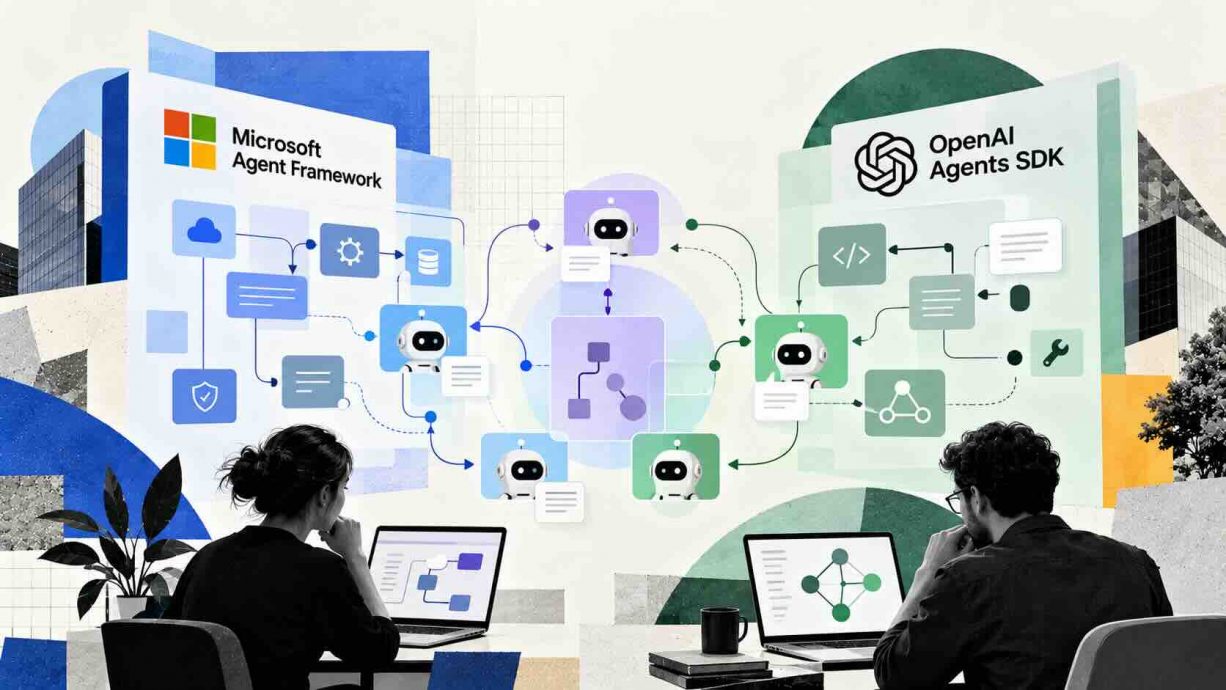
A Microsoft Agent Framework vs OpenAI Agents SDK comparison matters more in late 2026 than a year ago, because both toolkits now ship production-grade runtimes. Gartner predicted in June 2025 that over 40% of agentic AI projects will be canceled by the end of 2027. Framework choice is one of the few early decisions that is genuinely expensive to reverse. Microsoft’s toolkit reached version 1.0 in April 2026 as the successor to Semantic Kernel and AutoGen, while OpenAI added a model-native harness and sandboxes on April 15, 2026. The two projects start from opposite philosophies, with Microsoft favoring explicit graph workflows and OpenAI favoring a small set of primitives wrapped around a model-driven loop. This article walks through both toolkits one primitive at a time, using vendor documentation, verified customer stories, and side-by-side code to keep the analysis grounded. You will also find an interactive fit finder, an embeddable chart, a ten-dimension comparison table, and a decision framework you can apply to your own team. By the end, this Microsoft Agent Framework vs OpenAI Agents SDK comparison should leave you able to defend a choice to your architects, your security reviewers, and your finance team.
Quick Answers on Microsoft Agent Framework and OpenAI Agents SDK
Which is better, Microsoft Agent Framework or the OpenAI Agents SDK?
In a Microsoft Agent Framework vs OpenAI Agents SDK comparison, Microsoft wins for explicit workflows, checkpointing, and .NET or Azure shops, while OpenAI wins for lean, GPT-centric agents with handoffs, guardrails, and built-in tracing.
Can the OpenAI Agents SDK use models from other providers?
Yes. The SDK is provider-agnostic through its model interface, with LiteLLM and Any-LLM adapters available, although OpenAI’s Responses API remains the primary path and hosted tools tie you to OpenAI.
Does Microsoft Agent Framework only work on Azure?
No. Version 1.0 connects to Microsoft Foundry, Azure OpenAI, OpenAI, Anthropic Claude, Amazon Bedrock, Google Gemini, and Ollama in .NET and Python, though hosted deployment options lean toward Azure.
Key Takeaways
- Microsoft Agent Framework reached 1.0 in April 2026 with graph workflows, checkpointing, and five orchestration patterns for .NET and Python developers.
- The OpenAI Agents SDK stays deliberately small, built on agents, handoffs, guardrails, sessions, and tracing, and it gained native sandbox execution in April 2026.
- Choose Microsoft for durable, auditable, multi-step business processes on Azure, and choose OpenAI for fast, model-driven agents where GPT sits at the center.
- Neither toolkit removes the need for evaluation, human approval, and a portable architecture, since Gartner expects over 40% of agentic projects to be canceled by 2027.
Table of contents
- Introduction
- Quick Answers on Microsoft Agent Framework and OpenAI Agents SDK
- Key Takeaways
- What Is the Real Difference Between These Two Agent Toolkits?
- Origins and Current Status of Both Toolkits
- Design Philosophy: Graph Workflows Versus a Lean Agent Loop
- Core Building Blocks Compared Primitive by Primitive
- Multi-Agent Orchestration Patterns in Practice
- State, Memory, and Durable Execution
- Tools, MCP, and Protocol Support
- Guardrails, Middleware, and Safety Controls
- Observability and Tracing Compared
- Model and Provider Flexibility Beyond the Home Cloud
- Sandboxes, Harnesses, and Long-Running Agents
- Turning to Implementation: The Same Support Triage Agent in Each Toolkit
- Deployment, Hosting, and Cost Considerations
- Language Support, Ecosystem, and Developer Experience
- Where Each Toolkit Falls Short: Risks and Lock-In
- Ethics, Governance, and Human Oversight
- A Decision Framework for Agent Buyers
- Migration Paths From Semantic Kernel, AutoGen, and Swarm
- The Future of Agent SDKs Through 2027
- Key Insights
- Examples in Practice: Teams Shipping Agents on Each Stack
- Case Studies and Lessons From Production Deployments
- Frequently Asked Questions on Microsoft Agent Framework vs OpenAI Agents SDK
What Is the Real Difference Between These Two Agent Toolkits?
A Microsoft Agent Framework vs OpenAI Agents SDK comparison weighs two open-source toolkits for building LLM agents: Microsoft’s graph-workflow framework for .NET and Python, and OpenAI’s lightweight handoff-and-guardrail SDK, judged on orchestration, state, tooling, safety, deployment, and lock-in.
An Interactive From AIplusInfo
Which agent toolkit fits your team?
Set your stack and priorities to see how Microsoft Agent Framework and the OpenAI Agents SDK score against each other.
.NET and Azure estate
6 of 10
4 of 10
5 of 10
Microsoft Agent Framework fit
0
OpenAI Agents SDK fit
0
Scores are a heuristic built from the capabilities documented in this article, not a benchmark. For context, Gartner expects over 40% of agentic AI projects to be canceled by the end of 2027, so validate any result with a pilot.
Origins and Current Status of Both Toolkits
Microsoft announced its framework on October 1, 2025, describing it as a convergence of AutoGen, a Microsoft Research project, and Semantic Kernel, the company’s enterprise SDK. The release candidate followed in February 2026 with a promise that the API surface was stable. Version 1.0 shipped in early April 2026 for both .NET and Python under the MIT license. Microsoft positions the project as the successor to both predecessors and publishes migration guides for teams still running either one. That lineage explains why the toolkit inherits enterprise features such as middleware, telemetry, and typed state.
The OpenAI Agents SDK arrived on March 11, 2025 alongside the Responses API, and OpenAI described it as a significant evolution of its experimental Swarm project. It is also MIT licensed, ships first in Python with a JavaScript and TypeScript sibling, and has attracted roughly 28.6 thousand GitHub stars at the time of writing. On April 15, 2026, OpenAI announced a model-native harness and native sandbox execution, with Python available first and TypeScript planned for a later release. The SDK’s history is a story of steady additions to a deliberately small core rather than a rewrite. Developers who adopted the original handoff and guardrail primitives can therefore upgrade without relearning the basics.
Status as of September 2026 favors neither side outright, since both projects are past their first year and both now ship a supported runtime for long tasks. Microsoft’s Agent Harness and Foundry Hosted Agents reached general availability after the Build conference in early June 2026, and the main repository shows about 12.6 thousand stars. The gap in stars reflects the age and audience of each project more than its quality, because Microsoft’s framework only launched in October 2025 and targets enterprise teams. Buyers should also read the broader story of how Microsoft and OpenAI collaborate and compete, since the two companies are partners on models and rivals on developer tooling. Treat the star counts as a popularity signal only, and weigh release cadence, documentation depth, and vendor support more heavily.
Design Philosophy: Graph Workflows Versus a Lean Agent Loop
Turning to design, Microsoft describes its framework as combining AutoGen’s simple agent abstractions with Semantic Kernel’s enterprise features, then adding graph-based workflows for explicit multi-agent orchestration. Its documentation draws a clear line between agents and workflows, recommending an agent when the task is open-ended and a workflow when the process has well-defined steps. An agent handles a single conversation or task with tools, while a workflow connects agents and plain functions through explicit execution paths that you draw as a graph. This split is the heart of the whole debate, because it decides who is in charge of control flow. In Microsoft’s model, the developer owns the flow whenever the process matters.
OpenAI takes the opposite bet, and its documentation says the SDK balances enough features to be worth using with few enough primitives to stay quick to learn. The core concepts are agents, which are models equipped with instructions and tools, plus handoffs for delegation and guardrails for validation. A built-in run loop keeps calling the model and executing tools until the task is complete, so the model itself decides the next step. There is no graph to draw, which lowers the barrier for a first prototype and keeps a small agent readable in a few dozen lines. The trade-off is that control flow lives inside model behavior rather than in code you can diagram.
The consequences show up quickly in testing and in daily operations. A graph-based workflow is easier to unit test because each executor is a node with defined inputs and outputs, and a failed run can be replayed from a checkpoint. A model-driven loop is easier to extend because adding a specialist is often a matter of adding one more agent to a handoff list. Explicit graphs buy predictability, while model-driven loops buy speed of iteration, and neither is free. Teams should decide which failure they fear more, a rigid process that cannot adapt or a flexible agent that wanders off the intended path.
Real projects rarely sit at either extreme, and both toolkits acknowledge that. Microsoft lets you place agents inside workflow nodes and expose whole workflows as agents, so a graph can contain open-ended reasoning where it helps. OpenAI lets you wrap specialist agents as tools, so a manager agent can call them in a fixed order when you prompt it to do so. For readers who want context on the wider field, the site’s comparison of LangGraph, CrewAI, and AutoGen shows how the graph-versus-loop split predates both toolkits. The practical takeaway is to prototype the riskiest business step in both styles before committing the whole roadmap.
Core Building Blocks Compared Primitive by Primitive
Stepping back to the vocabulary, Microsoft organizes its framework around four components: agents, a harness agent, workflows, and integrations. The harness agent is an opinionated agent for long tasks, bundling planning, todo tracking, context compaction, file access, memory, and tool approval. Integrations cover model providers, tools, context providers, middleware, and user interface frameworks, so most extension work happens at that layer. The OpenAI Agents SDK maps the same territory with agents, tools, handoffs, guardrails, sessions, tracing, sandbox agents, and realtime voice agents. Its documentation home lists these as the primary concepts, and each one maps to a small module rather than a separate subsystem.
Laying the two vocabularies side by side shows where the real differences sit, and every serious head-to-head should include this mapping. Microsoft has workflows and OpenAI has none, while OpenAI has first-class voice pipelines that Microsoft’s four components do not list. Guardrails in OpenAI correspond loosely to middleware in Microsoft, though the two work at different layers of the call stack. Sessions in OpenAI correspond to sessions, memory providers, and checkpoints in Microsoft, depending on whether you mean chat history or workflow state. Using this mental translation table, an architect can read either toolkit’s documentation and find the equivalent concept in the other within a few minutes.
Multi-Agent Orchestration Patterns in Practice
In practice, orchestration is where the two toolkits diverge most visibly, and Microsoft ships the richer catalog. Its orchestration documentation lists five built-in patterns: sequential, concurrent, handoff, group chat, and Magentic. Sequential runs agents one after another, concurrent runs them in parallel, and handoff transfers control based on context or expertise. Group chat places agents in a shared conversation, while Magentic uses a manager agent that dynamically coordinates specialists. Because these patterns are prebuilt on top of the workflow engine, a team can adopt one, inspect the resulting graph, and then customize the edges when requirements change.
OpenAI offers two composition mechanisms rather than a catalog, and they are handoffs and agents as tools. A handoff is exposed to the model as a tool, so transferring to a refund specialist appears as a call to a function named after that agent. Control moves entirely to the receiving agent, the full conversation history is passed along by default, and everything stays inside a single run. Agents used as tools behave differently, because a nested specialist handles a structured subtask while the calling agent keeps overall control of the conversation. Choosing between a handoff and an agent-as-tool is the most important design decision in an OpenAI multi-agent system. A handoff suits open-ended routing, and an agent-as-tool suits a bounded delegated task.
Both models have sharp edges worth knowing before you build. OpenAI’s handoff input filters let you trim or summarize the history that the next agent sees, and a nested-history option is available as an opt-in beta. Input guardrails fire only for the first agent in a chain, and output guardrails fire only for the last. A middle agent can therefore act without a check unless you add tool guardrails. Microsoft’s patterns are heavier to configure, yet they share the workflow engine’s checkpointing and visualization. For deeper background on coordination strategies, see the site’s article on hierarchical coordination in multi-agent tasks, which explains why manager-style patterns like Magentic scale differently from flat handoffs.
State, Memory, and Durable Execution
Moving on to durability, Microsoft’s workflow engine saves state at the end of each superstep, which is one execution cycle across the graph. A checkpoint captures the state of every executor, the pending messages for the next superstep, pending requests and responses, and shared state. Three storage providers are built in: an in-memory store for tests, a file store for local development, and a Cosmos DB store for production and distributed workflows. Starting in Python 1.13.0, the framework also writes entry checkpoints before the first superstep and when responses to request events arrive, which makes runs fully replayable. That level of durability is a genuine advantage for long-running business processes.
Checkpoints come with rules that teams should respect from the first day. A workflow rehydrated into a new instance must have the same topology and the same executor identities as the original, so stable agent identifiers are mandatory in C#. Microsoft also warns that checkpoint storage is a trust boundary, which means you should never load checkpoints from untrusted sources and should whitelist any custom types. A checkpoint is executable state, so treat the storage location with the same care as a production database credential. These caveats are not flaws, but they do add operational work that a simple chat-history store would not require.
OpenAI approaches state through sessions, a persistent memory layer that maintains conversation history across runs. The documented backends include SQLite in file or in-memory form, an async SQLite variant, Redis, SQLAlchemy, and MongoDB. Dapr, OpenAI’s server-managed Conversations API, an advanced SQLite session with branching, and an encryption wrapper round out the list. A compaction session wraps any backend and calls the Responses API to shrink long histories automatically after each turn. The April 2026 sandbox update adds snapshotting and rehydration for workspaces, which gives long-running coding or file tasks a form of durable execution. For a broader treatment of the underlying concepts, read the site’s explainer on AI agent memory architecture before choosing between conversation memory and workflow state.
Tools, MCP, and Protocol Support
Beyond orchestration, both toolkits treat tools as the way agents touch the outside world, and both support the Model Context Protocol. Microsoft’s release post lists MCP for dynamic tool discovery, the Agent-to-Agent protocol for cross-runtime collaboration, and AG-UI style adapters for front ends. OpenAI’s SDK turns any Python function into a tool with automatic schema generation and can expose remote MCP tools to an agent. Hosted tools such as web search and code interpretation are also available through OpenAI’s platform, and they run on OpenAI’s infrastructure rather than yours. Developers who want the practical picture of how MCP changes daily work can read the site’s piece on how AI supercharges the MCP developer workflow.
Protocol breadth is where Microsoft currently leads on paper, especially for cross-vendor interoperability. Support for the Agent-to-Agent protocol means a Microsoft agent can collaborate with agents built on entirely different runtimes. OpenAI’s approach is more product-centered, with strong first-party tools and a growing ecosystem of partner tools, such as wallet and payment kits that shipped on launch day. Neither position is universally better, because open protocols reduce lock-in while first-party tools reduce integration work. If your roadmap includes an open agent web, the discussion of Microsoft’s push for open agents offers useful strategic context.
Guardrails, Middleware, and Safety Controls
Shifting focus to safety, OpenAI’s SDK provides three guardrail categories: input guardrails, output guardrails, and tool guardrails. Input guardrails run on the initial user message and support two modes, parallel by default and blocking when you need to prevent wasted tokens or side effects. Output guardrails run only after the final agent finishes, so they cannot execute in parallel with generation. Each guardrail signals failure through a tripwire that raises a specific exception and halts the run immediately. Rejected terminal tool output is replaced with a fixed withheld message instead of reaching the user. That vocabulary is compact and easy to teach, which is exactly the point of a small SDK.
Microsoft answers the same need with middleware, which is broader but less prescriptive. The framework supports three middleware types that intercept agent runs, function calls, and calls to the underlying chat client. Middleware forms a chain in which each layer receives a next function, so a layer can log, validate, transform, or terminate a function-calling loop early. Common uses include logging, security validation for sensitive data, error handling, and result transformation. Middleware gives you a general interception point, while guardrails give you a purpose-built validation primitive with tripwires. Neither is strictly better, though guardrails are faster to adopt and middleware is easier to reuse across projects.
Every safety design has coverage gaps, and the documentation is candid about them. OpenAI states that input and output guardrails run only on the first and last agents, and that tool guardrails do not apply to hosted tools or handoffs. A multi-agent chain that relies on hosted web search or code execution therefore needs its own controls at the platform boundary. Microsoft’s middleware sees every layer you register, yet you must write the policy logic yourself. For a deeper view of why probabilistic checks alone are not enough, read the site’s guide to deterministic guardrails for AI agents and pair it with hard permission limits.
Observability and Tracing Compared
Looking at observability, the OpenAI Agents SDK traces by default, wrapping every run in a trace named “Agent workflow” unless you rename it. The trace captures agent runs, model generations, function calls, guardrails, handoffs, and even audio transcription and speech synthesis. You can disable tracing with an environment variable, a function call, or a per-run configuration flag. Tracing is unavailable for organizations operating under a Zero Data Retention policy, which is a real constraint for regulated industries. The tracing documentation also lists more than 30 vendors that support custom trace processors, including Weights & Biases, Datadog, LangSmith, Langfuse, and MLflow.
Microsoft leans on OpenTelemetry, the vendor-neutral standard, and builds it into the framework and the harness by default. Workflow spans, metrics, events, and delivery status can be exported, and workflow topology can be rendered and exported for review. A browser-based DevUI debugger, which shipped as a preview feature at 1.0, visualizes execution flows during development. The practical difference is that OpenAI gives you an opinionated, zero-setup trace viewer tied to its platform. Microsoft gives you standard telemetry that flows into whatever backend your operations team already runs. Whichever you pick, tracing only becomes useful when paired with evaluation, and the site’s article on how to measure AI agent performance explains which metrics deserve dashboards.
Model and Provider Flexibility Beyond the Home Cloud
Given the pace of model releases, provider flexibility deserves more weight than most feature checklists give it. Microsoft’s 1.0 release lists connectors for Microsoft Foundry, Azure OpenAI, OpenAI, Anthropic Claude, Amazon Bedrock, Google Gemini, and Ollama. That is seven named providers across .NET and Python, and it means a team can run the same agent logic against a hosted frontier model or a local model. Foundry sits at the center of Microsoft’s own examples, and the documentation samples authenticate with Azure identity, so the path of least resistance is Azure. Even so, nothing in the framework itself forces Azure hosting.
OpenAI’s SDK is optimized for OpenAI models through the Responses API, and that is where new features land first. Non-OpenAI providers are supported through a model interface, and LiteLLM and Any-LLM adapters extend the reach to many others. The catch is that hosted tools and several platform features remain tied to OpenAI’s infrastructure. An agent that uses hosted web search or code interpretation cannot be moved to another provider without replacing those tools. The Python repository documents the adapters, and teams should test tool calling and structured output on any non-OpenAI model before trusting it.
Provider choice ultimately becomes a lock-in question, and the answer depends on what you are locking in. Model lock-in is manageable in both toolkits, because a thin adapter layer isolates the model call from business logic. Platform lock-in is harder to unwind, because tracing, hosted tools, checkpoint stores, and hosting targets each attach to a vendor’s cloud. The site’s analysis of vendor lock-in in agentic AI platforms offers a useful checklist for scoring that exposure. A sound rule is to keep prompts, tools, and evaluation datasets in portable formats, then treat the framework as a replaceable runtime.
Sandboxes, Harnesses, and Long-Running Agents
On top of loops and graphs, 2026 brought a third layer: the harness and the sandbox. OpenAI’s April 15, 2026 announcement introduced a model-native harness for working across files and tools, plus native sandbox execution in controlled environments. Supported sandbox providers include Blaxel, Cloudflare, Daytona, E2B, Modal, Runloop, and Vercel, and storage integrations cover AWS S3, Google Cloud Storage, Azure Blob Storage, and Cloudflare R2. A manifest abstraction makes workspaces portable, and built-in snapshotting and rehydration support durable execution when a container dies. OpenAI product team member Karan Sharma summarized the release as making the existing SDK compatible with all sandbox providers.
The harness ships with shell and apply-patch tools, skills for progressive disclosure, MCP tool use, and support for AGENTS.md custom instructions. In the Python docs, a sandbox agent is a distinct class, with local Unix and Docker clients plus additional clients for hosted providers. A sandbox agent is the right choice whenever an agent must inspect files, run commands, or apply patches over many steps. Python arrived first, while TypeScript support was described as planned, although the current TypeScript documentation already carries guides for sandbox agents. OpenAI has also said code mode and subagents are planned for both languages.
Microsoft’s counterpart is the Agent Harness, which reached general availability together with Foundry Hosted Agents after the June 2026 Build conference. InfoQ’s report lists the default features, starting with function invocation, per-call history persistence, and context compaction. Others include a todo list with plan and execute modes, file memory, skills, web search, tool approval, and built-in OpenTelemetry. Optional capabilities such as shell tooling, file access, background sub-agents, and automatic looping carry explicit warnings. Connectors exist for the GitHub Copilot SDK and the Claude Agent SDK, so the harness can wrap other vendors’ coding agents. Foundry Hosted Agents provide a managed deployment target with consumption-based billing.
The two designs make different bets about where isolation should live. OpenAI pushes isolation outward to third-party sandbox providers and lets you pick among seven, which suits teams already invested in Modal, E2B, or Cloudflare. Microsoft pushes isolation toward its own hosting layer and its approval controls, which suits teams that want one vendor accountable for the runtime. InfoQ also cites research suggesting that roughly 98.4% of an agent codebase is harness infrastructure rather than model logic. If that ratio holds, a mature harness may matter more to your delivery speed than any single orchestration primitive, so evaluate it as carefully as you would a database.
Turning to Implementation: The Same Support Triage Agent in Each Toolkit
Turning to implementation, consider a support desk in which a triage agent routes messages to billing and refund specialists. In OpenAI’s SDK, the design is compact because handoffs are declared as a list on the triage agent. The snippet below adapts the samples from the handoffs documentation into a small runnable example. Install the package first, then define two specialists and pass one directly and one wrapped in the handoff helper. The model decides at run time whether a customer message belongs to billing or refunds.
pip install openai-agentsfrom agents import Agent, Runner, handoff
billing_agent = Agent(
name="Billing agent",
instructions="Resolve invoice and payment questions.",
)
refund_agent = Agent(
name="Refund agent",
instructions="Handle refund requests under company policy.",
)
triage_agent = Agent(
name="Triage agent",
instructions="Route each customer message to the right specialist.",
handoffs=[billing_agent, handoff(refund_agent)],
)
result = Runner.run_sync(triage_agent, "I was charged twice for order 1042.")
print(result.final_output)Under the hood, each handoff becomes a tool the model can call, named after the receiving agent. Control transfers fully to the specialist, and the run continues inside the same trace, so you can inspect the routing decision afterward. The entire routing layer is roughly a dozen lines, which is the SDK’s strongest selling point for a first prototype. Adding a new specialist means adding one more agent to the list and adjusting the instructions. What you do not get is a guarantee that the model always routes correctly, so add evaluation cases for ambiguous messages before going live.
Microsoft’s version starts with the agent object, which the overview documentation shows built from a chat client, a name, and instructions. Install the Python package, then create one agent per role with a small helper. The helper keeps model configuration in one place, so changing the model or credential touches a single line. In a real deployment you would connect the agents through a workflow with a handoff or sequential orchestration, then attach a checkpoint store so that a crashed run can resume. The second snippet shows the documented checkpoint pattern in isolation, and it omits the executor definitions for brevity.
pip install agent-frameworkfrom agent_framework import Agent
from agent_framework.foundry import FoundryChatClient
from azure.identity import AzureCliCredential
def make_agent(name: str, instructions: str) -> Agent:
return Agent(
client=FoundryChatClient(
project_endpoint="https://your-foundry-service.services.ai.azure.com/api/projects/your-foundry-project",
model="gpt-5.4-mini",
credential=AzureCliCredential(),
),
name=name,
instructions=instructions,
)
billing = make_agent("Billing", "Resolve invoice and payment questions.")
refunds = make_agent("Refunds", "Handle refund requests under company policy.")
# result = await billing.run("I was charged twice for order 1042.")from agent_framework import InMemoryCheckpointStorage, WorkflowBuilder
checkpoint_storage = InMemoryCheckpointStorage()
builder = WorkflowBuilder(start_executor=start_executor, checkpoint_storage=checkpoint_storage)
builder.add_edge(start_executor, executor_b)
workflow = builder.build()
checkpoints = await checkpoint_storage.list_checkpoints(workflow_name=workflow.name)Comparing the two listings, the OpenAI version is shorter, while the Microsoft version exposes the seams where production concerns attach. Authentication, model endpoints, and checkpoint storage are explicit, which adds lines but also adds places to enforce policy. For a step-by-step build of your own agent, the site’s tutorial on building custom AI agents for workflow automation covers the surrounding process design. When you run your own bake-off, measure lines of code, time to first working demo, and time to add the second and third specialists. Those three numbers reveal far more than a feature matrix ever will.
Deployment, Hosting, and Cost Considerations
Moving on to hosting, both toolkits are free open-source libraries, so the real bill comes from models, infrastructure, and the people who operate them. OpenAI states that the updated Agents SDK is available to all API customers at standard pricing based on tokens and tool use. Sandbox execution runs on a provider you choose, so container time is likely a separate line item to model before launch. Microsoft’s framework is likewise free under the MIT license, and its costs arrive through model usage, Cosmos DB checkpoint storage, and consumption-based billing for Foundry Hosted Agents. Neither vendor publishes a single all-in price for a production agent, which makes a small pilot the only reliable way to forecast spend.
Token cost dominates most agent budgets, and framework design influences it more than people expect. A handoff-heavy system passes full conversation history to each receiving agent by default, so long chats multiply input tokens unless you filter history. OpenAI’s session compaction wrapper reduces that burden by summarizing older turns through the Responses API. Any agent design that passes unfiltered history between specialists will quietly multiply token spend as conversations grow. Microsoft’s harness offers context compaction as a default feature, and its graph structure lets you scope exactly which messages travel along each edge.
Pricing models for agent products are shifting quickly, and framework cost is only one component of the total. Teams that plan to resell or embed agents should read the site’s analysis of how AI agent pricing is evolving before fixing a unit-economics assumption. Model the cost per resolved task rather than cost per call, since retries, guardrail calls, and evaluation runs all consume tokens. Include the price of observability storage and the engineering hours needed to maintain adapters. A comparison that stops at license fees will understate the true difference by a wide margin.
Language Support, Ecosystem, and Developer Experience
Looking at developer experience, Microsoft offers first-class .NET and Python packages, installed with the NuGet package Microsoft.Agents.AI or the PyPI package agent-framework. Its overview page also notes a Go version in public preview, with declarative agents, retrieval, CodeAct, and functional workflows not yet available there. The main repository shows about 12.6 thousand stars, and the documentation lives on Microsoft Learn with samples in both languages. If your engineering organization writes C# for its core services, Microsoft’s toolkit is the only one of the two with a first-class native path. That alone can decide the question for banks, insurers, and manufacturers with large .NET estates.
OpenAI’s Python SDK is the reference implementation, and the TypeScript counterpart covers the same primitives for JavaScript and TypeScript teams. The TypeScript documentation includes guides for sandbox agents, human-in-the-loop flows, and realtime voice agents with WebSocket and WebRTC transports. It also lists extensions for Cloudflare and Twilio, which suits edge and telephony deployments. The documentation describes Python and TypeScript paths for OpenAI’s SDK, so JVM shops should confirm current support or call the underlying APIs directly. Developer experience also depends on how quickly you can debug, and here OpenAI’s built-in trace viewer and Microsoft’s DevUI preview both shorten the loop.
Where Each Toolkit Falls Short: Risks and Lock-In
Despite the momentum behind both projects, neither is risk-free, and the risks differ in kind. Microsoft’s framework is newer as a unified project, and several capabilities were still in preview when 1.0 shipped, including the DevUI debugger, skills, and the agent harness. Public production numbers for the framework itself are scarce, and much of the vivid customer material still describes Semantic Kernel, its predecessor. The Go version lacks features present in .NET and Python, and durable workflows introduce checkpoint stores that you must secure and version. Microsoft’s biggest risk is complexity, because a graph engine, middleware, memory providers, and hosting options give teams many places to make expensive mistakes.
OpenAI’s SDK risks look different and center on platform coupling and coverage gaps. Hosted tools tie you to OpenAI’s infrastructure, tracing is unavailable under Zero Data Retention, and tool guardrails do not cover hosted tools or handoffs. Sandbox and harness features arrived in Python before TypeScript, so polyglot teams may wait for parity. A model-driven loop also means control flow can drift, which raises evaluation costs as agent count grows. The site’s overview of securing the age of agentic AI explains how to layer permissions and monitoring around either runtime.
Both toolkits also inherit an industry-wide risk, which is hype outrunning delivery. Gartner has warned that many vendors engage in agent washing, and it estimates that only about 130 of thousands of agentic vendors offer genuine capabilities. That warning applies to internal projects as well, since a demo that impresses executives can hide brittle behavior under real traffic. The site’s discussion of navigating the hype of agentic AI is a useful reality check before committing budget. Set explicit success metrics, define an exit plan, and keep the framework behind an interface so that switching costs stay bounded.
Ethics, Governance, and Human Oversight
Stepping back from mechanics, ethics in agent frameworks comes down to who can stop an agent, who can see what it did, and who answers when it errs. Microsoft’s harness includes tool approval by default and marks shell access and background sub-agents as optional features with warnings. OpenAI’s SDK includes human-in-the-loop mechanisms that pause execution for approval, and its sandbox design limits what a code-executing agent can reach. Approval steps are only meaningful if reviewers see enough context to decide, so design the approval screen with the same care as the agent. Traces and checkpoints supply the audit trail, though you must retain them long enough to satisfy your regulators.
Governance also extends beyond the framework to the fleet of agents an organization runs. Microsoft’s broader platform adds fleet-level management and governance controls, which the site covered in its piece on Microsoft Agent 365 and enterprise agent governance. OpenAI’s tooling emphasizes policy-based refusals and logging at the API level, and its API lead has cited SOC 2 logging and data residency support for enterprise customers. Both approaches raise the same open questions about liability, consent for data used in agent memory, and the right to human review of consequential decisions. Treat those questions as design inputs from the first sprint, not as legal cleanup before launch.
A Decision Framework for Agent Buyers
For teams choosing between the two toolkits, a weighted framework beats intuition, and it starts with five questions. First, which language and cloud does your core engineering organization already run. Second, how important is durable, auditable, multi-step process control compared with flexible model-driven routing. Third, do your agents need sandboxed code execution or file manipulation. Fourth, how much provider independence do you need over the next three years. Fifth, what compliance rules govern traces, retention, and human approval? Scoring each question from zero to five for each toolkit turns a vague debate into a defensible record.
Applying that framework, a few patterns emerge from the documentation and the customer evidence. Choose Microsoft when your estate is .NET or Azure, when processes must be replayable from checkpoints, or when you already run AutoGen or Semantic Kernel. Choose OpenAI when GPT models are your center of gravity, when you want the smallest path to a prototype, or when voice and sandboxed coding agents matter. In a Microsoft Agent Framework vs OpenAI Agents SDK comparison, the deciding factor is usually the shape of the process, not the raw capability. Structured, repeatable, regulated processes favor graphs, while exploratory, conversational, tool-rich tasks favor loops.
Mixed strategies deserve a serious look, because the two toolkits are not mutually exclusive. Microsoft’s framework connects to OpenAI models directly, and OpenAI’s SDK can run behind services written in any stack. Many organizations will end up with a graph-based backbone for governed processes and lightweight agents for exploratory work. That pattern mirrors the split the site describes in domain-specific agents versus general agents, where narrow agents earn trust and broad agents earn flexibility. Whatever you choose, document the decision, the alternatives considered, and the conditions under which you would revisit it.
Finally, run a time-boxed bake-off before signing any long commitment. Build the same two workflows in both toolkits: one governed process with approval and one open-ended research task. Measure development time, defects found in evaluation, token cost per resolved task, and the effort required to add a new tool. Have a security reviewer read the traces and checkpoints produced by each run. Two weeks of disciplined comparison will settle most arguments that months of slideware cannot.
Migration Paths From Semantic Kernel, AutoGen, and Swarm
Moving on to migration, Microsoft’s release candidate announcement positions the framework as the successor to Semantic Kernel and AutoGen, with detailed migration guides for both. The migration story is strongest for teams already inside Microsoft’s ecosystem, because concepts from both predecessors have documented equivalents in the migration guides. Semantic Kernel users gain workflows and standardized protocol support, while AutoGen users gain the enterprise features that the research project lacked. Plan the migration as a strangler pattern, moving one agent or workflow at a time behind a stable interface. Freeze new feature work on the old stack once the first migrated service reaches production.
OpenAI’s lineage is shorter and simpler, since the Agents SDK grew out of Swarm and kept its handoff idea. Teams that prototyped with Swarm can map agents and handoffs directly, then add guardrails, sessions, and tracing as needed. Moving between the two toolkits is harder than either upgrade path, because graph nodes and model-driven handoffs are different mental models. The cheapest insurance against a future migration is keeping tools as standalone functions or MCP servers that either toolkit can call. Keep prompts and evaluation sets in version control, and record the expected behavior of each agent in tests that do not depend on framework internals.
The Future of Agent SDKs Through 2027
Looking ahead, the most likely path is convergence on shared protocols and a shared runtime shape. Both toolkits already support the Model Context Protocol, and Microsoft’s release also backs the Agent-to-Agent protocol, which points toward agents from different vendors collaborating. Microsoft first described that ambition in its October 2025 announcement, which featured KPMG, Commerzbank, Citrix, TCS, and Sitecore among its customers. The harness and sandbox pattern is spreading too, since each vendor now ships a supported runtime for long tasks. Expect the differences between the toolkits to narrow on features and widen on ecosystem, hosting, and governance.
Several concrete roadmap items are already public in vendor announcements and documentation. OpenAI has said that code mode and subagents are planned for both Python and TypeScript, and TypeScript is closing the gap on sandbox support. Microsoft listed skills and the DevUI debugger as preview features at 1.0, and its Go version is still maturing toward parity. Gartner projects that 33% of enterprise software applications will include agentic AI by 2028, up from less than 1% in 2024. Demand for agent frameworks will grow faster than best practices for operating them, which is where careful buyers gain an edge.
For readers deciding today, the practical conclusion of this Microsoft Agent Framework vs OpenAI Agents SDK comparison is to choose for your constraints and hedge for change. Pick Microsoft if your world is .NET, Azure, and governed workflows, and pick OpenAI if your world is GPT, speed, and sandboxed task agents. Isolate business logic, keep tools portable, and treat every framework as a replaceable layer. Revisit the decision after each vendor’s next major release, because both roadmaps are moving faster than annual planning cycles. Teams that keep their architecture flexible will be able to adopt whichever toolkit proves better in production.
Chart From AIplusInfo
Community size and documented surface area of two agent toolkits
GitHub stars in thousands, at the time of writing.
Microsoft Agent FrameworkOpenAI Agents SDK
Source: OpenAI Agents SDK repository and Microsoft Agent Framework repository, retrieved September 2026.
Key Insights
- Gartner expects over 40% of agentic AI projects to be canceled by the end of 2027, so framework choices should stay reversible and be judged on business outcomes early.
- Gartner also projects that 33% of enterprise software applications will include agentic AI by 2028, up from under 1% in 2024, so demand for agent tooling is climbing steeply.
- Microsoft's 1.0 release supports seven named model providers and five orchestration patterns, giving .NET and Python teams broad flexibility without forcing a single cloud.
- OpenAI's April 2026 update named seven sandbox providers, from Blaxel to Vercel, which shifts isolation and cost decisions outward to specialist infrastructure vendors.
- The tracing documentation lists more than 30 vendors that support custom trace processors, so observability need not lock teams into a single dashboard.
- The Agents SDK documents nine session backends, from SQLite to Dapr and encrypted wrappers, which gives teams a realistic path from local prototypes to shared production memory.
- KPMG's Clara AI platform serves 95,000 auditors across more than 140 countries, showing that agent architectures on Microsoft's stack can scale to global regulated workloads.
- Gartner estimates that only about 130 of thousands of agentic vendors offer genuine capabilities, so buyers should test any framework claim against their own evaluation data.
Taken together, these figures describe a market where demand is rising fast while delivery discipline lags behind. Microsoft's answer is breadth and control, with many providers, prebuilt orchestration patterns, and durable checkpoints. OpenAI's answer is focus and speed, with a small primitive set, default tracing, and a sandbox runtime supplied by specialist partners. The numbers also show both vendors converging on the same shape, which is a model, a harness, tools, and a safe place to run code. For a buyer, the differentiator is less about any single feature and more about who owns the control flow and who owns the runtime. A sober reading of this Microsoft Agent Framework vs OpenAI Agents SDK comparison suggests piloting both, measuring cost per resolved task, and keeping the architecture portable.
| Dimension | Microsoft Agent Framework | OpenAI Agents SDK |
|---|---|---|
| Primary orientation | Explicit graph workflows plus individual agents | Model-driven agent loop with handoffs |
| Languages | .NET and Python, with Go in public preview | Python and TypeScript |
| Multi-agent orchestration | Sequential, concurrent, handoff, group chat, and Magentic patterns | Handoffs and agents used as tools |
| State and durability | Superstep checkpoints stored in memory, on file, or in Cosmos DB | Sessions across nine backends, plus sandbox snapshots |
| Safety controls | Three middleware types and harness tool approval | Input, output, and tool guardrails plus human in the loop |
| Observability | OpenTelemetry built in, with a DevUI debugger in preview at 1.0 | Default tracing with more than 30 processor vendors, unavailable under Zero Data Retention |
| Model providers | Seven named connectors including Foundry, Bedrock, Gemini, and Ollama | OpenAI first through the Responses API, plus LiteLLM and Any-LLM adapters |
| Long-running agent runtime | Agent Harness and Foundry Hosted Agents, generally available after Build 2026 | Model-native harness and sandbox agents across seven sandbox providers |
| Protocol support | MCP, Agent-to-Agent, and AG-UI adapters | MCP plus first-party hosted tools |
| License and pricing | MIT license; you pay for models, storage, and hosting | MIT license; standard API pricing for tokens and tool use |
Examples in Practice: Teams Shipping Agents on Each Stack
Stripe's Invoice Resolution Agents
Among the most cited production stories for the OpenAI stack is Stripe, which OpenAI's API lead named at VentureBeat Transform in June 2025. Stripe built agents on the Responses API and Agents SDK for invoice resolution, and the company reported 35% faster invoice resolution after deployment. The same interview described sub-agent architectures, built-in tracing, and policy-based refusals as the ingredients that made the results repeatable. The limits were stated openly, because single-agent designs struggle at scale and evaluation remains what OpenAI called probably the biggest bottleneck to adoption. No baseline volume, sample size, or error rate was disclosed. The 35% figure is best read as a directional claim rather than a benchmark. Teams copying the pattern should still budget time for building their own evaluation sets before trusting any vendor benchmark.
Box's Enterprise Search Agents
Box shows how quickly a well-defined agent can reach users when the platform supplies the tools. According to OpenAI's March 11, 2025 launch post, Box deployed agents within days, using web search and the Agents SDK to query unstructured internal data alongside public information. The agents were built to respect enterprise security protocols, which is the main reason a content platform could expose them to customers. VentureBeat later reported that Box reached zero-touch ticket triage with the same stack. Neither source publishes accuracy rates, deflection percentages, or hours saved, so the outcome remains a qualitative success story. The design also still depends on OpenAI's hosted web search, which is a coupling that buyers should price into any portability plan.
Fujitsu's Composite AI on Semantic Kernel
Fujitsu offers the best public numbers from Microsoft's lineage, even though the project predates the unified framework. The company built its Composite AI platform on Semantic Kernel, and it used the system with Nakayama Transportation to cut dispatch planning from several hours to 10 minutes. A separate deployment for Fujitsu's own customer support produced an incident management system that was 25% more efficient than its predecessor, according to the company's case study. Semantic Kernel is now one of the two ancestors of Microsoft Agent Framework, which is why the story matters to buyers evaluating the successor. The article, published on May 21, 2024, does not discuss technical limitations or scalability constraints. Treat the results as evidence about the architecture family, not as a benchmark for version 1.0.
Recommended by AIplusInfo
Books to go deeper on agent design
Hand-picked titles on multi-agent systems, evaluation, and protocols that apply to either toolkit.
As an Amazon Associate, AIplusInfo earns from qualifying purchases.

Book
Building Applications with AI Agents: Designing and Implementing Multiagent Systems
Covers designing, orchestrating, and evaluating multiagent systems, which maps directly to the handoff and workflow choices compared in this article.
Buy on Amazon
Book
AI Engineering: Building Applications with Foundation Models
A practitioner's guide to evaluation, prompt design, and production architecture that applies to any agent framework you choose.
Buy on Amazon
Book
AI Agents in Action, Second Edition: Intelligent workflows with LLMs, MCP, A2A, and more
Walks through building agents with LLMs, MCP, and A2A, the same protocols that both toolkits now support.
Buy on AmazonCase Studies and Lessons From Production Deployments
Case Study: KPMG Clara AI for Global Audit
Beyond the examples above, KPMG faced a scale problem that few enterprises share, with 95,000 auditors across more than 140 countries working from manual documentation and small samples. Traditional audits relied on sampling because reviewing every transaction was impractical, which limited how much risk auditors could see. The firm built KPMG Clara AI as a cloud platform on Azure, combining Azure AI Foundry and Semantic Kernel for agentic capabilities. Cosmos DB handles distributed datasets, while AI Search supports retrieval over documents. Microsoft's customer story also describes planned adoption of Microsoft Agent Framework for multi-agent workflows with open-source connectors. The platform now supports analysis of whole datasets rather than samples, and it automates routine work such as data reconciliation and transaction testing.
The story carries limits that matter for a framework decision. Microsoft's article, dated October 1, 2025, describes Agent Framework as planned rather than deployed, so today's results still rest on Semantic Kernel. KPMG needed to develop new auditor skills in data analysis and technology, and it had to manage distributed datasets across heavily regulated jurisdictions. Enterprise-grade governance and observability were prerequisites for the rollout, not afterthoughts. No efficiency percentage or cost figure was published, which means the headline number is adoption scale rather than measured productivity. The lesson is that regulated firms adopt agent frameworks slowly and place governance ahead of raw capability.
Case Study: Oscar Health's Clinical Records Workflow
Oscar Health faced a familiar healthcare problem, which was extracting reliable metadata and encounter boundaries from long, messy patient files so that care teams could coordinate faster. Those documents mix visits, referrals, and attachments, and a model that cannot separate one encounter from the next produces misleading summaries. OpenAI listed Oscar Health among seven organizations that tested the updated Agents SDK announced on April 15, 2026, alongside Actively, LexisNexis, FurtherAI, Thomson Reuters, Zoom, and Tomoro AI. The team adopted the updated SDK for the extraction steps in that workflow. Staff Engineer Rachael Burns said the update made it production-viable to automate a critical clinical records workflow, according to coverage in AI News.
The evidence here is testimonial rather than statistical, and that is the main limitation. Neither OpenAI nor AI News published a percent improvement, hours saved, or error rate for the clinical workflow. Python was the only language supported for the new harness at launch, so teams on TypeScript had to wait for a later release. Sandbox execution also adds a moving part, since files, snapshots, and provider accounts all need governance in a regulated setting. The takeaway is that sandboxing can move an experimental extraction pipeline toward production, provided the organization supplies its own measurement. Healthcare buyers should demand baseline accuracy and audit results before scaling any similar design.
Case Study: Coinbase AgentKit on Launch Day
Coinbase faced a capability gap that pure language agents cannot fill, because software agents could reason about payments but could not hold wallets or move value on their own. The company built AgentKit as a tool library that gives agents onchain wallet capabilities, and it announced launch-day support for the Agents SDK on March 11, 2025. Coinbase said developers could add the integration in less than 10 minutes by supplying Coinbase and OpenAI API keys. OpenAI's own launch post added that Coinbase prototyped AgentKit into working agents in hours. The tool-library approach shows how a partner can extend an SDK without changes to its core. The wallet address also acts as an identifier that agents can use to discover and interact with each other.
The limits are easy to overlook because the announcement is promotional. Coinbase's page lists no technical limitations and carries only a standard disclaimer about investment risk and regulatory status. The claims about setup time are vendor-authored and were not independently measured. Autonomous payments also raise obvious questions about approval limits, fraud, and liability, which neither company answered in the launch material. The wider lesson is that a small, extensible core lets partners ship fast, while safety controls such as spending caps and human approval must be designed by the adopting team.
Frequently Asked Questions on Microsoft Agent Framework vs OpenAI Agents SDK
Microsoft Agent Framework is an open-source toolkit for building AI agents and multi-agent workflows in .NET and Python. It combines AutoGen's simple agent abstractions with Semantic Kernel's enterprise features, then adds graph-based workflows. Version 1.0 shipped in early April 2026 under the MIT license. Microsoft positions it as the successor to both Semantic Kernel and AutoGen.
The OpenAI Agents SDK is an open-source library for building agents from a small set of primitives: agents, handoffs, guardrails, sessions, and tracing. It launched in March 2025 as an evolution of the experimental Swarm project. Python is the reference implementation, and a JavaScript and TypeScript version exists. An April 2026 update added a model-native harness and native sandbox execution.
It depends on the shape of your process and your existing stack. In this Microsoft Agent Framework vs OpenAI Agents SDK comparison, Microsoft fits governed, replayable workflows on .NET or Azure. OpenAI fits fast, GPT-centric agents, voice, and sandboxed coding tasks. Run a two-week bake-off on your own workloads before committing.
Yes. The 1.0 release includes connectors for OpenAI and Azure OpenAI, alongside Microsoft Foundry, Anthropic Claude, Amazon Bedrock, Google Gemini, and Ollama. That means a team can keep its Microsoft workflow engine while calling models from several vendors. Authentication in Microsoft's samples uses Azure identity, so plan credentials accordingly.
The SDK is a library, so your orchestration code runs wherever your Python or TypeScript application runs. Models from other providers are supported through a model interface, and LiteLLM and Any-LLM adapters extend that reach. Hosted tools such as web search still run on OpenAI's platform. Test tool calling and structured output carefully on any non-OpenAI model.
An OpenAI handoff is exposed to the model as a tool, and control transfers entirely to the receiving agent within one run. Microsoft ships five prebuilt patterns, which are sequential, concurrent, handoff, group chat, and Magentic, all built on its workflow engine. The Microsoft approach gives you a graph you can inspect and checkpoint. The OpenAI approach gives you less code and more model-driven routing.
Microsoft has the more explicit answer, because its workflows save checkpoints at the end of every superstep. Built-in stores cover in-memory, file, and Cosmos DB storage, and a checkpoint can be restored into a new workflow instance with the same topology. OpenAI offers sessions for conversation history and snapshotting for sandbox workspaces. Neither toolkit replaces a proper job queue for business-critical processes.
Yes. Microsoft's release lists MCP for dynamic tool discovery, and OpenAI's SDK can expose remote MCP tools to an agent. Microsoft also supports the Agent-to-Agent protocol for collaboration across runtimes. Keeping tools as standalone functions or MCP servers is the best insurance against switching frameworks later.
Both libraries are open source under the MIT license, so there is no license fee. Your costs come from model tokens, tool usage, storage, and hosting. OpenAI states that the updated SDK is available at standard API pricing based on tokens and tool use. Microsoft's Foundry Hosted Agents use consumption-based billing, and checkpoint storage in Cosmos DB adds its own charges.
Microsoft Agent Framework supports .NET and Python, and a Go version is in public preview with fewer features. The OpenAI Agents SDK supports Python and has a separate JavaScript and TypeScript version. The new harness and sandbox features launched in Python first, although the TypeScript documentation now carries sandbox guides. Check the current documentation for the exact parity you need.
OpenAI guardrails are a purpose-built validation primitive with input, output, and tool variants and tripwire exceptions that halt a run. Microsoft middleware is a general interception chain for agent runs, function calls, and chat client calls. Guardrails are quicker to adopt, while middleware is more flexible and reusable. Both have coverage gaps, so add permission limits and human approval for risky actions.
Microsoft describes the framework as the successor to both projects and publishes detailed migration guides. New projects should generally start on the new framework, since it is where Microsoft's investment is concentrated. Existing production systems can migrate gradually, moving one agent or workflow at a time behind a stable interface. Keep tests independent of framework internals so the move stays low risk.
Yes, and many organizations will end up running both in different corners of the business. A graph-based backbone suits governed processes, while lightweight model-driven agents suit exploratory work. Microsoft's framework can call OpenAI models directly, and OpenAI's SDK can run behind services written in any stack. Standardize on shared tools, evaluation datasets, and observability so that neither team is locked into one runtime.