
Introduction
Enterprise teams are shipping autonomous software faster than they are shipping the controls that contain it. Gartner predicts that over 40 percent of agentic AI projects will be canceled by the end of 2027, citing inadequate risk controls alongside cost. That failure mode is rarely a model quality problem, and it is rarely a prompt engineering problem either. It is a containment problem, which is exactly what deterministic guardrails for AI agents are built to solve. A deterministic control evaluates the same input and returns the same verdict every single time it runs. That property is what lets a security team, an auditor, and a regulator agree on what an agent can do. This guide covers the architecture, the policy languages, the failure modes, and the measured cost of that enforcement layer.
Quick Answers on Deterministic Guardrails for Agents
What are deterministic guardrails for AI agents?
Deterministic guardrails for AI agents are rule based controls that evaluate every agent action against fixed policy and return the same allow or deny verdict each time.
How do they differ from model based safety filters?
Model based filters score text probabilistically and can be argued out of a decision. Deterministic guardrails compile to code paths that either permit or block an agent action, with no confidence score involved.
Where do deterministic guardrails run inside an agent system?
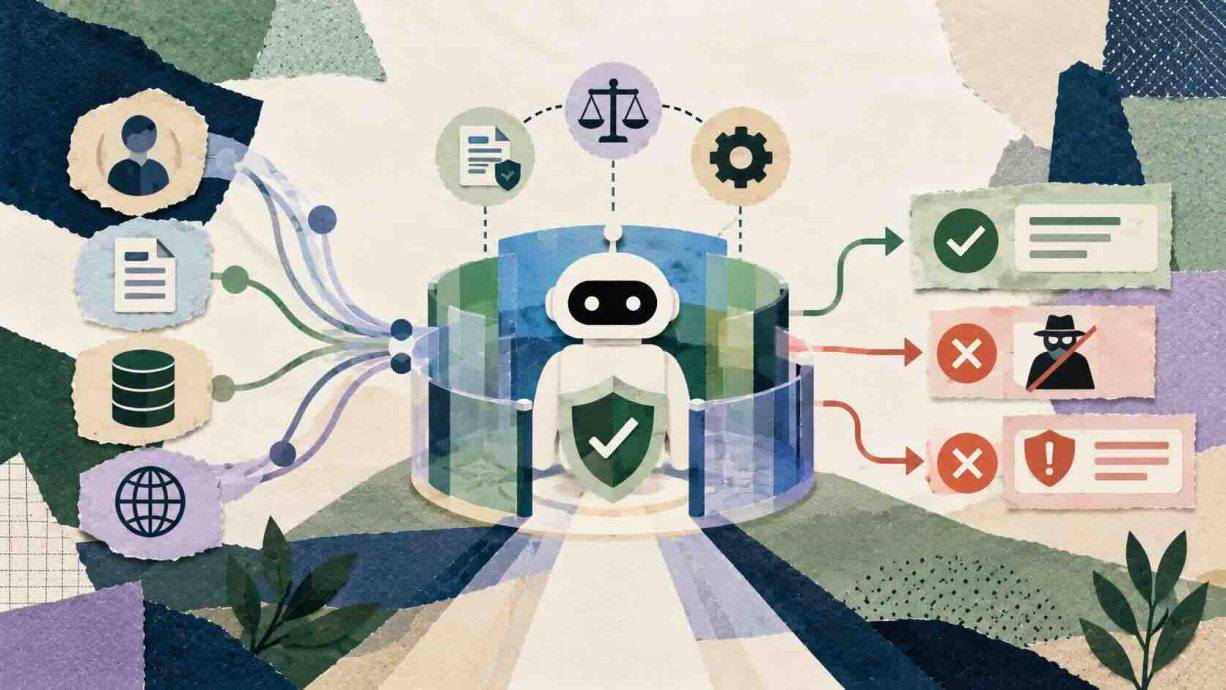
Deterministic guardrails run outside the model, usually at a gateway that intercepts every tool call. The agent proposes an action, the policy engine authorizes it, and only approved calls reach real systems.
Key Takeaways
- Deterministic guardrails for AI agents live outside the model, at the tool boundary, where every consequential action has to pass through a policy decision.
- Default deny plus typed argument schemas stops far more damage than any amount of prompt hardening, because the model never gets a vote.
- Policy as code with Cedar or Rego makes agent permissions versioned, testable, and reviewable by people who never read a transformer paper.
- Deterministic guardrails for AI agents cost real latency and real money, so measure the guardrail tax deliberately rather than discovering it in a quarterly cloud bill.
Table of contents
- Introduction
- Quick Answers on Deterministic Guardrails for Agents
- Key Takeaways
- What Is a Deterministic Guardrail in an Agent Stack?
- Why Probabilistic Agents Need Non-Probabilistic Controls
- The Anatomy of an Agent Action Loop
- Where Guardrails Sit in the Agent Architecture
- Tool Call Gating and the Least Privilege Boundary
- Data Access Boundaries and Scope Enforcement
- Action Chain Limits, Budgets, and Circuit Breakers
- Policy as Code with Cedar, Rego, and Typed Schemas
- Deterministic Guardrails Versus Model Based Filters
- Identity, Delegation, and the Agent Credential Problem
- Human Approval Gates and When They Earn Their Latency
- Observability, Audit Trails, and Replayable Decisions
- Testing Guardrails Through Red Teaming and Regression Suites
- Putting Deterministic Guardrails Into Production Workflows
- Measuring Cost, Latency, and the Guardrail Tax
- Where Deterministic Controls Fall Short and Introduce Risk
- The Ethical Weight of Automated Denials and Escalations
- Regulation, Standards, and Compliance Pressure on Agent Controls
- The Future of Agent Oversight and Verifiable Policy
- How to Build a Deterministic Guardrail Layer Step by Step
- Step 1 – Inventory every tool the agent can reach
- Step 2 – Define typed schemas for every tool argument
- Step 3 – Stand up a policy decision point
- Step 4 – Write default deny policies as versioned code
- Step 5 – Run the policy set in shadow mode
- Step 6 – Add chain limits, budgets, and approval gates
- Step 7 – Wire replayable logging and regression tests
- Key Insights
- Guardrails in Practice Across Real Agent Deployments
- Lessons From Enterprises That Shipped Agent Controls
- Common Questions About Deterministic Guardrails for Agents
What Is a Deterministic Guardrail in an Agent Stack?
Deterministic guardrails for AI agents are fixed, externally enforced rules that decide which actions an agent may take. They run outside the model, evaluate structured inputs, and return identical verdicts for identical requests, which makes agent behavior auditable rather than merely probable.
An Interactive From AIplusInfo
Model your agent guardrail coverage and its latency tax
Set the shape of one agent task, choose an enforcement posture, and see the containment coverage, the added latency and the review load that follow.
10 calls
30 percent
Default deny gateway
Forbidden actions contained
98%
Share of disallowed tool calls stopped before they reach a real system.
Added latency per task
1165 ms
Policy evaluation plus model rail time, multiplied across every call in the task.
Review hours per 10k tasks
33 h
Human time spent clearing approval queues at the current posture and gate rate.
Containment coverage by posture at your settings
Latency assumptions follow reported production figures of 200 to 600 ms for chained model rails, documented in this NeMo Guardrails production deployment guide, plus one to five ms for a remote policy decision point. Estimates are illustrative, not a benchmark of any single vendor.
Why Probabilistic Agents Need Non-Probabilistic Controls
A language model samples tokens, and sampling means the same prompt can produce two different plans on two different runs. That variance is a feature when the agent is drafting text and a liability when it is moving money. Controls built from the same probabilistic material inherit the same variance, so a classifier that blocks a request today may pass it tomorrow. Deterministic guardrails for AI agents break that dependency by moving the decision into code that cannot be persuaded. The OWASP GenAI Security Project ranks agent goal hijack as the leading agentic risk in its 2026 list. A hijacked goal only becomes an incident when the agent can reach a tool that does real damage.
Enterprise risk teams do not accept probabilistic answers for questions about access, and that standard predates generative AI by decades. A database grant either exists or it does not, and an audit log either shows the action or it does not. Agent platforms broke that expectation by letting natural language stand in for authorization logic. Our analysis of how autonomous agents challenge oversight frameworks shows that informal review collapses once fleets grow. A human reviewer can read ten agent transcripts a day and cannot read ten thousand. Rules that execute in microseconds can read all of them, every time, without fatigue or drift.
The practical consequence is a split in the stack between intent and permission. The model owns intent, proposing what it would like to do next given the task in front of it. A separate policy engine owns permission, deciding whether that proposal is allowed under current rules. Neither component can override the other, and the separation is what makes the behavior explainable after an incident. Teams that skip this split usually discover the gap during their first serious postmortem.
The Anatomy of an Agent Action Loop
Every agent runtime reduces to a loop with four moving parts that repeat until the task ends. The model receives context, emits a structured tool request, the runtime executes it, and the result returns as new context. That second step is where how function calling actually works stops being a detail and starts being a security boundary. The tool request is the only place where an agent touches the real world, so it is the only place enforcement truly matters. Everything before it is text, and text alone changes nothing in a payment ledger or a patient record. Everything after it is history that a control can log but can no longer prevent.
Memory complicates the picture because a prior step can plant instructions that a later step obeys. Work on how agent memory architecture works shows that retrieved context is treated with the same trust as the user prompt. A poisoned document therefore becomes a command once the agent reads it back into the loop. Guardrails placed only at the user input boundary miss that path completely. Placing them at the tool boundary catches it, because the damaging step still has to pass through the gate. The loop, not the prompt, is the correct unit of analysis for agent safety.
Where Guardrails Sit in the Agent Architecture
Building on that loop, the enforcement layer has exactly three candidate homes in a production stack. It can live inside the model through fine tuning and system prompts, which is convenient and unreliable. It can live inside the agent framework as application code, which is testable and easy to bypass with a second framework. It can live at a gateway that every tool call must traverse, which is the only option that survives a rewrite. AWS took the third path when it explained why Policy in AgentCore chose Cedar for agent authorization. The gateway pattern also matches how service meshes solved the same problem for microservices a decade earlier.
A gateway sees the agent identity, the tool name, the arguments, and the calling context on every request. Those four inputs are enough to express most enterprise rules without asking the model anything at all. A refund tool can be limited by amount, currency, customer tier, and time of day. A search tool can be limited to indexes the requesting user already has rights to read. None of those limits require the model to cooperate, which is the entire point of the design.
Placement also determines what happens when the enforcement layer itself fails. An in model guardrail fails open, because a model that forgets its instruction simply proceeds with the action. A gateway guardrail fails closed, because an unreachable policy engine means no authorization decision exists. Failing closed is uncomfortable in a demo and non negotiable in a regulated workflow. Teams should decide that default before launch rather than during an outage at two in the morning.
Our guide to a practical framework for securing agentic AI treats the gateway as the control plane rather than an optional add on. That framing changes procurement, because the control plane becomes a platform requirement instead of a per project choice. It also changes staffing, since platform engineers own the gateway while product teams own the agents. Separation of duties then follows naturally from the separation of the components themselves. Auditors recognize that shape immediately because it mirrors controls they already test elsewhere.
Tool Call Gating and the Least Privilege Boundary
Turning to the first enforcement point, tool call gating decides which functions an agent may invoke at all. The default posture should be deny, with each tool opened deliberately for a named agent and a named purpose. AWS documents this explicitly, noting that a Gateway blocks everything by default until a policy permits a call. Default deny is unpopular during development because every new capability needs an explicit grant. That friction is the mechanism working, not the mechanism failing at its job. Each grant becomes a reviewable artifact that someone signed off on with a reason attached.
Gating on the tool name alone is a weak boundary once tools accept rich arguments. A single email sending tool can reach an internal mailing list or an attacker controlled address. Argument level policy closes that gap by constraining recipients, amounts, identifiers, and destinations. Typed schemas make the constraint checkable before the call executes rather than after it fails. A tool without an argument schema is an unbounded capability wearing a friendly name. Teams that build custom agents for workflow automation hit this limit as soon as the second tool arrives. Schema first design costs an afternoon and saves an entire incident review.
Capability tokens offer a stronger variant of the same idea for multi step work. The orchestrator issues a short lived token that names the exact tools a given task may use. The agent presents that token on every call, and the gateway rejects anything outside its declared scope. Expiry limits blast radius when a token leaks into a log or a third party service. Scope and expiry together turn a standing permission into a bounded, revocable grant.
Data Access Boundaries and Scope Enforcement
Beyond the tool catalogue, the second boundary governs which records an agent may read or write. Most breaches in agent systems are not exotic, and they start with over broad retrieval scope. An agent granted a service account with tenant wide read access will eventually surface another tenant’s data. Microsoft made the same point when it wrote about AI tools moving from reading to acting inside enterprise environments. The correct pattern is to impersonate the requesting user rather than to run as a privileged robot. Row level security and index filtering then apply without any agent specific logic at all.
Scope enforcement also needs to survive the retrieval step, where documents arrive carrying their own instructions. A retrieved record should be labelled as data, never promoted to instruction, and never trusted to change policy. Classification labels carried alongside content let the gateway refuse an export of restricted material. The policy engine should read labels, not prose, because prose is exactly what an attacker controls. Our overview of the security risks of AI covers how this pattern shows up outside agent systems too. Labels travel well across systems, while informal trust assumptions rarely do.
Write access deserves its own boundary because reads are recoverable and writes often are not. A sensible default separates read scopes from write scopes and requires a distinct grant for each. Destructive operations such as deletion, schema change, and bulk update belong behind an approval step. Rate limits on writes prevent a confused agent from turning one error into ten thousand errors. Reversibility should be designed in, with soft deletes and staged commits wherever the domain allows.
Action Chain Limits, Budgets, and Circuit Breakers
Given the way agents chain steps, a single bad decision rarely stays a single bad decision. An agent that misreads a goal will pursue it repeatedly, spending tokens and touching systems each cycle. Deterministic guardrails for AI agents cap the step count, the tool call count, and the wall clock time. Budgets add a second dimension by capping spend, message volume, or records touched within a window. A cap that halts a runaway agent at step twelve is worth more than a report describing step four hundred. Obsidian Security frames these as deterministic controls for probabilistic systems, which is a fair description of the mechanism.
Circuit breakers extend the idea by reacting to error rates rather than to absolute counts. When denials, tool failures, or retries cross a threshold, the breaker trips and the agent pauses. A paused agent is a support ticket, while an unpaused one can become a regulatory disclosure. Breakers should trip per tenant and per tool so one noisy workflow does not halt an entire fleet. Recovery needs a defined path, usually a human reset with a recorded reason and a time stamp. Without that path teams disable the breaker within a week and lose the control entirely.
Policy as Code with Cedar, Rego, and Typed Schemas
With that boundary defined, the next question is which language expresses the rules. Two engines dominate enterprise agent work, and they make quite different trade offs. Cedar is an AWS authored language built around principals, actions, resources, and conditions. Rego is the language of Open Policy Agent, and the project documents it as a declarative policy language for hierarchical data. Cedar analyses cleanly and refuses ambiguous policies, which suits authorization decisions that must terminate quickly. Rego expresses richer logic such as delegation chains, set intersections, and tenant invariants.
Typed schemas sit underneath both engines and do work that neither language can do alone. A schema declares that a refund amount is a positive integer in minor currency units. It declares that a recipient field must match a corporate domain rather than any address at all. Validation against a schema rejects a malformed call before any policy evaluation even begins. That ordering matters because policy engines reason poorly about values they cannot parse. Schemas also generate documentation, which reduces the argument surface for both humans and models.
Version control turns policy into an artifact that behaves like the rest of the codebase. Every rule change arrives as a pull request with an author, a reviewer, and a rationale. Continuous integration can run the policy suite against recorded agent traffic before merge. Rollback becomes a revert rather than a frantic console session during an active incident. Compliance teams get a diffable history, which is often the evidence an auditor actually wants.
Deterministic Guardrails Versus Model Based Filters
Among the design choices teams face, the most consequential is whether a model judges a model. Model based filters are flexible, catching nuance that no rule set could enumerate in advance. They also carry a false positive rate, a false negative rate, and a monthly bill. NVIDIA’s NeMo Guardrails toolkit is the best known open implementation of programmable conversational rails. Its Colang flows run before, between, and after model calls, which is genuinely useful. The rails still depend on a model whenever they perform a self check on content.
Deterministic guardrails for AI agents occupy the opposite corner of that trade off space. They cannot read intent, cannot handle novelty, and cannot interpret a sentence they were not written for. What they can do is guarantee that a forbidden action never executes, regardless of phrasing. A rule that blocks refunds above five hundred dollars blocks them in every language and every jailbreak. That guarantee is what regulators, insurers, and internal audit functions are actually buying. Flexibility is valuable, yet it is not the property that survives a legal review.
The mature answer is layering rather than choosing, with each layer doing what it does well. Model based filters screen inbound content for prompt injection, abuse, and obvious policy breaches. Deterministic controls then gate the action itself, refusing anything outside the declared envelope. A failure in the first layer costs a wasted call, while a failure in the second costs an incident. Our guide to mastering agentic AI for smarter workflows shows how layered design keeps throughput acceptable. Layer ordering matters, because the cheapest and most certain check should always run first.
Cost behaves very differently across the two approaches over a full year of operation. A model based rail adds inference cost to every single request it inspects, forever. A compiled policy evaluates in well under a millisecond and costs effectively nothing per call. At ten million agent actions a month that difference dominates the platform budget. Teams usually discover this after the pilot, when volume finally makes the unit economics visible.
Identity, Delegation, and the Agent Credential Problem
Moving on from what an agent may call, the harder question is who the agent actually is. Most early deployments give the agent a shared service account with broad standing permissions. That choice destroys attribution, because every action in the log carries the same identity. An agent needs its own identity, and every task needs a delegation record tying it to a human principal. Microsoft moved in that direction with Agent 365 enterprise agent governance, which registers agents as directory objects. Directory registration brings lifecycle, ownership, and deprovisioning along with it at no extra design cost.
Delegation chains get complicated once one agent calls another agent on a user’s behalf. Each hop should narrow scope rather than preserve it, which is the opposite of default behavior. A supervisor agent holding six permissions should pass three to the worker it invokes. Policy engines can express that intersection explicitly and reject any request that widens the scope. Token expiry should shrink with each hop so a leaked downstream credential ages out quickly. Without those rules a multi agent system quietly accumulates the union of every permission granted.
Human Approval Gates and When They Earn Their Latency
Despite the appeal of full automation, some actions should never execute without a person confirming them. Approval gates are the crudest deterministic control and often the most defensible one. The rule is simple: above a threshold, the action queues instead of executing. Thresholds can be monetary, categorical, or based on how reversible the operation is. An approval gate converts an autonomy problem into a workflow problem, which organizations already know how to run. Our explainer on what human in the loop means covers the operating models that make this sustainable.
Gates have a cost that teams routinely underestimate when they design the first version. Every queued action consumes reviewer attention, and attention is the scarcest resource in operations. A gate that fires on twenty percent of actions will be rubber stamped within a month. Approval fatigue produces worse outcomes than no gate at all, because it manufactures false assurance. The target should be a firing rate low enough that each review receives genuine thought. Tuning that rate is an ongoing measurement exercise rather than a one time policy decision.
Good gates give reviewers the context needed to decide in seconds rather than in minutes. That means the proposed action, the reasoning trace, the affected records, and the applicable policy. It also means a clear default when nobody responds inside the service level window. Expiring to denial is safer, while expiring to approval quietly removes the control altogether. Reviewer decisions should feed back into policy so repeated approvals eventually become rules.
Observability, Audit Trails, and Replayable Decisions
From there, the question becomes evidence, because a control nobody can inspect is a control nobody trusts. Every policy decision should emit a record containing the input, the verdict, and the rule that fired. Storing only denials is a common mistake, since approvals carry most of the investigative value. A replayable log lets a team rerun last Tuesday’s traffic against today’s policy and see what changes. Research on a deterministic control plane for coding agents treats that replay property as a core requirement. Replay turns policy review from an argument about intent into a measurement of effect.
Agent traces need considerably more structure than ordinary application logs to be useful later. A useful trace links the task, the plan, each tool call, each policy verdict, and the outcome. Correlation identifiers tie those events together across services that never share a process. Work on semantic knowledge graphs for agents suggests storing traces as graphs rather than flat lines. Graph shaped traces answer questions about causation that a text search cannot answer at all. They also make it practical to show a regulator exactly why one action was blocked.
Retention policy deserves an explicit decision rather than a default from the logging vendor. Agent traces contain customer data, so indefinite retention creates a brand new privacy liability. A common compromise keeps full traces for ninety days and hashed summaries for two years. Denial records usually justify longer retention because they are the evidence of control effectiveness. Whatever the choice, it belongs in the same repository as the policies themselves.
Testing Guardrails Through Red Teaming and Regression Suites
In practice, a policy set decays the moment nobody tests it against adversarial traffic. Red teaming an agent differs from red teaming a model because the target is the action. The exercise asks whether any prompt, document, or tool response can produce a forbidden call. Academic work benchmarking guardrails against prompt input attacks found wide variation between defenses. A guardrail that has never been attacked in a test is an assumption, not a control. Scheduling that exercise quarterly is the minimum for any agent touching customer money.
Regression suites matter more than dramatic red team exercises over the life of a system. Each incident should produce a test case that replays the exact request that slipped through. Those cases accumulate into a corpus that any policy change must pass before deployment. The suite should include allow cases too, otherwise tightening a rule silently breaks a workflow. Running it on recorded production traffic gives realistic coverage without inventing synthetic edge cases. A policy suite with two hundred cases takes seconds to run and prevents most regressions.
Putting Deterministic Guardrails Into Production Workflows
For teams moving from pilot to production, sequencing matters more than the tooling choice. The first step is an inventory of every tool an agent can currently reach. Most teams find more tools than expected, because frameworks register helpers automatically. You cannot write a default deny policy for a catalogue you have never enumerated. The inventory should record the tool, its arguments, its blast radius, and its owner. That document becomes the input to every rule that deterministic guardrails for AI agents enforce.
The second step is shadow mode, where policies evaluate without blocking anything at all. Shadow mode reveals the false denial rate before it reaches a customer facing workflow. A week of shadow traffic usually exposes two or three rules that are far too tight. It also exposes tools nobody documented, because unexpected calls appear in the decision log. Teams should set an explicit exit criterion, such as a false denial rate below one percent. Skipping shadow mode is the most common reason a guardrail rollout gets reversed.
The third step is staged enforcement, starting with the least risky tenant or workflow. Enforcement should begin on read operations before it extends to writes and payments. Each stage needs a rollback switch that a single on call engineer can flip. Our analysis of why AI pilots fail to scale points repeatedly at missing operational scaffolding. Guardrails are scaffolding, and they need the same operational care as any production dependency.
Ownership is the fourth and least glamorous part of the whole sequence. A policy set without a named owner drifts within a quarter and rots within two. The owner reviews denial rates, approves rule changes, and reports coverage to leadership. Our guide to responsible AI governance frameworks places that accountability inside an existing risk function. Placing it there avoids building a parallel bureaucracy that the business will eventually route around.
Measuring Cost, Latency, and the Guardrail Tax
Stepping back from the architecture, every control adds latency that a user eventually feels. Compiled authorization policies typically evaluate in tens of microseconds on commodity hardware. Network hops to a remote policy service add one to five milliseconds per call. Model based rails are the expensive layer, and practitioners report that NeMo rail chains commonly add 200 to 600 milliseconds at the ninety fifth percentile. A ten step agent task multiplies every per call cost by ten, which turns a rounding error into a delay. Budgeting the tax per task rather than per call is the only honest way to measure it.
Financial cost splits into infrastructure, inference, and the human time spent on approvals. Infrastructure for a policy gateway is modest, often a few small instances per region. Inference cost for model based rails scales linearly with traffic and never really plateaus. Human approval time is the line item that surprises finance teams in the second quarter. A gate firing on five percent of ten thousand daily actions consumes real headcount. Modeling that load before launch prevents an unpleasant conversation about operating expense later.
Vendor choice also carries a hidden cost that shows up only at migration time. Policies written inside a proprietary console rarely export cleanly into another platform. Our piece on vendor lock in on agent platforms explains how that constraint compounds over time. Keeping policy in plain text files inside your own repository preserves the exit option. That single decision is usually worth more than any feature comparison between the engines.
Where Deterministic Controls Fall Short and Introduce Risk
Looking at the limits honestly, deterministic rules cannot reason about context they were never given. A rule permitting refunds under five hundred dollars will happily permit a thousand of them. Aggregate harm slips through boundaries drawn around individual actions, which is a structural weakness. Rules also fail when an attacker finds a permitted path that composes into a forbidden outcome. Threat modeling work on prompt injection with tool poisoning documents exactly that composition problem. A policy set that passes every individual test can still allow a harmful sequence of permitted calls. Sequence aware limits help, yet they never fully close the gap on their own.
Policy sprawl is the second failure mode, and it arrives quietly after the first year. Hundreds of narrow rules accumulate until nobody can predict what the set actually permits. Conflicting rules then resolve by evaluation order rather than by anyone’s stated intent. Periodic consolidation is unglamorous work that most teams defer until an incident forces it. A reported agent flaw opening an email attack vector shows how a narrow gap becomes a breach. Coverage metrics, not rule counts, are the signal worth reporting to leadership each quarter.
The Ethical Weight of Automated Denials and Escalations
Beyond the engineering question, every denial is a decision that affects a real person. An agent that refuses a hardship request is enforcing policy written by someone far away. The person receiving that refusal deserves a reason and a route to a human being. A guardrail without an appeal path converts a business rule into an unaccountable verdict. Designing the appeal path is part of designing the control, not a separate customer service task. Research on translating governance norms into enforceable runtime controls treats that translation as the hard part. Norms that never become enforceable text end up as posters rather than protections.
Escalation carries its own ethical weight because it moves work onto a human queue. If that queue is understaffed, the escalation is a denial with a longer waiting time. Service level commitments for human review should be published alongside the automation claims. Workers reviewing agent escalations also deserve protection from volume driven burnout. A system designed to escalate everything is not safer, it is simply slower and more expensive. Calibration between automation and review is an ethical choice as much as an operational one.
Transparency about what the guardrails do is the third obligation and the most commonly skipped. Customers interacting with an agent should know which decisions are automated and which are reviewed. Employees should know what their agents may do on their behalf and under whose authority. Publishing a plain language summary of the policy envelope costs little and builds real trust. Organizations that hide the envelope usually discover it during a journalist’s questions instead.
Regulation, Standards, and Compliance Pressure on Agent Controls
Turning to the legal picture, agent controls are moving from good practice toward expectation. NIST announced an AI Agent Standards Initiative in February 2026 covering identity, authorization, and monitoring. The Cloud Security Alliance published an agentic profile for the NIST AI Risk Management Framework alongside it. Those documents turn abstract governance language into control requirements an auditor can test. State level rules are moving faster than federal ones in the United States right now. Our Colorado AI Act compliance guide shows how quickly a state statute reaches operational teams.
The European approach centers human oversight as a legal requirement for high risk systems. Agent deployments in hiring, credit, and healthcare will inherit those obligations directly. Deterministic guardrails map neatly onto that requirement because they produce testable evidence. A probabilistic filter cannot demonstrate that a forbidden action was impossible, only that it was unlikely. That distinction is the difference between passing an audit and negotiating with one.
Procurement is where the pressure becomes concrete for most vendors selling agent software. Enterprise security questionnaires now ask how tool permissions are enforced and exactly where. A vendor answering with system prompt instructions loses the deal to one answering with policy code. Evidence requirements are pulling the market toward gateway enforcement faster than any regulation has. That commercial gravity will matter more than statute for the next two years.
The Future of Agent Oversight and Verifiable Policy
Looking ahead, the interesting work is in proving properties of a policy set rather than testing it. Formal analysis can answer whether any request could ever reach a forbidden tool. Cedar was designed with that analysis in mind, which is why it refuses ambiguous constructs. Verification moves the question from what we tested to what is structurally impossible. That property is what safety critical industries have expected from their controls for decades. Agent platforms are roughly where aviation software sat before formal methods became routine.
Standardization is the second thread, and it is moving faster than most teams expect. A shared vocabulary for agent identity, capability, and delegation would make policies genuinely portable. Our coverage of AI governance trends and regulations tracks how those standards are converging. Portability matters because most enterprises will run agents on more than one platform. Deterministic guardrails for AI agents will become a procurement checkbox within two budget cycles. Teams that build the layer now will simply tick the box while others rebuild.
Chart From AIplusInfo
The guardrail tax is small until a model joins the enforcement path
Added latency per tool call, in milliseconds, by enforcement layer. Lower is better.
Source: reported production latency of 200 to 600 ms for chained model rails in this NeMo Guardrails deployment analysis, with policy engine figures drawn from the Open Policy Agent policy language documentation and AWS guidance on Policy in Amazon Bedrock AgentCore. Policy engine values are typical figures for a warm service, not a vendor benchmark.
How to Build a Deterministic Guardrail Layer Step by Step
Step 1 - Inventory every tool the agent can reach
Start by listing every function, API, and helper that the agent runtime can invoke today. Most frameworks register tools dynamically, so read the runtime registry rather than the documentation. Record the tool name, its arguments, the systems it touches, and the worst case outcome. Assign a named owner to each entry, because unowned tools become unowned incidents later. Rank the list by blast radius so the riskiest capabilities receive policy first. Expect at least 3 entries that nobody in the organization is willing to claim. An inventory of 40 tools usually takes 2 days and reshapes the entire project plan.
Step 2 - Define typed schemas for every tool argument
Every tool needs a machine readable contract describing exactly what its arguments may contain. JSON Schema is sufficient for most cases and integrates with validation libraries teams already run. Constrain types, ranges, enumerations, and string patterns rather than accepting free text. The schema below limits a refund to a positive amount under a ceiling of 50000 minor units. Validation runs before policy evaluation, so malformed calls never reach the decision engine. A schema with 4 constrained fields removes more attack surface than 40 pages of prompt guidance. Schemas also generate documentation, which reduces the argument surface for both humans and models.
{
  "title": "issue_refund",
  "type": "object",
  "required": ["order_id", "amount_minor", "currency"],
  "properties": {
    "order_id":     { "type": "string", "pattern": "^ORD-[0-9]{8}$" },
    "amount_minor": { "type": "integer", "minimum": 1, "maximum": 50000 },
    "currency":     { "type": "string", "enum": ["USD", "EUR", "GBP"] },
    "reason_code":  { "type": "string", "enum": ["damaged", "late", "duplicate"] }
  },
  "additionalProperties": false
}
Step 3 - Stand up a policy decision point
The decision point is the service that every tool call must consult before execution. Deploy it as a sidecar for low latency or as a shared service for easier governance. The interface takes a request describing principal, action, resource, and context, returning allow or deny. Keep the response shape small so the runtime can act on it without parsing prose. Health checks matter here because an unavailable decision point must fail closed by design. A sidecar typically returns a verdict in under 1 millisecond, since no network hop is involved. Budget 3 to 5 milliseconds for a remote call and measure it under real production load.
Step 4 - Write default deny policies as versioned code
Write the first policy file with a single rule that denies everything by default. Add permits one tool at a time, each with the narrowest condition that still works. The Cedar policy below permits one agent to issue refunds under a fixed ceiling. Pro tip: keep policy files in the application repository so rule changes travel with code review. Rego is the better choice when rules need delegation chains or set intersections across tenants. Both engines support unit tests, and those tests belong in continuous integration from day 1. Resist the urge to encode business exceptions as wildcards, since wildcards outlive their justification.
// default is deny: AgentCore Gateway permits nothing without an explicit rule
permit (
  principal == Agent::"support-refund-bot",
  action    == Action::"invokeTool",
  resource  == Tool::"issue_refund"
)
when {
  context.amount_minor <= 50000 &&
  context.currency == "USD" &&
  principal.delegated_by has "employee_id"
};
Step 5 - Run the policy set in shadow mode
Shadow mode evaluates every policy without enforcing the resulting verdict on live traffic. Run it for at least 1 full business week to capture weekly patterns and batch jobs. The command below replays a recorded request against a Rego policy for a quick check. Track the would be denial rate per tool and investigate anything above 1 percent. Teams commonly watch that rate fall from 12 percent to under 1 percent during the week. Most early denials are schema mismatches rather than genuine policy violations by the agent. Exit shadow mode only when the team can explain every remaining denial in the log.
opa eval --format pretty \
  --data policies/agent_tools.rego \
  --input traces/2026-09-17/call-00841.json \
  "data.agent.tools.allow"
Step 6 - Add chain limits, budgets, and approval gates
Chain limits, budgets, and approval gates layer on top of the per call decision. Set a maximum step count, a maximum tool call count, and a wall clock deadline. A practical starting point is 25 steps, 40 tool calls, and a 10 minute deadline per task. Add spend and volume budgets scoped to the tenant, the task, and the calendar window. Route high impact actions to an approval queue with a service level and an expiry default. Tune thresholds so the gate fires rarely enough that each review receives genuine attention. Circuit breakers close the loop by pausing an agent once its error rate crosses a line.
Step 7 - Wire replayable logging and regression tests
Emit a structured record for every decision, including the input, the verdict, and the matching rule. Store approvals as well as denials, since approvals carry most of the investigative value. Wire correlation identifiers so a task can be reconstructed across every service it touched. Convert each incident into a regression test that replays the exact request that slipped through. A suite of 200 recorded cases runs in seconds and catches most policy regressions early. Run the full suite against every policy change in continuous integration before any merge. Review denial rates monthly with the named owner and retire rules that never fire.
Recommended by AIplusInfo
Books to go deeper on agent design and control
Three titles that map directly onto the tool boundary, the policy layer and the governance case described above.
As an Amazon Associate, AIplusInfo earns from qualifying purchases.

Book
Building Applications with AI Agents: Designing and Implementing Multiagent Systems
Covers single and multiagent design, including the tool interfaces a guardrail layer has to police.
Buy on Amazon
Book
AI Engineering: Building Applications with Foundation Models
A practical reference for evaluation, guardrails and the inference cost decisions around a production agent.
Buy on Amazon
Book
Mastering AI Governance: A Guide to Building Trustworthy and Transparent AI Systems
Maps governance obligations onto enforceable controls, the translation every guardrail programme has to make.
Buy on AmazonKey Insights
- Gartner expects more than 40 percent of agentic AI projects to be canceled by 2027, and it names inadequate risk controls as a driver alongside cost.
- The OWASP list of the top ten risks for agentic applications was built with more than 100 contributors and ranks goal hijack first.
- AWS made Policy in AgentCore generally available in March 2026, and its Cedar design rationale explains why default deny sits at the gateway.
- Practitioners running NeMo Guardrails in production report 200 to 600 milliseconds of added p95 latency, which multiplies across a ten step agent task.
- Microsoft's security team argues that the shift from reading to acting is the moment agent permissions stop being a theoretical concern for enterprises.
- Klarna's assistant handled 2.3 million chats in month one, yet the company later rehired staff after work equal to 853 agents hit its practical limits.
- Threat modeling of the Model Context Protocol tool description field shows unsanitized metadata can carry instructions that agents follow without any user awareness.
Taken together, these numbers describe a market that is deploying capability faster than control. The projects that fail rarely fail on model quality, and they routinely fail on containment. Deterministic guardrails for AI agents are the cheapest available answer to that specific gap. They cost microseconds at the policy layer and hundreds of milliseconds only when a model is involved. The design question is therefore not whether to enforce, but how much enforcement belongs in a model. Teams that answer that question early spend their second year scaling rather than rebuilding.
| Dimension | Deterministic policy enforcement | Model based safety filter | System prompt instruction |
|---|---|---|---|
| Decision consistency | Identical verdict for identical input, every time | Varies with sampling, model version and phrasing | Varies with context length and conversation drift |
| Auditability | Rule file, version history and matched rule identifier | Score and threshold, with no traceable rule | No record beyond the prompt text itself |
| Latency per call | Tens of microseconds compiled, one to five milliseconds remote | Roughly 200 to 600 milliseconds for chained rails | Zero, since it rides inside the existing call |
| Cost at scale | Effectively flat infrastructure cost per region | Inference cost that scales linearly with traffic | Extra input tokens on every single request |
| Coverage of novel phrasing | None, since unknown patterns fall outside the rules | Strong, because semantics generalise across wording | Moderate, and easily displaced by later instructions |
| Failure mode | Fails closed when the decision point is unreachable | Fails open when confidence lands below threshold | Fails silently when the instruction is forgotten |
| Accountability and evidence | Produces artifacts an auditor or regulator can test | Produces statistics that describe likelihood only | Produces nothing a compliance team can rely on |
| Change management | Pull request, review, tests and revertible deployment | Retraining, threshold tuning and drift monitoring | Prompt edit with no test suite and no rollback |
Guardrails in Practice Across Real Agent Deployments
AWS AgentCore Gateway Enforcing Cedar at the Tool Boundary
AWS deployed Cedar inside Amazon Bedrock AgentCore Policy and made it generally available in March 2026. The gateway intercepts every agent tool call and evaluates it against a policy set before execution. Teams that adopted it report replacing dozens of hand written permission checks with a single policy file. The AWS security engineering write up explains that Cedar was chosen because its policies can be analyzed automatically. A limitation is that policies stay tied to the AgentCore runtime, so they do not port elsewhere. Default deny also required roughly two weeks of tuning before internal teams stopped filing access tickets.
NVIDIA NeMo Guardrails Running Programmable Rails Around Live Agents
NVIDIA built NeMo Guardrails as an open toolkit that runs Colang flows around every model call. Teams have rolled it out to enforce topic boundaries, refusal rules, and retrieval constraints in production. Practitioners measuring the deployment report that rail chains commonly add 200 to 600 milliseconds at the ninety fifth percentile. That overhead is acceptable for a single turn chat and painful inside a twenty step agent loop. The critique that lands hardest is that self check rails still call a model to judge a model. Determinism therefore stops at the rail boundary, which is why teams pair it with policy enforcement.
Microsoft Agent 365 Giving Every Agent a Directory Identity
Microsoft rolled out Agent 365 to register enterprise agents as first class directory objects. Each agent receives its own identity, lifecycle, and permission set rather than a shared service account. Security teams gain attribution, because every logged action now maps to exactly one named agent. Microsoft's own security guidance on AI tools moving from reading to acting frames identity as the first control. The limitation is licensing and platform gravity, since the model works best inside the Microsoft estate. Early adopters also report several weeks of cleanup to retire the shared accounts that predated it.
Lessons From Enterprises That Shipped Agent Controls
Case Study: Klarna Rebalancing Automation With Human Escalation
Klarna faced a support backlog that its human team could not clear at an acceptable cost. The company deployed an AI assistant that handled 2.3 million conversations in its first month. That volume covered roughly two thirds of all chats and matched the output of 700 agents. By the third quarter of 2025 the assistant was credited with work equal to 853 employees in company reporting. Cost avoidance reported alongside that figure reached roughly 60 million dollars on an annual basis. The solution was never purely technical, because the escalation path did most of the safety work.
The limitation became public when Klarna rehired human staff for disputes and hardship cases. Customers pushed back on an assistant that could not exercise judgment in financial distress. The controversy was less about accuracy and more about which decisions should never be automated. Klarna now routes complex cases to people while the assistant keeps the routine volume. That split is a deterministic guardrail expressed as an operating model rather than a policy file. The lesson is that category based routing beats confidence thresholds for irreversible customer outcomes.
Case Study: Air Canada and the Cost of an Ungrounded Policy Answer
Air Canada faced a customer who relied on its website assistant for bereavement fare guidance. The assistant described a retroactive discount available within 90 days, a policy that never existed. The airline argued the chatbot was a separate entity responsible for its own statements. The British Columbia Civil Resolution Tribunal rejected that defense and held the airline liable for negligent misrepresentation in February 2024. Damages totaled 812.02 Canadian dollars, a trivial sum beside the precedent that it established. The problem was never model capability, and it was entirely a missing grounding constraint.
A deterministic solution here is narrow and boring, which is exactly what makes it effective. Policy answers should be retrieved from a versioned source and rendered without paraphrase. The assistant may summarize the retrieved text, yet it may never assert a policy absent from it. A citation requirement enforced in code turns that rule from guidance into a hard constraint. The limitation is that grounded answers feel stiffer and cover fewer edge cases than free generation. Air Canada removed the assistant rather than rebuild it, which is the costlier of the two options.
Case Study: Cursor and the Support Bot That Invented a Login Rule
Anysphere faced a support load that its small team struggled to answer quickly enough. The company deployed an AI support agent that signed its replies with the name Sam. In April 2025 the agent told users that Cursor allowed only one device per subscription. No such policy existed, and the incident report filed in the AI Incident Database records the fallout in detail. Developers canceled subscriptions within hours as the claim spread across Hacker News and Reddit. The company confirmed the answer was a hallucination and restored the correct multi device behavior.
The limitation exposed here is subtle, because no tool call and no privileged action occurred. A pure speech act still produced commercial damage and a public trust problem for the company. Deterministic guardrails address this by constraining which claims an agent may assert without support. Policy statements route to a retrieval tool, and unsupported assertions are blocked before sending. Labelling automated replies as automated is the second control, and it was missing entirely. The controversy cost more than a month of support headcount would have cost to retain.
Common Questions About Deterministic Guardrails for Agents
Deterministic guardrails for AI agents are fixed rules enforced outside the model that decide which actions an agent may perform. They evaluate structured inputs such as the agent identity, the tool name, and the call arguments. The same request always produces the same verdict, which makes the behavior testable and auditable. They complement the model rather than replacing it, since the model still proposes what to do next.
A system prompt is advice that the model may follow, ignore, or lose as the context grows. A deterministic guardrail is code that executes between the agent and the tool it wants to call. No phrasing, jailbreak, or injected document can talk a compiled policy out of its decision. Prompts shape behavior, while guardrails constrain outcomes, and serious deployments need both of those layers.
The strongest placement is a gateway that every tool call must pass through before execution. A gateway sees the agent identity, the tool, the arguments, and the calling context on each request. Framework level checks are easier to write and trivially bypassed by a second framework. In model guardrails fail open, which is the wrong default for anything touching money or records.
Yes, because the two layers catch quite different classes of failure at different costs. Model based filters detect novel abuse and prompt injection that no rule set could enumerate. Deterministic guardrails for AI agents then guarantee that a forbidden action never executes at all. Run the cheap deterministic check first so expensive inference only sees requests that could be allowed.
Cedar suits authorization decisions that must terminate fast and be analyzed automatically for unintended access. Rego suits richer logic such as delegation chains, set intersections, and tenant specific invariants. Cedar is the native choice inside Amazon Bedrock AgentCore, which reduces integration work considerably. Teams already running Open Policy Agent elsewhere usually gain more from reusing their Rego skills.
A compiled policy evaluates in tens of microseconds, which is invisible next to model inference. A remote policy service adds roughly one to five milliseconds per call over the network. Model based rails are the expensive layer, commonly adding 200 to 600 milliseconds at the ninety fifth percentile. Multiply any per call figure by the number of steps in the task to budget honestly.
A tool call gateway sits between the agent runtime and the systems that tools actually touch. Every proposed call is authorized there, so enforcement survives a change of agent framework. The gateway is also the natural place to log decisions, apply budgets, and trip circuit breakers. Without it, enforcement scatters across application code where nobody can audit it as one set.
Give each agent its own identity rather than a shared service account with broad standing permissions. Issue short lived capability tokens that name the exact tools a single task may use. Narrow the scope at every delegation hop so a supervisor cannot widen what a worker receives. Reject any request whose scope exceeds the intersection of the caller and the delegated grant.
No, and any vendor claiming otherwise is selling confidence rather than an actual control. Guardrails do not stop injection, they stop the injected instruction from reaching a dangerous tool. That distinction matters because the attack will land eventually, and containment is what limits damage. Treat injection as inevitable and design the blast radius of every single tool accordingly.
Few enough that each review receives genuine attention, which usually means under five percent of actions. Gate on irreversibility and impact rather than on model confidence, which is not a reliable signal. Set a service level for human review and a safe default when nobody responds in time. Expiring to denial preserves the control, while expiring to approval quietly removes it.
Record the full input, the verdict, the rule that matched, and the resulting action taken. Store approvals as well as denials, because approvals carry most of the investigative value later. Include correlation identifiers so an entire task can be reconstructed across several different services. Keep the log replayable so a new policy can be tested against yesterday's real traffic.
Run the policy set in shadow mode for at least one full business week first. Measure the would be denial rate per tool and investigate anything above one percent. Red team the agent by attempting to reach forbidden tools through prompts and poisoned documents. Convert every incident into a regression test that runs on each policy change before merge.
They produce exactly the evidence auditors ask for, including a rule file, a decision log, and a test suite. The NIST AI Agent Standards Initiative and the OWASP agentic list both point toward enforceable controls. A probabilistic filter can show that a forbidden action was unlikely, never that it was impossible. That gap is what turns a routine audit into a lengthy negotiation over interpretation.