

Introduction
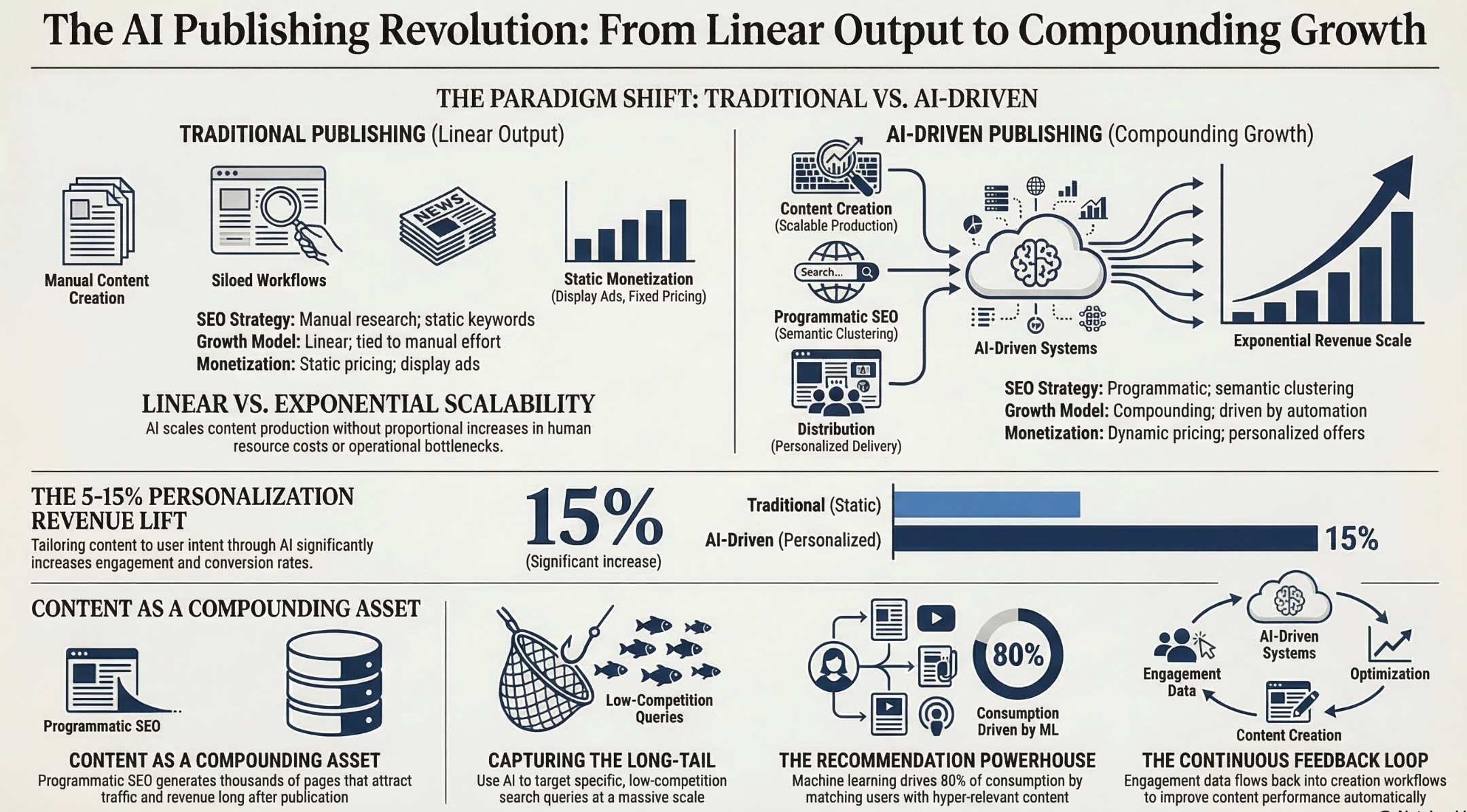
Digital publishing has reached a saturation point where content supply exceeds available audience attention across most platforms, which has reduced the effectiveness of traditional monetization strategies such as display advertising and static subscriptions. According to McKinsey, personalization can increase revenue by 5 to 15 percent across industries, highlighting how relevance drives engagement and conversion. Using artificial intelligence to make publishing profitable enables organizations to align content with search intent at scale through AI content generation, programmatic SEO, and predictive analytics systems. These systems allow publishers to capture long-tail keyword traffic, improve content performance optimization, and continuously refine strategies using engagement analytics. The opportunity lies in transforming publishing into a compounding traffic and revenue engine driven by data-driven workflows and automation. The challenge is designing integrated systems that connect content creation, distribution, and monetization rather than treating AI as a standalone tool. This article explores how to implement scalable AI publishing systems that drive traffic, engagement, and profitability.
Key Takeaways
- Using artificial intelligence to make publishing profitable enables scalable content systems that capture long-tail keyword traffic efficiently.
- AI-powered programmatic SEO and content automation workflows allow publishers to generate high-ranking content aligned with search intent.
- Personalization engines and recommendation systems improve engagement analytics, which directly increases retention and conversion rates.
- Data-driven publishing systems integrate content creation, distribution, and monetization into a continuous optimization feedback loop.
Table of contents
- Introduction
- Key Takeaways
- Using Artificial Intelligence to Make Publishing Profitable
- Core Concepts of Using Artificial Intelligence to Make Publishing Profitable
- AI Content Creation Systems and Automated Editorial Workflows
- AI-Powered SEO and Programmatic Content Strategy
- Long-Tail Keyword Strategy and Topic Clustering
- AI Content Distribution Systems and Growth Loops
- AI Monetization Models for Traffic Conversion
- AI Revenue Streams in AI-Driven Publishing Systems
- AI Tools and Platforms for SEO Publishing
- Data Infrastructure and Feedback Loops in AI-Driven Publishing
- Key Statistics
- Traditional vs AI-Driven Publishing
- Cost Structure and ROI of AI-Driven Publishing Systems
- Real-World Examples of Using Artificial Intelligence to Make Publishing Profitable
- Case Studies of Using Artificial Intelligence to Make Publishing Profitable
- Step-by-Step Model of Using Artificial Intelligence to Make Publishing Profitable
- Implementation Guide for Using Artificial Intelligence to Make Publishing Profitable
- Strategic Implications of Using Artificial Intelligence to Make Publishing Profitable
- Risks and Limitations of Using Artificial Intelligence to Make Publishing Profitable
- Future Outlook of Using Artificial Intelligence to Make Publishing Profitable
- Content Cluster Strategy for Using Artificial Intelligence to Make Publishing Profitable
- Conclusion
- FAQ
- References
Using Artificial Intelligence to Make Publishing Profitable
Using artificial intelligence to make publishing profitable refers to applying machine learning, automation, and analytics to optimize content creation, SEO performance, distribution, and monetization. This approach enables publishers to scale content systems, capture long-tail search demand, and improve revenue through continuous data-driven optimization.
Core Concepts of Using Artificial Intelligence to Make Publishing Profitable
Using artificial intelligence to make publishing profitable begins with transforming publishing into a data-driven system built on content automation, predictive analytics, and continuous optimization. AI content generation tools enable publishers to create large volumes of content aligned with search intent and user demand. These tools rely on machine learning workflows that analyze engagement analytics, keyword performance, and ranking signals across content assets. This allows publishers to continuously refine content performance optimization strategies using real-time feedback. As a result, content production shifts from manual execution to scalable systems driven by data and automation.
At the distribution layer, recommendation systems and personalization engines play a critical role in improving content relevance and reach. These systems use predictive analytics to analyze browsing behavior, contextual signals, and engagement patterns across users. Audience segmentation becomes more precise, which improves conversion rate optimization and retention metrics across platforms. Content distribution algorithms ensure that relevant content is delivered at the right time and through the right channels. This increases visibility, improves user experience, and strengthens overall SEO performance across content ecosystems.
Monetization becomes more efficient through AI monetization models that integrate dynamic pricing, subscription optimization, and affiliate content strategies. Engagement analytics provide insights into which content drives the highest value across different audience segments. AI-driven analytics dashboards allow publishers to track revenue optimization and identify growth opportunities continuously. This creates a feedback loop where content creation, distribution, and monetization are interconnected and constantly improving. The result is a scalable publishing system where profitability emerges from intelligent systems rather than isolated decisions.
To better understand how AI-powered recommendation systems improve content discovery and engagement, you can explore a detailed breakdown of how these systems work in publishing environments.
AI Content Creation Systems and Automated Editorial Workflows
Using artificial intelligence to make publishing profitable depends heavily on scalable content creation systems that align with search demand and user intent. AI content generation tools enable publishers to produce large volumes of articles targeting long-tail keywords efficiently. These tools use natural language processing and machine learning workflows to generate drafts, optimize structure, and improve readability. This allows publishers to reduce production time while maintaining consistency across content assets. As a result, content automation becomes a core component of scalable digital publishing strategy.
Automated editorial workflows ensure that content creation is not only fast but also strategically aligned with SEO goals. AI writing assistants help structure content based on semantic keyword clustering and search intent analysis. These systems integrate keyword research, content generation, and optimization into a single workflow. Content performance optimization becomes continuous, as machine learning models refine outputs based on engagement analytics and ranking signals. This enables publishers to produce content that improves over time rather than remaining static after publication.
AI blogging tools also support experimentation across topics, formats, and audience segments within publishing ecosystems. Publishers can generate multiple variations of content and test performance using analytics dashboards. This allows rapid iteration and refinement based on real user behavior and search performance. Content systems become adaptive, learning from performance data to improve future outputs. For example, understanding how AI is transforming professional tools and workflows across industries helps contextualize how these systems evolve in real environments.
These systems also enable publishers to scale content production across multiple categories without proportional increases in cost. AI content generation combined with programmatic SEO allows thousands of pages to be created efficiently. This approach captures long-tail search demand while maintaining relevance and quality. Over time, this creates a compounding traffic engine driven by data and automation. Using artificial intelligence to make publishing profitable ultimately depends on designing content systems that evolve continuously based on performance insights.
AI-Powered SEO and Programmatic Content Strategy
Using artificial intelligence to make publishing profitable requires a strong foundation in AI-powered SEO and programmatic content systems. Programmatic SEO enables publishers to generate thousands of pages targeting long-tail keyword queries efficiently. AI content generation tools enhance this process by creating semantically rich content aligned with search intent and user needs. These systems combine keyword research, structured templates, and automation to scale content production without sacrificing quality. As a result, publishers can capture large volumes of organic traffic across diverse topic clusters.
Search engines prioritize content that demonstrates relevance, depth, and alignment with user intent across queries. Google emphasizes creating helpful, people-first content that satisfies search expectations effectively. AI writing assistants support this by optimizing content structure, keyword placement, and semantic relationships within articles. These tools enable publishers to implement semantic keyword clustering and long-tail keyword targeting strategies efficiently. This improves rankings across both primary and secondary keyword variations within a topic.
Programmatic content strategies rely on structured data and repeatable templates that scale across thousands of pages. AI systems analyze search patterns, identify keyword gaps, and generate content designed to fill those gaps. This approach allows publishers to compete in highly competitive niches by covering a wide range of queries comprehensively. Content distribution algorithms further enhance performance by amplifying high-ranking pages across channels. This creates a system where content production and distribution work together to drive sustained traffic growth.
Understanding how AI is reshaping real-world workflows and decision making across digital systems provides valuable context for how AI-driven SEO strategies evolve in practice. These systems ensure that content reaches users based on relevance and behavior rather than static publishing schedules. Over time, this improves engagement signals, which strengthens search rankings and visibility. Using artificial intelligence to make publishing profitable depends on integrating SEO, content generation, and distribution into a unified system.
AI-driven analytics dashboards provide continuous feedback on content performance, keyword rankings, and user engagement metrics. Publishers can identify which pages drive traffic, conversions, and revenue across different segments. This allows for continuous optimization of content and SEO strategies based on real-time data. The system becomes self-improving, as each iteration refines performance and expands reach. Ultimately, AI-powered SEO transforms publishing into a scalable traffic engine that compounds over time.
Long-Tail Keyword Strategy and Topic Clustering
Using artificial intelligence to make publishing profitable depends heavily on capturing long-tail keyword demand through structured and scalable SEO systems. Long-tail keywords represent highly specific search queries that often have lower competition and higher intent. AI-powered keyword research tools analyze search patterns, user behavior, and content gaps to identify these opportunities efficiently. This allows publishers to target thousands of queries that traditional strategies often overlook. As a result, long-tail keyword targeting becomes a primary driver of organic traffic growth.
AI systems enable publishers to build scalable content systems around semantic keyword clustering and topic relationships. Instead of creating isolated articles, publishers can organize content into clusters centered around a core pillar topic. Each supporting article targets a specific variation or subtopic within the broader theme. This approach improves topical authority and aligns with how search engines evaluate content relevance. Over time, this structure strengthens rankings across entire keyword clusters rather than individual pages.
Programmatic SEO plays a critical role in executing long-tail strategies at scale within publishing ecosystems. AI content generation tools can produce large volumes of pages using structured templates and dynamic data inputs. These pages target variations of keywords, formats, and user intent combinations efficiently. This enables publishers to expand their reach across thousands of search queries without significantly increasing operational costs. The result is a scalable system that continuously captures new traffic opportunities.
Understanding how AI systems are transforming complex domains such as robotics and engineering classification highlights how structured content and semantic relationships improve discoverability and search performance. These examples demonstrate how AI can organize complex topics into accessible and searchable formats. Applying similar principles to publishing allows content to rank across a wide range of related queries. This strengthens both visibility and authority within competitive niches.
AI-driven analytics dashboards provide insights into keyword performance, content gaps, and ranking opportunities across clusters. Publishers can identify which topics drive traffic and which require further optimization or expansion. This allows continuous refinement of content strategies based on real performance data. The system evolves as new keywords emerge and user behavior shifts over time. Using artificial intelligence to make publishing profitable ultimately depends on building adaptive keyword strategies that scale with demand.
AI Content Distribution Systems and Growth Loops
Using artificial intelligence to make publishing profitable ultimately depends on integrating distribution, personalization, and feedback loops into a unified system. Each component contributes to a compounding growth engine that improves over time. Publishers who build these systems can scale efficiently while maintaining relevance and engagement. This approach transforms distribution from a static function into a strategic advantage.AI Content Distribution Systems and Growth Loops
Using artificial intelligence to make publishing profitable requires distribution systems that amplify content reach and reinforce SEO performance through continuous feedback loops. AI content distribution algorithms analyze user behavior, timing signals, and platform dynamics to determine when and where content should appear. These systems prioritize relevance by aligning content with user intent and contextual signals across channels. As a result, publishers can maximize visibility without relying on manual scheduling or static distribution strategies. This creates a dynamic distribution layer that adapts continuously to audience behavior.
Personalization engines play a critical role in improving engagement and retention within AI-driven publishing systems. These engines use predictive analytics to tailor content recommendations based on user preferences, browsing history, and interaction patterns. Audience segmentation becomes more refined, allowing publishers to deliver highly relevant content experiences at scale. This increases session duration, reduces bounce rates, and improves overall engagement analytics. Over time, these improvements strengthen search performance through positive user interaction signals.
Growth loops emerge when content performance data feeds directly back into content creation and optimization workflows. High-performing content is amplified across channels, while underperforming content is refined or replaced. AI-driven analytics dashboards track metrics such as click-through rates, dwell time, and conversion rates across content assets. These insights inform future content strategies and distribution decisions. This creates a self-reinforcing system where each iteration improves traffic, engagement, and monetization outcomes.
Understanding how AI is shaping user behavior and decision making across digital environments provides important context for how distribution systems evolve in real-world scenarios. These systems ensure that content reaches users based on relevance and behavioral signals rather than static publishing schedules. Over time, this improves engagement metrics, which strengthens search rankings and visibility across platforms.
AI Monetization Models for Traffic Conversion
Using artificial intelligence to make publishing profitable requires converting traffic into measurable revenue through intelligent monetization systems. AI monetization models rely on predictive analytics, user behavior data, and engagement signals to optimize conversion outcomes. These systems move beyond static advertising and subscription models toward dynamic, personalized revenue strategies. By aligning monetization with user intent, publishers can increase revenue without compromising user experience. This creates a more efficient and scalable approach to digital publishing profitability.
Dynamic pricing is a key component of AI-driven monetization strategies within publishing ecosystems. AI systems analyze user behavior, content engagement, and historical conversion data to adjust pricing in real time. This allows publishers to present subscription offers that reflect user willingness to pay and perceived value. Subscription optimization improves as pricing strategies adapt continuously based on performance data. Over time, this increases conversion rates and maximizes revenue per user across segments.
Affiliate content optimization is another powerful monetization strategy enabled by artificial intelligence systems. AI tools analyze user intent and match content with relevant products, services, or recommendations. This ensures that affiliate links are contextually aligned with user needs and search queries. As a result, click-through rates and affiliate revenue increase without disrupting the content experience. This approach allows publishers to monetize informational content effectively while maintaining trust and relevance.
Understanding how AI-driven content systems improve performance, engagement, and decision making across digital platforms provides useful context for how monetization strategies evolve alongside user behavior. These systems rely on continuous feedback from engagement analytics and conversion data. AI-driven analytics dashboards help publishers identify which content drives revenue and which requires optimization. This enables a continuous improvement cycle across monetization strategies.
Using artificial intelligence to make publishing profitable ultimately depends on integrating monetization into the broader content and SEO system. Traffic, engagement, and revenue must function as interconnected components rather than isolated metrics. Publishers who adopt this approach can maximize the value of their content assets. This transforms monetization from a passive outcome into an actively optimized system.
AI Revenue Streams in AI-Driven Publishing Systems
Using artificial intelligence to make publishing profitable requires diversifying revenue streams beyond traditional advertising models. AI enables publishers to identify, optimize, and scale multiple revenue channels based on user behavior and content performance. These systems rely on engagement analytics, predictive modeling, and audience segmentation to align revenue strategies with demand. As a result, publishers can build resilient business models that do not depend on a single monetization source. This approach improves stability and increases long-term profitability across content ecosystems.
Subscription models become more effective when powered by AI-driven personalization and behavioral insights. AI systems analyze how users interact with content, which topics they prefer, and how frequently they return. This data allows publishers to tailor subscription offers based on individual user profiles and engagement levels. Subscription optimization improves as AI continuously refines pricing, messaging, and timing. Over time, this increases conversion rates and customer lifetime value across different audience segments.
Affiliate marketing also benefits significantly from AI-driven content optimization and recommendation systems. AI tools match user intent with relevant products or services within content experiences. This ensures that affiliate links are contextually aligned with what users are actively searching for. As a result, click-through rates and conversion rates increase without disrupting the content flow. This allows publishers to monetize informational and educational content more effectively.
Digital products represent another important revenue stream within AI-driven publishing systems. Publishers can create courses, reports, templates, and premium resources based on high-performing content topics. AI-driven analytics dashboards identify which topics generate the most engagement and demand. This allows publishers to prioritize content that can be converted into paid offerings. Over time, this creates a scalable pipeline for product development and revenue growth.
Understanding how artificial intelligence helps businesses improve efficiency, scale operations, and drive revenue growth provides important context for how publishing monetization models evolve in practice. These systems demonstrate how data-driven decision making directly supports revenue expansion. Using artificial intelligence to make publishing profitable depends on building flexible revenue systems that adapt to changing user behavior. This ensures long-term sustainability and competitive advantage in digital publishing markets.
AI Tools and Platforms for SEO Publishing
Using artificial intelligence to make publishing profitable requires a robust stack of AI tools and platforms that support content creation, SEO optimization, and performance analytics. These tools enable publishers to build scalable content systems that align with search demand and user intent. AI content generation platforms use natural language processing to produce structured, high-quality drafts efficiently. This allows publishers to accelerate production while maintaining consistency across large volumes of content. As a result, content automation becomes a foundational capability within AI-driven publishing ecosystems.
SEO-focused AI tools play a critical role in identifying keyword opportunities and optimizing content for search engines. These platforms analyze search intent, competition levels, and semantic relationships across keywords. This enables publishers to implement long-tail keyword targeting and semantic keyword clustering strategies effectively. AI writing assistants further enhance optimization by improving readability, structure, and keyword placement within content. Together, these tools transform SEO from a manual process into a scalable and repeatable system.
Analytics platforms provide the data infrastructure needed to measure performance and guide decision making. AI-driven analytics dashboards track metrics such as traffic, engagement, rankings, and conversion rates across content assets. These insights allow publishers to identify high-performing content and areas that require optimization. Feedback loops ensure that data continuously informs content creation and SEO strategies. This creates a system where performance improves over time through iterative refinement.
Recommendation engines and personalization platforms enhance content discovery and engagement across publishing environments. These systems use predictive analytics to deliver content tailored to user preferences and behavior. This improves user experience while increasing retention and session depth. Understanding how artificial intelligence systems actually work under the hood across models, data pipelines, and decision layers helps publishers select and integrate the right tools effectively. This ensures that tool selection aligns with both technical and strategic publishing goals.
Using artificial intelligence to make publishing profitable ultimately depends on integrating these tools into a cohesive system rather than using them in isolation. Each platform must contribute to a unified workflow that connects content creation, SEO optimization, distribution, and monetization. Publishers who build well-integrated tool stacks can scale efficiently while maintaining quality and relevance. This creates a sustainable competitive advantage in the evolving digital publishing landscape.
Data Infrastructure and Feedback Loops in AI-Driven Publishing
Using artificial intelligence to make publishing profitable requires a strong data infrastructure that supports continuous learning and optimization across content systems. Data infrastructure includes pipelines, storage systems, analytics platforms, and machine learning models that process large volumes of user and content data. These systems collect signals from user behavior, search performance, engagement metrics, and conversion outcomes. This data is then structured and analyzed to inform decisions across content creation, SEO strategy, and monetization. Without reliable data infrastructure, AI systems cannot deliver accurate insights or meaningful improvements.
Data pipelines play a critical role in aggregating and transforming raw data into actionable intelligence within publishing ecosystems. These pipelines collect data from sources such as search engines, analytics tools, and user interaction logs. The data is cleaned, structured, and stored in formats that support analysis and modeling. This enables publishers to track performance across keyword rankings, traffic patterns, and user engagement metrics. Over time, these pipelines create a centralized source of truth that supports data-driven publishing systems.
Feedback loops are the mechanism through which AI systems continuously improve performance based on real-world outcomes. Engagement analytics, such as click-through rates, dwell time, and conversion rates, feed back into content and SEO workflows. Machine learning models use this data to refine predictions, optimize recommendations, and improve content performance. This creates a system where each iteration enhances the effectiveness of future content and strategies. As a result, publishing systems become adaptive and self-improving over time.
Understanding how artificial intelligence is applied across different domains, including scientific and technical fields, to process data and generate insights highlights the importance of structured data systems and feedback mechanisms. These principles demonstrate how complex systems rely on data to drive decision making and optimization. Applying similar approaches to publishing enables more accurate targeting, better content performance, and improved monetization outcomes.
Using artificial intelligence to make publishing profitable ultimately depends on building data systems that connect every stage of the publishing lifecycle. Content creation, SEO optimization, distribution, and monetization must all feed into a unified data layer. Publishers who invest in strong data infrastructure can make faster, more informed decisions across their operations. This creates a competitive advantage that compounds over time as systems learn and improve continuously.
Key Statistics
- McKinsey reports that companies using personalization strategies see revenue increases of 5 to 15 percent, driven by aligning content and offers with user intent and behavior patterns. This result is achieved through predictive analytics, audience segmentation, and real-time content optimization across channels. This matters because personalized publishing experiences significantly improve engagement, retention, and monetization outcomes in competitive digital environments.
- Harvard Business Review highlights that reducing customer churn by just 5 percent can increase profits by 25 to 95 percent, emphasizing the importance of retention strategies powered by AI-driven personalization. This improvement is achieved by using behavioral data and machine learning models to deliver relevant content and offers. This matters because retention is often more cost-effective than acquisition in digital publishing models.
- Netflix reports that more than 80 percent of content consumption is driven by recommendation systems, which rely on machine learning to match users with relevant content efficiently. This outcome is achieved through large-scale data analysis, collaborative filtering, and continuous feedback loops. This matters because recommendation systems directly influence engagement, session duration, and content monetization potential.
- Google emphasizes that helpful, people-first content significantly improves search rankings, as search algorithms prioritize relevance, depth, and user satisfaction signals. This result is achieved by aligning content with search intent, improving structure, and ensuring semantic coverage across topics. This matters because SEO performance directly drives traffic, which is the foundation of publishing profitability.
- Stripe indicates that businesses implementing optimized pricing strategies can increase revenue by up to 30 percent, driven by data-driven pricing models and experimentation. This improvement is achieved through dynamic pricing, A/B testing, and behavioral analysis of user willingness to pay. This matters because monetization efficiency determines how effectively traffic is converted into revenue.
These statistics collectively demonstrate that using artificial intelligence to make publishing profitable depends on personalization, optimization, and data-driven decision making across the entire content lifecycle. They highlight how engagement, retention, and monetization are interconnected within AI-driven systems. Together, they show that profitability emerges from continuous optimization rather than isolated improvements.
Traditional vs AI-Driven Publishing
| Dimension | Traditional Publishing | AI-Driven Publishing |
|---|---|---|
| Content Creation | Manual writing with limited scalability and slower production cycles | AI content generation enables high-volume, scalable content production aligned with search demand |
| SEO Strategy | Keyword-focused with manual research and static optimization | Programmatic SEO with semantic keyword clustering and continuous optimization using AI |
| Content Distribution | Fixed publishing schedules with limited personalization | AI-driven distribution algorithms optimize timing, channels, and audience targeting dynamically |
| Audience Targeting | Broad segmentation based on basic demographics | Advanced audience segmentation using behavioral data and predictive analytics |
| Monetization | Static pricing models and reliance on display advertising | Dynamic pricing, subscription optimization, and diversified AI monetization models |
| Analytics | Basic reporting with delayed insights and limited actionability | Real-time analytics dashboards with predictive insights and continuous feedback loops |
| Scalability | Limited by human resources and operational constraints | Scales efficiently through automation, machine learning workflows, and content systems |
| Decision Making | Intuition-driven and reactive to performance trends | Data-driven, proactive, and continuously optimized through AI feedback systems |
| Content Performance | Inconsistent results with limited ability to iterate quickly | Continuous content performance optimization driven by engagement analytics |
| Revenue Growth | Incremental growth tied to manual expansion efforts | Compounding growth driven by scalable traffic systems and optimized monetization |
This comparison highlights how using artificial intelligence to make publishing profitable shifts the entire operating model from manual execution to intelligent systems. Traditional publishing relies on isolated processes that do not scale efficiently with increasing content demand. AI-driven publishing integrates content creation, SEO, distribution, and monetization into a unified system that continuously improves performance. This shift enables publishers to capture more traffic, engage users more effectively, and convert that engagement into measurable revenue outcomes.
Cost Structure and ROI of AI-Driven Publishing Systems
Using artificial intelligence to make publishing profitable significantly changes the cost structure and return on investment across digital publishing operations. Traditional publishing models rely heavily on manual labor, which increases costs as content production scales. AI-driven systems reduce these costs by automating content creation, SEO optimization, and distribution workflows. This allows publishers to produce more content without proportional increases in operational expenses. As a result, cost efficiency improves while output and scalability increase simultaneously.
In traditional models, content production involves writers, editors, SEO specialists, and distribution teams working in separate workflows. Each additional piece of content requires incremental time, effort, and coordination across these roles. This creates bottlenecks that limit scalability and increase production timelines. AI content generation tools streamline these workflows by integrating multiple functions into a single system. This reduces dependency on manual processes and accelerates content delivery across platforms.
ROI improves significantly in AI-driven publishing systems because content becomes a compounding asset rather than a one-time investment. Programmatic SEO allows publishers to generate thousands of pages that continue to attract traffic over time. AI-driven analytics dashboards identify high-performing content and guide optimization efforts to improve returns. This creates a feedback loop where each piece of content contributes to long-term traffic growth and revenue generation. Over time, this leads to exponential returns compared to traditional publishing approaches.
Monetization efficiency also improves as AI systems optimize pricing, affiliate strategies, and user engagement. Dynamic pricing models adjust subscription offers based on user behavior and conversion data. Affiliate content optimization increases revenue by aligning recommendations with user intent. These strategies ensure that traffic is converted into revenue more effectively. This makes monetization an integrated part of the publishing system rather than a separate function.
| Component | Traditional Publishing | AI-Driven Publishing |
|---|---|---|
| Content Production Cost | High and increases with scale due to manual processes | Lower per unit due to automation and scalable content systems |
| Time to Publish | Slow due to multi-step workflows and dependencies | Faster due to integrated AI workflows and automation |
| SEO Execution | Manual and limited in scale | Programmatic and scalable across thousands of pages |
| Traffic Growth | Linear and dependent on manual expansion | Exponential through long-tail keyword capture and optimization |
| Monetization Efficiency | Static and less responsive to user behavior | Dynamic and optimized using predictive analytics |
| ROI | Variable and often unpredictable | Compounding and driven by continuous optimization |
This comparison shows that using artificial intelligence to make publishing profitable creates a more efficient and scalable economic model. Costs decrease as automation replaces manual workflows, while output increases through scalable content systems. ROI improves as content continues to generate traffic and revenue over time. This shift allows publishers to operate with greater efficiency and predictability in competitive digital markets.
Real-World Examples of Using Artificial Intelligence to Make Publishing Profitable
Using artificial intelligence to make publishing profitable is not theoretical, as several leading technology companies have already operationalized these systems at scale. These organizations use AI-driven content systems, recommendation engines, and data-driven publishing strategies to capture attention and convert engagement into revenue. Their approaches demonstrate how content, distribution, and monetization can be integrated into a unified system. By analyzing these examples, publishers can understand how AI transforms content into a scalable growth engine. These systems provide practical insight into how traffic and revenue can be optimized simultaneously.
Netflix provides one of the most well-known examples of AI-driven content distribution and monetization. Its recommendation system uses machine learning to analyze viewing behavior, preferences, and engagement patterns across millions of users. This allows Netflix to personalize content recommendations and increase session duration significantly. More than 80 percent of content consumption on the platform is driven by these recommendation systems. This approach improves retention, reduces churn, and maximizes the value of content assets across the platform. The success of Netflix highlights how personalization engines directly influence both engagement and revenue outcomes.
Amazon applies artificial intelligence to content discovery, product recommendations, and conversion optimization across its ecosystem. Its recommendation systems analyze user behavior, purchase history, and contextual signals to deliver highly relevant suggestions. This system increases click-through rates and improves conversion rates across product and content experiences. Amazon also uses AI-driven content systems to optimize product descriptions, search results, and user journeys. This integrated approach ensures that content and commerce function together as a unified revenue system. The result is a highly optimized platform where every interaction contributes to monetization.
Understanding how artificial intelligence helps businesses scale operations, improve efficiency, and drive measurable revenue growth provides additional context for how these systems operate across industries. These examples demonstrate that AI is not limited to content creation but extends across entire business models. By applying similar principles, publishers can build systems that integrate SEO, content, and monetization effectively. This allows them to compete in increasingly crowded digital markets.
Google uses artificial intelligence to power search algorithms, content ranking systems, and advertising platforms that drive massive revenue streams. Its algorithms analyze content relevance, user intent, and engagement signals to determine search rankings. This ensures that high-quality, relevant content is surfaced to users based on their queries. Google’s advertising systems also use AI to optimize ad targeting and pricing dynamically. This creates a highly efficient ecosystem where content discovery and monetization are tightly integrated. Publishers can learn from this model by aligning their content strategies with search intent and user behavior.
These real-world examples show that using artificial intelligence to make publishing profitable requires integrating multiple systems rather than focusing on a single capability. Content creation, distribution, and monetization must work together as part of a unified strategy. AI enables this integration by providing the data, automation, and intelligence needed to optimize each component continuously. Publishers who adopt these approaches can build scalable systems that drive both traffic and revenue.
Case Studies of Using Artificial Intelligence to Make Publishing Profitable
Using artificial intelligence to make publishing profitable becomes clearer when examined through structured case studies that show real implementation and measurable outcomes. These case studies highlight how AI-driven systems transform content into scalable traffic and revenue engines. Each example focuses on the problem, the AI mechanism applied, the implementation workflow, and the resulting business impact. This approach provides practical insight into how publishers can replicate similar strategies within their own ecosystems. It also reinforces how AI integrates content, SEO, distribution, and monetization into a unified system.
Case Study 1: Netflix and AI-Driven Content Discovery
Netflix faced the challenge of retaining users in a highly competitive streaming environment with vast content libraries. Users often struggled to find relevant content quickly, which reduced engagement and increased churn risk. Netflix implemented a recommendation system powered by machine learning models that analyze user behavior, viewing history, and interaction patterns. These models use collaborative filtering, deep learning, and contextual analysis to match users with relevant content. The system continuously updates recommendations based on real-time engagement data and feedback loops.
The implementation involved building large-scale data pipelines that process billions of user interactions daily. AI models were trained on this data to predict user preferences and optimize content recommendations dynamically. The system was integrated across all user touchpoints, including homepages, search results, and notifications. As a result, more than 80 percent of content consumption on Netflix is driven by recommendations. This significantly increased engagement, reduced churn, and improved customer lifetime value. The success of Netflix demonstrates how personalization engines can directly impact both traffic and revenue outcomes.
Case Study 2: Amazon and AI-Driven Conversion Optimization
Amazon faced the challenge of converting massive volumes of traffic into consistent and scalable revenue across its platform. Users often required guidance to navigate large product catalogs and discover relevant items efficiently. Amazon implemented AI-driven recommendation systems that analyze browsing behavior, purchase history, and contextual signals. These systems use predictive analytics to deliver personalized product suggestions across multiple touchpoints. This includes homepage recommendations, product pages, and email campaigns.
The implementation involved integrating machine learning models into the core infrastructure of the platform. These models continuously analyze user data and update recommendations in real time. AI-driven content systems also optimize product descriptions, search rankings, and user journeys. This creates a seamless experience where content and commerce are tightly integrated. As a result, Amazon has reported that a significant portion of its revenue is driven by recommendation systems. This demonstrates how AI can transform content into a direct revenue driver through conversion optimization.
Case Study 3: Medium and AI-Driven Content Distribution
Medium faced the challenge of connecting readers with relevant content while supporting writers in a competitive publishing ecosystem. Traditional chronological feeds were not effective in surfacing high-quality content consistently. Medium implemented AI-driven recommendation systems that analyze reading behavior, engagement patterns, and content quality signals. These systems prioritize content based on relevance, quality, and user interest. This ensures that readers are exposed to content that matches their preferences.
The implementation involved building machine learning models that evaluate content performance and user engagement continuously. These models rank articles dynamically and adjust distribution strategies based on real-time data. Content is promoted through personalized feeds, email newsletters, and notifications. This approach increases visibility for high-quality content and improves reader engagement. As a result, Medium has improved content discovery, increased session duration, and strengthened its subscription model. This case demonstrates how AI-driven distribution systems can enhance both user experience and monetization.
These case studies show that using artificial intelligence to make publishing profitable requires integrating data, algorithms, and workflows across the entire publishing lifecycle. Each company uses AI differently, but the underlying principle remains consistent. Content must be aligned with user intent, distributed effectively, and monetized through optimized systems. Publishers who adopt these strategies can build scalable, data-driven ecosystems that drive sustained growth and profitability.
Step-by-Step Model of Using Artificial Intelligence to Make Publishing Profitable
Using artificial intelligence to make publishing profitable requires a structured, repeatable model that integrates SEO, content creation, distribution, and monetization into a unified system. This model ensures that every stage of the publishing lifecycle contributes to traffic growth and revenue generation. Instead of treating these functions separately, AI enables a connected workflow driven by data and continuous optimization. Each step builds on the previous one, creating a compounding system that improves over time. This approach allows publishers to scale efficiently while maintaining alignment with search demand and user intent.
The first step involves identifying long-tail keyword opportunities and building a structured topic cluster strategy. AI-powered keyword research tools analyze search patterns, competition levels, and user intent signals across large datasets. This enables publishers to identify high-value keyword opportunities that are often overlooked by traditional methods. These keywords are then grouped into semantic clusters that form the foundation of a scalable content system. This ensures that content is organized in a way that supports both SEO performance and user navigation.
The second step focuses on AI-driven content creation and optimization within publishing workflows. AI content generation tools produce structured drafts that align with keyword intent and semantic relevance. AI writing assistants refine content by improving readability, structure, and keyword placement across articles. Machine learning workflows analyze performance data to continuously improve content quality and effectiveness. This creates a system where content evolves based on real-world engagement and ranking signals.
The third step involves distributing content through AI-powered algorithms and personalization engines. Content distribution systems analyze user behavior, timing, and contextual signals to optimize reach across platforms. Personalization engines tailor content recommendations based on user preferences and interaction patterns. This ensures that content is delivered to the right audience at the right time. Over time, this improves engagement metrics such as click-through rates, dwell time, and session duration.
The fourth step focuses on monetization through AI-driven strategies that convert traffic into revenue. Dynamic pricing models adjust subscription offers based on user behavior and engagement signals. Affiliate content optimization aligns product recommendations with user intent within content experiences. AI-driven analytics dashboards track conversion rates and revenue performance across segments. This ensures that monetization strategies are continuously refined based on data and performance insights.
The final step involves establishing feedback loops that connect all components of the system. Engagement analytics, ranking data, and conversion metrics feed back into content creation, SEO, and distribution workflows. Machine learning models use this data to refine predictions and improve system performance over time. This creates a self-improving publishing system that becomes more effective with each iteration. Using artificial intelligence to make publishing profitable ultimately depends on implementing this integrated model consistently and at scale.
Implementation Guide for Using Artificial Intelligence to Make Publishing Profitable
Using artificial intelligence to make publishing profitable requires a structured implementation approach that translates strategy into execution across systems, teams, and workflows. This process involves setting up infrastructure, selecting tools, defining workflows, and aligning content with SEO and monetization goals. Publishers must move beyond experimentation and build repeatable systems that scale efficiently. Each step in this guide focuses on practical actions that can be implemented within real publishing environments. The goal is to create a system that continuously generates traffic, engagement, and revenue.
The first step involves establishing a clear content and SEO strategy based on long-tail keyword targeting and topic clustering. Publishers should use AI-powered keyword research tools to identify high-intent queries with low competition. These keywords must be organized into structured clusters that align with a central pillar topic. This ensures that content supports both search visibility and user navigation across the site. A well-defined strategy provides the foundation for scalable content production and optimization.
The second step focuses on selecting and integrating AI tools that support content creation, SEO, and analytics workflows. Publishers should choose AI content generation platforms, SEO tools, and analytics dashboards that work together seamlessly. Integration is critical because isolated tools cannot deliver compounding results across systems. These tools must support automation, data collection, and performance tracking across content assets. This creates a unified workflow that connects content creation with measurable outcomes.
The third step involves building automated editorial workflows that enable consistent and scalable content production. AI writing assistants should be used to generate drafts, optimize structure, and refine content based on SEO requirements. Editors should focus on quality control, ensuring that content meets standards for accuracy, clarity, and relevance. Machine learning workflows should analyze performance data and provide recommendations for improvement. This ensures that content evolves continuously based on real-world performance signals.
The fourth step focuses on implementing AI-powered distribution and personalization systems across publishing channels. Content distribution algorithms should be configured to optimize timing, platform selection, and audience targeting. Personalization engines should deliver tailored content experiences based on user behavior and preferences. This improves engagement metrics such as session duration and repeat visits. Over time, these systems strengthen both user experience and search performance.
The fifth step involves integrating monetization strategies into the publishing system from the beginning. Publishers should implement dynamic pricing models, affiliate content strategies, and subscription optimization techniques. AI-driven analytics dashboards should track conversion rates, revenue per user, and content-driven monetization performance. This allows publishers to identify which content generates revenue and optimize accordingly. Monetization should be treated as an integrated function rather than a separate layer.
The final step involves establishing continuous feedback loops that connect all components of the system. Data from engagement analytics, SEO performance, and monetization outcomes must be fed back into workflows. Machine learning models should use this data to refine predictions, optimize recommendations, and improve content strategies. This creates a self-improving system that becomes more effective over time. Using artificial intelligence to make publishing profitable depends on maintaining this cycle of continuous optimization and iteration.
Strategic Implications of Using Artificial Intelligence to Make Publishing Profitable
Using artificial intelligence to make publishing profitable fundamentally shifts publishing from a content-driven activity to a systems-driven business model. Traditional publishing relies on discrete efforts across content creation, SEO, and monetization, often operating in silos. AI integrates these functions into a unified system where each component reinforces the others through continuous feedback loops. This creates a compounding effect where traffic, engagement, and revenue improve over time. As a result, publishers must rethink their operating models to prioritize systems over individual outputs.
One major implication is the transition from linear growth to exponential growth in content performance and traffic acquisition. In traditional models, scaling content requires proportional increases in resources, including writers and editors. AI-driven systems break this constraint by enabling content automation and programmatic SEO at scale. Publishers can generate thousands of pages targeting long-tail keyword opportunities without significantly increasing operational costs. This allows smaller teams to compete with larger organizations by leveraging intelligent systems rather than manual processes.
Another important implication is the increasing importance of data as a strategic asset within publishing organizations. AI systems rely on high-quality data to optimize content creation, distribution, and monetization strategies. Publishers must invest in data infrastructure, analytics platforms, and machine learning capabilities to remain competitive. Data-driven decision making replaces intuition as the primary driver of strategy and execution. Organizations that effectively leverage data gain a significant advantage in identifying opportunities and optimizing performance.
AI also changes how publishers think about content quality and relevance within competitive markets. Search engines prioritize content that aligns closely with user intent and delivers meaningful value. AI tools enable publishers to analyze search patterns and engagement signals to refine content continuously. This ensures that content remains relevant and competitive over time. Publishers who fail to adapt risk producing content that does not meet evolving user expectations or search engine standards.
Finally, using artificial intelligence to make publishing profitable introduces new competitive dynamics across the industry. Barriers to entry decrease as AI tools become more accessible, allowing more participants to create and scale content. At the same time, competition intensifies as more publishers adopt similar strategies. Success will depend on how effectively organizations integrate AI into their workflows and differentiate through execution. Publishers who build robust, data-driven systems will be better positioned to capture traffic, engage audiences, and drive sustainable revenue growth.
Risks and Limitations of Using Artificial Intelligence to Make Publishing Profitable
Using artificial intelligence to make publishing profitable introduces several risks and limitations that publishers must address proactively to ensure sustainable growth. While AI enables scalability and efficiency, it also creates dependencies on data quality, algorithm performance, and system design. Poorly implemented AI systems can produce low-quality content, misaligned SEO strategies, and ineffective monetization outcomes. These risks can negatively impact search rankings, user trust, and long-term brand credibility. Publishers must balance automation with oversight to maintain quality and relevance.
One major limitation is the risk of generating low-quality or repetitive content through AI content generation tools. Without proper editorial control, automated systems may produce content that lacks depth, originality, or accuracy. Search engines increasingly prioritize high-quality, people-first content that demonstrates expertise and authority. Content that fails to meet these standards may be penalized or fail to rank effectively. Publishers must implement quality assurance processes that combine AI efficiency with human judgment and editorial standards.
Another significant risk involves over-reliance on programmatic SEO without sufficient differentiation or value creation. Generating large volumes of content targeting long-tail keywords can lead to saturation and diminishing returns if not executed thoughtfully. Search engines may identify patterns of low-value or duplicate content, which can impact rankings negatively. Publishers must ensure that programmatic content provides unique insights, comprehensive coverage, and meaningful user value. This requires careful planning and continuous optimization of content strategies.
Data dependency also presents challenges within AI-driven publishing systems, particularly when data quality is inconsistent or incomplete. AI models rely on accurate and structured data to generate insights and recommendations effectively. Poor data quality can lead to incorrect predictions, misaligned targeting, and suboptimal decision making. Publishers must invest in data governance, validation processes, and infrastructure to ensure reliability. This ensures that AI systems produce actionable and accurate outputs.
Ethical considerations and user trust are increasingly important in AI-driven publishing environments. Transparency in how content is generated, personalized, and monetized is essential for maintaining credibility. Users may be concerned about privacy, data usage, and the authenticity of AI-generated content. Publishers must establish clear policies and communicate them effectively to their audiences. This helps build trust while ensuring compliance with evolving regulations and standards.
Finally, competitive pressure increases as more organizations adopt AI-driven publishing strategies across industries. As barriers to entry decrease, differentiation becomes more challenging. Publishers must focus on execution quality, unique insights, and system integration to stand out. Simply adopting AI tools is not sufficient to achieve sustainable success. Using artificial intelligence to make publishing profitable requires thoughtful implementation, continuous optimization, and a commitment to delivering real value to users.
Future Outlook of Using Artificial Intelligence to Make Publishing Profitable
Using artificial intelligence to make publishing profitable will continue to evolve as search engines, user behavior, and content ecosystems become more sophisticated. AI-driven publishing systems will shift from reactive optimization toward predictive and autonomous decision making across workflows. Machine learning models will anticipate search demand, generate content proactively, and optimize distribution before trends fully emerge. This will allow publishers to capture traffic earlier and maintain a competitive advantage in fast-moving markets. As a result, publishing will become increasingly proactive rather than reactive in strategy and execution.
Search engines are also evolving toward deeper semantic understanding and intent-based ranking systems. This means content must move beyond keyword targeting toward comprehensive topic coverage and contextual relevance. AI systems will play a critical role in analyzing search intent and structuring content to meet evolving ranking signals. Publishers will need to focus on building authority within topic clusters rather than optimizing individual pages in isolation. This reinforces the importance of scalable content systems that align with semantic search principles.
Monetization strategies will become more personalized and dynamic as AI systems gain access to richer behavioral data. Subscription models, affiliate strategies, and digital product offerings will adapt in real time based on user engagement patterns. This will increase conversion rates and improve revenue per user across segments. AI-driven analytics dashboards will provide deeper insights into how content influences revenue outcomes. This will allow publishers to optimize monetization strategies with greater precision and effectiveness.
Understanding how AI is transforming content delivery, personalization, and learning systems across digital platforms provides insight into how future publishing ecosystems will evolve. These systems highlight how user-centric experiences will become the foundation of content strategy. Publishers who align with these trends can build more adaptive and scalable approaches. This ensures long-term competitiveness in rapidly evolving digital environments.
Using artificial intelligence to make publishing profitable will ultimately depend on how effectively publishers integrate these advancements into their workflows. Organizations that invest in data infrastructure, automation, and continuous optimization will gain a significant advantage. The future of publishing will be defined by intelligent systems that learn, adapt, and scale over time. Publishers who embrace this shift will be able to build sustainable, high-performing content ecosystems.
Content Cluster Strategy for Using Artificial Intelligence to Make Publishing Profitable
Using artificial intelligence to make publishing profitable requires a well-defined content cluster strategy that organizes content into scalable, interconnected systems. A content cluster consists of a central pillar page supported by multiple related articles targeting specific long-tail keywords. This structure improves topical authority and helps search engines understand the depth and relevance of content across a domain. AI-powered keyword clustering tools identify relationships between topics, queries, and user intent signals. This allows publishers to build comprehensive content ecosystems that capture traffic across a wide range of search queries.
The pillar page serves as the central authority on a topic and targets high-volume, competitive keywords. Supporting articles focus on long-tail keyword variations and specific subtopics within the broader theme. These articles are internally linked to the pillar page and to each other, creating a network of related content. This internal linking structure distributes authority across the cluster and improves ranking performance for all pages. Over time, this approach strengthens visibility across both primary and secondary keyword groups.
AI enables publishers to scale content clusters efficiently through programmatic SEO and content automation workflows. Machine learning models analyze search demand, identify keyword gaps, and generate content ideas aligned with user intent. AI content generation tools then produce optimized articles that fit within the cluster structure. This allows publishers to expand clusters rapidly while maintaining consistency and relevance. The result is a scalable system that continuously captures new traffic opportunities as search demand evolves.
Content clusters also improve user navigation by guiding readers through logically connected topics within a publishing ecosystem. When users can easily discover related content, engagement metrics such as session duration and page depth increase. These signals reinforce content relevance and improve search engine rankings over time. A well-structured cluster reduces friction in the user journey and encourages deeper exploration of content. This strengthens both user experience and SEO performance across the site.
Using artificial intelligence to make publishing profitable ultimately depends on building content clusters that function as interconnected systems rather than isolated articles. Each piece of content contributes to the overall authority and visibility of the cluster. AI-driven analytics dashboards provide insights into which clusters perform best and where expansion is needed. This allows publishers to refine and scale their strategies continuously. A strong content cluster strategy creates a foundation for sustained traffic growth and long-term profitability.
Conclusion
Using artificial intelligence to make publishing profitable represents a structural shift from manual content workflows toward scalable, data-driven systems that continuously optimize performance. AI enables publishers to capture long-tail keyword traffic through programmatic SEO, automate content creation through machine learning workflows, and improve engagement through personalization engines and recommendation systems. These capabilities transform publishing into a compounding growth engine where traffic, engagement, and revenue reinforce each other over time. As competition increases across digital ecosystems, traditional publishing approaches struggle to scale efficiently or maintain relevance. Publishers who adopt AI-driven systems can build sustainable advantages by aligning content with search intent and user behavior at scale.
The most effective strategies integrate content creation, SEO optimization, distribution, and monetization into a unified system supported by data infrastructure and continuous feedback loops. AI-driven analytics dashboards provide actionable insights that refine strategies and improve outcomes over time. Success depends on designing systems that align with business goals, maintain content quality, and adapt to evolving search dynamics. Publishers must invest in structured workflows, content clusters, and monetization strategies that convert traffic into revenue efficiently. Using artificial intelligence to make publishing profitable ultimately requires treating content as a scalable system that evolves through continuous optimization and learning.
FAQ
The required traffic depends on monetization strategy, niche, and conversion rates across content assets. Many publishers begin generating revenue with a few thousand monthly visitors if targeting high-intent keywords. Higher traffic volumes increase revenue potential, especially when combined with optimized monetization systems. AI helps accelerate traffic growth by scaling long-tail keyword coverage efficiently.
ROI in AI publishing comes from reduced production costs, increased traffic, and improved monetization efficiency. AI enables publishers to create more content at lower cost while improving SEO performance. Over time, content becomes a compounding asset that continues generating traffic and revenue. This leads to higher returns compared to traditional publishing models.
Publishers must ensure that AI-generated content provides real value, accuracy, and originality. Search engines prioritize helpful content that aligns with user intent and demonstrates expertise. Avoiding duplication, thin content, and keyword stuffing is critical for maintaining rankings. Combining AI with editorial oversight ensures quality and compliance with search guidelines.
High-performing niches typically include finance, health, technology, education, and business topics with strong search demand. These areas have large volumes of long-tail keywords and high monetization potential. AI systems can efficiently scale content across these niches while maintaining relevance. Choosing a niche with both traffic and revenue potential is essential for success.
Scaling programmatic SEO requires structured templates, semantic keyword clustering, and strong editorial standards. AI tools should generate content that is unique, relevant, and aligned with search intent. Continuous monitoring and optimization ensure that quality remains consistent as scale increases. Balancing automation with human oversight is key to sustainable growth.
Costs vary depending on tools, infrastructure, and scale, but can range from low monthly subscriptions to larger investments in custom systems. Many publishers start with affordable AI tools for content generation and analytics. As systems scale, investments in data infrastructure and automation increase. The long-term cost is often offset by improved efficiency and revenue growth.
AI can produce content at scale and optimize for SEO efficiently, while human writers provide depth, creativity, and expertise. The best results come from combining both approaches within a hybrid workflow. AI handles data-driven tasks such as keyword optimization and structure, while humans ensure quality and insight. This combination improves both performance and credibility.
Success is measured through metrics such as organic traffic, keyword rankings, engagement rates, and conversion performance. Revenue metrics such as revenue per user and lifetime value are also critical indicators. AI-driven analytics dashboards provide real-time insights into these metrics. Continuous optimization based on data ensures sustained growth.
Small teams can compete effectively by leveraging AI to scale content production and SEO strategies. Automation reduces the need for large content teams while maintaining output and efficiency. AI tools enable small teams to target large keyword sets and optimize performance continuously. This levels the playing field in competitive publishing environments.
AI publishing does not fully replace traditional models but enhances them by improving efficiency and scalability. Publishers still need strategy, editorial oversight, and domain expertise to succeed. AI acts as a multiplier that increases output and performance across systems. The future lies in integrating AI with traditional publishing practices for optimal results.
References
Penn, Joanna. Artificial Intelligence, Blockchain, and Virtual Worlds: The Impact of Converging Technologies On Authors and the Publishing Industry. The Creative Penn, 2020.
Wayne, Gunter, Darrell. Transforming Scholarly Publishing With Blockchain Technologies and AI. IGI Global, 2021.
Kadam, Sudhir. Zero to AI: Business Strategy for an AI-Native World.
Generative AI: Navigating the Course to the Artificial General Intelligence Future.
Scaling Responsible AI: From Enthusiasm to Execution.
AI and Society: Navigating Policy, Ethics, and Innovation in a Transforming World.
McKinsey & Company. “The Value of Getting Personalization Right or Wrong Is Multiplying.”
https://www.mckinsey.com/capabilities/growth-marketing-and-sales/our-insights/the-value-of-getting-personalization-right-or-wrong-is-multiplying
Harvard Business Review. “The Value of Keeping the Right Customers.”
https://hbr.org/2014/10/the-value-of-keeping-the-right-customers
Google. “Creating Helpful, Reliable, People-First Content.”
https://developers.google.com/search/docs/fundamentals/creating-helpful-content
Netflix Technology Blog. “The Netflix Recommender System: Algorithms, Business Value, and Innovation.”
https://netflixtechblog.com/the-netflix-recommender-system-algorithms-business-value-and-innovation-9e8e3d3b5c7
Stripe. “Pricing Strategies: How to Price Your Products.”
https://stripe.com/resources/more/pricing-strategies