

Introduction
Amazon has spent over 25 years building artificial intelligence into the fabric of its business, and in 2026, the company’s AI ambitions have reached a scale that no competitor can easily replicate. According to Amazon’s Q1 2026 earnings report, AWS revenue grew 28 percent year over year to $37.6 billion, marking the fastest growth in 15 quarters, while the company’s custom chips business surpassed a $20 billion annual revenue run rate growing at triple-digit percentages. From the recommendation engines that personalize shopping for hundreds of millions of customers to the AI-driven robots sorting packages in fulfillment centers, Amazon treats artificial intelligence not as a product feature but as the operating system of its entire enterprise. The company just launched Alexa for Shopping, merging its Rufus chatbot with Alexa+ to create what it calls the most personalized AI shopping assistant in the world. CEO Andy Jassy has committed $200 billion in capital expenditures for 2026 alone, the largest investment in corporate history, directed overwhelmingly at AI infrastructure and custom silicon. This article examines how Amazon is using AI in almost everything it does, from warehouse robotics and healthcare to cloud computing and drone delivery.
Quick Answers on How Amazon Uses Artificial Intelligence
What AI technologies does Amazon use across its business?
Amazon deploys machine learning, deep learning, natural language processing, computer vision, reinforcement learning, and custom AI chips across e-commerce, cloud computing, logistics, advertising, healthcare, and entertainment.
How does Amazon use AI to personalize shopping?
Amazon’s recommendation engine and Alexa for Shopping analyze purchase history, browsing behavior, voice interactions, and seasonal patterns to predict what customers want before they search for it.
Is Amazon building its own AI chips?
Amazon designs and manufactures Trainium chips for AI model training and Inferentia chips for inference workloads, with its custom silicon business now exceeding a $20 billion annual revenue run rate.
Key Takeaways
- Amazon’s custom silicon program, including Trainium and Inferentia chips, gives the company a reported 40 percent cost advantage over third-party GPUs for large-scale AI workloads.
- Amazon’s AI strategy operates as a self-reinforcing flywheel where internal retail and logistics innovations become commercial AWS services that generate revenue and attract more data, making every AI system smarter.
- The company’s $200 billion capital expenditure plan for 2026 is the largest single-year corporate investment in history, directed primarily at AI data centers and custom chip production.
- Alexa for Shopping, launched in May 2026, merges the Rufus product research chatbot with Alexa+ to create an agentic AI assistant that remembers preferences across devices and automates purchases.
Table of contents
- Introduction
- Quick Answers on How Amazon Uses Artificial Intelligence
- Key Takeaways
- Defining AI at Amazon’s Scale
- The Amazon Flywheel and Why AI Accelerates It
- Alexa and the Evolution of Conversational AI
- Recommendation Engines That Drive Billions in Sales
- AI-Powered Logistics and Fulfillment Automation
- Robotics Inside Amazon’s Next-Generation Warehouses
- AWS Bedrock and the Model-Agnostic Cloud Strategy
- Custom Silicon: Trainium, Inferentia, and Graviton
- Dynamic Pricing and Fraud Detection at Marketplace Scale
- Amazon Advertising and AI-Driven Revenue Growth
- Prime Video, Content Intelligence, and Personalized Streaming
- Healthcare AI: From One Medical to Amazon Pharmacy
- Prime Air Drones and Autonomous Last-Mile Delivery
- Data Collection, Privacy, and Ethical Challenges
- The $200 Billion Bet on AI Infrastructure
- How Amazon’s AI Strategy Creates an Insurmountable Moat
- What Amazon’s AI Future Looks Like Beyond 2026
- Key Insights
- Real-World Examples
- Case Studies
- Frequently Asked Questions About How Amazon Uses Artificial Intelligence
Defining AI at Amazon’s Scale
Artificial intelligence at Amazon refers to the integrated deployment of machine learning, deep learning, natural language processing, and computer vision across every business unit to automate decisions, personalize experiences, and optimize operations at a scale measured in billions of daily interactions. The company’s AI systems process data from over 300 million active customer accounts, more than half a million warehouse robots, hundreds of millions of Alexa-enabled devices, and the largest cloud computing platform on the planet. Understanding what deep learning is and how it differs from broader AI provides essential context for grasping the technical foundations that power Amazon’s product catalog of hundreds of millions of items. Amazon’s AI is not a single product or department; it is the connective tissue that links every part of a $717 billion annual revenue operation into a coherent, data-driven system.
What sets Amazon apart from other technology companies deploying AI is the breadth and depth of integration across both digital and physical operations. A competitor might build a better chatbot or a more capable large language model, but replicating a nationwide network of AI-optimized fulfillment centers, a custom chip manufacturing program, a healthcare delivery platform, and the world’s largest cloud infrastructure simultaneously requires a level of capital, data, and operational complexity that creates structural barriers to entry. Amazon’s approach to AI is deliberately full-stack: the company designs the chips, builds the cloud platform, develops the foundation models, and deploys the consumer and enterprise applications that run on top of everything. This vertical integration means that improvements at any layer of the stack compound across every other layer, accelerating performance gains in ways that horizontally focused competitors cannot match.
Amazon AI Impact Explorer
Explore how Amazon deploys artificial intelligence across its major business units. Select a division to see key metrics, competitive positioning, and strategic insights.
Amazon AI at a Glance: Q1 2026
AWS Revenue
$37.6B
+28% YoY
AI Chips Run Rate
$20B+
Triple-digit growth
Ad Revenue, TTM
$70B+
AI-powered targeting
2026 Capex Plan
$200B
Largest in corporate history
The Amazon Flywheel and Why AI Accelerates It
Amazon's business model has always been described as a flywheel, a self-reinforcing cycle where lower prices attract more customers, more customers attract more sellers, more sellers create more selection, and greater scale drives down costs that enable even lower prices. AI has transformed this flywheel from a conceptual strategy into a computational engine that operates at a speed and precision no human organization could achieve manually. Machine learning models optimize pricing across millions of products multiple times per day, predict demand patterns months in advance to pre-position inventory, and personalize the shopping experience for each individual customer based on behavioral signals that accumulate with every interaction. The result is a system where each rotation of the flywheel generates data that makes every subsequent rotation faster and more efficient.
The self-reinforcing nature of the AI flywheel creates what strategists describe as a data moat, a competitive advantage that deepens over time because the systems become more accurate with each additional data point they process. Amazon's retail operation serves as the world's largest laboratory for developing AI capabilities, generating proprietary datasets that no competitor can access or replicate. Predictive analysis at Amazon demonstrates how the company uses these datasets to forecast demand, optimize supply chains, and anticipate customer needs at a granular level. Every AI model trained on Amazon's internal data eventually becomes a candidate for commercialization through AWS, turning internal R&D costs into external revenue streams that fund the next generation of innovation.
The flywheel effect explains why Amazon's AI investments generate returns that compound rather than plateau, creating a gap between Amazon and its competitors that widens with each passing quarter. When Amazon deploys a demand forecasting model across its fulfillment network, the resulting efficiency gains reduce delivery times, which increases customer satisfaction, which drives more orders, which generates more data for the forecasting model. This cycle repeats continuously across every business unit, from advertising optimization to healthcare triage. Companies that attempt to compete with Amazon on any single dimension, whether logistics speed, recommendation accuracy, or cloud AI services, find themselves fighting against the accumulated momentum of a system where every component reinforces every other component.
Alexa and the Evolution of Conversational AI
Alexa has undergone a fundamental transformation since Amazon launched the voice assistant in 2014, evolving from a smart speaker that answered simple queries and played music into an agentic AI platform powered by large language models and deeply integrated with Amazon's entire product ecosystem. The launch of Alexa+ in early 2025 replaced the assistant's prior software architecture with generative AI capabilities that enable multi-step reasoning, contextual memory across conversations, and autonomous task execution on behalf of users. Amazon reported that customers using Alexa+ talk to the assistant twice as much as before, complete purchases on devices three times more frequently, stream music 25 percent more, and use smart home functions 50 percent more often. The role of voice AI in transforming customer interactions extends far beyond consumer convenience into enterprise contact center automation that Amazon also delivers through AWS.
In May 2026, Amazon launched Alexa for Shopping, merging the capabilities of its Rufus product research chatbot with Alexa+ to create what the company describes as the most personalized AI shopping assistant in the world. Rufus, which launched in 2024, had been used by more than 300 million customers in 2025, with monthly active users growing over 115 percent and engagement increasing nearly 400 percent year over year. By combining Rufus's deep product knowledge with Alexa's personalization engine, the new system remembers preferences, tracks price history for up to a year, automates recurring purchases, compares products across Amazon and third-party retailers, and continues shopping conversations seamlessly across phone, desktop, and Echo Show devices. Users can type questions directly into the Amazon search bar or speak to Alexa, and the system provides contextual responses rather than standard search result listings.
Alexa for Shopping represents Amazon's strategic response to the growing threat of third-party AI shopping agents from OpenAI, Google, and Perplexity that could redirect consumer purchasing away from Amazon's platform. CEO Andy Jassy argued during the company's Q1 2026 earnings call that competing AI agents lack access to personalized shopping history, reliable pricing data, and real-time inventory information that Amazon's integrated system provides. The "Buy for Me" feature extends Alexa's agentic capabilities beyond Amazon's own marketplace, enabling the assistant to complete purchases on third-party websites using the customer's stored payment information. This aggressive expansion of Alexa's commercial capabilities signals that Amazon views conversational AI not as a feature layer on top of e-commerce but as the primary interface through which future shopping will occur.
Recommendation Engines That Drive Billions in Sales
Amazon's recommendation system was one of the earliest and most commercially successful applications of machine learning in consumer technology, and by 2026 it has evolved into what industry analysts describe as predictive commerce. The system no longer simply suggests products based on browsing history; it builds detailed behavioral models using purchase patterns, voice interactions with Alexa, seasonal data, demographic signals, and real-time browsing behavior to anticipate what customers will need before they actively search for it. Amazon's Anticipatory Shipping system reportedly pre-positions products closer to predicted customers before orders are placed, a capability that only works at scale because the recommendation engine's accuracy has improved to the point where pre-shipping consumable and household goods is economically viable. The evolution of chatbot development trends reveals how conversational interfaces are becoming the delivery mechanism for these recommendations rather than traditional product listing pages.
The commercial impact of AI-powered recommendations extends across every revenue stream in Amazon's consumer business. Personalized homepage layouts, targeted email campaigns, cross-sell suggestions during checkout, and contextual product placements within Prime Video content all originate from the same underlying machine learning infrastructure. Each customer interaction feeds back into the model, creating a personalization engine that becomes more accurate with every session. The recommendation system's importance to Amazon's revenue cannot be overstated: it influences a substantial portion of all purchases on the platform by surfacing products that customers did not know they wanted but that the algorithm predicted they would buy. This capability represents one of the clearest examples of AI generating direct, measurable business value at scale.
Amazon has also extended its recommendation technology to third-party businesses through AWS services like Amazon Personalize, which gives other companies access to the same algorithmic infrastructure that powers Amazon.com's product suggestions. Retailers, media companies, and content platforms can deploy personalized recommendation models without building machine learning infrastructure from scratch, creating another revenue stream that monetizes Amazon's internal AI capabilities. This pattern of developing AI internally, proving it at Amazon's own massive scale, and then offering it externally as a commercial service repeats across virtually every AI domain the company operates in, from demand forecasting to fraud detection to natural language understanding.
AI-Powered Logistics and Fulfillment Automation
Amazon's logistics network, consisting of hundreds of fulfillment centers, sorting facilities, delivery stations, trucks, vans, and drones, is one of the largest and most complex physical operations on Earth, and AI serves as the central nervous system that coordinates every component. Machine learning models forecast demand for hundreds of millions of individual products, determine optimal inventory placement across the network, calculate the most efficient delivery routes, and dynamically allocate tasks between human workers and robotic systems based on real-time workload conditions. The company delivered more than one billion items with same-day or overnight shipping in Q1 2026 alone, a logistical achievement that would be impossible without AI-driven orchestration operating at every decision point. Exploring how a fully automated warehouse functions reveals the scale of algorithmic coordination required to process millions of orders daily.
Amazon's custom-built demand forecasting models, including the proprietary DeepFleet system, are trained on the company's massive and unique datasets encompassing order histories, seasonal trends, regional demand variations, and external signals like weather patterns and cultural events. These models predict not just what customers will order but when and where they will order it, enabling pre-positioning strategies that shave hours off delivery times by storing products in facilities closest to anticipated demand. The forecasting capabilities developed internally have been productized and offered externally through AWS services like Amazon Forecast and AWS Supply Chain, allowing other businesses to benefit from the same predictive algorithms. Amazon's logistics AI creates a competitive moat that software-only competitors cannot replicate, because optimizing a physical fulfillment network of this scale requires proprietary operational data that exists nowhere else.
Inside Amazon's smart warehouse operations, AI systems manage the constant flow of goods through receiving, stowing, picking, packing, and shipping stages, optimizing each transition to minimize wasted time and movement. Computer vision systems perform automated quality checks, identifying damaged or mislabeled items in real time before they reach customers. AI-driven sortation systems organize packages by destination and shipping method, ensuring rapid dispatch across multiple delivery channels. The integration of these systems creates fulfillment operations where humans and machines collaborate under AI coordination, with each participant assigned tasks that match their strengths: robots handle repetitive physical movement while humans manage tasks requiring dexterity, judgment, and exception handling.
Robotics Inside Amazon's Next-Generation Warehouses
Amazon now operates more than half a million robots across its global fulfillment network, making it one of the largest deployers of industrial robotics in history. These machines range from the original Kiva mobile robots, acquired in 2012, that transport shelving units to human workers, to next-generation systems capable of picking individual items from mixed containers, sorting packages by destination, and navigating dynamic warehouse environments using real-time AI decision-making. The company's newest fulfillment center in Shreveport, Louisiana, integrates several large-scale robotic products that work together under AI orchestration, representing a fundamental rethinking of how warehouses are designed and operated. Amazon Robotics is pioneering agentic AI in warehouse environments, where robots make autonomous decisions about navigation, task prioritization, and object manipulation without waiting for centralized instructions.
One of the most complex challenges Amazon's robotics team addresses is teaching machines to handle the company's nearly infinite variety of products, from fragile electronics to irregularly shaped household items to soft-packed clothing. Principal scientist Mike Wolf's team develops machine learning algorithms that enable robots to learn from every physical interaction, refining their ability to predict how objects will respond when grasped, lifted, or rotated. Every failed attempt feeds data back into the AI model, creating a continuous improvement cycle where robots become more capable with each shift they operate. The development of computer vision and reinforcement learning techniques for robotic manipulation, including Simultaneous Localization and Mapping for navigation, has pushed Amazon's warehouse systems to the frontier of applied robotics research.
The strategic significance of Amazon's robotics investment extends beyond operational efficiency: it creates a physical infrastructure barrier that purely digital competitors cannot overcome. A competitor might match Amazon's recommendation algorithm or build a comparable cloud platform, but replicating a global network of AI-optimized fulfillment centers populated by hundreds of thousands of intelligent robots requires billions of dollars in capital, years of operational learning, and proprietary training data generated only through operating at Amazon's scale. The robots themselves generate continuous streams of performance data that improve the AI models controlling them, creating yet another flywheel effect where scale begets intelligence and intelligence begets greater scale.
Amazon's approach to robotics also emphasizes human-robot collaboration rather than full replacement of human workers, with AI systems designed to complement human capabilities rather than eliminate them. The company describes these systems as "cobots," collaborative robots engineered to work safely alongside people in shared spaces. AI algorithms dynamically allocate tasks between robots and humans based on the specific requirements of each order, assigning repetitive heavy lifting to machines while routing tasks requiring fine motor skills or judgment to human associates. This strategy addresses both the operational reality that full automation of all warehouse tasks remains technically challenging and the public relations sensitivity around workforce displacement in an industry that employs hundreds of thousands of people.
AWS Bedrock and the Model-Agnostic Cloud Strategy
Amazon Web Services has positioned itself as the essential infrastructure layer of the AI economy through a deliberate model-agnostic strategy that contrasts sharply with competitors who promote proprietary AI models as their primary offering. AWS Bedrock serves as an orchestration platform where enterprises can access, evaluate, and deploy foundation models from multiple providers, including Amazon's own Nova model family, Anthropic's Claude, Meta's Llama, and other third-party models, all through a single API with consistent enterprise security and compliance controls. This approach resonates with enterprise customers who want flexibility to switch between models without rebuilding their infrastructure, effectively making AWS the operating system on which the broader AI industry runs. The concept of AI as a service finds its most expansive implementation in Bedrock's marketplace model that treats foundation models as interchangeable components within a larger platform.
The commercial success of this strategy is evident in the numbers: AWS's AI revenue run rate exceeded $15 billion as of Q1 2026, and the broader AWS segment generated $37.6 billion in quarterly revenue with 28 percent year-over-year growth. Amazon announced expanded partnerships with both Anthropic and OpenAI to bring their frontier models to Bedrock, positioning AWS as the neutral ground where competing AI providers coexist under Amazon's infrastructure umbrella. The company also launched Amazon Bedrock Managed Agents, a service that simplifies the deployment of agentic AI systems capable of reasoning, planning, and taking autonomous actions on behalf of enterprise users. This progression from model hosting to agent orchestration reflects the broader industry shift from static AI inference toward dynamic, multi-step AI workflows.
Amazon's cloud AI strategy succeeds because it aligns with how enterprise buyers actually make technology decisions: they prioritize security, scalability, and integration over allegiance to any single AI model. AWS already holds established relationships with millions of enterprise customers who run core business workloads on the platform, and adding AI capabilities to those existing relationships creates a switching cost advantage that new AI-focused cloud providers cannot easily overcome. The recent announcement of Amazon Connect expanding into four agentic AI solution categories, covering supply chain decisions, hiring, customer experience, and healthcare, demonstrates how Amazon is embedding AI into vertical enterprise workflows rather than offering it as a horizontal technology layer.
Custom Silicon: Trainium, Inferentia, and Graviton
Amazon's investment in custom AI chips represents one of the most strategically significant technology decisions in the company's history, giving it cost and performance advantages that reduce dependency on third-party GPU suppliers and create differentiated value for AWS customers. Trainium chips are designed specifically for training large AI models, while Inferentia chips optimize the inference workloads that run trained models in production, and Graviton processors handle general-purpose cloud computing with superior energy efficiency. The custom chips business surpassed a $20 billion annual revenue run rate in Q1 2026, growing at triple-digit percentages year over year, and Amazon has landed over 2.1 million AI chips in the past 12 months, with more than half being Trainium units. Anthropic announced plans to secure up to five gigawatts of current and future generations of Trainium chips to train and power its advanced AI models, validating the competitiveness of Amazon's silicon against industry-standard NVIDIA GPUs.
The economics of custom silicon create a structural advantage that compounds with scale. Amazon claims that Trainium3, built on a 3-nanometer process node, delivers approximately a 40 percent cost advantage over third-party GPUs for large-scale model training workloads. By designing chips specifically for the AI workloads that run on AWS, Amazon can optimize the entire hardware-software stack in ways that are impossible when using general-purpose processors designed to serve multiple customers across different use cases. This vertical integration mirrors the strategy Apple employed with its M-series chips, where controlling both the silicon and the software that runs on it produces performance and efficiency gains that off-the-shelf components cannot deliver. Trainium4 is already in development targeting a 2027 launch with higher compute density and memory bandwidth.
The custom chip program transforms Amazon from an AI infrastructure provider that resells third-party hardware into a silicon company that controls the most fundamental layer of the AI compute stack. This position gives Amazon pricing power, supply chain independence, and the ability to offer performance guarantees that competitors reliant on NVIDIA's allocation schedule cannot match. Amazon also announced plans to deploy one million or more NVIDIA GPUs starting in 2026, ensuring that AWS customers have access to the widest range of accelerated compute options regardless of their hardware preference. This dual approach, offering both proprietary and third-party silicon, reinforces the model-agnostic philosophy that makes AWS attractive to enterprises reluctant to lock into a single vendor.
The broader implications of Amazon's chip strategy extend to the geopolitical landscape of AI computing, where nations increasingly require AI data to be stored and processed within their borders under "sovereign AI" mandates. Building a global network of data centers equipped with proprietary chips positions Amazon to meet these requirements more quickly and cost-effectively than competitors who depend entirely on NVIDIA's supply chain for their AI compute capacity. Amazon's willingness to invest $200 billion in a single year on AI infrastructure, predominantly on data centers and chip deployment, signals a conviction that demand for AI compute will grow faster than supply for the foreseeable future and that the companies controlling the infrastructure will capture a disproportionate share of the value created by the AI economy.
Dynamic Pricing and Fraud Detection at Marketplace Scale
Amazon's dynamic pricing engine adjusts prices across millions of products multiple times per day, a capability that only AI-driven automation can deliver at the scale of the world's largest online marketplace. Machine learning models evaluate competitor pricing, demand elasticity, inventory levels, shipping costs, and historical purchase patterns to determine optimal price points that balance competitiveness, margin, and conversion rate for each product in each market. Digital transformation powered by AI has made this kind of real-time pricing adjustment a baseline expectation in e-commerce, but Amazon's implementation benefits from data volumes and computational resources that smaller retailers cannot access.
Fraud detection operates as the security layer that protects both Amazon's marketplace and the trust of its customers, using machine learning to identify unusual transactions, fake reviews, counterfeit products, and fraudulent seller behavior in real time. AI models analyze behavioral patterns across billions of transactions to detect anomalies that rule-based systems would miss, and the models improve continuously as they process new fraud vectors. The combination of dynamic pricing and fraud detection creates a marketplace environment where customers trust that they are getting competitive prices on authentic products, a trust foundation that took decades to build and that AI helps Amazon maintain at a scale no human review team could manage. These systems operate invisibly to the consumer, but they represent some of the most commercially valuable AI applications in the company's portfolio.
Amazon Advertising and AI-Driven Revenue Growth
Amazon's advertising business has grown into a $70 billion-plus trailing twelve-month revenue stream, making it one of the largest and fastest-growing digital advertising platforms in the world, powered almost entirely by AI-driven targeting and optimization. The advertising engine leverages Amazon's unique advantage of having direct purchase intent data: when a shopper searches for a product on Amazon, the signal is far more commercially valuable than a general web search because it indicates active buying intent. Machine learning models match this intent data with advertiser campaigns to deliver sponsored product placements, display ads, and video advertisements that are precisely targeted to the customers most likely to convert. Amazon generated $17.2 billion in advertising revenue in Q1 2026 alone, with new AI-powered tools expanding reach across streaming and shopping experiences.
Prime Video advertising represents the newest frontier of Amazon's AI-driven ad business, integrating non-intrusive, AI-targeted advertisements into streaming content based on viewer preferences, demographics, and purchase behavior. The integration of advertising AI with Amazon's shopping data creates a closed-loop attribution system where the company can directly measure whether an ad viewed during a Prime Video show led to a purchase on Amazon.com. This end-to-end attribution capability, from ad impression to purchase, gives Amazon's advertising platform a measurement advantage that traditional media companies and even competitors like Google cannot fully replicate. Industry analysts project that AI-driven advertising on Prime Video alone could add $10 billion to Amazon's bottom line by 2027, demonstrating how AI monetization extends far beyond the company's technology and cloud divisions.
Prime Video, Content Intelligence, and Personalized Streaming
Amazon applies AI extensively within Prime Video to personalize content recommendations, optimize streaming quality, and generate the data insights that inform content acquisition and original production decisions. Machine learning models analyze viewing patterns, completion rates, genre preferences, time-of-day behavior, and cross-platform engagement signals to serve personalized content carousels that maximize viewer engagement and retention. The impact of AI on the entertainment industry is reshaping how studios green-light projects, how marketing campaigns are targeted, and how audiences discover content in an era of overwhelming choice. Amazon also introduced "Hear the highlights," an AI-powered audio summary feature that millions of customers have used, streaming over 40 million minutes of audio content.
Content intelligence at Amazon goes beyond recommendation to inform strategic investment decisions about which shows to produce, which markets to prioritize, and how to structure release schedules for maximum audience impact. AI models predict potential viewership for proposed productions based on similar titles' performance, audience sentiment analysis from social media, and competitive positioning against other streaming platforms' release calendars. Amazon's content AI creates a feedback loop where viewing data informs production, production generates new viewing data, and each cycle produces a library of content increasingly calibrated to the preferences of Prime's subscriber base. The success of Project Hail Mary, which earned nearly $615 million at the box office, demonstrates how data-informed content strategy can produce commercial hits that drive both subscription value and broader cultural impact.
Healthcare AI: From One Medical to Amazon Pharmacy
Amazon's expansion into healthcare represents one of the most ambitious applications of its AI capabilities outside the core retail and cloud businesses, integrating One Medical's primary care services with Amazon Pharmacy's prescription fulfillment and a new AI-powered health assistant. In March 2026, Amazon launched Health AI, an agentic assistant built on Amazon Bedrock that provides 24/7 personalized health insights and guidance, with the ability to book appointments, manage prescriptions, and provide instant virtual care through messaging with One Medical clinicians backing every interaction. Virtual care visits through the platform nearly tripled year over year, with a majority of those visits now facilitated by Health AI, making Amazon the only major AI assistant to enable integrated care services at this scale. The platform also integrates with the nationwide Health Information Exchange to access comprehensive medical histories with patient consent.
Amazon's healthcare AI strategy follows the same pattern as its retail and cloud businesses: use proprietary data to build AI capabilities that improve service quality while reducing costs, then scale those capabilities across a large user base to create network effects that competitors cannot easily match. Health AI solves a fundamental flaw of earlier healthcare chatbots by connecting directly to patient medical records, current medications, and lab results rather than operating in isolation from clinical data. The system can autonomously connect patients to human providers and queue prescription renewals at Amazon Pharmacy when clinical care is required, creating a seamless experience that bridges AI triage and human medicine. Five free virtual care visits through Prime membership adds a healthcare value proposition that strengthens the broader Prime subscription ecosystem.
Prime Air Drones and Autonomous Last-Mile Delivery
Amazon's Prime Air drone delivery program has reached genuine commercial scale in 2026 after years of regulatory navigation, technical refinement, and iterative design improvements to the autonomous delivery platform. The latest generation of delivery drones uses onboard AI for real-time obstacle avoidance, weather adaptation, and precision landing in tight residential spaces, managed through a centralized AI dispatch system that optimizes routing, battery management, and airspace coordination without human intervention per flight. A look at which companies use drone delivery reveals that Amazon's investment in autonomous aerial logistics exceeds that of most competitors by an order of magnitude. Eligible Prime members in select suburban and semi-urban zones across the United States and the United Kingdom can receive packages weighing under five pounds within 30 minutes.
The AI systems powering Prime Air extend beyond individual flight control to encompass fleet management, demand prediction, weather integration, and regulatory compliance monitoring across all operational zones. Deep learning models process sensor data from cameras, radar, and lidar to navigate around obstacles including trees, power lines, birds, and other aircraft in real time, while reinforcement learning algorithms optimize delivery route efficiency across the entire fleet. Prime Air represents the physical manifestation of Amazon's AI capabilities: the same machine learning expertise that predicts what you will buy also determines when, where, and how a drone will deliver it to your doorstep. The program's progress from concept to commercial operation demonstrates Amazon's ability to combine software AI with complex physical engineering at a scale that most companies struggle to achieve.
Data Collection, Privacy, and Ethical Challenges
Amazon collects an extraordinary volume of personal data across its ecosystem, including shopping behavior, voice interactions with Alexa, viewing habits on Prime Video, health records through One Medical, smart home device usage, and location data from delivery interactions. This data forms the foundation of every AI system the company operates, creating a tension between the personalization benefits that customers value and the privacy concerns that regulators and advocacy groups increasingly raise. Amazon's approach to data collection has drawn scrutiny from regulators in the United States and Europe, particularly around voice recording practices, biometric data from cashierless stores, and the company's ability to cross-reference data across services in ways that individual users may not fully understand. The company maintains an Alexa Privacy Dashboard that allows users to review and manage their interactions, but critics argue that the default data collection settings favor Amazon's AI training needs over user privacy preferences.
Algorithmic bias presents another ethical dimension that Amazon has confronted publicly, most notably when an internal AI recruiting tool was found to discriminate against female candidates because it was trained on historical hiring data that reflected existing gender imbalances in the technology industry. The incident highlighted the risk that AI systems trained on biased historical data will perpetuate and amplify those biases at scale, a concern that extends across all of Amazon's AI applications from lending decisions in financial services to healthcare triage recommendations. Responsible AI practices require continuous algorithmic auditing, diverse training data, and transparent decision-making processes that many organizations, including Amazon, are still working to implement fully.
The ethical challenge for Amazon is that the same data aggregation capabilities that make its AI systems uniquely powerful also create uniquely concentrated risks if that data is breached, misused, or applied in discriminatory ways. The company's position as both a platform operator and a competitor to sellers on its own marketplace raises additional questions about whether AI-derived insights from third-party seller data create unfair competitive advantages for Amazon's own private-label products. These tensions between innovation and responsibility are not unique to Amazon, but the company's scale amplifies both the benefits and the risks of every AI decision it makes.
The $200 Billion Bet on AI Infrastructure
Amazon's announcement of approximately $200 billion in planned capital expenditures for fiscal year 2026, directed predominantly at AWS and AI infrastructure, represents the largest single-year corporate investment in history and a bold statement about the company's conviction that demand for AI compute will continue accelerating. The investment covers construction of new data centers, deployment of custom Trainium and Inferentia chips alongside NVIDIA GPUs, expansion of networking infrastructure to support the massive data transfer requirements of agentic AI workloads, and research and development on next-generation silicon. The scale of this commitment has raised questions among some investors about near-term free cash flow impact, with the company's trailing twelve-month free cash flow contracting significantly as a direct result of the infrastructure buildout.
CEO Andy Jassy has framed the spending as a strategic necessity rather than an option, arguing that the companies controlling AI infrastructure will capture a disproportionate share of the value created by the AI economy for decades to come. The global shift toward sovereign AI requirements, where nations mandate that AI data be stored and processed within their borders, has necessitated a more geographically distributed and expensive data center footprint than Amazon originally planned. Each new data center facility requires not just computing hardware but also reliable power supply, cooling infrastructure, and high-bandwidth networking, creating construction timelines that span years. Amazon's willingness to commit capital at this scale reflects a calculated bet that the revenue generated by AI workloads will significantly exceed the infrastructure costs over the coming decade.
The $200 billion investment positions Amazon to serve the anticipated wave of enterprise AI adoption that industry analysts predict will accelerate through the late 2020s and into the 2030s. As more companies move from AI experimentation to production deployment, their compute requirements will grow by orders of magnitude, and the cloud providers with sufficient capacity and competitive pricing will capture the majority of that demand. Amazon's first-mover advantage in building data center capacity at this scale, combined with the cost advantages of its custom silicon, creates a compounding infrastructure moat that later entrants will find prohibitively expensive to match.
The financial logic of the $200 billion bet becomes clearer when viewed through the lens of Amazon's AWS operating income trajectory, which reached $14.2 billion in Q1 2026 alone, up from $11.5 billion in the same quarter the previous year. At this pace, AWS is generating over $50 billion in annual operating profit from a business that barely existed 20 years ago, and AI workloads represent the fastest-growing segment within that portfolio. The capital expenditure program is essentially a multi-decade investment in expanding the highest-margin, fastest-growing business unit in Amazon's portfolio, backed by customer demand signals that management describes as exceeding current capacity across multiple regions and chip types.
How Amazon's AI Strategy Creates an Insurmountable Moat
Amazon's competitive advantage in AI derives not from any single technology or product but from the integration of multiple reinforcing capabilities that collectively create barriers no competitor can overcome by matching Amazon on just one dimension. The company controls custom silicon design through Trainium and Graviton, the cloud platform through AWS and Bedrock, consumer AI applications through Alexa and the shopping experience, enterprise AI through Amazon Q and Connect, physical logistics through robotics and fulfillment AI, and content delivery through Prime Video's recommendation systems. Each capability feeds data and insights into the others, creating a system where the whole is dramatically more valuable than the sum of its parts. A competitor might match Amazon's recommendation engine or build better warehouse robots, but replicating the entire interconnected system requires simultaneous excellence across hardware, software, logistics, and consumer platforms.
The flywheel effect that accelerates Amazon's AI moat also operates at the level of developer and enterprise adoption. As more developers build applications on AWS Bedrock and more enterprises deploy AI workloads on Amazon's infrastructure, the platform accumulates institutional knowledge, tooling, integrations, and community resources that make it increasingly costly for customers to switch to alternative providers. Amazon's strategy of supporting multiple foundation models rather than forcing customers onto a proprietary model reduces the perceived risk of vendor lock-in, which paradoxically increases actual platform stickiness by removing the most common objection to long-term commitment.
Amazon's AI moat is not a single wall but a series of concentric defenses: custom chips reduce costs, the cloud platform captures enterprise workloads, the retail operation generates proprietary data, the logistics network creates physical barriers, and the consumer products drive engagement that feeds data back into every other layer. Breaching any single defense does not compromise the system because the remaining layers continue generating compounding advantages. This structural resilience explains why Amazon's AI position has strengthened rather than weakened as competition from Google, Microsoft, and Meta has intensified, and it suggests that the gap between Amazon and its competitors will continue to widen as each layer of the moat deepens independently.
What Amazon's AI Future Looks Like Beyond 2026
Amazon's trajectory points toward a future where AI becomes entirely invisible to the customer, embedded so deeply into every interaction that the distinction between an "AI-powered" experience and a "normal" experience disappears completely. The development of Alexa from a voice assistant into an agentic shopping companion foreshadows a broader evolution where AI agents handle progressively more complex tasks on behalf of consumers, from managing household budgets and scheduling home maintenance to negotiating service contracts and coordinating multi-destination travel itineraries. Amazon's expansion of the "Buy for Me" feature, which enables Alexa to purchase products from third-party websites, signals a vision where Amazon's AI becomes the universal commerce interface regardless of where the actual purchase occurs.
In enterprise markets, AWS is moving from providing AI infrastructure to offering complete agentic AI solutions that embed directly into customer business workflows across supply chain management, human resources, customer experience, and healthcare. The launch of Amazon Connect in four vertical configurations, covering decisions, talent, customer, and health, demonstrates that Amazon's AI ambitions extend well beyond generic model hosting into domain-specific solutions that compete with specialized enterprise software vendors. Amazon's healthcare AI platform, connecting One Medical's clinical capabilities with Amazon Pharmacy's fulfillment and Bedrock's generative AI, represents a template for how the company will approach other verticals including financial services, education, and industrial operations.
The next decade of Amazon's AI story will be defined by the degree to which the company can extend its flywheel from digital commerce into physical-world services that touch every aspect of daily life, from the food you eat to the healthcare you receive to the home you live in. Amazon's investment in satellite internet through Project Kuiper (now Amazon Leo), autonomous delivery through Prime Air, healthcare through One Medical, and entertainment through Prime Video and MGM Studios collectively create a constellation of services unified by AI-driven personalization and operational optimization. The company that started by selling books online is positioning itself as the AI-powered infrastructure layer of modern life, and its $200 billion annual investment suggests it is willing to spend whatever it takes to get there.
Key Insights
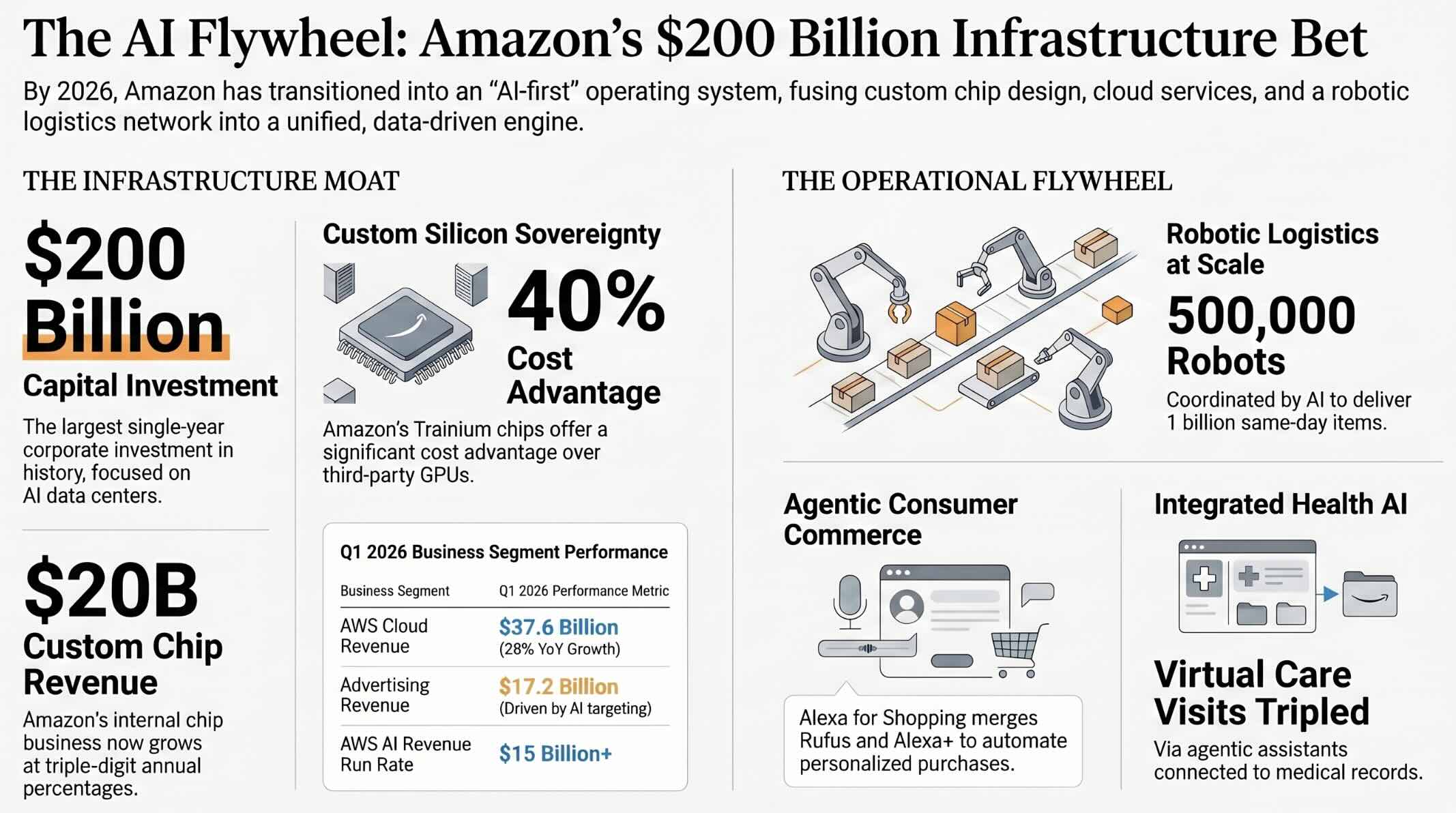
- According to The Motley Fool's analysis, Amazon's AI moat rests on three strategic pillars of custom silicon sovereignty, model-agnostic cloud platform, and physical logistics AI integration that competitors cannot replicate by matching any single dimension.
- According to Amazon's Q1 2026 earnings report, AWS revenue grew 28 percent year over year to $37.6 billion while operating income reached $14.2 billion, confirming that AI workloads are the primary growth driver for the company's highest-margin business.
- Amazon's custom chips business exceeded a $20 billion annual revenue run rate growing at triple-digit percentages, with over 2.1 million AI chips landed in the past 12 months across Trainium, Inferentia, and Graviton product lines.
- Rufus, Amazon's AI shopping assistant, was used by more than 300 million customers in 2025 with monthly active users growing over 115 percent and engagement increasing nearly 400 percent year over year before being merged into Alexa for Shopping.
- Amazon CEO Andy Jassy reported that Alexa+ users complete purchases three times more frequently and talk to the assistant twice as much compared to the original Alexa, demonstrating measurable commercial impact from the generative AI upgrade.
- Amazon's fulfillment network delivered more than one billion items with same-day or overnight shipping in Q1 2026, a logistical achievement powered by AI demand forecasting, robotic automation, and route optimization systems across hundreds of facilities.
- The company's advertising revenue reached $70 billion in trailing twelve-month revenue with Q1 2026 generating $17.2 billion, driven by AI-powered targeting that leverages purchase intent data unavailable to traditional advertising platforms.
- Amazon Health AI virtual care visits nearly tripled year over year, with a majority now facilitated by the agentic assistant, making Amazon the only major AI platform offering integrated clinical care services through a consumer-facing AI agent.
These insights collectively demonstrate that Amazon has moved beyond treating AI as a technology initiative and instead operates it as the foundational layer connecting every business unit, revenue stream, and customer interaction. The velocity of growth across custom chips, advertising, cloud AI services, and healthcare indicates that the flywheel is accelerating rather than plateauing. The convergence of Alexa's consumer AI capabilities with AWS's enterprise offerings creates a dual-sided platform that generates data and revenue from both consumers and businesses. Amazon's scale of investment, speed of execution, and depth of integration across digital and physical operations make its AI position uniquely difficult to challenge.
| Dimension | Amazon Before AI Integration | Amazon with Full AI Integration (2026) |
|---|---|---|
| Transparency | Pricing rules and product rankings operated as internal business logic with limited visibility to sellers or customers | AI-driven pricing and recommendation algorithms remain proprietary, though Amazon faces growing regulatory pressure to explain how automated systems affect seller visibility and consumer pricing |
| Participation | Customers interacted through static search and browse interfaces that required explicit product queries and manual comparison | AI agents like Alexa for Shopping enable conversational, voice-driven, and automated participation where the system proactively suggests, compares, and purchases based on learned preferences |
| Trust | Customer trust was built through delivery reliability, return policies, and review systems managed by human moderation teams | Trust increasingly depends on algorithmic integrity across dynamic pricing, fraud detection, review authenticity, and responsible handling of vast personal data collected across every service |
| Decision Making | Business decisions relied on executive judgment supported by analytics dashboards with limited real-time data processing capability | AI systems make millions of autonomous decisions per hour across pricing, inventory, delivery routing, ad targeting, and content recommendation, with humans providing strategic oversight |
| Misinformation | Product information depended on seller-provided descriptions and customer reviews moderated by human and rule-based systems | AI-generated product summaries, reviews, and chatbot responses create new risks of hallucinated or inaccurate information requiring continuous algorithmic quality control |
| Service Delivery | Logistics operated through human-coordinated warehouse processes with limited automation and manual route planning | Over half a million robots, AI demand forecasting, autonomous drones, and real-time route optimization deliver more than a billion items same-day or overnight per quarter |
| Accountability | Service failures were traceable to specific operational decisions made by identifiable teams and individuals | Algorithmic decisions affecting pricing, product visibility, seller account status, and delivery prioritization create accountability gaps that require new governance frameworks |
Real-World Examples
Amazon's AI-Powered Warehouse Robotics at Scale
Amazon deploys more than half a million robots across its global fulfillment network, using AI to coordinate movement, picking, packing, and sorting operations alongside hundreds of thousands of human workers. The Kiva robot system, which transports shelving units to human workers for order picking, was the foundation of this program, but newer systems can identify and grasp individual items from mixed bins using computer vision and reinforcement learning. According to IEEE Spectrum's coverage of Amazon's robotics program, the company's next-generation fulfillment center in Shreveport, Louisiana, integrates multiple robotic systems under unified AI orchestration, representing the most automated Amazon warehouse to date. The robotics program delivered measurable improvements in order processing speed and accuracy while enabling the company to handle peak demand volumes that would overwhelm purely human-operated facilities. Critics highlight ongoing concerns about worker safety in human-robot collaborative environments and the long-term employment implications for warehouse workers as automation capabilities continue expanding.
Alexa for Shopping: Merging AI Assistants Into Agentic Commerce
Amazon launched Alexa for Shopping in May 2026, combining its Rufus product research AI with Alexa+ to create a conversational shopping agent that remembers customer preferences, tracks prices for up to a year, automates recurring purchases, and compares products across Amazon and third-party retailers. According to CNBC's coverage of the launch, the tool replaced the standalone Rufus chatbot and is now available directly in the Amazon search bar without requiring a Prime membership or Echo device. Alexa for Shopping can even purchase products from third-party websites through its "Buy for Me" feature, extending Amazon's commerce reach beyond its own marketplace. The system's measurable impact includes Alexa+ users completing purchases three times more frequently than original Alexa users and engagement increasing nearly 400 percent year over year. Privacy advocates have raised concerns about the depth of personal data integration required to power this level of personalization across shopping history, voice interactions, and cross-platform behavioral signals.
Amazon Health AI: Agentic Healthcare on Bedrock
Amazon launched Health AI in 2026 as an agentic assistant built on Amazon Bedrock, integrated with One Medical's clinical services and Amazon Pharmacy's prescription fulfillment system to provide 24/7 personalized health guidance with the ability to take clinical action. According to HIT Consultant's reporting, the system connects directly to the nationwide Health Information Exchange to access comprehensive patient records with consent, overcoming the isolation problem that limited earlier healthcare chatbots. Virtual care visits through the platform nearly tripled year over year, and Prime members receive up to five free virtual care visits as part of their subscription. The system autonomously connects patients to human clinicians when clinical judgment is required, creating a hybrid model that bridges AI triage with human medicine. Limitations include geographic availability constraints for in-person One Medical services and ongoing concerns about the accuracy and liability framework for AI-generated health recommendations.
Case Studies
AWS Custom Silicon Strategy: From Chip Design to $20 Billion Revenue
Amazon faced a strategic challenge common to all major cloud providers: dependency on NVIDIA's GPU supply chain created cost pressures and supply constraints that limited the ability to offer competitive pricing on AI workloads. The company invested in designing custom chips from scratch, developing Trainium for model training, Inferentia for inference, and Graviton for general compute, each optimized for specific workload profiles that generic processors could not match. By Q1 2026, Amazon's chips business had exceeded a $20 billion annual revenue run rate, validated by Anthropic's commitment to secure up to five gigawatts of Trainium capacity for training advanced AI models, as detailed in Amazon's SEC filing. The program delivers a reported 40 percent cost advantage over third-party GPUs for large-scale training workloads, directly translating into more competitive pricing for AWS customers.
The custom silicon initiative also gave Amazon supply chain independence during a period when NVIDIA GPU allocation was constrained and competitors were competing for limited chip supplies. The limitation acknowledged by industry analysts is that Amazon's chips currently lack the developer ecosystem maturity and broad model compatibility that NVIDIA's CUDA platform has built over decades, meaning that some advanced AI workloads still require NVIDIA hardware that Amazon also offers through its data centers.
Amazon Connect: AI Agents for Enterprise Workflows
Amazon identified an opportunity to expand its contact center platform, Amazon Connect, from a telephony replacement tool into a suite of AI-powered solutions that automate complex enterprise decision-making across multiple verticals. In 2026, Amazon launched four distinct Connect configurations: Decisions (supply chain), Talent (hiring), Customer (customer experience), and Health (healthcare), each embedding agentic AI capabilities that reason and act autonomously within existing business workflows, as announced during AWS's 2026 product event. The Health configuration delivers agentic patient verification, appointment management, ambient documentation, and medical coding, giving patients faster access to care and clinicians more time for clinical work. The measurable impact includes reduced call center volumes, faster patient throughput, and improved staff capacity for specialized work. The limitation is that deploying these agentic systems requires significant data integration and workflow redesign that many enterprises have not yet completed, creating adoption barriers despite the technology's demonstrated capabilities.
Amazon's AI-Driven Advertising Engine: $70 Billion and Growing
Amazon's advertising business grew from a minor revenue supplement into a $70 billion trailing twelve-month juggernaut by building AI targeting systems that leverage the company's unique access to purchase intent data from hundreds of millions of active shoppers. The AI engine matches advertiser campaigns with customer intent signals in real time, delivering sponsored products, display ads, and Prime Video advertisements to the consumers most likely to convert, as Amazon's Q1 2026 earnings confirm with $17.2 billion in quarterly advertising revenue. The system creates a closed-loop attribution model where ad impressions can be directly linked to purchases on Amazon.com, a measurement capability that traditional media companies cannot replicate. The integration of AI-driven ads into Prime Video represents the newest revenue expansion, with analysts projecting $10 billion in additional revenue by 2027. Critics argue that the growing prominence of sponsored results in Amazon search may degrade the organic shopping experience and create an environment where visibility increasingly depends on advertising spend rather than product quality.
Frequently Asked Questions About How Amazon Uses Artificial Intelligence
Amazon's recommendation engine builds behavioral models using purchase history, browsing patterns, voice interactions with Alexa, seasonal data, and demographic signals to predict customer needs before they are expressed as explicit searches. The system powers everything from personalized homepage layouts to targeted email campaigns and contextual product suggestions during checkout. This predictive commerce capability has evolved to the point where Amazon can pre-position products near anticipated customers through Anticipatory Shipping before orders are placed.
Alexa for Shopping is Amazon's latest AI assistant that combines Rufus product research capabilities with Alexa+ personalization to create a conversational shopping agent available in the Amazon search bar and on Echo devices. The system remembers customer preferences across sessions, tracks prices for up to a year, automates recurring purchases, and compares products across Amazon and third-party websites. Users can ask natural language questions about products and receive contextual recommendations rather than standard search result listings.
Amazon designs three families of custom processors: Trainium for AI model training, Inferentia for inference workloads, and Graviton for general cloud computing, each optimized for specific use cases on AWS. The custom chips business surpassed a $20 billion annual revenue run rate in 2026, and Amazon claims Trainium3 delivers approximately 40 percent cost savings compared to third-party GPUs. Amazon also deploys NVIDIA GPUs alongside its own silicon to give customers the widest range of hardware options.
Amazon operates more than half a million robots across its global fulfillment network, ranging from Kiva mobile robots that transport shelving units to advanced systems capable of picking individual items using computer vision and machine learning. These robots work alongside human employees under AI coordination that dynamically allocates tasks based on real-time workload conditions. The company's newest fulfillment centers integrate multiple robotic systems under unified AI orchestration for maximum automation.
Amazon Bedrock is AWS's model-agnostic AI platform that allows enterprises to access foundation models from multiple providers, including Amazon's Nova, Anthropic's Claude, and Meta's Llama, through a single API with enterprise security controls. The platform's importance lies in giving customers flexibility to switch between models without rebuilding infrastructure. Bedrock has expanded to include managed agents that can autonomously reason, plan, and execute multi-step workflows on behalf of enterprise users.
Amazon launched Health AI in 2026 as an agentic assistant that integrates One Medical clinical services, Amazon Pharmacy prescription fulfillment, and the Health Information Exchange to provide personalized health guidance backed by clinical data. The system books appointments, manages prescriptions, and provides virtual care through messaging, with visits nearly tripling year over year. Prime members receive up to five free virtual care visits as part of their subscription.
Amazon committed approximately $200 billion in capital expenditures for fiscal year 2026, the largest single-year corporate investment in history, directed primarily at AI data center construction, custom chip deployment, and networking infrastructure. CEO Andy Jassy has argued that controlling AI infrastructure will determine which companies capture the most value from the AI economy. The investment is expected to expand AWS capacity across multiple global regions to meet accelerating enterprise demand.
Amazon's Prime Air drones use onboard AI for real-time obstacle avoidance, weather adaptation, and precision landing, managed by a centralized AI dispatch system that handles routing and airspace coordination autonomously. The program has reached commercial scale in select zones across the United States and United Kingdom for packages under five pounds delivered within 30 minutes. Deep learning processes sensor data from cameras, radar, and lidar for navigation safety.
Amazon's advertising AI matches campaigns with purchase intent signals from hundreds of millions of active shoppers, delivering targeted ads across search results, product pages, and Prime Video streaming content. The system creates closed-loop attribution linking ad impressions directly to purchases on Amazon, a measurement advantage over traditional advertising platforms. AI-driven advertising generated $17.2 billion in Q1 2026 revenue.
Amazon collects extensive personal data across shopping, voice interactions, viewing habits, health records, and smart home usage, creating rich behavioral profiles that power its AI but also raise privacy concerns. The company offers tools like the Alexa Privacy Dashboard for managing data, but critics argue that default collection settings favor Amazon's needs over user preferences. Regulatory scrutiny continues around voice recording practices, biometric data use, and cross-service data aggregation.
Machine learning models analyze patterns across billions of transactions to detect fraudulent activity, fake reviews, counterfeit products, and suspicious seller behavior in real time on Amazon's marketplace. The AI identifies anomalies that rule-based systems would miss and improves continuously by processing new fraud patterns. These systems protect both customer trust and marketplace integrity at a scale no human review team could manage.
Amazon positions its warehouse AI and robotics as tools that complement human workers rather than replace them, with AI assigning repetitive tasks to robots and routing tasks requiring dexterity and judgment to people. The company has invested in workforce training programs and collaborative robot designs that operate safely alongside human employees. The long-term trajectory suggests that the nature of warehouse jobs will evolve significantly, with roles shifting from physical labor toward machine supervision and exception handling.
Amazon Q is Amazon's AI assistant designed for enterprise and developer use cases, helping businesses build applications, analyze data, and automate workflows on AWS infrastructure. Alexa is focused on consumer-facing voice assistance, smart home control, and shopping through devices and apps. Both draw on Amazon's AI capabilities but serve different audiences and use cases, with Q emphasizing code generation and enterprise knowledge management.