
Introduction
Artificial intelligence detectors are used to detect AI generated content. AI-generated content has grown rapidly as tools like ChatGPT and Gemini produce essays, articles and social posts in seconds. This efficiency also raises concerns about authenticity and ethics. AI detectors help educators, marketers and publishers confirm if text is human or machine written.
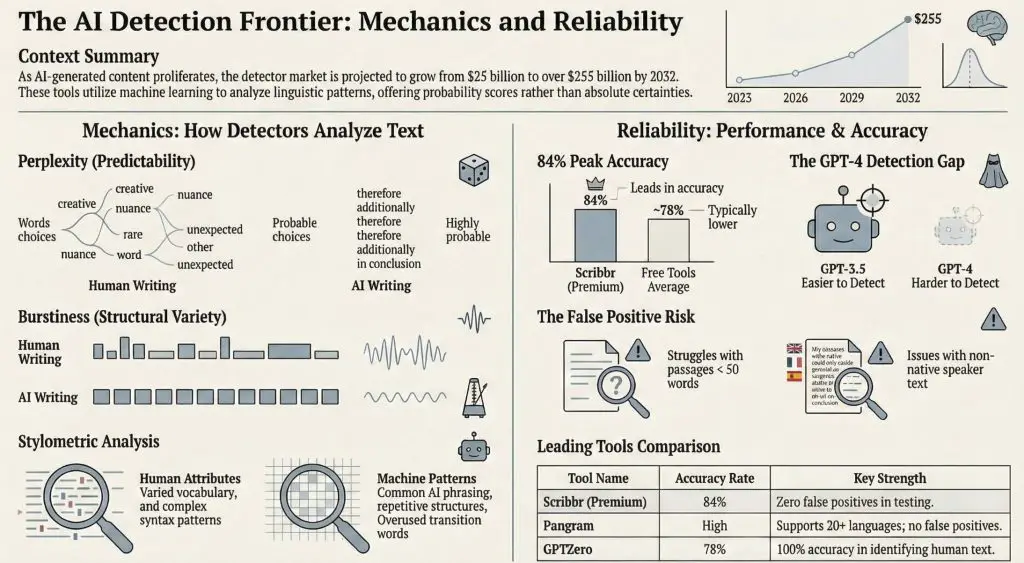
Research shows the AI detector market was about $25 billion in 2023. It may exceed $255 billion by 2032. Universities and businesses already use these tools in academic integrity checks and brand monitoring.
Key Takeaways
- The rise of AI writing has created a demand for tools that detect AI generated content.
- AI detectors analyze text patterns, perplexity and burstiness using machine learning models.
- The best tools provide probability scores and cannot guarantee absolute certainty.
- Scribbr’s premium detector achieved 84% accuracy, while free tools like QuillBot and Scribbr free scored around 78%. Pangram’s detector reported no false positives and supports many languages.
- Evaluation criteria include accuracy, false positive rate, supported models and languages, pricing, integrated features and privacy.
- No AI detector is perfect; false positives can occur, and hybrid or short texts remain challenging.
How AI Detectors Work
AI detectors examine text with algorithms and machine learning to estimate if it is AI generated. Most tools rely on pattern recognition, comparing word choice, sentence structure and predictability with known characteristics of AI writing.
Perplexity measures how predictable the words in a text are. Human writing tends to have higher perplexity than AI generated content. Burstiness measures variation in sentence length and structure. Humans naturally mix short and long sentences. AI often produces uniform patterns. Detectors also use stylometric analysis, linguistic features and semantic embeddings to classify text. Sophisticated tools provide probability scores rather than definitive judgments.
Why Use AI Detectors
Undisclosed AI content can damage trust and reputations. Customers lose confidence in brands if testimonials or posts are produced by a machine. In academia, AI detectors help maintain integrity by identifying AI generated assignments. Businesses use them to avoid search engine penalties for low quality content and to ensure compliance with regulations.
AI detectors also support legal and editorial processes where authenticity matters. They assist with plagiarism detection and help verify authorship. Marketers use these tools to ensure influencer content is genuine.
Evaluation of Leading AI Detectors
Comparative tests reveal that no detector is perfect. In a study of twelve tools, Scribbr’s premium AI detector achieved the highest accuracy at 84%. It produced no false positives. Free tools such as QuillBot and Scribbr free scored about 78% accuracy. Researchers noted that false positives can occur and that GPT‑4 content is generally harder to detect than GPT‑3.5.
A 30‑tool evaluation found that Pangram’s detector passed all tests with no false positives. It supports more than twenty languages. QuillBot detected all Gemini generated texts but struggled with Claude and ChatGPT outputs. GPTZero correctly classified about 78% of AI texts and 100% of human texts. Tools like ZeroGPT and Writer performed poorly, often misclassifying human or AI content.
Different articles highlight integrated solutions. Quetext integrates AI detection with plagiarism and citation tools. It offers an integrity suite for educators and publishers. Some detectors offer API access, Chrome extensions and support for multiple languages.
Choosing The Right AI Detector
When selecting an AI detector, consider the following criteria:
- Accuracy and false positives: Evaluate how often a tool correctly identifies AI content and mislabels human text. Look for detectors with published false positive rates under two percent.
- Supported models and languages: Ensure the detector recognizes content from models like GPT‑4, Claude and Gemini. It should handle the languages you need.
- Usage limits and pricing: Free tools often have word limits and restricted features. Paid plans may offer unlimited scans or advanced analysis.
- Integrated features: Some detectors combine plagiarism checking, citation generation or content moderation, providing a comprehensive integrity platform.
- Privacy and data handling: Check whether the service stores submitted text for training. Privacy focused detectors emphasise that they do not retain or reuse your content.
- Integration and workflow: Consider whether you need API access, a browser extension or integration with Google Docs or learning management systems.
Limitations and Challenges of AI Detectors
AI detectors are not infallible. Even the best tools cannot guarantee perfect accuracy. False positives may occur, especially for non native English writers. Many detectors struggle to identify hybrid content that mixes AI and human edits or text generated by newer models. Short passages of fewer than fifty words are particularly hard to classify.
Because AI and detection algorithms continue to evolve, results can vary across tools and over time. Users should interpret scores as indicators rather than definitive proof and combine tool output with human judgment. Multiple detectors may be needed to build confidence.
Effective Use of AI Detectors
To get the most from AI detectors:
- Update practices regularly as models and detection methods evolve.
- Use detectors as part of a broader verification process rather than as sole arbiters.
- Combine AI detection with plagiarism checking and fact checking for comprehensive integrity.
- Cross check results across multiple detectors to reduce the risk of false positives.
Conclusion
AI detectors play a vital role in maintaining authenticity and trust across education, marketing, publishing and other fields. They help identify AI generated content and support decision making when authenticity matters. While detection tools are improving, they cannot replace human judgment. Users should combine these tools with careful review and choose detectors that align with their needs. As AI and detection methods evolve, staying informed about new tools and best practices will remain crucial.
References
Driessen, Koen. “Best AI Detector: Free and Premium Tools Compared.” Scribbr, 26 Feb. 2024, updated 18 Nov. 2024.
Tian, Edward. “Perplexity, Burstiness, and Statistical AI Detection.” GPTZero, 1 Mar. 2023.
Heffernan, Emily. “Burstiness & Perplexity: Definition and Examples.” QuillBot Blog, 28 Aug. 2025.
Emi, Bradley. “Why Perplexity and Burstiness Fail to Detect AI.” Pangram Labs Blog, 4 Mar. 2025.
Hiller, Abby, and Alex Imas. “Artificial Writing and Automated Detection.” Becker Friedman Institute for Economics, 6 Oct. 2025.