
Introduction
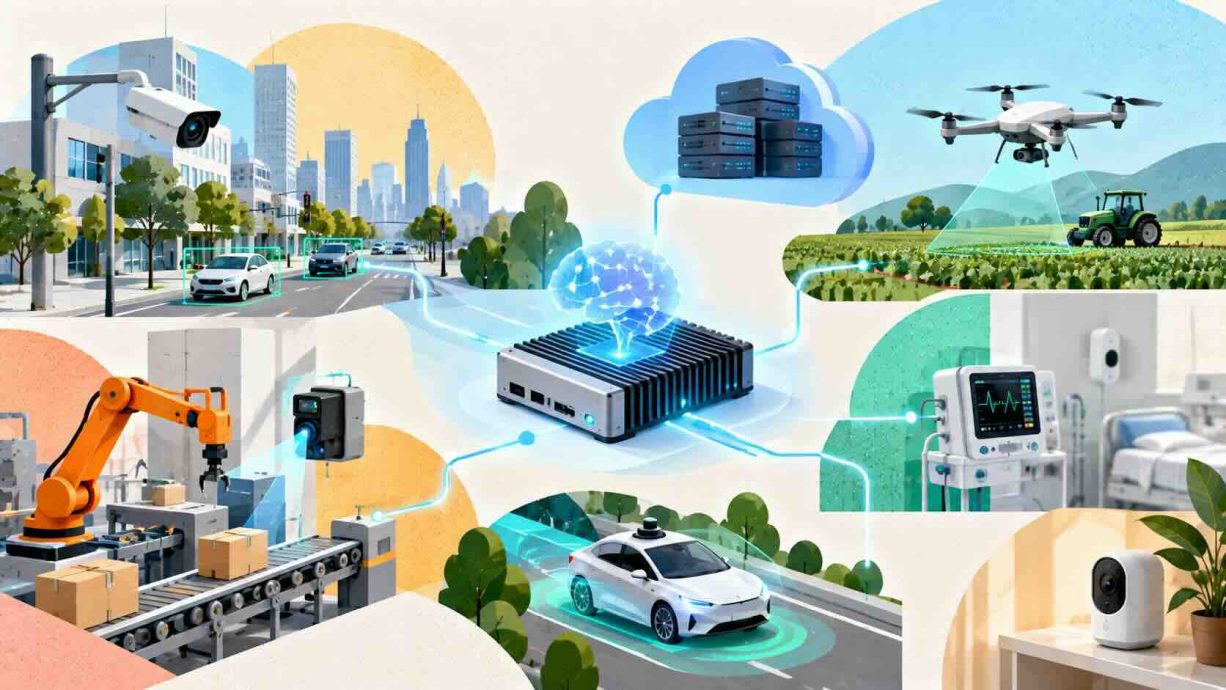
Teams that want edge AI use cases and hardware explained in plain language usually face one choice: run the model on the device, or ship the data elsewhere. Market analysts at P&S Intelligence value the sector at USD 26.9 billion in 2025 and project it to pass USD 128 billion by 2032. That growth rests on a simple pattern in which cameras, sensors, phones, and robots produce more data than networks carry and more decisions than distant servers answer in time. This guide separates the hardware tiers, from microcontrollers to robot-grade computers, and matches each tier to the workloads that fit it. It also covers model compression, language models on small devices, security duties, and the honest limits of the technology. An interactive picker below helps translate your own workload into a hardware class. Read it as a working reference for engineers, product owners, and buyers who need to choose silicon without relying on marketing numbers.
Quick Answers on Edge AI Use Cases and Hardware
What is edge AI?
Edge AI runs trained models on devices near the data, such as cameras, phones, and controllers, instead of sending every input to the cloud. That cuts delay, bandwidth use, and exposure of sensitive data.
Which hardware runs edge AI?
Edge AI hardware spans microcontrollers, accelerators near 4 to 26 TOPS, embedded GPU modules up to 275 TOPS, and robot computers above 2,000 FP4 teraflops. Match the tier to your model, deadline, and power budget.
When should you choose edge over cloud?
Choose edge AI when decisions must land within milliseconds, connectivity is unreliable, or raw data is too large or too private to upload. Keep model training and fleet-wide analytics in the cloud, where scale is cheap.
Key Takeaways
- Edge AI moves inference onto the device, which cuts latency and bandwidth, so it suits cameras, machines, wearables, and robots better than remote servers do.
- Hardware tiers differ by orders of magnitude, from milliwatt microcontrollers to robot computers rated above 2,000 FP4 teraflops, so match the tier to the workload.
- TOPS figures are not comparable across vendors unless precision is equal, so benchmark your own model on candidate hardware before you buy.
- Quantization, secure updates, and device security decide whether a prototype survives production, so budget engineering time for them early.
Table of contents
- Introduction
- Quick Answers on Edge AI Use Cases and Hardware
- Key Takeaways
- What Is MCP Server Security?
- Why Intelligence Is Moving Out of the Cloud
- Anatomy of an Edge AI System From Sensor to Action
- Edge AI Hardware Tiers From Microcontrollers to Robot Computers
- NVIDIA Jetson and Embedded GPU Modules
- Dedicated Accelerators and the Meaning of TOPS
- Phones, Watches, and Laptop NPUs
- TinyML on Microcontrollers
- Shrinking Models With Quantization and Compilation
- Running Language Models at the Edge
- Edge AI in Factories and Industrial Operations
- Edge AI in Healthcare, Retail, and Mobility
- Putting Edge AI Hardware Selection Into Practice
- Securing and Updating Edge Fleets
- Where Edge AI Still Falls Short
- Ethics, Consent, and Accountability for On-Device Decisions
- The Future of Edge AI Hardware
- Key Insights on Edge AI
- Edge AI Deployments Seen in Practice
- Lessons From Real Edge AI Projects
- Common Questions About Edge AI Use Cases and Hardware
What Is MCP Server Security?
Edge AI use cases and hardware explained describe how trained models run on local devices such as cameras and phones, which chips enable that, and which applications benefit.
An Interactive From AIplusInfo
Which Edge AI Hardware Class Fits Your Workload?
Adjust four choices and watch an illustrative demand score and the matching hardware class respond.
Sensor anomaly
Seconds
4 streams
40 percent
Illustrative demand score
0
Microcontroller class
Where the demand comes from
Illustrative model, not a measurement. Weights follow published module ranges such as Jetson modules from 34 to 275 TOPS and accelerators from 4 to 26 TOPS, so treat the tiers as a starting point.
Why Intelligence Is Moving Out of the Cloud
Cloud AI worked well when applications were forms and feeds, where an answer in a few hundred milliseconds felt instant. Sensors changed that equation by producing continuous video, audio, and vibration streams that must be judged while events are still unfolding. A vendor analysis from iFactory puts a cloud round trip at 300 to 500 milliseconds against 1 to 10 milliseconds for local inference. Those figures are marketing claims rather than independent measurements, so treat them as directional only. The physics behind them is plain, because data must be serialized, uploaded, queued, processed, and returned across a wide-area network. Each stage adds delay that no faster model can remove. Edge AI attacks the problem by moving the model to the place where the data is born. The core trade is simple: the edge buys speed, privacy, and resilience, while the cloud keeps scale, training, and central oversight.
Bandwidth and cost form the second pressure on cloud-only designs. A single high-definition camera produces far more data than a typical sensor, and sending every frame to a remote service would be slow and expensive. Local inference lets a device send only events, such as an alert, a count, or a cropped image, instead of the raw stream. Reliability matters as well, since a model on the device keeps working during outages that would silence a cloud service. Remote sites such as mines, farms, and ships often have weak connectivity, so local intelligence is the only dependable option. Analysts list real-time processing, wider connectivity, and bandwidth savings among the main demand drivers for the whole sector.
Privacy is the third pressure, and it increasingly shapes design decisions. Processing a video frame or a heartbeat trace on the device means the raw data never has to leave the person’s wrist, home, or workplace. That does not make a system automatically private, because devices can still log or transmit whatever they see. It does reduce the number of places where sensitive data is stored, which narrows the attack surface and the compliance burden. The sections on security and ethics below return to this point with the caveats that matter. For the wider supply picture, our look at the turning point facing AI hardware places these shifts in the context of chip demand. Treat latency, cost, and privacy as the three tests for whether a workload belongs at the edge.
Anatomy of an Edge AI System From Sensor to Action
An edge AI system is a pipeline with five stages, and weakness in any stage limits the whole. A sensor such as a camera, microphone, or accelerometer captures the raw signal. Preprocessing converts that signal into the format the model expects, for example by resizing frames or computing audio features. The model then runs inference on an accelerator, a CPU, or a microcontroller and produces a label, a score, or a bounding box. Postprocessing turns that output into a decision, and an actuator or application acts on it by stopping a conveyor, sounding an alert, or steering a robot arm. Latency and accuracy depend on the whole chain, not on the chip alone. Teams that benchmark only the model often miss that capture and preprocessing consume a large share of the time budget.
Beyond the loop on the device, most deployments keep a thin connection to the cloud. The cloud handles training, version management, fleet monitoring, and the analysis of events that devices upload. Training usually happens centrally on large GPUs, while inference, which holds 85 percent of the edge AI market in 2025, runs on the devices for most of their lives. Models are compressed and compiled for the target chip before they are pushed to devices as signed updates. Our guide to IoT device management covers the operational side of keeping thousands of such devices healthy. Teams new to this architecture should plan the update path before choosing a model, since a device that cannot be updated safely becomes a liability. Anyone studying edge AI use cases and hardware explained at the system level should begin with that update path.
Edge AI Hardware Tiers From Microcontrollers to Robot Computers
Stepping back from individual products, the edge AI use cases and hardware explained here fall into four broad tiers that differ by orders of magnitude in power. At the bottom sit microcontrollers that draw milliwatts and run models of a few hundred kilobytes for wake words, vibration monitoring, and simple sensing. Above them are low-power accelerators, such as the Hailo and Coral parts, which add roughly 4 to 26 TOPS in a few watts for cameras and gateways. The third tier is the embedded GPU module, typified by NVIDIA Jetson, which offers tens to hundreds of TOPS and a full software stack for robots and vision systems. The top tier now holds robot-grade computers, led by Jetson AGX Thor, that target humanoids and large vision-language models. Each tier solves a different problem, and buying one tier too high wastes power and budget just as buying too low causes missed deadlines.
System-on-chip NPUs form a parallel track that cuts across the tiers. Smartphones, watches, laptops, and cars embed neural processing units into the same chip as the CPU and GPU, so the accelerator costs almost no extra board space. Counterpoint Research counted edge AI smartwatch shipments growing 70 percent year over year in the first quarter of 2026, which shows how quickly NPUs reach consumer products. For a product team, an SoC NPU is attractive because it ships with the device and shares memory with the application processor. The trade-off is less control, since the supported operators and compilers are decided by the chip vendor. Developers often discover that a model falls back to the CPU because a single operator is unsupported on the NPU.
Memory and power usually decide the tier before raw compute does. A model must fit in memory with room for activations, and the bandwidth between memory and the accelerator often limits real throughput. Power sets the thermal design, the battery life, and the enclosure, which matter as much as speed in a camera mounted on a pole. Cost follows a similar ladder, from a few dollars for a microcontroller to a developer kit that starts at $3,499 for Jetson AGX Thor. The useful question is not how fast a chip can go but how fast it can go within the envelope you actually have. A thermal limit that throttles the chip after ten minutes makes a peak benchmark number meaningless. Measure sustained performance, because the datasheet figure describes a best case.
Software support is the fourth factor and the one buyers most often underestimate. A chip is only as useful as its compiler, its supported operators, and its model zoo. NVIDIA offers CUDA and TensorRT for Jetson, Hailo and Google ship their own compilers, and microcontrollers rely on TensorFlow Lite for Microcontrollers and vendor toolchains. Each toolchain imposes constraints on model architecture, precision, and input size. Porting a model after the hardware is chosen can cost weeks and may force accuracy compromises. For that reason, prototype on candidate hardware early and treat the compiler as part of the product.
NVIDIA Jetson and Embedded GPU Modules
Turning to GPU-based modules, NVIDIA’s Jetson family is the reference platform for robots, drones, and vision systems. A published comparison lists the Orin Nano 4GB at 34 TOPS and the AGX Orin 64GB at 275 TOPS. Power modes span roughly 7 to 60 watts across the family. The Orin NX sits between them at 117 TOPS for the 8GB model and 157 TOPS for the 16GB model. These are vendor-quoted figures that depend on precision and sparsity settings, so dense workloads usually achieve less. What a Jetson adds beyond raw compute is software, including CUDA, TensorRT, and a large library of vision pipelines. That ecosystem, more than the TOPS rating, is why Jetson dominates robotics prototypes. Teams already trained on NVIDIA GPUs can often move a model to a Jetson with limited code changes.
Looking at the newest generation, NVIDIA announced general availability of Jetson AGX Thor on August 25, 2025. The company says it delivers up to 2,070 FP4 teraflops with 128 GB of memory. That is described as up to 7.5 times the AI compute and 3.5 times the energy efficiency of Orin. Its announcement names Agility Robotics, Amazon Robotics, Boston Dynamics, Caterpillar, Figure, Hexagon, Medtronic, and Meta among the adopters. FP4 is a four-bit floating point format, so the headline number applies to models prepared for it and uses sparsity. A 130-watt envelope puts Thor in a different class from small cameras and gateways. It targets general robotics, from humanoid robots to heavy machinery and medical systems, where large vision and language models run locally. Buyers should treat 2,070 as a ceiling for ideal workloads rather than a prediction for their own model.
Rivals are pressing from several directions, as our coverage of the AI chip competition among Amazon, Google, and NVIDIA explains. For most embedded projects the practical decision is between staying inside the NVIDIA stack and trading some software convenience for lower power or cost. The smaller Thor T4000 variant is listed at 1,200 FP4 teraflops with 64 GB of memory and a 40 to 70 watt range. That spread suggests NVIDIA expects a wide variety of robot designs. At the other end, the Orin Nano modules bring CUDA to products that need only a handful of cameras. A good rule is to start with the smallest module that meets the deadline with margin, then move up only when measurements demand it. That discipline keeps unit cost, heat, and battery size under control.
Dedicated Accelerators and the Meaning of TOPS
Moving on to dedicated accelerators, the Hailo and Google Coral families show how much inference fits into a few watts. A catalog of embedded chips lists the Hailo-8 at 26 TOPS and about 2.5 watts. It rates the Hailo-8L at 13 TOPS and about 1.5 watts, and the Coral Edge TPU at about 4 TOPS and 2 watts. Hailo also sells camera system-on-chip parts, with the Hailo-15H rated at 20 TOPS in roughly 3 to 5 watts and the Hailo-15L at 7 TOPS in about 2 watts. The Hailo-8 ships on the Raspberry Pi 5 AI Kit, which made it the most accessible accelerator for hobbyists and prototypes. These parts suit smart cameras, retail analytics boxes, and gateways that watch several streams without a fan. A low-power accelerator is often the best value in edge AI because it adds one capability at a fraction of the power of a GPU module. Their main constraint is that the chip runs only models its compiler can translate.
Digging into the numbers, TOPS stands for trillions of operations per second, and it describes the theoretical peak of the multiply-accumulate units. The figure depends on numeric precision, since a chip quoted at INT4 can perform more operations per second than the same silicon at INT8. The same catalog warns that the Hailo-10H’s 40 TOPS is an INT4 figure while most other entries are INT8, so the two cannot be compared directly. Peak ratings also ignore memory bandwidth, batch size, and the efficiency of the compiler, all of which shape real frame rates. A chip with fewer TOPS and better memory handling can beat a larger one on a specific model. Vendor numbers are therefore a screening tool, never a purchase decision.
Choosing among accelerators is easier when the use case is narrow. One practical comparison of the two small boards finds that the Coral suits a few cameras with the lowest power draw. The Hailo-8L suits deployments with more cameras and newer model architectures. The same write-up notes that Coral runs only INT8 TensorFlow Lite models compiled for the Edge TPU, and that the platform has seen little meaningful updating for a long time. Hailo needs an M.2 or PCIe slot, which on a Raspberry Pi means a Pi 5 with the AI HAT. Neither board accelerates every workload, so a photo-search or speech project may still need a GPU. Pick the accelerator whose supported model list already contains your architecture, because adding a custom layer can erase the advantage.
Evaluating a candidate takes four measurements rather than one datasheet line. First, run your own model through the vendor compiler and confirm that every layer maps to the accelerator instead of falling back to the host CPU. Second, measure frames per second at the batch size and resolution your product will use. Third, record power at the wall during a sustained run of at least ten minutes. Fourth, test accuracy after compilation, because the compiler may quantize or fuse layers in ways that change outputs. Teams that do these four checks rarely buy the wrong chip, and teams that skip them often discover the problem after the housing has been molded. Keep that discipline when reading any article on edge AI use cases and hardware explained, including this one.
Phones, Watches, and Laptop NPUs
Shifting to consumer devices, neural processing units now ship in nearly every premium phone, watch, and laptop. Counterpoint Research reports that edge AI smartwatch shipments grew 70 percent year over year in early 2026, reaching 25 percent of the market. It expects penetration to pass 32 percent for the full year. Apple accounts for about 90 percent of those edge AI watch shipments, helped by the 4-core Neural Engine in its S9 chip introduced in 2023. Huawei, Qualcomm, and Google are building their own wearable silicon with dedicated NPUs, so competition is rising. The features that run on the wrist include fall detection, arrhythmia alerts, sleep apnea screening, and heart rate analysis. Wearables prove that edge AI works at a few hundred milliwatts when the model is designed for the chip. Counterpoint does not count platforms without a dedicated NPU, such as Ambiq’s Apollo line, which shows that definitions shape the statistics.
Laptops now carry larger NPUs, and one vendor article reports Snapdragon X2 at up to 75 TOPS and an Apple M5 40-core Neural Engine above 38 TOPS. The same article cautions that popular runtimes such as Ollama, llama.cpp, and LM Studio did not use the NPU as of mid-2026. They ran on the integrated GPU or the CPU instead of the NPU. Models must be converted to ONNX and compiled for the vendor’s execution provider before an NPU will run them. That friction explains why many laptop NPUs sit idle outside operating system features such as background blur or live captions. Developers who want the NPU should target the platform frameworks, such as Apple’s Foundation Models framework, rather than generic runtimes.
Privacy is both the selling point and the open question for these devices. Running recognition locally keeps raw audio and images on the hardware, which our discussion of AI in phones and computers and data privacy explores in detail. The benefit holds only if the vendor documents what leaves the device, because summaries, embeddings, and crash logs can still travel. Consumers rarely have a way to verify those claims, so independent audits and clear settings matter. Product teams should publish a plain list of the data that stays local and the data that is uploaded. That transparency costs little and builds the trust that always-on sensors require. Clear disclosure belongs in every discussion of edge AI use cases and hardware explained for consumers.
TinyML on Microcontrollers
Looking at the smallest class, TinyML runs neural networks on microcontrollers with kilobytes of memory and power budgets below a milliwatt. The MLPerf Tiny benchmark, developed by more than 50 organizations from industry and academia, defines four tasks that mirror real products. They are keyword spotting with a 52.5 KB DS-CNN model and visual wake words with a 325 KB MobileNetV1. The other two are image classification on CIFAR-10 with a 96 KB ResNet and anomaly detection with a 270 KB autoencoder. Each task has a quality target, such as 90 percent top-1 accuracy for keyword spotting, so a fast chip cannot win by being wrong. The suite measures latency in inferences per second and energy in microjoules per inference, using the median of five runs. Energy per inference, not peak speed, is the number that determines battery life on tiny devices. The reference implementations run on an MCU-class board using TensorFlow Lite for Microcontrollers.
Building on those tasks, typical TinyML products include wake-word detection, gesture recognition, predictive maintenance on motors, and presence sensing for lighting. Such devices usually belong to a larger network of sensors that report to a gateway. Adding a small model to each node can reduce radio traffic dramatically, since the node transmits a verdict instead of a waveform. Our overview of how AI and IoT collaborate shows how that division of labor works across a deployment. The main difficulty is data, because microcontroller models need clean, labeled examples from the real sensor, not from a laboratory dataset. Teams should collect field data early and expect two or three rounds of retraining before accuracy stabilizes.
Shrinking Models With Quantization and Compilation
Turning to the software side, quantization is the technique that makes most edge deployments possible. It stores weights and activations in lower precision, such as eight-bit integers instead of 32-bit floats, which shrinks the model and speeds up arithmetic on chips built for integers. One practitioner guide tabulates INT8 at 0 to 2 percent accuracy loss and four times smaller than FP32. It lists INT4 at 1 to 5 percent loss and about eight times smaller. In its YOLOv8-medium example, COCO mAP falls from 50.2 at FP16 to 49.8 at INT8 and 47.1 at INT4, a drop the author calls noticeable in production. For Llama 3.2 3B, perplexity moves from 5.9 to 6.0 to 6.4 while size falls from 6.0 GB to 3.0 GB to 1.8 GB. The lesson is that INT8 is usually safe for vision, while INT4 deserves a careful test. Treat these as one author’s figures rather than universal constants, since results vary by model and hardware.
Post-training quantization is the simplest route because it converts a trained model without retraining. The same guide says it works well for classifiers and detectors above roughly 10 million parameters but can break for very small models or those with outlier weights. When accuracy drops by one to three percent, quantization-aware training simulates low precision during fine-tuning and, according to the guide, recovers 50 to 80 percent of the loss. Our own walkthrough of post-training quantization for edge AI covers calibration choices and common pitfalls. Pruning and knowledge distillation add further savings, and analysts name these on-device optimizations as a driver of the whole market. Apply them in sequence, measuring accuracy after each step so you know which change caused a regression.
Compilation is the last step before deployment, and it deserves equal attention. Frameworks such as TensorFlow Lite, ONNX Runtime, TensorRT, and vendor tools like the Hailo Dataflow Compiler translate a model into instructions for a specific chip. They fuse layers, choose kernels, and sometimes quantize again, so the compiled model can behave differently from the original. The practitioner guide recommends validating on about 1,000 real production images and comparing the full-precision and quantized outputs side by side. It also reports a model that lost 0.5 percent on ImageNet but about 4 percent on a client’s product photos. Public benchmarks therefore do not predict production accuracy, and only your own data can settle the question. Compression is a core chapter of any serious treatment of edge AI use cases and hardware explained.
Running Language Models at the Edge
Looking at generative AI, small language models are the newest workload to reach edge hardware. The Raspberry Pi AI HAT+ 2 pairs a Hailo-10H rated at 40 TOPS in INT4 with 8 GB of dedicated memory and sells for $130. At launch it supported models such as DeepSeek-R1-Distill at 1.5 billion parameters, Llama 3.2 at 1 billion, and Qwen2.5 variants at 1.5 billion. The announcement says edge language models that fit in onboard memory typically run at one to seven billion parameters. They are not meant to match the knowledge of much larger cloud models. Fine-tuning is possible through LoRA adapters for language models, and the Hailo Dataflow Compiler for vision models. The best edge language models are narrow specialists working inside a constrained task, not general chatbots. The announcement also notes that vision performance is broadly equivalent to the 26 TOPS board, so the upgrade is about language, not sight.
On larger devices the ceiling rises, but the limits remain real. A vendor article argues that models of roughly three to nine billion parameters handle most agentic loop work, such as parsing, tool calls, and structured output, on laptops and workstations. It adds that NPUs are not a path to 70-billion-parameter models, which at Q8 need about 96 GB of memory. Memory capacity and bandwidth, not TOPS, usually decide how large a language model can run and how fast it produces tokens. For telecom and industrial pipelines, our report on edge small language models shows how compact models can filter and structure data at the source. Selection should start from the task, then the smallest model that passes an evaluation set, and only then the hardware.
Practical deployment details at the edge differ quite a lot from cloud habits. Quantized formats such as GGUF dominate local runtimes, while ONNX is the common path for NPUs. Latency is dominated by memory bandwidth during token generation, so doubling TOPS rarely doubles speed. Context length consumes memory as well, which means a long conversation can push a small device out of capacity. Teams should cap context, cache prompts, and fall back to a cloud model for rare hard cases. Such hybrid designs keep most requests private and fast while preserving quality where it matters.
Edge AI in Factories and Industrial Operations
Among the strongest use cases, manufacturing combines tight deadlines with expensive downtime. An IndustryWeek overview explains that edge AI lets a plant stop production or start a fix quickly when sensors spot a problem such as overheating. It also keeps models running during internet outages, which matters on remote sites. Market data supports the trend, since P&S Intelligence names manufacturing as the end use with the highest growth, at a 25.9 percent compound annual rate through 2032. Video surveillance remains the largest single application at 35 percent of the 2025 market. Factories adopt edge AI because a late answer is the same as a wrong answer on a moving line. Quality inspection and predictive maintenance are the two projects most plants start with.
In practice the latency argument becomes concrete on a production line. An illustrative calculation from iFactory assumes a packaging line running 400 units per minute, which leaves 150 milliseconds per unit. With a 500 millisecond cloud response, about 3.3 units pass the inspection point before a verdict returns, so the defect is seen but cannot be stopped. A welding robot with a two second cycle that checks quality at one second would receive a cloud answer when the weld is already 75 percent complete. These are vendor illustrations built on stated assumptions, not field measurements. They still capture why control loops under tens of milliseconds are almost always local.
Computer vision does much of the work on these lines. Cameras feed accelerators or GPU modules that flag scratches, missing parts, and misalignments in real time. Our survey of computer vision technologies in robotics describes the techniques behind such systems. Picking the right resolution matters as much as picking the chip, because higher resolution multiplies compute and bandwidth. Many plants discover that cropping to a region of interest delivers the needed accuracy at a fraction of the cost. Lighting and camera mounting often affect accuracy more than the model architecture.
Integration is usually the stage where promising pilot projects stall. The IndustryWeek piece lists scattered operational data, a shortage of staff who can connect business needs to AI, and legacy equipment that lacks the compute for local models. It also repeats a RAND finding that more than 80 percent of AI initiatives fail. Its advice is to start with a focused pilot in quality inspection or equipment monitoring and scale with IT and operations working together. Staged modernization through APIs avoids ripping out machines that still work. A narrow pilot with a clear dollar metric earns the trust that later phases need.
Edge AI in Healthcare, Retail, and Mobility
Beyond the factory, healthcare uses edge AI wherever privacy and speed both matter. Wearables run arrhythmia and fall detection on the wrist, and our overview of wearables and AI in real-time health tracking explains how continuous signals become alerts. An ABI Research article also describes laparoscopic surgery use cases such as low-latency streaming and real-time bleeding detection, though it offers no measured outcomes. The attraction is that a decision can arrive during the procedure instead of afterward. Keeping patient data on the device also reduces the number of systems that must be secured and audited. In medicine the edge is chosen as much for data minimization as for speed. Clinical validation is still required, because on-device does not mean accurate.
Retail applies the same logic to shelves, queues, and stores. The ABI article describes cameras and sensors that flag empty shelves so staff can restock, and a vendor that analyzes store video for customer traffic, heatmaps, and checkout wait times. Those examples are promotional and report no measured results, so they show capability rather than proof. The privacy stakes are higher in stores than in warehouses because shoppers are identifiable people. Responsible deployments count and measure without storing faces, and they post clear notices. Processing video on the device and keeping only counts is both a legal safeguard and a practical way to cut storage.
Mobility rounds out the picture, since vehicles and drones cannot depend on a network for safety decisions. Cars, delivery robots, and agricultural machines fuse camera, radar, and lidar data on board with powerful computers. Adopters named in NVIDIA’s Thor announcement include Caterpillar, which suggests heavy machinery is an active market. Vehicle makers combine perception, planning, and control in tightly certified software stacks. Safety certification, not raw compute, is often the gating factor in these domains. Teams should budget for validation and functional safety work from the first design review.
Putting Edge AI Hardware Selection Into Practice
Given the range of options, a repeatable selection process beats intuition. Begin by writing down the deadline in milliseconds, the number of parallel streams, the power budget, and the environment, because those four facts eliminate most candidates. Next, profile your model to learn its parameter count, memory footprint, and operator list. The picker earlier in this guide turns those inputs into an illustrative hardware class, and it is a starting point rather than a verdict. The cheapest hardware that meets the deadline with margin is the right hardware. Margin matters because real workloads include preprocessing, networking, and logging that datasheets ignore.
From there, prototype on two candidates from adjacent hardware tiers. Run the full pipeline, from capture to action, with realistic data and all streams active. Record sustained throughput, tail latency, power, and temperature over at least an hour. Compare quantized accuracy on your own validation set, not on a public benchmark. If a candidate needs custom operators or heavy rework, count that engineering time as part of its price. Many teams find that a mid-tier module with strong tooling beats a faster chip with a thin software ecosystem.
Operations should be designed alongside the hardware, not after it. Decide how models will be versioned, signed, rolled out in stages, and rolled back. Plan monitoring that reports accuracy proxies, such as confidence distributions, because ground truth is rarely available in the field. A grounding in basic connectivity and device concepts helps, and our introduction to the Internet of Things is a good refresher. Reserve a fraction of compute for updates and diagnostics so the system can improve without a hardware swap. Document the decision, including the rejected options, so the next team understands why the choice was made. Writing it down turns edge AI use cases and hardware explained here into a repeatable internal standard.
Securing and Updating Edge Fleets
Given how exposed these devices are, securing hardware that sits in public places is harder than securing servers in a data center. A practitioner guide lists the main threats as model theft through cloned storage, data exfiltration, adversarial inputs, and device tampering. Someone with physical access can unplug a device, copy its storage, and extract an unencrypted model. A crafted sticker or lighting trick can cause a defect detector to miss real defects. JTAG debugging ports and replaceable firmware give attackers further footholds. Assume that anyone who can touch the device will eventually try to open it. The guide’s own anecdote of an unencrypted model on an SD card is unnamed, so treat it as illustrative rather than documented.
Defenses follow a layered pattern that starts with the device itself. Encrypt the model at rest and seal the key in a trusted platform module so it works only on that device. Enable secure boot, require signed firmware and model packages, and use remote attestation before pushing updates. Restrict network egress to known endpoints and use mutual TLS between device and cloud. Validate inputs for anomalous brightness, contrast, or noise, and route low-confidence predictions to a human or a fallback model. Keep audit logs in tamper-evident storage so incidents can be reconstructed.
Where Edge AI Still Falls Short
Despite the progress, edge AI has limits that vendors seldom emphasize. P&S Intelligence lists high upfront costs for hardware, integration, and training as a key restraint, along with integration complexity across heterogeneous devices. Ongoing maintenance and security costs add to the bill, because a fleet of devices needs updates for years. Compute is another ceiling, since models that fit in a few gigabytes cannot match the breadth of large cloud systems. Edge language models in the one to seven billion parameter range work best on narrow tasks. Edge AI is a constraint-driven discipline, and the constraints do not disappear when the demo works.
Measurement problems compound the difficulty for buyers and engineers alike. TOPS figures differ by precision, vendor benchmarks differ by workload, and public accuracy rarely predicts production accuracy. Many claims in this field come from vendor blogs and promotional articles, including several cited above, and few come from independent testing. Platforms can also stagnate, as the discussion of Coral’s aging software shows. A cautious team treats every number as a hypothesis and verifies it on its own data. Pilots should include a kill criterion so a failing project ends cheaply.
Edge systems also fail in ways that cloud systems do not. Sensors drift, lenses get dirty, lighting changes with the seasons, and the world produces inputs the training set never contained. Without a feedback path, accuracy decays silently over many months. Monitoring confidence and sampling uncertain cases for human review catches drift early. Data privacy rules can restrict what may be collected for retraining, which slows improvement. Planning for these realities early separates systems that last from demos that fade. Honest edge AI use cases and hardware explained should always include these failure modes. The same surveillance concerns that shape policy, discussed in our piece on AI and data redefining surveillance security, apply when cameras are involved.
Ethics, Consent, and Accountability for On-Device Decisions
Stepping back from engineering, on-device processing changes who holds the data and who answers for mistakes. Federated learning is one response, because raw data stays on the device and only model updates travel. An experiment on five Raspberry Pi 4 devices running federated learning reached 85 percent test accuracy on MNIST in about two minutes with non-identical data. Each worker exchanged roughly 400 KB of model data per training round. The authors describe their privacy analysis as qualitative and propose differential privacy and encryption as extra layers without testing them. Our overview of secure federated learning for IoT explains those protections. Keeping data local reduces exposure, but it does not replace consent, transparency, or oversight. Model updates can still leak some information about the examples used in training.
Accountability is the harder question, and it has no settled answer yet. When a camera flags a worker or a watch misses an arrhythmia, responsibility is shared among the chip vendor, the model builder, the integrator, and the operator. Contracts and documentation should say who maintains the model, who reviews errors, and how affected people can contest decisions. Video surveillance is the largest application of edge AI, so consent signage, retention limits, and audit trails matter in practice. Always-on microphones and cameras deserve clear off switches and visible indicators. Organizations that publish plain descriptions of what their devices sense earn more trust than those that rely on legal fine print. Responsible edge AI use cases and hardware explained must include these duties from the start.
The Future of Edge AI Hardware
Looking ahead, the available market data points to steady and sustained expansion. P&S Intelligence projects growth from USD 33.4 billion in 2026 to USD 128.5 billion in 2032, a 25.3 percent compound annual rate, with software expected to grow fastest. Asia-Pacific is forecast to have the highest regional growth at 26.5 percent. Hardware will keep absorbing the largest share, but value is shifting toward the tools that compile, deploy, and monitor models. Counterpoint expects edge AI smartwatches to pass 32 percent penetration in 2026. The next wave is generative models on small devices, supported by chips designed for four-bit arithmetic.
New silicon approaches may reduce the power needed for inference even further. Analog and neuromorphic designs promise efficient inference by computing in memory or with spikes, as our report on an analog neuromorphic chip for efficient AI describes. Such chips are early and need software maturity before they challenge mainstream accelerators. Meanwhile robot-class computers such as Jetson Thor push large multimodal models into machines that move. Vehicles, tractors, and humanoid robots will drive demand, and safety rules will shape their designs, as our explainer on AI in autonomous vehicles suggests.
Standards and tooling will matter just as much as the chips themselves. Benchmarks such as MLPerf Tiny show how shared tests make claims comparable, and similar suites are emerging for larger devices. Expect portable model formats, better compilers, and signed supply chains to reduce lock-in. Regulation of surveillance and automated decisions will push vendors toward on-device privacy features and auditable logs. Teams that learn these fundamentals now will be able to adopt new hardware without rewriting everything. Those habits will keep edge AI use cases and hardware explained today useful as the chips change. The practical advice stays constant: measure your own workload, keep the stack updatable, and respect the people whose data your devices see.
Chart From AIplusInfo
Where Edge AI Money and Work Go
Share of the 2025 edge AI market by component (percent).
Source: P&S Intelligence edge AI market report. Hardware holds 60 percent of the 2025 market and inference holds 85 percent; the software remainder is derived. Chart by AIplusInfo.
Key Insights on Edge AI
- P&S Intelligence values the market at USD 26.9 billion in 2025 and projects USD 128.5 billion by 2032, a 25.3 percent compound annual growth rate that signals sustained investment.
- The same report finds that hardware holds 60 percent of the 2025 market and inference holds 85 percent, so most spending goes to chips that run models.
- Video surveillance is the largest edge AI application at 35 percent, while manufacturing is the fastest-growing end use at 25.9 percent, so demand comes from cameras and factories.
- Counterpoint Research found that edge AI smartwatch shipments grew 70 percent year over year to reach 25 percent penetration in early 2026, proving that dedicated NPUs now reach mass-market wearables.
- NVIDIA says Jetson AGX Thor delivers up to 2,070 FP4 teraflops and 7.5 times the AI compute of Orin, moving large multimodal models into robots.
- IndustryWeek reports that Hitachi cut data transmission by more than 90 percent and unplanned downtime by up to 30 percent with alert-only edge sensors, though without methodology.
- One practitioner guide puts INT8 quantization at 0 to 2 percent accuracy loss and four times smaller models, making compression the cheapest lever for small hardware.
- The Raspberry Pi AI HAT+ 2 offers 40 TOPS at INT4 with 8 GB of memory for $130, yet its launch models stay near 1.5 billion parameters.
Taken together, these figures describe a market that is growing quickly while its hardware keeps getting smaller, cheaper, and more capable. Most of the money flows to inference hardware, which confirms that edge AI use cases and hardware explained simply come down to running trained models near the data. The strongest applications, from surveillance to factory inspection to wearables, share a need for fast and private decisions. Compression and compilation decide whether a model fits, and the numbers show that careful quantization costs little accuracy when validated. Vendor claims still need independent checks, because many cited results lack methodology or baselines. Teams that match the hardware tier to a measured workload will spend less and ship sooner than teams that chase the largest TOPS figure.
| Option | Typical compute (vendor-quoted) | Typical power | Best fit | Main limit |
|---|---|---|---|---|
| Microcontroller with TinyML | Kilobyte models, under a milliwatt class | Milliwatts | Wake words, vibration, simple sensing | Tiny models only |
| Google Coral Edge TPU | About 4 TOPS at INT8 | About 2 W | A few cameras with classic detectors | TFLite-only, aging platform |
| Hailo-8L | 13 TOPS at INT8 | About 1.5 W | Cost-sensitive single-stream vision | Needs M.2 or PCIe slot |
| Hailo-8 | 26 TOPS at INT8 | About 2.5 W | Multi-stream camera analytics | Models must be compiled for Hailo |
| Hailo-10H | 40 TOPS at INT4 | About 2.5 W | Small language and vision-language models | INT4 figure is not comparable to INT8 |
| Jetson Orin Nano 4GB | 34 TOPS | 7 to 25 W | Robots and vision with CUDA | Limited memory |
| Jetson AGX Orin 64GB | 275 TOPS | 15 to 60 W | Autonomous machines and large edge models | Cost and heat |
| Jetson AGX Thor T5000 | 2,070 FP4 TFLOPS, sparse | 40 to 130 W | Humanoids and heavy multimodal models | Price and power envelope |
Edge AI Deployments Seen in Practice
Hitachi’s Edge Sensors for Predictive Maintenance
Beyond the theory, Hitachi shows what happens when analysis moves next to the machine. The company used edge AI sensors to analyze vibration and temperature data on factory equipment, and only alerts were sent on to the cloud. IndustryWeek reports that data transmission dropped by more than 90 percent and that predictive maintenance reduced unplanned downtime by up to 30 percent. The design keeps raw sensor streams on site, which lowers bandwidth cost and keeps the model working during network outages. The limitation is that the article reports the results without a baseline, a time period, or a method, so they work as directional evidence rather than a benchmark. A plant adopting the same approach should measure its own downtime before and after a pilot of at least 3 months.
Smartwatch Health Alerts on a Dedicated Neural Engine
Looking at consumer devices, Apple’s S9 chip, introduced in 2023, includes a 4-core Neural Engine that runs health models on the wrist. Counterpoint Research reports that Apple accounts for about 90 percent of edge AI smartwatch shipments in early 2026. The category reached 25 percent of all smartwatch shipments in that quarter. On-device features include fall detection, arrhythmia alerts, sleep apnea screening, and elevated blood pressure notifications, so sensitive signals need not leave the watch. The result is instant alerts with little battery drain, and it shows that NPUs make continuous monitoring practical. The limitation is that the Counterpoint note supplies shipment data rather than clinical accuracy figures, so it cannot say how reliable each alert is. Buyers should look for regulatory clearance and published validation before trusting a health feature.
Generative AI on a Raspberry Pi 5 With the AI HAT+ 2
Among hobbyist and prototype platforms, the Raspberry Pi AI HAT+ 2 shows how small a generative AI setup can be. It pairs a Hailo-10H accelerator rated at 40 TOPS in INT4 with 8 GB of dedicated memory and sells for $130. At launch it ran models such as Llama 3.2 at 1 billion parameters and several 1.5 billion parameter Qwen and DeepSeek-R1-Distill variants. The demonstration also included a vision-language model describing a live camera stream. All frames can stay on the board, which hints at private assistants that never upload video. The limitation is that the announcement gives no tokens-per-second, power, or latency numbers, and vision speed is broadly equivalent to the older 26 TOPS board. Everything runs locally, so 100 percent of prompts stay off the cloud, yet it remains a prototyping tool until independent measurements arrive.
Recommended by AIplusInfo
Books to go deeper on securing agent integrations
Hand-picked titles that map to the threat modeling, API testing, and adversarial defense work described above.
As an Amazon Associate, AIplusInfo earns from qualifying purchases.

Book
AI at the Edge: Solving Real-World Problems with Embedded Machine Learning
A practical walkthrough of designing, building, and deploying embedded machine learning projects, from data collection to hardware choice.
Buy on Amazon
Book
TinyML: Machine Learning with TensorFlow Lite on Arduino and Ultra-Low-Power Microcontrollers
The classic introduction to running neural networks on microcontrollers, with worked examples for speech, vision, and gesture models.
Buy on Amazon
Book
Practical Deep Learning for Cloud, Mobile, and Edge: Real-World AI and Computer-Vision Projects Using Python, Keras and TensorFlow
Hands-on computer vision projects that show how to shrink and deploy models for phones, single-board computers, and embedded accelerators.
Buy on AmazonLessons From Real Edge AI Projects
Case Study: Why a Packaging Line Cannot Wait for the Cloud
Among the clearest illustrations, an iFactory analysis tests what a cloud round trip does to a fast production line. The problem is a line running 400 units per minute, which leaves 150 milliseconds for each unit to be inspected. The vendor's solution is local inference at 1 to 10 milliseconds, set against a stated cloud delay of 300 to 500 milliseconds. At 500 milliseconds, about 3.3 units pass the inspection point before an answer returns, so the defect is seen but cannot be stopped. The impact is a latency reduction of more than 98 percent, since 5 milliseconds replaces 500, which lets the line reject a unit before it moves on. The limitation is that this vendor blog has inconsistent figures, since its stage ranges sum to 220 to 500 milliseconds, so the arithmetic is only illustrative.
Case Study: Federated Learning Across Five Raspberry Pi Devices
Turning to privacy-preserving training, a research team asked whether small boards could learn together without sharing raw data. The problem was training a model near the data on hardware with 4 GB of memory and no accelerator. The team's solution used federated averaging across five Raspberry Pi 4 devices and a laptop acting as server, as described in the published experiment. The impact was 85 percent test accuracy on MNIST in about two minutes with non-identical data, and 95 percent in as few as 6 rounds with identical data. The limitation is scale, since the study used only five devices and one small dataset, and its privacy analysis stayed qualitative without testing differential privacy or encryption.
Compute proved the bottleneck, because the slowest device averaged about 15 seconds of calculation per round while communication took far less. That finding matters for planners, because it shows that on small boards the processor, not the network, often limits collaborative training. The authors also assumed steady power, so battery drain remains unmeasured. Any production design would need to test energy use and straggler handling before scaling beyond a lab. Teams should also measure how much accuracy changes when devices drop out of a training round.
Case Study: Quantization That Passed Benchmarks and Failed Production
Among the most useful warnings, a practitioner guide describes a model that lost only 0.5 percent accuracy on ImageNet after quantization. The same model lost about 4 percent on a client's own product images. The problem was a team that trusted public benchmarks to predict how the compressed model would behave in the field. The author's solution is to run both the FP16 and INT8 versions on about 1,000 production images and compare the results before shipping. The impact is a decision rule in which a drop under 1 percent ships and a drop of 1 to 3 percent triggers quantization-aware training. A larger drop keeps the model at a higher numeric precision. The limitation is that the client, hardware, and dollar figures in the guide are anonymous and unverifiable, so the story is a cautionary example rather than a documented incident.
Common Questions About Edge AI Use Cases and Hardware
Edge AI means running a trained model on or near the device that collects the data, such as a camera, phone, or controller. The device makes its own decision instead of sending every input to a remote server. That reduces delay, bandwidth use, and the amount of sensitive data stored elsewhere. Training usually still happens in the cloud before the model is deployed.
Cloud AI processes data in remote data centers, while edge AI processes it locally on the device or a nearby gateway. Edge systems answer faster and keep working when connectivity fails. Cloud systems offer far more compute and are better suited to training large models. Most real products combine both, with the edge handling inference and the cloud handling updates.
Market research from P&S Intelligence names video surveillance as the largest application, at 35 percent of the 2025 market. Consumer electronics is the largest end use, and manufacturing is the fastest growing. Other common projects include predictive maintenance, quality inspection, wearables, and retail analytics. Robotics and vehicles are growing as more powerful modules become available.
TOPS stands for trillions of operations per second and describes a theoretical peak for the chip's arithmetic units. Comparisons are only fair when the numeric precision matches, because an INT4 rating is not equivalent to an INT8 rating. Memory bandwidth, batch size, and the compiler also change real performance. Always benchmark your own model on the candidate hardware before making a purchase.
Small accelerators such as the Hailo-8 and Google Coral Edge TPU draw roughly 2 to 2.5 watts according to published catalogs. Jetson modules span about 7 watts to 60 watts across the Orin family. Jetson AGX Thor works in a range up to 130 watts. Sustained power under load matters more than datasheet idle figures.
Edge devices can run small language models, typically in the one to seven billion parameter range for dedicated accelerators. The Raspberry Pi AI HAT+ 2 supports models around 1 to 1.5 billion parameters at launch. Models with 70 billion parameters need far more memory than NPUs or small boards provide. Hybrid designs send rare hard requests to a cloud model.
Quantization stores model weights in lower precision, such as eight-bit integers, so the model is smaller and faster. One practitioner guide reports INT8 accuracy loss of 0 to 2 percent and INT4 loss of 1 to 5 percent. Real losses depend on the model and data, so validate on production samples. Quantization-aware training can recover a meaningful part of the loss when needed.
TinyML is machine learning on microcontrollers with kilobytes of memory and power budgets below a milliwatt. Typical tasks include keyword spotting, gesture recognition, and vibration anomaly detection. The MLPerf Tiny benchmark measures accuracy, latency, and energy per inference on four such tasks. The reference models in that benchmark are all smaller than 330 kilobytes in size.
Edge AI can improve privacy because raw data stays on the device and only results or model updates travel. The benefit depends on what the device logs or transmits, so vendors should document data flows. Federated learning and encryption add further protection but do not remove all risk. Consent and data retention rules still apply to local processing just as they do elsewhere.
Physical access creates risks such as model theft from cloned storage, firmware tampering, and debugging port abuse. Adversarial inputs, like a crafted sticker, can also fool vision models. Common defenses include encrypted models, secure boot, signed updates, remote attestation, and mutual TLS. Low-confidence predictions should route to a human or a fallback model.
Choose a Jetson module when you need the CUDA ecosystem, flexible models, or several tasks on one board. Choose a Hailo accelerator when the workload is a defined vision model and power or cost is tight. Prototype both with your own model and compare sustained frame rate and watts. Software effort often outweighs small differences in the price of the hardware itself.
Edge hardware has limited memory and compute, so models must be compressed and may lose some accuracy. P&S Intelligence lists high upfront costs and integration complexity as key restraints. Fleets require secure update systems and continuous monitoring for accuracy drift over time. Vendor benchmarks are often not independently verified, which makes careful testing essential.
P&S Intelligence estimates the market at USD 26.9 billion in 2025 and USD 33.4 billion in 2026. It projects USD 128.5 billion by 2032, a compound annual growth rate of 25.3 percent. Hardware holds 60 percent of the 2025 total, and software is expected to grow fastest. Forecasts vary between research firms, so treat any single number as an estimate.