
Introduction
Edge AI vs Cloud AI Differences matter because every inference request has to run somewhere, and that choice shapes latency, cost, privacy, and reliability for years. P&S Intelligence puts the edge AI market at USD 33.4 billion in 2026, up from USD 26.9 billion in 2025, as buyers move workloads closer to data. At the same time, cloud AI remains the default for training, very large models, and unpredictable demand, so the real decision is rarely all or nothing. This guide compares the two approaches side by side for buyers who must justify an infrastructure budget with evidence instead of slogans. You will find a plain definition, a scoring tool, a decision framework, hardware tiers, quantization trade-offs, three deployments, three case studies, and thirteen answers to common questions. Each claim links to the page that carries it, and vendor-authored numbers are labeled as such so you can discount them appropriately. If you already follow how AI relates to cloud computing, this article extends that foundation into the physical placement of inference.
Quick Answers on Edge AI vs Cloud AI Differences
What are the main Edge AI vs Cloud AI Differences?
The main differences are location, latency, cost model, and data exposure. Edge AI runs models on or near the device for fast local responses, while cloud AI runs them in remote data centers for scale and elasticity.
When should a business choose edge AI instead of cloud AI?
Choose edge AI when responses must arrive within roughly 100 milliseconds, connectivity is unreliable, or raw data cannot leave the site. Choose cloud AI when demand is bursty, models are large, or you need frontier capabilities.
Is a hybrid design better than edge AI or cloud AI alone?
Often yes. A hybrid design handles simple, urgent, or sensitive requests locally and escalates hard requests to the cloud. It adds routing complexity, so it usually pays off only above about 100,000 queries per day.
Key Takeaways
- Edge AI wins on latency, offline operation, and data locality, while cloud AI wins on elasticity, model size, and speed of access to new capabilities.
- Cost depends on utilization, not on location: idle cloud GPUs and underused edge boxes are both expensive, so measure sustained load before buying.
- Shrinking a model for the edge usually costs a few points of accuracy, so test quantized models on your own data before committing.
- Most production systems end up hybrid, with a small local model handling urgent or private requests and a larger cloud model handling the rest.
Table of contents
- Introduction
- Quick Answers on Edge AI vs Cloud AI Differences
- Key Takeaways
- What Is the Real Gap in Edge AI vs Cloud AI Differences?
- Where the Computation Physically Happens
- Latency Budgets and the Physics of Distance
- Cost Structures Beyond the Sticker Price
- Privacy, Residency, and Regulatory Exposure
- Model Size, Quantization, and What Fits on a Device
- Hardware Tiers Edge AI Buyers Should Know
- Reliability, Fleet Operations, and Security Exposure
- Training Versus Inference Placement
- A Decision Framework for Choosing Between Edge AI and Cloud AI
- Hybrid Routing Patterns That Hold Up in Production
- Putting a Pilot Into Production Without Regret
- Risks: Where Edge AI Falls Short
- Ethics, Energy, and Access Questions
- The Future of Edge AI and Cloud AI Convergence
- Bringing the Evidence Together for Your Next Budget Cycle
- Key Insights
- Edge AI vs Cloud AI Differences in Practice Across Three Deployments
- Lessons From Three Edge and Cloud Case Studies
- Common Questions About Edge AI vs Cloud AI Differences
What Is the Real Gap in Edge AI vs Cloud AI Differences?
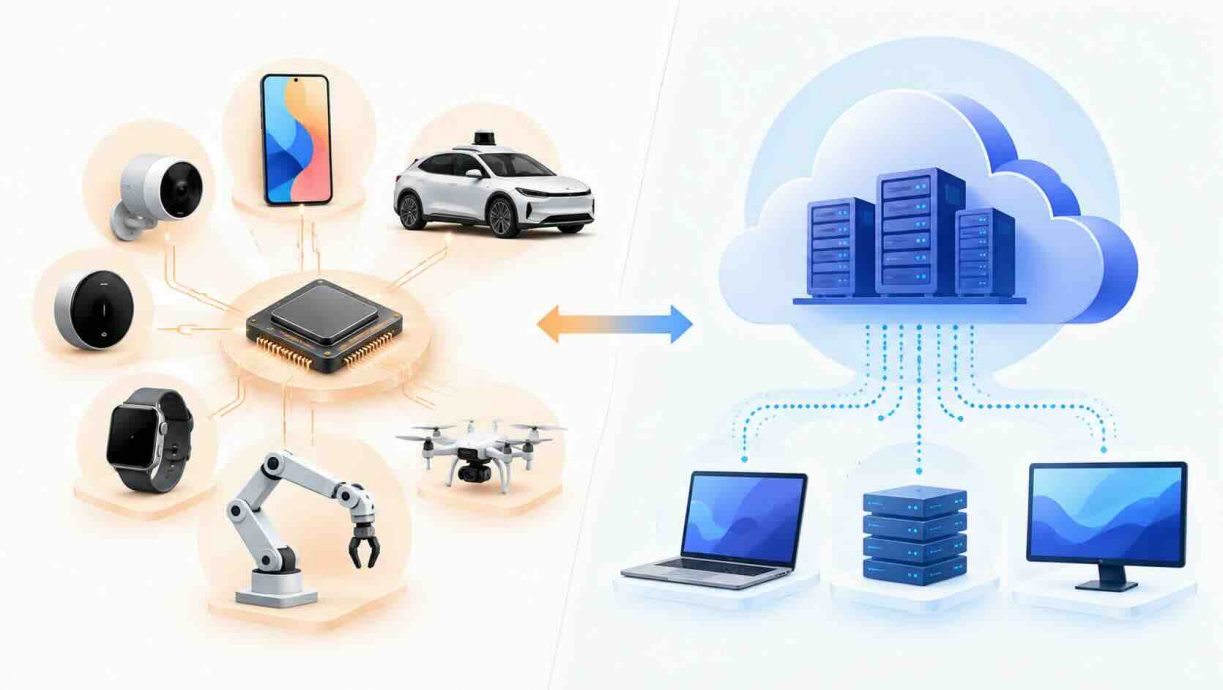
Edge AI vs Cloud AI Differences describe where inference executes: edge AI runs models on devices or local servers near the data source, while cloud AI runs them in remote data centers. The split determines latency, bandwidth, privacy exposure, cost structure, and operational responsibility.
An Interactive From AIplusInfo
Where Should This Workload Run?
Move the four controls to describe one AI workload and see a placement recommendation, three scores, and a rough monthly cost.
100,000
310 ms
Internal
Typical
Recommended placement
Hybrid
Placement scores
Rough monthly cost
Managed cloud API, low to high
$0
Owned edge nodes
$0
Illustrative model, not a quote. It assumes 1,000 tokens per request, a managed API at 3 to 15 dollars per million tokens (DataNorth), and a 7B-class model at 100 tokens per second on a 2,000 dollar node over three years with power and upkeep, run at 50 percent target load (Spheron). Hybrid routing usually repays its engineering cost only above about 100,000 queries per day (Tianpan). Staff time, integration, and model quality differences are excluded.
Where the Computation Physically Happens
Stepping back from the marketing language, the cleanest way to separate the two approaches is to ask where the matrix multiplication physically happens. Edge computing is a spectrum rather than a single place, running from the phone in a pocket to the camera on a pole. Closer to the core, it includes the gateway in a factory cabinet and the server rack in a branch office. Cloud AI sits at the far end of that spectrum, in regional data centers where thousands of accelerators are pooled and rented by the hour or by the token. A useful middle ground is the telecom edge, where edge small language models in telecom show how carriers place compact models close to network traffic. Each step toward the cloud adds compute and removes control over timing, which is the trade this article keeps returning to.
Looking at a concrete architecture makes the split easier to see. In a reference design published by AWS, each camera runs a detector continuously, then calls a quantized 8-billion-parameter vision-language model only on the regions that matter. The cloud half of that design handles queueing, orchestration, retraining jobs, and over-the-air updates, as described in the AWS physical AI blog on Edge Impulse. Notice that neither half works alone: the edge cannot retrain itself cheaply, and the cloud cannot see the warehouse floor without streaming every frame. That division of labor, perception at the edge and coordination in the cloud, repeats across industries.
Cloud AI deserves an equally concrete description, because its strengths come from pooling. Shared data centers keep expensive accelerators busy by mixing many customers, so one request can reach a model far larger than any phone could hold. Elastic capacity also means a team can run a thousand parallel experiments on Monday and none on Tuesday without owning idle hardware. The price of that flexibility is distance, because every request must cross a network, queue for capacity, and return. Edge AI trades that flexibility for proximity, and nearly every difference in the sections that follow is a consequence of this single trade.
Latency Budgets and the Physics of Distance
Beyond the headline claim that edge is faster, latency deserves a budget, because different applications tolerate very different delays. Light in optical fiber covers roughly 200 kilometers per millisecond, so a data center 1,000 kilometers away adds about 10 milliseconds of round-trip propagation before any queueing or computation. Practical measurements are larger: one hybrid inference guide from Spheron puts typical network round trips to a cloud endpoint at 20 to 80 milliseconds. Interactive chat tolerates about half a second, while voice assistants aim for a total pipeline near 500 milliseconds, so the network share matters. Every extra hop, from a mobile network to a corporate gateway, adds delay that you pay on every single request.
Large language models add a second delay that has nothing to do with distance. Cloud calls also wait for scheduling, prompt processing, and the first generated token, which one practitioner analysis by Tianpan estimates at 200 to 500 milliseconds before the first token arrives. That same analysis notes that a 3-billion-parameter on-device model can generate each token in under 20 milliseconds with no network dependency. These figures come from a single practitioner and will vary by provider, region, and load, so treat them as orders of magnitude rather than guarantees. Still, the gap between tens of milliseconds and hundreds of milliseconds is large enough to change which products are feasible.
Safety-critical systems set the hardest limits, and they show where the cloud cannot compete. A 2026 analytical study of offloading autonomous driving over 5G and 6G separates a 100-millisecond reactive budget from a 300-millisecond deliberative tier and assumes an onboard fallback for reactive control. Its authors find that memory-bandwidth-bound decoding takes about 114 milliseconds on 2025 hardware, which already exceeds the reactive budget before any network time is added. For control loops measured in tens of milliseconds, the practical answer is to keep inference on the device. For summaries, reports, and planning, a half-second cloud round trip is invisible, which is why the same product often uses both.
Cost Structures Beyond the Sticker Price
Turning to money, the biggest mistake buyers make is comparing a cloud price per million tokens with a hardware price per box. Cloud AI is an operating expense that scales with usage, while edge AI is a capital expense that scales with device count and then charges nothing per inference. A Spheron estimate shows the shape of the comparison: a consumer RTX 5090 amortized over three years works out to roughly 0.35 dollars per million tokens at sustained load. The same source puts an on-demand H100 near 0.19 dollars per million tokens when batching keeps it busy. Hardware location alone therefore does not decide the winner; utilization does.
Utilization is the hidden variable that flips the result in both directions. The Spheron analysis notes that at 10 percent utilization the on-demand cost per token rises about tenfold. It also finds cloud on-demand pricing competitive with owned hardware only near 70 percent sustained use. An always-on H100 at 2.01 dollars per hour costs roughly 1,450 dollars per month whether or not anyone sends a request. Edge boxes suffer the mirror problem, because a camera analytics server that runs at 5 percent load still needs power, cooling, and a technician. Before comparing vendors, measure your queries per day, your peak-to-average ratio, and how many hours the hardware would actually stay busy.
Real deployments add costs that never appear on a pricing page. Bandwidth is the most underestimated line item in these comparisons. Fora Soft's 2026 camera model calculates that fifty 5-megapixel cameras uploading everything generate about 12.75 terabytes per month. With edge filtering, the same cameras need roughly 0.6 terabytes. In the same model, a do-it-yourself edge design costs about 7.49 dollars per camera per month, against 27.21 dollars for cloud-only AWS. The authors sell these services and state several assumptions, so treat the result as a template. You can explore Fora Soft's camera cost comparison and substitute your own inputs. Cloud bills also include egress fees, storage, and engineering time, all of which belong in a total cost of ownership view.
Finally, the people cost often decides the outcome more than the hardware does. A guide to ways to reduce LLM inference costs shows how much savings are available without moving anything to the edge, through caching, batching, and smaller models. Tianpan's analysis cautions that below roughly 100,000 queries per day, the savings from a hybrid router rarely cover the engineering effort required to build and maintain it. Optimize the cloud bill first, and move to the edge only when a specific workload proves it needs local execution. Teams that skip this order end up funding a device fleet to solve a problem that a cheaper model tier would have fixed.
Privacy, Residency, and Regulatory Exposure
Shifting focus to data protection, edge AI is attractive because raw data can stay where it was captured. A phone that transcribes speech locally never uploads the audio, and a factory camera that flags defects locally never exports images of workers. Google's documentation for Gemini Nano on Android states that prompts run locally with no server calls, and that the AICore service does not store inputs or outputs after processing. That design removes an entire class of breach and subpoena exposure, because data that never leaves the device cannot be intercepted in transit or retained by a vendor. Regulated industries such as healthcare and finance often start their evaluations with this property alone.
Local processing is not the same as legal compliance, and buyers should resist that shortcut. Fora Soft's analysis notes that edge deployment does not remove obligations under GDPR Article 9 or Illinois biometric rules, because the controller still decides what is captured and retained. What edge mainly reduces is the cross-border transfer analysis and the chain of processors that touch the data. A hospital that keeps imaging inference inside its own network still needs access controls, audit logs, and retention schedules. That is why AI in phones and computers remains a useful reminder that on-device processing shifts risk rather than erasing it.
Cloud providers have also narrowed the gap with confidential computing and regional controls. Tianpan reports that confidential computing overhead for inference has fallen from 10 to 30 percent to roughly 2 to 5 percent. That makes encrypted cloud inference far more practical than it was. Apple's Private Cloud Compute follows the same logic by sending only the requests that the on-device model cannot handle to servers built on Apple silicon. The strongest privacy posture is usually a layered one: local by default, cloud only by exception, and summaries instead of raw content at the boundary. Sending full conversation history to the cloud after local processing, by contrast, quietly undoes the benefit.
Model Size, Quantization, and What Fits on a Device
Given the privacy appeal of local models, the central constraint at the edge turns out to be memory, not arithmetic. A model's weights must fit in device memory alongside the runtime, the input buffers, and everything else the device is doing. Quantization is the main tool for fitting them, and the guide to post-training quantization for edge AI walks through the mechanics. Storing weights in 4 bits instead of 16 cuts memory by about 75 percent and, according to Tianpan, speeds inference by two to four times on supporting hardware. Anything beyond that budget forces the device to swap, throttle, or fail, which is why memory planning comes before benchmarking.
The accuracy cost of that compression is smaller than most buyers fear, but it is not zero. A study of more than 500,000 evaluations across the Llama 3.1 family found FP8 quantization effectively lossless across all model scales. In the same study, carefully tuned INT8 lost only about 1 to 3 percent accuracy. Four-bit weight-only schemes performed competitively with 8-bit methods in the same study. Apple's on-device foundation model, which has roughly 3 billion parameters, averages 3.7 bits per weight using mixed 2-bit and 4-bit palettization. Those results explain why small language models are now practical on phones, laptops, and industrial gateways.
Benchmarks can still mislead, so validate on your own data before you trust any figure from a vendor or a paper. Fora Soft reports that a YOLOv8n detector on a Jetson Orin NX dropped from 0.37 to 0.32 mAP when moved from FP32 to INT8. That is a relative loss of about 13.5 percent, while latency fell from 6.17 to 2.32 milliseconds. Tianpan describes a distilled model that retained 95 percent of its parent's score on a general benchmark but only 70 percent in one specific domain. Calibrate and test quantized models on a sample of your own production inputs, because general benchmarks hide domain gaps. If the accuracy loss on your data is unacceptable, the answer may be a larger edge module or a cloud fallback rather than a heroic compression effort.
Hardware Tiers Edge AI Buyers Should Know
Looking at the hardware landscape, it helps to sort devices into tiers by memory and power rather than by marketing names. At the top of the practical edge range, NVIDIA's Jetson Orin Nano Super developer kit delivers 67 sparse INT8 TOPS in a 25-watt envelope. NVIDIA cut the developer kit price to 249 dollars from the original 499 when it released the boost. Laptops form the next tier, with Microsoft requiring at least 40 TOPS of NPU performance and 16 gigabytes of memory for Copilot+ PCs. Industrial boxes pair an x86 host with an accelerator such as a Hailo-8 or a 25-TOPS DEEPX module for factory lines.
Spec sheets deserve skepticism because TOPS is a peak rating, not a measured workload. Fora Soft found that a Jetson Orin Nano Super handled about 8 to 12 cameras at 1080p in practice, far fewer than the theoretical figure. Decoding and memory bandwidth bind first, long before the advertised TOPS are exhausted. A peak rating tells you what the silicon could do, not what your pipeline will. Spheron lists a Jetson AGX Orin with 64 gigabytes of unified memory at 60 to 120 tokens per second on a 7-billion-parameter model. It lists a 128-gigabyte Apple M4 Max at 80 to 150 tokens per second on the same class of model. For context on who supplies this silicon and where it is heading, the overview of the AI chip wars is a good companion. Ask every vendor for measured throughput on your model, at your precision, with your input pipeline.
Reliability, Fleet Operations, and Security Exposure
On top of the compute questions, reliability changes character when inference moves from a data center to thousands of scattered devices. Cloud providers publish service levels, replicate across zones, and absorb hardware failures without the customer noticing. A fleet of edge devices fails differently, through corrupted model downloads, full storage, overheated enclosures, dead power supplies, and flaky uplinks. Tianpan's analysis recommends an automatic cloud fallback whenever an on-device model fails to load because of memory pressure, corruption, or unsupported hardware. The reverse also holds, since cloud outages and rate limits need queuing or an honest message that the answer will take longer. Practices from IoT device management, such as inventory, health telemetry, and remote recovery, apply directly to any edge AI fleet.
Fleet operations are the cost that surprises new edge teams the most. Every model update must reach devices with limited storage and intermittent connectivity, and a bad update can degrade hundreds of locations at once. The practical answer is staged rollout, with a small canary group first, automatic quality metrics per tier, and instant rollback when those metrics drop. The AWS reference design for camera fleets keeps a human approving each retrained model before deployment, which trades speed for safety. Cloud AI hides this burden because the provider updates the model behind a stable endpoint, although that also means your behavior can change without notice. Decide who owns versioning before the first device ships, because ownership gaps are where fleets quietly rot.
Security exposure differs as well, and neither side is simply safer. Edge devices can be stolen, opened, or tampered with, so model weights, credentials, and any cached data need hardware-backed protection and encryption at rest. Cloud platforms offer mature identity, logging, and isolation tools, but they concentrate valuable data and traffic in one place that attackers prefer to target. The right comparison is not which side is more secure but which attack surface your team is equipped to defend. A small company with no security staff may do better trusting a hyperscaler's controls than managing a thousand unattended boxes. A large manufacturer with strong plant security may prefer to keep sensitive imagery inside its own walls.
Training Versus Inference Placement
From there, it helps to separate the two halves of the machine learning lifecycle, because they behave differently. Training is compute-hungry, bursty, and tolerant of delay, which makes it a natural fit for pooled cloud accelerators. Inference runs continuously, has strict latency targets, and touches live data, which pulls it toward the edge. P&S Intelligence reports that inference accounted for about 85 percent of edge AI function share in 2025, with training at the edge growing faster from a smaller base. That pattern matches intuition: devices mostly run models that were trained elsewhere.
Some learning does move toward the edge, usually in lightweight forms. Federated learning lets devices compute updates locally and share only those updates, and secure federated learning for IoT shows how that approach protects raw data. Apple's on-device model uses small adapter layers of tens of megabytes to specialize behavior without retraining the whole network. A practical rule is to train and evaluate in the cloud, then push compact, signed artifacts to devices. Teams that attempt full training on constrained hardware usually discover that data preparation, evaluation, and governance remain cloud-shaped problems. Plan for retraining as a fleet-wide pipeline, because model drift appears in the field long before it appears in a dashboard.
A Decision Framework for Choosing Between Edge AI and Cloud AI
Choosing among architectures works best when you score each workload against a short list of questions instead of debating philosophy. The DataNorth comparison of cloud, edge, and local AI frames them as how sensitive the data is, how fast the response must be, and how often the workload runs. Sensitivity pushes toward local execution, speed pushes toward the edge, and low or unpredictable frequency pushes toward pay-per-use cloud. Add two practical questions about connectivity and model size, and you have five inputs that cover most buying decisions. Score each input from low to high, weight it by how much it hurts if you get it wrong, and compare the totals.
Fora Soft's four gates turn those questions into thresholds that a finance team can check. The first gate asks whether something local must act in under one second, and if so, inference should run on site. The second gate multiplies camera count by roughly 0.8 megabits per second for 5-megapixel video and compares the result with the sustained uplink you can actually buy. The third gate asks whether residency rules or contracts restrict moving raw footage, in which case you should anonymize at capture. The fourth gate asks about scale, because fixed engineering costs are only worth paying when many devices share them. These gates come from one vendor's video use case, so adapt the numbers to your own workload before relying on them.
Scale thresholds deserve a worked example, because they decide whether a custom build pays off. In the same analysis, a 100,000-dollar build beats a premium subscription only above roughly 108 cameras over three years, or 65 cameras over five years. The authors advise budgeting 10 to 20 percent of build cost each year for upkeep, which pushes those thresholds higher. Small deployments should therefore buy a managed service, mid-sized ones should consider hybrid boxes, and only large fleets justify custom hardware. The same logic applies to language models: the privacy challenges and solutions in AI often decide the placement before cost enters the conversation. If compliance forces local execution, the cost comparison becomes a question of which local option is cheapest.
The interactive scorer earlier in this article encodes these ideas in a form you can try with your own numbers. It asks for your daily request volume, your latency budget, your data sensitivity, and your connectivity, then estimates a placement and a rough monthly cost for each option. Treat its output as a conversation starter for your architecture review, not as a purchase order. The model is deliberately simple: it uses published price points and the thresholds discussed above, and it cannot see your integration costs or your team's skills. Run it for each major workload separately, since one company often needs cloud for analytics and edge for cameras. Where the scorer and your intuition disagree, write down why, because that disagreement usually points to a hidden assumption worth testing.
Hybrid Routing Patterns That Hold Up in Production
Building on that framework, most mature deployments end up with a router that decides per request where inference should run. Tianpan describes a three-stage cascade that starts with an intent classifier running in under 5 milliseconds. A complexity estimator then scores the request, and a cost-aware scheduler weighs cloud latency and rate limits. Simple, latency-critical tasks such as autocomplete or classification go to the device, while long-context reasoning goes to the cloud. Ambiguous requests are where routing quality matters most, and binary simple-versus-complex rules tend to break down in production. A local AI coding stack is a familiar example, where small local models handle completions and cloud models handle architecture-level questions.
Speculative execution is the second routing pattern that is worth knowing about. The device answers immediately while a verifier checks confidence, and low-confidence answers escalate to the cloud without making the user wait twice. Tianpan estimates that this approach can keep roughly 70 to 80 percent of queries local, and Spheron suggests starting with 70 to 85 percent of traffic as a target. Those shares only hold if the local model passes your evaluation on most queries, so measure quality per tier in production rather than trusting a benchmark. Without per-tier metrics, bad routing decisions are invisible, and users simply experience an assistant that is sometimes inexplicably worse. Log which tier answered, how confident it was, and whether the user accepted the result.
The third pattern concerns what crosses the boundary between device and cloud. Sending the full conversation history to the cloud after local processing undermines the privacy benefit, so the device should produce a compact, privacy-safe summary instead. Routing priority also matters, and the Spheron guide orders it as personal data first, then token budget, then task type, then optional confidence. Hybrid routing is worth building only when a measurable cluster of requests is both safe to answer locally and expensive to answer remotely. Tianpan's advice is to start cloud-only, instrument the request distribution, and add edge inference when the data shows a clear win. That sequence keeps complexity proportional to evidence, which is the discipline most failed hybrid projects lacked.
Putting a Pilot Into Production Without Regret
Next, a pilot should be designed to answer a single question: does this workload clear the gates at acceptable quality and cost? Pick one narrow workload with a measurable outcome, such as defect detection on one line or transcription for one team. Run it in the cloud first to establish a baseline for accuracy, latency, and spend, because you cannot judge an edge deployment without a reference. Then quantize the model and calibrate on real inputs, since Fora Soft suggests that calibrating on about 1,000 frames from your own cameras narrows the accuracy gap. Teams building agents for phones and laptops can study on-device agents built with Kotlin for patterns that keep local tools responsive.
Shadow mode is the safest next step, because the edge system runs beside the incumbent without taking action. Compare its outputs with the baseline for at least a few weeks, and look specifically at the tail cases where errors cost the most. If the shadow results hold, move to a canary group of devices or users with automatic rollback tied to quality metrics. Tianpan emphasizes staged rollouts, A/B tests, and rollback triggers because edge model updates must also respect limited device storage. Define success criteria in advance, including accuracy thresholds, latency percentiles, and a maximum cost per thousand inferences. Pilots that lack written criteria tend to continue indefinitely, because nobody can agree on whether they worked.
Production readiness is mostly about the boring parts that nobody wants to demo. Document who owns model versions, who responds when a device goes dark, and what the fallback behavior is when the edge model cannot answer. Budget for monitoring, secure update channels, spare hardware, and a refresh cycle, since devices age faster than cloud contracts expire. A pilot is finished only when someone has rehearsed the rollback and the cloud fallback under realistic failure conditions. Include finance in the review so that the total cost of ownership, not just the hardware quote, drives the final decision. When the numbers hold under those conditions, expand gradually and keep the cloud path alive as insurance.
Risks: Where Edge AI Falls Short
Despite the savings that edge enthusiasts promote, edge AI has real failure modes that buyers should price in. The first is a quality gap, because smaller models trained or distilled to fit a device inherit the strengths and mistakes of their teachers. Tianpan describes a distilled model that kept 95 percent of its parent's general benchmark score but only 70 percent in one specific domain. Those errors are stated with the same confidence as correct answers, which makes them hard to detect without domain-specific evaluation. Applications such as medical or legal analysis, where every response needs maximum accuracy, are poor candidates for the smallest local models.
Operational and strategic risks come next, and they tend to appear after the pilot succeeds. Hardware bought for today's model may be too small for next year's, leaving stranded assets, and vendor-specific toolchains can lock you into a single silicon family. Even a well-designed edge system can disappoint when settings are misused. An Arkansas trial of John Deere's See & Spray showed low sensitivity cut herbicide use 43 to 59 percent but let small weeds survive. Surviving Palmer amaranth in that trial raised the weed population by 280 percent per year, which illustrates how a cost-saving setting can create a larger downstream problem. Every edge efficiency gain should be paired with a metric that would reveal a hidden quality loss. Read smart farming with AI and IoT for more on the agricultural context of such trade-offs.
Ethics, Energy, and Access Questions
Looking beyond the balance sheet, the placement of AI carries ethical weight that spreadsheets rarely capture. Edge deployments can protect privacy by keeping raw data local, but they can also normalize pervasive sensing, because cheap cameras and microphones with local intelligence are easy to install everywhere. Cloud deployments centralize data, which raises concerns about retention, secondary use, and dependence on a few providers. Neither architecture is ethical by default, so the question is who consents, who can inspect the system, and who can switch it off. Document the purpose of each sensor and model, and publish retention rules that employees and customers can read.
Energy is the other side of the ledger, and the picture is mixed. Reporting on forecasts that data center energy use could quadruple by 2030 highlights how central power has become to cloud AI economics. Efficiency work such as optimizing AI data centers for sustainability matters because pooled hardware can run at high utilization. Edge devices spread the load into small power envelopes, such as the 7, 15, and 25 watt modes on Jetson Orin Nano Super. They also add manufacturing impact and electronic waste that must be counted. Measure energy and carbon per thousand inferences for both options instead of assuming that local means green. Access also matters, because edge AI lets people in low-connectivity regions use intelligent tools offline, while cloud AI keeps the most capable models available to anyone with a connection.
The Future of Edge AI and Cloud AI Convergence
Looking ahead, the boundary between the two approaches is moving in both directions at once. Market researchers disagree on size but agree on direction: P&S Intelligence projects the edge AI market reaching USD 128.5 billion by 2032 at a 25.3 percent compound annual growth rate. IMARC Group, using a different scope, estimates USD 90.8 billion by 2034 at 16.83 percent growth from a 2026 base of USD 26.2 billion. The gap between those figures is a reminder to treat any single forecast as a range. What both reports share is the expectation of double-digit annual growth, which signals durable demand for local inference.
Hardware progress is the main driver behind this convergence from both directions. Neural processing units have become a standard laptop feature, with Copilot+ PCs requiring 40 TOPS, and low-power modules like the Jetson Orin Nano Super now cost a few hundred dollars. Model compression keeps improving, so tasks that required a data center two years ago fit in a phone today. Meanwhile, cloud accelerators keep getting larger and cheaper per token, which means the economic argument for the edge must keep pace with a moving target. The result is convergence rather than victory, with devices handling more of the common cases and clouds handling the hardest ones.
Autonomous machines show most clearly where the line between edge and cloud may move next. The 2026 offloading study estimates that the latency floor for autonomous driving models falls below 100 milliseconds around 2027, and that sixth-generation networks could support feature-level offload by about 2028. It also finds that once a model is latency-admissible, pooled cloud GPUs can undercut onboard hardware that sits idle much of the time. Readers curious about the vehicle side can review how self-driving cars actually work. Latency decides which model placements are possible in a given year, and cost decides which of those are sensible. Revisit your placement decisions annually, because yesterday's edge-only workload may be tomorrow's hybrid candidate.
Chart From AIplusInfo
Monthly cost per camera, 50-camera deployment
US dollars per camera per month at 2026 list prices. The edge design is a do-it-yourself build.
Source: Fora Soft, Edge AI vs Cloud AI for video surveillance. The authors sell these services and state several assumptions.
Bringing the Evidence Together for Your Next Budget Cycle
Rounding out the analysis, the evidence points to a simple stance: start with the cloud and instrument everything. Then move specific workloads to the edge when they clear the gates. Edge AI vs Cloud AI Differences are real but conditional, because location changes latency, privacy, and cost only for workloads whose volume and constraints justify the move. Hyperscalers are expected to spend roughly USD 725 billion on capital expenditure in 2026, so cloud capacity and model quality will keep improving regardless of your decisions. That momentum is an argument for keeping the cloud path available even in edge-heavy designs. It is also a reminder that edge investments must justify themselves against a rapidly improving alternative.
For your next budget cycle, translate the framework into three concrete actions. First, inventory your AI workloads with their request volumes, latency needs, data sensitivity, and connectivity. Second, run the scorer and the four gates on each workload, and shortlist the ones where edge or hybrid clearly wins. Third, fund a pilot with written success criteria, a cloud baseline, a rollback plan, and a review date. The most defensible architecture is the one whose placement you can explain with measurements, not the one your vendor prefers. Share the results with finance and security early, and you will turn a technology debate into an evidence-based plan.
Key Insights
- P&S Intelligence projects edge AI growing from USD 33.4 billion in 2026 to USD 128.5 billion by 2032, a 25.3 percent annual growth rate.
- Inference accounted for about 85 percent of the edge AI function share in 2025, which confirms that most edge hardware runs models trained elsewhere rather than training them locally.
- Careful INT8 quantization costs only about 1 to 3 percent accuracy across more than 500,000 Llama 3.1 evaluations, so compression alone rarely justifies keeping a workload in the cloud.
- One practitioner guide puts network round trips to a cloud endpoint at 20 to 80 milliseconds, a large share of the roughly 500-millisecond budget for a voice pipeline.
- At 10 percent utilization the on-demand cost per token rises about tenfold, according to Spheron's inference cost analysis, so idle capacity matters more than list price.
- Fifty 5-megapixel cameras that upload everything generate about 12.75 terabytes monthly, while edge filtering cuts that to roughly 0.6 terabytes in Fora Soft's vendor-authored model.
- Below roughly 100,000 queries per day, hybrid routing savings rarely cover the engineering cost, so most teams should start cloud-only and instrument demand first.
- NVIDIA's Jetson Orin Nano Super reaches 67 sparse INT8 TOPS at up to 25 watts for 249 dollars, which puts server-class inference within reach of small teams.
Taken together, these figures describe a market that is growing quickly but still constrained by physics and arithmetic. Latency and bandwidth push specific workloads toward the device, while utilization and engineering effort push everything else toward the cloud. Quantization has removed the old objection that edge models are too inaccurate, although validation on your own data remains essential. Hardware prices have fallen far enough that a pilot costs less than a month of a modest cloud bill. The sensible path is therefore sequential: measure in the cloud, move proven workloads to the edge, and keep a fallback in place. That sequence keeps the benefits of both architectures while limiting the regret of any single bet.
| Dimension | Edge AI | Cloud AI | Hybrid |
|---|---|---|---|
| Response latency | Milliseconds to low hundreds of milliseconds with no network hop; a 3B on-device model can generate each token in under 20 ms | Network round trip of 20 to 80 ms plus an estimated 200 to 500 ms before the first token for large language models | Local for urgent requests, cloud for deliberate ones |
| Cost model | Capital expense per device, then near-zero marginal cost per inference | Operating expense per token or GPU hour that scales with usage | Mixed; savings depend on the share routed locally, with 70 to 85 percent as a common starting target |
| Privacy and data residency | Raw data stays on site, though GDPR and biometric rules still apply | Data crosses networks and processors; confidential computing overhead is now about 2 to 5 percent | Local by default, with summaries instead of raw content at the boundary |
| Scalability | Grows by adding devices and the staff to run them | Grows by renting more pooled accelerators | The cloud absorbs bursts that local devices cannot |
| Connectivity dependence | Works offline or on weak links | Needs reliable connectivity and available capacity | Degrades gracefully to local models during outages |
| Model size and capability ceiling | Bounded by device memory; quantized 3B to 8B models are common | Frontier-scale models and long context windows | Small model first, large model on escalation |
| Operational burden | Fleet updates, monitoring, spare hardware, and physical security | Provider manages hardware; you manage spend, rate limits, and model versions | Both burdens, plus router quality metrics |
| Energy profile | Small power envelopes such as 7 to 25 W modules, plus embodied carbon and e-waste | Pooled hardware at high utilization, with large aggregate demand | Depends on routing share and device efficiency |
| Best-fit workloads | Safety loops, cameras, offline apps, and sensitive data | Training, analytics, bursty chat, and rapid prototyping | Assistants, retail stores, vehicles, and factories |
| Typical time to first value | Weeks to months for hardware and integration | Days with an API key and a prototype | Months, because both paths must be built and tested |
Edge AI vs Cloud AI Differences in Practice Across Three Deployments
Apple Intelligence Splits Work Between Device and Private Cloud
Apple deployed a model of about 3 billion parameters on the iPhone and runs a larger model on Apple silicon servers through Private Cloud Compute. The on-device model uses mixed 2-bit and 4-bit palettization that averages 3.7 bits per weight, roughly 77 percent smaller than 16-bit storage. On an iPhone 15 Pro, Apple measured about 0.6 milliseconds of time-to-first-token latency per prompt token and generation near 30 tokens per second. Small adapter layers, typically tens of megabytes, specialize that single base model for tasks such as summarization and rewriting. The trade-off is capability, because the local model cannot match the server model on complex requests, so some requests still escalate to Private Cloud Compute. Apple describes the design and its privacy rationale in its introduction to Apple foundation models, and the speed figures come from Apple rather than an independent lab.
Amazon Just Walk Out Runs Inference Inside the Store
Amazon built its own edge computing devices and installed them in stores so that the vast majority of reasoning happens on site, according to Amazon's engineering leads quoted by VentureBeat. The system is used in more than 170 retail locations worldwide and relies on ceiling cameras and shelf weight sensors feeding a single transformer model. Amazon says replacing a chain of separate models with one transformer made the system faster, more accurate, and cheaper to retrain. It adds that on-site processing brings a reduction in bandwidth needs. A VentureBeat analysis of Just Walk Out notes that Amazon did not disclose latency, accuracy figures, or the cost of the edge hardware. This example shows that edge AI can be the only practical design when many video streams need continuous interpretation. It also still demands scale and capital that many buyers lack.
John Deere See and Spray Decides at Nozzle Speed
John Deere deployed boom-mounted cameras and machine learning on its sprayers to detect weeds while the machine moves, then fire nozzles only where a weed appears. Deere reports that customers covered about 5 million acres in 2025 and saved roughly 31 million gallons of herbicide mix. That equals an average cut of close to 50 percent in non-residual herbicide use. The company charges a technology fee of 1 dollar per fallow acre or 5 dollars per in-crop acre, and its savings guarantee means farmers pay only when savings are delivered. Decisions must happen in a fraction of a second at field speeds, which is why inference runs on the machine instead of in a distant data center. The figures are summarized in a CropLife report on See and Spray, but they come from Deere itself and have not been independently verified. Compatibility limits also apply, since the system requires specific sprayer models, a factory install or an upgrade kit, and supported crop row spacing.
Recommended by AIplusInfo
Books to go deeper on edge AI
Three practitioner titles that map to the deployment, monitoring, and model-shrinking topics covered above.
As an Amazon Associate, AIplusInfo earns from qualifying purchases.

Book
AI at the Edge: Solving Real-World Problems with Embedded Machine Learning
A practical O'Reilly guide to designing, deploying, and maintaining machine learning on edge devices, matching the pilot and fleet themes in this article.
Buy on Amazon
Book
Designing Machine Learning Systems: An Iterative Process for Production-Ready Applications
Chip Huyen's O'Reilly book covers deployment, monitoring, and serving trade-offs that decide whether a model belongs on a device or in the cloud.
Buy on Amazon
Book
TinyML: Machine Learning with TensorFlow Lite on Arduino and Ultra-Low-Power Microcontrollers
Warden and Situnayake show how to shrink models onto microcontrollers, a hands-on look at the memory and power limits discussed in the quantization section.
Buy on AmazonLessons From Three Edge and Cloud Case Studies
Case Study: Klarna's Cloud Assistant at Scale
Klarna faced a customer service challenge familiar to any consumer finance brand, with millions of conversations across dozens of markets and languages and constant pressure on response times. The company deployed an AI assistant built with OpenAI models and served from the cloud, which gave it elastic capacity without owning any inference hardware. In its first month the assistant handled 2.3 million conversations, equal to two-thirds of Klarna's service chats, and cut typical resolution time from 11 minutes to under 2 minutes. Klarna also reported a 25 percent drop in repeat inquiries and estimated a 40 million dollar profit improvement for 2024. Cloud delivery fit this workload because demand was unpredictable, conversations were text, and no millisecond control loop was involved.
The limitations deserve equal attention, because the evidence is promotional rather than independent. These figures come from OpenAI's customer story about Klarna, which gives no methodology, and the 40 million dollar number is an estimate rather than a reported result. The conversation counts cover only the first month, so they may not reflect long-term performance. The page says customer satisfaction was on par with human agents but publishes no score to support that claim. Buyers should treat the case as evidence that cloud AI scales quickly for text workloads, not as proof of any particular savings figure.
Case Study: Routing Queries Between Small and Large Models
The problem addressed by Microsoft researchers is that large cloud language models are expensive to call, yet many queries are easy enough for a small model. Their solution, described in a paper on hybrid LLM inference, is a router that predicts query difficulty and sends each query to a small or large model. A quality threshold can be adjusted at test time, so operators can trade cost against response quality without retraining anything. The authors report that the approach can make up to 40 percent fewer calls to the large model with no drop in response quality. The small model can run on an edge device, which makes the design a template for hybrid edge and cloud deployments.
Several limitations apply before you copy this design into your own architecture. The reported savings depend on the model pair, the query mix, and the quality of the difficulty predictor, so your own results will differ. The paper is a research result published on arXiv, not a production report, and it does not include the cost of operating a router fleet. Practitioner guidance reinforces the caution, since savings below about 100,000 queries per day rarely repay the engineering work. A router also adds another component that must be monitored, versioned, and tested for failure.
Case Study: Offloading Autonomous Driving to the Cloud
Autonomous vehicles pose the hardest placement problem in AI infrastructure, because frontier driving models are large and the control loop is unforgiving. A 2026 study by Parsa, Han, and Choi examines whether the heavy compute could move off the vehicle. Onboard hardware can cost up to 8,500 dollars per vehicle-year and sits idle much of the time. Their solution is an analytical framework that combines communication limits, GPU service time, stochastic latency, and cost, applied to New York City. The authors find that autoregressive decoding takes about 114 milliseconds on 2025 hardware, which exceeds the 100-millisecond reactive budget regardless of bandwidth. They project the latency floor falling below 100 milliseconds around 2027, with sixth-generation networks admitting feature-level offload by about 2028, and a possible cost reduction versus idle onboard hardware.
The study keeps an onboard fallback for reactive control, so it argues for hybrid placement rather than a cloud-only car. The main limitation is that its conclusions are model-based projections, not field measurements, and they depend on assumptions about network coverage, load, and pooled GPU prices. The paper is available as an arXiv study of cloud offloading for autonomous driving, and readers should treat its dates as forecasts. The authors summarize the lesson well: latency decides which model is admissible in which year, while cost decides whether it is economical. That framing applies far beyond cars, to any workload where a control loop and a cloud model must coexist.
Common Questions About Edge AI vs Cloud AI Differences
The main difference is the physical location where the model performs inference for each request. Edge AI executes models on devices or local servers near the data source, while cloud AI executes them in remote data centers. That placement drives latency, bandwidth use, privacy exposure, and cost structure. Edge favors speed and locality, whereas cloud favors scale and flexibility.
Edge AI removes the network round trip, which one practitioner guide puts at 20 to 80 milliseconds to a cloud endpoint. For large language models, cloud calls can also add an estimated 200 to 500 milliseconds before the first token appears. A small on-device model can generate tokens in under 20 milliseconds each. The real gap depends on your provider, region, model size, and load.
It depends almost entirely on how well you can utilize the hardware and on your overall scale. An owned device costs the same whether it is busy or idle, while on-demand cloud cost per token rises roughly tenfold at 10 percent utilization. Edge tends to win for steady, high-volume workloads such as continuous video analytics. Cloud tends to win for bursty or low-volume workloads where owning hardware would sit idle.
Edge AI can reduce exposure because raw data may never leave the device or site. That removes transit risk and limits the number of processors that handle the data. It does not remove legal duties under rules such as GDPR Article 9 or biometric privacy laws. Strong access controls, retention limits, and audit logs are still required.
A large evaluation of Llama 3.1 models found FP8 quantization effectively lossless and carefully tuned INT8 losing about 1 to 3 percent accuracy. Smaller or distilled models can lose more on narrow domains, and one example fell from 95 percent to 70 percent of its parent's score. Vision models can also drop noticeably, as a YOLOv8n test showed a 13.5 percent relative mAP loss at INT8. Always validate on a sample of your own production inputs.
The answer depends on the model and the number of streams. A Jetson Orin Nano Super offers 67 sparse INT8 TOPS at up to 25 watts and handled about 8 to 12 cameras at 1080p in one test. Laptops with a 40 TOPS NPU can run small language models locally. Industrial boxes combine an x86 host with accelerators such as Hailo-8 for factory lines.
Small and mid-sized models run well on edge hardware once quantized. Apple's on-device model has about 3 billion parameters, and a quantized 7-billion-parameter model reaches 60 to 120 tokens per second on a Jetson AGX Orin. A 70-billion-parameter model needs roughly 40 gigabytes even at 4 bits and runs slowly on a laptop. Frontier-scale models and very long contexts still belong in the cloud.
A hybrid design makes sense when a meaningful share of requests is simple, urgent, or sensitive while the rest needs a larger model. It also helps when connectivity is unreliable but the best answers require cloud capability. Practitioners suggest it rarely pays off below about 100,000 queries per day. Start cloud-only, measure the request mix, and add local inference where the data shows a clear win.
Published break-even estimates vary widely depending on the use case and workload. One camera model suggests a 100,000-dollar custom build pays back against a premium subscription at roughly 108 cameras over three years. Another source puts on-premise breakeven against cloud APIs at 12 to 24 months for sustained, high-utilization workloads. Include 10 to 20 percent of build cost per year for upkeep when you calculate your own timeline.
Video surveillance held the largest application share of the edge AI market in 2025, at about 35 percent, according to P&S Intelligence. Manufacturing is expected to grow fastest, driven by inline inspection and predictive maintenance. Agriculture, retail, vehicles, and healthcare also benefit from local decisions and offline operation. Consumer electronics held the largest end-use share at about 25 percent.
The biggest risks are quality gaps in compressed models, fleet management failures, and security exposure of physical devices. Hardware can also become stranded when next year's model outgrows today's memory budget. Misconfigured efficiency settings can create hidden downstream costs, as an Arkansas herbicide trial showed. Mitigate these risks with domain testing, staged rollouts, signed updates, and a cloud fallback.
Edge AI is very unlikely to replace cloud AI, because the two handle different parts of the workload. Training, large models, analytics, and bursty demand remain cloud strengths. Inference for latency-critical, offline, or sensitive tasks keeps moving to devices. The most likely outcome is convergence, with routers deciding placement request by request.
Start by inventorying your AI workloads with their request volumes, latency needs, data sensitivity, and connectivity. Score each workload against the four gates described in this article, and try the interactive scorer. Pilot the most promising candidate with a cloud baseline, written success criteria, and a rollback plan. Revisit the decision each year as hardware and models improve.