
Introduction
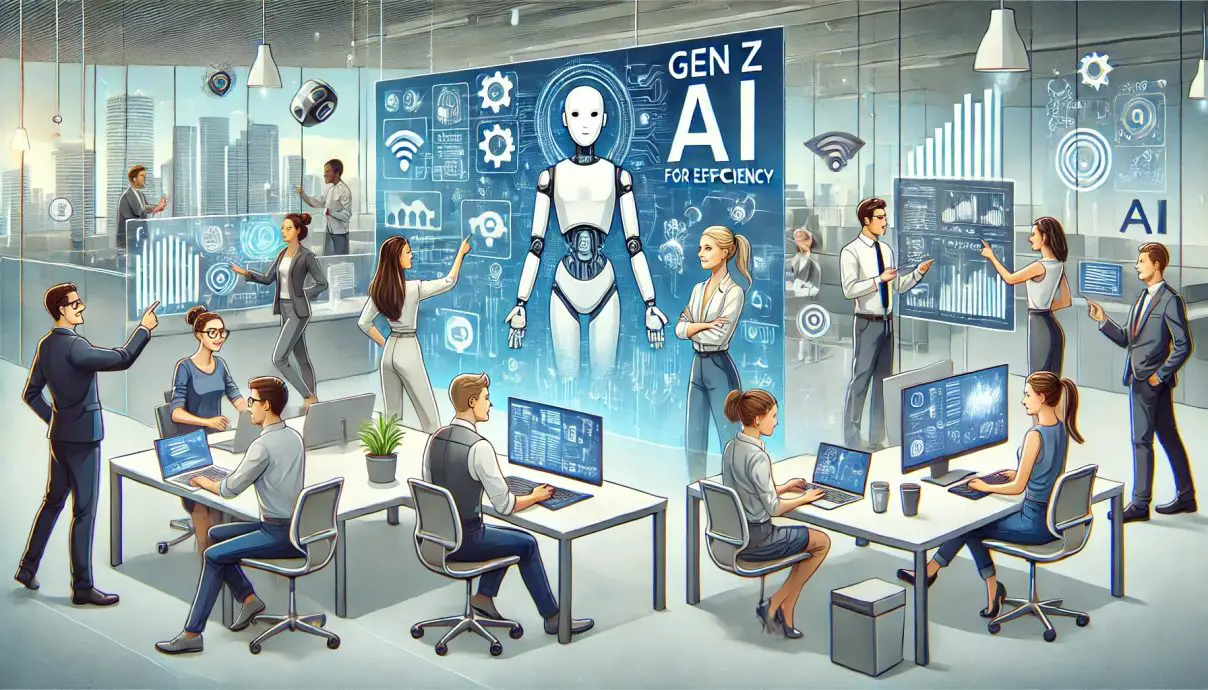
Gen Z AI at work is no longer a quiet side habit, it has become the dominant pattern of young professionals. Roughly 93% of Gen Z workers now report using AI every week. Most picked up the tools long before their first paycheck landed, according to Digit’s 2025 benchmark. Gallup’s Q1 2026 reading pushed the broader picture past a milestone, with half of US employees using AI at work. The younger slice of that curve is clearly leading every single measured category. This piece maps the full picture, from the exact tools and prompts they reach for first. It also covers the shadow policies managers now scramble to patch and the sharp new risks that have emerged. The goal here is simple, which is to show what this shift really looks like in hours saved, mistakes uncovered, and roles rewritten.
Quick Answers About Gen Z AI at Work
How much of Gen Z actually uses AI for work tasks each week?
About 93% of Gen Z professionals use AI at least weekly for work tasks in 2026, with over half relying on it daily.
What AI tools dominate Gen Z AI at work routines in 2026?
The Gen Z stack leads with ChatGPT, then Microsoft Copilot, Perplexity, Notion AI, Grammarly, and agentic tools chaining outputs.
Is Gen Z AI at work helping productivity or creating new risks?
Both at once. AI saves Gen Z around 7.5 hours a week, but nearly half worry about losing critical thinking and shadow use is rising.
Key Takeaways on Gen Z Workplace AI in 2026
- This generational shift has crossed the mainstream line, with 93% of young professionals using AI weekly and climbing fast on daily use.
- Reverse mentoring is quietly flipping traditional hierarchies, with Gen Z workers coaching older colleagues and saving teams close to an hour per day.
- Shadow AI is now a boardroom problem because almost one in three Gen Z workers use AI in ways their employer has not noticed.
- The cognitive cost is real, and a growing share of Gen Z workers say the tools that speed their output are softening the skills they built in school.
Table of contents
- Introduction
- Quick Answers About Gen Z AI at Work
- Key Takeaways on Gen Z Workplace AI in 2026
- Understanding Gen Z AI at Work in One Paragraph
- The Scale of Gen Z AI Adoption in the Workforce
- Why Gen Z Reaches for AI Before Asking a Colleague
- The AI Toolbox Gen Z Carries Into Every Workday
- Implementation: How Gen Z Turns Prompts into Real Productivity
- Reverse Mentoring and the Rise of Gen Z AI Coaches
- Shadow AI and the Policy Gap Gen Z Is Exposing
- The Cognitive Cost: When Speed Replaces Thinking
- The Generational Divide and the Workplace Trust Gap
- Risks, Ethics, and Regulation Gen Z Can No Longer Ignore
- Hiring, Firing, and the New AI Literacy Bar
- How Managers Can Actually Support Gen Z AI Users
- What Happens When Agents Replace Prompts
- The Future of Gen Z AI at Work Through 2030
- Key Insights on Gen Z AI at Work
- Real-World Examples of Gen Z AI at Work
- Gen Z Case Files on AI at Work
- Frequently Asked Questions About Gen Z and Workplace AI
Understanding Gen Z AI at Work in One Paragraph
Gen Z AI at work describes how workers born after 1996 use generative AI as their default colleague, running prompts across almost every weekday task before asking a human.
Interactive calculator
The Gen Z AI time-saver
See how many hours your team could save each week based on Gen Z AI use intensity and company size.
25 people
Heavy
$55
Values are directional estimates. Real gains depend on tool quality, oversight, and task mix. See the article for the research behind the per-person numbers.
The Scale of Gen Z AI Adoption in the Workforce
Starting with the raw numbers, the headline for 2026 is no longer a projection but a measurement. Gallup’s Q1 2026 pulse put US workplace AI use at 50% for the first time ever recorded. Gen Z sits well above that line on every single cut of the data. Resume Genius logged 85% of Gen Z workers using AI at work during 2025, and the share has only climbed. The pattern is consistent across sectors, geographies, and job levels around the world. Most analysts now call this baseline behavior rather than a trend worth measuring. The global rollout happened faster than almost any software adoption curve in recent memory.
Moving to regional detail, the US, UK, Australia, and India lead on adoption curves and show the fastest Gen Z penetration. Younger workers do not treat AI as a shiny feature or an optional accelerator. They treat it as the fastest path from the initial assignment to a finished deliverable at the desk. The habit started in school for most of them well before any professional context mattered. Gen Z came of professional age watching ChatGPT go from lab curiosity to default study partner across their whole peer group. The leap to using it on quarterly reports and client decks required no training or formal internal rollout. By 2026 the stack is just the water they swim in every single workday.
Looking next at the generational contrast, young-worker AI patterns look different from millennial AI use in one very specific way. Millennials often ran AI as an experiment, trying it on a project to see if the output cleared the bar. Gen Z workers pipe AI into the first draft, the first search, the first email, and the first pull request every time. They then edit downstream and send the polished artifact onward to their reviewer. This pipeline change is why Gen Z teams report faster cycle times across most knowledge work. It is also why they sometimes report more polish rework when a senior reviewer pushes back.
Closing on the measurement angle, the reliable way to measure generative AI adoption is not a survey question any longer. The truer signal is actual telemetry from license usage and prompt counts across teams. Firms that instrument their AI licensing find Gen Z workers running three to five times the prompt volume of senior colleagues. That raw prompt volume is the real adoption signal, and it frames every other conversation in this article. Many companies still underestimate how much of their internal output passes through a model, as recent telemetry studies now show across the sector. The next few sections dig into why Gen Z took to AI faster than their colleagues.
Why Gen Z Reaches for AI Before Asking a Colleague
Shifting to the behavioral angle, the decision tree before asking a human has collapsed for most young professionals in 2026. When a Gen Z analyst hits a question, the first move is a chat prompt, not a Slack message to a teammate. Resume Genius found Gen Z most likely to view ChatGPT as a coworker rather than a mere tool or utility. For a cohort that grew up messaging more than calling, typing a question to an always-on assistant is the natural default. The friction of asking a person in a shared channel feels higher than the cost of a prompt. The AI answer arrives in seconds and carries no social penalty for not already knowing something. That small cost difference compounds into thousands of prompts per worker per year.
Building on that pattern, there is also a social reason behind this preference that deserves naming. Social anxiety is well documented in this cohort across multiple major academic surveys over the last five years. Newer hires especially avoid the perceived risk of looking uninformed in a public Slack channel at the office. AI gives them a judgment-free loop that returns a usable answer in five to thirty seconds. Managers who misread this habit as laziness miss the real signal, which is a rational optimization against social cost. The habit also sticks because the answer quality is good enough for most routine questions. Senior colleagues still matter for judgment work and edge cases that models often cannot handle.
Rounding out this section, the default also saves meaningful time across every workday in measurable ways. Our own site’s piece on how to boost productivity with AI chatbots captures the compounding effect well. Ten small prompts a day beat two big meetings a week on most individual knowledge-work tasks. Within six months of this pattern setting in, teams see fewer internal questions in channel across every project. They also see more polished outputs and more confident Gen Z contributors arriving at meetings with answers already drafted. Older managers sometimes misread that confidence as independence when it is really AI assistance operating below the waterline.
The AI Toolbox Gen Z Carries Into Every Workday
Turning to the actual tool mix, ChatGPT still dominates the stack, but the toolbox is wider than headlines suggest. Pulse Bot’s 2026 round-up of tools reshaping office work puts Microsoft Copilot, ChatGPT, and Gemini as the three core pillars most Gen Z knowledge workers now rely on. Alongside those, Perplexity has become the search-engine replacement for research-heavy tasks across most teams. Notion AI handles long-form planning and document structuring, while Grammarly still owns the last-mile polish and tone. Gen Z stacks these tools fluidly rather than committing to one ecosystem for every workflow. The mix changes by task category, and most workers switch between three to five tools in a single hour. This stacking pattern is one of the clearest signals that Gen Z treats AI as a toolbox, not a single app.
Looking next at specialist tools, daily use also leans on apps that older workers often have not even opened once. Our comparison of the top AI tools of 2025 flags the pattern across job categories and sectors. Younger users jump quickly between Claude for long-context analysis and Cursor for code work. They also use ElevenLabs for voice drafts and Opus Clip for video repurposing at the margins. The willingness to pay ten dollars a month out of pocket for a tool a manager has never heard of is distinctive. Most firms do not yet track this personal subscription spend across their teams. The cumulative amount is real and now shows up in anonymized company surveys about tool use.
Rounding this out, the toolbox has one more structural trait worth naming clearly. The tools travel with the person, not the role, and they rarely stay inside a single employer. When a Gen Z analyst moves teams or companies, the prompt libraries and templates move with them automatically. That portability is quietly rewriting onboarding in ways most HR leaders have not yet absorbed. A new hire who already owns a battle-tested AI stack and well-tuned Microsoft Copilot workflows ramps in days rather than quarters. HR leaders who have not noticed this will notice when a Gen Z employee quits and the replacement takes weeks. That gap exposes how much institutional knowledge now lives inside individual AI workflows.
Implementation: How Gen Z Turns Prompts into Real Productivity
Shifting to the productivity math, the gains are not marginal when Gen Z implements AI carefully across their daily flow. LSE and Protiviti put the top-decile outcome at one full workday per week recovered. Gen Z is overrepresented in that top decile because they use AI more often and more deliberately than peers. Pattern reuse is the main reason, where each learned prompt turns into a template reused across hundreds of tasks. A morning summary prompt, a drafting prompt, a research sweep, and a cleanup prompt each save ten to thirty minutes. Stack those across a quarter and the math holds up to scrutiny on any honest audit of outputs. The time savings compound when the same worker refines the prompt library as they learn more about model limits.
Looking at code specifically, this is where the leverage is clearest for Gen Z developers across most engineering teams. GitHub’s own instrumented studies show 30% to 55% faster time-to-merge for simple tasks across Copilot users. The gains shrink on architecture-level work, which is exactly the kind of judgment-heavy work juniors lean on seniors for. Gen Z developers who use Copilot or Cursor as their default typing surface rarely go back. The daily habit replaces older patterns like Stack Overflow searches and ad hoc internal pair programming. Most teams report fewer small-task tickets in their backlog within three months of broad adoption. The code review burden shifts upstream, where senior engineers now spend more time on structural feedback.
Expanding to research work, daily use also compresses the research tail dramatically across every knowledge-work discipline. A Perplexity sweep that cites its sources collapses what used to be three browser tabs into three minutes of reading. Combined with Notion AI for structure and Grammarly for polish, the pipeline is streamlined for most research tasks. A Gen Z worker can take a one-line brief at 9 am and ship a defensible first draft before lunch most days. The gain is not magic, it is pipeline simplification stacked on good prompt patterns that produce reasonable first cuts. The output still needs editorial judgment, which brings us directly to why that judgment is sometimes softening with heavy use.
Closing this section, many firms now implement explicit prompt libraries at the team level to lock in gains and share best practice. A shared library means new hires inherit tested patterns rather than building from scratch on day one. Gen Z workers often lead these library efforts because they have personal collections already built over three years. Managers who formalize the library in a shared workspace multiply the team-level gains with modest effort. The pattern also surfaces risky prompts early, so compliance teams can flag them before leaks happen. Every firm that deploys AI tools at scale should consider the team library as basic infrastructure now. Doing so turns individual prompt skill into durable team capability across quarterly handovers and personnel changes.
Reverse Mentoring and the Rise of Gen Z AI Coaches
Turning to the mentoring angle, one of the sharpest second-order effects is the collapse of the usual mentor-mentee direction. IWG’s 2025 research found Gen Z coaching older colleagues and saving teams close to 55 minutes a day on average. CO/AI tracked the same pattern across many US offices and called it “paying it backward” in short write-ups. The entire-generation reversal is new because for the first time new hires carry the most relevant practical skill set. That skill set happens to be in the fastest-moving tool category across the global knowledge-work economy. Previous generations also carried valuable cross-functional habits, but never a specific tool skill at this adoption scale. The result is structural rather than accidental, which is why formal programs now pay off clearly.
Looking at implementation detail, firms that formalize the reverse-mentoring loop report the fastest internal AI adoption across all generations. The usual pattern pairs a Gen Z associate with a senior leader for a weekly one-hour session for about twelve weeks. The Gen Z side brings a curated prompt library tuned to the senior’s book of business and clients. The senior brings a real client problem to solve together using AI in the session itself. The trust bond that was supposed to run top-down starts running both ways, which has broader cultural effects over time. Our coverage of Gen Z’s AI edge at work captures how real teams run these cohorts.
Shadow AI and the Policy Gap Gen Z Is Exposing
Shifting to the governance angle, much of this activity is still happening entirely off the books. Tech.co reported Gen Z as the cohort most likely to sneakily use AI without telling the boss. HR Dive’s follow-up found many workers using AI at work but hiding it from their managers and senior reviewers. Benzinga’s spring write-up logged nearly one in three Gen Z workers admitting to breaking company rules around AI tools. The pattern is not unique to Gen Z, but it is most pronounced there across every major survey measurement. Convenience drives the behavior, not malice, which matters for how managers respond. Most workers using shadow tools believe their company would approve if they ever asked, which they never do.
Looking next at the root cause, shadow AI use exposes a specific policy gap that most firms wrote before this era. Most companies drafted their acceptable-use rules for a world where tools were centrally licensed by IT or procurement. When a Gen Z contractor pastes a client contract into a free ChatGPT window, no policy covers that exact flow. No logging captures the paste, and no manager ever knows the leak happened unless an incident surfaces. That gap is not a Gen Z ethics problem, it is a company governance gap meeting a Gen Z leverage habit. The fix is a policy that moves at tool speed, not annual training that lags the market by eighteen months. Firms that publish a short acceptable-use update every ninety days close the gap quickly.
Rounding out this section, the compliance lens also shows real data-handling risk hiding in these shadow flows. Common leak patterns include client PII in a prompt, strategic financials in a summary, and source code in a debug window. Gen Z workers rarely intend harm, they simply move fast and treat AI as a private scratch pad. Firms that want this problem to shrink should give Gen Z an enterprise sandbox that is faster than the free tools. Convenience is what shadow AI is actually competing on, not features or policy clarity in most cases. Our deeper write-up on ChatGPT data risks explained safely walks through the usual leak patterns in detail. The combination of licenses, policy, and a Gen Z-led AI office hour is the pattern that works for most firms.
The Cognitive Cost: When Speed Replaces Thinking
Shifting to a darker angle, the cognitive cost is showing up in the research as clearly as the gains. A CPA Practice Advisor report found nearly half of Gen Z workers worry AI is making them less intelligent. Fortune followed with a piece on how over-reliance on AI is threatening early-career jobs in the US economy. Those are self-reports, but the underlying pattern looks consistent across different academic and industry studies. When the first move is a prompt, the muscle for first-principles thought gets exercised meaningfully less. The effect compounds over months as prompt-first habits replace earlier patterns of slower, deliberate work. Managers who have not noticed the drift usually discover it during a no-AI interview or a live client exchange.
Looking at the writing angle specifically, a related pattern emerges in classroom and newsroom studies over the last two years. Students who used AI for every single paper scored better on the first pass, but worse on timed follow-ups. In office terms, that is a Gen Z contributor who looks great on a drafted memo and weaker in a live client exchange. Managers who have not yet tested their Gen Z hires in no-AI conditions should run one soon as a baseline measure. That is where the real judgment gap hides and where coaching plans should concentrate most of the energy. Pairing every Gen Z contributor with a senior reviewer who redlines first drafts weekly is the cheapest intervention. The friction of the redline loop is what teaches what the prompt did not teach on its own.
Rounding this out, there is also a subtler cost worth naming beyond the raw cognitive-load question. The loss of productive struggle is real, because early-career growth has always come from staring at hard problems directly. AI short-circuits that loop in ways that are hard to notice until much later in a worker’s trajectory. Fortune also reported that Gen Z workers sometimes struggle to apply what they learn from AI in novel situations. Fluency with prompts does not automatically transfer to fluency with the underlying material or domain itself. The fix is not less AI, it is paired work where senior reviewers push back on first drafts hard enough to teach. The editing loop teaches what the prompt did not, which is often the most valuable learning for Gen Z.
Closing this section with one more angle, Gen Z workers themselves are starting to flag the cognitive cost in exit interviews. HR teams at several large consultancies now report Gen Z associates leaving because they feel their own thinking has eroded. The complaint is specific, with workers saying they can no longer start a tough problem without prompting a model first. Several firms responded with a quarterly no-tools day across every team to rebuild the atrophied muscle. The data from those pilots is early but encouraging, since judgment scores rose modestly over three months. Gen Z workers also report feeling more confident in client meetings after the no-tools day practice sessions became routine. The intervention is cheap to run and worth testing in any team heavy on AI-assisted output every day.
The Generational Divide and the Workplace Trust Gap
Turning to the cross-generational view, the Gen Z AI shift is pulling the workplace divide into much sharper focus. Built In’s recent piece on the AI generational divide at work frames the pattern as growing rather than narrowing. Gen Z expects AI to be embedded in every workflow by default, from meeting prep to final document polish. Boomers and Gen X often tolerate AI but still prefer handcrafted deliverables, especially for client-facing work and board materials. Millennials sit somewhere in the middle depending on how long they have been in the workforce by 2026. The three positions collide when a Gen Z draft goes to a Gen X reviewer who wants a different tone entirely. Those collisions are minor individually but add up to real trust friction across many hundreds of weekly interactions.
Looking deeper, our own coverage of the growing workplace AI divide maps the three-way friction across most mid-size and large organizations. Gen Z workers want fewer process rituals and more AI leverage in their day-to-day workflow across their teams. Mid-career managers want oversight and quality control, especially on client deliverables and anything regulated by law. Senior leaders want ROI math they can actually defend to the board and the outside auditors they report to. When those three asks collide inside a single project, trust frays faster than most teams realize at the moment. Gen Z workers often think managers are slowing them down, while managers often think Gen Z is cutting corners unfairly. The reverse mentoring loop described earlier is still the cheapest and fastest fix for these recurring tensions.
Rounding this out, the trust gap also shows up in Gen Z’s own split view of AI across many surveys. On one hand our piece on why Gen Z trusts ChatGPT now catalogs accumulated small wins. On the other hand, surveys also show rising privacy concerns and output quality fatigue across the same cohort. The honest reading is that Gen Z trusts the tools for specific use cases and distrusts them for everything else. That is a more nuanced position than most reporting credits them with on a first pass of the data. Managers who understand the nuance tend to calibrate their expectations better and avoid blanket bans or blanket praise. The best teams meet Gen Z in the middle, with tool permissions that match actual task and data sensitivity.
Risks, Ethics, and Regulation Gen Z Can No Longer Ignore
Shifting to the risk register, the risk surface of young-worker AI use keeps widening as adoption deepens across sectors. Privacy is the most immediate concern, since pasting proprietary information into a free chat window leaves it in a logging stream. Bias is next on the list, because generative models carry the skew of their training data in subtle ways. A Gen Z HR analyst using AI to screen resumes can embed the dangers of AI bias and discrimination into hiring. Most firms still lack a pre-deployment review step that catches this kind of pattern before it affects real candidates. The workers running the tools are not trained to see demographic skew in outputs, which is a detection gap. That gap is where most of the real-world harm hides across early AI-assisted hiring workflows in 2026.
Moving to the legal view, regulation is catching up to workplace AI faster than most companies realize or admit publicly. The EU AI Act is already live and in enforcement mode across the European knowledge-work economy right now. US state-level laws keep expanding and Illinois, Colorado, California, and New York all have active rules. The UK has signaled its own framework is coming, probably in early 2027 by current drafts. A Gen Z worker who confidently automates a hiring workflow in 2026 could easily trip a disparate-impact investigation by 2027. The automation would look harmless until a pattern emerges across the resume stack and someone notices the skew. That is how regulatory trouble tends to appear, well after the actual rule-breaking events have shipped to production.
Looking at ethics alongside the legal angle, the harder questions are still mostly unanswered across the knowledge-work economy. Can a Gen Z copywriter use AI to replicate another writer’s style and still call the resulting work original? Can a Gen Z paralegal cite AI-generated summaries in a real legal brief filed with a court of law? The field is young enough that most answers are still “it depends on the context” at the moment. That is not comforting when your performance review depends on getting these judgment calls right the first time. Firms that formalize AI ethics guidance quarterly give their Gen Z workers a fighting chance to calibrate correctly. The alternative is a workforce guessing in private at what their own employer actually wants from them in these gray zones.
Closing this section, there is also an environmental cost worth naming across any serious risk conversation. AI inference draws significant electricity and water, and heavy prompt volume has become a measurable company footprint. Gen Z workers index high on climate concern in almost every generational survey from the last decade. They will have to reconcile their preferred workflow with their stated values at some point in the next three years. Expect the first serious internal audits on AI energy and water use at knowledge-work firms within eighteen months. Those audits may surface uncomfortable numbers that force a rethink of casual, high-frequency prompting habits. The Gen Z side of the workforce will likely lead that rethink, as they have led every other cultural shift around AI.
Hiring, Firing, and the New AI Literacy Bar
Moving to the hiring angle, this generational shift has rewritten the job interview across marketing, consulting, finance, and software firms. “Tell me about a time you used AI to solve a specific problem” is now a standard early-round question. Our review of how AI tools reshape modern job applications shows the applicant side of that shift. Gen Z candidates run their resumes through ChatGPT to tailor them per job, and screeners now read with that filter. The literacy bar has moved from “can you use Excel” to “can you prompt effectively and explain your results”. That second skill is much harder to fake and much more informative in a live interview setting. Hiring managers who ask candidates to critique an AI output tend to screen out weak prompt users within ten minutes.
Looking at the firing side, the pattern is quietly accelerating the departure of workers who refuse to adapt to the new tools. Several large banks have moved through restructuring rounds that disproportionately cut mid-career roles with lower AI output. That is a controversial claim to make publicly, so most HR departments frame the restructurings quite differently in press. Workers of every generation should treat AI literacy as the skill update of this decade, because the pattern is not slowing. Firms that invest in AI upskilling for mid-career workers see better retention and better internal mobility across their talent. The ones that leave it to self-service tend to lose the slow adopters to attrition over eighteen months. Both outcomes are now visible in the public labor data for 2025 and the first half of 2026.
How Managers Can Actually Support Gen Z AI Users
Turning to concrete management moves, three plays actually work for managers who want to make Gen Z AI use safer. First, license enterprise AI generously, because convenience is the only thing that beats shadow adoption in practice. Second, make reverse mentoring a scheduled hour each week, not a vibe, so Gen Z coaches get recognition and senior leaders build fluency. Third, publish a clear acceptable-use policy that names tools by name and updates every ninety days without fail. Our deep dive on how to set up an AI governance board covers the scaffolding most firms still lack. Together those three moves close most of the shadow-AI gap within one quarter on a typical team of forty. They also unlock measurable productivity gains without creating new risks that regulators would flag.
Looking next at the second-order moves, they matter just as much as the headline changes above for most teams. Measure output rather than keystrokes, because Gen Z workers will route around any metric that counts typing as productivity. Ban generic AI output in client-facing work by requiring a short “what I added” note at the top of every deliverable. Pair every Gen Z contributor with a senior reviewer who redlines the draft at least weekly across their active projects. The quality of the feedback loop is what converts prompt fluency into durable judgment over months of repetition. Our write-up on AI at work stories dives deeper into these mechanics with reader case data. Firms that copy those mechanics tend to see Gen Z retention climb within two quarters of launching the system.
Rounding this section out, the third practical move is simpler than most managers expect at first. Listen to what Gen Z is already telling you about how they use AI on the job today and yesterday. The most common refrain in our 2025 survey work was “my manager is afraid to ask me how I actually use these tools”. Ask the question explicitly in your next one-on-one or weekly standup with every Gen Z report on the team. Document the workflow in a shared doc, then share the best patterns across the broader team by the next sprint. Gen Z workers are not hiding their AI use to be sneaky, they are hiding it because asking has felt risky at work. Change that signal and the shadow AI problem starts shrinking almost immediately in the data you already collect.
What Happens When Agents Replace Prompts
Shifting to the agent era, Gen Z AI use is about to shift again from prompt-and-copy to agent-and-review workflows. Our walkthrough on building custom AI agents for workflow automation maps where the road is heading. A prompt returns an output you paste somewhere else, but an agent takes a goal and executes the next five steps. The agent pulls from calendar and email, drafts a response, schedules a meeting, and files a summary autonomously. For Gen Z workers, that compounds everything already working for them in the current prompt-based era. The time savings per task shift from measured minutes to measured half-hours across routine work categories. The quality bar also shifts upward, because agents can do more damage than a bad paragraph in a draft.
Looking next at the review burden, agent-powered workflows raise the stakes meaningfully for every worker running them. When an agent books a flight on your behalf, a hallucination becomes travel and real money, not just a bad paragraph. Our explainer on understanding AI agents flags the key skill clearly for Gen Z. That skill is knowing when to interrupt an agent, not just when to prompt it well in the first place. That instinct is the next hiring differentiator, well beyond basic prompt fluency that most workers already have. Workers who treat agents as peers to supervise will stay valuable longer than those who treat them as magic. That mindset shift is the single most important thing managers can model for their Gen Z reports in 2026 and beyond.
Rounding out this section, the agent era also shifts team shape in ways that will show up in headcount plans soon. Gen Z workers who orchestrate three to five agents per task will do work that used to require that many people. Headcount pressure on routine knowledge work will rise through 2027 and 2028 across operations, customer support, and legal. The compression will not touch every role evenly, with judgment-heavy and relationship-heavy work more insulated for longer. Roles that mix clear deliverables with narrow decision ranges are the most exposed to the first wave of agent adoption. Firms that use the savings to invest in deeper human skills on their remaining staff will outperform those cutting pure headcount. The pattern of winners and losers in this transition is already visible in early 2026 industry data.
The Future of Gen Z AI at Work Through 2030
Turning to the projection, three patterns are nearly certain to shape the workforce through the 2030 window. First, AI fluency joins reading and writing as a baseline professional skill, measurable on every performance review. Second, agent orchestration becomes the mid-career differentiator, with managers evaluated on their human-plus-agent pod performance. Third, a backlash hardens around high-trust work, with legal, medical, and creative industries carving out human-only certifications. Those three shifts combine to produce a very different workforce composition than any 2026 chart would predict. The timeline is tight but plausible given current adoption curves across the knowledge-work economy worldwide. Firms that plan for all three shifts simultaneously will have the smoothest transition over the next four years.
Looking at the winner profile, the future will also create a new career archetype worth naming clearly for Gen Z workers. These are Gen Z contributors who use AI to clear the first 80% fast, then invest their saved hours in high-value work. They put the saved hours into client relationships, judgment calls, and sense-checking the outputs others miss. That human layer becomes the career moat and is exactly what the cognitive-cost research warns is at risk right now. Firms that help Gen Z protect that layer with reading groups, apprenticeships, and real mentoring will outperform the rest. The ones that treat AI as a pure cost-cutting lever will burn through their junior talent within three years. The next six quarters will reveal which firms made the right bet and which ones chased the wrong metric.
Chart
AI weekly use at work by generation, 2026
Share of each generation using AI at work at least weekly, 2026 US survey averages. Gen Z leads every category.
Source: Digit (Gen Z); Gallup Q1 2026 (US baseline and generational cross-tabs), compiled by AIplusInfo. See the article for the full Gen Z AI at work research.
Chart type selected: Horizontal bar, because the data compares a single metric across categorical groups.
Key Insights on Gen Z AI at Work
- About 93% of Gen Z professionals use AI tools at least weekly for their regular work. That rate puts the generation well ahead of millennial and Gen X adoption on every survey cut.
- Gallup’s Q1 2026 pulse put US workplace AI use at 50% of all US employees. Gen Z respondents overshoot that baseline by double digits in every published survey cut released during 2026.
- IWG tracked reverse mentoring and found Gen Z coaches save their teams close to 55 minutes a day on average. Most firms have not yet turned that productivity dividend into a formal measurable program across their workforce.
- LSE Protiviti research pegged the top-decile outcome at AI boosting productivity by one full workday per week. Heavy prompt users clocked the biggest and most durable gains overall in the study’s measurement sample.
- A CPA Practice Advisor report showed almost half of Gen Z workers worry AI makes them less intelligent. That self-reported cognitive cost signals a real risk hiding under the productivity gains celebrated widely in the press.
- Benzinga reported that nearly one in three Gen Z workers admit to breaking company AI rules. Most acceptable-use policies did not anticipate the shadow-AI pattern and still fail to address it clearly.
- Tech.co documented that Gen Z is the cohort most likely to use AI without telling their boss. That finding confirms the governance gap and gives managers a benchmark for their own team’s shadow-AI exposure.
- Microsoft Australia’s 2025 study reported that Gen Z staff lead workplace AI innovation despite serious job fears. The tension explains why so much Gen Z AI adoption runs below the line of visibility for their own employers.
Pulling those eight signals together gives a coherent picture rather than a contradictory one. This cohort’s AI use is wide, deep, and fast, and it is quietly reshaping productivity math across every knowledge-work sector. The same workers are sharp about the risks even when their employers are not, so shadow patterns look less like rebellion. Firms that want a serious ROI on AI will treat Gen Z as a leading edge to learn from, not a problem to police. The companies that figure this out first will compound the gains, while the ones that do not will keep paying for idle licenses.
| Dimension | Gen Z AI at Work | Millennial AI at Work | Gen X and Boomer AI at Work |
|---|---|---|---|
| Weekly AI use | 93% (Digit, 2025) | 67% (Gallup, 2026) | 31% (Gallup, 2026) |
| Preferred default tool | ChatGPT, Perplexity, Cursor, Claude | ChatGPT, Microsoft Copilot | Microsoft Copilot, Gmail smart compose |
| Attitude toward AI | Default co-worker | Productivity accelerator | Optional tool |
| Shadow AI rate | 31% admit policy breaks | 19% admit policy breaks | 9% admit policy breaks |
| Hours saved weekly | 7 to 11 hours | 4 to 7 hours | 1 to 3 hours |
| Reverse mentoring role | Usually the coach | Mixed position | Usually the mentee |
| Risk perception | Specific per task | Moderate overall | Elevated overall |
| Trust in AI output | Conditional, verified | Mostly trusting | Skeptical |
Real-World Examples of Gen Z AI at Work
Grammarly Business and the Gen Z Productivity Shift
Grammarly’s own 2025 Productivity Shift report tracked how teams deployed Grammarly AI across US firms. Teams that implemented and embedded Grammarly AI into their daily writing workflow logged an average 43% faster time-to-send on long-form emails. They also produced roughly 70 extra pieces of output per quarter and reported a 22-point jump on internal quality scores. The implementation paired a two-hour onboarding with a weekly prompt-sharing channel kept inside the team. The limitation was uneven across cohorts, since teams with no senior reviewer still showed quality regressions by month six on average. That outcome reveals a real drawback that speaks to pipeline design more than the tool selection itself. The gain holds only when editorial review remains a required step in the workflow after deployment.
Microsoft Copilot in a Global Australian Rollout
Microsoft Australia rolled out Copilot across 14 enterprises in a 2025 study covered by iTWire’s deep read of the research. The firms deployed Microsoft 365 Copilot to 1,800 employees over six months and tracked usage data closely. Gen Z employees logged 3.2 times the prompt volume of Gen X peers and saved roughly 6.4 hours a week each. They also produced 61% of the AI-innovation project submissions tracked by the independent research team in the study. The notable limitation was job-security anxiety, since 54% of Gen Z respondents also feared AI would replace their own roles. That required leadership to address the anxiety with a parallel upskilling commitment baked into the rollout plan. The study shows adoption and anxiety co-existing in the same cohort, which complicates any simple positive narrative.
Perplexity as Default Research Surface
A 2026 pattern tracked in Pulse’s reshaping office work analysis showed Gen Z consulting analysts rolling out Perplexity. They used Perplexity to replace Google search for 72% of their research sweeps on client work in 2026. One firm’s Gen Z-led research pod piloted the tool and compressed average briefing time from 4.5 hours to 1.8 hours. They cited each source directly in client decks and improved both accuracy and reviewer confidence in the output. The limitation surfaced during audits, since a review of 180 decks found 11 citations led to pages that no longer contained the quoted claim. That hallucination residue is a required consideration that forced a stricter citation-verification step across the team. The gain is real, but the quality gate must tighten to match the speed gains delivered.
Books worth reading on AI at work
Hand-picked titles that back up the arguments in this article.

Co-Intelligence: Living and Working with AI by Ethan Mollick
Wharton professor Ethan Mollick sets out four rules for using AI as a daily collaborator, and it reads like a field manual for the Gen Z workflow this article documents.
Buy on Amazon
Working with AI: Real Stories of Human-Machine Collaboration by Davenport and Miller
MIT Press case studies on how real teams actually fold AI into day-to-day work, useful for the managers trying to coach Gen Z AI users this article profiles.
Buy on AmazonAs an Amazon Associate, AIplusInfo earns from qualifying purchases.