
Introduction
Learning how to set up an AI governance board is now a practical requirement rather than a theoretical exercise for compliance teams. A Gartner poll found that 55% of organizations have already established AI boards to govern their initiatives. The pressure comes from every direction at once, including regulators, customers, insurers, and employees who paste company data into public chatbots. A board that exists only on an org chart helps nobody, because it approves nothing, measures nothing, and escalates nothing. This guide shows you how to build one that actually decides, from charter and membership to risk tiers, review workflow, cadence, and metrics. It also maps the work to the EU AI Act, the NIST AI RMF, and ISO/IEC 42001, so the board produces evidence that auditors recognize. Along the way you can track AI governance trends and regulations as they change and copy the templates into your own repository.
Quick Answers on Setting Up an AI Governance Board
How do you set up an AI governance board?
Here is how to set up an AI governance board: secure an executive mandate, write a charter, name cross-functional members, define decision rights, tier use cases by risk, and meet monthly.
Who should sit on an AI governance board?
A core AI governance board of five to seven members usually includes an executive sponsor, legal or privacy, security, data science, a business owner, and a process owner who runs the intake queue.
Which frameworks should an AI governance board follow?
Most boards align with the NIST AI RMF for risk practices, ISO/IEC 42001 for a certifiable management system, and the EU AI Act for legal duties, using one shared inventory and evidence trail.
Key Takeaways
- A board only works when its charter states which decisions it owns, which it merely informs, and which are out of scope.
- Five to seven core members plus on-call experts keep meetings short and decisions defensible.
- Risk tiers let low-risk tools pass in days while high-risk systems receive full review and ongoing monitoring.
- One inventory and one evidence trail can satisfy the EU AI Act, the NIST AI RMF, and ISO/IEC 42001 together.
Table of contents
- Introduction
- Quick Answers on Setting Up an AI Governance Board
- Key Takeaways
- What Is an AI Governance Board and What Does It Decide
- Why Organizations Need Oversight of AI Now
- Mapping the Regulatory Landscape: EU AI Act, NIST AI RMF, and ISO 42001
- Charter Essentials That Give a Board Real Authority
- Membership and RACI Roles That Make Decisions Stick
- Decision Rights and Escalation Paths
- Risk Tiering for AI Use Cases
- Designing the Review Workflow From Intake to Retirement
- Meeting Cadence and Agenda Design
- Metrics That Show the Board Adds Value to the Business
- Putting the Board to Work Across Procurement, Agents, and Shadow AI
- Ethics, Fairness, and Human Oversight the Board Must Own
- Where AI Governance Boards Fall Short
- The Future of AI Governance: Agents and Continuous Assurance
- How to Set Up an AI Governance Board Step by Step
- Step 1 – Secure the executive mandate and define scope
- Step 2 – Draft the board charter
- Step 3 – Name members and build the RACI matrix
- Step 4 – Set decision rights and escalation rules
- Step 5 – Define risk tiers and scoring
- Step 6 – Build the intake and review workflow
- Step 7 – Set the meeting cadence and agenda
- Step 8 – Choose metrics and reporting
- Step 9 – Map controls to the EU AI Act, NIST AI RMF, and ISO 42001
- Key Insights on AI Governance Boards
- Governance Operating Models Compared
- How Mastercard, Unilever, and Microsoft Govern AI in Practice
- Lessons From Governance Failures in Hiring, Customer Service, and Retail
- Common Questions About Setting Up an AI Governance Board
What Is an AI Governance Board and What Does It Decide
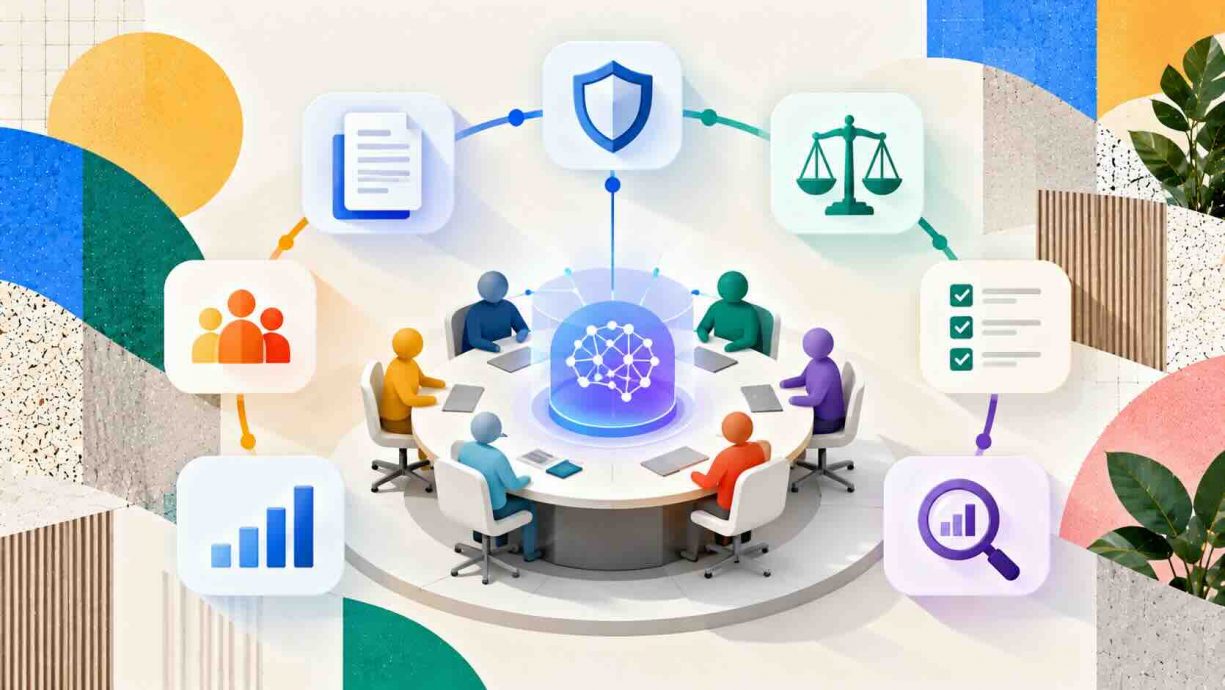
An AI governance board is a cross-functional body that approves, monitors, and retires AI systems. Knowing how to set up an AI governance board means defining its charter, members, decision rights, risk tiers, and review cadence.
An Interactive From AIplusInfo
How Big Should Your AI Governance Board Be?
Adjust request volume, board size, risk mix, and operating model to see review workload, board load, and the likely wait for a high-risk decision.
90
6
Balanced
Central, delegated low tier
Board workload
0 h
person-hours per month on board agenda
Board load
0%
of review capacity
High-risk wait
0 d
estimated days to a decision
Suggested core size
6
benchmark range is five to seven
Adjust the controls to see guidance.
Illustrative model: each member gives six hours a month and 60% goes to reviews; effort per case is 0.4 to 1.5 hours for low, 4 to 5 for medium, and 16 for high. Context: a Gartner poll found 55% of organizations run AI boards, and Voltage Control recommends a core of five to seven.
Why Organizations Need Oversight of AI Now
Building on that definition, the case for a board starts with how widely AI has spread through ordinary business functions. McKinsey's State of AI research reports that nearly nine in ten respondents use AI regularly in at least one business function. Marketing drafts copy with it, finance forecasts with it, engineers write code with it, and support teams answer customers with it. Each of those uses carries a different mix of privacy, accuracy, security, and legal exposure. No single department sees the whole picture, which is exactly the gap a cross-functional board closes. Without one, every team makes its own risk decisions, and the organization learns about the worst ones only after something breaks.
The cost of unmanaged AI adoption is measurable rather than hypothetical, and recent breach data shows it clearly. In its 2025 breach study, IBM reported that 13% of organizations had experienced breaches of AI models or applications, and 97% of those lacked proper AI access controls. The same study found that 63% of breached organizations either had no AI governance policy or were still drafting one. Shadow AI, meaning unsanctioned tools adopted without review, added an average of $670,000 to breach costs when its usage was high. These figures describe failures of ownership more than failures of technology, because nobody was empowered to say yes, no, or not yet. A governance board assigns that power to named people operating under a documented process.
A governance board also differs from the committees most companies already run. An ethics board debates principles, a security steering group manages threats, and a model risk committee validates statistical models. An AI governance board sits across all three and owns the single decision of whether a specific AI use may go live. It should borrow from each of them without replacing any, so privacy reviews, security assessments, and model validations still happen in their usual homes. The board's job is to make sure those reviews feed one decision and leave one record. That single record is what regulators, customers, and auditors ask to see first.
Mapping the Regulatory Landscape: EU AI Act, NIST AI RMF, and ISO 42001
Shifting from the why to the what, three documents shape most boards in 2026, and each plays a different role. The EU AI Act is binding law with fines, the NIST AI RMF is a voluntary risk framework, and ISO/IEC 42001 is a management system standard you can certify against. A board that understands the difference avoids duplicate work, because one set of records can answer all three. The European Commission's AI Act page confirms that the Act entered into force on 1 August 2024. Prohibitions and AI literacy duties have applied since 2 February 2025, and obligations for general-purpose AI models since 2 August 2025. Your board should treat those dates as already in the past for any organization that sells into the European Union.
The high-risk timeline is where most confusion lives, so it deserves precision. The AI Omnibus amendment moved the deadline for stand-alone high-risk systems, such as recruitment and credit scoring, from 2 August 2026 to 2 December 2027. High-risk AI embedded in regulated products moves from 2 August 2027 to 2 August 2028. Transparency duties under Article 50, such as disclosing chatbot interactions and labeling synthetic content, still apply from 2 August 2026. Only the deadlines moved, while the requirements themselves stayed the same, so a board that waits for 2027 to start will find the work is large. Penalties under Article 99 reach EUR 35 million or 7% of worldwide turnover for prohibited practices, and EUR 15 million or 3% for most other operator duties.
Turning to the voluntary frameworks, the NIST AI Risk Management Framework was released on 26 January 2023 and organizes AI risk work into Govern, Map, Measure, and Manage. NIST describes Govern as a cross-cutting function that supplies the policies, accountability structures, and culture the other three rely on. Its subcategories read like a job description for your board, including GOVERN 2.1 on documented roles and communication lines and GOVERN 2.3 on executive accountability for risk decisions. NIST also published a generative AI profile, NIST-AI-600-1, on 26 July 2024, which adds risks specific to foundation models. Treat the Govern function as the board's operating manual, and treat Map, Measure, and Manage as the work the board reviews. Adopting that mapping early keeps your charter and your control library speaking the same language.
Rounding out the picture, ISO/IEC 42001:2023 was published on 18 December 2023 as the first international standard for an AI management system. It uses a Plan-Do-Check-Act cycle and applies to organizations of any size that develop, provide, or use AI-based products or services. Its leadership clause expects top management to commit to the system and assign responsibilities, which is precisely what a chartered board demonstrates. Its management review clause expects leaders to evaluate the system at planned intervals, which maps neatly onto your quarterly agenda. A published NIST crosswalk pairs each Govern subcategory with ISO 42001 clauses, so evidence collected once can serve both. Certification is optional, but many procurement teams now ask for it, and the board is the natural owner of that decision.
Charter Essentials That Give a Board Real Authority
Stepping back to the document that anchors everything, the charter decides whether the board is a decision-maker or a discussion club. A useful charter is short, signed by the executive sponsor, and specific about powers rather than aspirations. Voltage Control's council guide recommends three lists: the decisions the council owns, the decisions it only informs, and what falls outside its scope. That structure prevents the two most common failures, which are the board that second-guesses everything and the board that never decides anything. Your charter should also state the powers explicitly, namely approve, reject, require modification, and escalate. Vague language such as "provide guidance" produces vague outcomes and invites teams to ignore the board.
Scope deserves its own paragraph because AI touches nearly every system a company runs. Decide whether the board covers only systems your teams build, or also vendor tools, embedded features in existing software, and employee use of public chatbots. Most organizations land on all of them, tiered by risk, because the incidents that make headlines usually involve a purchased tool or an unsanctioned one. Approvals should happen at the use-case level rather than the tool level, since the same model can be harmless for drafting meeting notes and dangerous for screening applicants. The charter should name review triggers, such as a new tool, a materially different use of an approved tool, or an incident. Anything the charter does not mention will be argued about later, so write down the boring edge cases now.
The final charter elements cover accountability and renewal, which teams often postpone until a problem forces the issue. Name the executive sponsor, the chair, the reporting line, and the forum where the board's summary reaches senior leadership or the audit committee. Include a review date so the charter is revisited at least once a year, ideally just after each major regulatory milestone. Link the charter to your wider responsible AI governance frameworks so principles, policies, and procedures form one coherent stack. A charter that cannot be summarized on one page will not be read, and a charter that is not read will not be followed. Step 2 of the how-to section below provides a machine-readable template you can adapt in an afternoon. Treat the first version as a draft, because the first ninety days will teach you which clauses need tightening.
Membership and RACI Roles That Make Decisions Stick
Moving on to people, the right board is small enough to decide quickly and broad enough to see the risks. The same Voltage Control guide suggests a core group of five to seven members. That group includes an executive sponsor who breaks ties, a legal or privacy lead, a head of AI or data science, a business operations lead, and a process owner. Security, procurement, human resources, and compliance experts can sit on call and join for relevant decisions rather than attending every meeting. The IAPP's AI governance profession report shows why this blend matters, since privacy and legal and compliance each lead AI governance at 22% of surveyed organizations. No single function owns AI risk alone, so the board's membership should mirror the way risk actually crosses departments. Rotating a business-unit representative every six months keeps the board connected to real use cases and spreads institutional knowledge.
A RACI matrix turns that membership into clear, documented accountability for every recurring governance activity. For each activity, such as intake triage, tier assignment, approval, monitoring, and incident response, mark who is Responsible, Accountable, Consulted, or Informed. The use-case owner is usually Responsible for evidence, the board chair or sponsor is Accountable for the decision, legal, privacy, and security are Consulted, and executive leadership is Informed. Only one role should be Accountable per activity, because shared accountability tends to mean no accountability. The matrix should also cover the board itself, including who maintains the inventory and who publishes the minutes. For a deeper look at where these bodies are heading, see this analysis of the future roles for AI ethics boards.
Decision Rights and Escalation Paths
Given the charter and the roster, decision rights define exactly who may say yes to what. Start by listing the decisions that come up repeatedly, such as approving a new use case, accepting residual risk, pausing a live system, approving a vendor, and granting an exception. For each decision, record the authority level: individual reviewer, subcommittee, full board, or executive sponsor. Low-risk decisions should be delegated to trained reviewers with a clear checklist, which keeps the full board focused on the cases that deserve its time. NIST's GOVERN 2.3 expects executives to take responsibility for decisions about AI development and deployment risks, so the charter should reserve final risk acceptance for a named senior leader. Written decision rights also protect team members, because a reviewer who followed the documented path cannot be blamed for a result the policy allowed.
Voting mechanics matter far more than most teams expect when the first contested decision arrives. Set a quorum, state whether decisions pass by majority or consensus, and require that every decision record its rationale and conditions. One practical pattern is a short window after a split vote, during which any member may request executive review before the decision becomes final. Define a pause right as well, so any member or incident owner can suspend a live system, with the full board ratifying at its next meeting. Escalation paths should list triggers rather than feelings, for example a regulator inquiry, a customer harm report, a material model change, or a tier upgrade. Decisions without a published escalation path usually get escalated informally and unevenly, which defeats the point of having a board.
Legal obligations also shape who must decide, and they vary by jurisdiction, sector, and your role in the supply chain. State laws such as the Colorado AI Act place duties on deployers of high-risk systems. The Colorado AI Act compliance guide explains what impact assessments and notices look like in practice. The EU AI Act similarly distinguishes providers from deployers, and your board should record which role your organization plays for each system. Where you are a deployer of a vendor's high-risk system, your decision rights should include the right to demand documentation before approval. A decision right you cannot exercise, because the vendor will not share evidence, is a decision you should decline to make. Build that logic into approval conditions, and record the exceptions leadership signs off on.
Risk Tiering for AI Use Cases
Turning to the engine of the whole system, risk tiering decides how much review each use case receives. Without tiers, the board either drowns in trivial requests or waves through dangerous ones, and both outcomes erode trust. A simple scheme scores each use case from 0 to 3 on five criteria: impact on people, degree of autonomy, reversibility of harm, scale of exposure, and regulatory exposure. The total maps to a tier, for example low from 0 to 4, medium from 5 to 8, high from 9 to 12, and unacceptable from 13 to 15. Published tiering templates use similar bands, and the exact thresholds are your choice rather than a requirement of ISO. What matters is that the scoring is written down, repeatable, and applied before work begins rather than after.
Override rules keep the arithmetic honest by preventing a clever score from hiding a genuinely dangerous use. Any system that makes or materially influences a decision about a person's employment, credit, housing, education, health, or legal standing should be at least high, whatever its score. Any use that falls into an EU AI Act high-risk category should likewise be at least high, and any use that resembles a prohibited practice should be declined at intake. Overrides should only raise a tier, never lower it, so no score can talk the board out of scrutiny. Record the reasoning for each tier assignment because auditors will ask how you decided. The goal is consistency, which is what lets teams predict the process instead of lobbying around it.
Each tier then carries a package of requirements that grows heavier as the potential harm grows. Low-tier uses might need only registration in the inventory, acceptance of the acceptable-use policy, and a named owner. Medium-tier uses add a documented assessment, a privacy review, and a basic monitoring plan with a six-month check-in. High-tier uses add a full impact assessment, bias and robustness testing, human oversight design, and board approval with conditions. Service levels should scale too, perhaps two business days for low, ten for medium, and thirty for high, so teams can plan launches. Guidance on managing AI-related risks and challenges can supply the control library behind each requirement.
Tier assignments are not permanent, which is the point teams forget most often. A system moves up when its scope widens, when it starts acting autonomously, when it ingests more sensitive data, or when an incident reveals a weakness. It may move down when compensating controls prove effective and the board documents why. Re-score on a schedule as well as on triggers, for example annually for medium tiers and every six months for high tiers. Emerging measurement work, such as a new AI risk assessment benchmark, can inform the scoring criteria over time. Treat the tier as a living property of the system rather than a stamp applied at launch.
Designing the Review Workflow From Intake to Retirement
From there, the workflow turns policy into a repeatable path that any employee can follow. Intake should be a single front door, such as a short form or ticket type, that captures the use case, data involved, vendor or model, affected people, and intended benefit. A process owner triages every request within two business days, assigns a provisional tier, and routes it to the right reviewers. Fast triage is the cheapest trust-builder available, because teams forgive rigor but resent silence. The intake record also seeds your AI inventory, which NIST lists as GOVERN 1.6 and which every framework expects you to maintain. An inventory built from intake beats one built from surveys, since it stays current by design.
Assessment and decision come next, and both should scale with the tier assigned at triage. Reviewers collect evidence proportionate to the tier, such as data lineage, test results, vendor documentation, human oversight design, and a description of what happens when the system is wrong. For high-tier systems, include adversarial testing, and consider the practices described in this overview of red teaming AI for safer models. The board then decides to approve, approve with conditions, request changes, or reject, and the decision memo records the rationale. Conditions should be concrete and checkable, for instance "human review of every adverse recommendation" or "quarterly fairness report to the board". A decision without recorded conditions and owners is a hope, not a control. Store memos in a searchable place so future reviews can find precedent.
The workflow does not end at launch, because most AI risk emerges after systems meet real users. Monitoring plans should name metrics, thresholds, and the person who receives alerts, and the board should review monitored systems at least quarterly. Changes to models, prompts, data sources, or vendors should trigger a lightweight change review rather than a silent update. Incidents follow a defined path: contain, assess, notify, remediate, and report back to the board with lessons learned. When a system is retired, the workflow closes the loop by recording deletion of data, revocation of access, and archival of evidence. NIST's GOVERN 1.7 covers safe decommissioning for exactly this reason, because abandoned AI systems are quiet sources of risk.
Meeting Cadence and Agenda Design
Moving on to rhythm, a board that meets too rarely becomes a bottleneck, and one that meets too often becomes a burden. A sensible default is a monthly meeting during the first year of adoption, with a quarterly deep dive on production systems layered on top. Voltage Control's guidance suggests three standing agenda slots: pending decisions, monitoring review of live systems, and emerging issues that are time-boxed and promoted to decisions only when needed. Circulate pre-reads at least three working days ahead so the meeting is spent deciding rather than reading aloud. Keep the session to ninety minutes, and let the process owner run the clock. Low-risk approvals happen asynchronously between meetings so the queue never waits for the calendar.
Beyond the meeting itself, the board needs a reporting rhythm that reaches leadership. A short quarterly summary should cover decisions made, systems retired, incidents, metric trends, and regulatory changes. The NACD's 2025 board practices survey found that over 62% of responding directors reserve agenda time for full-board AI discussions, so your summary will land in a receptive room. Send the same one-page summary every quarter in the same format, because trend lines are more persuasive than any single dashboard. Schedule an annual session to review the charter, the tier scheme, and the membership roster against the previous year's lessons. Record minutes with decisions, conditions, owners, and dates so that the next meeting can begin from facts instead of recollections.
Metrics That Show the Board Adds Value to the Business
Given the cadence in place, start with the question executives will inevitably ask: is this board reducing risk without slowing the business? Coverage metrics answer the first half, such as the share of systems in the inventory, the share with a tier, and the share of high-tier systems monitored. Speed metrics answer the second half, such as median days from intake to decision by tier and the share of requests decided within the published service level. Quality metrics test whether decisions stick, including the share of approval conditions closed on time and the number of systems found in production without approval. Together these three families give a balanced picture that neither the risk function nor the product teams can easily dismiss.
Outcome metrics complete the set, though they need careful interpretation. Count incidents and near misses by tier, severity, and time to containment, and track audit or regulator findings that relate to AI. A rising incident count may signal better reporting rather than worse behavior, so pair it with training completion and shadow AI discoveries. IBM's data shows only 34% of organizations with an AI governance policy regularly audit for unsanctioned AI, which makes discovery rate a differentiating metric. Fairness and performance metrics for individual systems come from testing programs like those described in this guide to AI bias audits for fairness. Define each metric with an owner, a data source, and a threshold that triggers action.
The last warning concerns vanity metrics, which look impressive on slides but change nothing about risk. Counting meetings held, policies published, or training slides delivered says little about whether risk fell. The most honest metric is the share of AI use that flows through the front door, because everything else depends on it. If teams avoid the intake process, the board is governing a shrinking slice of reality, and its other numbers will look better than the truth. Review the metric set annually and retire any number nobody acts on. A short list that drives decisions beats a long dashboard that nobody opens.
Putting the Board to Work Across Procurement, Agents, and Shadow AI
Stepping back from design to daily operation, three arenas test the board hardest: procurement, autonomous agents, and unsanctioned tools. In procurement, require vendors to answer a standard questionnaire covering training data provenance, evaluation results, subprocessors, data retention, incident notification, and audit rights. Add contract clauses that preserve your ability to obtain documentation, to be told about material model changes, and to exit cleanly. NIST's GOVERN 6.1 asks organizations to address risks from third-party entities, and embedded AI features in ordinary software count as third-party AI. Make the questionnaire part of the standard procurement workflow, so no vendor tool reaches a purchase order without a tier.
Agents raise the stakes because they act rather than merely answer. Review what tools an agent can call, what data it can read and write, what spending or action limits apply, and which steps need human approval. Analysis of autonomous agents that challenge oversight shows why audit logs and clear responsibility must exist before deployment rather than after the first incident. Shadow AI needs a different tactic, namely amnesty combined with a fast sanctioned alternative, because bans alone push usage underground. This overview of the shadow AI threat describes how unsanctioned tools spread, and your board should publish an approved list that is easy to find. Discovery through network logs, expense reports, and browser extensions then shows whether the front door is working.
Ethics, Fairness, and Human Oversight the Board Must Own
Looking past compliance, the board owns a set of questions that no regulation fully answers. Who is affected by this system, and did anyone representing them have a say in its design? NIST's GOVERN 3.1 and GOVERN 5.1 point in this direction by calling for diverse teams and for feedback from people outside the development group. A board should ask for evidence of fairness testing across relevant groups. It should read the limitations section of every model card as carefully as the headline accuracy. When results differ across groups, the question is not whether the gap exists but whether it is justified, disclosed, and mitigated. Documenting those conversations is what turns ethics from a slogan into a control.
Transparency and explanation come next, because people cannot contest a decision they do not understand. People affected by automated decisions deserve to know that AI was involved, what it considered, and how to contest the outcome. Techniques covered in this explainer on why explainable AI is important help teams meet that expectation, though explanations must be understandable to the audience rather than merely technically accurate. Labeling practices offer a useful model, and the way newsrooms define ethical AI use shows how disclosure rules can be written plainly. The board should confirm that each high-tier system has a named appeal path and a person with authority to override the model. Human oversight only counts when the human has time, information, and permission to disagree with the machine.
Human oversight design is the final ethical lever, and it is the one most often implemented in name only. A reviewer who rubber-stamps ninety-nine of a hundred recommendations is not providing oversight, so the board should look at override rates and the time reviewers spend per case. Training matters here as well, because the EU AI Act's literacy duty still expects organizations to invest in staff understanding even after the omnibus softened it. Define who may operate, who may supervise, and who may use each system, a distinction NIST's GOVERN 3.2 asks policies to make explicit. Review any system where the human role has quietly shrunk to clicking approve. The aim is accountable judgment, which is different from the appearance of a person in the loop.
Where AI Governance Boards Fall Short
Despite the best intentions, many boards fail in predictable ways, and naming them in advance helps you avoid them. The most common failure is the rubber stamp, where a board approves nearly everything because it lacks time, evidence, or the courage to refuse. The opposite failure is the bottleneck, where review queues stretch for months and teams route around the process. Both failures share a root cause: tiers and service levels were never defined, so every request was treated as equally risky and equally urgent. Mastercard's own experience, covered later, shows that thorough review can take over a year for new offerings, which is a reminder that rigor has real costs. Knowing how to set up an AI governance board well includes knowing where it will strain.
Other weaknesses are structural, and they usually trace back to who was invited and who was left out. Boards dominated by one function inherit that function's blind spots, so a legal-heavy board may over-document while a technology-heavy board may under-weigh affected people. Paper compliance is another trap, in which policies are polished but no one checks whether teams follow them, a pattern echoed in discussions of the dangers of AI opacity. Boards can also lag the technology, approving a chatbot in January and discovering in June that it now calls tools and writes to databases. Finally, regulation keeps moving, and the interplay among AI ethics and laws means yesterday's compliant design may need revisiting. The remedy for every one of these failures is evidence: sampled audits, published metrics, and a willingness to change the charter when the facts demand it.
The Future of AI Governance: Agents and Continuous Assurance
Looking ahead, the most important shift is from periodic approval to continuous assurance. Today most boards review a system at launch and again on a schedule, but agentic systems change behavior between reviews as they chain tools and act on new inputs. Expect boards to rely increasingly on automated controls, such as policy-as-code gateways that check each tool call against rules and log the outcome. Work on deterministic guardrails for AI agents describes this pattern, in which the same request always yields the same allow-or-deny verdict. The board's role then moves from reading documents to setting the policies those gateways enforce and reviewing the evidence they produce. That is a healthier division of labor, since humans decide what is acceptable and machines check it constantly.
Vendors are building the plumbing too, which should make the board's evidence collection far less manual. Platforms such as the one described in this piece on enterprise agent governance at Microsoft register agents, assign owners, and apply access policies in a central directory. For your board, that means the inventory can become a live system of record rather than a spreadsheet maintained by hand. Regulation will keep shaping the agenda as well, with high-risk obligations under the EU AI Act arriving in December 2027 and August 2028, and national laws adding their own duties. Certification against ISO/IEC 42001 is likely to become a routine procurement question, much as SOC 2 reports did for cloud vendors. The practical lesson is to build an evidence trail now, because the organizations that start early will answer questionnaires in hours instead of months.
The skills on the board will evolve with the technology. Expect more members with experience in security engineering, data engineering, and model evaluation, alongside the legal and ethics expertise that dominates early rosters. Boards will also need ways to hear from affected communities and employees, since the harms they review land on people who rarely sit in the room. Charters will include explicit provisions on retiring systems, because the number of AI components in a typical enterprise will grow faster than anyone's ability to remember them. If you take one idea from this section, make it that governance is a capability you operate, not a document you publish. Start small, publish your metrics, and let the board earn its authority by making fast, fair decisions.
Chart From AIplusInfo
Who Leads AI Governance Today
Share of surveyed organizations by function holding primary responsibility, in percent.
Source: IAPP and Credo AI governance survey, spring 2024, more than 670 respondents.
How to Set Up an AI Governance Board Step by Step
Shifting from concepts to execution, this section explains how to set up an AI governance board in nine steps, each with a template you can paste into a repository. Treat the files as living policy documents, stored in version control so that every change has an author, a date, and a reviewer. A realistic schedule places steps one through four in the first thirty days, steps five through seven by day sixty, and steps eight and nine by day ninety. Each snippet uses plain YAML or JSON, which keeps the templates readable by lawyers and parsable by automation. Adjust names, thresholds, and numbers to fit your organization, and have counsel review the final charter before it is signed. The goal is a working board with evidence, not a perfect one with nothing to show.
Step 1 - Secure the executive mandate and define scope
Begin with a sponsor at the executive level, because a board without one will lose every priority argument in the first 30 days. Write a one-page mandate that states why the board exists, which risks it addresses, and which executive is accountable for its outcomes. List the AI activities in scope, including built systems, purchased tools, embedded features, and employee use of public chatbots. Estimate the time commitment for members, which is typically a few hours a month for the core group plus occasional reviews. Agree on three success criteria that leadership will recognize, such as full inventory coverage, a published tier scheme, and decisions within service levels. Capture all of this in a short file so the mandate cannot quietly drift.
# mandate.yaml
mandate:
  sponsor: "Chief Operating Officer"
  purpose: "Decide whether AI uses may go live, and keep a record of why."
  scope:
    - "AI systems we build"
    - "AI tools and embedded features we buy"
    - "Employee use of public generative AI"
  member_time_commitment_hours_per_month: 6
  success_criteria:
    - "100% of AI systems registered in the inventory within 90 days"
    - "Tier scheme published and applied to every new request"
    - "Median decision time within published service levels"
  first_review_date: "2027-01-15"
Step 2 - Draft the board charter
The charter converts the mandate into specific powers and limits that members can actually enforce. Use the three-list structure recommended by Voltage Control: decisions the board owns, decisions it only informs, and matters out of scope. State the powers plainly, namely approve, approve with conditions, reject, and escalate, and give the board a pause right for live systems. Define review triggers so teams know when to return, including a new tool, a materially different use, a significant model change, or an incident. Specify the quorum, the voting rule, and the process owner who maintains the queue and the minutes. Keep the document to about 1 page of prose, with the structured file below as the machine-readable twin.
Name an annual review date and a document owner, so that the charter does not freeze while the technology moves. Circulate the draft to legal, security, privacy, and two business leaders before signature, and record their comments. Ask the executive sponsor to sign it and to announce it to the organization in plain language. A signed charter that nobody has heard of is as ineffective as no charter at all. Publish it on the intranet next to the intake form, so the authority and the front door sit together.
# charter.yaml
charter:
  name: "AI Governance Board"
  version: "1.0"
  effective_date: "2026-11-01"
  sponsor: "Chief Operating Officer"
  chair: "Head of Risk"
  owns:
    - "Approval of new AI use cases rated medium or high"
    - "Acceptance of residual risk for high-tier systems"
    - "Pausing or retiring live AI systems"
  informs:
    - "Low-tier registrations handled by delegated reviewers"
    - "Vendor selection (board reviews AI risk only)"
  out_of_scope:
    - "Employment decisions unrelated to AI"
    - "General IT change management"
  powers: ["approve", "approve_with_conditions", "request_changes", "reject", "pause", "escalate"]
  review_triggers:
    - "new_tool"
    - "materially_different_use"
    - "significant_model_change"
    - "incident"
  quorum: 4
  decision_rule: "majority_with_recorded_rationale"
  annual_review_month: "October"
Step 3 - Name members and build the RACI matrix
Choose 5 to 7 core members who together cover the legal, technical, security, and business perspectives. Add on-call experts for human resources, procurement, and compliance who join when a decision touches their field. The NIST Playbook's GOVERN guidance emphasizes documented roles and clear lines of communication, so write down who does what rather than assuming it. Use a RACI matrix with exactly one Accountable role per activity, and make sure the Accountable person has the authority to act. Include the board's own housekeeping in the matrix, such as maintaining the inventory, publishing minutes, and reporting to leadership. Confirm each person's time commitment with their manager so that board service is recognized as part of their job.
# raci.yaml
roles:
  sponsor: "Chief Operating Officer"
  chair: "Head of Risk"
  core_members: ["Legal", "Privacy", "Data Science", "Security", "Business Operations"]
  process_owner: "AI Governance Program Manager"
  on_call: ["Procurement", "Human Resources", "Compliance"]
activities:
  intake_triage:      {R: "process_owner", A: "chair", C: ["Privacy", "Security"], I: ["use_case_owner"]}
  tier_assignment:    {R: "process_owner", A: "chair", C: ["Legal", "Data Science"], I: ["sponsor"]}
  approval_high_tier: {R: "use_case_owner", A: "sponsor", C: ["Legal", "Privacy", "Security", "Data Science"], I: ["executive_team"]}
  monitoring:         {R: "use_case_owner", A: "chair", C: ["Security"], I: ["board"]}
  incident_response:  {R: "security", A: "sponsor", C: ["Legal", "Privacy"], I: ["executive_team", "audit_committee"]}
  inventory_upkeep:   {R: "process_owner", A: "chair", C: [], I: ["board"]}
Step 4 - Set decision rights and escalation rules
Decision rights answer who may approve what, and at which tier. Delegate low-tier approvals to trained reviewers using a checklist, and send medium-tier cases to a subcommittee of two or three members. Reserve high-tier approvals for the full board with sponsor sign-off. Define the voting rule and include a short review window after a split vote, during which any member may ask the sponsor to look again. Add a pause right so a live system can be suspended immediately by the chair, the sponsor, or the incident owner. Align the structure with NIST's GOVERN 2.3, which expects senior leaders to own decisions about AI development and deployment risk. List escalation triggers explicitly, such as a regulator inquiry, a harm report, or a tier upgrade, so escalation never depends on mood.
# decision_rights.yaml
decision_rights:
  low:    {approver: "delegated_reviewer", sla_business_days: 2,  board_visibility: "monthly_report"}
  medium: {approver: "subcommittee_of_3",  sla_business_days: 10, board_visibility: "monthly_agenda"}
  high:   {approver: "full_board",         sla_business_days: 30, final_risk_acceptance: "sponsor"}
  unacceptable: {approver: "none",         action: "decline_at_intake"}
voting:
  quorum: 4
  rule: "majority"
  split_vote_review_window_hours: 48
pause_right: ["chair", "sponsor", "incident_owner"]
escalation_triggers:
  - "regulator_inquiry"
  - "customer_harm_report"
  - "tier_upgrade"
  - "material_model_change"
  - "repeated_condition_breach"
Step 5 - Define risk tiers and scoring
Tiering is the step that keeps the board fast and keeps teams from routing around it. Score each use case from 0 to 3 on impact on people, autonomy, reversibility, scale, and regulatory exposure, then map the total to a tier. Apply override rules that can raise a tier but never lower it. For example, any automated decision about a person is at least high, and any EU AI Act high-risk category is at least high. The Security Scientist tiering guide describes a comparable scheme, and the thresholds below are a starting point you should tune with your own examples. Test the scheme on ten real systems before launch, and adjust the bands until the results match your intuition about which systems deserve the most attention.
Document the requirements attached to each tier next to the scoring rules. Pro tip: run the scoring on your ten most important existing systems first, because a tier scheme that rates your riskiest system as low is broken before it starts. Low tiers need registration and an owner, medium tiers add an assessment and basic monitoring, and high tiers add testing, human oversight design, and board approval. Re-score on a schedule and on triggers so tiers track reality. The Python function below keeps the arithmetic transparent, and the same logic can live in a form or spreadsheet if your team prefers.
# tiers.yaml
criteria: ["impact_on_people", "autonomy", "reversibility", "scale", "regulatory_exposure"]
score_range_per_criterion: [0, 3]
bands:
  low:          [0, 4]
  medium:       [5, 8]
  high:         [9, 12]
  unacceptable: [13, 15]
overrides:
  - when: "automated_decision_about_person"
    minimum_tier: "high"
  - when: "eu_ai_act_high_risk_category"
    minimum_tier: "high"
  - when: "resembles_prohibited_practice"
    minimum_tier: "unacceptable"
requirements:
  low:    ["register_in_inventory", "named_owner", "acceptable_use_policy"]
  medium: ["documented_assessment", "privacy_review", "monitoring_plan", "six_month_recheck"]
  high:   ["impact_assessment", "bias_and_robustness_testing", "human_oversight_design", "board_approval", "quarterly_review"]
# tier_score.py
ORDER = ["low", "medium", "high", "unacceptable"]
def band(total):
if total <= 4:
return "low"
if total <= 8:
return "medium"
if total <= 12:
return "high"
return "unacceptable"
def assign_tier(scores, overrides=()):
"""scores: dict of five criteria, each 0 to 3. overrides: tiers that set a minimum."""
total = sum(scores.values())
tier = band(total)
for minimum in overrides:
if ORDER.index(minimum) > ORDER.index(tier):
tier = minimum
return tier, total
# Example: resume screener that ranks candidates automatically
print(assign_tier(
{"impact_on_people": 3, "autonomy": 2, "reversibility": 2, "scale": 2, "regulatory_exposure": 3},
overrides=("high",),
))Step 6 - Build the intake and review workflow
Create one front door for every AI request, whether it is a form, a ticket type, or a short questionnaire. Capture the business purpose, data categories, affected people, vendor or model, level of autonomy, and the owner who will answer for the system. Have the process owner triage each submission within two business days, assign a provisional tier, and route it to the right reviewers. Every submission becomes an inventory record, which satisfies NIST's inventory expectation in GOVERN 1.6 and gives auditors a single list to inspect. Make the form short enough that people complete it honestly, and let the tier determine which follow-up questions appear. Track the status of each request visibly so that teams can see where they are in the queue.
{
  "intake_form": {
    "id": "AI-2026-0142",
    "title": "Customer support reply assistant",
    "owner": "[email protected]",
    "business_purpose": "Draft replies to billing questions for agent review",
    "model_or_vendor": "Third-party LLM API",
    "data_categories": ["customer_name", "order_history"],
    "affected_people": ["customers"],
    "autonomy": "human_reviews_every_reply",
    "provisional_tier": "medium",
    "status": "in_assessment",
    "decision": null,
    "conditions": [],
    "next_review_date": null
  }
}
Step 7 - Set the meeting cadence and agenda
Fix the rhythm before the first decision arrives, because ad hoc meetings breed ad hoc outcomes. Start with a monthly 90-minute meeting, a quarterly deep dive into monitored production systems, and an annual charter review. Use three standing agenda items, which are pending decisions, monitoring review, and emerging issues, and cap the last item so it cannot swallow the session. Circulate pre-reads three working days ahead and require owners to submit evidence by the same deadline. Handle low-tier approvals asynchronously, so the monthly meeting is reserved for cases that need discussion. Publish minutes within two working days, recording each decision, its rationale, its conditions, and the person who owns each condition.
# cadence.yaml
meetings:
  monthly_board:
    duration_minutes: 90
    agenda:
      - {item: "Pending decisions", minutes: 50}
      - {item: "Monitoring review of live systems", minutes: 25}
      - {item: "Emerging issues (time-boxed)", minutes: 15}
    pre_reads_due_business_days_before: 3
    minutes_published_within_business_days: 2
  quarterly_deep_dive:
    focus: "All high-tier systems, incidents, metric trends, regulatory changes"
    report_to: ["executive_team", "audit_committee"]
  annual_review:
    items: ["charter", "tier_scheme", "membership", "metrics_set"]
async_approvals:
  tiers: ["low"]
  reviewer_pool_size: 4
Step 8 - Choose metrics and reporting
Select a small set of about 8 metrics across coverage, speed, quality, and outcomes, and give each an owner and a threshold. Coverage tells you what share of AI use the board can see, speed tells you whether teams experience the board as helpful, and quality tells you whether conditions are met. Outcome metrics such as incidents and near misses show whether risk is actually falling. Automate collection from the intake system where possible so reporting does not become a monthly chore. Publish a one-page quarterly summary in a consistent format, and annotate any metric that moves sharply. Retire metrics that no one acts on, because a short list that drives decisions is better than a dashboard that nobody opens.
# metrics.yaml
metrics:
  - {name: "inventory_coverage_pct",        family: "coverage", target: ">= 95",  owner: "process_owner"}
  - {name: "tiered_systems_pct",            family: "coverage", target: "100",    owner: "process_owner"}
  - {name: "median_days_to_decision_low",   family: "speed",    target: "<= 2",   owner: "process_owner"}
  - {name: "median_days_to_decision_high",  family: "speed",    target: "<= 30",  owner: "chair"}
  - {name: "conditions_closed_on_time_pct", family: "quality",  target: ">= 90",  owner: "chair"}
  - {name: "unapproved_systems_found",      family: "quality",  target: "0",      owner: "security"}
  - {name: "ai_incidents_per_100_systems",  family: "outcome",  target: "trend_down", owner: "security"}
  - {name: "shadow_ai_tools_discovered",    family: "outcome",  target: "report_trend", owner: "security"}
reporting: {frequency: "quarterly", format: "one_page", audience: ["executive_team", "audit_committee"]}
Step 9 - Map controls to the EU AI Act, NIST AI RMF, and ISO 42001
The final step turns your operating records into regulatory evidence. For each control the board runs, such as inventory, tiering, human oversight, monitoring, and incident response, record which obligations it supports. NIST's AI RMF Govern function provides the subcategories, and a published crosswalk maps them to ISO/IEC 42001 clauses, including leadership in clause 5 and management review in clause 9.3. Keep an eye on EU timelines, since the Gibson Dunn summary of the omnibus agreement places stand-alone high-risk obligations at 2 December 2027. Fines under Article 99 reach EUR 35 million or 7% of turnover for prohibited practices, which justifies the effort. If certification is a goal, review the scope and requirements described on the ISO/IEC 42001 standard page before choosing an auditor.
# control_map.yaml
controls:
  ai_inventory:
    nist_ai_rmf: ["GOVERN 1.6"]
    iso_42001: ["Clause 4", "Annex A resource controls"]
    eu_ai_act: ["Art. 26 deployer duties", "Art. 49 registration (where applicable)"]
  roles_and_accountability:
    nist_ai_rmf: ["GOVERN 2.1", "GOVERN 2.3"]
    iso_42001: ["Clause 5.1", "Clause 5.3"]
    eu_ai_act: ["Art. 4 AI literacy", "Art. 26"]
  risk_tiering_and_assessment:
    nist_ai_rmf: ["GOVERN 1.3", "MAP", "MEASURE"]
    iso_42001: ["Clause 6.1"]
    eu_ai_act: ["Art. 6 and Annex III classification", "Art. 9 risk management"]
  human_oversight:
    nist_ai_rmf: ["GOVERN 3.2"]
    iso_42001: ["Annex A responsible use controls"]
    eu_ai_act: ["Art. 14 human oversight"]
  management_review:
    nist_ai_rmf: ["GOVERN 1.5"]
    iso_42001: ["Clause 9.3"]
    eu_ai_act: ["Art. 17 quality management (providers)"]
Recommended by AIplusInfo
Books to deepen your governance playbook
Two practical reads that connect to the charter, risk, and oversight steps above.
As an Amazon Associate, AIplusInfo earns from qualifying purchases.

Book
Trustworthy AI: A Business Guide for Navigating Trust and Ethics in AI
A business-oriented guide to the trust, ethics, and accountability questions a governance board has to answer before approving AI systems.
Buy on Amazon
Book
Responsible AI in the Enterprise: Practical AI risk management for explainable, auditable, and safe models
Practical coverage of AI risk management, auditability, and enterprise governance frameworks that supports the policies and controls a board oversees.
Buy on AmazonKey Insights on AI Governance Boards
- A Gartner poll reports that 55% of organizations have established AI boards to govern their initiatives, so a board is fast becoming a baseline expectation.
- IBM's 2025 breach study found that 63% of breached organizations lacked an AI governance policy or were still drafting one, showing that ownership gaps precede incidents.
- The IAPP's governance survey of more than 670 respondents found that privacy and legal and compliance each lead AI governance at 22% of organizations, which argues for shared ownership.
- NACD's 2025 oversight survey found that over 62% of directors reserve agenda time for full-board AI discussions, so quarterly summaries now reach a receptive audience.
- Under Article 99 of the EU AI Act, fines for prohibited practices reach EUR 35 million or 7% of worldwide turnover, making intake screening for banned uses essential.
- The AI Omnibus agreement moves stand-alone high-risk obligations to 2 December 2027, which gives boards time to build evidence but not time to delay.
- Microsoft's 2025 transparency report cites more than 1,300 generative AI cases in one deployment safety process in 2024, showing that governance at volume needs tiers and delegation.
Taken together, these figures describe a gap between how quickly AI spreads and how slowly ownership forms inside organizations. Adoption data shows governance boards becoming common, yet breach data shows that many organizations still lack the policies that boards exist to produce. Regulators have extended some deadlines without removing any duties, and the fines are large enough to attract executive attention. The survey of who leads governance today shows that no single function holds the whole picture of risk. That is why a small cross-functional board with clear decision rights, tiered review, and published metrics is the most practical response available. Organizations that build it now will answer future audits with records they already keep.
Governance Operating Models Compared
Choosing among the available structures is easier when you compare them on the same dimensions, and four operating models appear most often. A central board makes every significant decision in one forum, while a federated model places trained representatives in each business unit. An existing risk committee absorbs AI as one more agenda item, and some organizations have no formal body at all. The table below rates each model across nine dimensions, from decision speed to shadow AI visibility. None of the ratings is absolute, because a small company with ten AI uses has very different needs from a bank with thousands. Use the comparison to decide where you start and what you will add as volume grows.
Most organizations end up with a hybrid, and the evidence from large programs supports that pattern. IBM describes a central AI Ethics Board supported by a policy advisory committee. AI Ethics Focal Points embedded in business units act as first contact and escalate to the board when needed. A practical path is to launch a central board, tier aggressively, delegate low-risk approvals, and add federated focal points only when the queue demands them. Folding AI into an existing risk committee can work for a small portfolio, but it tends to lose focus when agendas fill with older topics. Operating with no formal body is the riskiest option, since decisions still get made, only invisibly and inconsistently.
| Dimension | Central board | Federated hubs | Existing risk committee | No formal body |
|---|---|---|---|---|
| Decision speed | Moderate; fast with tier delegation | Fast for low risk, slower for escalations | Slow; competes with other agenda items | Fast but unreviewed |
| Consistency of decisions | High; one forum sets precedent | Medium; varies by hub | Medium; depends on committee focus | Low; each team decides alone |
| Accountability clarity | High; named chair and sponsor | Medium; shared between hub and center | Medium; AI is one of many topics | Low; no accountable owner |
| Depth of AI expertise | Concentrated in core members | Spread thin across focal points | Limited unless experts are added | Varies by team |
| Scalability with volume | Limited unless review is delegated | High; capacity grows with units | Low; queue backs up | Appears high but hides risk |
| Overhead and cost | Moderate; a program manager is needed | Higher; training and coordination | Low; reuses an existing forum | None until an incident occurs |
| Quality of audit evidence | High; one record and inventory | Medium; needs central aggregation | Medium; scattered across minutes | Poor; little documentation |
| Regulatory readiness | High; maps to EU AI Act, NIST, ISO 42001 | High if hubs follow shared templates | Partial; gaps in AI-specific controls | Low; hard to demonstrate compliance |
| Shadow AI visibility | Good with a single front door | Good locally, patchy overall | Poor; AI not tracked separately | Very poor |
How Mastercard, Unilever, and Microsoft Govern AI in Practice
Mastercard's Ad Hoc AI Governance Council
Turning to real organizations, Mastercard built an AI Governance Council with 4 standing members. They are the chief privacy officer, the chief data officer, the chief security officer, and the executive vice president for AI. Other executives join when relevant, such as the chief human resources officer when a tool assesses job applicants. The council meets ad hoc to avoid bureaucracy, and it reviews a project only after it reaches a suitable stage of maturity. According to IMD's account of the program, the framework led Mastercard to avoid merging one acquired company's data and to withdraw from some startup deals on governance grounds. The trade-off is a significant increase in lead time, because implementing new products and services can take over a year. Mastercard also treats the framework as unfinished and is still only considering an external AI ethics advisory board.
Unilever's Red, Yellow, and Green Assurance Process
Moving to a consumer goods setting, Unilever adopted an AI assurance process in which proposers submit each use case and method before development begins. Internal reviewers assess the proposal, and complex cases go to external experts, with a platform from partner Holistic AI scoring risk across explainability, robustness, efficacy, bias, and privacy since 2021. Each use case receives a red, yellow, or green rating at triage, again after analysis, and once more after mitigation. A senior executive board with legal, HR, and data and technology representation makes final decisions on accepting, revising, or rejecting each case. Several hundred use cases have passed through the process so far. MIT Sloan Management Review reported that every submitter with a red-rated case resolved its issues, a 100% resolution rate for the handful of red ratings. The limits are plain, because complex cases still require manual assessment and high-impact decisions such as resume screening still need human review.
Microsoft's Sensitive Uses Review and Responsible AI Council
Looking at a technology provider, Microsoft ran a layered structure in which an Office of Responsible AI advises teams and leads its Sensitive Uses program. The company's 2025 transparency report says a Responsible AI Council provides executive oversight through quarterly meetings led by Brad Smith and Kevin Scott. In that report, Microsoft states that generative AI accounted for 77% of Sensitive Uses cases. More than 1,300 generative AI cases also entered its separate deployment safety process in 2024. It also reports that 99% of employees had completed its Trust Code course as of 22 January 2025. The sensitive review often produces requirements that go beyond baseline standards, and some services such as facial recognition are limited to approved customers. The report still gives no absolute count of Sensitive Uses cases, and it calls multilingual safety evaluation data an industry-wide challenge.
Lessons From Governance Failures in Hiring, Customer Service, and Retail
Case Study: iTutorGroup's Age-Screening Settlement
Stepping back from success stories, the clearest lessons come from systems that reached production without anyone asking basic questions. The Equal Employment Opportunity Commission alleged that the tutoring company iTutorGroup programmed its recruiting software to reject female applicants aged 55 or older and male applicants aged 60 or older. The agency claimed the filter rejected about 200 qualified U.S. applicants, which created exposure that a simple intake review of input fields would likely have caught. A governance board would have faced the problem immediately, because an automated rule keyed to age is exactly the kind of use that tier overrides treat as high risk. The company denied the allegations, and the case therefore illustrates why documented review matters even when facts are contested.
The remedy came as a proposed settlement entered on 9 August 2023, in which the company would pay $365,000, split evenly between compensatory damages and back pay. According to Norton Rose Fulbright's summary, the company would also be barred from asking applicants for birth dates and would deliver four hours of anti-discrimination training. The agreement set monitoring and reporting obligations lasting at least five years, a solution that mirrors the conditions and follow-up a board would impose voluntarily. The limits of the example matter too, because the settlement still required court approval and the summary does not explain how the software worked beyond the age rule. The practical lesson is to register hiring tools, review the data fields they use, and test outcomes before an agency does it for you.
Case Study: Air Canada's Chatbot Liability Ruling
Beyond hiring, customer-facing chatbots create liability that many companies assume belongs to the software vendor. In November 2022, the airline's website chatbot told a customer he could apply for a bereavement fare retroactively after completing his travel. The linked policy page said the opposite, so the customer faced a refused refund and took the dispute to British Columbia's Civil Resolution Tribunal. The airline argued that it could not be held liable for information provided by its chatbot, and that the customer could have found the correct policy elsewhere on its site. There was no evidence of a pre-launch accuracy test against the airline's own policy pages, which is the kind of check a tiered review would require.
On 14 February 2024, the tribunal found negligent misrepresentation and ordered payment of $812.02 in damages, interest, and fees. As this legal analysis of the ruling explains, the tribunal said the airline remained responsible for all information on its website, whether static or generated by a chatbot. The solution for other companies is to require accuracy testing against authoritative sources, visible escalation to a human, and ownership of the chatbot's output. The ruling increased legal exposure for every business that publishes a chatbot, even though the award was small. Because it came from a tribunal rather than a high court, its precedent value remains contested, but the reasoning is easy for other adjudicators to borrow.
Case Study: Rite Aid's Facial Recognition Ban
Looking at retail, Rite Aid deployed AI facial recognition in hundreds of stores from at least October 2012 to July 2020. The Federal Trade Commission alleged that the company lacked any process to assess misidentification risk. It also alleged that Rite Aid did not test accuracy before deployment and did not vet its two vendors. It also alleged that employees who acted on alerts were inadequately trained, and that nobody monitored false positives afterward. The consequences were severe, including over 900 match alerts in five days across more than 130 stores that all matched one person. One Bronx store's upload alone generated over 1,000 alerts for the same individual, nearly 5% of all alerts in that period. Its internal presentation listed only media attention and customer acceptance as risks.
As Manatt summarized, the proposed order imposed a five-year ban on facial recognition for surveillance and required deletion of images and any models derived from them. The company would also have to implement a comprehensive monitoring program, give notice to affected consumers, and have its chief executive certify compliance each year. The order was a proposal that still depended on bankruptcy court approval, which shows how costly a missing governance process becomes once a company is under financial strain. Every failure on the FTC's list maps to a board control: risk assessment, pre-deployment testing, vendor vetting, training, and post-deployment monitoring. A board that asks for those five artifacts before approval prevents most of the harm described here.
Common Questions About Setting Up an AI Governance Board
An AI governance board is a cross-functional group that decides whether AI systems may be deployed and under what conditions. It sets risk tiers, reviews high-impact uses, and monitors systems after launch. The board also keeps the records that regulators, customers, and auditors expect to see.
A functioning board can be stood up in about ninety days if an executive sponsor is in place. The first month covers the mandate, charter, members, and decision rights. The second adds risk tiers and the intake workflow, and the third adds cadence, metrics, and control mapping.
The chair should be a senior leader with cross-functional credibility, such as the head of risk, the chief operating officer, or the chief data officer. Avoid choosing someone whose own projects will frequently be under review. The executive sponsor should be a separate person who breaks ties and owns final risk acceptance.
A core group of five to seven members keeps meetings productive while covering legal, privacy, security, data science, and business perspectives. Add on-call experts for procurement, human resources, and compliance when a decision touches their field. Larger groups tend to slow decisions, dilute accountability, and make scheduling harder.
An ethics board usually debates principles and advises on contested questions, while a governance board makes binding decisions about specific systems. The governance board also owns tiering, intake, monitoring, and evidence for regulators. Many organizations keep an ethics group as an advisory input to the governance board.
Yes, because purchased tools and embedded AI features carry the same privacy, accuracy, and legal risks as systems you build. You remain responsible for how you deploy them, and some regulations assign duties specifically to deployers. The board reviews vendor documentation, contract terms, and your intended use before approval.
Monthly meetings work well during the first year of adoption, with a quarterly deep dive on live systems and an annual charter review. Low-risk approvals should be handled asynchronously by delegated reviewers between meetings. Move to a lighter schedule only when the queue and incident rate stay consistently low.
Score each use case on impact on people, autonomy, reversibility, scale, and regulatory exposure, then map the total to low, medium, high, or unacceptable. Add override rules so automated decisions about people and EU AI Act high-risk categories are never rated below high. Document the reasoning, and re-score when scope, data, or autonomy changes.
Track coverage, speed, quality, and outcomes, such as the share of systems in the inventory, median days to decision by tier, and the share of conditions closed on time. Add incident and near-miss counts and the number of unapproved systems found in production. The share of AI use that goes through the intake process is the most revealing single number.
The EU AI Act does not prescribe a board by name. It does require risk management, human oversight, documentation, and AI literacy efforts that a board is well placed to coordinate. High-risk obligations for stand-alone systems now apply from 2 December 2027 after the omnibus amendment. Transparency duties under Article 50 and the prohibitions already apply.
Certification is optional, but the standard gives a structured way to show that leadership, risk assessment, and monitoring are managed systematically. A chartered board naturally supplies evidence for leadership commitment and management review. Many organizations adopt the standard's structure first and pursue certification when customers or procurement teams begin to ask.
The NIST AI RMF organizes risk work into Govern, Map, Measure, and Manage, and its Govern function describes the policies and accountability structures a board formalizes. Subcategories such as GOVERN 2.1 on roles and GOVERN 2.3 on executive accountability read like board responsibilities. The board reviews the outputs of Map, Measure, and Manage for each system.
Boards usually fail because they rubber-stamp requests, become bottlenecks, or lack real authority. Missing risk tiers, unclear decision rights, and absent metrics are the common root causes. Teams then route around the process, which leaves the board governing a shrinking share of actual AI use.
Start with a lean group of three to five people covering legal or privacy, technology, and a business owner. Use a one-page charter, a simple three-tier scheme, and a shared intake form with a spreadsheet inventory. This is how to set up an AI governance board without a large budget, and you can add structure as AI use grows.