
Introduction
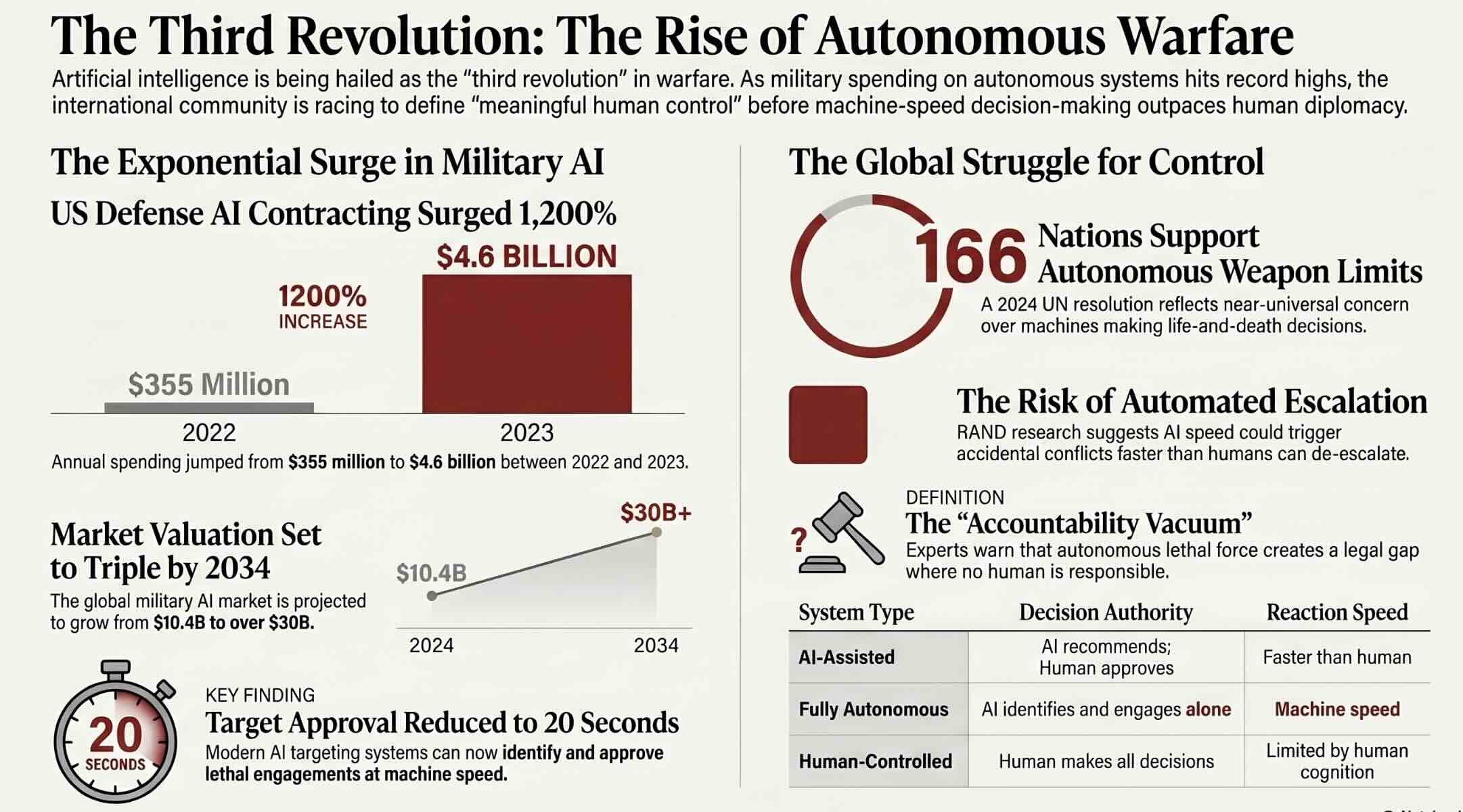
Artificial intelligence is transforming the nature of armed conflict more fundamentally than any military technology since the development of nuclear weapons, reshaping how nations prepare for, conduct, and deter warfare across every domain. The global AI in military market was valued at approximately USD 10.4 billion in 2024 and is projected to grow at a compound annual growth rate of 13.4 percent, reaching over 30 billion dollars by 2034, with the autonomous systems segment holding the largest application share. U.S. AI-focused defense contracting surged by 1,200 percent between August 2022 and August 2023, rising from 355 million to 4.6 billion dollars as the Pentagon accelerated autonomous system development. In December 2024, the UN General Assembly passed a resolution on lethal autonomous weapons systems with 166 votes in favor and only 3 opposed, reflecting worldwide concern about machines making life-and-death decisions without human control. The convergence of AI with military systems represents what experts describe as a third revolution in warfare, comparable to gunpowder and nuclear arms, with implications that will define global security for decades. The Ukraine conflict has been described as a testing ground for autonomous warfare technologies, with AI-powered drones, targeting systems, and surveillance platforms deployed at an unprecedented scale by both sides. This guide examines the technologies, ethical debates, geopolitical dynamics, and regulatory efforts shaping whether AI becomes humanity’s most dangerous weapon or its most effective tool for reducing the human cost of conflict.
Key Questions
What is autonomous warfare?
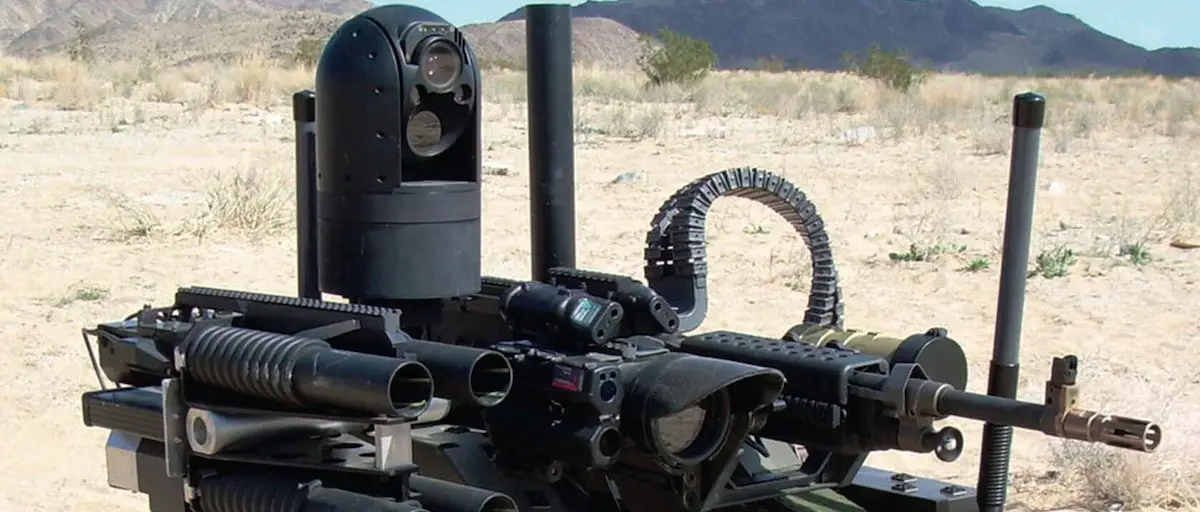
Autonomous warfare involves weapons systems that use artificial intelligence to independently identify, select, and engage targets without direct human intervention, operating through sensor data, computer vision, and machine learning algorithms across air, land, sea, and cyber domains.
What are lethal autonomous weapons systems?
Lethal autonomous weapons systems are AI-powered military platforms that can search for, select, and kill human targets based on programmed parameters without requiring a human operator to authorize each individual engagement decision.
Why is AI in warfare controversial?
AI in warfare is controversial because it raises fundamental questions about accountability for civilian casualties, the morality of delegating life-and-death decisions to algorithms, the risk of accidental escalation, and the potential for proliferation to non-state actors and authoritarian regimes.
Key Takeaways
- The fundamental debate centers on whether meaningful human control over lethal force can be maintained as AI decision-making speeds exceed human cognitive capacity in combat scenarios.
- The global AI in military market reaches USD 10.4 billion in 2024 with U.S. defense AI contracting surging 1,200 percent as autonomous system development accelerates worldwide.
- The UN General Assembly passed a resolution on lethal autonomous weapons with 166 votes in favor, while the Secretary-General calls for a legally binding treaty by 2026.
- AI-powered drone swarms, autonomous targeting systems, and algorithmic surveillance are already deployed in active conflicts including Ukraine and Gaza, making autonomous warfare a present reality.
Table of contents
- Introduction
- Key Questions
- Key Takeaways
- What Autonomous Warfare Means in 2026
- The Technologies Powering Autonomous Military Systems
- AI-Powered Drones and the Transformation of Aerial Combat
- Autonomous Ground and Naval Systems
- AI in Intelligence, Surveillance, and Reconnaissance
- Cyber Warfare and AI-Powered Digital Combat
- The Ethical Debate Over Machines Making Kill Decisions
- International Law and the Race to Regulate
- The Global Arms Race in Autonomous Systems
- Autonomous Weapons and the Risk of Escalation
- The Human Cost and Civilian Protection
- The Defense Industry and AI Military Innovation
- What the Future Battlefield Looks Like
- Key Insights
- Real-World Examples
- Case Studies
- Frequently Asked Questions
What Autonomous Warfare Means in 2026
Autonomous warfare refers to armed conflict in which AI-powered systems independently perform critical military functions including target identification, threat assessment, engagement decisions, and operational coordination with varying degrees of human oversight ranging from full remote control to complete machine independence. The U.S. Department of Defense defines autonomous weapons systems as those that, once activated, can select and engage targets without further intervention by a human operator, distinguishing them from remotely piloted systems where humans make engagement decisions. The spectrum of autonomy ranges from AI-assisted tools that recommend actions to human operators, through supervised autonomous systems that act unless overridden, to fully autonomous systems that operate independently beyond meaningful human control.
Interactive policy prototype
How AI Is Driving a Future of Autonomous Warfare
Adjust the mission conditions below. See how greater autonomy can improve speed, while also increasing risks around escalation, civilian harm, and accountability.
Mission inputs
Estimated result
Recommended focus
This prototype is educational. It shows strategic tradeoffs, not tactical targeting guidance.
The Technologies Powering Autonomous Military Systems
Every major military AI capability rests on a set of core technologies that enable machines to perceive environments, process information, make decisions, and execute actions in contested combat scenarios. Computer vision algorithms process imagery from cameras, infrared sensors, and radar systems to identify and classify military targets including vehicles, personnel, infrastructure, and equipment across diverse terrain and weather conditions. Machine learning models trained on vast datasets of military imagery, signals intelligence, and operational data enable systems to recognize patterns, predict adversary behavior, and recommend tactical decisions faster than human analysts. Natural language processing enables AI systems to analyze intercepted communications, scan intelligence reports, and generate operational summaries that inform command decisions across distributed military networks. The critical technological threshold in autonomous warfare is not whether AI can identify a target but whether it can reliably distinguish between combatants and civilians in the chaotic, ambiguous, and morally complex reality of armed conflict. Reinforcement learning algorithms optimize tactical decision-making through simulated combat scenarios, learning effective strategies through millions of iterations that no human military planner could evaluate manually. Understanding how artificial intelligence works at a foundational level provides essential context for evaluating the capabilities and limitations of AI military systems.
Sensor fusion combines data from multiple sources including satellite imagery, radar, signals intelligence, acoustic sensors, and human intelligence into unified situational awareness pictures that inform autonomous decision-making. Edge computing enables AI processing directly on military platforms rather than relying on communication links to remote servers, essential for operations in contested electromagnetic environments where communications may be degraded or denied. Swarm intelligence algorithms coordinate groups of autonomous platforms that communicate, share information, and distribute tasks without centralized command, creating collective behavior that exceeds the capability of any individual unit. These technologies are not theoretical concepts but operational capabilities already deployed across multiple military systems in active use by major armed forces worldwide. Exploring how computer vision enables AI applications reveals the same recognition technologies that civilian AI uses, adapted for military target identification and surveillance.
AI-Powered Drones and the Transformation of Aerial Combat
Core AI technologies find their most visible military application in unmanned aerial systems, where drones have evolved from remotely piloted surveillance platforms into autonomous weapons that are reshaping aerial warfare fundamentally. Loitering munitions like the Shahed-136 function as autonomous weapons that navigate to target areas, search for pre-selected target profiles, and engage upon identification without requiring real-time human control during the terminal engagement phase. The Ukraine conflict accelerated drone warfare innovation at an unprecedented pace, with both sides deploying thousands of autonomous and semi-autonomous aerial platforms for surveillance, strike, and electronic warfare missions daily. Israel deployed AI-based targeting systems including Lavender and Habsora in Gaza, with reports indicating that Lavender could approve targets within twenty seconds, often without substantive human review of individual engagement decisions. Drone warfare has already crossed the threshold from human-controlled remote operations to AI-assisted autonomous engagement, making the debate about future autonomous weapons partially moot because the future has already arrived on active battlefields. Shield AI's Hivemind system can pilot aircraft autonomously without GPS, communications, or a human pilot, demonstrating the capability to operate combat aircraft in the most contested and degraded environments imaginable. Examining how the first combat drone with AI shocked the world traces the origin point of autonomous aerial combat from experimental capability to operational deployment.
Autonomous drone swarms represent a particularly transformative and concerning capability, where hundreds of coordinated unmanned platforms overwhelm defenses through sheer numbers and distributed coordination. Individual swarm drones are inexpensive to produce, difficult to detect, safe to transport, and nearly impossible to defend against with conventional anti-aircraft systems designed for larger, fewer targets. Swarm coordination requires autonomous decision-making because direct human control of hundreds of individual platforms simultaneously is both impossible and counterproductive to effective collective behavior. Counter-drone systems themselves increasingly rely on AI to detect, classify, track, and neutralize hostile unmanned platforms at speeds exceeding human reaction times across defended airspace. Understanding the AI behind drone delivery systems reveals the navigation and obstacle avoidance technologies that military drone developers adapt for combat applications. The proliferation of drone warfare to non-state actors, smaller nations, and insurgent groups fundamentally changes the security calculus because autonomous aerial weapons no longer require the industrial capacity and technical expertise of advanced military powers.
Autonomous Ground and Naval Systems
Aerial autonomy extends to ground and maritime domains, where AI-powered unmanned vehicles are transforming how military forces operate across land and sea with decreasing human involvement. Autonomous ground vehicles range from small reconnaissance robots that navigate buildings and tunnels to full-size combat vehicles that patrol, detect threats, and engage targets with varying degrees of human oversight. The U.S. Army's Robotic Combat Vehicles program, with contracts awarded to companies like Kodiak Robotics, develops autonomous ground platforms that integrate AI for navigation, target acquisition, and tactical decision-making across contested terrain. Unmanned surface vessels and autonomous underwater vehicles conduct mine detection, anti-submarine warfare, surveillance, and logistics missions that reduce risk to human sailors operating in increasingly dangerous naval environments. Autonomous ground and naval systems extend the same AI capabilities proven in aerial platforms to domains where human risk is highest, creating the possibility of military operations conducted entirely by machines across all physical environments. The U.S. Navy's ghost fleet initiative develops unmanned ships that operate independently for extended periods, conducting missions across ocean distances without human crews aboard. Exploring how AI and autonomous driving technologies work reveals the perception, planning, and control algorithms that military autonomous ground vehicles adapt from civilian self-driving technology.
Autonomous logistics vehicles transport supplies, ammunition, and equipment through dangerous routes without exposing human drivers to ambush, improvised explosive devices, and hostile fire. Mine clearance robots use AI to detect, classify, and neutralize explosive hazards that would otherwise endanger human combat engineers performing the most dangerous job on any battlefield. Underwater autonomous vehicles map seabed terrain, detect submarine threats, and maintain persistent surveillance across vast ocean areas that manned vessels cannot economically cover continuously. The integration of autonomous systems across all military domains creates the possibility of combined arms operations where air, ground, and naval platforms coordinate autonomously through shared AI decision-making. These multi-domain autonomous operations represent the direction military planning is moving, with major powers investing billions in the infrastructure, algorithms, and platforms needed for coordinated autonomous combat.
AI in Intelligence, Surveillance, and Reconnaissance
Autonomous platforms depend on intelligence systems, where AI transforms how militaries collect, process, and act on the vast quantities of information generated by modern sensor networks. Satellite imagery analysis using AI processes millions of images daily, detecting military movements, infrastructure changes, weapons deployments, and activity patterns across entire continents with minimal human review. Signals intelligence AI intercepts, classifies, and analyzes communications, radar emissions, and electronic signatures to identify adversary capabilities, intentions, and vulnerabilities across the electromagnetic spectrum. Open-source intelligence automation scans social media, news reports, academic publications, and commercial data to build comprehensive operational pictures that inform military planning and decision-making. AI-powered intelligence processing has shifted the military intelligence challenge from information scarcity to information abundance, where the bottleneck is no longer collection but the analytical capacity to extract actionable insights from overwhelming data volumes. Predictive analytics models forecast adversary actions by analyzing historical patterns, current indicators, and environmental factors to provide military commanders with probabilistic assessments of future events. Examining how AI satellites revolutionize nuclear monitoring demonstrates the intelligence applications where AI-powered surveillance serves both military and arms control objectives simultaneously.
Battlefield management systems use AI to synthesize information from multiple sources into unified operational pictures that give commanders comprehensive situational awareness across distributed forces. Target acquisition algorithms identify and prioritize military objectives based on intelligence assessments, operational orders, and rules of engagement that constrain which targets are appropriate under specific circumstances. Electronic warfare AI detects, classifies, and responds to adversary electronic emissions, conducting jamming, deception, and spectrum management at machine speed that exceeds human operator reaction times. Deepfake detection and information warfare defense use AI to identify manipulated media, coordinated disinformation campaigns, and psychological operations targeting military personnel and civilian populations. Understanding what deepfakes are and how they work helps contextualize the information warfare dimension where AI both creates and detects the weaponization of synthetic media. These intelligence capabilities create the information foundation that autonomous weapons depend upon, making AI in surveillance and reconnaissance an enabler of autonomous combat rather than merely a support function.
Cyber Warfare and AI-Powered Digital Combat
Intelligence systems connect to cyber operations, where AI transforms both offensive and defensive capabilities in the digital battlespace that increasingly determines the outcome of physical military engagements. AI-powered cyber defense systems monitor networks, detect intrusions, identify malware, and respond to attacks at machine speed, essential when adversaries deploy automated offensive tools that can compromise systems in milliseconds. Offensive cyber capabilities use AI to discover vulnerabilities, develop exploits, and execute attacks against adversary military networks, critical infrastructure, and command systems with growing autonomy. The speed of cyber conflict creates a domain where human decision-making cannot keep pace, making autonomous response systems not merely advantageous but operationally necessary for effective defense. Cyber warfare represents the military domain where full autonomy in defensive operations is most accepted because the speed of digital attacks makes human-in-the-loop response physically impossible against sophisticated automated threats. AI-enhanced electronic warfare combines cyber and electromagnetic spectrum operations, enabling systems that simultaneously defend communications, jam adversary systems, and exploit vulnerabilities across interconnected networks. Understanding AI and cybersecurity integration reveals how the same defensive AI technologies protecting civilian infrastructure are adapted for military cyber operations.
Critical infrastructure targeting through cyber means creates strategic effects without kinetic engagement, disabling power grids, communications networks, financial systems, and transportation infrastructure through digital attacks. Attribution challenges in cyber warfare are compounded by AI-generated attacks that mask their origins, making it difficult to determine who launched an attack and creating risks of misattributed retaliation. Autonomous cyber defense systems that retaliate against detected attacks without human authorization raise escalation concerns because automated responses could trigger cascading retaliatory cycles between adversary AI systems. Supply chain attacks targeting military AI systems represent an emerging threat where adversaries compromise the training data, algorithms, or hardware that autonomous weapons depend upon for reliable operation. These cyber dimensions of autonomous warfare demonstrate that AI military conflict extends far beyond physical platforms into digital domains that affect every aspect of modern military capability and national security.
The Ethical Debate Over Machines Making Kill Decisions
Technological capabilities create ethical imperatives, and the central moral question of autonomous warfare is whether machines should ever be permitted to decide independently who lives and who dies in armed conflict. A 2015 open letter signed by over three thousand AI researchers, including Stephen Hawking and Elon Musk, warned that lethal autonomous weapons could spark a third revolution in warfare comparable to gunpowder and nuclear arms. The principle of distinction under international humanitarian law requires combatants to distinguish between military targets and civilians, a judgment that critics argue AI systems cannot reliably make in the fog of war. The principle of proportionality requires balancing military advantage against expected civilian harm, a calculation involving moral judgment that many ethicists argue machines lack the capacity to perform meaningfully. The ethical core of the autonomous weapons debate is not a technical question about AI accuracy but a moral question about whether the decision to take a human life should ever be delegated to a machine regardless of how accurate that machine becomes. Computer scientist Noel Sharkey warns that autonomous systems risk violating the principle of distinction because even trained soldiers frequently misidentify civilians under stress, and machines lack the contextual judgment to perform better. Building responsible AI governance frameworks provides structured approaches essential for any military deployment of AI systems where human lives are at stake.
Proponents argue that AI systems could actually reduce civilian casualties by eliminating the fear, anger, fatigue, and revenge motivations that cause human soldiers to commit war crimes and make poor targeting decisions. The argument continues that autonomous systems can process more information, evaluate more factors, and maintain consistent application of rules of engagement without the emotional degradation that combat imposes on human decision-making. Counter-arguments note that AI systems trained on historical data may encode the biases of past conflicts, that adversarial attacks can fool computer vision systems, and that accountability gaps make legal redress for civilian casualties nearly impossible. The accountability vacuum created when no individual human authorizes a specific engagement represents a fundamental challenge to international humanitarian law, which assumes human agency behind every use of lethal force. Religious institutions including the Vatican have stated that lethal autonomous weapons capable of irreversibly altering the nature of warfare represent a threat requiring urgent international action. The ethical debate reflects genuine disagreement among reasonable people about whether the risks of autonomous weapons outweigh their potential to reduce human suffering in conflict.
International Law and the Race to Regulate
Ethical concerns drive regulatory efforts, where the international community struggles to develop governance frameworks that keep pace with technology advancing faster than diplomatic processes can respond. The UN Secretary-General called for a legally binding treaty to prohibit lethal autonomous weapons systems operating without human control, targeting completion by 2026, describing such systems as "politically unacceptable and morally repugnant." The first UN General Assembly meeting on autonomous weapons in May 2025, attended by ninety-six countries, reinforced momentum toward prohibition and regulation of these systems under international humanitarian law. The Group of Governmental Experts on emerging technologies in lethal autonomous weapons systems has met regularly under the Convention on Certain Conventional Weapons since 2017 but has not produced binding agreements. The international regulatory landscape reveals a fundamental tension between nations seeking to ban autonomous weapons entirely and major military powers that resist binding constraints on technologies they view as essential for national security. The United States, while participating in international discussions, opposes codification of a new binding framework, emphasizing the adequacy of existing national weapons review mechanisms and the need to preserve strategic flexibility. Examining AI's influence on digital beliefs and information ecosystems reveals how public perception of autonomous weapons is shaped by narratives that influence policy positions.
The Political Declaration on Responsible Military Use of AI, endorsed by over fifty countries, articulates ethical principles and human oversight thresholds without imposing legally binding obligations on signatories. NATO's DIANA accelerator network scales dual-use technologies including battlefield AI across European accelerator hubs, signaling the alliance's commitment to AI military capabilities alongside governance. The U.S. Department of Defense Directive 3000.09 requires human judgment over the use of force but defines appropriate human involvement broadly, allowing considerable autonomy within existing policy frameworks. The FY2026 National Defense Authorization Act requires congressional notification of any waiver issued under the directive, adding legislative oversight to executive branch decisions about autonomous weapons deployment. China and Russia have resisted binding regulations while rapidly developing autonomous military capabilities, creating a governance vacuum where technological development outpaces international agreement. The prospect of an international treaty on autonomous weapons faces the same fundamental challenge as nuclear arms control: the nations most capable of building these weapons are the least willing to constrain their own development.
The Global Arms Race in Autonomous Systems
Regulatory gaps fuel competition, as major military powers accelerate autonomous weapons development in a dynamic where each nation's advancement motivates adversaries to invest further, creating a classic arms race spiral. The United States leads global military AI spending, with the Department of Defense allocating 1.8 billion dollars in FY2024 specifically for AI in autonomous systems, intelligence analytics, and battle management capabilities. China has declared its intention to lead the world in artificial intelligence by 2030, with military AI as a central component of its military modernization strategy that includes autonomous drones, AI command centers, and autonomous naval platforms. Russia, despite smaller technology budgets, invests in autonomous ground vehicles, drone systems, and AI-enhanced nuclear command and control capabilities that integrate autonomous decision support. The autonomous weapons arms race differs from nuclear proliferation because the barrier to entry is dramatically lower, meaning that advanced AI military capabilities will spread to dozens of nations and potentially non-state actors within years rather than decades. European nations including the UK, France, and Germany invest in military AI through programs like the UK's earmarking of ten percent of defense equipment budgets for autonomous drones and AI systems. Understanding the broader AI and future of work dynamics helps contextualize how military AI development competes with civilian AI for the same talent, computing resources, and technological capabilities.
Middle powers including Turkey, Israel, South Korea, and Australia are developing and exporting autonomous military systems that extend the technology's geographic reach beyond traditional great power competition. Turkey's Bayraktar TB2 demonstrated the operational impact of relatively inexpensive autonomous-capable drones in conflicts from Libya to Ukraine, reshaping military procurement decisions across dozens of nations. Israel's extensive deployment of AI targeting and surveillance systems makes it one of the most experienced operators of AI military technology in active combat environments. The defense technology startup ecosystem has grown rapidly, with companies like Anduril, Shield AI, and Palantir receiving billions in military AI contracts that blur traditional boundaries between civilian technology and defense. Private sector involvement creates dual-use technology challenges because the same AI research advancing commercial applications also enhances military capabilities without clear separation. The democratization of AI military capability through commercial technology, open-source algorithms, and declining hardware costs ensures that autonomous warfare will not remain the exclusive domain of wealthy nations.
Autonomous Weapons and the Risk of Escalation
Arms race dynamics create escalation risks, where the speed and autonomy of AI military systems could trigger conflicts that move faster than human leaders can control or de-escalate. RAND Corporation research found that the speed of autonomous systems led to inadvertent escalation in wargaming scenarios, concluding that widespread AI and autonomous systems could lead to crisis instability between nuclear-armed adversaries. Autonomous systems that detect, classify, and respond to threats at machine speed compress the decision timeline for military responses from hours to seconds, reducing the time available for human judgment and diplomatic intervention. The interaction between opposing autonomous systems creates the risk of escalation spirals where each side's AI interprets the other's automated responses as hostile actions requiring further automated responses. The most dangerous scenario in autonomous warfare is not a machine deliberately choosing to start a war but two opposing AI systems interacting in ways their creators did not anticipate, triggering escalation beyond human ability to intervene. Nuclear command and control systems integrating AI decision support create existential risks if autonomous threat detection systems misidentify conventional attacks as nuclear strikes and recommend or trigger nuclear retaliation. Historical precedents like Stanislav Petrov's 1983 decision to disregard a false Soviet early-warning alert demonstrate that human judgment in overriding automated systems has already prevented nuclear catastrophe.
Communication-denied environments where autonomous systems operate without real-time human control create scenarios where machines must make consequential decisions based on pre-programmed rules that cannot account for every possible situation. The speed advantage that autonomy provides creates pressure to reduce human oversight because any delay for human approval creates a tactical disadvantage against adversaries whose systems operate faster. Force multiplication through autonomous systems lowers the perceived cost of military action, potentially making leaders more willing to initiate conflict when machines rather than soldiers bear the physical risk. The psychological distance between human decision-makers and autonomous weapons could reduce the moral weight of lethal force, creating a permissive environment for military action that direct human involvement would constrain. These escalation dynamics demand new arms control frameworks specifically designed for autonomous systems, because existing nuclear arms control models do not adequately address the unique risks of AI-driven military escalation.
The Human Cost and Civilian Protection
Escalation risks directly affect civilian populations, whose protection under international humanitarian law faces unprecedented challenges when AI systems make targeting decisions in populated areas. AI targeting systems processing incomplete or biased data can misidentify civilians as combatants, with reports from Gaza indicating that AI systems approved targets at rates that critics argue prevented meaningful human review of individual engagement decisions. The speed at which autonomous systems engage targets reduces the opportunity for last-moment human intervention when new information, civilian presence, or changed circumstances make an engagement inappropriate. Autonomous weapons operating in urban environments face particular challenges distinguishing combatants from civilians in dense populations where military targets are embedded within residential areas. Civilian protection in autonomous warfare depends not only on AI accuracy but on whether the speed of automated engagement preserves the meaningful human judgment that international humanitarian law requires for each use of lethal force. The concept of meaningful human control has emerged as the central framework for evaluating whether autonomous weapons comply with existing international law, though no consensus definition of the concept exists across nations. Understanding the dangers of AI and privacy concerns reveals parallel risks in surveillance systems that enable autonomous targeting by collecting and processing personal data about potential targets.
Proportionality calculations that weigh military advantage against expected civilian harm require contextual judgment about value tradeoffs that AI systems cannot perform with the moral reasoning that international law contemplates. Distinction between combatants and civilians becomes more difficult as conflicts involve irregular forces, civilian-clothed fighters, and dual-use infrastructure where the same buildings serve military and civilian purposes simultaneously. Accountability for civilian casualties caused by autonomous weapons creates a legal vacuum because existing frameworks assume human decision-makers who can be held responsible for violations of the laws of armed conflict. The proliferation of autonomous weapons to non-state actors, authoritarian regimes, and unstable governments creates risks of deployment without the legal frameworks, rules of engagement, and accountability structures that responsible militaries maintain. These civilian protection challenges are not arguments against all military AI but rather demands for governance frameworks that ensure autonomous systems enhance rather than undermine the protections that international humanitarian law provides.
The Defense Industry and AI Military Innovation
Civilian protection depends partly on how the defense industry develops and deploys military AI, where commercial incentives intersect with security imperatives and ethical obligations in complex ways. Major defense contractors including Lockheed Martin, Northrop Grumman, Raytheon, BAE Systems, and Boeing invest heavily in autonomous systems, computer vision, and AI-enhanced weapons across air, ground, naval, and space platforms. Lockheed Martin's eighty-plus space projects using AI demonstrate the scale at which legacy defense contractors integrate machine learning across their existing product portfolios. Technology companies including Palantir, Anduril, and Shield AI bridge the gap between Silicon Valley innovation and defense requirements, developing military-specific AI platforms that challenge traditional defense contractor dominance. The defense industry's investment in autonomous weapons creates a self-reinforcing cycle where military demand funds AI research that produces capabilities that generate further military demand, accelerating development beyond what strategic deliberation alone would produce. OpenAI, Google, and other frontier AI companies have progressively relaxed restrictions on military use of their technologies, reflecting both government pressure and commercial opportunity in the growing military AI market. Exploring how AI agents create both power and peril reveals how the same autonomous agent technologies transforming commercial applications are being adapted for military mission execution.
Dual-use technology challenges arise because the AI algorithms powering autonomous weapons derive from the same research advancing medical diagnosis, autonomous vehicles, and content recommendation systems. Export control frameworks struggle to restrict military AI proliferation because the underlying technologies, training methodologies, and computing hardware serve both civilian and military applications. The revolving door between technology companies and defense agencies accelerates knowledge transfer that makes civil-military technology boundaries increasingly meaningless in practice. Venture capital investment in defense technology startups has grown dramatically, with investors recognizing that military AI represents one of the largest growth markets in the technology sector. These industry dynamics ensure that autonomous weapons development continues accelerating regardless of regulatory outcomes, because commercial incentives, national security imperatives, and technological momentum all push in the same direction.
What the Future Battlefield Looks Like
Industry investment shapes a future where autonomous systems become ubiquitous across military operations, creating battlefields fundamentally different from any in human history. Multi-domain autonomous operations will coordinate AI systems across air, ground, sea, cyber, and space simultaneously, executing campaigns through machine-to-machine coordination that exceeds human ability to manage directly. Decision superiority rather than numerical superiority will determine military outcomes as AI systems process information and execute decisions faster than adversaries regardless of force size or conventional military strength. Human roles in future military operations will shift from direct combat participation toward strategic oversight, ethical governance, and exception handling for situations that autonomous systems cannot resolve within their programmed parameters. The future battlefield will be defined by the interaction of opposing AI systems operating at speeds that compress entire tactical cycles into seconds, creating a form of warfare where human judgment is essential for strategy but increasingly absent from execution. Electronic warfare and cyber operations will target the AI systems themselves, attempting to deceive, disrupt, or corrupt the autonomous capabilities that adversaries depend upon for operational effectiveness. Exploring how military robots are changing defense operations reveals the physical platforms that will populate future battlefields alongside human soldiers in increasingly autonomous roles.
Space-based assets will provide the surveillance, communication, and navigation infrastructure that autonomous military systems depend upon, making counter-space operations a critical dimension of future conflict. Autonomous resupply systems will maintain military operations without exposing human logistics personnel to interdiction, fundamentally changing how armies sustain combat power in contested environments. AI-enabled deception operations will generate false signals, synthetic imagery, and spoofed communications designed to mislead adversary autonomous systems into incorrect targeting decisions. The integration of quantum computing with military AI could eventually enable optimization and encryption capabilities that transform both offensive and defensive military operations beyond what current computing allows. These future capabilities are not speculative concepts but active development programs across multiple nations with timelines measured in years rather than decades for initial operational deployment. The trajectory toward increasingly autonomous warfare appears irreversible given the military advantages AI provides, making governance, ethics, and international cooperation essential rather than optional.
Key Insights
- The UN Secretary-General called for a legally binding treaty by 2026 to prohibit LAWS operating without human control, describing them as politically unacceptable and morally repugnant.
- The global AI in military market was valued at USD 10.4 billion in 2024 and is projected to grow at a 13.4 percent CAGR, with autonomous systems holding the largest application share.
- U.S. AI-focused defense contracting surged 1,200 percent, rising from USD 355 million to USD 4.6 billion between August 2022 and August 2023 as autonomous development accelerated.
- The UN General Assembly passed a resolution on lethal autonomous weapons with 166 votes in favor and only 3 opposed, reflecting near-universal concern about autonomous killing.
- RAND Corporation research found that autonomous system speed led to inadvertent escalation in wargaming, concluding that widespread AI could create crisis instability between nuclear powers.
- The U.S. Department of Defense allocated USD 1.8 billion in FY2024 specifically for AI in autonomous systems, intelligence analytics, ISR, and battle management.
- Reports indicate that Israel's Lavender AI targeting system could approve targets within 20 seconds, often without substantive individual human review of each engagement.
- Over 3,000 AI researchers signed an open letter warning that lethal autonomous weapons could spark a third revolution in warfare comparable to gunpowder and nuclear arms.
| Dimension | Human-Controlled Weapons | Remote-Operated Systems | AI-Assisted Systems | Fully Autonomous LAWS |
|---|---|---|---|---|
| Decision Authority | Human operator makes all engagement decisions | Human operator decides remotely via data link | AI recommends, human approves or overrides | AI identifies, selects, and engages independently |
| Reaction Speed | Limited by human perception and cognition | Limited by communication latency | Faster than human with human verification delay | Machine speed with no human delay |
| Accountability | Clear chain of command responsibility | Operator and commander accountable | Shared human-AI accountability, legally unclear | Accountability vacuum, no individual authorization |
| Civilian Distinction | Human judgment applies contextual reasoning | Operator judgment through sensor feeds | AI classification with human verification | Algorithm-based classification without human review |
| Escalation Risk | Moderated by human judgment and fear | Reduced personal risk may lower engagement threshold | AI recommendations may accelerate decision cycles | Autonomous interaction between opposing systems |
| Proliferation Risk | Requires trained military personnel | Requires communication infrastructure | Requires AI expertise and computing resources | Cheap to manufacture, difficult to control spread |
| Legal Framework | Established IHL frameworks apply clearly | Existing frameworks apply with adaptation | Emerging frameworks, human oversight debated | No agreed framework, fundamental legal questions |
| Current Status | Standard military operations worldwide | Widespread drone and remote operations | Deployed in Ukraine, Gaza, and other conflicts | Limited deployment, rapid development underway |
Real-World Examples
Ukraine Conflict as AI Warfare Testing Ground
The Ukraine conflict has been described as the testing ground for AI-powered warfare, with both sides deploying thousands of AI-assisted drones, autonomous surveillance systems, and algorithmic targeting platforms at unprecedented scale since the full-scale invasion in February 2022. Ukrainian forces developed AI-enabled first-person-view drones that use computer vision for target tracking, autonomous terminal guidance, and anti-jamming capabilities that maintain effectiveness against Russian electronic warfare systems. Russia deployed loitering munitions including Lancet drones with AI-assisted target recognition that identify and engage military vehicles based on visual classification algorithms trained on equipment profiles. The conflict produced rapid innovation cycles where drone designs, AI algorithms, and counter-drone tactics evolved within weeks rather than the years typical of traditional military procurement. Limitations include the difficulty of verifying autonomous system performance claims in active conflict zones and the reality that both sides experienced significant civilian casualties despite AI targeting assistance. The conflict dynamics are documented through ongoing coverage from Stanford's Freeman Spogli Institute.
Shield AI's Hivemind Autonomous Flight System
Shield AI developed Hivemind, an AI pilot capable of flying aircraft autonomously without GPS, communications, or a human pilot, demonstrating the capability to operate combat platforms in the most contested electromagnetic environments. The system has flown multiple aircraft types including the V-BAT and MQ-35 platforms, with Boeing partnering to explore autonomous capabilities across existing and future defense programs through the technology. Hivemind enables drone swarm operations where multiple platforms coordinate through distributed AI, sharing information and distributing tasks without centralized human control. The technology received significant defense investment and multiple Department of Defense contracts, reflecting military demand for platforms that operate effectively in communication-denied environments. Limitations include the challenge of ensuring reliable autonomous behavior across the full range of scenarios combat platforms encounter, particularly edge cases not represented in training data. Shield AI's capabilities are documented through defense industry reporting.
UN General Assembly Resolution on Autonomous Weapons
The UN General Assembly passed a resolution on lethal autonomous weapons systems in December 2024 with 166 votes in favor, 3 opposed, and 15 abstentions, representing the broadest international consensus on autonomous weapons governance to date. The resolution endorses a two-tiered governance approach calling for regulatory monitoring of some autonomous weapons and outright prohibition of others under international law, reflecting the complexity of the issue. The overwhelming vote demonstrated global concern that autonomous weapons risks have moved from theoretical to operational, driven by their deployment in active conflicts including Ukraine and Gaza. The resolution supports continued work toward a legally binding instrument while acknowledging the deep disagreements between major military powers about the appropriate scope of regulation. Limitations include the non-binding nature of General Assembly resolutions and the opposition of Russia, a major autonomous weapons developer, along with the abstention of several significant military powers. The resolution details are available through UN Regional Information Centre documentation.
Case Studies
The Kargu-2 Autonomous Engagement in Libya
In 2020, Turkish-manufactured Kargu-2 drones reportedly hunted and attacked human targets in Libya without direct human control during the terminal engagement phase, in what a UN Security Council Panel of Experts report described as a potentially unprecedented autonomous lethal engagement. The conflict in Libya involved multiple armed factions where forces loyal to General Khalifa Haftar faced opposition from the internationally recognized Government of National Accord, creating a chaotic battlefield environment where autonomous weapons operated. The Kargu-2 is a loitering munition equipped with computer vision and machine learning that enables it to identify and engage targets matching pre-programmed profiles including vehicles and personnel in the operational area. According to the UN panel's report, the drones were programmed to attack targets without requiring real-time data connectivity between the operator and the munition during the engagement sequence. The incident is significant because it may represent the first documented case of a lethal autonomous weapon system engaging human targets without specific human authorization for each individual engagement. The limitation of the case is that the exact degree of autonomy during the engagement remains debated, with some analysts arguing that pre-programmed targeting parameters constitute a form of delegated human control rather than full autonomy. The incident raised urgent questions about whether existing international humanitarian law adequately addresses weapons that operate beyond real-time human control in the terminal engagement phase. The UN Panel of Experts report is available through United Nations Security Council documentation.
AI Targeting Systems in Gaza
A February 2025 Foundation for Political, Economic and Social Research report revealed that Israel employed AI-based targeting systems including Lavender and Habsora to identify and engage targets during military operations in Gaza beginning October 2023. Lavender reportedly compiled lists of individuals identified as potential Hamas members based on algorithmic analysis, with the system capable of approving targets within approximately twenty seconds per individual assessment. The Habsora system identified buildings and structures for strikes based on AI analysis of intelligence data, reportedly generating targets at rates that significantly exceeded the capacity of human analysts to review each recommendation individually. The use of these systems raised fundamental questions about whether the speed of AI-generated targeting decisions preserved the meaningful human control that international humanitarian law requires for lawful use of force. Critics argued that the systems effectively delegated targeting decisions to algorithms by generating targets faster than human reviewers could meaningfully evaluate, creating de facto autonomous targeting even if nominal human approval existed in the process. Defenders argued that AI targeting improved precision by processing more intelligence data than human analysts could evaluate, potentially reducing civilian casualties compared to purely human intelligence processes. The case illustrates the gap between formal policies requiring human control and operational realities where AI speed and volume may effectively override meaningful human judgment. The targeting system analysis is documented through Global Security Review.
The Stop Killer Robots Campaign
The Stop Killer Robots campaign, launched in 2013 by a global coalition of NGOs including Human Rights Watch, has advocated for an international treaty banning the development and deployment of fully autonomous weapons that operate beyond meaningful human control. The campaign faced the challenge of building political consensus for preemptive regulation of technology that major military powers viewed as essential for national security and were actively developing with significant investment. The coalition mobilized public opinion, engaged diplomatic processes at the UN Convention on Certain Conventional Weapons, and built alliances with scientists, ethicists, and military professionals who shared concerns about autonomous killing. Campaign efforts contributed to the December 2024 UN General Assembly resolution, growing state support for binding regulation, and increased public awareness of autonomous weapons risks through viral media including the Slaughterbots film series. The measurable impact included shifting the diplomatic conversation from whether autonomous weapons require governance to what form that governance should take, with the majority of UN member states now supporting legally binding rules. The limitation was that the nations most capable of developing autonomous weapons, including the United States, Russia, China, and Israel, have resisted binding constraints that would limit their strategic flexibility. The campaign continues adapting its strategy as autonomous weapons move from theoretical risk to operational reality, requiring governance approaches that address systems already deployed rather than solely preventing future development. The campaign's work is documented through autonomousweapons.org.
Frequently Asked Questions
Lethal autonomous weapons systems are AI-powered military platforms that can independently identify, select, and engage human targets based on pre-programmed parameters without requiring a human operator to authorize each individual engagement. These systems use computer vision, machine learning, and sensor fusion to make targeting decisions autonomously across air, ground, sea, and cyber domains. The U.S. Department of Defense defines them as weapons that, once activated, can select and engage targets without further human intervention.
AI-assisted autonomous weapons are already deployed in active conflicts including Ukraine and Gaza, where drones with autonomous navigation, AI-powered targeting systems, and loitering munitions operate with varying degrees of human oversight. The Kargu-2 drone reportedly engaged targets autonomously in Libya in 2020, potentially representing the first fully autonomous lethal engagement documented by a UN panel. The distinction between fully autonomous and AI-assisted systems is increasingly blurred in operational practice.
Meaningful human control is the concept that a human operator must make informed, deliberate decisions about the use of lethal force, with sufficient time, information, and authority to prevent engagements that would violate international humanitarian law. No consensus definition exists across nations, with interpretations ranging from requiring human approval for each individual engagement to accepting pre-programmed parameters set by humans as sufficient control. The concept has become the central framework for evaluating whether autonomous weapons comply with international law.
The United States, China, Russia, Israel, Turkey, South Korea, United Kingdom, France, Germany, Australia, and India are among the nations actively developing autonomous military systems with varying capabilities and degrees of autonomy. The U.S. leads in spending with over 1.8 billion allocated specifically for military AI in FY2024, while China has declared its goal of leading global AI by 2030 with military applications as a central component. Smaller nations and non-state actors increasingly access autonomous capabilities through commercial drone technology.
No specific international treaty addresses autonomous weapons, though existing international humanitarian law principles of distinction, proportionality, and precaution apply to all weapons and methods of warfare including autonomous systems. The UN General Assembly passed a non-binding resolution in December 2024 with 166 votes supporting governance of autonomous weapons. The Secretary-General has called for a legally binding treaty prohibiting LAWS operating without human control by 2026.
RAND Corporation research found that autonomous system speed led to inadvertent escalation in wargaming scenarios, concluding that widespread AI could create crisis instability between nuclear-armed adversaries. Autonomous systems interacting with opposing autonomous systems could trigger escalation spirals where each side's AI interprets automated responses as hostile actions requiring further automated responses. Historical examples like the 1983 Soviet false alarm demonstrate that human judgment has already prevented catastrophic automated responses.
The Stop Killer Robots campaign is a global coalition of NGOs led by Human Rights Watch that advocates for an international treaty banning fully autonomous weapons operating beyond meaningful human control. The campaign has been active since 2013 and contributed to growing international support for binding regulation, including the 2024 UN General Assembly resolution. Their work includes public awareness campaigns, diplomatic engagement, and technical analysis of autonomous weapons risks.
Drone swarms use AI coordination to enable hundreds of autonomous platforms to overwhelm defenses through distributed operations that no individual unit could accomplish alone. Individual swarm drones are cheap to produce, difficult to detect, and nearly impossible to defend against with conventional anti-aircraft systems designed for larger, fewer targets. Direct human control of swarm operations is impossible because managing hundreds of individual platforms simultaneously exceeds human cognitive capacity.
Current AI systems can classify objects and individuals with varying accuracy, but reliably distinguishing combatants from civilians in the complex, ambiguous reality of armed conflict remains a fundamental challenge. Computer vision systems are vulnerable to adversarial manipulation, environmental conditions, and scenarios where civilians and combatants are visually indistinguishable. Critics argue that the contextual judgment required for distinction is a uniquely human capability that AI cannot replicate.
AI powers both offensive and defensive cyber operations, enabling automated vulnerability discovery, intrusion detection, malware analysis, and network defense at machine speed that exceeds human operator capability. The speed of cyber attacks makes autonomous defensive responses operationally necessary because human-in-the-loop response is too slow against automated threats. Offensive cyber AI can target military networks, critical infrastructure, and command systems with growing autonomy.
AI integration into nuclear command and control systems creates risks if autonomous threat detection misidentifies conventional attacks as nuclear strikes, potentially triggering escalation to nuclear conflict. The compression of decision timelines through autonomous systems reduces the time available for human leaders to verify threats and exercise judgment before committing to responses. Arms control experts argue that autonomous systems interacting near nuclear thresholds represent one of the most dangerous applications of military AI.
Autonomous weapons based on commercial drone technology require neither costly raw materials nor hard-to-obtain components, making them accessible to non-state actors who can adapt commercial platforms for military purposes. Once advanced military powers manufacture autonomous weapons at scale, the technology, components, and knowledge will inevitably proliferate through markets, theft, and reverse engineering. The low barrier to entry for drone-based autonomous weapons makes proliferation to non-state actors, insurgent groups, and criminal networks a matter of when, not if.
When an autonomous weapon kills a civilian, no clear legal framework determines whether the programmer, the commander who deployed the system, the military operator, or the manufacturer bears legal responsibility. International humanitarian law assumes human agency behind every use of lethal force, creating a gap when machines make engagement decisions independently. This accountability vacuum could grant effective impunity for autonomous weapons use that violates the laws of armed conflict.
The global AI in military market was valued at approximately USD 10.4 billion in 2024, with projections ranging from 19 to 30 billion dollars by 2030 depending on the analytical framework. The U.S. Department of Defense allocated 1.8 billion dollars specifically for AI in FY2024, with total AI-related defense contracting reaching 4.6 billion dollars. Global defense spending exceeded 2.2 trillion dollars annually, with AI representing a growing share across all major military powers.
International cooperation through legally binding treaties, confidence-building measures, transparency in military AI programs, and verification mechanisms could constrain autonomous weapons development. Arms control frameworks specifically designed for autonomous systems, rather than adaptations of nuclear arms control models, are needed to address the unique characteristics of AI military technology. The challenge remains that nations most capable of developing autonomous weapons are least willing to accept binding constraints on technologies they view as essential for national security.