
Introduction
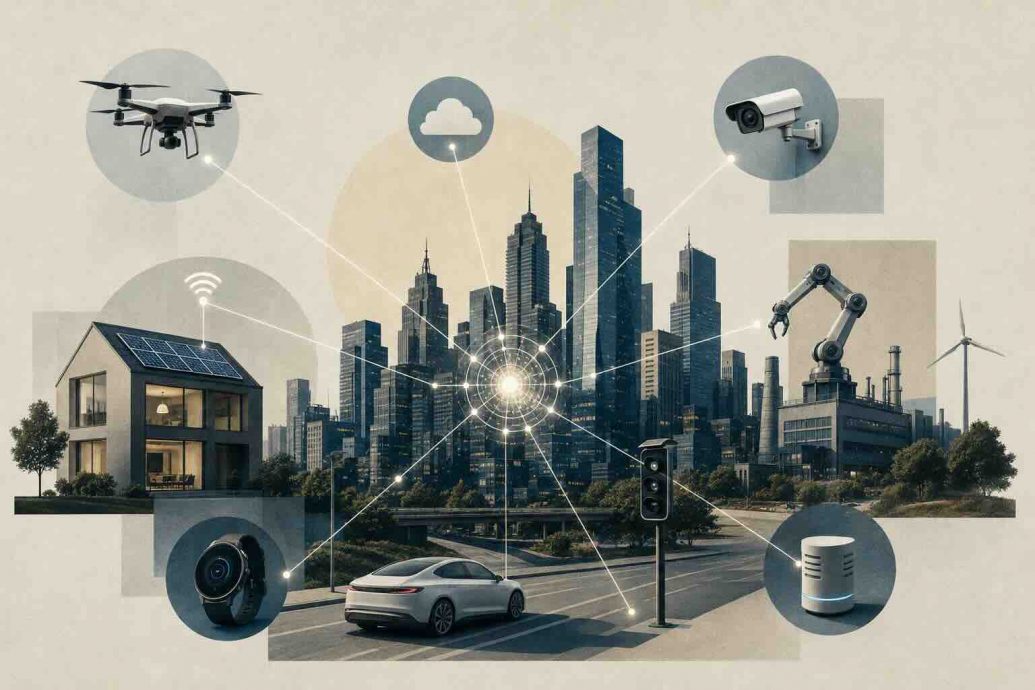
The Internet of Things has moved from a buzzword to the backbone of modern industry, and today’s IoT trends touch nearly every sector. Active connections reached roughly 20 billion in 2025 and will climb to about 21.9 billion in 2026 worldwide. These connected sensors stream live data from factories, hospitals, farms, vehicles, and living rooms every second of the day. Leaders who track these shifts gain a clear map of where budgets, talent, and attention should flow next. The market is enormous, with global spending on the Internet of Things set to cross one trillion dollars in 2026. This guide breaks down the shifts that matter most, from edge intelligence and 5G to digital twins and security. You will leave with practical context, real deployment numbers, and a grounded sense of what comes next.
Quick Answers About IoT
What are the most important IoT trends in 2026?
The leading IoT trends in 2026 are edge AI, 5G connectivity, digital twins, industrial IoT, and stronger security regulation. Each one pushes intelligence closer to the device.
How many connected IoT devices exist today?
Active IoT connections reached about 20 billion in 2025 and will hit roughly 21.9 billion in 2026. Analysts expect more than 50 billion devices by 2035.
Why do IoT trends matter for businesses?
IoT trends matter because they cut costs, prevent downtime, and open new revenue. Firms using connected sensors report strong gains in efficiency, safety, and customer insight.
Key Takeaways
- Edge AI, 5G, digital twins, industrial IoT, and security regulation are the defining IoT trends of 2026.
- Connected devices will pass 21.9 billion in 2026 and head toward 50 billion by 2035.
- Predictive maintenance and connected healthcare already show double-digit cost and downtime savings.
- Security and privacy remain the biggest barriers, with new regulation arriving in 2026.
Table of contents
- Introduction
- Quick Answers About IoT
- Key Takeaways
- What Is the Internet of Things?
- Why IoT Trends Matter for Business Now
- Edge AI Is Reshaping How Devices Think
- Faster Connectivity With 5G and Beyond
- Digital Twins Reach Production Scale
- Industrial IoT and the Smart Factory
- Predictive Maintenance Goes Mainstream
- Connected Care and the Internet of Things
- Smart Homes and Consumer IoT Trends
- Putting the Internet of Things to Work
- Security Risks That Shadow Connected Devices
- The Ethics of Always-On IoT Data
- The Future of the Internet of Things Beyond 2026
- Key Insights
- How the Leading IoT Trends Compare
- The Internet of Things in Practice Today
- Lessons From Real IoT Deployments
- Common Questions About IoT
What Is the Internet of Things?
The Internet of Things connects everyday devices to networks and software. These sensors collect data, share it, and trigger automated actions. IoT trends describe how this connected technology evolves each year. They span smart homes, factories, hospitals, vehicles, and cities. Tracking IoT trends helps leaders plan budgets and adopt tools.
IoT Savings Estimator
Illustrative estimate based on a 35% downtime-reduction benchmark for predictive IoT programs. Adjust the controls to model your own IoT trends business case.
Why IoT Trends Matter for Business Now
IoT trends now sit at the center of business strategy, not on its edge. Companies use connected data to cut waste, raise output, and respond to customers in real time. The financial stakes are large, with worldwide IoT spending crossing one trillion dollars in 2026. Greater China leads that spending, followed by North America at over one hundred billion dollars. Every connected sensor turns a physical event into a data point a system can act on. That shift lets firms move from guesswork to evidence across daily operations.
The reach of connected technology now extends well past the factory floor. Retailers track shelves, hospitals track patients, and cities track traffic with the same core technology. You can see this in practical guides on how to control IoT devices across a home or site. Each new sensor adds context that software can combine into a fuller operating picture. Leaders report that this visibility shortens decisions that once took days. The payoff is faster reaction and far fewer costly surprises.
Adoption is no longer limited to large enterprises with deep budgets. Affordable sensors and cloud platforms put connected systems within reach of small teams. A focused pilot can prove value before any large rollout begins. That low barrier is why adoption keeps spreading across so many industries at once. The result is a broad shift in how ordinary businesses collect and use data. Momentum like this rarely reverses once the savings become clear.
Edge AI Is Reshaping How Devices Think
The defining shift among current IoT trends is intelligence moving onto the device itself. Edge AI lets sensors analyze data locally and act within milliseconds rather than waiting on the cloud. Specialized chips, including RISC-V processors and compact accelerators, now sit inside cameras and controllers. This local processing cuts bandwidth, lowers latency, and keeps sensitive data closer to its source. Vendors exploring edge AI safety are baking models directly into hardware. The result is a device that senses, decides, and responds on its own.
Running models at the edge changes how engineers design whole systems. Teams now balance on-device compute against battery life and cost in ways the cloud never required. A smart camera can spot a defect without sending video anywhere, which protects privacy. That autonomy matters most when connections drop or every millisecond counts. Edge intelligence also reduces the data firms must store and move at scale. Smaller data flows cut cloud bills and ease pressure on crowded networks. These pressures make edge AI one of the most practical shifts to plan around.
Faster Connectivity With 5G and Beyond
Building on that edge intelligence, faster networks give connected devices room to breathe. 5G delivers latency as low as one millisecond and data rates that reach twenty gigabits per second. It can support up to one million devices per square kilometer in a dense deployment. That capacity lets a factory or stadium run thousands of sensors without congestion. Reliable, real-time links turn many promising use cases from demos into production systems. Connectivity is the quiet foundation under almost every other shift.
The benefits reach well beyond raw speed for most organizations. Low latency means a robot arm or vehicle can react to sensor input almost instantly. Network slicing lets operators reserve dedicated bandwidth for critical machines. Connected fleets, including autonomous vehicles, depend on this kind of responsive link. The same network can carry both routine telemetry and urgent control signals. That flexibility makes 5G a workhorse for industrial settings.
Coverage and cost still shape how quickly these gains arrive. Rural areas often lag the dense cities where carriers concentrate their early rollouts. Private 5G networks help large sites guarantee performance on their own terms. Many firms pair 5G with low-power options for sensors that send small bursts of data. Choosing the right mix of networks keeps budgets sane as devices multiply. Connectivity planning is now a core part of any IoT strategy.
Looking ahead, the roadmap already points past current 5G toward even denser networks. Standards bodies are testing features built specifically for massive machine traffic. Satellite links are filling gaps where ground networks cannot reach today. Together these options promise near-universal coverage for connected devices. That reach will unlock new use cases in shipping, farming, and remote infrastructure. The network layer keeps expanding to meet rising demand.
Digital Twins Reach Production Scale
Shifting from connectivity to insight, digital twins turn live sensor data into working models. A digital twin is a virtual replica of a physical asset that updates continuously from IoT feeds. Operators test changes on the model before touching real equipment in the field. In wind-farm management, twins have raised energy efficiency by up to 25 percent. They also cut unexpected failures by around 30 percent by spotting stress early. That blend of simulation and live data is why twins moved from pilots to production.
The value grows as twins link to broader systems across an operation. A factory twin can model an entire line, while a city twin can model traffic or water flow. Planners use these models to weigh decisions against real consequences. Connecting twins to supply chain data extends the view from one machine to a whole network. Each added data source makes the model sharper and more useful. Decisions then rest on evidence rather than intuition.
Building accurate twins still demands clean, well-labeled data and steady upkeep. A model is only as good as the sensor streams feeding it each day. Teams must reconcile messy real-world readings with the idealized digital version. That work takes engineering time and disciplined data governance. Done well, the twin becomes a trusted sandbox for risky changes. Done poorly, it drifts away from the reality it claims to mirror.
Industrial IoT and the Smart Factory
Turning to the factory floor, industrial IoT remains the largest engine of connected growth. IIoT links machines, sensors, and control systems across production lines and supply chains. Manufacturers use it to raise output, cut waste, and catch quality problems early. The same playbook already powers proven uses, such as the sensors behind IoT in retail. Connected lines feed dashboards that reveal bottlenecks in real time. That visibility is reshaping how modern plants are run.
The smart factory combines IIoT with edge AI and analytics into one loop. Sensors gather data, models interpret it, and machines adjust without waiting for humans. This closed loop drives a large share of total IoT market growth. Teams often start with a single production line before expanding further. Early wins there build the case for wider investment. Scaling then becomes a matter of repeating what already works.
Predictive Maintenance Goes Mainstream
Beyond raw monitoring, predictive maintenance has become one of the most bankable IoT trends. Connected sensors track vibration, temperature, and wear on equipment in real time. Algorithms then flag likely failures days or weeks before they occur. Documented programs cut maintenance costs by 25 to 30 percent, according to McKinsey estimates. Some operations report downtime falling by as much as half. The math is simple, since avoided breakdowns are far cheaper than emergency repairs.
The approach spread fast because the savings are easy to measure. A single avoided failure on a critical line can fund an entire sensor program. Maintenance shifts from fixed schedules to condition-based action driven by data. Crews fix the right machine at the right time instead of guessing. That precision extends asset life and frees up skilled labor. Plants can then redeploy technicians toward higher-value improvement projects instead of routine checks. The result is steadier production and a calmer maintenance team.
Success still hinges on data quality and patient tuning of the models. Noisy or sparse sensor readings produce false alarms that erode trust. Teams must label failures carefully so algorithms learn the right patterns. Early programs often need months before predictions become reliable. Strong governance keeps the models honest as equipment ages. With that discipline, predictive maintenance pays back quickly and repeatedly.
Connected Care and the Internet of Things
Among the most human-centered IoT trends, connected care is reshaping how medicine reaches patients. Hospitals use connected monitors, wearables, and smart beds to track vital signs continuously. That stream of data lets clinicians act on early warning rather than scheduled checks. Work on AI in healthcare shows how connected data and models combine at the bedside. Remote monitoring already extends care far beyond hospital walls. The shift moves medicine from episodic visits toward continuous oversight.
The outcomes reported so far are striking across several programs. Remote patient monitoring has cut hospital readmissions by as much as 40 percent. Connected cardiac monitoring in one pilot lowered emergency visits by 28 percent in six months. Continuous glucose monitors stream readings straight to phones and clinician dashboards. These tools catch deterioration that periodic visits would miss entirely. Patients gain both convenience and a real safety margin.
The economic case is large as well as clinical. Analysts have projected that remote monitoring could create up to 1.6 trillion dollars in annual value. Best-in-class hospitals using 5G and edge computing report efficiency gains of 20 to 30 percent. Connected devices reduce manual charting and free nurses for direct care. Diagnostics and mobile health see some of the clearest improvements. The savings stack up alongside a better patient experience.
Privacy and reliability still set the pace of adoption in healthcare. Patient data demands strict consent, encryption, and tight access control. A dropped signal or false alert can carry real clinical consequences. Hospitals must integrate devices with electronic records without creating new risks. Strong security and clear governance remain non-negotiable here. Trust, in the end, decides how far connected care can spread.
Smart Homes and Consumer IoT Trends
On top of the industrial story, consumer IoT trends keep spreading inside the home. Nearly half of United States households are expected to use smart home devices by 2026. Voice assistants now learn habits and adjust thermostats, lights, and locks automatically. Upgrades like those in smart home assistants push more intelligence onto local devices. The global smart home market is heading toward roughly 180 billion dollars in 2026. Convenience and energy savings drive most of this steady consumer adoption.
The same devices raise fresh questions about privacy and always-on sensing. Microphones and cameras in living spaces collect far more than simple commands. Concerns about always-on AI wearables mirror these worries on the body as well as the home. Fragmented standards still make some devices hard to connect cleanly. Buyers increasingly weigh security and data practices alongside features. That scrutiny is slowly pushing makers toward safer defaults.
Putting the Internet of Things to Work
Given the breadth of these IoT trends, a disciplined rollout beats chasing every shiny device. Start by naming a costly problem, such as unplanned downtime or wasted energy. Pick one line, building, or route where sensors can prove value quickly. Much like adopting machine learning in small steps, a tight pilot limits risk. Measure a clear baseline before any sensors go live. That discipline turns a vague ambition into a testable business case.
Architecture choices matter as much as the use case itself. Decide early what runs at the edge and what belongs in the cloud. Choose connectivity that fits the data volume and latency you actually need. Plan for security and device management from the first day, not as an afterthought. Standard platforms reduce custom work and speed up later expansion. These decisions shape cost and flexibility for years.
Scaling works best when you repeat proven patterns rather than reinvent them. Document what worked in the pilot and turn it into a reusable template. Train staff so they trust and act on the new data streams. Expand to the next line or site once metrics confirm the gains. Keep governance tight as the number of devices climbs. Assign clear owners for security, data, and device retirement before the fleet grows large. Steady, evidence-led growth outperforms a rushed, broad rollout.
Security Risks That Shadow Connected Devices
Despite the upside, security remains the darkest shadow over these IoT trends. Many devices still ship with default passwords that attackers exploit at scale. Botnets such as Aisuru now harness compromised devices for record DDoS attacks. Work on IoT and cybersecurity shows how quickly these threats are evolving. Edge devices have become a leading entry point into corporate networks. Every new sensor is also a potential door for intruders.
The numbers behind these attacks are sobering and growing fast. Botnet capacity rose roughly fivefold in a single year, reaching tens of terabits per second. The Verizon DBIR found edge and VPN exploitation jumped from 3 percent to 22 percent of breaches. Supply-chain malware has compromised more than 10 million devices in some campaigns. Default credentials on cameras, printers, and controllers remain a primary spread path. Attackers scan constantly for the weakest connected link.
Regulation is finally catching up with the scale of the problem. The EU Cyber Resilience Act will require reporting exploited vulnerabilities within 24 hours from September 2026. Full conformity obligations follow in late 2027 for connected products. These rules push manufacturers toward secure defaults and timely patches. Buyers gain leverage to demand unique passwords and regular firmware updates. Compliance is becoming a baseline expectation, not a bonus.
Defending connected systems takes layered, ongoing effort. Segment networks so a single compromised device cannot reach critical systems. Change default credentials and enforce strong authentication everywhere. Keep firmware current and retire devices that no longer receive updates. Monitor traffic for the odd patterns that signal a hijacked sensor. Run regular drills so the team can respond quickly when an alert finally fires. Security is a continuous practice, never a one-time setup.
The Ethics of Always-On IoT Data
With that scrutiny in mind, the ethics of always-on IoT data deserve real attention. Connected sensors quietly record movement, health, speech, and habits around the clock. People rarely understand how much information their devices collect each day. Debates over AI ethics and laws increasingly extend to this constant sensing. Consent, transparency, and data minimization are no longer optional niceties. The question is not only what is possible, but what is acceptable.
Concerns about data privacy on devices sit at the heart of this debate. Who owns the readings, and who can sell or share them, remains contested. Surveillance creep can turn helpful tools into instruments of control. Bias in sensor data can quietly disadvantage some groups over others. Clear policies and honest defaults help rebuild fragile public trust. Ethical design will shape which IoT trends society actually welcomes.
The Future of the Internet of Things Beyond 2026
Looking ahead, the next wave of IoT trends points toward quieter, smarter, more autonomous systems. Analysts expect connected devices to surpass 50 billion by the middle of the next decade. More intelligence will run directly on devices, with less reliance on distant clouds. Connected infrastructure will spread through projects in smart cities worldwide. Systems will increasingly cooperate with one another with minimal human input. The technology is steadily fading into the background of daily life.
Sustainability will shape design as much as performance does. Low-power sensors and efficient networks reduce the energy cost of billions of devices. Connected systems already help manage water, waste, and traffic more cleanly. Thoughtful urban design will weave these sensors into streets and buildings. Efficiency becomes a feature that buyers and regulators both demand. Green goals and connected data are starting to reinforce each other.
The boundaries between IoT, AI, and automation will keep dissolving. Devices will sense, decide, and act as parts of larger intelligent systems. Regulation and standards will mature to match this rising autonomy. Trust, security, and ethics will gate how far the technology travels. The organizations that prepare now will adapt fastest as the shift accelerates. The future of connected technology is arriving one sensor at a time.
Connected IoT Devices by Year
Active IoT connections worldwide, in billions (projected)
Source: IoT Analytics and Statista IoT device projections, 2025 to 2026.
Key Insights
- Active IoT connections will reach about 21.9 billion in 2026 and pass 50 billion by 2035, reports IoT Analytics.
- Global IoT spending crosses one trillion dollars in 2026, with the wider market valued above 1.3 trillion dollars by Statista forecasts.
- Predictive maintenance can cut maintenance costs 25 to 30 percent and downtime up to 50 percent, per industry research.
- 5G supports up to one million devices per square kilometer with latency near one millisecond, enabling dense IoT deployments.
- Wind-farm digital twins have raised energy efficiency up to 25 percent and cut failures by 30 percent, notes industry analysis.
- Remote patient monitoring has lowered hospital readmissions by as much as 40 percent in recent healthcare pilots.
- The EU Cyber Resilience Act requires reporting exploited vulnerabilities within 24 hours from September 11, 2026, per compliance guidance.
Taken together, these shifts point to a single direction of travel. Intelligence is moving to the edge, connectivity is getting denser, and data now feeds live models of the physical world. The clearest gains show up where downtime is expensive and sensors are cheap. Security and ethics now shape adoption as much as raw capability does. The winners will be teams that pair small, well-scoped pilots with strong governance. That combination turns connected data into durable advantage rather than scattered experiments.
How the Leading IoT Trends Compare
Stepping back from individual technologies, it helps to see how the leading trends stack up. Each trend sits at a different stage of maturity and carries its own payoff and risk. The table below compares the headline benefit and main weakness of each shift. Use it to decide where your first or next investment belongs. Smart programs often combine two or three of these trends rather than chasing one. Reading the trade-offs early prevents expensive mistakes later.
| Trend | Maturity | Primary benefit | Main risk |
|---|---|---|---|
| Edge AI | Growing | Real-time local decisions | Hardware and model upkeep |
| 5G connectivity | Scaling | Dense, low-latency links | Uneven coverage and cost |
| Digital twins | Emerging | Safe virtual testing | High data-quality demands |
| Industrial IoT | Mature | Higher output, less waste | Legacy system integration |
| Predictive maintenance | Mature | Less downtime and cost | Needs clean sensor data |
| Connected healthcare | Growing | Continuous patient insight | Privacy and compliance |
| Smart home | Mature | Convenience and energy savings | Fragmented standards |
| Security regulation | New | Safer devices and trust | Compliance overhead |
No single column tells the whole story for a given business. A hospital weighs connected care and security far more heavily than a logistics firm would. Even mature trends like predictive maintenance still demand clean data and skilled staff. Smart waste management shows how cities blend several of these shifts at once. The right mix depends on your assets, budget, and risk tolerance. Treat the table as a starting map, not a final verdict.
The Internet of Things in Practice Today
John Deere’s Connected Tractors
In practice, few IoT trends look as concrete as the connected machinery on a modern farm. John Deere has deployed more than 300 sensors and 140 controllers on its 8RX tractor, as precision farming coverage details. The fleet processes around 15,000 measurements per second to guide planting and spraying. Operators monitor equipment health and soil conditions remotely through the JDLink cloud platform. The payoff shows up as higher yields and fuel savings of more than 10 percent. The approach still depends on rural broadband, which limits coverage in remote fields. That gap means some farms cannot yet capture the full benefit.
Siemens Smart Manufacturing
Siemens has rolled out IoT sensors across its electronics production lines to monitor processes in real time. Vibration sensors and heat cameras flag equipment problems 7 to 10 days before they happen, as industrial automation analysis explains. That early warning prevents expensive unplanned shutdowns on high-value lines. Managers use the same data to fine-tune quality and throughput. Reported gains include fewer defects and shorter stoppages measured in hours. The system still requires skilled engineers to interpret edge cases correctly. Without that human layer, alerts can pile up faster than teams can act.
Dexcom Connected Glucose Monitoring
Dexcom built a connected glucose monitor that streams readings to phones and clinician dashboards. Care teams use the live data to adjust therapy between visits rather than waiting, as healthcare IoT analysis notes. Patients gain tighter control and a lower risk of dangerous lows. Clinics report better outcomes and fewer emergency interventions measured over weeks. The device still needs periodic calibration and a stable connection to stay accurate. Signal gaps can briefly interrupt the stream of sensor data. Even so, the model extends care well beyond the clinic walls.
Lessons From Real IoT Deployments
Case Study: Smart City Predictive Maintenance
Beyond the headline examples, cities are quietly applying these IoT trends to aging infrastructure. Utilities have deployed connected sensors across water, transport, and energy networks to predict failures early, as infrastructure research shows. AI-driven platforms in these programs cut maintenance costs by 25 to 30 percent. They also reduced unplanned downtime by 35 to 50 percent across several networks. The data helps crews fix small faults before they grow into outages. Integration across old and new systems still proves complex and slow. That friction means rollouts often take longer than planners expect.
Case Study: Hospital Remote Patient Monitoring
A California hospital piloted IoT-based cardiac monitoring to watch patients after discharge. The program streamed vital signs to clinicians through connected wearable devices, as connected care reporting describes. Within six months, emergency visits fell by 28 percent among monitored patients. Broader remote monitoring efforts have cut hospital readmissions by as much as 40 percent. Nurses gained earlier warning of trouble without extra bedside checks. Staff still face data overload when too many alerts arrive at once. Tuning thresholds carefully remains essential to keep the system useful.
Case Study: Industrial Predictive Maintenance at Scale
The industrial predictive maintenance market has grown from 1.5 billion dollars to a projected 28 billion by 2026, as market analysis reports. Manufacturers that adopted connected monitoring report downtime reductions of up to 50 percent. Around 95 percent of adopters say the investment delivered positive returns. Only about 27 percent, though, recovered the full cost within the first year. The pattern shows clear value that still takes patience to realize. Clean sensor data and steady tuning remain the price of those gains. Plants that skip that groundwork rarely see the promised savings.
Common Questions About IoT
Edge AI, 5G connectivity, digital twins, industrial IoT, and tighter security regulation lead the list. Each trend moves intelligence closer to the device. Together they make connected systems faster, cheaper, and more autonomous. Most enterprises will feel the effects across operations and products.
Active IoT connections reached roughly 20 billion in 2025. Analysts expect about 21.9 billion by the end of 2026. Forecasts point to 39 billion by 2030 and more than 50 billion by 2035. Growth is fastest in industrial and smart-city segments.
Edge AI runs machine learning directly on the device instead of the cloud. Sensors analyze data locally and act in milliseconds. This cuts bandwidth, lowers latency, and improves privacy. It is one of the defining IoT trends shaping 2026 hardware design.
5G delivers latency as low as one millisecond and supports a million devices per square kilometer. That density lets factories and cities run thousands of sensors at once. Real-time control becomes reliable. Without this connectivity, many advanced IoT trends would stall.
A digital twin is a live virtual model of a physical asset fed by IoT sensors. Operators test changes safely before touching real equipment. Wind-farm twins have raised energy efficiency by up to 25 percent. They turn raw sensor data into decisions.
Connected sensors track vibration, heat, and wear in real time. Algorithms flag failures days before they happen. Documented programs cut maintenance costs by 25 to 30 percent. Downtime can fall by as much as half across heavy industry.
Security is improving but remains a serious weakness. Default credentials still fuel large botnets that launch record DDoS attacks. New rules like the EU Cyber Resilience Act force faster patching. Buyers should demand unique passwords and regular firmware updates.
Industrial IoT connects machines, sensors, and control systems inside factories and supply chains. It powers smart factories, predictive maintenance, and quality control. IIoT drives a large share of IoT market growth. Manufacturers use it to raise output and reduce waste.
Hospitals use connected monitors, wearables, and smart beds to track patients continuously. Remote monitoring has cut readmissions by up to 40 percent in pilots. Glucose monitors stream readings straight to clinicians. These IoT trends extend care beyond the hospital walls.
Manufacturing, healthcare, agriculture, logistics, and smart cities see the clearest gains. Each relies on real-time data from many distributed sensors. Energy and retail follow close behind. The common thread is using connected data to act faster and waste less.
Costs vary widely with scale, sensors, and connectivity choices. Many teams start with a small pilot under one connected line or building. Cloud and edge platforms reduce upfront spending. A focused pilot proves value before a costly full rollout.
Key risks include cyberattacks, privacy exposure, vendor lock-in, and integration complexity. Poorly secured devices can become entry points into core networks. Data collection raises consent and compliance questions. Strong governance and segmentation reduce most of these dangers.
Expect more on-device intelligence, tighter regulation, and ambient systems that fade into the background. Devices will cooperate with less human input. Sustainability and energy efficiency will shape design. The line between IoT, AI, and automation will keep blurring.