
Introduction
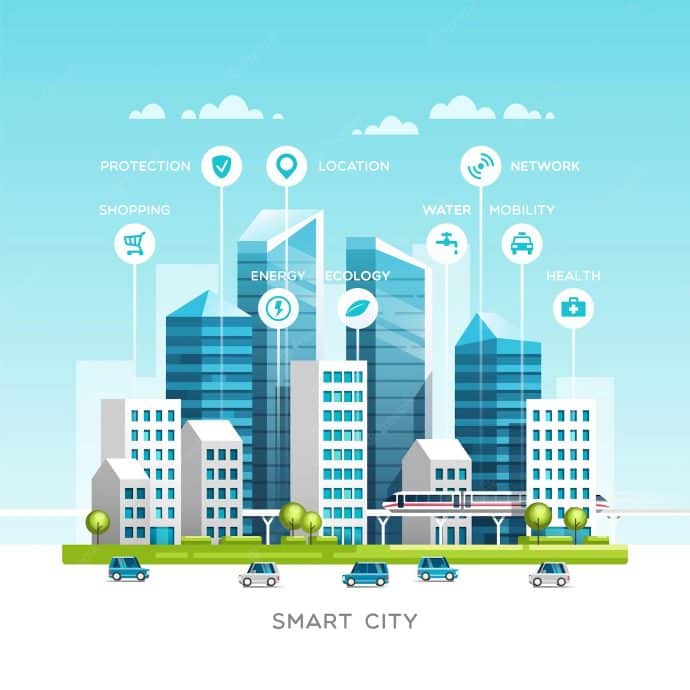
Cities around the world are turning to artificial intelligence and smart cities represent the most ambitious result of that shift. The global smart cities market reached an estimated $952 billion in 2025, and analysts at Fortune Business Insights project it will climb to $1.19 trillion in 2026 while growing at a compound annual rate near 23 percent through 2034. More than 1,000 cities now operate active AI programs that manage everything from traffic signals and energy grids to waste collection and emergency response. This convergence of Internet of Things sensors, machine learning models, and cloud computing is producing measurable results: AI traffic systems have cut urban congestion by up to 25 percent, and smart energy management has reduced building electricity use by as much as 40 percent in pilot cities like Berlin. The stakes extend beyond efficiency because how a city deploys AI determines whether its residents gain safer streets and cleaner air or face unchecked surveillance and widening inequality. This article examines the technologies, applications, risks, and governance structures that define artificial intelligence and smart cities in 2026 and the years ahead.
Quick Answers on Artificial Intelligence and Smart Cities
What is artificial intelligence in smart cities?
Artificial intelligence and smart cities refers to machine learning systems that collect, analyze, and act on urban data from IoT sensors to optimize transportation, energy, public safety, and citizen services in real time.
How does AI reduce traffic congestion in cities?
AI analyzes live camera feeds, sensor data, and GPS signals to adjust traffic light timing dynamically, reroute vehicles, and predict congestion patterns before they form, cutting travel times by up to 25 percent.
What are the biggest risks of AI in smart cities?
The largest risks include mass surveillance without informed consent, algorithmic bias that disproportionately affects marginalized communities, cybersecurity vulnerabilities in connected infrastructure, and a lack of transparent governance frameworks.
Key Takeaways
- The global smart city market is projected to surpass $1.19 trillion in 2026, driven primarily by AI, IoT, and digital twin deployments across transportation, energy, and public safety sectors.
- AI traffic optimization systems are delivering measurable outcomes, including 25 percent reductions in congestion and 15 to 20 percent cuts in urban vehicle emissions in cities that have deployed them at scale.
- Privacy and surveillance remain the most contested issues as only 25 percent of smart cities conduct privacy impact assessments before launching new AI technologies.
- Digital twin platforms in cities like Singapore and Barcelona are enabling planners to simulate infrastructure changes before committing resources, reducing planning errors and accelerating project delivery.
Table of contents
- Introduction
- Quick Answers on Artificial Intelligence and Smart Cities
- Key Takeaways
- Understanding Artificial Intelligence in Smart City Development
- How AI Is Reshaping Urban Infrastructure
- Traffic Optimization and Intelligent Transportation
- Smart Energy Grids and Sustainable Power Management
- Public Safety and AI-Powered Emergency Response
- Digital Twins and Virtual City Models
- AI-Driven Waste Management and Environmental Monitoring
- Smart Water Systems and Resource Conservation
- Citizen Services and AI-Powered Public Administration
- Data Privacy and Surveillance Concerns in Connected Cities
- Algorithmic Bias and Equity Challenges
- Cybersecurity Risks in Smart City Networks
- Governance Frameworks for Responsible AI Deployment
- The Global Smart City Market and Investment Landscape
- Where Artificial Intelligence and Smart Cities Technology Is Heading Next
- Key Insights
- How AI Compares Across Smart City Applications
- Pioneering AI Deployments in Urban Centers
- Lessons From Leading Smart City Programs
- Common Questions About Artificial Intelligence and Smart Cities
Understanding Artificial Intelligence in Smart City Development
Artificial intelligence and smart cities describes the integration of machine learning, computer vision, natural language processing, and predictive analytics into urban infrastructure to collect sensor data, identify patterns, automate decisions, and continuously improve city operations across transportation, energy, safety, and public services.
Smart City AI Impact Calculator
Estimate potential efficiency gains from AI deployment across city domains
How AI Is Reshaping Urban Infrastructure
Urban infrastructure has traditionally relied on fixed schedules and manual inspections, but artificial intelligence is replacing that static approach with systems that sense, learn, and respond in real time. IoT sensors embedded in roads, bridges, water mains, and electrical grids now generate continuous streams of data that AI platforms process to detect anomalies before they escalate into failures. Predictive maintenance software alone saves municipalities billions by converting unplanned outages into scheduled repairs, with industrial operators losing an estimated $50 billion annually to unplanned downtime. These capabilities allow city engineers to allocate limited budgets toward the infrastructure components that need attention most urgently rather than following rigid maintenance calendars that often miss developing problems.
The shift toward AI-managed infrastructure also changes how cities plan for growth. Machine learning models can simulate the impact of a new transit line or housing development on traffic flow, energy demand, and public services before a single construction permit is issued. Cities including Singapore, Barcelona, and Helsinki have piloted AI-driven urban planning tools that test thousands of development scenarios in hours rather than months. The hardware segment of smart city technology, which includes sensors, meters, cameras, and IoT trend technologies, is expected to account for roughly 43.5 percent of the market in 2026 as cities build the physical backbone that software layers depend on. Cloud and edge computing platforms then process the data those devices produce, making it possible for a single operations center to monitor an entire metropolitan region.
Interoperability remains one of the most persistent technical barriers. Cities often purchase devices from dozens of manufacturers, and those devices speak different data protocols. The 2026 Smart Cities Connect conference highlighted that the cities seeing the greatest returns are those investing in platform-based infrastructure that standardizes data formats across departments and municipalities. Without this data readiness foundation, even the most advanced AI models cannot produce reliable results. Cities that treat AI deployment as a technology overlay on broken data pipelines consistently underperform cities that invest in governance, integration, and data quality first.
Traffic Optimization and Intelligent Transportation
Moving from broad infrastructure to one of the most visible AI applications, traffic optimization demonstrates how artificial intelligence and smart cities produce results that citizens experience every day. AI-powered traffic management systems analyze live feeds from cameras, inductive loop sensors, and connected vehicle GPS data to adjust signal timing in real time. Research from StartUs Insights found that these systems cut travel times by 25 percent and reduce urban vehicle emissions by 20 percent in cities that deploy them across major corridors. The McKinsey Global Institute estimates that AI traffic optimization can reduce emissions by up to 15 percent specifically in dense metropolitan areas where idling vehicles contribute heavily to air quality problems.
Intelligent traffic management systems go beyond simple signal control. They incorporate predictive models that anticipate congestion before it forms by analyzing historical traffic patterns alongside real-time inputs like weather data, event schedules, and construction zone alerts. When the system detects a developing bottleneck, it can reroute traffic through alternative corridors using dynamic message signs and connected navigation apps. Mobility-as-a-Service platforms have shifted 38 percent of users away from daily car use in cities where they operate, accelerating demand for smart parking, electric vehicle charging corridors, and seamless multimodal journey planning. These platforms rely on AI to match riders with the fastest combination of buses, trains, bikes, and ride-sharing vehicles for each specific trip.
Autonomous vehicles represent the next frontier in urban transportation, and AI is the enabling technology. Cities like Detroit are exploring drone operations and autonomous vehicle corridors through partnerships around innovation districts. Dubai’s Roads and Transport Authority has deployed AI signal optimization alongside its S’hail mobility platform to coordinate autonomous and conventional vehicles on shared roads. The technology is maturing, but equitable access remains a concern because smaller and lower-income municipalities often lack the sensor networks and data pipelines that AI traffic tools require. The technology itself is ready; the deployment gap is a funding and governance problem, not a technical one.
Smart Energy Grids and Sustainable Power Management
Energy is another domain where artificial intelligence and smart cities are producing quantifiable gains, and the transition from traffic to energy reveals how interconnected urban AI systems are becoming. AI monitors energy flow across entire municipal grids, identifies waste, and shifts loads to match fluctuating supply from renewable sources. Smart grids powered by machine learning balance electricity distribution in real time: when rooftop solar panels produce more power than residents consume, the AI routes surplus energy to storage batteries or neighboring buildings that need it. Berlin’s smart lighting program achieved a 40 percent reduction in energy consumption by using AI to dim streetlights based on pedestrian and vehicle presence rather than maintaining uniform brightness all night.
Virtual power plants represent a major evolution in decentralized energy resilience. These AI-coordinated networks aggregate thousands of distributed energy resources, including home batteries, commercial generators, and electric vehicle chargers, into a unified grid asset that can deliver over 100 megawatts of backup capacity. During outages, microgrids powered by renewable sources can provide up to 48 hours of carbon-free electricity to critical facilities like hospitals and emergency shelters. Renewable energy sources are projected to generate about 84 percent of global electricity by 2040, and AI will be essential for managing the variability that comes with solar and wind dependence. The algorithms must predict weather patterns, consumer demand curves, and equipment performance simultaneously to keep the grid stable.
Public Safety and AI-Powered Emergency Response
The energy domain’s reliance on real-time AI decision-making extends naturally into public safety, where the speed of response determines outcomes measured in lives saved. AI-powered security analytics in smart cities report up to 40 percent reductions in crime rates and 35 percent faster emergency response times according to data compiled by StartUs Insights in their 2026 trend report analyzing over 1,970 startups in the smart city sector. Video analytics platforms use computer vision to detect incidents like accidents, fires, or unusual crowd behavior and automatically alert dispatchers with precise location data, eliminating the lag between an event occurring and response teams receiving notification.
Predictive policing algorithms analyze historical crime data to identify patterns and allocate resources proactively. Some departments have used these tools to position patrol units in areas where crime is statistically most likely to occur during specific hours, reducing both response times and overall incident rates. Cities that already operate large camera networks are investing in AI layers that convert passive video surveillance into actionable insights, with the focus shifting toward real-time event detection and situational awareness tied to initiatives like Vision Zero, which aims to eliminate traffic fatalities. The demand for platforms that go beyond basic metrics and provide behavioral insights is rising as municipalities seek data that directly informs infrastructure changes and policy decisions.
The ethical tensions in this space are significant and worth confronting directly. Facial recognition systems enable rapid identification of suspects and can aid investigations, but research consistently shows that these systems misidentify people from ethnic minorities at disproportionately higher rates. The gap between what AI-powered public safety tools can do technically and what they should do ethically remains one of the most urgent debates in smart city governance. Any deployment of AI for public safety must include transparent oversight, community engagement in how the tools are used, and clear accountability structures for when the systems produce errors.
Digital Twins and Virtual City Models
While AI-powered safety tools respond to events after they happen, digital twins offer cities the ability to predict and prevent problems before they materialize. A digital twin is a real-time virtual replica of a physical city system that continuously updates itself based on live sensor data, enabling planners and operators to simulate scenarios, test interventions, and optimize performance without disrupting the actual infrastructure. Singapore’s Virtual Singapore initiative created a comprehensive 3D digital twin of the entire city-state, integrating data from transportation, buildings, environmental monitoring, and public utilities into a unified platform that supports urban planning, sustainability analysis, and emergency preparedness.
Barcelona implemented digital twins as part of its 15-minute city initiative, deploying networks of sensors, cameras, and IoT devices across its transportation infrastructure to build a living model of city mobility. The system collects real-time data on traffic conditions, parking availability, and public transit usage, then feeds it into the twin where advanced AI algorithms optimize signal timing and route recommendations. The results include reduced congestion, improved traffic flow, higher public transportation utilization, and better parking management. In the research space, ETH Zurich and the Singapore-MIT Alliance are developing a Digital Urban Climate Twin to investigate sustainability and livability, specifically targeting urban heat island effects in dense neighborhoods.
AI-Driven Waste Management and Environmental Monitoring
The same sensor-and-twin logic that powers transportation and energy optimization is transforming how cities handle waste, connecting the digital twin concept to tangible environmental outcomes. IoT-based fill-level sensors embedded in waste bins send real-time alerts when containers are nearly full, enabling dynamic collection routes that respond to actual demand rather than following fixed schedules. This approach has reduced unnecessary truck runs by up to 90 percent in pilot programs, cutting fuel consumption, vehicle emissions, and labor costs simultaneously. The global smart waste management market grew from $2.73 billion in 2024 to an estimated $3.17 billion in 2025 and is projected to reach $14 billion by 2035 at a compound annual growth rate of 16 percent.
Environmental monitoring extends beyond waste to air quality, noise levels, and water contamination. Networks of low-cost sensors distributed across city neighborhoods provide granular pollution data that AI models use to identify emission hotspots, predict poor air quality days, and trigger automated responses like rerouting traffic away from school zones during high-pollution periods. Building sustainable smart cities requires treating environmental monitoring not as a reporting exercise but as a real-time management tool that feeds directly into operational decisions. The integration of satellite imagery, ground-level sensors, and AI analytics creates a multi-layered view of urban environmental health that was impossible to achieve with traditional monitoring stations alone.
Smart Water Systems and Resource Conservation
Water management illustrates how AI can protect critical natural resources while saving money, extending the environmental monitoring theme into one of the most essential city services. AI-powered leak detection systems analyze pressure data, flow rates, and acoustic signals from sensors installed along water distribution networks to identify leaks before they escalate into major breaks. Cities lose an average of 20 to 30 percent of treated water to leaks in aging infrastructure, and AI-driven predictive maintenance is helping municipalities reclaim significant portions of that loss. Under India’s Smart Cities Mission, 28 cities have added over 2,900 million liters per day of drinking water treatment capacity, much of it managed by AI systems that optimize chemical dosing, filtration rates, and distribution pressure.
Smart irrigation systems use weather forecasts, soil moisture data, and evapotranspiration models to water public parks and green spaces only when conditions require it, reducing water consumption by 30 to 50 percent compared to timer-based systems. IoT monitoring technologies that cities deploy for traffic are increasingly being adapted for water infrastructure, using the same connectivity platforms to manage a completely different resource domain. This convergence reduces deployment costs because the communication backbones, data platforms, and analytics engines can serve multiple city functions from a single investment.
Citizen Services and AI-Powered Public Administration
The operational efficiencies AI brings to physical infrastructure extend into how governments interact with citizens, making public administration the next logical domain to examine. AI chatbots and virtual assistants handle routine inquiries about permits, tax payments, and service requests, freeing human staff to focus on complex cases that require judgment and empathy. Singapore’s Ask Jamie AI assistant supports real-time multilingual service delivery across more than 70 government agencies, processing thousands of citizen interactions daily. Estonia’s e-Residency program offers digital identity and cross-border access to services, representing a governance-centric model where AI is deeply integrated with administrative systems.
AI is becoming standard for permitting processes, 311 service lines, and multilingual support in city governments across North America and Europe. The technology reduces processing times for building permits from weeks to days by automatically checking applications against zoning codes, fire safety requirements, and environmental regulations. The European Union has reported that integrating digital services into municipal operations has led to an 85 percent reduction in city operating costs in programs that achieve full implementation. Geolocation-enabled augmented reality applications are also making public services more accessible: the Athens Acropolis uses mobile AR to digitally reconstruct damaged historical structures for visitors, while Amsterdam partnered with Capgemini to deliver an interactive experience covering 750 years of city heritage powered by generative AI.
Data Privacy and Surveillance Concerns in Connected Cities
The benefits AI delivers in citizen services come at a cost that is not always visible to the public, and that cost is measured in personal data. Smart cities collect information from traffic cameras, facial recognition systems, smart meters, environmental sensors, and digital service interactions, building detailed profiles of residents’ movements, energy use, commuting patterns, and service consumption. A World Economic Forum study found that only 25 percent of smart cities conduct privacy impact assessments before implementing new technology, exposing the remaining 75 percent to compliance failures and citizen trust erosion. The European Union’s AI Act and GDPR provide regulatory frameworks, but enforcement varies widely and many cities outside Europe operate with minimal data protection requirements.
Mass surveillance represents the most contentious issue. When cameras, sensors, and AI analytics operate across an entire city, residents may not know their data is being collected, who has access to it, or how it is being used. AI amplifies existing privacy risks by enabling cross-referencing of data points that were previously siloed: a system that connects traffic camera footage with mobile phone location data and smart meter readings can reconstruct a person’s daily routine with disturbing precision. Public-private partnerships complicate accountability because private technology companies often store, process, and analyze data that the city collects, raising questions about data ownership and the commercial use of civic information.
Trust erosion is not hypothetical. Cities that have deployed AI surveillance without transparent communication have faced organized public backlash that delayed or killed smart city projects entirely. The path forward requires treating privacy as a design requirement, not an afterthought, embedding data minimization principles, access controls, and audit trails into every AI system before deployment. Residents should be informed about what data is collected, given a meaningful choice about participation, and provided with accessible mechanisms to review and challenge automated decisions that affect them.
Algorithmic Bias and Equity Challenges
Privacy is not the only dimension of harm that AI in smart cities can produce; algorithmic bias introduces a separate category of risk that disproportionately affects communities that are already marginalized. Facial recognition systems, predictive policing tools, and automated resource allocation models are all trained on historical data that reflects existing inequalities. When a predictive policing algorithm is trained on arrest data that overrepresents certain neighborhoods or demographics, it directs more police attention to those same communities, creating a feedback loop that entrenches rather than reduces bias. Research has shown that facial recognition technology misidentifies people from ethnic minorities at significantly higher rates than it does for white individuals.
The equity challenge extends to who benefits from smart city investments. Wealthier neighborhoods with newer infrastructure tend to receive sensor deployments, fiber connectivity, and AI-powered services before lower-income areas, widening the digital divide rather than closing it. Smaller and lower-income municipalities often lack the sensor networks, data pipelines, and technical staff needed to implement AI solutions, meaning the efficiency gains that smart cities promise accrue primarily to cities that can already afford them. Addressing algorithmic bias requires diverse development teams, mandatory bias audits before deployment, and community participation in defining what outcomes AI systems should optimize for. An algorithm that maximizes economic efficiency may produce outcomes that are technically optimal but socially harmful if the affected communities had no voice in setting its objectives.
Cybersecurity Risks in Smart City Networks
Bias and privacy are risks that stem from how AI is designed and governed, but cybersecurity threats attack the infrastructure itself, making them a different kind of existential risk for connected cities. Every IoT sensor, connected traffic signal, smart meter, and municipal database represents a potential entry point for attackers. With billions of IoT connections globally, the attack surface of a smart city dwarfs that of a traditional corporate network. AI-driven cybersecurity tools are themselves becoming essential for defending smart city infrastructure, using machine learning to detect anomalies in network traffic, identify potential intrusions, and respond to threats faster than human analysts can act.
The convergence of operational technology and information technology in smart cities creates risks that did not exist when these systems were separate. A cyberattack on a traffic management system could cause gridlock or accidents. An intrusion into a water treatment facility could alter chemical dosing levels. AI-driven phishing attacks and deepfakes that impersonate trusted city officials can create false urgency around payments or public safety incidents. Robust encryption, layered authentication, regular penetration testing, and AI-powered threat detection must become standard components of every smart city deployment, not optional add-ons considered after the system is live. Cities must also plan for worst-case scenarios by maintaining analog backup systems for critical infrastructure so that a cyber incident does not cascade into a humanitarian crisis. Building AI and cybersecurity skill sets within municipal IT departments is essential for maintaining these defenses over time.
Governance Frameworks for Responsible AI Deployment
The risks identified in the preceding sections, from privacy violations and algorithmic bias to cybersecurity breaches, all point to the same root cause: insufficient governance structures for how cities adopt and manage AI. Responsible AI governance in smart cities requires clear policies on data collection, algorithmic transparency, citizen participation, and accountability mechanisms that assign responsibility when systems fail or produce harmful outcomes. The EU AI Act classifies high-risk AI systems, including those used in law enforcement and critical infrastructure, under strict regulatory requirements that mandate conformity assessments, human oversight, and documentation of training data and decision logic.
Cross-departmental coordination is equally important. Many cities deploy AI in transportation, energy, safety, and administration as separate initiatives that share no data standards, procurement processes, or oversight mechanisms. The 2026 Smart Cities Connect conference emphasized that interoperability across departments and municipalities is key to building a robust network of smart cities. Cities that centralize their AI governance under a chief data officer or smart city office tend to achieve better coordination, reduce redundant spending, and maintain more consistent privacy protections. Data governance strategies that work in corporate environments need adaptation for the public sector, where the consequences of failure affect entire populations rather than individual customers.
Community engagement must be genuine rather than performative. The cities that see the most public trust are those that invite residents to participate in defining the goals that AI systems pursue, not merely inform them about decisions that have already been made. Governance is not a constraint on innovation; it is the foundation that makes sustainable innovation possible because cities that lose public trust cannot maintain the political support needed to fund and expand smart city programs.
The Global Smart City Market and Investment Landscape
Understanding the governance landscape provides context for the enormous investment flows that are driving artificial intelligence and smart cities forward globally. The smart city market was valued at approximately $952 billion in 2025, and multiple analyst firms project it will exceed $1 trillion in 2026. Mordor Intelligence estimates the market at $1.96 trillion in 2026 with a 15.65 percent CAGR through 2031, while other forecasters project even higher figures depending on which segments they include. North America dominated with roughly 39.6 percent market share in 2025, but Asia Pacific is the fastest-growing region, led by China’s projected $84.63 billion market, India’s $53.98 billion, and Japan’s $54.67 billion in 2026.
India’s Smart Cities Mission aims to develop 100 smart cities with substantial investments in transportation, energy, and digital infrastructure. Saudi Arabia’s Vision 2030 includes partnerships with Huawei to deploy WiFi-7, 5G-A, and AI/IoT systems across the 1.6-million-square-meter KAFD smart district. Africa is generating the fastest percentage growth in smart city deployment, with leapfrog deployments bypassing legacy infrastructure entirely. Smart utilities held 28.44 percent of revenue share in 2025, while smart public safety systems are projected to post the fastest growth rate at 17.24 percent CAGR through 2031. Hardware spending still dominates, but a clear pivot toward subscription-based analytics platforms is transferring value from device manufacturers to software vendors who provide the AI intelligence layer.
Where Artificial Intelligence and Smart Cities Technology Is Heading Next
Investment trends indicate where the technology is heading, and several converging forces will reshape artificial intelligence and smart cities over the next decade. Generative AI is entering urban services through applications like Amsterdam’s heritage experience and multilingual citizen chatbots, and its ability to synthesize unstructured data will expand the range of urban challenges that AI can address. Data spaces will provide federated architectures that allow different city departments and municipalities to share data without centralizing it, addressing both interoperability and privacy concerns simultaneously. The concept of the “Citiverse,” which Tampere is exploring around the Nokia Arena, merges digital twin technology with immersive spatial computing to create collaborative virtual environments where planners, businesses, and citizens can interact with city data spatially.
Autonomous mobility corridors will expand as cities gain confidence in mixed traffic environments where self-driving vehicles, drones, and conventional transportation share the same infrastructure. AI in architecture and building design will produce structures that actively manage their own energy consumption, occupancy, and environmental impact, feeding data back into the city digital twin to improve district-level optimization. The AI in smart cities market specifically is projected to grow from approximately $50.63 billion in 2025 to $460.47 billion by 2034, representing a compound annual growth rate of 27.80 percent. The question for the next decade is not whether cities will adopt AI but whether they will do so in ways that serve all residents equitably while protecting civil liberties.
Edge computing will play an increasingly central role as processing moves closer to the sensors themselves, reducing latency for time-critical applications like autonomous vehicle coordination and emergency response. The 70 percent of the world’s population expected to live in urban areas by 2050 will create pressure that only AI-augmented infrastructure can manage. Cities that build strong governance foundations today will be positioned to adopt emerging technologies responsibly, while those that rush deployment without adequate oversight risk entrenching problems that become exponentially harder to correct once systems are deeply embedded in daily urban life.
Measurable AI Impact Across Smart City Domains (2025-2026)
Sources: StartUs Insights 2026, iFactory Global Trends 2025, Fortune Business Insights
Key Insights
- The global smart city market reached $952 billion in 2025 and is projected to grow at a 23.20 percent CAGR to surpass $6.3 trillion by 2034, according to Fortune Business Insights.
- AI traffic optimization systems cut urban congestion by 25 percent and vehicle emissions by 20 percent in cities with full corridor deployments, per StartUs Insights 2026 analysis.
- Only 25 percent of smart cities conduct privacy impact assessments before deploying new AI technologies, exposing the majority to compliance failures, according to a World Economic Forum study cited by TrustArc.
- AI security analytics report up to 40 percent crime reduction and 35 percent faster emergency response times in cities using smart policing platforms, based on a 2026 analysis of 1,970+ global startups.
- Berlin’s AI-powered smart lighting program achieved a 40 percent reduction in energy consumption by dimming streetlights based on real-time pedestrian and vehicle presence, as reported by iFactory’s global trends report.
- Asia Pacific holds approximately 46 percent of global IoT device installations in smart city environments, with deployment density exceeding 2,800 sensors per square kilometer in major urban zones, per iFactory 2025 data.
- IoT-based waste management systems reduced unnecessary collection truck runs by up to 90 percent in pilot programs, while the global smart waste management market is projected to reach $14 billion by 2035, according to StartUs Insights.
These data points reveal a market that has moved decisively past the pilot phase into scaled deployment, with the largest gains concentrated in traffic management, energy optimization, and public safety. The 23 percent compound growth rate suggests that cities worldwide view AI investment as essential infrastructure spending rather than experimental technology exploration. The gap in privacy assessment adoption, where three out of four cities skip formal impact assessments, stands out as the most concerning finding because it indicates that regulatory and governance practices are lagging far behind technological deployment. Addressing that gap will require national and international policy coordination alongside local governance reforms. The geographic concentration of IoT deployments in Asia Pacific aligns with the region’s urbanization trajectory and government spending patterns, but it also means that the privacy, security, and governance challenges identified in this analysis will manifest at the largest scale in markets where regulatory frameworks are still developing.
How AI Compares Across Smart City Applications
| Dimension | Traffic Optimization | Energy Management | Public Safety | Waste Management | Citizen Services |
|---|---|---|---|---|---|
| Transparency | Medium: signal logic is explainable but complex models are opaque | High: energy routing follows measurable physical rules | Low: predictive policing models often lack public auditability | High: fill-level sensors produce simple threshold-based decisions | Medium: chatbot logic is trainable but reasoning is not always visible |
| Citizen Participation | Indirect through feedback on commute quality and routing suggestions | Growing through demand-response programs and smart meter dashboards | Minimal direct input; community advisory boards in some cities | Passive participation via sensor-equipped bins; complaint channels | Direct through digital service portals and satisfaction surveys |
| Trust Level | Generally high because outcomes are personally experienced daily | Moderate; concerns about smart meter data collection | Contested; surveillance associations reduce public trust | High; visible improvement in street cleanliness | Growing as AI assistants improve accuracy and language support |
| Decision Making | Automated in real time with human override capability | Automated load balancing with operator monitoring | AI recommends, human officers decide and act | Automated route optimization, human collection execution | AI handles routine queries, complex cases escalated to staff |
| Misinformation Risk | Low but manipulated traffic data could cause congestion attacks | Moderate if compromised sensors report false grid conditions | High if facial recognition produces false matches | Low; limited consequences from sensor data manipulation | Medium if chatbots provide incorrect information at scale |
| Service Delivery | 25% congestion reduction, 15-20% emission cuts | 30-40% energy savings in pilot programs | 40% crime reduction, 35% faster response times | 90% reduction in unnecessary truck runs | 85% operating cost reduction in fully digital programs |
| Accountability | City transportation departments with clear reporting lines | Utility companies with regulatory oversight | Complex: spans police, city government, and technology vendors | Municipal waste departments with contractor oversight | Government IT departments with citizen ombudsman channels |
Pioneering AI Deployments in Urban Centers
Singapore’s Virtual Singapore Digital Twin Platform
Singapore’s Smart Nation initiative represents one of the most comprehensive AI-powered urban management systems in operation. The Virtual Singapore platform is a 3D digital twin that integrates data from transportation, buildings, environmental monitoring, and public services into a unified model that city planners use to simulate development scenarios and test policy interventions before implementation. VIZZIO Technologies created the world’s largest urban digital twin by cloning all of Singapore at a 1:1 scale, dividing the city-state into 728 million one-square-meter tiles. The Ask Jamie AI assistant serves over 70 government agencies with multilingual real-time support. In April 2025, Singapore integrated IoT infrastructure alerts and AI-powered traffic optimization into its MyTransport.SG app, demonstrating how multiple AI systems can converge into a single citizen-facing tool. The limitation is that Singapore’s centralized governance model makes its approach difficult to replicate in federal systems where city, state, and national authorities share jurisdiction.
Barcelona’s 15-Minute City and Smart Mobility Network
Barcelona deployed a sensor-rich mobility network as part of its 15-minute city initiative, using cameras, IoT devices, and AI analytics to build a real-time digital twin of the city’s transportation system. The digital twin continuously updates based on live data, enabling officials to monitor traffic conditions, optimize signal timing, and adjust public transit schedules dynamically. The measurable outcomes include reduced congestion, improved traffic flow, and increased public transportation usage across the metropolitan area. Barcelona also uses the MareNostrum supercomputer to process urban data for planning, and has partnered with Bologna to collaborate on digital twin governance standards. The limitation lies in the cost: Barcelona’s dense sensor infrastructure required substantial upfront investment that smaller European cities cannot easily replicate, and the maintenance burden of thousands of connected devices creates ongoing operational expenses.
Berlin’s AI-Powered Smart Lighting and Energy Optimization
Germany’s Smart Communities program encompasses over 70 participating cities, and Berlin’s smart lighting initiative stands as a flagship energy efficiency deployment. The system uses AI to adjust streetlight brightness based on real-time pedestrian and vehicle presence detected through connected sensors, achieving a 40 percent reduction in energy consumption compared to traditional timer-based systems. The AI models learn neighborhood-specific usage patterns over time, further optimizing dimming schedules as seasonal and behavioral data accumulates. The program demonstrates that even a single application domain, lighting, can produce substantial savings when AI is applied thoughtfully. The limitation is that the efficiency gains depend on replacing legacy lighting fixtures with connected LED units, and cities with recently upgraded but non-connected lighting face the challenge of justifying a second investment cycle before the first has been fully amortized.
Lessons From Leading Smart City Programs
Case Study: India’s Smart Cities Mission and Drinking Water Infrastructure
India’s Smart Cities Mission, one of the world’s largest urban development programs, aims to create 100 smart cities with substantial investments in transportation, energy, water, and digital infrastructure. By June 2025, 28 cities under the mission had added over 2,900 million liters per day of drinking water treatment capacity, much of it managed by AI systems that optimize chemical dosing, filtration rates, and distribution pressure. The program demonstrates how AI can address fundamental quality-of-life challenges in developing nations, not just efficiency improvements in already-functional systems. The scale of the initiative, covering cities with vastly different infrastructure starting points, has produced valuable lessons about adapting AI solutions to local conditions rather than imposing standardized platforms.
The limitation is implementation speed. With 100 cities at various stages of readiness, many have struggled to integrate AI tools with legacy water infrastructure that lacks the sensors and connectivity needed for real-time management. Procurement processes designed for traditional construction projects have proven poorly suited to agile technology deployments. The mission illustrates that AI success in smart cities depends as much on institutional reform, workforce training, and procurement modernization as it does on the technology itself.
Case Study: Estonia’s AI-Integrated Digital Government
Estonia operates one of the most fully digitized government systems in the world, with AI embedded across tax filing, healthcare records, voting, and business registration. The e-Residency program extends digital identity to non-citizens, enabling cross-border access to Estonian government services from anywhere in the world. The system processes over 99 percent of government services online, and AI handles routine administrative decisions while flagging complex cases for human review. The measurable impact includes dramatically reduced processing times for permits, registrations, and tax filings, alongside significant operational cost savings across government agencies.
The limitation is scalability. Estonia’s success rests on a small population of approximately 1.3 million people, a high baseline digital literacy rate, and political consensus around digital government that developed over decades. Larger, more diverse nations face fragmented regulatory environments, varying digital literacy levels, and political resistance that Estonia did not encounter. The case study demonstrates that AI in government works best when it builds on a foundation of digital identity, interoperable data systems, and sustained political commitment rather than being deployed as a standalone modernization project.
Case Study: Dubai’s AI Traffic Optimization and Autonomous Vehicle Corridor
Dubai’s Roads and Transport Authority has deployed AI signal optimization and the S’hail multimodal mobility platform as part of the city’s broader strategy to have 25 percent of all transportation trips served by autonomous vehicles by 2030. The AI system coordinates traffic signals across the city’s highway and arterial network while the S’hail platform integrates public transit, ride-hailing, bike-sharing, and autonomous shuttles into a single journey-planning interface. The platform uses machine learning to predict demand patterns and adjust service frequency in real time. Early results show improved traffic flow during peak hours and higher adoption rates for multimodal commuting.
The limitation is the gap between pilot success and citywide deployment. Dubai’s autonomous vehicle ambitions depend on regulatory frameworks that are still evolving, and the integration of autonomous vehicles with conventional traffic in dense urban environments presents safety challenges that AI alone cannot fully resolve. The city’s extreme climate also creates unique sensor reliability issues, as high temperatures and sandstorms degrade camera and lidar performance. The case study highlights that ambitious targets benefit from AI, but real-world deployment timelines often exceed initial projections due to regulatory, environmental, and safety factors that technology cannot shortcut.
Common Questions About Artificial Intelligence and Smart Cities
A smart city uses interconnected sensors, data platforms, and AI algorithms to manage urban services like transportation, energy, water, and public safety in real time. AI processes the massive data streams these sensors produce, identifying patterns and predicting problems before they occur. The technology automates routine decisions so city operators can focus on strategic planning and complex situations that require human judgment. This integration creates a continuous feedback loop where each operational improvement generates data that further refines the system.
Costs vary enormously based on scope, existing infrastructure, and geographic context. A single smart traffic management corridor can cost $5 to $50 million depending on the number of intersections and sensor density required. Comprehensive citywide deployments involving transportation, energy, water, and safety systems require hundreds of millions to billions in investment, which is why most cities adopt phased implementation strategies that prioritize high-ROI applications first.
Singapore, Barcelona, Seoul, Dubai, and Helsinki are consistently ranked among the most advanced. Singapore’s Virtual Singapore digital twin and Ask Jamie AI assistant cover the broadest range of city functions. Barcelona leads in mobility and 15-minute city planning. Estonia leads in digital government services. Each city excels in different domains, reflecting local priorities and governance structures rather than a single universal model.
It can if deployed without proper safeguards. Smart city sensors collect data on movement patterns, energy use, and public behavior that can build detailed profiles of individuals. Only 25 percent of smart cities currently conduct privacy impact assessments before deploying new AI technologies. Responsible deployment requires data minimization, transparent collection policies, citizen consent mechanisms, and independent oversight to prevent misuse.
Digital twins are real-time virtual replicas of physical city systems that continuously update based on live sensor data. They allow planners to simulate infrastructure changes, test policy interventions, and predict outcomes before committing resources. Singapore, Barcelona, and several European cities use digital twins to optimize transportation, assess environmental impacts of new developments, and coordinate emergency responses across multiple agencies.
AI analyzes real-time data from cameras, road sensors, and connected vehicle GPS signals to adjust traffic light timing dynamically. The systems reroute vehicles through less congested corridors and predict bottlenecks before they form using historical and live pattern data. In cities with full corridor deployments, these tools have cut travel times by 25 percent and reduced vehicle emissions by 15 to 20 percent by minimizing idling time.
Yes, and the results are already measurable. AI-managed smart grids balance electricity distribution in real time, route surplus solar and wind energy to storage or neighboring buildings, and optimize building HVAC systems based on occupancy and weather forecasts. Berlin’s AI smart lighting reduced energy consumption by 40 percent. Virtual power plants coordinated by AI deliver over 100 megawatts of backup capacity from distributed energy resources.
Every connected sensor, traffic signal, and database creates a potential entry point for attackers. Smart city networks face risks including data breaches from compromised IoT devices, ransomware attacks on critical infrastructure like water treatment or traffic management systems, and AI-powered phishing campaigns that impersonate city officials. Robust encryption, regular penetration testing, and AI-driven threat detection are essential defenses.
The market was valued at approximately $952 billion in 2025. Multiple analyst firms project it will exceed $1 trillion in 2026, with compound annual growth rates between 15 and 23 percent depending on which segments are included. Forecasts for 2034 range from $4 trillion to over $6 trillion, driven by AI adoption, IoT expansion, and government investment in urban infrastructure worldwide.
Algorithmic bias occurs when AI systems trained on historical data reproduce or amplify existing inequalities. In smart cities, this appears in predictive policing tools that over-target historically surveilled neighborhoods, facial recognition that misidentifies people from minority groups at higher rates, and resource allocation models that prioritize wealthier areas. Mandatory bias audits and diverse development teams are critical countermeasures.
Timelines depend on the application. AI traffic optimization systems can show measurable congestion reduction within 6 to 12 months of deployment. Energy management systems typically demonstrate ROI within 1 to 3 years through reduced utility costs. Comprehensive smart city programs that span multiple domains generally require 3 to 5 years of phased implementation before aggregate citywide benefits become quantifiable.
Smaller cities can benefit from targeted AI deployments that address their specific pain points, such as water leak detection, streetlight optimization, or citizen service chatbots. Cloud-based AI platforms have reduced upfront costs by eliminating the need for local data centers. The challenge for smaller municipalities is typically workforce capacity and technical expertise rather than technology availability, making partnerships with regional technology providers or university research groups a practical path forward.
The EU AI Act classifies high-risk AI systems under strict requirements for transparency, human oversight, and documentation. The GDPR sets data protection standards that many cities use as a baseline. Effective local governance includes appointing a chief data officer, conducting mandatory privacy impact assessments, establishing citizen advisory boards, and requiring algorithmic audits before and after deployment. No single framework is sufficient alone; responsible AI governance requires layered protections.