
Introduction
How LLMs Are Revolutionizing Chemical Synthesis Planning is not just a headline. It signals a pivotal moment where artificial intelligence intersects with the core of chemistry. For decades, chemical synthesis planning has required intensive manual work, expert-level knowledge, and iterative trial-and-error. Now, the rise of Large Language Models (LLMs) is accelerating this process by enabling AI-driven retrosynthesis, predicting reaction pathways, and translating plain-language prompts into precise lab instructions. Researchers in pharmaceuticals, materials science, and AI are leveraging the capabilities of generative models like GPT and Codex to enhance discovery pipelines and experiment planning. This article explores the technology, shares real-world applications, and outlines both the scientific potential and the current limitations of LLM-enabled synthesis tools.
Key Takeaways
- LLMs are connecting natural language inputs with chemical informatics, reshaping synthesis workflows in drug and material development.
- Hybrid systems that combine LLMs with synthesis engines significantly reduce planning time and extend the range of accessible compounds.
- Prompt engineering allows chemists to guide AI tools through retrosynthetic strategies using simple human-readable instructions.
- Real-world studies show clear benefits, although issues such as output biases and hallucinations must be addressed.
Introduction to Chemical Synthesis Planning
Chemical synthesis planning involves designing the sequence of reactions necessary to build a target compound from simpler starting materials. This process traditionally depends on deep chemical knowledge, time-consuming database searches, and strategic reasoning. In many research environments, this means spending days mapping out retrosynthetic routes by hand, essentially working backwards from the desired molecule to determine how to synthesize it.
Retrosynthesis is the method of breaking down complex molecules into simpler, known precursors. While software for computer-aided synthesis planning has existed for years, adoption was limited due to usability challenges and the need for expert oversight. LLMs now provide a more intuitive connection between user inputs and chemical reasoning. They understand natural language and convert it into structured synthesis instructions that machines can process.
From Text to Molecule: How LLMs Power Hybrid Synthesis Systems
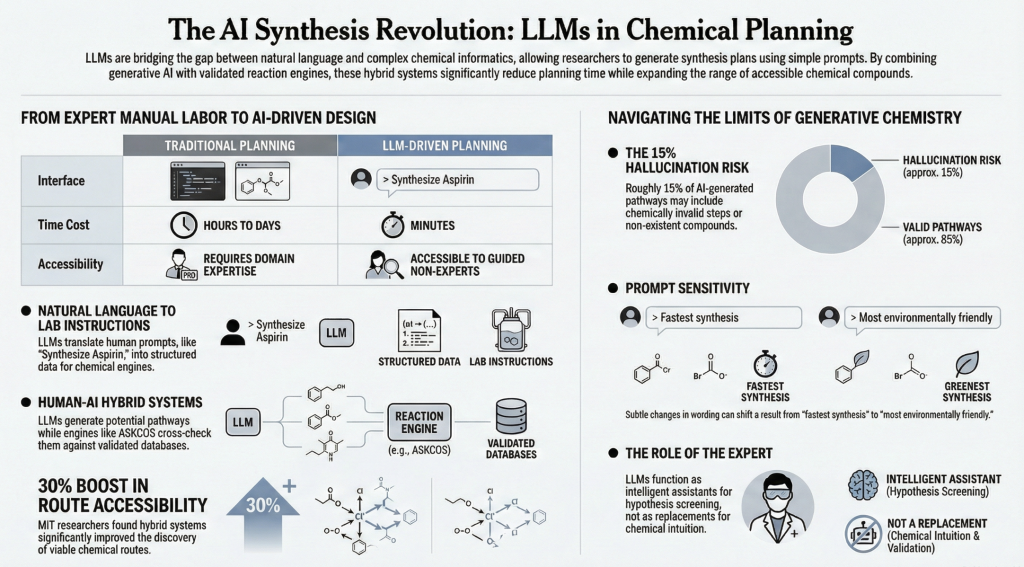
A hybrid synthesis system combines a generative language model with traditional chemical reaction engines. The typical sequence looks like this:
- A user provides a prompt, such as “Synthesize aspirin from salicylic acid.”
- The LLM processes the text and generates a structured representation, including possible intermediates, reaction types, and compounds.
- This suggestion is passed to a synthesis engine like ASKCOS or AiZynthFinder, which cross-checks feasibility using validated chemical databases.
- The interface then displays alternative synthesis pathways, helping chemists in practical lab planning.
The LLM serves as a language bridge. It takes human language and translates it into the inputs needed by reaction engines. In this way, it enables both expert and novice users to initiate complex planning without extensive training in chemical informatics.
Sidebar: Retrosynthesis and Prompting Explained
- Retrosynthesis: A process in chemistry where a target molecule is deconstructed into simpler, known building blocks through reverse-engineering steps.
- LLM Prompting: Prompts like “Devise a synthesis plan for ibuprofen” allow the model to infer sequences of reactions and recommend viable routes that can be validated with synthesis engines.
Case Studies and Academic Use
In one study by MIT’s Department of Chemical Engineering, researchers found that a hybrid LLM system improved route accessibility by over 30 percent compared to traditional tools. The LLM-assisted planner delivered faster synthesis strategies and improved the ranking of viable chemical routes. A separate experiment conducted at the University of Toronto used GPT-powered prompts within an existing planning tool, resulting in multi-step pathways that aligned with published synthesis literature.
Pharmaceutical companies are now experimenting with LLMs to speed up early discovery. Organizations like Novartis and Genentech are testing models that convert research questions into proposed synthesis routes. These tools do not replace expert chemists. Instead, they act as intelligent assistants during the hypothesis stage and early route screening. Ongoing efforts such as AI in drug discovery illustrate how LLMs contribute to faster, more efficient candidate evaluation.
LLM-Powered vs Traditional Synthesis Planning
| Aspect | Traditional Planning | LLM-Driven Planning |
|---|---|---|
| Interface | Graphical or code-based | Natural language prompts |
| Time Cost | Hours to days | Minutes |
| Accessibility | Requires domain expertise | Accessible to guided non-experts |
| Output Validation | Manual checking | Model-assisted with engine-based cross-verification |
Challenges: Limitations, Biases, and Reliability
Despite major advances, there are challenges. One of the biggest concerns is hallucination. In a study from a European partnership, about 15 percent of generated pathways included either synthetic steps that were chemically invalid or compounds that do not exist. This kind of error could lead to wasted time without careful oversight.
Prompt phrasing also influences results. Changing a few words in a user prompt can shift the entire pathway. For example, “Create a quick synthesis for compound Y” may lead to a different result compared to “Find an environmentally friendly path for Y.” This sensitivity makes prompt refinement an important step in synthesis collaboration between humans and LLMs.
Data bias can also distort results. Many LLMs are trained on past reaction data that favors certain geographic research domains or areas of commercial interest. This means the models may suggest synthesis paths that reflect existing literature rather than global chemical diversity. Projects such as how AI is finding new medicines are helping reduce such limitations with more inclusive datasets and broader evaluation standards.
Overall, careful integration of these systems, including human review and validation software, helps mitigate issues while retaining the speed and flexibility of AI tools.
Expert Perspective on What’s Next
Dr. Connor Coley at MIT, a leader in data-driven synthesis, recently remarked that combining LLMs with chemistry creates new possibilities for expansion and efficiency. Yet, he noted that balancing the flexibility of natural language with chemical verification is essential for trusted deployment.
Leading labs like OpenBioML are working to incorporate multi-modal data sources. These inputs include molecular structures, lab protocols, and even experiment videos. Such advances aim to enrich synthesis prompts with diverse information. Projects tracking the transformation of cancer treatment by AI suggest that multi-modal inputs may improve precision in both clinical and chemical applications.
FAQs
How are Large Language Models used in chemistry?
LLMs are used to translate natural-language instructions into structured chemical actions. They support reaction prediction, suggest synthetic routes, and function as collaborative tools in labs working on compound design and synthesis planning.
Can AI help with drug discovery?
Yes, AI plays a growing role in optimizing drug pipelines. LLMs in particular help identify molecule candidates, predict synthesis steps, and screen compounds. Projects such as the first AI-designed drug in human trials highlight significant promise in this space.
What is chemical synthesis planning?
It is the process of organizing reactions to produce a target compound from simpler materials. This often involves retrosynthesis, where chemists break a molecule down into usable building blocks.
What role does machine learning play in retrosynthesis?
Machine learning models identify valid chemistry patterns and suggest efficient synthetic routes. LLMs enhance this by understanding language-based prompts, allowing broader exploration and interaction by users with varying expertise.
Conclusion
Large language models are beginning to reshape how chemists approach synthesis planning. By translating natural language prompts into structured, stepwise reaction pathways, these systems lower the friction between conceptual intent and executable plans. They enable faster exploration of alternative routes, surface prior art and reaction precedents more efficiently, and expand access to sophisticated planning tools beyond highly specialized experts.
Importantly, these models do not replace chemical intuition, mechanistic reasoning, or laboratory expertise. They cannot independently assess feasibility under real experimental constraints, nor can they substitute for judgment built through experience. Instead, they function as intelligent collaborators that augment human reasoning, accelerate hypothesis generation, and help chemists navigate increasingly complex chemical spaces with greater efficiency and breadth.