
Introduction
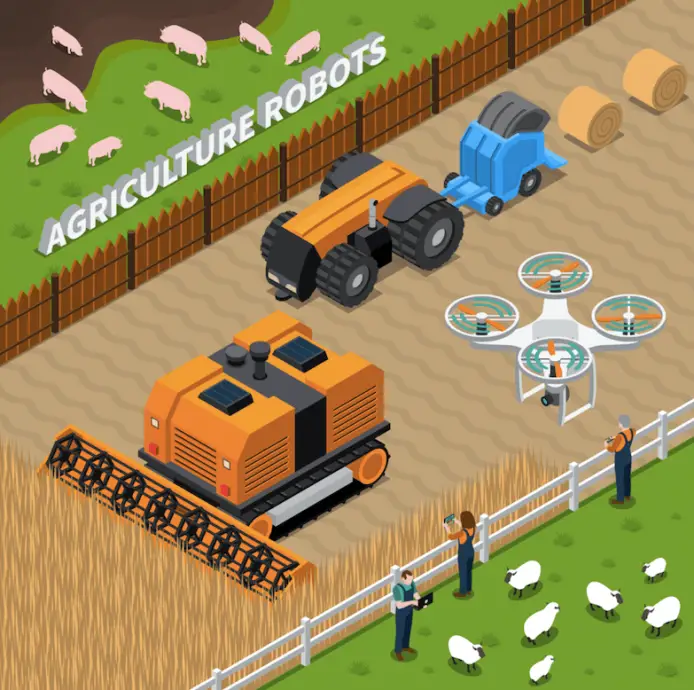
Artificial intelligence is transforming agriculture by improving efficiency, productivity, and sustainability across global farming systems. According to the Food and Agriculture Organization, global food production must increase significantly to meet demand by 2050. Farmers are adopting artificial intelligence tools to optimize crop yields and resource usage. These technologies enable data-driven decisions that improve farming outcomes across diverse environments. Agricultural systems are becoming more precise and responsive through intelligent automation and analytics. Climate variability increases pressure on farmers to adopt advanced and adaptive technologies. Artificial intelligence plays a central role in shaping the future of agriculture globally.
Key Takeaways
- Artificial intelligence in agriculture uses data, automation, and analytics to improve crop yields and farming efficiency.
- AI-driven agriculture includes precision farming, predictive analytics, and smart irrigation systems for better productivity.
- The role of artificial intelligence in agriculture is to optimize farming decisions and improve food production at scale.
- Artificial intelligence enables data-driven farming decisions and improves productivity
- Precision agriculture reduces waste and optimizes resource utilization
- Automation enhances efficiency and reduces reliance on manual labor
- AI supports sustainable and climate-resilient farming practices
Table of contents
- Introduction
- Key Takeaways
- How artificial intelligence is transforming modern farming practices
- Core technologies powering AI-driven agriculture systems
- Precision farming and data-driven crop management strategies
- AI in soil analysis and nutrient optimization for better yields
- The role of computer vision in crop monitoring and disease detection
- Using AI for irrigation management and water efficiency
- Predictive analytics for yield forecasting and farm planning
- Automation in agriculture through AI-powered machinery and robotics
- The impact of AI on reducing waste and improving supply chains
- How AI supports sustainable farming and environmental conservation
- Challenges in adopting artificial intelligence across farming systems
- Cost barriers and accessibility issues in AI-driven agriculture
- Applications that showcase the role of artificial intelligence in agriculture.
- Crop Monitoring and Management
- Precision Farming
- Autonomous Farming
- Livestock Monitoring
- Supply Chain Optimization
- Disease and Pest Prediction
- Agri-FinTech
- Precision Agriculture
- Yield Prediction
- Soil Health Monitoring
- Livestock Management
- Artificial Intelligence in Self-driving tractors
- Artificial Intelligence and Robotics
- Defense against pests using artificial intelligence
- Why Is using automation and artificial intelligence beneficial For agriculture?
- Shifting landscapes of being a farmer
- AI and Agriculture Challenges
- Ethical considerations in data usage and agricultural AI systems
- The role of governments and policies in AI agriculture adoption
- Strategies for farmers to implement AI technologies effectively
- Case for integrating AI with traditional farming knowledge
- How global agriculture companies are using artificial intelligence
- Examples of AI applications improving agricultural productivity
- Failures and risks in AI agriculture systems and deployments
- Future of agriculture with AI-driven smart farming ecosystems
- Key Insights
- Real-World Examples of AI in Agriculture
- Case Studies
- Conclusion – The Role of artificial intelligence in agriculture.
- FAQ’s
- References
How artificial intelligence is transforming modern farming practices
Artificial intelligence in agriculture refers to the use of AI systems to analyze data, automate processes, and optimize farming practices for improved productivity and sustainability.
Artificial intelligence is fundamentally transforming modern farming practices through data-driven decision making and intelligent automation. Farmers use artificial intelligence tools to analyze environmental conditions and crop performance across seasons. These insights help optimize planting schedules, fertilization strategies, and harvesting operations effectively. AI systems process large datasets collected from sensors, satellites, and historical records. This allows farmers to respond quickly to changing environmental and market conditions. Agricultural productivity improves through more precise and informed operational decisions. Artificial intelligence is redefining how farming operations are managed across global agricultural systems.
AI-driven systems enable continuous monitoring of crops across large and diverse agricultural landscapes. Real-time data helps identify issues such as pests, diseases, and nutrient deficiencies early. This allows farmers to take timely action and reduce potential crop losses significantly. Farmers can adjust inputs such as water, fertilizers, and pesticides more efficiently. This improves yield outcomes while reducing unnecessary resource consumption. Artificial intelligence tools enhance visibility and control over complex farming operations. Farming becomes increasingly proactive instead of reactive with these systems.
Artificial intelligence also supports scalability in farming operations by enabling efficient management of large agricultural areas. Automated systems reduce dependence on manual labor for repetitive and time-intensive tasks. Farmers can focus more on strategic planning and long-term decision making activities. AI tools improve consistency across various farming processes and operations. This results in more reliable and predictable agricultural outcomes over time. Modern farming increasingly depends on intelligent systems for continuous optimization. Artificial intelligence continues to reshape agricultural practices worldwide.
Core technologies powering AI-driven agriculture systems
Artificial intelligence in agriculture relies on core technologies that enable efficient data collection, processing, and automation across farming systems. These technologies include machine learning models, sensors, drones, and satellite imaging systems used in precision agriculture. Each component contributes to gathering accurate data about crops, soil conditions, and environmental factors. Machine learning models analyze patterns and generate predictions based on historical and real-time agricultural data. Sensors capture continuous measurements related to soil moisture, temperature, and nutrient levels. These technologies work together to support informed decision making across farming operations. Core technologies form the foundation of modern artificial intelligence in agriculture systems.
Machine learning algorithms process large agricultural datasets to identify trends and optimize farming strategies effectively. These algorithms can predict crop yields, detect diseases, and recommend precise interventions based on data analysis. Farmers benefit from increased efficiency and reduced uncertainty in their decision making processes. Improved accuracy in predictions leads to better planning and resource allocation across farming cycles. Machine learning systems continuously improve through exposure to new and evolving data inputs. This enhances their ability to provide actionable insights for farmers. Artificial intelligence technologies become more reliable and impactful with continuous learning.
Drones and satellite imaging provide detailed visual data that supports large-scale crop monitoring and analysis. These tools enable farmers to observe variations in crop health across different areas of a field. High-resolution imagery helps identify stress factors such as pests, diseases, and water shortages early. This supports targeted interventions and efficient resource allocation across farming operations. Visual data enhances understanding of field conditions and improves overall agricultural productivity. Imaging technologies allow monitoring of large areas that are difficult to assess manually. These systems significantly improve efficiency and scalability in agriculture.
IoT devices connect sensors and systems to create integrated networks that support continuous data flow and monitoring. These connected systems provide real-time insights into various aspects of farming operations and environmental conditions. Farmers receive alerts and recommendations based on automated data analysis and predictive models. This improves responsiveness to changes in weather, soil conditions, and crop health indicators. IoT networks enhance coordination between irrigation, fertilization, and harvesting processes effectively. Integrated systems support efficient management of agricultural resources and operations. Connectivity plays a critical role in enabling intelligent agriculture systems.
Precision farming and data-driven crop management strategies
Precision farming uses artificial intelligence to optimize agricultural practices through detailed data analysis and targeted decision making. Farmers collect data from soil sensors, weather systems, and satellite imagery to monitor crop conditions continuously. AI systems analyze this data to generate actionable insights for improving farming efficiency. These insights guide decisions related to planting density, irrigation schedules, and fertilizer application strategies. Precision farming reduces waste by ensuring resources are applied only where and when they are needed. This improves productivity while minimizing environmental impact across agricultural systems. Precision farming enables highly targeted and efficient crop management through artificial intelligence technologies.
Artificial intelligence-driven crop management strategies allow farmers to address variability within fields more effectively. Different areas of a field may require different levels of water, nutrients, or pest control interventions. AI systems identify these variations and recommend precise actions tailored to specific zones. This targeted approach improves crop health and overall yield outcomes significantly. Farmers can reduce overuse of chemicals and inputs through data-driven decision making processes. Precision farming supports both cost savings and environmental sustainability across farming operations. AI enhances the ability to manage complexity within modern agricultural systems.
Precision farming also supports long-term optimization by using historical data to improve future agricultural decisions. Farmers analyze trends across multiple seasons to refine strategies and improve productivity outcomes. Artificial intelligence tools provide evolving recommendations based on accumulated data and insights. This continuous learning process enhances resilience against environmental variability and climate change. Farmers can adapt practices to changing conditions with greater confidence and accuracy. Data-driven farming becomes more effective as systems learn and improve over time. Artificial intelligence plays a central role in enabling these adaptive strategies.
AI in soil analysis and nutrient optimization for better yields
Artificial intelligence enhances soil analysis by providing detailed insights into nutrient levels and soil composition across agricultural fields. AI systems analyze soil samples and sensor data to determine nutrient availability and deficiencies accurately. These insights help farmers apply fertilizers more effectively and reduce unnecessary input usage. Optimized nutrient management improves crop growth, health, and overall yield outcomes significantly. Farmers can avoid overapplication of fertilizers that negatively impact soil quality and ecosystems. Soil analysis becomes more precise and efficient through artificial intelligence technologies. Artificial intelligence-driven soil analysis improves nutrient optimization and agricultural productivity significantly.
Artificial intelligence tools identify patterns in soil data to recommend optimal fertilization strategies for different crops and regions. These recommendations consider crop requirements, environmental conditions, and soil characteristics simultaneously. Farmers can tailor nutrient application to specific areas within a field for better efficiency. This targeted approach reduces waste and improves effectiveness of resource utilization across farming operations. AI systems continuously refine recommendations based on new data and seasonal variations. This enhances accuracy and reliability of soil management practices over time. Data-driven soil optimization supports sustainable agricultural practices effectively.
Improved soil analysis supports long-term sustainability by maintaining soil health and preventing degradation across agricultural systems. Balanced nutrient application ensures that soil fertility is preserved for future farming cycles. Artificial intelligence tools help farmers monitor soil conditions consistently over time. This enables proactive management of soil quality and nutrient levels across different environments. Healthy soil contributes to stable yields and improved resilience against environmental stress factors. AI technologies play an essential role in maintaining soil productivity and sustainability. Sustainable soil management benefits both agricultural productivity and environmental conservation.
The role of computer vision in crop monitoring and disease detection
Computer vision enables artificial intelligence systems to analyze visual data for crop monitoring and early disease detection across agricultural fields. Cameras, drones, and imaging devices capture detailed images of crops under different environmental conditions. Artificial intelligence models process these images to identify patterns, anomalies, and signs of crop stress. This allows detection of diseases, pests, and nutrient deficiencies at early stages. Early identification helps farmers take timely actions and prevent widespread damage across crops. These systems improve accuracy and speed of monitoring compared to manual inspection methods. Computer vision significantly enhances the effectiveness of crop monitoring and disease detection in agriculture.
Artificial intelligence-driven image analysis identifies subtle changes in plant health that may not be visible to human observers. These changes include variations in color, texture, growth patterns, and leaf structure across crops. Early detection improves effectiveness of interventions and reduces potential losses in agricultural production. Farmers can apply targeted treatments to affected areas instead of entire fields. This reduces resource usage and minimizes environmental impact from excessive chemical application. Computer vision systems provide continuous monitoring across large agricultural areas efficiently. Visual data becomes a critical asset for improving agricultural decision making.
Computer vision also supports automation by guiding machinery and robotic systems in performing agricultural tasks with precision. These systems use visual data to navigate fields and identify crops for harvesting or treatment. Automation reduces reliance on manual labor and improves operational efficiency across farming activities. Robotic systems can perform repetitive tasks consistently and accurately over time. Farmers benefit from reduced operational costs and improved productivity across large-scale farming operations. Computer vision integrates effectively with other artificial intelligence technologies in agriculture. This integration enhances overall performance and efficiency of modern farming systems.
Using AI for irrigation management and water efficiency
As crop monitoring improves, artificial intelligence plays a critical role in optimizing irrigation management and improving water efficiency across agricultural systems. AI tools analyze data from soil moisture sensors, weather forecasts, and crop conditions to determine precise water requirements. This enables farmers to schedule irrigation based on actual needs rather than fixed routines. Efficient irrigation reduces water waste and ensures crops receive adequate hydration for optimal growth. Water management becomes more responsive to environmental conditions through real-time data analysis. These systems help farmers conserve water resources while maintaining productivity. Artificial intelligence enables precise and efficient irrigation management in modern agriculture systems.
Artificial intelligence systems continuously monitor soil moisture levels to ensure crops receive optimal water supply across different field zones. Farmers receive recommendations on when and how much water should be applied for maximum efficiency. This prevents overwatering and reduces unnecessary consumption of limited water resources. Efficient irrigation improves crop yields while lowering operational costs for farmers. Water conservation becomes achievable through data-driven irrigation strategies powered by artificial intelligence. These systems support sustainable agricultural practices in water-scarce regions. Smart irrigation technologies enhance resilience in changing climate conditions.
Artificial intelligence-driven irrigation systems adapt dynamically to changing environmental conditions such as rainfall patterns and temperature fluctuations. Systems adjust water distribution automatically based on updated data inputs and predictive analytics. This improves responsiveness and efficiency in managing irrigation across large agricultural areas. Farmers can manage water resources more effectively during droughts or irregular weather patterns. Adaptive irrigation systems reduce dependency on manual decision making and guesswork. Artificial intelligence supports long-term sustainability through optimized water usage strategies. Efficient water management benefits both agricultural productivity and environmental conservation.
Predictive analytics for yield forecasting and farm planning
As irrigation systems become more efficient, predictive analytics enables farmers to forecast yields and plan operations with greater accuracy. Artificial intelligence models analyze historical data, weather patterns, and crop conditions to generate reliable predictions. These predictions help farmers make informed decisions about planting schedules and harvesting timelines. Accurate forecasting improves allocation of resources such as labor, water, and fertilizers across farming cycles. Farmers can reduce uncertainty and manage risks more effectively through data-driven planning. Predictive analytics enhances strategic decision making across agricultural operations. Predictive analytics provides valuable insights for optimizing yield outcomes and farm planning decisions.
Artificial intelligence systems consider multiple variables, including soil conditions, climate patterns, and crop health indicators, when generating forecasts. These insights allow farmers to anticipate potential challenges such as droughts, pest outbreaks, or yield fluctuations. Early predictions enable proactive adjustments to farming strategies and resource allocation. This improves resilience against environmental variability and unexpected disruptions. Farmers can optimize input usage based on expected outcomes and performance trends. Predictive analytics supports more efficient and adaptable farming operations over time. Data-driven insights improve consistency and reliability in agricultural planning.
Long-term planning benefits from predictive insights generated by artificial intelligence systems across multiple growing seasons. Farmers can analyze trends and refine strategies to improve productivity and sustainability outcomes. Artificial intelligence tools provide recommendations that evolve based on accumulated data and performance metrics. This continuous learning process enhances decision making and operational efficiency over time. Farmers can adapt practices to changing environmental and market conditions with greater confidence. Predictive analytics enables continuous improvement across agricultural systems globally. Data-driven planning becomes essential for modern and scalable farming operations.
Automation in agriculture through AI-powered machinery and robotics
As predictive insights improve planning, automation enhances execution through artificial intelligence-powered machinery and robotics in agriculture. Autonomous tractors and harvesters perform tasks with high precision and consistency across large agricultural fields. These machines reduce dependence on manual labor for repetitive and physically demanding farming activities. Automation improves operational efficiency and reduces costs associated with labor and resource management. Farmers can manage larger areas with fewer human resources through intelligent systems. AI-powered machinery operates continuously with minimal supervision under controlled conditions. Automation is transforming agricultural operations through intelligent and efficient machinery systems.
Robotic systems perform tasks such as planting, harvesting, spraying, and sorting crops with advanced precision and reliability. These systems use sensors, computer vision, and artificial intelligence models to navigate complex agricultural environments. This reduces errors and ensures consistent application of inputs across different areas of a field. Automated systems improve productivity by performing tasks faster than traditional manual methods. Farmers benefit from increased efficiency and reduced variability in crop management processes. Robotics enhances scalability of agricultural operations across different types of farms. Intelligent machinery plays a key role in modernizing agricultural practices.
Automation also improves safety by reducing exposure to hazardous conditions and physically demanding tasks in farming environments. Farmers avoid risks associated with heavy machinery, chemical exposure, and extreme weather conditions during operations. Artificial intelligence-powered systems handle complex tasks with consistent accuracy and reliability. This improves working conditions and reduces likelihood of injuries in agricultural settings. Automation contributes to overall sustainability by optimizing resource usage and reducing waste. Farmers gain greater control over operations through intelligent and automated systems. Artificial intelligence continues to drive innovation in agricultural automation globally.
The impact of AI on reducing waste and improving supply chains
As automation improves operational efficiency, artificial intelligence plays a critical role in reducing waste and improving agricultural supply chains globally. AI systems analyze production data to identify inefficiencies in harvesting, storage, and distribution processes. This helps farmers and suppliers minimize losses and optimize resource utilization across the supply chain. Predictive analytics aligns production with demand, reducing overproduction and unnecessary waste. Efficient logistics improve transportation and storage of agricultural products across different markets. Artificial intelligence enhances coordination between producers, distributors, and retailers effectively. Artificial intelligence significantly improves efficiency and reduces waste across agricultural supply chains.
Artificial intelligence tools identify inefficiencies such as delays, spoilage risks, and storage challenges within supply chain operations. These insights allow stakeholders to optimize transportation routes and storage conditions for perishable goods. Improved coordination reduces losses during transit and storage stages of agricultural products. Farmers and distributors can make data-driven decisions to improve operational efficiency and profitability. Artificial intelligence enables better forecasting of demand and supply fluctuations across markets. This improves resilience and adaptability of agricultural supply chains. Data-driven optimization strengthens overall supply chain performance significantly.
Improved supply chain management supports sustainability by reducing resource waste and environmental impact across agricultural systems. Efficient logistics minimize energy consumption and emissions associated with transportation and storage activities. Artificial intelligence-driven systems enhance transparency and traceability across supply chains for better accountability. This improves trust among consumers, producers, and regulatory bodies within agricultural ecosystems. Sustainable supply chains contribute to long-term viability of farming operations and food systems. Artificial intelligence plays a central role in optimizing supply chains effectively. These improvements benefit both economic and environmental outcomes.
How AI supports sustainable farming and environmental conservation
As supply chains become more efficient, artificial intelligence supports sustainable farming practices and environmental conservation efforts across agricultural ecosystems. AI systems optimize use of resources such as water, fertilizers, and energy through precise data analysis. This reduces environmental impact while maintaining or improving agricultural productivity levels. Farmers can adopt practices that minimize waste and protect natural ecosystems effectively. Artificial intelligence enables balance between productivity and environmental responsibility in modern farming. These technologies support sustainable agricultural practices at scale across diverse regions. Artificial intelligence plays a critical role in promoting sustainability and environmental conservation in agriculture.
Artificial intelligence-driven systems monitor environmental conditions to support sustainable decision making across farming operations. Farmers receive recommendations that reduce emissions and resource consumption through optimized practices. These insights help improve environmental outcomes while maintaining consistent productivity levels. Artificial intelligence tools track environmental impact metrics to support accountability and transparency. Sustainable practices become more measurable and actionable with data-driven insights. Farmers can implement eco-friendly strategies with greater confidence and effectiveness. Environmental sustainability becomes integrated into daily agricultural operations.
Artificial intelligence also supports conservation by identifying areas that require protection, restoration, or improved management practices. Data analysis helps detect environmental changes such as soil degradation or water scarcity risks early. This enables proactive measures to preserve ecosystems and natural resources effectively. Artificial intelligence contributes to long-term sustainability of agricultural systems globally. Conservation efforts become more targeted and efficient through advanced analytics and monitoring systems. Farmers can balance productivity with ecological preservation more effectively. Artificial intelligence strengthens the connection between agriculture and environmental stewardship.
Challenges in adopting artificial intelligence across farming systems
As artificial intelligence adoption expands, several challenges emerge that affect implementation across diverse agricultural systems globally. Farmers often face difficulties integrating new technologies with existing farming infrastructure and practices. Limited technical knowledge can hinder effective use of artificial intelligence tools in agriculture. Variability in farm sizes and resources creates uneven adoption rates across regions and communities. Infrastructure limitations such as connectivity and access to reliable data also impact implementation efforts. These challenges slow down widespread adoption of advanced agricultural technologies. Adoption challenges create barriers to scaling artificial intelligence across global farming systems effectively.
Artificial intelligence systems require high-quality data to function accurately and deliver reliable insights for farming decisions. Many agricultural regions lack consistent access to structured and accurate data sources for analysis. Data collection processes may be inconsistent or incomplete across different farming environments. This reduces effectiveness of artificial intelligence models in generating useful recommendations. Farmers may struggle to trust outputs when data quality is uncertain or unreliable. Improving data infrastructure is essential for successful adoption of artificial intelligence technologies. Reliable data forms the foundation for effective agricultural innovation.
Integration of artificial intelligence technologies into traditional farming practices also presents cultural and operational challenges for farmers. Many farmers rely on experience and established methods that may not align with new technologies. Resistance to change can slow adoption of artificial intelligence solutions in agriculture. Training and education are required to support transition to data-driven farming practices. Farmers need support systems to understand and implement these technologies effectively. Adoption depends on balancing innovation with practical usability in farming environments. Addressing these challenges is critical for long-term success of artificial intelligence in agriculture.
Cost barriers and accessibility issues in AI-driven agriculture
As adoption challenges become clearer, cost barriers significantly impact accessibility of artificial intelligence technologies across agricultural systems. Many advanced tools require substantial upfront investment in hardware, software, and infrastructure components. Small and medium-sized farmers often struggle to afford these technologies without external support or financing. High costs limit adoption primarily to large-scale agricultural operations with greater financial resources. This creates disparities in access to innovation across different farming communities globally. Financial constraints slow down widespread implementation of artificial intelligence solutions. Cost barriers remain one of the most significant challenges in scaling artificial intelligence in agriculture.
Accessibility issues extend beyond cost to include availability of technical expertise and support services for farmers. Many rural regions lack access to training programs and technical assistance for implementing artificial intelligence tools. Farmers may find it difficult to understand and operate complex systems without adequate support. This limits effectiveness of technology adoption even when tools are available. Access to reliable internet connectivity also affects usability of cloud-based artificial intelligence solutions. Infrastructure gaps create additional challenges for farmers in remote areas. Improving accessibility requires addressing both financial and technical barriers simultaneously.
Applications that showcase the role of artificial intelligence in agriculture.
Artificial Intelligence (AI) is revolutionizing the agriculture industry by offering innovative solutions to improve productivity, sustainability, and efficiency. Here are some key applications of AI in agriculture.
Crop Monitoring and Management
AI-powered systems can analyze satellite imagery, drone data, and IoT sensor data to monitor crop health, detect diseases, pests, and nutrient deficiencies. This enables farmers to take timely action, optimize resource usage, and maximize crop yields.
Precision Farming
AI enables precision agriculture by using data analytics to optimize farming practices. AI algorithms process data on weather conditions, soil composition, and historical crop performance to provide tailored recommendations for irrigation, fertilization, and pesticide application. This reduces waste, minimizes environmental impact, and improves resource efficiency.
Autonomous Farming
AI-driven robotics and autonomous vehicles are transforming farming operations. Robots equipped with computer vision can autonomously harvest crops, weed fields, and perform labor-intensive tasks. Autonomous drones can survey vast areas and collect data for crop monitoring and mapping.
Livestock Monitoring
AI-based systems can monitor the health and behavior of livestock using sensors and computer vision. They can detect early signs of diseases, monitor feeding patterns, and optimize breeding processes. This helps farmers improve animal welfare, prevent diseases, and increase productivity.
Supply Chain Optimization
AI algorithms can optimize supply chain logistics by analyzing factors such as demand, transportation routes, and storage conditions. This improves inventory management, reduces waste, and ensures timely delivery of agricultural products.
Disease and Pest Prediction
AI models can analyze historical data, weather patterns, and other relevant variables to predict disease outbreaks and pest infestations. Early detection and intervention help farmers take preventive measures, minimize crop loss, and reduce the need for chemical interventions.
Agri-FinTech
AI-powered platforms and apps provide farmers with financial and market insights, enabling them to make informed decisions. These platforms analyze market trends, crop performance, and financial data to offer personalized recommendations and access to credit and insurance services.
Precision Agriculture
AI algorithms can process data on soil composition, weather patterns, and crop health to provide precise recommendations for irrigation, fertilization, and pesticide application. This helps farmers optimize resource usage, minimize environmental impact, and increase crop yields.
Yield Prediction
AI models can analyze historical data, weather patterns, and other relevant factors to predict crop yields. This information enables farmers to make informed decisions regarding planting, harvesting, and market planning, leading to improved efficiency and profitability.
Soil Health Monitoring
AI-based systems can monitor soil health by analyzing soil samples and sensor data. This helps farmers understand soil conditions, nutrient levels, and potential soil degradation issues. With this information, farmers can implement targeted soil management practices and optimize soil health.
Livestock Management
AI-powered solutions can monitor livestock health, behavior, and feeding patterns using sensors and computer vision. This helps farmers identify and address health issues, optimize feeding practices, and improve overall livestock management.
Artificial Intelligence in Self-driving tractors
Self-driving cars are becoming an increasingly regular occurrence with Tesla leading the way, among other developers. It’s only natural that the concept would find its way towards agriculture. Vehicles play a significant role in agriculture, and arguably none is more critical than the tractor.
The self-driving tractors are capable of performing multiple activities without any human supervision. These tractors will avoid obstacles and independently identify their plowing position while traveling at the ideal speed. Without worrying about the driver’s fatigue, these tractors are capable of completing more tasks and managing multiple activities without tiring.
Artificial Intelligence and Robotics
Robotics and artificial intelligence go hand in hand. There are several practical applications that are finding their way towards agriculture. For example, there are picking robots designed to help pick up the produce once it’s time to harvest. These robots can pick the produce much faster than a human and manage a larger volume as well.
One the other hand, the See & Spray AI system is completely revolutionizing crop management. The cameras allow the AI to detect any potential weeds or issues with the crop. It can then spray the weeds with herbicide or provide fertilizer to certain plants. It allows farmers to manage their crops and end up picking higher volumes.
Defense against pests using artificial intelligence
Pests are among the worst enemies that farmers encounter. They’re capable of destroying a field of crops in its entirety. However, the use of AI can help farmers defend better against potential pests. By using cameras and satellite imagery, AI companies are providing farmers with smartphone apps capable of warning against incoming pests.
The systems compare new satellite images with historical data, then the AI algorithm determines whether or not the insects have landed at another location. If the algorithm detects any potential movements in the pests, they’ll update the farmers with their location.
Why Is using automation and artificial intelligence beneficial For agriculture?
While there are many arguments against the use of automation, some argue that it’s replacing valuable jobs and the role of human labor in traditional agriculture. However, due to land scarcity, there’s only so much that we can produce using traditional agricultural methods. The use of artificial intelligence and automation would allow existing farmers to get more out of what they already own.
Artificial intelligence will help improve the output, management, and sustainability of agriculture in the future. The nature of most of these applications doesn’t outright replace human labor either. The artificial intelligence can work alongside the farmer to help produce the best results.
As the population of the world continues to grow, the agricultural sector needs to increase its output. The implementation of AI can help ensure that the transfer to more modern methods of agriculture is as efficient and lucrative as possible.
The smart farm
Advancements in artificial intelligence based technologies have led to smarter farms or farming models with highly adaptive capability.
Data capture and analysis
Farms can set up setup, track and analyze a diverse set of data points thereby helping farmers make smarter decisions. This data analysis helps in arriving at much smarter approaches to the problems at hand and helps in better decision making.
Automation and robotics
Any basic repetitive work that saves the farmer time and can be automated should be automated. Robots are used in farm activities such as fruit picking and lettuce thinning among many others. This can lead to productivity gains with indefatigability, consistent work quality and cost savings in the long run.
Predictive analytics
Artificial intelligence has an array of tools to predict changes in weather patterns, soil conditions, pest infestation or soil quality and composition in order to improve planning and farm management. These tools help farmers take advantage of the predictions and assist them in making informed decisions.
Similar to other industries, farms face constraints relating to the use of AI such as investment costs, compatibility with current tech infrastructure, skills and resource availability, privacy, security, and possible regulatory issues.
Despite these potential constraints, the stage is set for smart farms, precision farming, and agricultural intelligence.
Shifting landscapes of being a farmer
Artificial intelligence is transforming agriculture and provides diverse approaches for abundant harvests in all aspects of agriculture. With such transformation, innovative farms require innovative workers. Amidst these dramatic technological advances, they would need need new ways to adapt and think out of the box to manage their agricultural farm lands.
They need to use the right tools during their journey that are at their disposal.While extensive technical expertise may not be required, but, basic understanding and operational implications may be necessary. Through artificial intelligence, they can have deeper and better understanding of their “workplace” aka the farm.
To adapt to artificial intelligence the agriculture sector needs to pivot to a better sense of tooling and training for the human resources required to manage farming. Everyone in the organization should be trained and educated to stay up to date with the artificial intelligence economy.
Since artificial intelligence and robotics will take a lot of work from the agriculturists, it is critical for the agriculturists to partner with tech firms to obtain unique, innovative and cutting edge technologies that would not only boost productivity but will also help them differentiate themselves from the competition. Strategic planning and partnerships can give agriculturists an upper hand.
Rolling out these technologies at scale will give the agriculturists and farmers the economies of scale. While AI and robotic tech tools can be expensive and may be a huge investment for some, it is important for the entire community come up with solutions across the beard that give the opportunities at scale for small time farms by collaborating with other farmers, cooperatives, suppliers, government, universities and even the local community to drive the costs down.
AI and Agriculture Challenges
Despite the numerous benefits and potential applications of Artificial Intelligence (AI) in agriculture, there are also several challenges that need to be addressed. Here are some key challenges associated with AI in agriculture.
Data Accessibility and Quality
AI relies heavily on high-quality data for accurate analysis and predictions. However, in agriculture, accessing reliable and comprehensive data can be a challenge. Farmers may have limited access to data due to technological barriers, data privacy concerns, or lack of connectivity in rural areas. Ensuring data accessibility and improving data quality are critical for effective AI implementation in agriculture.
Adoption and Affordability
The adoption of AI technologies in agriculture requires significant investment in infrastructure, equipment, and training. Many farmers, especially those in small-scale operations or developing regions, may face financial constraints that hinder the adoption of AI solutions. Making AI technologies more affordable and accessible to all farmers, regardless of their scale or location, is essential for widespread adoption.
Skill Gap and Training
Effective utilization of AI in agriculture requires a skilled workforce capable of understanding and leveraging AI technologies. However, there is a shortage of professionals with expertise in both agriculture and AI. Bridging this skill gap and providing adequate training programs for farmers and agricultural professionals are crucial for successful AI integration in the sector.
Ethical Considerations
AI technologies raise ethical concerns related to data privacy, security, and transparency. Agricultural data often includes sensitive information about farmers, crops, and land. Ensuring that AI systems maintain privacy, protect data integrity, and operate in a transparent manner is essential for building trust and addressing ethical concerns.
Contextual Adaptability
AI models and algorithms developed for one region or crop may not be directly applicable in different contexts. Agricultural practices vary across regions due to diverse climates, soil conditions, and farming techniques. Developing AI solutions that can adapt and provide context-specific recommendations and insights is crucial for maximizing their effectiveness and relevance in different agricultural settings.
Regulatory and Policy Frameworks
The rapid advancement of AI in agriculture poses challenges for regulatory and policy frameworks to keep pace with technological developments. Establishing appropriate regulations and policies that ensure the responsible and ethical use of AI, protect farmers’ interests, and address potential risks or biases is essential for the sustainable integration of AI in agriculture.
Ethical considerations in data usage and agricultural AI systems
As accessibility improves, ethical considerations become critical when using artificial intelligence systems in agriculture and farming operations. Artificial intelligence relies on large volumes of data collected from farms, equipment, and environmental systems. Questions arise regarding ownership, privacy, and control of agricultural data generated through these systems. Farmers may be concerned about how their data is stored, shared, or monetized by technology providers. Lack of transparency can reduce trust in artificial intelligence solutions and slow adoption. Ethical frameworks are necessary to ensure responsible use of data across agricultural ecosystems. Ethical considerations play a vital role in shaping trust and adoption of artificial intelligence in agriculture.
Data security is another major concern when implementing artificial intelligence systems across connected agricultural networks. Unauthorized access or misuse of data can create risks for farmers and agricultural businesses. Sensitive information about crop yields, soil conditions, and operational strategies may be exposed. Protecting data through secure systems and policies is essential for maintaining trust. Farmers need assurance that their data will not be exploited unfairly by external entities. Strong governance structures help address these risks effectively. Ethical data management supports sustainable adoption of artificial intelligence technologies.
The role of governments and policies in AI agriculture adoption
As ethical considerations become more prominent, governments play a critical role in shaping adoption of artificial intelligence across agricultural systems. Public policies help establish guidelines for responsible use of artificial intelligence technologies in farming. Governments introduce programs that support innovation, research, and infrastructure development in agriculture. These initiatives encourage farmers to adopt advanced technologies through incentives and subsidies. Regulatory frameworks ensure that artificial intelligence systems operate within defined standards and practices. Policies also promote transparency and accountability across agricultural ecosystems. Government policies are essential for enabling responsible and scalable adoption of artificial intelligence in agriculture.
Governments collaborate with industry stakeholders and research institutions to develop strategies for integrating artificial intelligence into agriculture. These collaborations support knowledge sharing and development of best practices across regions. Public investments in infrastructure improve access to technology and data for farmers. Training programs and extension services help farmers understand and use artificial intelligence tools effectively. Policy frameworks also address challenges related to data privacy and security in agriculture. Coordinated efforts strengthen adoption and impact of artificial intelligence solutions. Government support accelerates innovation and transformation in agricultural systems.
Challenges remain in implementing consistent policies across different regions and agricultural contexts globally. Variations in regulatory approaches can create uncertainty for technology providers and farmers. Governments must balance innovation with regulation to avoid limiting technological progress. Overregulation may slow adoption, while insufficient regulation may create risks. International cooperation is necessary to address cross-border challenges in agriculture and technology. Effective policies require continuous evaluation and adaptation to evolving technologies. Governments play a central role in shaping the future of artificial intelligence in agriculture.
Strategies for farmers to implement AI technologies effectively
As policy frameworks evolve, farmers need practical strategies to implement artificial intelligence technologies effectively within their operations. Adoption begins with identifying specific problems that artificial intelligence can solve in farming processes. Farmers should evaluate tools based on their relevance to crop types, farm size, and environmental conditions. Starting with small pilot implementations allows farmers to test technologies before scaling across operations. This reduces risk and builds confidence in artificial intelligence solutions over time. Strategic planning ensures alignment between technology adoption and farming goals. Effective implementation strategies help farmers maximize value from artificial intelligence technologies in agriculture.
Training and education play a critical role in successful adoption of artificial intelligence systems across farming environments. Farmers must develop skills to interpret data insights and operate advanced tools effectively. Access to training programs and expert support improves understanding and usability of technologies. Collaboration with agricultural advisors and technology providers enhances implementation outcomes significantly. Continuous learning helps farmers adapt to evolving technologies and best practices. Knowledge sharing within farming communities supports broader adoption and innovation. Education strengthens the foundation for data-driven agriculture.
Farmers should also focus on integrating artificial intelligence technologies with existing farming practices and workflows. Seamless integration improves efficiency and reduces disruption to daily operations. Data collected from multiple sources should be consolidated for better analysis and decision making. Farmers can use integrated systems to manage irrigation, fertilization, and crop monitoring processes effectively. This improves coordination and consistency across farming activities. Integration enhances overall productivity and operational efficiency in agriculture. Artificial intelligence becomes more impactful when aligned with existing systems.
Case for integrating AI with traditional farming knowledge
As implementation strategies mature, integrating artificial intelligence with traditional farming knowledge becomes essential for achieving balanced outcomes. Farmers possess valuable experiential knowledge gained from years of observing environmental and crop patterns. Artificial intelligence systems provide data-driven insights that complement this existing expertise effectively. Combining both approaches enhances decision making and improves overall farming performance significantly. Farmers can validate artificial intelligence recommendations using their practical experience in real-world conditions. This integration creates more reliable and context-aware farming strategies. Combining artificial intelligence with traditional knowledge strengthens agricultural decision making and outcomes.
Traditional knowledge helps interpret artificial intelligence outputs in ways that are relevant to local conditions and practices. Farmers understand nuances such as soil behavior, climate variability, and crop responses that may not be fully captured in data. This contextual understanding improves accuracy of decisions based on artificial intelligence insights. Artificial intelligence provides scale and speed, while traditional knowledge offers depth and experience. Together, they create a more holistic approach to farming operations. Integration supports adaptability across diverse agricultural environments. This balance enhances resilience and sustainability in farming systems.
Integrating artificial intelligence with traditional practices also supports smoother adoption of new technologies among farmers. Familiar approaches reduce resistance to change and increase confidence in using advanced tools. Farmers are more likely to trust systems that align with their existing knowledge and practices. This improves adoption rates and long-term success of artificial intelligence solutions. Blending innovation with tradition creates practical and sustainable pathways for transformation. Collaboration between technology and experience drives meaningful progress in agriculture. Artificial intelligence becomes more effective when grounded in real-world farming knowledge.
How global agriculture companies are using artificial intelligence
As integration improves across farms, global agriculture companies are leveraging artificial intelligence to scale innovation and improve operational efficiency. Large organizations invest in advanced technologies to optimize crop production, supply chains, and resource management systems. Artificial intelligence enables these companies to analyze vast datasets from multiple regions and farming environments. This supports strategic decision making and improves productivity across global operations. Companies use predictive analytics to forecast demand and optimize distribution networks effectively. These technologies enhance competitiveness and efficiency in agricultural markets. Global agriculture companies are driving large-scale adoption of artificial intelligence technologies in farming.
Companies implement artificial intelligence solutions such as precision agriculture tools, autonomous machinery, and data analytics platforms. These solutions improve crop monitoring, yield optimization, and resource management across large farming operations. Artificial intelligence systems help identify inefficiencies and recommend improvements in real time. This leads to better outcomes in productivity, sustainability, and cost management. Companies also collaborate with research institutions to develop innovative agricultural technologies. These partnerships accelerate advancement and adoption of artificial intelligence solutions. Industry leaders play a key role in shaping future agricultural practices.
Global agriculture companies also focus on developing scalable solutions that can be adapted for different regions and farming conditions. These solutions address challenges such as climate variability, resource scarcity, and population growth. Artificial intelligence supports development of resilient agricultural systems that can respond to changing conditions effectively. Companies aim to make technologies accessible to a broader range of farmers over time. This includes developing affordable tools and platforms for smaller farming operations. Industry-driven innovation contributes to transformation of global agriculture. Artificial intelligence continues to expand its impact across agricultural ecosystems.
Examples of AI applications improving agricultural productivity
As industry adoption expands, real-world applications demonstrate how artificial intelligence improves productivity across agricultural systems. Farmers use AI-powered tools for crop monitoring, yield prediction, and resource optimization in various regions. These applications analyze data from sensors, satellites, and historical records to provide actionable insights. Farmers can make timely decisions that improve crop health and maximize yield outcomes effectively. Artificial intelligence systems help reduce waste and improve efficiency across farming operations. Productivity increases through better use of resources and improved planning strategies. Real-world applications highlight measurable productivity gains from artificial intelligence in agriculture.
In crop monitoring, artificial intelligence systems detect early signs of disease and pest infestations across large agricultural areas. Farmers receive alerts that enable quick intervention and prevent widespread damage to crops. This reduces losses and improves overall yield quality significantly. Artificial intelligence also supports precision fertilization and irrigation to optimize resource usage. These applications ensure inputs are applied only where needed for maximum effectiveness. Farmers benefit from improved efficiency and reduced environmental impact. Crop monitoring systems demonstrate clear advantages of artificial intelligence in agriculture.
Artificial intelligence is also used in predictive analytics to forecast yields and optimize supply chain decisions effectively. These systems analyze historical and real-time data to predict production outcomes accurately. Farmers and distributors can align supply with demand to reduce waste and improve profitability. Artificial intelligence supports better coordination across production, storage, and distribution processes. This improves efficiency and resilience across agricultural systems. Data-driven decision making enhances overall productivity and sustainability. Predictive applications continue to expand across agricultural operations globally.
Artificial intelligence-powered automation systems improve efficiency by performing repetitive tasks such as harvesting and sorting crops accurately. These systems operate with precision and consistency across different farming environments. Automation reduces labor requirements and increases speed of operations significantly. Farmers can manage larger areas with fewer resources through intelligent machinery. This improves scalability and operational efficiency across farms. Automation applications demonstrate the transformative impact of artificial intelligence in agriculture. These systems continue to evolve with advancements in technology.
Failures and risks in AI agriculture systems and deployments
As applications expand, failures and risks in artificial intelligence systems highlight challenges that must be addressed for successful adoption. Artificial intelligence systems may produce inaccurate predictions if data quality is poor or incomplete. This can lead to incorrect decisions that negatively impact crop yields and resource utilization. Farmers may face financial losses due to reliance on unreliable system outputs. Overdependence on technology without proper validation can increase risks in farming operations. These challenges emphasize the need for careful implementation and monitoring of systems. Failures and risks highlight limitations of artificial intelligence in agricultural deployments.
Artificial intelligence systems may also fail to adapt to unexpected environmental conditions or anomalies in data inputs. Sudden weather changes or unusual events can affect accuracy of predictions and recommendations. This creates uncertainty and reduces reliability of artificial intelligence solutions in agriculture. Farmers must combine data insights with practical knowledge to mitigate these risks effectively. Continuous improvement and validation of models are required to enhance reliability. Risk management strategies are essential for successful use of artificial intelligence. Addressing these limitations is critical for long-term adoption.
Security risks also arise from increased reliance on connected systems and data-driven technologies in agriculture. Unauthorized access to data can compromise sensitive information related to farming operations and production strategies. Cybersecurity measures are necessary to protect systems from potential threats and misuse. Farmers must ensure that data and systems are secure to maintain trust and reliability. Addressing security concerns supports safe adoption of artificial intelligence technologies. Risk mitigation requires collaboration between technology providers and agricultural stakeholders. Artificial intelligence systems must be designed with security in mind.
Future of agriculture with AI-driven smart farming ecosystems
As risks are addressed, the future of agriculture will be shaped by artificial intelligence-driven smart farming ecosystems. These ecosystems integrate multiple technologies to create connected and intelligent farming environments. Artificial intelligence enables seamless coordination between data collection, analysis, and automated decision making processes. Smart farming systems improve efficiency, productivity, and sustainability across agricultural operations. Farmers can manage entire ecosystems through integrated platforms and tools. This transforms agriculture into a more data-driven and responsive industry. The future of agriculture will be defined by intelligent and interconnected farming ecosystems powered by artificial intelligence.
Artificial intelligence will continue to evolve with advancements in machine learning, robotics, and data analytics technologies. These advancements will improve accuracy, scalability, and accessibility of artificial intelligence solutions in agriculture. Farmers will benefit from more reliable insights and automated systems that enhance productivity. Integration with emerging technologies such as blockchain and IoT will improve transparency and traceability. This strengthens trust across agricultural supply chains and markets. Innovation will drive continuous improvement in agricultural systems globally. Artificial intelligence will remain central to future agricultural development.
The future of agriculture also depends on collaboration between governments, organizations, and farmers to implement artificial intelligence effectively. Policies, education, and infrastructure will support adoption of advanced technologies across regions. Farmers will need to adapt to changing practices and embrace data-driven decision making approaches. Sustainable practices will be integrated into intelligent farming systems to address environmental challenges. Artificial intelligence will help meet global food demand while minimizing resource usage. Collaboration and innovation will shape resilient and efficient agricultural ecosystems. The transformation of agriculture through artificial intelligence will continue to accelerate.
Key Insights
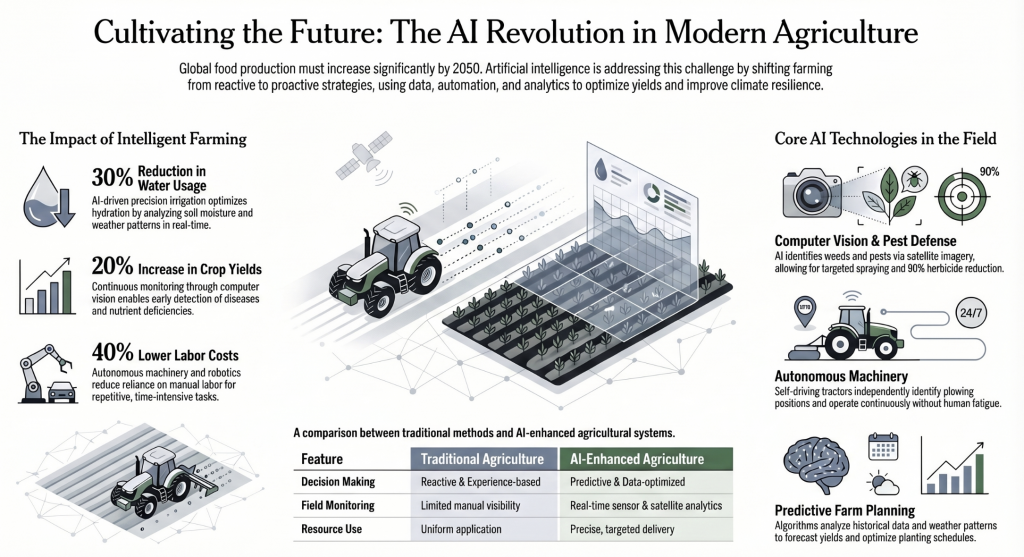
- Global food demand is projected to increase by nearly 50 percent by 2050, requiring advanced technologies like AI to improve productivity (https://www.fao.org/3/i6583e/i6583e.pdf).
- Precision agriculture can reduce water usage by up to 30 percent, demonstrating measurable efficiency improvements using AI systems (https://www.worldbank.org/en/topic/agriculture/brief/precision-agriculture).
- AI-driven crop monitoring can increase yields by up to 20 percent by enabling early detection of disease and stress conditions (https://www.mckinsey.com/industries/agriculture/our-insights/agriculture-technology-future).
- The global smart agriculture market is expected to exceed 20 billion dollars by 2027, reflecting rapid adoption of AI technologies (https://www.marketsandmarkets.com/Market-Reports/smart-agriculture-market-239736436.html).
- AI-powered irrigation systems significantly reduce water waste while improving crop productivity across diverse agricultural environments (https://www.fao.org/climate-smart-agriculture/en/).
- Autonomous farming equipment can reduce labor costs by up to 40 percent, showing strong economic impact of AI-driven automation (https://www.bcg.com/publications/2020/artificial-intelligence-agriculture).
- AI-enabled supply chain optimization reduces food waste and improves efficiency across global agricultural distribution networks (https://www.weforum.org/agenda/2021/02/how-ai-is-transforming-food-systems/).
| Dimension | Traditional Agriculture | AI-Enhanced Agriculture | Risk |
|---|---|---|---|
| Transparency | Limited visibility into farm operations | Real-time monitoring and analytics | Data misuse and lack of control |
| Participation | Human-driven decisions | Automated and data-driven systems | Reduced human oversight |
| Trust | Based on experience | Based on predictive models | Overreliance on AI outputs |
| Decision Making | Reactive | Predictive and optimized | Incorrect predictions from poor data |
| Misinformation | Minimal | Data misinterpretation possible | Misuse of analytics |
| Service Delivery | Manual processes | Automated workflows | System failures |
| Accountability | Individual farmer | Shared across systems | Diffused responsibility |
Real-World Examples of AI in Agriculture
John Deere uses artificial intelligence in its See & Spray technology to identify weeds and apply herbicides precisely. The system uses computer vision to distinguish crops from weeds in real time. This implementation reduces herbicide usage by up to 90 percent in certain conditions. The measurable outcome includes cost savings and reduced environmental impact. A limitation is that system accuracy depends on crop type and field conditions. Source: https://www.deere.com/en/our-company/news-and-announcements/see-spray-technology/
Blue River Technology, acquired by John Deere, developed machine learning systems for precision weed control. Their technology applies herbicides only where needed using real-time image recognition. This significantly reduces chemical usage and improves sustainability outcomes. The measurable outcome includes lower input costs and improved efficiency. A limitation is high initial investment and reliance on high-quality imaging data. Source: https://www.bluerivertechnology.com/technology/
IBM partnered with farmers through its Watson Decision Platform for Agriculture to provide predictive insights. The system analyzes weather, soil, and crop data to improve decision making. Farmers using the platform reported improved yield predictions and risk management capabilities. The measurable outcome includes better planning and reduced uncertainty. A limitation is dependence on accurate data inputs and integration complexity. Source: https://www.ibm.com/products/environmental-intelligence-suite/agriculture
Case Studies
Microsoft developed the FarmBeats project to improve data-driven farming using artificial intelligence and IoT systems. The problem involved lack of connectivity and data availability in rural agricultural areas. The solution included low-cost sensors, drones, and AI models for real-time farm insights. The measurable impact included improved crop monitoring and optimized resource usage across pilot farms. However, limitations included infrastructure challenges and scalability across different regions.
Bayer uses artificial intelligence through its Climate FieldView platform to support precision agriculture. The problem involved inefficient resource use and lack of data-driven decision making. The solution included AI-powered analytics for field monitoring, planting optimization, and yield forecasting. The measurable impact included improved productivity and more efficient input usage across farms. However, limitations include high subscription costs and data integration challenges.
Trimble provides AI-enabled precision agriculture solutions for automated guidance and field analytics. The problem involved inefficiencies in field operations and resource allocation. The solution included GPS-guided systems and AI analytics for optimized farming operations. The measurable impact included increased efficiency and reduced overlap in field activities. However, limitations include dependence on hardware compatibility and technical expertise.
Conclusion – The Role of artificial intelligence in agriculture.
Artificial intelligence has a vital role to play in the future of humankind. That includes the agricultural industry as well. The potential of machine learning and continuously improving AI means that the ceiling for growth in the agricultural sector is massive.
The smart implementation of AI into agriculture would help ensure the sustainability of the industry in the future!
FAQ’s
Artificial intelligence in agriculture helps farmers analyze data, automate processes, and improve decision making across farming operations. These systems optimize crop yields, resource usage, and overall efficiency. AI enables more precise and sustainable farming practices globally.
AI improves crop yields by analyzing soil data, weather patterns, and crop health indicators. Farmers receive recommendations for irrigation, fertilization, and pest control. This targeted approach increases productivity while reducing waste and resource usage.
Examples include precision farming, crop monitoring using computer vision, predictive analytics for yield forecasting, and autonomous machinery. These technologies improve efficiency and reduce manual labor. AI applications are widely used in modern agricultural systems.
AI is used in precision farming to analyze data from sensors, drones, and satellite imagery. This data helps farmers apply resources such as water and fertilizers precisely. Precision farming improves efficiency and reduces environmental impact.
Technologies include machine learning models, IoT sensors, drones, satellite imaging, and computer vision systems. These tools collect and analyze agricultural data in real time. They enable intelligent decision making across farming operations.
AI improves productivity, reduces costs, and enhances sustainability in farming systems. It enables efficient use of resources such as water and fertilizers. Farmers can make better decisions based on data-driven insights.
Risks include high costs, data dependency, and potential system failures. Farmers may face challenges in adopting and maintaining these technologies. Security and privacy concerns also affect trust in AI systems.
AI analyzes soil moisture levels and weather data to optimize irrigation schedules. Farmers receive recommendations on when and how much to water crops. This improves water efficiency and supports sustainable farming practices.
Small farmers can use AI through affordable tools and mobile applications designed for accessibility. However, cost and infrastructure challenges may limit adoption. Support programs and training can improve access to these technologies.
AI supports sustainability by optimizing resource usage and reducing environmental impact. It helps farmers minimize waste and improve efficiency. Sustainable practices become more achievable with data-driven insights.
The future includes smart farming ecosystems, automation, and advanced analytics systems. AI will continue to improve productivity and sustainability. Integration with other technologies will enhance agricultural innovation.
AI reduces waste by optimizing production, storage, and distribution processes. Predictive analytics align supply with demand more effectively. This minimizes losses and improves efficiency across agricultural supply chains.
References
Abraham, Ajith, et al. AI, Edge and IoT-Based Smart Agriculture. Academic Press, 2021.
Ahamed, Tofael. IoT and AI in Agriculture: Self- Sufficiency in Food Production to Achieve Society 5.0 and SDG’s Globally. Springer Nature, 2023.
Allen, Daniel T. “Farmers Are Using AI to Spot Pests and Catch Diseases — and Many Believe It’s the Future of Agriculture.” Insider, 8 Nov. 2019, https://www.businessinsider.com/farmers-artificial-intelligence-in-agriculture-catch-disease-pests. Accessed 4 June 2023.
Satapathy, Suchismita, et al. Innovation in Agriculture with IoT and AI. Springer Nature, 2022.
Vuppalapati, Chandrasekar. Machine Learning and Artificial Intelligence for Agricultural Economics: Prognostic Data Analytics to Serve Small Scale Farmers Worldwide. Springer Nature, 2021.
Walch, Kathleen. “How AI Is Transforming Agriculture.” Forbes, 5 July 2019, https://www.forbes.com/sites/cognitiveworld/2019/07/05/how-ai-is-transforming-agriculture/#6e7a0f704ad1. Accessed 4 June 2023.