
Introduction
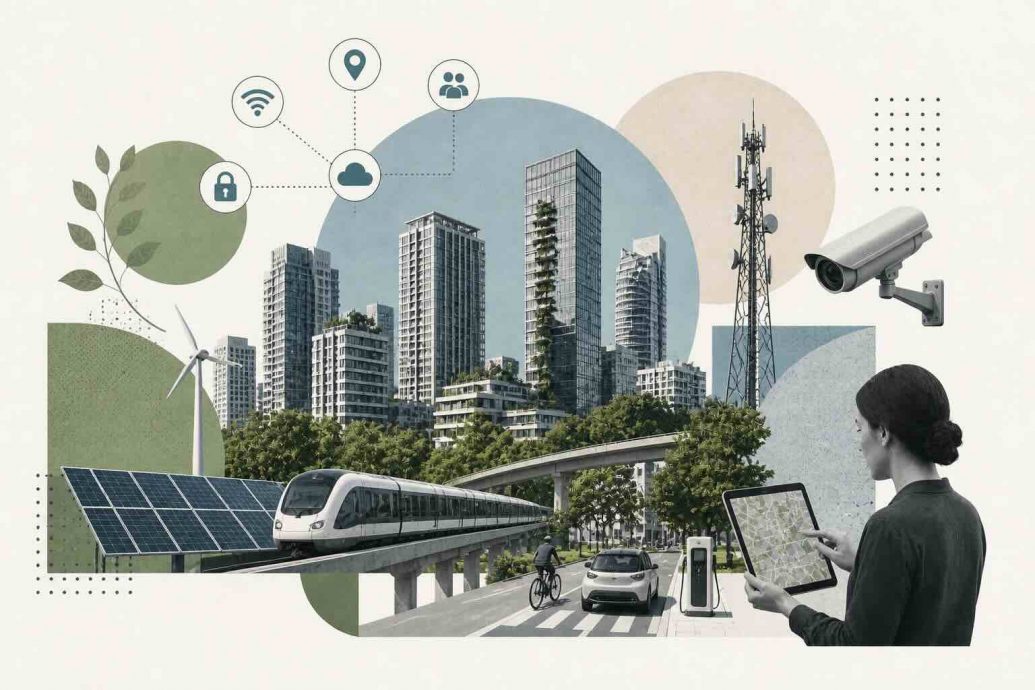
Cities are home to more than half the world’s population, and that share is climbing toward 70 percent by 2050, placing enormous pressure on urban infrastructure, public services, and natural resources that were never designed for such scale. The global smart cities market was valued at approximately USD 952.13 billion in 2025 and is projected to reach USD 6,315 billion by 2034, expanding at a compound annual growth rate of 23.20 percent. Smart cities use Internet of Things sensors, artificial intelligence, data analytics, and connected infrastructure to optimize how urban areas manage energy, transportation, water, waste, public safety, and governance in real time. Singapore’s Smart Nation machine learning models predicted bus crowding with 92 percent accuracy in 2025, trimming average commute times by 11 minutes and illustrating the tangible impact these technologies deliver. Connected public transport ranks as the most widely adopted smart city application at 74 percent, with traffic monitoring and management close behind at 72 percent. This article explains what smart cities are, how they work, what technologies power them, and what challenges must be addressed to ensure that urban intelligence benefits all residents equitably. From sensor-equipped water networks in India to AI-optimized snow removal in Munich, smart city initiatives are solving real problems at every scale of urban life.
Key Questions
What is a smart city?
A smart city is an urban area that uses IoT sensors, AI analytics, connected infrastructure, and data-driven governance to optimize transportation, energy, water, waste management, public safety, and citizen services, improving quality of life while reducing resource consumption and environmental impact.
How do smart cities use technology?
Smart cities use networks of connected sensors, cameras, and devices to collect real-time data on traffic flow, energy consumption, air quality, water usage, and public safety, then apply AI analytics to automate decisions that improve efficiency and service delivery.
What are examples of smart city technologies?
Smart city technologies include intelligent transportation systems, smart grids for energy management, IoT-connected water networks, AI-powered public safety surveillance, digital twin models for urban planning, and citizen engagement platforms that enable data-driven governance.
Key Takeaways
- About 70 percent of the global population could be living in smart cities by 2050, making urban technology investment a defining challenge of the coming decades.
- The global smart cities market is projected to grow from USD 952 billion in 2025 to USD 6,315 billion by 2034, driven by urbanization, IoT deployment, and sustainability mandates.
- Connected public transport is the most adopted smart city application at 74 percent, with traffic management at 72 percent, reflecting mobility as the primary driver of urban intelligence investment.
- Singapore’s AI-powered transit models achieved 92 percent accuracy in predicting bus crowding, reducing average commute times by 11 minutes through real-time optimization.
Table of contents
- Introduction
- Key Questions
- Key Takeaways
- Defining What a Smart City Is
- The Core Technologies Powering Smart Cities
- Smart Transportation and Mobility Systems
- Smart Energy Grids and Sustainability
- Smart Water Management and Waste Systems
- Public Safety and Emergency Response
- Citizen Engagement and Digital Governance
- Privacy, Surveillance, and Ethical Challenges
- How Smart Cities Are Built and Maintained
- Real-World Examples of Smart Cities in Action
- Case Studies in Smart City Implementation
- The Business Case for Smart City Investment
- What the Future Holds for Smart Cities
- Key Insights
- Frequently Asked Questions
Defining What a Smart City Is
A smart city is an urban area that integrates Internet of Things sensors, artificial intelligence, data analytics, and connected digital infrastructure to collect and analyze real-time information across transportation, energy, water, public safety, and governance systems, enabling data-driven decisions that improve efficiency, sustainability, and quality of life for residents.
Smart City Readiness Dashboard
Model your city’s smart readiness and projected impact across transportation, energy, water, safety, and governance. Adjust parameters to explore how different investment levels transform urban outcomes.
City Profile
Configure your city profile to explore smart city readiness and impact.
The Core Technologies Powering Smart Cities
Smart cities depend on a layered technology stack that begins with physical sensing infrastructure, moves through connectivity and data processing, and culminates in AI-powered analytics that translate raw urban data into automated decisions and actionable insights. IoT sensors form the foundation, deployed across roads, bridges, buildings, water pipes, electrical grids, and public spaces to continuously measure variables including traffic volume, air quality, energy consumption, noise levels, and structural integrity. Communication networks including 5G, fiber optics, LoRaWAN, and satellite connectivity transmit sensor data to cloud and edge computing platforms where it is stored, processed, and analyzed at speeds measured in milliseconds. Artificial intelligence and machine learning algorithms identify patterns, predict demand, detect anomalies, and automate responses across every city system simultaneously, from adjusting traffic signals to rerouting power distribution during peak demand. Artificial intelligence and smart cities are deeply intertwined, as AI serves as the analytical brain that converts the massive data streams generated by urban IoT networks into operational intelligence. The technology stack of a smart city creates a digital nervous system that continuously senses, processes, and responds to urban conditions at a scale and speed that manual management cannot approach.
Digital twin technology has emerged as one of the most powerful planning and operational tools in the smart city toolkit, enabling city administrators to create virtual replicas of urban infrastructure that simulate the impact of changes before they are implemented in the physical world. Munich's open-source digital twin processed 2.3 billion sensor readings to optimize snow-removal routes, slashing fuel use by 18 percent and saving EUR 4.2 million in overtime costs during a single winter season. The Internet of Things explained provides the foundation for understanding how connected devices create the data layer that digital twins depend on for accuracy. Cloud computing platforms provide the scalable storage and processing power that smart city operations require, while edge computing handles time-sensitive decisions closer to the data source, reducing latency for applications like traffic signal optimization and emergency response. The ITU's Y.4000 standards, ratified in 2024, unlocked true plug-and-play interoperability for smart city devices, enabling cities to swap sensors and systems without vendor lock-in. The convergence of these technologies creates an integrated urban operating system that manages complexity at scales previously impossible.
Smart Transportation and Mobility Systems
Transportation represents the single largest domain of smart city investment and the area where connected technology delivers the most visible improvements to residents' daily lives. Intelligent transportation systems use cameras, sensors, and AI to monitor traffic flow in real time, adjusting signal timing, rerouting vehicles through navigation applications, and managing incidents to reduce congestion that costs urban economies billions in lost productivity annually. AI in traffic management enables adaptive signal control that responds to actual traffic conditions rather than operating on fixed timers, reducing delays at intersections by 20 to 40 percent in implementations worldwide. Smart parking solutions use sensors embedded in parking spaces or mounted on poles to detect vacancy in real time, guiding drivers directly to available spots and reducing the circling behavior that accounts for up to 30 percent of urban traffic congestion. Autonomous driving technology is integrating into smart city transportation networks through connected vehicle infrastructure that enables cars to communicate with traffic signals, other vehicles, and road sensors for safer, more efficient movement. Smart transportation systems transform urban mobility from a collection of disconnected services into a coordinated network where every mode, from buses and trains to bikes and autonomous vehicles, operates as part of an integrated system optimized by real-time data.
Public transit optimization powered by AI is delivering measurable improvements in service quality, ridership, and operational efficiency across cities that have invested in connected transit infrastructure. AI and bus transportation systems use predictive models that forecast demand by route, time, and weather to optimize scheduling, fleet deployment, and capacity allocation. Subway systems enhanced by AI benefit from predictive maintenance that identifies equipment issues before they cause service disruptions, reducing delays and improving system reliability. Leveraging IoT for traffic monitoring enables cities to collect comprehensive mobility data that informs infrastructure investment decisions and identifies the transportation bottlenecks that have the greatest impact on commuter experience. The smart transportation segment is expected to witness a CAGR of 33 percent from 2025 to 2030, reflecting the massive investment flowing into urban mobility solutions worldwide.
Multimodal integration is the next frontier of smart transportation, where AI platforms coordinate across buses, trains, ride-sharing, bike-sharing, scooters, and walking routes to provide end-to-end journey planning that optimizes for time, cost, and environmental impact. Mobility-as-a-Service platforms aggregate transportation options into single applications where residents can plan, book, and pay for multimodal journeys without switching between separate service providers. Sustainable public transportation is being advanced through AI optimization of electric bus fleets, route planning that minimizes energy consumption, and demand-responsive services that replace fixed routes in low-ridership areas with on-demand microtransit.
Smart Energy Grids and Sustainability
Building on transportation efficiency, smart energy management represents the second largest domain of smart city technology, where intelligent grid infrastructure is essential for meeting sustainability goals while maintaining reliability as renewable energy sources become dominant. Smart grids use IoT sensors throughout the electrical distribution network to monitor power flow, detect faults, balance supply and demand, and integrate distributed energy resources like rooftop solar panels and battery storage systems into a cohesive energy ecosystem. The U.S. Department of Energy's Grid Resilience and Innovation Partnerships program released USD 3.5 billion to projects demonstrating real-time voltage optimization, reducing outage durations by up to 50 percent. AI-powered demand response systems analyze consumption patterns to shift non-essential energy use to off-peak periods, reducing strain on the grid while lowering costs for consumers and utilities alike. AI and climate change mitigation are connected through smart energy systems that enable cities to transition to renewable sources while maintaining the grid stability that modern urban life demands. Smart energy infrastructure is the backbone of the sustainable city, enabling the transition from fossil fuels to renewables while improving reliability and reducing the costs that urban residents and businesses pay for power.
Smart building technology complements grid-level intelligence by optimizing energy consumption within individual structures that collectively account for approximately 40 percent of urban energy demand. AI's impact on smart homes extends to commercial and institutional buildings where automated HVAC, lighting, and occupancy management systems reduce energy consumption by 20 to 30 percent without compromising comfort. Building management systems connected to city-level energy platforms can participate in demand response programs, automatically reducing consumption during grid stress events in exchange for financial incentives. Smart lighting systems that adjust brightness based on ambient conditions, pedestrian presence, and time of day deliver 50 to 70 percent energy savings compared to conventional street lighting while improving public safety through consistent illumination.
Smart Water Management and Waste Systems
Extending the smart city infrastructure from energy to water and waste, IoT-connected management systems are addressing the critical resource challenges that growing urban populations create for municipal water supplies and waste collection services. Smart water networks use sensors distributed throughout pipe systems to monitor flow rates, pressure, water quality, and leak indicators in real time, enabling maintenance teams to identify and repair problems before they cause major service disruptions or water loss. Under India's Smart Cities Mission, 28 cities added over 2,900 million liters per day of drinking water treatment capacity and placed 17,026 kilometers of water networks under SCADA monitoring to reduce leaks and non-revenue water. Smart metering implementations have demonstrated the ability to cut non-revenue water by 23 percent, speed leak repairs by 64 percent, and reduce billing complaints by 41 percent through real-time consumption tracking and automated alerts. AI in waste management uses IoT sensors in collection bins to monitor fill levels, enabling route optimization that reduces fuel consumption, emissions, and the operational cost of collection services. Smart water and waste systems transform municipal resource management from calendar-based operations to data-driven services that respond to actual conditions, saving water, reducing waste, and improving the efficiency of the infrastructure that supports urban life.
The environmental monitoring capabilities of smart city sensor networks extend beyond water and waste to encompass air quality, noise pollution, and urban heat island effects that directly impact public health and quality of life. Dense networks of air quality sensors provide hyperlocal pollution data that enables targeted interventions, from traffic restrictions in high-pollution zones to green infrastructure placement that reduces particulate levels. Noise monitoring supports enforcement of regulations and urban planning decisions that balance economic activity with residential quality of life. These environmental intelligence capabilities create feedback loops between city operations and environmental outcomes, enabling administrators to measure the impact of policy decisions in real time rather than relying on periodic studies that may be months or years out of date.
Public Safety and Emergency Response
Smart city technology is reshaping how urban areas approach public safety, from predictive policing and gunshot detection to coordinated emergency response systems that reduce the time between incident occurrence and first responder arrival. AI-powered surveillance systems analyze video feeds from cameras distributed across urban environments to detect unusual behavior patterns, unattended objects, and crowd dynamics that may indicate safety concerns. The Los Angeles Police Department's upgraded real-time crime center cut property-crime response times by 14 percent in 2025 through AI-assisted analysis of multiple data streams. Emergency management platforms integrate data from weather sensors, traffic systems, building monitors, and communication networks to coordinate multi-agency responses to natural disasters, infrastructure failures, and public safety events. AI and cybersecurity are essential components of smart city public safety, as the connected infrastructure that enables intelligent services also creates cybersecurity vulnerabilities that must be protected. Smart public safety systems are projected to deliver the fastest growth in the smart city market at a 17.24 percent CAGR, reflecting the critical importance of security and emergency management in the value proposition that smart cities offer their residents.
The balance between public safety technology and civil liberties represents one of the most contested aspects of smart city development. Facial recognition, license plate readers, and behavioral analytics raise legitimate concerns about surveillance overreach that can disproportionately affect marginalized communities. China's social credit system illustrates the most extreme application of urban surveillance technology, where integrated monitoring systems assess citizen behavior across multiple dimensions with consequences that affect daily life. Privacy concerns in AI are amplified in smart city contexts where the density and integration of data collection systems create comprehensive profiles of resident behavior that exceed anything possible with isolated technologies. Democratic governance models for smart city surveillance require transparent policies, independent oversight, data minimization practices, and meaningful community input that ensure technology serves public safety without undermining the civil liberties it is meant to protect.
Citizen Engagement and Digital Governance
As smart cities collect and act on urban data, the relationship between governments and residents is being redefined through digital governance platforms that enable transparency, participation, and accountability at scales traditional bureaucracy cannot support. E-governance portals provide single-point access to municipal services including permit applications, utility management, complaint resolution, and public records that previously required in-person visits to multiple offices. Citizen feedback platforms analyze sentiment from social media, service requests, and survey data using natural language processing to identify emerging community concerns before they escalate into major issues. The European Union's May 2025 Smart Cities Regulation invested EUR 12 billion in projects that set standards for interoperability, data protection, and citizen engagement across member states. IoT device management is critical for maintaining the sensor networks that generate the data on which citizen services depend, as device failures create gaps in service delivery that undermine public confidence. Digital governance transforms the relationship between cities and citizens from periodic elections and complaint-driven interaction into continuous engagement where residents actively participate in shaping the services and policies that affect their daily lives.
Open data initiatives that make city-generated data publicly available enable civic technologists, researchers, and community organizations to develop applications and analyses that extend the value of smart city investments beyond what government agencies produce internally. Participatory budgeting platforms powered by data visualization tools enable residents to understand trade-offs and allocate portions of municipal budgets to priorities they identify, rather than relying entirely on representative decision-making. Fog computing in smart city networks enables distributed data processing that supports the low-latency responses citizen-facing applications require. The integration of digital governance with operational smart city systems creates accountability loops where residents can see how their input translates into measurable changes in service delivery and quality of life.
Privacy, Surveillance, and Ethical Challenges
The ethical dimensions of smart cities extend across fundamental questions about privacy, surveillance, algorithmic bias, digital equity, and the concentration of power in the hands of technology platforms and the governments that deploy them. The density of sensors, cameras, and connected devices in smart cities creates comprehensive data profiles of resident behavior, movement, and consumption that raise serious privacy concerns even when individual data is anonymized. Ethical dilemmas in AI are amplified in urban environments where the scale of data collection, the integration of multiple data sources, and the potential for mission creep create risks that isolated technology deployments do not present. Algorithmic bias in smart city systems can result in inequitable service delivery, with resource allocation models that historically underserve marginalized communities perpetuating those patterns when trained on biased historical data. AI ethics and laws provide frameworks for addressing these challenges, but the pace of smart city deployment often outstrips the development of governance structures needed to ensure ethical operation. The ethical challenge of smart cities is not whether to deploy technology but how to deploy it in ways that strengthen democratic governance, protect individual privacy, ensure equitable service delivery, and maintain the trust between residents and the institutions that serve them.
Digital equity is a particularly pressing concern, as smart city services that are accessible only through smartphones, high-speed internet, or digital literacy risk creating a two-tier system where technologically connected residents receive superior services while others are left behind. Older adults, low-income communities, people with disabilities, and residents with limited digital literacy may find themselves excluded from services that migrate from physical to digital channels without adequate transition support. Dangers of AI bias in smart city contexts can manifest in predictive policing that over-targets certain neighborhoods, resource allocation that favors areas with better data coverage, and service design that assumes universal technology access. The environmental sustainability claims of smart cities also require scrutiny, as the energy consumption of data centers, sensor networks, and communication infrastructure partially offsets the efficiency gains these systems deliver. Responsible smart city development requires deliberate investment in digital inclusion alongside technology deployment, ensuring that urban intelligence benefits all residents rather than amplifying existing inequalities.
How Smart Cities Are Built and Maintained
Transitioning from principles to practice, the development of smart cities follows implementation pathways that range from greenfield construction of entirely new urban areas to the incremental retrofit of existing infrastructure in established cities. How smart cities can be built sustainably requires planning that addresses technology selection, data governance, financing, community engagement, and long-term maintenance from the earliest stages of development. Public-private partnerships have emerged as the dominant financing and delivery model for smart city projects, combining government authority and public interest focus with private sector technology expertise and capital. The U.S. ARPA-I program earmarked USD 2 billion for proof-of-concept projects combining electric vehicle charging, smart streetlights, and stormwater sensors within shared conduit, cutting installation costs by nearly 40 percent through integrated infrastructure design. How smart cities promote sustainability depends on implementation approaches that prioritize environmental outcomes alongside operational efficiency and cost savings. The most successful smart city implementations are those that start with clearly defined problems, engage residents in solution design, build on open standards that prevent vendor lock-in, and plan for the long-term maintenance and evolution that connected infrastructure demands.
Standards and interoperability have become critical priorities as cities learn from early implementations where proprietary systems created data silos and vendor dependencies that limited flexibility and increased costs. The United Kingdom's Local Digital Fund committed GBP 500 million in 2025 to standardize APIs across council services, giving residents single-portal access to municipal services. IoT trends shaping urban development include the shift toward open-source platforms and standardized data formats that enable cities to integrate best-of-breed solutions from multiple providers. Maintenance planning is equally important, as sensor networks, communication infrastructure, and software platforms all require ongoing investment that must be budgeted from the initial project design phase to ensure long-term operational viability.
Real-World Examples of Smart Cities in Action
Singapore's Smart Nation initiative represents the most comprehensive national-scale smart city deployment, integrating AI, IoT, and data analytics across transportation, healthcare, government services, and urban planning. The city-state's machine learning models predicted bus crowding with 92 percent accuracy in 2025, enabling real-time fleet adjustments that trimmed average commute times by 11 minutes and improved passenger satisfaction across the public transit system. The measurable outcome extends beyond transportation to include unified digital identity systems, automated government services, and an integrated urban planning platform that models the impact of development decisions across multiple city systems. The limitation is that Singapore's small geographic size, advanced infrastructure, and centralized governance create conditions that are difficult to replicate in larger, more decentralized nations. Source: Mordor Intelligence smart cities analysis
Munich's deployment of an open-source digital twin illustrates how European cities are using AI and IoT to solve practical operational challenges while maintaining data sovereignty and vendor independence. The city's digital twin processed 2.3 billion sensor readings during the winter season to optimize snow-removal routes, analyzing road conditions, traffic patterns, and weather forecasts to generate efficient clearing plans. The measurable outcome was an 18 percent reduction in fuel consumption and EUR 4.2 million in overtime savings during a single season, demonstrating rapid return on technology investment. The limitation is that digital twin effectiveness depends on sensor density and data quality, requiring sustained infrastructure investment and calibration to maintain model accuracy over time. Source: Mordor Intelligence
India's Smart Cities Mission demonstrates how a developing nation is deploying connected urban infrastructure at scale to address basic service delivery challenges affecting hundreds of millions of residents. Under the program, 28 cities added over 2,900 million liters per day of drinking water treatment capacity and placed 17,026 kilometers of water networks under SCADA monitoring to reduce leaks and non-revenue water losses. Smart metering implementations reduced non-revenue water by 23 percent, sped leak repairs by 64 percent, and reduced billing complaints by 41 percent through real-time monitoring and automated alerts. The limitation is that the digital divide between participating cities and those not selected creates disparities in service quality, and infrastructure maintenance in challenging environmental conditions requires ongoing investment beyond initial deployment. Source: BayelsaWatch smart city statistics
Case Studies in Smart City Implementation
Singapore's Smart Nation Platform
Singapore's comprehensive Smart Nation initiative addresses the challenge of managing an island city-state with 5.9 million residents in approximately 733 square kilometers, where every dimension of urban life requires optimization to maintain livability in one of the world's most densely populated nations. The problem was that growing population density, limited land area, and rising expectations for service quality demanded a level of urban management precision that traditional approaches could not deliver. The solution involved deploying an integrated national sensor network, unified data platform, and AI analytics layer that connects transportation, healthcare, government services, water management, and urban planning into a coordinated system. The measurable impact includes 92 percent accuracy in transit crowding prediction, 11-minute average commute time reduction, seamless digital government services, and comprehensive urban planning simulation. The limitation is that Singapore's centralized governance model enables top-down technology deployment at a speed and consistency that democratic nations with distributed authority structures cannot easily replicate. The debate concerns whether the surveillance density required for Singapore's optimization levels is acceptable in societies that place higher value on privacy and individual autonomy. Source: Mordor Intelligence and MarketsandMarkets
Barcelona's Integrated Smart City Transformation
Barcelona's smart city program, one of Europe's most ambitious, addresses the challenge of modernizing a historic Mediterranean city with dense urban fabric, high tourism pressure, and ambitious sustainability goals. The problem was that aging infrastructure, traffic congestion, water scarcity, and energy costs were degrading quality of life for residents while the city pursued aggressive carbon reduction targets. The solution deployed over 19,500 smart meters, IoT-connected park irrigation systems that reduced water consumption by 25 percent, smart street lighting that cut energy use by 30 percent, and an integrated mobility platform connecting buses, bikes, and parking. The measurable impact includes significant reductions in water and energy consumption, improved air quality monitoring, and enhanced tourist and resident service delivery through unified digital platforms. The limitation is that the high capital cost of retrofitting historical infrastructure with smart technology required significant public investment and created implementation timelines measured in years rather than months. The case demonstrates how established European cities can layer smart technology onto existing infrastructure without compromising the historical character that defines their identity. Source: Fortune Business Insights smart cities market report
India's Smart Water Infrastructure Under the Smart Cities Mission
India's Smart Cities Mission confronts the challenge of delivering reliable basic services to rapidly urbanizing communities where existing infrastructure is overwhelmed by population growth and climate variability. The problem was that water losses through leaky pipe networks, inefficient billing systems, and delayed maintenance were depriving communities of resources while consuming municipal budgets. The solution deployed SCADA-monitored water networks, smart meters, and AI-powered leak detection across 28 participating cities, creating real-time visibility into water distribution systems that previously operated largely blind. The measurable impact includes 23 percent reduction in non-revenue water, 64 percent faster leak repair, 41 percent fewer billing complaints, and the addition of over 2,900 million liters per day of drinking water treatment capacity. The limitation is the challenge of maintaining sophisticated monitoring infrastructure in environments with inconsistent power supply, extreme weather, and limited technical workforce. The controversy centers on whether the Smart Cities Mission's selective city participation creates inequality between technologically enabled cities and those left to manage without smart infrastructure support. Source: BayelsaWatch smart city statistics
The Business Case for Smart City Investment
The economic justification for smart city investment operates across multiple dimensions, from direct operational savings and productivity improvements to broader economic development, environmental benefits, and quality-of-life gains that attract talent and investment. Smart city technologies deliver measurable returns through reduced energy consumption, optimized water management, decreased traffic congestion costs, and improved emergency response that reduces property damage and loss of life. The smart utilities segment alone held 28.44 percent of market revenue in 2025, demonstrating the concrete financial value of intelligent resource management at city scale. Government incentive programs are reducing the capital burden on municipalities, with the U.S. allocating billions through ARPA-I and grid modernization programs while the EU invested EUR 12 billion through its Smart Cities Regulation. Measuring ROI on AI investments in urban contexts requires frameworks that capture both direct financial returns and the broader economic and social value that smart city infrastructure generates. The business case for smart cities extends well beyond operational savings to encompass economic competitiveness, environmental sustainability, resident satisfaction, and the talent attraction that increasingly determines which cities thrive in the global economy.
The financing landscape for smart city projects is evolving through innovative models that combine public investment, private capital, and performance-based contracts that align technology vendor incentives with measurable urban outcomes. The future of AI in urban settings points toward increasing returns as AI models learn from larger datasets, sensor costs continue to decline, and interoperability standards reduce integration complexity. Cities that invest early in smart infrastructure build data assets and operational capabilities that compound in value over time, creating advantages that late adopters find progressively more expensive to close.
What the Future Holds for Smart Cities
The trajectory of smart city development points toward increasingly autonomous urban systems where AI manages routine city operations while human administrators focus on strategic planning, community engagement, and the governance challenges that technology alone cannot address. Autonomous mobility networks will integrate self-driving vehicles, drone delivery, and hyperloop connections into transportation systems that operate with minimal human control. Drone delivery technologies will extend smart city logistics beyond ground-level infrastructure, enabling aerial delivery and emergency response capabilities. By 2040, renewable energy sources are projected to generate about 84 percent of global electricity, and smart grids will be essential for managing the complexity of distributed renewable generation at city scale. Smart farming technologies will integrate with urban food systems through vertical farms and peri-urban agriculture managed by the same IoT and AI platforms that operate city infrastructure. The future smart city will be an integrated living system where every component, from energy and water to transportation and public safety, operates as part of a coordinated whole, continuously optimized by AI and informed by real-time data from millions of connected sensors.
The most critical challenge facing the future of smart cities is ensuring that technological advancement serves equitable human development rather than concentrating benefits among those already best served by existing urban systems. Emerging jobs in AI will include urban data scientists, smart infrastructure managers, and digital equity officers who ensure that technology deployment serves all community members. Climate resilience will become the primary driver of smart city investment as extreme weather events, rising sea levels, and heat stress demand urban systems capable of rapid adaptation. The cities that approach smart development with both technological ambition and ethical commitment will create models that demonstrate how urban intelligence can improve life for all residents rather than just those with the resources to access its benefits.
Key Insights
- Smart public safety solutions are growing at the fastest 17.24 percent CAGR within the smart city market, driven by interconnected surveillance, AI crime prediction, and coordinated emergency response systems.
- The global smart cities market is valued at approximately USD 952 billion in 2025 and projected to reach USD 6,315 billion by 2034 at a 23.20 percent CAGR, making it one of the fastest-growing technology markets globally.
- Singapore's Smart Nation ML models predicted bus crowding with 92 percent accuracy, trimming average commute times by 11 minutes and demonstrating the tangible quality-of-life improvements smart cities deliver.
- Munich's open-source digital twin processed 2.3 billion sensor readings to optimize snow removal, reducing fuel use by 18 percent and saving EUR 4.2 million in a single season.
- India's Smart Cities Mission placed 17,026 km of water networks under SCADA monitoring, reducing non-revenue water by 23 percent and speeding leak repairs by 64 percent across 28 cities.
- Connected public transport leads smart city adoption at 74 percent, with traffic monitoring at 72 percent, reflecting mobility as the primary use case driving urban technology investment.
- The EU invested EUR 12 billion in smart city projects through the 2025 Smart Cities Regulation, while the U.S. ARPA-I earmarked USD 2 billion for integrated urban infrastructure pilots.
| Dimension | Traditional City Management | Smart City Management |
|---|---|---|
| Decision Making | Based on periodic surveys, manual inspections, and historical data with significant lag | Informed by real-time sensor data, predictive analytics, and AI-generated recommendations |
| Transportation | Fixed transit schedules and static traffic signals with limited responsiveness | Adaptive signal control, real-time routing, demand-responsive transit, and multimodal integration |
| Energy Management | Centralized generation with limited visibility into distribution and consumption patterns | Smart grids with real-time monitoring, demand response, and distributed renewable integration |
| Water Systems | Calendar-based maintenance with limited leak detection and manual meter reading | IoT-monitored networks with automated leak detection, smart metering, and real-time quality analysis |
| Public Safety | Reactive response to reported incidents with limited coordination between agencies | Predictive analytics, integrated surveillance, and coordinated multi-agency emergency management |
| Citizen Engagement | Periodic elections and complaint-driven interaction through in-person or phone channels | Continuous digital engagement with real-time service requests, feedback, and participatory governance |
| Resource Efficiency | High waste due to uniform service delivery that cannot adapt to variable demand | Optimized resource allocation based on real-time demand, weather, and usage pattern data |
| Infrastructure Maintenance | Scheduled maintenance and reactive repairs after failures occur | Predictive maintenance that identifies issues before failure and optimizes repair scheduling |
Frequently Asked Questions
A smart city is an urban area that uses IoT sensors, AI analytics, connected infrastructure, and data-driven governance to optimize city services including transportation, energy, water, waste management, and public safety. The technology enables real-time monitoring and automated decision-making that improve efficiency and quality of life. The global smart cities market is projected to grow from USD 952 billion in 2025 to over USD 6 trillion by 2034.
Smart cities work through a layered technology stack: IoT sensors collect data from urban infrastructure, communication networks transmit it to cloud and edge computing platforms, and AI algorithms analyze the data to automate decisions and generate insights for city administrators. This creates a digital nervous system that continuously monitors and responds to urban conditions. The integration of these layers enables coordinated management across transportation, energy, water, and public safety systems.
Leading smart city examples include Singapore, which achieved 92 percent accuracy in transit crowding prediction; Barcelona, which reduced water consumption by 25 percent through IoT irrigation; Copenhagen, which targets carbon neutrality through smart energy systems; and cities across India's Smart Cities Mission that reduced water losses by 23 percent. Each city adapts smart technology to its specific challenges and priorities.
Smart cities use IoT sensors, 5G connectivity, artificial intelligence, machine learning, cloud computing, edge processing, digital twin models, autonomous vehicles, smart grids, and citizen engagement platforms. These technologies work together to collect, process, and act on urban data in real time. The hardware segment accounts for over 44 percent of the market, reflecting the critical role of physical sensing infrastructure.
How do smart cities improve transportation?
Smart cities improve transportation through adaptive traffic signals that reduce delays by 20 to 40 percent, real-time transit information that improves ridership, smart parking that reduces congestion from circling vehicles, and multimodal platforms that integrate buses, trains, bikes, and ride-sharing into coordinated systems. The smart transportation segment is growing at a 33 percent CAGR, making it the fastest-growing application area.
Smart cities enhance physical safety through integrated surveillance, AI-powered threat detection, predictive policing, and coordinated emergency response that reduces incident response times. The cybersecurity risks of connected infrastructure create new vulnerabilities that must be managed through robust security frameworks. The balance between safety technology and civil liberties requires transparent governance, community oversight, and data protection policies.
Smart cities save energy through intelligent grid management, automated building systems, smart street lighting that adjusts to conditions, and demand response programs that shift consumption to off-peak periods. Smart lighting alone delivers 50 to 70 percent energy savings, while building automation reduces consumption by 20 to 30 percent. Smart grids enable integration of renewable energy sources that reduce dependence on fossil fuels.
A digital twin in smart cities is a virtual replica of urban infrastructure that uses real-time sensor data to simulate conditions and test scenarios before implementing changes in the physical city. Munich's digital twin processed 2.3 billion sensor readings to optimize snow removal, saving EUR 4.2 million in a single season. Digital twins enable evidence-based planning that reduces risk and improves the effectiveness of infrastructure investments.
Smart city costs vary enormously based on scope, with individual projects ranging from millions for targeted solutions like smart parking to billions for comprehensive citywide transformations. Government programs in many regions cover significant portions of implementation costs, with the EU investing EUR 12 billion and the U.S. allocating billions through ARPA-I and grid programs. ROI typically materializes within three to seven years through operational savings and efficiency gains.
Privacy concerns include the comprehensive surveillance capabilities of integrated sensor networks, the potential for data misuse by government or corporate entities, algorithmic bias in predictive systems, and the lack of meaningful consent when public spaces are monitored by cameras and sensors. Residents may not be aware of the extent of data collection or how their information is used. Effective governance requires transparent data policies, independent oversight, and data minimization practices.
Smart cities manage water through IoT sensors monitoring pipe networks in real time, smart meters tracking household consumption, AI algorithms detecting leaks and predicting maintenance needs, and SCADA systems controlling treatment and distribution infrastructure. India's Smart Cities Mission demonstrated 23 percent reductions in non-revenue water and 64 percent faster leak repairs through these technologies.
AI serves as the analytical brain of smart cities, processing data from millions of sensors to identify patterns, predict demand, detect anomalies, and automate responses across transportation, energy, water, safety, and governance systems. The AI in smart cities market is estimated at USD 50.63 billion in 2025. AI enables the level of real-time optimization that makes smart city concepts practically achievable at urban scale.
Smart cities address climate change through renewable energy integration, energy-efficient buildings and infrastructure, optimized transportation that reduces emissions, smart water management that conserves resources, and environmental monitoring that tracks progress toward sustainability goals. By 2040, renewable sources are projected to generate 84 percent of global electricity, and smart grids will be essential for managing this transition. Climate resilience mandates are increasingly requiring cities to deploy real-time sensing and adaptive management systems.
The future of smart cities includes autonomous mobility networks, AI-managed urban operations, drone delivery logistics, fully renewable energy systems, and participatory digital governance that enables continuous citizen engagement. About 70 percent of the global population could live in smart cities by 2050, making urban technology investment one of the defining challenges of the coming decades. The most critical question is whether smart city benefits will be distributed equitably across all communities.