
Introduction
The convergence of artificial intelligence and robotics has shifted from a research curiosity into a commercial reality that is reshaping industries from automotive manufacturing to healthcare, logistics, and agriculture at an accelerating pace. According to the International Federation of Robotics, the global market value of industrial robot installations reached an all-time high of US$16.7 billion in 2024, with 542,000 units installed worldwide and more than 4.6 million industrial robots now in operational use across the globe. This surge reflects not just incremental improvement but a fundamental transformation in what robots can do: machines that once followed rigid, pre-programmed routines are learning to perceive their environments, make real-time decisions, and adapt to unpredictable conditions through AI-powered perception, reasoning, and control systems. The era of Physical AI, where intelligent software meets capable hardware in the real world, has arrived, and its implications reach far beyond factory floors. Humanoid robots are loading parts on automotive assembly lines, surgical robots are performing minimally invasive procedures with sub-millimeter precision, and agricultural robots are tending crops with sensor-driven accuracy that no human crew can replicate at scale. This article examines the technologies, applications, market forces, and ethical considerations that define the assimilation of AI into robotics and its role in shaping the next phase of technological progress.
Essential Questions About AI in Robotics
How is AI transforming the capabilities of modern robots?
AI enables robots to perceive environments through computer vision, make autonomous decisions using machine learning, and adapt to new tasks through reinforcement learning and imitation, moving far beyond fixed programming into intelligent, context-aware operation.
What industries benefit most from AI-powered robotics?
Manufacturing, logistics, healthcare, and agriculture lead AI robotics adoption. Factories use collaborative robots for assembly, warehouses deploy autonomous mobile robots for picking, hospitals rely on surgical robots for precision, and farms use drones and ground robots for planting and harvesting.
What is Physical AI and why does it matter in 2026?
Physical AI refers to AI systems that operate in and learn from the physical world through embodied robots. It combines simulation-trained neural networks with real-world sensor data, enabling robots to handle unstructured environments that traditional automation cannot address.
Key Takeaways
- Safety standards, workforce transformation, and ethical frameworks remain critical challenges that will determine how quickly and responsibly AI-integrated robotics scales across industries and into everyday life.
- AI-powered robots are transitioning from rigid, pre-programmed machines to adaptive systems capable of learning, perceiving, and making decisions autonomously in real-time industrial and service environments.
- The global robotics technology market is projected to reach USD 124.37 billion in 2026, with collaborative robots (cobots) growing at a CAGR of 27.5 percent through 2030, driven by falling costs and expanding AI capabilities.
- Humanoid robots have moved from laboratory prototypes to production-line workers, with Figure AI’s robots contributing to over 30,000 BMW vehicles and major manufacturers racing toward mass production.
Table of contents
- Introduction
- Essential Questions About AI in Robotics
- Key Takeaways
- Understanding the Convergence of AI and Robotics
- Why the Robotics Industry Needs Artificial Intelligence
- Machine Learning as the Engine of Robotic Perception
- Computer Vision and Spatial Awareness in Modern Robots
- The Rise of Collaborative Robots in Manufacturing
- Autonomous Mobile Robots in Logistics and Warehousing
- Humanoid Robots and the Race to Commercial Deployment
- Surgical Precision: AI-Powered Medical Robotics
- Agricultural Robots and Precision Farming
- Physical AI and the Simulation Revolution
- Agentic AI and Multi-Robot Coordination
- Safety Standards and Regulatory Considerations
- Workforce Transformation and the Human-Robot Partnership
- Investment Trends and Market Forces Driving Adoption
- Overcoming Technical and Ethical Barriers
- The Decade Ahead for Intelligent Robotics
- Key Insights
- Real World Examples Of AI In Robotics
- Case Studies
- Frequently Asked Questions About AI in Robotics
Understanding the Convergence of AI and Robotics
AI in robotics is the integration of machine learning, computer vision, natural language processing, and autonomous decision-making capabilities into robotic systems, enabling them to perceive, reason, and act in dynamic physical environments without explicit step-by-step programming for every task.
AI Robotics ROI Explorer
Select an industry and configure deployment parameters to estimate the return on investment, productivity gains, and workforce impact of AI-powered robotics.
Estimated Annual ROI
Productivity Gain
Estimated Unit Cost
Payback Period
Deployment Insight
A fleet of 5 cobots running 2 shifts in manufacturing delivers strong ROI within the first year. Cobots excel at pick-and-place and inspection tasks, making them ideal for high-mix, small-batch production environments.
Why the Robotics Industry Needs Artificial Intelligence
Traditional industrial robots have served manufacturing for decades by executing repetitive, precisely programmed motions with speed and consistency that human workers cannot match over extended production shifts. These legacy systems excel in structured environments where every variable is controlled, from the exact position of incoming parts to the precise timing of each operation in the assembly sequence. The limitation, and the reason AI has become indispensable, is that these robots are fundamentally brittle: they cannot adapt when a part arrives at a slightly different angle, when a new product variant is introduced to the line, or when an unexpected obstacle enters their workspace. The gap between automation versus AI and its importance has never been more clearly illustrated than in the current generation of intelligent robotic systems that learn from experience rather than relying entirely on human programming.
Artificial intelligence fills this adaptability gap by giving robots the capacity to process sensory input, recognize patterns, and generate appropriate responses to situations they have never explicitly been programmed to handle. A robot equipped with machine learning algorithms can identify a defective component on a production line by comparing it against thousands of training images, adjust its grip force based on the weight and texture of an unfamiliar object, or reroute its path through a warehouse when a human worker steps into its planned trajectory. The shift from programmed automation to learned behavior represents the single most consequential change in robotics since the introduction of the first industrial robot arm in the 1960s. This capability is not just a technological upgrade; it is what makes robotics viable in the vast range of unstructured, variable, and human-adjacent environments where fixed automation has always failed.
The economic pressure driving AI integration into robotics is equally compelling, as labor shortages across manufacturing, logistics, healthcare, and agriculture create urgent demand for systems that can perform complex tasks without requiring a human operator for every decision point. Employers worldwide are struggling to fill positions that require repetitive physical labor, and demographic trends in aging populations across Japan, South Korea, Germany, and China suggest the shortfall will only deepen in the years ahead. Robots powered by AI offer a scalable response to this structural labor gap, capable of operating across multiple shifts, learning new tasks through demonstration rather than reprogramming, and delivering consistent quality without the fatigue, injury risk, or turnover that characterize human-dependent workflows. The convergence of demographic need, technological readiness, and falling hardware costs explains why AI’s role in boosting automation has accelerated so dramatically in the past three years.
Machine Learning as the Engine of Robotic Perception
Machine learning algorithms give robots the ability to interpret raw sensor data, from camera feeds and lidar point clouds to force-torque measurements and acoustic signals, into meaningful representations of the world that inform every action the robot takes. Supervised learning allows robots to classify objects, detect defects, and recognize human gestures by training on labeled datasets that associate specific inputs with correct outputs. Reinforcement learning takes this further by enabling robots to discover optimal behaviors through trial and error within simulated or real environments, accumulating experience across thousands of iterations to develop skills like grasping irregularly shaped objects, navigating cluttered spaces, or balancing on uneven terrain. The ability of modern machine learning models to generalize from training data to novel situations is what separates today’s intelligent robots from the hard-coded automatons of previous generations. Understanding deep learning and its role in AI provides essential context for appreciating how neural networks power the perception and decision-making capabilities of robotic systems across every application domain.
Transfer learning and few-shot learning techniques are reducing the amount of data and time required to teach a robot new tasks, addressing one of the most persistent bottlenecks in deploying AI-powered robotics at scale. Rather than training each robot from scratch on every new task, transfer learning allows models developed for one application to be fine-tuned for related tasks with significantly smaller datasets and shorter training cycles. This approach is particularly valuable in manufacturing environments where product lines change frequently and the cost of retraining a robotic system from scratch would negate the efficiency gains that justified the investment. Imitation learning, where robots acquire skills by watching human demonstrations captured through teleoperation or motion-capture systems, is emerging as a practical alternative to lengthy reinforcement learning cycles for tasks that require dexterity and contextual awareness.
Computer Vision and Spatial Awareness in Modern Robots
Computer vision serves as the primary sensory modality for the majority of AI-powered robots operating in industrial, commercial, and service environments, translating visual information from cameras into actionable understanding of the physical world. Modern robotic vision systems combine RGB cameras for color and texture analysis, depth sensors for three-dimensional spatial mapping, and infrared imagers for operation in low-light or visually cluttered environments. These sensors feed data into convolutional neural networks and vision transformer models that perform object detection, semantic segmentation, pose estimation, and scene classification at speeds measured in milliseconds. The breadth of computer vision applications in robotics extends from quality inspection on factory floors to surgical guidance in operating rooms, demonstrating the versatility of visual AI as a foundational technology for intelligent machines.
Spatial awareness goes beyond simple object recognition to encompass the robot’s understanding of its own position, the geometry of its surroundings, and the predicted trajectories of moving objects and people within its workspace. Simultaneous localization and mapping (SLAM) algorithms allow mobile robots to build and update maps of their environment in real time while tracking their own position within those maps, enabling autonomous navigation through dynamic spaces like warehouses, hospitals, and retail stores. Force and tactile sensors complement visual data by giving robots a sense of touch that informs grasping, insertion, and assembly tasks where visual feedback alone is insufficient to ensure success. The fusion of multiple sensory modalities, vision, depth, force, and sometimes even sound, into a unified perception pipeline is what enables robots to operate reliably in the messy, unpredictable conditions of the real world rather than only in the controlled environments of research laboratories.
The evolution from rule-based image processing to deep learning-based visual perception has dramatically expanded the range of tasks that robotic systems can perform without human supervision or environmental modification. Earlier vision systems required carefully controlled lighting, standardized part placement, and high-contrast backgrounds to function reliably, limiting their deployment to highly structured manufacturing cells. Neural network-based vision models trained on diverse, real-world datasets can handle variations in lighting, orientation, occlusion, and background clutter that would have defeated previous generations of machine vision systems. This robustness is a critical enabler for deploying robots in unstructured environments like agricultural fields, construction sites, and residential spaces where environmental conditions cannot be standardized or predicted.
The Rise of Collaborative Robots in Manufacturing
Beyond the capabilities of traditional industrial robots, collaborative robots, commonly known as cobots, represent a fundamental shift in how human workers and machines share physical workspace, tasks, and responsibility on production lines. Unlike conventional industrial robots that operate behind safety cages and exclusion zones, cobots are designed with force-limited joints, rounded surfaces, and integrated sensor arrays that allow them to work safely alongside human operators without physical barriers. This design philosophy makes cobots accessible to small and medium-sized enterprises that lack the floor space, capital, or engineering expertise required to deploy traditional industrial automation behind safety fencing. The cobot market is projected to grow from US$1.3 billion in 2024 to more than US$7 billion by 2030, expanding at a compound annual growth rate of 27.5 percent according to ABI Research, reflecting the broad commercial appeal of automation that integrates with existing human workflows rather than replacing them entirely.
The AI capabilities embedded in modern cobots enable them to learn new tasks through physical demonstration rather than traditional robot programming, dramatically reducing the setup time and specialized expertise required to deploy robotic automation on a production line. A human operator can guide a cobot through a series of motions by hand, and the robot’s machine learning algorithms will generalize from those demonstrations to replicate the task autonomously with consistent precision across thousands of repetitions. This teach-by-demonstration approach makes robotics and manufacturing processes accessible to companies that employ skilled tradespeople rather than dedicated robot programmers, lowering the barrier to entry for automation in industries like metal fabrication, woodworking, food processing, and consumer electronics assembly. The ability to reprogram a cobot for a new task in hours rather than days or weeks also supports the growing demand for flexible manufacturing systems that can handle small-batch, high-mix production runs.
Safety intelligence built into AI-powered cobots goes beyond simple force limitation to include predictive collision avoidance, intent recognition, and adaptive speed control that responds to the proximity and behavior of nearby human workers. Advanced sensor fusion systems combine data from cameras, lidar, force-torque sensors, and proximity detectors to create a real-time safety envelope around the robot that expands and contracts based on the current risk level of the workspace. Cobots that can anticipate human movements and adjust their behavior accordingly represent a qualitative advance over earlier models that simply stopped when contact was detected, because anticipatory safety reduces the frequency of disruption while maintaining or improving the overall safety level. The latest ISO 10218 and ANSI/A3 R15.06 standards have moved away from defining safety at the robot level and now focus on safety at the application level, recognizing that the same robot can operate safely or dangerously depending on how it is deployed and what tasks it performs.
The economic case for cobots strengthens as their capabilities expand and their price points continue to decline, with entry-level models now available for under $40,000 and capable of delivering return on investment within twelve to eighteen months for many applications. Standard Bots’ RO1, for example, offers a six-axis cobot with AI-driven capabilities comparable to much more expensive systems at a price point of approximately $37,000, making robotic automation financially accessible to small shops and local manufacturers for the first time. The ability of cobots to operate across multiple shifts, maintain consistent quality, and reduce workplace injury rates creates a compelling total cost of ownership that extends well beyond the direct labor replacement calculation. For businesses exploring the newest robot applications across industries, cobots represent the most accessible entry point into AI-powered automation.
Autonomous Mobile Robots in Logistics and Warehousing
Autonomous mobile robots (AMRs) have become the backbone of modern warehouse and distribution center operations, using AI-powered navigation, path planning, and obstacle avoidance to transport goods through complex, dynamic environments without fixed infrastructure like tracks, wires, or magnetic strips. Unlike their predecessors, automated guided vehicles (AGVs), which follow predetermined routes and require significant facility modification, AMRs build and continuously update maps of their environment using SLAM algorithms and adapt their paths in real time to account for obstacles, other robots, and human workers sharing the same aisles. The market for automated guided vehicles and workspace optimization in logistics is anticipated to reach USD 35 billion by 2026, reflecting the scale at which companies are investing in AI-driven material handling to meet the throughput demands of e-commerce fulfillment and just-in-time manufacturing. The transformation of fully automated warehouse operations illustrates how AI-powered mobile robots are reshaping the physical infrastructure of global supply chains.
Fleet management software powered by AI coordinates dozens or hundreds of AMRs operating simultaneously within a single facility, optimizing task allocation, traffic flow, and charging schedules to maximize throughput while preventing congestion and deadlocks. The intelligence of a modern AMR fleet resides not just in the individual robots but in the orchestration layer that treats the entire fleet as a coordinated system, continuously rebalancing workloads based on real-time demand signals, robot availability, and facility conditions. These coordination algorithms draw on techniques from operations research, multi-agent reinforcement learning, and graph theory to solve optimization problems that grow exponentially more complex as fleet sizes increase. The result is warehouse operations that can flex capacity up or down in response to demand peaks without the lead times and training costs associated with scaling a human workforce.
Humanoid Robots and the Race to Commercial Deployment
The transition of humanoid robots from carefully staged demonstrations to real industrial production environments marks one of the most significant milestones in the history of AI-powered robotics and signals the beginning of a new era in human-machine collaboration. Figure AI’s 11-month deployment at BMW’s Spartanburg plant, where its Figure 02 robots loaded over 90,000 sheet metal parts across 1,250 operational hours and contributed to the production of more than 30,000 BMW X3 vehicles, represents the first publicly documented, production-scale deployment of humanoid robots in automotive manufacturing. The robots achieved greater than 99 percent placement accuracy per shift while meeting the 84-second cycle time targets required by the production line, demonstrating that humanoid form factors can deliver the reliability and throughput that industrial environments demand. BMW has since expanded its humanoid robotics program from Spartanburg to its Leipzig plant in Germany, a customer-initiated expansion that signals genuine commercial confidence rather than experimental curiosity.
The competitive landscape for humanoid robotics in 2026 features an unprecedented concentration of capital, talent, and corporate commitment from companies spanning the technology, automotive, and industrial sectors worldwide. Tesla’s Optimus program aims to leverage the company’s vertically integrated AI, battery, and manufacturing capabilities to produce humanoid robots at a target price between $20,000 and $30,000, a price point that would transform humanoids from specialized industrial equipment into broadly accessible automation platforms. Boston Dynamics, now owned by Hyundai, has transitioned its Atlas platform from hydraulic research hardware to an all-electric commercial system with factory deployments targeted for 2028, while Chinese manufacturers like AGIBOT have already shipped over 10,000 units by early 2026. The humanoid robotics market, valued at $2.1 billion in 2025 and projected to reach $38 billion by 2035 according to Goldman Sachs, is attracting a level of investment that has no precedent in the history of robotics.
Manufacturing costs for humanoid robots declined 40 percent between 2023 and 2024 according to Goldman Sachs data cited in Deloitte’s 2026 Tech Trends report, with Bank of America projecting unit costs will fall below $17,000 by 2030 as production scales and supply chains mature. Western pilot-stage humanoid robots currently cost between $90,000 and $100,000 per unit, while Chinese-manufactured units carry bill-of-materials costs closer to $35,000, creating competitive dynamics that mirror the pattern seen in electric vehicles where Chinese manufacturers leveraged scale and supply chain advantages to undercut Western incumbents on price. The Robot-as-a-Service (RaaS) business model is emerging as a pathway to accelerate adoption by allowing enterprises to pay per use rather than bearing the full capital cost of purchasing robots, lowering the barrier to entry for small and medium-sized businesses that cannot justify six-figure hardware investments. The question facing the industry is not whether humanoid robots will reach mass production but how quickly costs will decline to the point where the ROI equation favors robotic labor over human labor for a broad range of routine physical tasks.
Surgical Precision: AI-Powered Medical Robotics
AI-powered surgical robots represent one of the most impactful applications of intelligent robotics in healthcare, combining the precision of mechanical actuators with the perceptual and analytical capabilities of machine learning to perform minimally invasive procedures that reduce patient trauma, shorten recovery times, and improve clinical outcomes. The global medical robotics market is projected to reach $20.6 billion by 2026, growing at a compound annual growth rate of 21.1 percent, driven by the expanding range of procedures that robotic systems can support and the measurable improvements in patient outcomes that clinical studies have documented. Intuitive Surgical’s da Vinci system remains the market leader, with thousands of units installed worldwide performing procedures in urology, gynecology, thoracic surgery, and general surgery, while newer entrants are expanding into orthopedics, neurosurgery, and interventional cardiology. The integration of AI into robotic surgery applications enables capabilities like real-time tissue classification, automated suturing, and predictive analytics that alert surgeons to potential complications before they become clinically significant.
Research data indicates that robot-assisted surgery reduced the length of hospital stays by 21 percent and decreased post-operative complications by 26 percent compared to traditional surgical approaches, translating into measurable benefits for both patient outcomes and healthcare system economics. AI-enhanced surgical robots do not replace surgeons but amplify their capabilities by providing magnified three-dimensional visualization, tremor-filtered instrument control, and data-driven guidance that enables precision beyond the limits of unassisted human hands. The expansion of telemedicine and teleoperated surgical robots has further extended the reach of specialized surgical expertise to underserved regions, allowing experienced surgeons to guide or perform procedures remotely on patients hundreds or thousands of miles from the nearest specialist center.
Agricultural Robots and Precision Farming
The application of AI-powered robotics in agriculture is addressing some of the most pressing challenges facing global food production, from chronic labor shortages in harvesting and planting to the environmental imperative to reduce chemical inputs through targeted, precision application of fertilizers, herbicides, and pesticides. Agricultural robots equipped with computer vision and machine learning can distinguish weeds from crops at the individual plant level, enabling mechanical or laser-based weed removal that eliminates the need for broad-spectrum herbicide application across entire fields. GPS-guided autonomous tractors and planting systems optimize seed spacing, depth, and row alignment with centimeter-level accuracy that maximizes yield potential while minimizing seed waste and soil compaction. The breadth of AI-driven applications in automated farming spans the entire agricultural cycle from soil preparation through harvesting and post-harvest quality sorting.
Drone-based crop monitoring systems use multispectral and thermal imaging combined with AI analysis to detect plant stress, nutrient deficiencies, disease outbreaks, and pest infestations weeks before symptoms become visible to the human eye, enabling targeted interventions that prevent yield losses rather than reacting to damage after it has occurred. Autonomous harvesting robots represent the frontier of agricultural AI robotics, addressing the specific challenge of picking fruits and vegetables that vary in size, shape, color, and ripeness and that require gentle handling to avoid damage during harvest. These systems combine advanced visual perception with compliant, force-controlled grippers designed to mimic the careful touch of a human hand, though current harvest robots still operate significantly slower than experienced human pickers for most crop types. The economic viability of agricultural robots is driven less by speed than by availability: unlike seasonal human labor, robots can operate continuously across extended harvest windows, tolerate extreme temperatures, and maintain consistent picking quality without the fatigue-related decline that affects human workers over long shifts.
The environmental benefits of AI-guided precision agriculture extend beyond reduced chemical use to include optimized water management, reduced soil compaction from lighter robotic platforms, and data-driven crop management decisions that increase per-acre yields while decreasing the environmental footprint of food production. Sensor networks deployed across fields generate continuous streams of data on soil moisture, temperature, nutrient levels, and microclimate conditions that AI systems integrate into whole-farm management models capable of prescribing irrigation schedules, fertilizer applications, and planting strategies tailored to the specific conditions of each field zone. These data-driven approaches align with the broader movement toward sustainable agriculture by demonstrating that technology can help farmers produce more food with fewer inputs, a proposition that resonates with both economic self-interest and environmental responsibility.
Physical AI and the Simulation Revolution
Physical AI, the concept of training AI models to operate in and learn from the physical world through embodied robotic systems, has emerged as the defining technological theme in robotics for 2026, bridging the gap between digital intelligence and real-world capability. The core innovation enabling Physical AI is the use of photorealistic simulation environments where robots can train on millions of task variations, failure cases, and environmental conditions in virtual worlds before deploying their learned behaviors to physical hardware. NVIDIA’s Isaac platform and similar simulation frameworks allow robot developers to generate synthetic training data at scales that would be impossible to collect in the real world, where every physical trial consumes time, energy, and carries the risk of damaging expensive hardware. The simulation-to-reality transfer process, commonly called sim-to-real, is improving rapidly as physics engines become more accurate and domain randomization techniques help models generalize across the gap between simulated and real-world conditions.
The economic and practical significance of simulation-based training is enormous: a robot that would need months of physical practice to learn a complex manipulation task can achieve equivalent competence through days of simulated training running across parallel GPU clusters. This approach also enables the training of behaviors that would be dangerous or impractical to practice on physical hardware, such as falling and recovery maneuvers for bipedal robots, handling sharp or hazardous objects, and operating in extreme environmental conditions. As World Economic Forum panelists at Davos 2026 noted, the foundational era of robotics is over, and the industry is entering the era of deployment where the challenge shifts from making a robot move to making it think and act responsibly alongside humans.
Agentic AI and Multi-Robot Coordination
Building on the simulation capabilities that accelerate individual robot training, agentic AI introduces a paradigm where robotic systems reason, plan, and execute complex workflows autonomously across multi-step processes that span entire operations rather than isolated tasks. Agentic AI combines analytical AI for structured decision-making with generative AI for adaptability, creating robotic systems capable of independently managing supply chain disruptions, optimizing production flow, and coordinating responses to unexpected events without waiting for human intervention at each decision point. This technology transforms robots from reactive tools that respond to commands into proactive agents that pursue objectives, evaluate outcomes, and adjust strategies in pursuit of higher-level operational goals. The International Federation of Robotics identified agentic AI as a key trend driving autonomy in robotics for 2026, reflecting the industry’s recognition that the next leap in robotic capability will come from cognition rather than hardware improvements.
Multi-robot coordination extends the agentic AI concept from individual robots to fleets and teams of machines that must collaborate to accomplish tasks no single robot could complete alone, mirroring the division of labor that makes human teams more productive than individuals working in isolation. Current fleet management systems allow multiple robots to share maps, distribute tasks, and avoid collisions, but true peer-to-peer learning and self-organization, where robots teach each other new skills and dynamically restructure team roles based on evolving conditions, remains an emerging capability that is expected to see real deployments in 2026. Industrial robotics vendors have laid the groundwork with synchronized motion for multi-arm systems and fleet management software for warehouse AMR fleets, and the next frontier involves imitation-driven collaboration where robots intuitively follow a lead robot’s demonstration or a human operator’s intent. The vision of cooperative robotic teams that learn, adapt, and self-organize represents the ultimate expression of AI in robotics: systems that are not just individually intelligent but collectively capable of solving problems that exceed the capacity of any single machine or human worker.
NVIDIA’s Isaac platform already supports multi-robot coordination simulation, and enterprise field validation cases are expected by late 2026, signaling that the technology is moving from research demonstrations into commercial pilot deployments. The practical implications for manufacturing, logistics, and construction are significant: a team of coordinated robots can perform complex assembly sequences, manage material flow through an entire facility, or collaborate on construction tasks like bricklaying and welding with efficiency gains that scale non-linearly as team size increases. The challenge of robotics impacting the workplace becomes more nuanced as multi-robot systems take on tasks that previously required coordination among human teams rather than just replacing individual manual operations.
Safety Standards and Regulatory Considerations
The integration of AI into robotic systems fundamentally changes the safety landscape, introducing new categories of risk that existing regulatory frameworks were not designed to address and creating urgent demand for updated standards that balance innovation with protection. Traditional robot safety standards were designed for deterministic, predictable machines operating in fenced-off cells where human contact was physically prevented rather than intelligently managed, and these frameworks are inadequate for AI-powered robots that make autonomous decisions, learn new behaviors, and operate in shared spaces with human workers. The latest revisions to ISO 10218 and ANSI/A3 R15.06 have begun to address this gap by shifting the safety definition from the robot level to the application level, recognizing that safety depends on how a robot is deployed and what tasks it performs rather than on the robot’s physical form or specifications alone. Understanding robot safety standards is essential for any organization considering the deployment of AI-powered robotic systems in environments where humans and machines share workspace.
AI-driven autonomy introduces risks that are qualitatively different from those posed by traditional automation, because the behavior of a learning system cannot be fully specified in advance and may change in unexpected ways as the robot accumulates experience and encounters novel situations. A robot that uses reinforcement learning to optimize its grasping strategy may discover effective but unexpected grip patterns that were not anticipated during safety certification testing, creating a gap between the tested behavior and the deployed behavior that current testing methodologies are not equipped to verify. Regulatory bodies in the European Union, the United States, Japan, and South Korea are developing new frameworks that address the testing, validation, and human oversight requirements specific to autonomous robotic systems. The legal and ethical ambiguity surrounding liability for decisions made by AI-powered robots, particularly in safety-critical applications like surgery, driving, and elder care, has prompted calls for clear frameworks that define who bears responsibility when an autonomous system causes harm.
The intersection of robotics regulation with broader AI governance creates a complex policy landscape that companies must navigate across multiple jurisdictions with varying approaches to autonomy, safety certification, and liability allocation. The European Union’s AI Act classifies certain robotic applications, particularly those in healthcare, critical infrastructure, and public safety, as high-risk systems subject to mandatory conformity assessments, transparency requirements, and human oversight provisions. Companies developing AI and autonomous driving systems face a parallel set of regulatory challenges that share many structural similarities with industrial and service robotics regulation, including the fundamental question of how to certify systems whose behavior is learned rather than explicitly programmed.
Workforce Transformation and the Human-Robot Partnership
The widespread deployment of AI-powered robots across manufacturing, logistics, healthcare, and service sectors is catalyzing a workforce transformation that extends far beyond the simple narrative of machines replacing human jobs to encompass new roles, skills, and models of human-machine collaboration. The historical pattern of technological disruption shows that automation displaces some jobs while creating others, often in roles that did not exist before the technology was introduced, and the AI robotics revolution appears to be following this pattern while operating at a faster pace and broader scope than previous waves of industrial automation. Factory workers who once performed repetitive assembly tasks are transitioning into roles as robot operators, programmers, and supervisors who manage fleets of intelligent machines rather than performing the physical tasks themselves. The close cooperation between employers and their human workforce in implementing robots plays a crucial role in ensuring acceptance and capturing the full productivity potential of human-robot collaboration.
Education and training systems must evolve rapidly to prepare workers for a labor market where proficiency in robotics, data analysis, and human-machine interaction becomes as fundamental as literacy and numeracy were in previous industrial eras. Technical training programs, community college curricula, and corporate upskilling initiatives are expanding to include robot programming, sensor calibration, data interpretation, and the operational management of mixed human-robot teams that characterize modern production environments. The question of whether robots are taking our jobs or creating new ones is not a binary proposition; the evidence suggests both are happening simultaneously, with the net effect depending heavily on how effectively workers, employers, and educational institutions adapt to the changing skill landscape.
The benefits that robots deliver in addressing labor shortages, removing humans from dangerous or physically degrading tasks, and opening new career opportunities are significant enough that most industry analyses project net positive workforce outcomes when measured across entire economies rather than individual displaced roles. Robots excel at tasks that are repetitive, physically demanding, ergonomically harmful, or require sustained precision over extended shifts, which are precisely the categories of work that cause the highest rates of workplace injury, musculoskeletal disorder, and employee turnover. The most productive deployments of AI-powered robots treat automation not as a substitute for human labor but as a complement that frees workers to focus on tasks requiring creativity, judgment, interpersonal skills, and the kind of contextual problem-solving that current AI cannot replicate. Countries with the highest robot density per worker, including South Korea, Japan, and Germany, also maintain among the lowest unemployment rates in the developed world, suggesting that robotics adoption at the national level can coexist with healthy employment.
The social contract between employers, workers, and governments must evolve to address the transition costs and distributional effects of rapid automation, ensuring that the economic gains from AI-powered robotics are shared broadly rather than concentrated among capital owners and technologists. Policies including portable skills credentials, transition support for displaced workers, investment in STEM education, and incentive structures that reward companies for upskilling their existing workforce alongside deploying new technology are emerging as components of a responsible automation strategy. The pace of change demands that these policy responses move from pilot programs and academic discussions into scaled implementation before the next wave of robotic deployment outpaces the capacity of workers and communities to adapt.
Investment Trends and Market Forces Driving Adoption
The financial commitment flowing into AI-powered robotics in 2026 reflects investor and corporate confidence that the technology has crossed the threshold from experimental to commercially viable, with total robotics startup funding exceeding $8.5 billion in 2025, the highest level since 2021. Humanoid-specific funding reached $4.3 billion in 2025, a six-fold increase from 2018, driven by marquee investments in companies like Figure AI (valued at $39 billion), Tesla’s Optimus program, and a wave of Chinese startups including AGIBOT, Unitree, and Fourier Intelligence that are scaling production volumes at an unprecedented pace. The global robotics technology market, valued at approximately USD 108.43 billion in 2025 according to Precedence Research, is projected to reach USD 124.37 billion in 2026 and approximately USD 416.26 billion by 2035, expanding at a compound annual growth rate of 14.40 percent. This growth trajectory reflects not speculative enthusiasm but structural demand driven by labor shortages, reshoring initiatives, tariff-driven manufacturing realignment, and the proven operational benefits of AI-integrated automation.
Corporate investment strategies in robotics are increasingly shaped by the convergence of information technology and operational technology, a trend the International Federation of Robotics highlights as foundational to the next phase of industrial digitalization and Industry 4.0. The merge of IT’s data-processing power with OT’s physical control capabilities creates robotic systems that are networked, data-rich, and continuously optimized through cloud-based analytics and fleet learning. Companies that view robotics investment purely as a capital expenditure for labor replacement are missing the larger strategic opportunity: AI-powered robots generate vast quantities of operational data that, when properly analyzed, yield insights into process optimization, quality improvement, and predictive maintenance that multiply the return on the initial hardware investment many times over. Defense robotics is also emerging as a stable demand vertical, exemplified by Anduril’s 10-year, $642.2 million Navy contract for counter-drone solutions, underscoring the breadth of applications driving market expansion.
Overcoming Technical and Ethical Barriers
Despite the remarkable progress in AI-powered robotics, significant technical barriers remain that prevent the technology from achieving the full generality and reliability required for deployment across the widest range of potential applications in unstructured environments. Dexterous manipulation, the ability to handle objects with the precision, adaptability, and gentleness of human hands, remains what Amazon Robotics’ Chief Technologist Tye Brady describes as a holy grail of the field, requiring robots to model object properties like weight, fragility, and surface texture in real time and adjust their grip and motion strategies accordingly. Battery life constrains the operational endurance of mobile and humanoid robots, with most current systems capable of four to eight hours of continuous operation before requiring charging or battery swaps that interrupt workflow continuity. The understanding of end effectors in robotics is essential for appreciating the engineering challenges that stand between current robotic capabilities and the human-level dexterity that many applications demand.
The ethical dimensions of AI-powered robotics encompass questions of job displacement, privacy, surveillance, autonomy, and accountability that extend beyond engineering into the domains of philosophy, law, and social policy. Robots equipped with cameras, microphones, and other sensors generate continuous streams of data about the environments and people they interact with, raising legitimate concerns about workplace surveillance, data security, and the potential for misuse of information collected during routine robotic operation. The deployment of autonomous weapons systems represents the most extreme ethical frontier, where the question of whether machines should be empowered to make life-and-death decisions without human oversight demands careful consideration and international regulatory coordination. The challenges explored in discussions about AI driving a future of autonomous warfare illustrate the highest-stakes dimension of the broader ethical debate surrounding autonomous robotic systems.
The path to responsible AI robotics deployment requires not just technological solutions but institutional frameworks that embed ethical review, transparent decision-making, and meaningful human oversight into the design, deployment, and governance of robotic systems throughout their operational lifecycle. Industry consortia, academic research groups, and regulatory bodies are collaborating to develop standards for explainable robot behavior, algorithmic bias testing, and data governance that address the unique challenges of embodied AI systems operating in physical proximity to humans. The companies and countries that establish robust ethical frameworks early will be better positioned to earn public trust, attract talent, and navigate the regulatory landscape as AI-powered robotics scales from pilot programs to ubiquitous deployment.
The Decade Ahead for Intelligent Robotics
As the robotics industry looks toward the remainder of the 2020s and into the 2030s, the trajectory points toward a world where AI-powered robots are as integrated into daily economic life as computers and smartphones are today, operating not just in factories and warehouses but in hospitals, farms, restaurants, construction sites, and eventually homes. Foundation models that unify perception, language understanding, and physical action, known as vision-language-action (VLA) models, are emerging as the software architecture that will power the next generation of general-purpose robots capable of understanding natural language instructions, perceiving complex environments, and executing multi-step tasks with minimal task-specific training. The maturation of these models will enable a shift from robots that are programmed for individual tasks to platforms that can be directed through conversation and demonstration, dramatically expanding the range of users who can deploy and manage robotic systems. The convergence of AI, robotics, and edge computing is creating systems that process sensory data, make decisions, and execute actions locally without depending on cloud connectivity, enabling real-time autonomy in environments where network latency or connectivity gaps would compromise performance.
The cost trajectory for AI-powered robots strongly suggests that economic barriers to adoption will continue to fall, making robotic automation accessible to organizations of every size and in every sector rather than remaining the exclusive domain of large enterprises with substantial capital budgets. The pattern is clear: industrial robot prices have declined steadily for decades while capabilities have expanded exponentially, and the current generation of AI-powered systems is accelerating this trend by reducing the software and integration costs that historically accounted for the majority of total deployment expense. Cloud-based robot management platforms, standardized software interfaces, and modular hardware designs are further reducing the friction and cost of adopting robotic automation, while the Robot-as-a-Service model eliminates the capital expenditure barrier entirely by converting robot deployment into an operational expense that scales with actual usage. Within the next five years, the combination of falling hardware costs, maturing AI software, and proven deployment playbooks will make the question for most businesses not whether to deploy robots but how quickly they can integrate them into their operations.
The social and economic transformation driven by AI-powered robotics will be at least as profound as the transformations driven by the steam engine, electricity, and the internet, but compressed into a shorter timeframe and touching a broader range of industries and occupations simultaneously. Countries that invest proactively in robotics infrastructure, workforce development, and adaptive governance frameworks will capture disproportionate economic benefits, while those that delay risk falling behind in manufacturing competitiveness, service delivery, and innovation capacity. The geopolitical dimension of robotics leadership is already visible in the competition between the United States, China, Japan, South Korea, and Europe for dominance in key technology areas including AI software, humanoid hardware, simulation platforms, and semiconductor manufacturing. The stakes extend beyond economic competitiveness to encompass national security, healthcare delivery, food production capacity, and the ability to sustain economic growth in the face of demographic decline.
The ultimate promise of AI in robotics is not the replacement of humans but the augmentation of human capability, creating a world where people are freed from the most dangerous, repetitive, and physically degrading tasks to focus their energy and creativity on the work that only humans can do. Realizing this promise requires not just continued investment in technology but a parallel commitment to ethical governance, inclusive education, transparent deployment, and a social contract that ensures the benefits of robotic automation are distributed broadly across society rather than concentrated among those who own the machines. The next decade will be defined by the choices that engineers, executives, policymakers, and communities make about how AI-powered robots are designed, deployed, regulated, and integrated into the fabric of economic and social life. The technology is ready; the question is whether the institutions, policies, and values that govern its use are equally prepared for the transformation ahead.
Key Insights
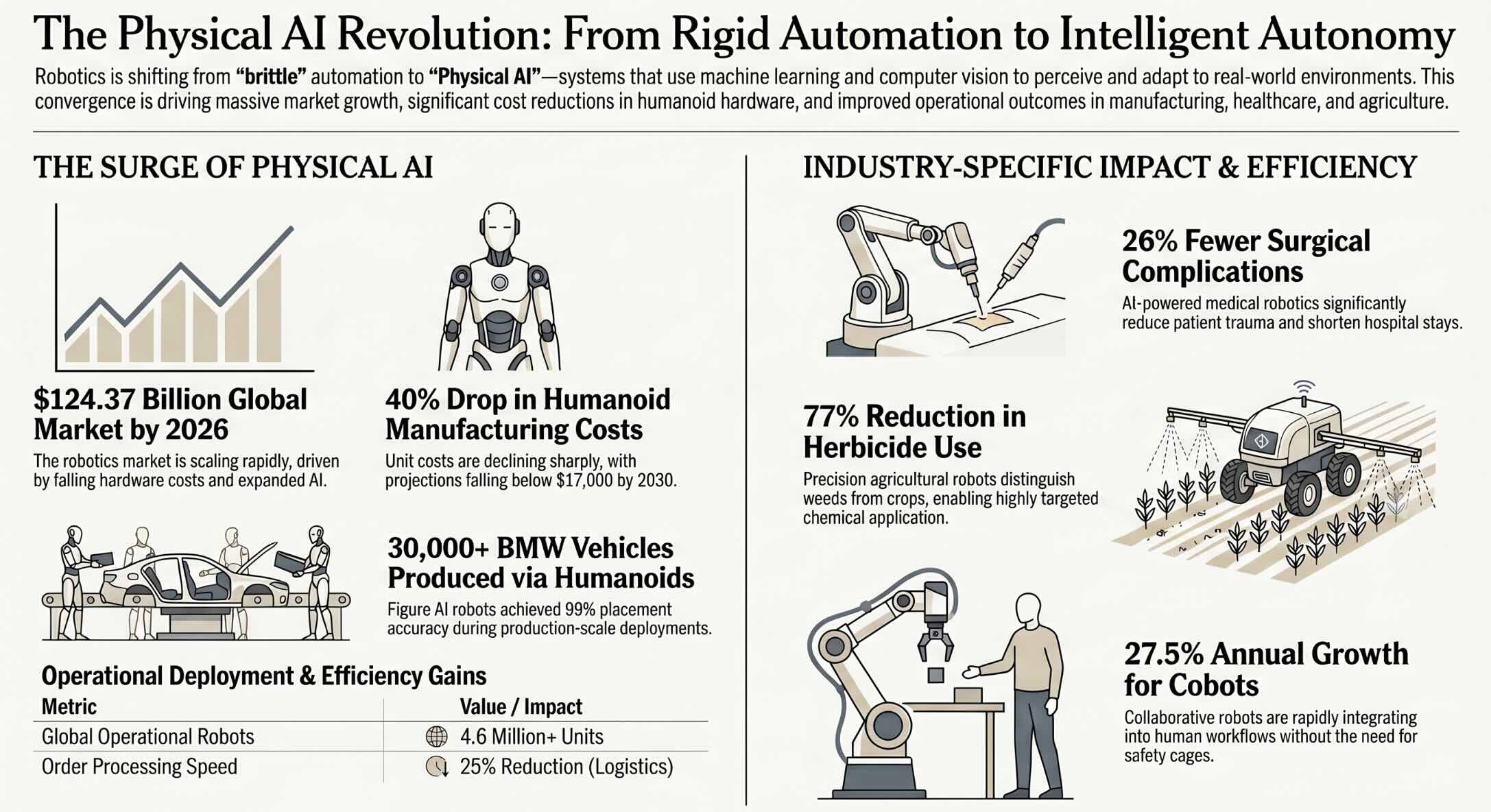
- The global robotics technology market is valued at approximately USD 108.43 billion in 2025 and is projected to reach approximately USD 416.26 billion by 2035, expanding at a CAGR of 14.40 percent, underscoring the massive scale of investment flowing into AI-powered robotic systems.
- Figure AI’s humanoid robots contributed to the production of more than 30,000 BMW X3 vehicles during an 11-month deployment, loading over 90,000 parts with greater than 99 percent placement accuracy, demonstrating production-scale viability.
- The International Federation of Robotics reported that 542,000 industrial robots were installed in 2024, with the total operational stock worldwide exceeding 4.6 million units, more than double the count from ten years earlier.
- Collaborative robot (cobot) revenue is projected to grow at a CAGR of 27.5 percent between 2024 and 2030, increasing from US$1.3 billion to more than US$7 billion, driven by AI-enabled teach-by-demonstration and falling hardware costs.
- Manufacturing costs for humanoid robots declined 40 percent between 2023 and 2024 according to Goldman Sachs data, with Bank of America projecting unit costs below $17,000 by 2030 as production scales globally.
- Total robotics startup funding exceeded $8.5 billion in 2025, the highest since 2021, with humanoid-specific funding hitting $4.3 billion, a six-fold increase from 2018.
- Robot-assisted surgery reduced hospital stays by 21 percent and post-operative complications by 26 percent compared to traditional approaches, driving the medical robotics market toward a projected $20.6 billion by 2026.
- The humanoid robotics market, valued at $2.1 billion in 2025, is projected to reach $38 billion by 2035 according to Goldman Sachs, reflecting the transition from prototypes to commercial-scale production.
These data points collectively demonstrate that AI-powered robotics has moved decisively from laboratory experimentation to commercial deployment across multiple industries simultaneously. The investment trajectory signals that institutional and venture capital alike treat intelligent robotics as critical infrastructure rather than speculative technology. The convergence of declining hardware costs, maturing AI software, regulatory evolution, and proven operational returns creates conditions for exponential adoption growth over the next decade. Platforms and manufacturers that establish early commercial traction and build scalable deployment playbooks will capture disproportionate market share as adoption accelerates. The industry’s most significant remaining challenges lie not in fundamental technology development but in scaling production, standardizing safety frameworks, and managing the workforce transitions that accompany broad-based automation.
| Dimension | Traditional Industrial Robots | Collaborative Robots (Cobots) | AI-Powered Autonomous Robots | Humanoid Robots |
|---|---|---|---|---|
| Transparency | Low; deterministic behavior but opaque to non-engineers | Moderate; teach-by-demonstration makes operation visible | Limited; AI decision-making creates black-box challenges | Emerging; explainable AI models under active development |
| Participation | None; operates behind safety cages away from humans | High; designed for direct human-robot collaboration | Variable; AMRs share space, surgical robots require surgeon input | High; designed to work in human-centric environments |
| Trust | Established through decades of proven industrial reliability | Growing rapidly as safety records improve and costs decline | Building through pilot programs and measured deployment | Early stage; requires demonstrated safety and consistent performance |
| Decision Making | Fully pre-programmed; no autonomous decision capability | Semi-autonomous; follows taught patterns with basic adaptation | Highly autonomous; AI makes real-time navigation and task decisions | Advancing; combines learned behaviors with real-time environmental reasoning |
| Misinformation | Not applicable | Not applicable | Risk of sensor errors leading to incorrect decisions | Risk of misinterpreting instructions or environmental cues |
| Service Delivery | Excellent for high-volume, repetitive manufacturing tasks | Versatile across small-batch, high-mix production environments | Optimal for logistics, material handling, and facility operations | Broad potential across manufacturing, service, and domestic environments |
| Accountability | Clear; manufacturer and integrator share defined liability | Developing; shared responsibility between human and robot | Complex; liability allocation for autonomous decisions is unresolved | Most complex; novel form factor introduces unprecedented liability questions |
Real World Examples Of AI In Robotics
BMW’s AI-Powered Humanoid Robot Deployment
BMW’s partnership with Figure AI at its Spartanburg, South Carolina plant represents the first production-scale deployment of humanoid robots in the automotive industry, setting a precedent that other manufacturers are now moving to replicate across their own operations. The Figure 02 robots operated on active production lines for 11 months, loading sheet metal parts into body-in-white assemblies with greater than 99 percent placement accuracy while maintaining the 84-second cycle time targets required by the production schedule. According to BMW’s press communications, the robots accumulated over 1,250 operational hours and handled more than 90,000 parts, generating performance data that directly informed the design improvements incorporated into Figure’s next-generation Figure 03 hardware. The deployment’s primary limitation, identified through operational data, was the robot’s forearm reliability under demanding packaging conditions, a finding that illustrates how real-world industrial deployment generates engineering insights that laboratory testing alone cannot replicate.
Amazon’s Warehouse Robotics Ecosystem
Amazon has built the world’s largest deployment of AI-powered warehouse robots, operating hundreds of thousands of mobile robots across its global fulfillment network to automate the storage, retrieval, and transport of merchandise through facilities processing millions of orders daily. The company’s Proteus and Sparrow systems use computer vision and machine learning to autonomously navigate warehouse environments, identify and grasp individual items from mixed-SKU inventory, and coordinate with human workers in shared workspaces without safety barriers. According to Amazon’s technology reports, the robotics systems have reduced order processing times by approximately 25 percent while improving worker safety by eliminating the need for employees to carry heavy loads across warehouse floors for extended shifts. Critics note that Amazon’s robotics deployment has coincided with workforce reductions at some facilities and raised concerns about the pace of automation outstripping the availability of retraining programs for displaced workers.
Intuitive Surgical’s da Vinci Robotic Surgery Platform
Intuitive Surgical’s da Vinci system has established robotic surgery as a standard of care across multiple surgical specialties, with over 9,000 systems installed worldwide and more than 14 million procedures performed since the platform’s introduction, making it the most commercially successful medical robot in history. The system translates a surgeon’s hand movements into precise micro-motions at the instrument tips, providing magnified 3D visualization and wristed instrument articulation that exceeds the dexterity of the human hand in confined surgical spaces. According to Intuitive Surgical’s clinical data, hospitals using da Vinci systems for prostatectomy procedures report shorter hospital stays, fewer blood transfusions, and faster return to normal activities compared to open surgical approaches. The platform’s limitation is its cost, with systems priced at approximately $1.5 to $2.5 million and per-procedure instrument costs that add significantly to the total expense, creating access disparities between well-funded urban medical centers and resource-constrained rural and developing-world hospitals.
Case Studies
Figure AI’s Transition from Prototype to Production Partner
Figure AI faced the challenge of proving that humanoid robots could operate reliably and productively in real automotive manufacturing environments, a milestone that no company had previously achieved at production scale with verifiable, publicly documented results. The company deployed its Figure 02 robots at BMW’s Spartanburg plant in 2024, starting with a single use case that required loading sheet metal parts into body assemblies with millimeter-level precision under demanding cycle time constraints. According to Figure AI’s operational reports, the first industrial use case took 12 months to deploy, but a second use case at a separate paying customer was operational in just 30 days, demonstrating the AI-driven deployment economics that accelerate as the platform matures. The deployment generated critical engineering data, identifying the forearm as the top failure point under tight packaging conditions, which directly informed the redesigned wrist electronics in Figure 03 that eliminate the distribution board and dynamic cabling. The limitation is that Figure’s production capacity remains constrained, with its BotQ manufacturing facility initially targeting 12,000 units annually, and scaling to the 100,000-unit volumes needed for broad industrial adoption will require significant further investment in manufacturing infrastructure and supply chain development.
Deere and Company’s Autonomous Agricultural Platform
Deere and Company (John Deere) confronted the problem of chronic labor shortages in agriculture combined with growing environmental pressure to reduce chemical inputs, creating dual incentives for deploying AI-powered autonomous farming equipment across its global customer base. The company developed an autonomous tractor platform powered by computer vision, GPS-guided navigation, and machine learning-based crop and weed recognition that enables fully driverless field operations for tillage, planting, and targeted herbicide application. According to Deere’s technology announcements, the autonomous system achieved commercial availability in 2024 for select operations, with farmer customers reporting the ability to prepare fields during overnight hours without operator supervision, effectively doubling the productive hours available during critical planting and harvest windows. The system’s AI-powered See and Spray technology reduced herbicide application volumes by up to 77 percent on target fields by distinguishing individual weeds from crop plants and applying chemical only where needed. The primary limitation is cost, as the autonomous-ready equipment commands a significant premium over conventional machinery, and the technology currently operates effectively only in open-field row crop environments rather than orchards, vineyards, or other specialty crop settings that present more complex navigation and manipulation challenges.
Hyundai’s Integration of Boston Dynamics into Manufacturing Operations
Hyundai Motor Group’s acquisition of Boston Dynamics positioned the automotive conglomerate to integrate the world’s most advanced legged robot technology into its manufacturing operations, creating a vertically integrated pipeline from robot development through factory deployment at scale. The challenge Hyundai aimed to address was the need for robotic systems capable of navigating the complex, multi-level environments of automotive manufacturing plants where wheeled robots cannot easily traverse stairs, elevated platforms, and irregular floor surfaces that characterize real factory layouts. Hyundai is deploying the all-electric Atlas platform for inspection, material transport, and quality verification tasks across its manufacturing facilities, with full factory deployments targeted for 2028 following a structured pilot program that began in 2025. According to Boston Dynamics’ commercial deployment plans, the new Atlas platform combines the advanced locomotion capabilities developed over decades of research with practical industrial features including a four-hour battery runtime, fleet management through the Orbit software platform, and modular tool attachments that allow the same robot to perform different tasks across different production areas. The primary limitation is the platform’s premium pricing, with the electric Atlas reportedly commanding approximately $420,000 per unit, positioning it as a high-end solution that requires substantial operational utilization to justify the capital investment relative to lower-cost mobile robot alternatives.
Frequently Asked Questions About AI in Robotics
Traditional robots execute pre-programmed sequences of motions without adapting to changes in their environment, relying entirely on human engineers to define every action in advance. AI-powered robots use machine learning, computer vision, and sensor fusion to perceive their surroundings, make autonomous decisions, and adapt their behavior in real time to handle novel situations that were not explicitly programmed.
Collaborative robots, or cobots, are designed with force-limited joints, integrated sensors, and safety-rated control systems that allow them to work alongside human operators without safety cages or physical barriers. Traditional industrial robots operate at high speeds and forces behind fenced enclosures because they lack the awareness and control capabilities needed to detect and respond to human presence safely.
Manufacturing, logistics and warehousing, healthcare, and agriculture are leading adoption, driven by labor shortages, rising wage costs, and the proven ability of AI-powered robots to improve productivity and quality. The automotive and electronics sectors have the highest installed base, while healthcare and agriculture are growing at the fastest rates.
Humanoid robot prices in 2026 range from approximately $13,500 for Chinese-manufactured consumer models like the Unitree G1 to over $420,000 for premium platforms like Boston Dynamics’ electric Atlas. Tesla targets a consumer price between $20,000 and $30,000 for Optimus, and manufacturing costs across the sector are declining rapidly as production scales.
Yes, modern AI-powered robots can learn new tasks through imitation learning, where a human demonstrates the task and the robot generalizes from the demonstration, or through reinforcement learning, where the robot discovers optimal behaviors through trial and error in simulated or real environments. These capabilities dramatically reduce the time and expertise required to deploy robots on new applications.
Physical AI refers to AI systems designed to operate in and learn from the physical world through embodied robotic platforms, using simulation-trained neural networks combined with real-world sensor data. It enables robots to handle unstructured environments by training on millions of task variations in virtual worlds before deploying learned behaviors to physical hardware.
Surgical robots provide surgeons with magnified three-dimensional visualization, tremor-filtered instrument control, and wristed instrument articulation that exceeds human hand dexterity in confined spaces. Clinical data shows robot-assisted procedures reduce hospital stays by approximately 21 percent and decrease post-operative complications by 26 percent compared to traditional surgical approaches.
The primary international standards are ISO 10218 for industrial robot safety and ISO/TS 15066 for collaborative robot applications, supplemented by regional regulations like the EU AI Act for high-risk AI systems. Recent revisions focus on safety at the application level rather than the robot level, and new frameworks are being developed to address the unique challenges of AI-driven autonomous behavior.
AI-powered robots are primarily replacing tasks rather than entire jobs, automating repetitive, dangerous, and physically demanding work while creating new roles in robot operation, programming, maintenance, and data analysis. Countries with the highest robot density per worker, including South Korea, Japan, and Germany, maintain among the lowest unemployment rates in the developed world.
Agricultural robots use computer vision and machine learning for precision weed removal, autonomous planting, GPS-guided field operations, drone-based crop monitoring, and selective harvesting. These systems reduce chemical inputs by up to 77 percent for targeted herbicide application, optimize irrigation, and enable 24-hour field operations during critical planting and harvest windows.
Agentic AI combines analytical AI for structured decision-making with generative AI for adaptability, creating robotic systems that reason, plan, and execute complex multi-step workflows autonomously. This transforms robots from reactive tools that respond to individual commands into proactive agents that pursue higher-level operational objectives and adjust strategies based on outcomes.
Photorealistic simulation environments allow robots to train on millions of task variations, failure cases, and environmental conditions in virtual worlds before deploying their learned behaviors to physical hardware. This sim-to-real transfer approach reduces training time from months to days, eliminates the risk of damaging expensive hardware during learning, and enables training on behaviors that would be dangerous to practice physically.
Robot-as-a-Service (RaaS) allows enterprises to access robotic automation through subscription or per-use pricing rather than purchasing robots outright, converting the deployment from a capital expenditure to an operational expense. This model lowers the barrier to entry for small and medium-sized businesses and is expected to become a mainstream adoption pathway by 2027.
Multi-robot coordination uses fleet management software powered by AI to distribute tasks, optimize traffic flow, manage charging schedules, and prevent collisions among dozens or hundreds of robots operating in shared spaces. Advanced systems are developing peer-to-peer learning capabilities where robots share knowledge and dynamically restructure team roles based on evolving conditions.