

Introduction
Artificial intelligence and architecture are converging in ways that fundamentally alter how buildings are conceived, designed, and constructed across the globe. Architecture firms of all sizes are integrating machine learning tools into workflows that span conceptual design through construction documentation and post-occupancy analysis. According to a 2024 report by the American Institute of Architects, nearly 60 percent of large architecture firms have adopted or are actively piloting AI tools within their design processes. This convergence raises critical questions about creativity, professional identity, and the quality of spaces people inhabit daily. Clients are beginning to expect faster turnarounds, more design options, and data-backed performance predictions that only computational tools can deliver at the pace the market demands. The meeting of artificial intelligence and architecture represents one of the most significant shifts in how humans shape their physical environment since the advent of computer-aided design. Understanding this transformation requires examining the technologies, professional disruptions, and ethical considerations driving the change.
Key Questions
What is artificial intelligence in architecture?
Artificial intelligence in architecture uses machine learning, generative design, and data analysis to assist architects in creating, optimizing, and evaluating building designs for performance, sustainability, and regulatory compliance.
How do architects use AI for building design?
Architects use AI for generative floor plans, structural optimization, energy modeling, site analysis, regulatory compliance checks, construction scheduling, and photorealistic visualization of unbuilt projects.
Can AI replace architects entirely?
AI cannot fully replace architects because design requires human judgment on cultural context, aesthetic values, client relationships, and ethical responsibility that algorithms cannot replicate independently.
Key Takeaways
- The architect’s role is evolving from sole creator to creative director who guides and curates AI-generated design options.
- Artificial intelligence and architecture are merging through generative design, digital twins, and machine learning tools that accelerate and optimize building creation.
- AI enables sustainable architecture by simulating energy performance, material usage, and environmental impact before construction begins.
- Ethical risks include design homogenization, job displacement among junior architects, and unresolved liability questions for AI-informed structural decisions.
Table of contents
- Introduction
- Key Questions
- Key Takeaways
- The Intersection of AI and Modern Building Design
- How AI Is Transforming the Way Architects Design Buildings
- The Evolution of Computational Design Into Intelligent Systems
- Generative Design and the Machines That Draft Floor Plans
- How Neural Networks Learn to Optimize Building Structures
- Digital Twins and the Rise of Living Building Models
- Real Architecture Firms Already Using AI in Practice
- Sustainable Design Through Machine Learning and Energy Modeling
- AI-Driven Urban Planning and the Future of City Landscapes
- The Tension Between Algorithmic Efficiency and Human Creativity
- When Every Building Starts to Look the Same
- How AI Handles Building Codes, Zoning, and Regulatory Compliance
- The Changing Role of the Architect in an Automated Profession
- Liability and Risk When Algorithms Make Structural Decisions
- How Smaller Firms Are Using AI to Compete With Industry Giants
- Job Displacement and the Reshaping of Architecture Careers
- Ethical Questions Surrounding AI-Designed Spaces
- Client Experience and AI-Powered Visualization Tools
- Construction Robotics and the AI-Driven Building Site
- Lessons From Projects Where AI Design Succeeded and Failed
- The Future of Human-AI Partnership in Shaping the Built World
- Impact of Text to Image AI software on Architecture
- Key Insights
- Real-World Examples
- Case Studies
- Conclusion
- Frequently Asked Questions
- References
The Intersection of AI and Modern Building Design
Artificial intelligence and architecture describes the integration of machine learning algorithms, generative design systems, and data-driven optimization tools into the practice of designing, engineering, and constructing buildings and urban environments.
How AI Is Transforming the Way Architects Design Buildings
The transformation begins at the earliest stages of architectural practice, where AI tools now assist designers in generating conceptual options that would have taken weeks to develop manually. Generative design platforms like Autodesk Revit and Spacemaker allow architects to input project constraints such as site boundaries, zoning requirements, and budget parameters. The software then produces dozens or hundreds of design variations optimized across multiple performance criteria simultaneously. Architects review, refine, and combine the strongest options rather than starting each concept from a blank canvas. AI is not replacing the architect’s creative vision but expanding the range of possibilities that vision can explore within practical constraints. The shift from manual drafting to AI-assisted generation represents the most dramatic change in architectural production methods since the transition from hand drawing to CAD software in the 1990s.
The impact extends beyond initial concept development into the detailed design and documentation phases that consume the majority of an architectural project’s timeline. AI-powered tools can automate the production of construction documents by translating three-dimensional models into dimensioned drawings, material schedules, and specification sheets. Clash detection algorithms identify conflicts between structural, mechanical, and electrical systems before they become costly problems during construction. These capabilities accelerate project delivery timelines and reduce the error rates that traditionally plagued complex building projects. Firms that have adopted AI-driven design applications report measurable improvements in documentation accuracy and client satisfaction scores. The productivity gains are reshaping competitive dynamics within the profession, as AI-enabled firms can deliver more refined work in shorter timeframes.
Client engagement is also being transformed as AI enables architects to present design options with unprecedented realism and interactivity during the approval process. Neural rendering tools generate photorealistic images of unbuilt spaces that allow clients to evaluate materials, lighting, and spatial proportions before committing to a final design. Virtual reality walkthroughs powered by AI-generated environments let stakeholders experience a proposed building at human scale from any vantage point. These presentation capabilities reduce the communication gap between architect and client that has historically led to misunderstandings and costly design revisions. The ability to visualize multiple options rapidly also empowers clients to participate more actively in the design process as informed collaborators rather than passive reviewers. AI-enhanced presentation tools are becoming essential differentiators for firms competing in markets where client experience drives repeat business.
The Evolution of Computational Design Into Intelligent Systems
Architecture has a longer history with computation than many observers realize, stretching back to the parametric experiments of the 1960s and the CAD revolution of the following decades. Early computational tools automated drafting tasks but did not contribute to design thinking in any meaningful sense. Parametric design software like Grasshopper introduced the ability to define relationships between design variables, allowing architects to explore complex geometries through mathematical rules. These tools were powerful but required extensive manual setup and lacked the capacity to learn from outcomes or optimize independently. The evolution from parametric tools to intelligent systems marks the transition from computers that follow instructions to computers that generate solutions. The architectural profession’s long engagement with computation provided the technical literacy and cultural openness that made AI adoption possible.
The current generation of AI tools differs from their predecessors because they incorporate machine learning models trained on vast datasets of architectural precedents, building performance data, and construction outcomes. These systems can identify patterns in successful designs and apply those patterns to new projects without explicit programming from the architect. A machine learning model trained on thousands of hospital floor plans, for example, can generate layouts that optimize patient flow, staff efficiency, and emergency evacuation simultaneously. The system improves over time as it receives feedback on which generated designs performed well in practice and which required significant revision. This learning capability transforms the design tool from a static instrument into an evolving collaborator that grows more useful with each project. The architecture profession is beginning to grapple with the implications of working alongside tools that accumulate knowledge independently.
Generative Design and the Machines That Draft Floor Plans
Moving from the historical trajectory to today’s most visible application, generative design has emerged as the flagship use case for AI in architecture. Generative design refers to a process where the architect defines goals, constraints, and performance criteria, and the AI system produces multiple design solutions that satisfy those parameters. The approach differs fundamentally from traditional design, where the architect develops a single concept and iterates on it through successive refinements. In generative workflows, the architect evaluates and curates from a field of algorithmically produced options, selecting the most promising candidates for further development. Generative design shifts the architect’s primary task from creation to curation, fundamentally altering the creative process that has defined the profession for centuries. The technology draws on generative adversarial networks and optimization algorithms that can explore design spaces far larger than any human could navigate manually.
Floor plan generation illustrates the practical capabilities and current limitations of generative design with particular clarity. AI systems trained on thousands of residential and commercial floor plans can generate layouts that satisfy spatial adjacency requirements, circulation efficiency targets, and dimensional standards. A generative tool might produce fifty viable apartment layouts for a given building footprint, each balancing bedroom sizes, living area proportions, and natural light access differently. Architects can then filter these options by client preferences, local building code requirements, and aesthetic considerations that the algorithm cannot fully evaluate. The generated plans serve as sophisticated starting points rather than finished designs, requiring human refinement for spatial quality and experiential richness. The technology excels at solving quantifiable optimization problems but struggles with the subjective qualities that distinguish good architecture from merely functional space planning.
The computational infrastructure required for generative design has become significantly more accessible over the past five years. Cloud-based platforms allow architecture firms to run computationally intensive generative processes without investing in expensive hardware or maintaining specialized IT staff. Software-as-a-service models from companies like Spacemaker, Finch, and TestFit offer subscription-based access to generative design tools tailored specifically for architectural applications. These platforms integrate with existing BIM workflows, allowing architects to import generative results directly into their production environments. The accessibility of cloud-based tools has democratized generative design, enabling small and mid-size firms to compete with large practices that previously held exclusive access to computational design capabilities. The marketplace for AI architecture tools is expanding rapidly, with new entrants appearing each year to address specific building types and design challenges.
The output quality of generative design systems varies significantly depending on the training data, constraint definitions, and evaluation criteria that the architect provides. Systems trained on narrow datasets may produce repetitive or culturally inappropriate designs that fail to respond to local context, climate, or architectural tradition. Architects who rely on generative tools without critically evaluating output risk producing buildings that satisfy technical metrics while lacking the spatial poetry that distinguishes memorable architecture. The most effective practitioners use generative design as an analytical complement to their creative intuition rather than a replacement for it. This balanced approach requires architects to develop new competencies in defining algorithmic constraints that capture design intent without over-constraining the solution space. The skill of framing problems for AI is becoming as important as the skill of solving them through traditional design methods.
How Neural Networks Learn to Optimize Building Structures
The generative design process described above often feeds into a second layer of AI optimization focused specifically on structural engineering and material performance. Neural networks trained on structural analysis datasets can predict how a proposed building form will perform under various load conditions without running time-consuming finite element simulations. These predictive models compress hours of structural computation into seconds, enabling architects to evaluate the structural feasibility of design options during the conceptual phase rather than waiting for engineering review. The speed advantage allows design teams to explore structurally ambitious forms that they might otherwise dismiss as impractical before analysis. Neural networks are democratizing structural experimentation by giving architects immediate feedback on the engineering consequences of their design decisions. This rapid feedback loop between architectural ambition and structural reality is producing buildings that push formal boundaries while maintaining safety margins.
Topology optimization represents one of the most visually striking applications of neural networks in architectural engineering. The technique uses AI to determine the optimal distribution of material within a defined volume, removing unnecessary mass while maintaining structural integrity. The resulting forms often resemble organic structures bone-like lattices, tree-branching supports, and flowing surfaces that distribute forces with remarkable efficiency. Architects and engineers at firms like Arup and Skidmore, Owings & Merrill have used topology optimization to reduce material consumption by up to 40 percent in specific structural components. The environmental implications are significant, as reduced material usage translates directly into lower embodied carbon and reduced construction costs. The aesthetic qualities of topology-optimized structures have also attracted architects who see in these forms a new design language that emerges from performance rather than stylistic convention.
Material science intersections with AI are opening new possibilities for architectural innovation that extend beyond structural optimization. Machine learning models can predict the long-term performance of novel building materials, including bio-based composites, engineered timber, and recycled aggregates, under various environmental conditions. These predictions enable architects to specify unconventional materials with greater confidence in their durability and safety performance over building lifespans. The integration of material performance data with generative design tools allows systems to optimize not only for structural efficiency but also for material sustainability, cost, and availability. Research labs at MIT, ETH Zurich, and Delft University are publishing datasets that train AI models on material behavior under stress, temperature variation, and moisture exposure. The convergence of AI with material science promises to expand the palette of building materials available to architects while reducing the risk associated with material innovation.
Digital Twins and the Rise of Living Building Models
The optimization capabilities described in the previous sections become even more powerful when connected to real-time data through digital twin technology. A digital twin is a virtual replica of a physical building that continuously updates based on sensor data from the actual structure, creating a living model that reflects current conditions and predicts future performance. These models integrate data from HVAC systems, occupancy sensors, energy meters, and weather stations to provide a comprehensive, real-time picture of building operations. Architects and facility managers use digital twin platforms to identify inefficiencies, predict maintenance needs, and test operational changes before implementing them in the physical building. Digital twins transform architecture from a discipline focused on the moment of construction into one that engages with a building’s entire operational lifecycle. The technology is reshaping how architects think about their responsibility to a building after it is occupied.
The data generated by digital twins also feeds back into the design process for future projects, creating a knowledge loop that improves architectural outcomes over time. When a digital twin reveals that a specific floor plan configuration leads to energy waste or poor occupant satisfaction, that insight can inform the design constraints for the next building in a firm’s portfolio. This feedback mechanism means that AI-enabled architecture firms accumulate operational intelligence that makes each successive project more informed than the last. The firms that invest in post-occupancy data collection through digital twins gain a competitive advantage rooted in evidence rather than assumption. Smart home technologies represent the residential-scale version of this same feedback principle. The long-term value of digital twins extends beyond any individual building to the collective improvement of architectural knowledge across the profession.
Real Architecture Firms Already Using AI in Practice
Shifting from individual technologies to organizational adoption, the landscape of AI in architecture practice reveals that adoption has moved well beyond experimental labs into daily production workflows. Zaha Hadid Architects has developed an in-house computational design group that uses machine learning to generate complex facade patterns, optimize structural geometries, and simulate pedestrian flows through large public buildings. Foster + Partners employs AI tools across multiple project phases, from site analysis using satellite imagery and computer vision to energy optimization during schematic design. Gensler, the world’s largest architecture firm by revenue, has integrated AI-driven space planning tools into its workplace design practice, using occupancy data to inform layouts that improve employee productivity. These firms are not experimenting with AI as a novelty but deploying it as a core production tool that delivers measurable competitive advantages. Each implementation reflects strategic decisions about where AI can add the most value within that firm’s specific practice areas and client base.
Mid-size firms are finding targeted AI applications that address their particular market positions and client expectations. Perkins and Will uses machine learning to analyze building performance data across its healthcare portfolio, identifying design patterns that correlate with better patient outcomes. KPF employs AI-driven massing studies that evaluate hundreds of tower configurations for daylighting, wind impact, and view access in dense urban contexts. SHoP Architects has built proprietary tools that connect parametric design models directly to fabrication systems, using AI to optimize the manufacturing process for custom building components. These applications demonstrate that AI adoption in architecture is not one-size-fits-all but varies based on firm specialization, project types, and the specific design challenges each practice confronts. The diversity of implementations suggests that the profession is in a period of productive experimentation where best practices are still emerging. Firms that identify the right AI applications for their unique circumstances gain advantages that cannot be replicated by simply purchasing the same software.
The geographic distribution of AI adoption in architecture reveals significant variation across markets and regulatory environments. Scandinavian firms have been early adopters of AI-driven sustainability analysis, reflecting the region’s strong regulatory emphasis on energy performance and carbon reduction in construction. Chinese architecture and engineering firms are deploying AI at scale for urban planning and mass housing projects, leveraging the technology’s capacity to handle enormous project volumes. Middle Eastern practices are using AI for climate-responsive design in extreme environments, optimizing building orientations and facade systems for desert conditions. The variation in adoption patterns reflects not only differences in technological access but also in architectural culture, client expectations, and regulatory frameworks. International firms that operate across these markets must develop AI strategies flexible enough to address diverse design challenges and compliance requirements. The global landscape of AI in architecture is rich with regional innovation that the profession can learn from across borders.
Sustainable Design Through Machine Learning and Energy Modeling
The environmental urgency facing the construction industry makes sustainable design one of the most consequential applications of AI in architecture today. Buildings account for approximately 40 percent of global energy consumption and roughly one-third of greenhouse gas emissions, making the design phase a critical intervention point for climate impact reduction. Machine learning models can simulate a building’s energy performance across thousands of design variables orientation, glazing ratio, insulation thickness, shading systems, and HVAC configurations in a fraction of the time required by traditional energy modeling software. These simulations enable architects to identify the combinations of design decisions that minimize energy consumption while maintaining occupant comfort and aesthetic quality. AI-driven energy modeling transforms sustainability from an afterthought addressed in the engineering phase into a generative force that shapes design decisions from the earliest conceptual stages. The connection between AI and climate change mitigation is nowhere more tangible than in the design of high-performance buildings.
Embodied carbon analysis represents a growing area where AI assists architects in making material choices that reduce the total environmental footprint of a building across its full lifecycle. Traditional lifecycle analysis requires architects to manually research the carbon intensity of each material specification, a process that is time-consuming and prone to inconsistency. AI tools can instantly calculate the embodied carbon of a proposed design by cross-referencing the bill of materials against comprehensive environmental product declaration databases. This capability allows architects to compare design alternatives not only on cost and performance but also on their carbon implications with quantitative precision. The integration of embodied carbon analysis into generative design workflows means that AI can produce options optimized for both operational energy efficiency and material sustainability simultaneously. Firms specializing in sustainable design report that AI-driven carbon analysis has become indispensable for meeting the increasingly ambitious carbon reduction targets set by clients and regulatory bodies.
Passive design strategies that harness natural ventilation, daylighting, and thermal mass have been central to sustainable architecture for decades, and AI is enhancing their effectiveness through precise environmental simulation. Machine learning models trained on microclimate data can predict wind patterns, solar exposure, and temperature gradients at a site level with granularity that enables passive strategies to be optimized for specific locations. An AI system might recommend adjusting a building’s orientation by three degrees and modifying the depth of window reveals to achieve a 15 percent improvement in natural ventilation without mechanical assistance. These recommendations emerge from the analysis of thousands of environmental simulations that explore the interaction between building form and local climate conditions. The precision of AI-driven passive design analysis allows architects to push sustainable performance further than intuition-based approaches while reducing the risk of underperformance. The technology is particularly valuable in tropical and Mediterranean climates where well-calibrated passive strategies can eliminate or significantly reduce the need for air conditioning.
AI-Driven Urban Planning and the Future of City Landscapes
The sustainable building design capabilities of AI extend naturally into the larger scale of urban planning, where algorithms analyze entire neighborhoods and city districts as interconnected systems. AI urban planning tools can model the interactions between building density, transportation networks, green space distribution, and public infrastructure to optimize city layouts for livability, economic activity, and environmental performance. Cities including Singapore, Barcelona, and Helsinki have piloted AI-driven planning tools that simulate the impact of proposed developments on traffic patterns, air quality, and social equity before construction permits are issued. The technology’s capacity for urban design analysis at city scale offers planners a powerful predictive tool that traditional methods cannot match. AI-driven urban planning enables cities to test thousands of development scenarios computationally before committing resources to physical construction, reducing costly planning errors and unintended consequences. The implications for housing affordability, public health, and climate resilience are substantial enough that municipal governments are investing heavily in AI planning capabilities.
The integration of AI into urban planning also raises governance questions about who controls the algorithms that shape the city and whose values they embed in their optimization criteria. An algorithm that prioritizes economic efficiency may produce dense, transit-oriented developments that maximize tax revenue but displace existing communities or reduce green space below acceptable thresholds. The design of optimization criteria for urban AI tools is a profoundly political act that determines which outcomes the system will favor and which it will sacrifice. Smart city frameworks must incorporate mechanisms for public participation in defining the goals that AI planning tools pursue. Planners and architects who use these tools bear responsibility for ensuring that algorithmic recommendations reflect community values rather than purely technical or economic objectives. The challenge of democratic governance in AI-assisted planning will intensify as these tools become more capable and more widely adopted by municipal authorities.
The Tension Between Algorithmic Efficiency and Human Creativity
The capabilities demonstrated in urban planning and building design bring into sharp focus a philosophical tension that runs through every application of AI in architecture. Algorithms optimize for measurable performance criteria energy consumption, structural efficiency, material cost, spatial adjacency, circulation distance but architecture aspires to qualities that resist quantification. The feeling of light entering a cathedral, the intimate scale of a courtyard, the symbolic resonance of a civic building’s facade: these experiential qualities emerge from design intuitions that no current AI system can formalize or optimize. Architects who rely too heavily on algorithmic output risk producing buildings that perform well on spreadsheets but fail to move the people who inhabit them. Architecture at its best creates emotional experiences that no algorithm can measure, and the profession’s value depends on preserving this irreducibly human dimension of design. The tension between optimization and expression defines the central creative challenge of practicing architecture in the age of AI.
This tension manifests differently across building types and design contexts in ways that complicate any universal prescription for AI’s role. A data center or warehouse may benefit enormously from pure optimization with minimal human intervention in the design process. A museum, memorial, or place of worship demands a level of symbolic, cultural, and emotional sophistication that current AI systems cannot independently produce. The spectrum between these extremes includes most building types, where the appropriate balance between algorithmic efficiency and human creativity must be calibrated project by project. Architects who develop the judgment to navigate this spectrum will distinguish themselves from practitioners who apply AI uniformly across all project types. The calibration requires understanding both the strengths of AI in quantitative optimization and the irreplaceable role of human intuition in qualitative design judgment.
The design education system is beginning to address this tension by teaching students to view AI as a creative collaborator rather than either a threat or a shortcut. Studios at architecture schools including the Architectural Association, MIT, and Columbia are introducing exercises where students use generative tools and then critically evaluate the output against experiential and cultural criteria. These pedagogical approaches aim to produce architects who can leverage AI’s computational power while maintaining the design sensibility that distinguishes architecture from engineering. The goal is not to resist AI but to integrate it into a creative practice that remains grounded in human values, cultural context, and spatial experience. Students who graduate with fluency in both computational and humanistic modes of design thinking will be best prepared for a profession that increasingly demands both. The evolution of architectural education reflects a broader reckoning with how creative professions maintain their distinctiveness in an era of algorithmic capability.
The tension between efficiency and creativity extends to the business model of architectural practice itself, where AI pressures firms to redefine what clients are paying for. If algorithms can produce code-compliant, structurally sound, and energy-efficient designs at a fraction of the traditional cost, the value proposition of hiring an architect must be articulated in terms that go beyond technical competence. Firms that position themselves as purveyors of design quality, cultural sensitivity, and placemaking qualities that AI cannot deliver independently will command premium fees in a market where basic design services become increasingly commoditized. The business case for architecture as creative revolution rests on the profession’s ability to demonstrate value that algorithms cannot replicate. Those firms that fail to articulate this distinction risk being undercut by technology-driven competitors offering faster, cheaper, but aesthetically and culturally impoverished design services. The economics of architectural practice in the AI era will reward creativity, judgment, and client relationships over production speed and volume.
When Every Building Starts to Look the Same
The creative tension described above carries a specific cultural risk that critics have already begun to identify in built projects influenced by AI tools. When multiple firms in the same market use identical generative design platforms trained on similar datasets, the resulting buildings tend to converge toward shared formal characteristics that reflect the biases and optimization tendencies of the software rather than the unique qualities of place. This convergence produces a visual homogeneity that erodes the distinctiveness of urban environments and diminishes architecture’s role as an expression of local culture and identity. Cities that embrace AI-generated design uncritically may find their skylines increasingly interchangeable, lacking the idiosyncratic character that makes each city’s built environment memorable and meaningful. The risk of stylistic homogenization is not hypothetical but observable in developments where algorithmic optimization has produced buildings that are technically excellent and culturally anonymous. The architecture profession must actively resist this tendency by maintaining human creative leadership over the aesthetic and cultural dimensions of design.
The homogenization risk is amplified by the economic incentives that drive AI adoption in speculative real estate development. Developers seeking to maximize return on investment naturally gravitate toward AI tools that optimize for leasable area, construction cost, and regulatory compliance metrics that are indifferent to cultural expression or contextual sensitivity. When AI-generated designs become the default for commercial and residential development, the built environment increasingly reflects the optimization priorities of capital rather than the aspirations of communities. Architects working within these market pressures face the challenge of advocating for design quality and cultural responsiveness while satisfying clients focused primarily on financial performance. The most effective strategy involves demonstrating that culturally responsive design generates long-term economic value through tenant satisfaction, community goodwill, and brand differentiation. Developers who recognize this relationship between design quality and asset value become allies in resisting the homogenizing tendencies of purely algorithmic design.
Regional architectural traditions offer a counterbalance to homogenization when they are intentionally incorporated into AI-driven design processes. Training generative design tools on datasets that include vernacular architecture, local material traditions, and climate-responsive building forms specific to a region can produce output that is both computationally optimized and culturally grounded. This approach requires architects to curate training data thoughtfully, ensuring that the AI system’s understanding of good design reflects the values and traditions of the community it serves. Some firms have begun building proprietary datasets of regional precedents that give their AI tools a distinct design sensibility rooted in local context. The effort to regionalize AI design tools represents a promising strategy for preserving architectural diversity in an era of technological convergence. Architecture’s enduring power comes from its ability to express the identity of the people and places it serves, and AI tools must be shaped to support rather than diminish that expression.
How AI Handles Building Codes, Zoning, and Regulatory Compliance
The design homogenization concern connects to a more technical dimension of AI’s role: the automation of regulatory compliance that governs every architectural project. Building codes, zoning ordinances, fire safety requirements, and accessibility standards create a dense regulatory landscape that architects must navigate for every project they undertake. AI-powered compliance tools can scan a proposed design against thousands of code provisions simultaneously, identifying violations that human reviewers might miss during manual plan checking. These systems reduce compliance-related delays and costly redesigns by catching issues during the design phase rather than during the permitting process. AI-driven code compliance tools are transforming one of the most tedious aspects of architectural practice into an automated quality assurance process that improves accuracy while saving time. The technology is particularly valuable in jurisdictions with complex or frequently updated regulatory frameworks where human expertise alone cannot keep pace with the volume of applicable rules.
The automation of compliance checking raises questions about the appropriate boundary between AI assistance and professional judgment in regulatory matters. Some code provisions involve interpretive judgment determining whether a proposed design meets the “intent” of a fire safety requirement, for example that current AI systems handle poorly. Life-safety decisions demand a level of professional accountability that cannot be delegated to software without clear protocols for human override and review. Regulatory bodies in several jurisdictions are developing frameworks for AI-assisted plan review that preserve the licensed professional’s responsibility for code compliance while leveraging AI for efficiency. The architecture profession’s regulatory structure, built around individual licensure and professional liability, must adapt to accommodate tools that perform tasks traditionally reserved for licensed practitioners. The evolution of AI compliance tools will require parallel evolution in professional licensing standards and liability frameworks.
The Changing Role of the Architect in an Automated Profession
Compliance automation is just one facet of a broader transformation in what it means to be an architect in an era of intelligent tools. The traditional image of the architect as a solitary creative genius drawing buildings into existence is giving way to a more collaborative model where the architect directs teams of human specialists and AI systems working in concert. Design decisions that once resided entirely within the architect’s judgment are now informed and sometimes constrained by algorithmic analysis of performance data, client preferences, and market conditions. This redistribution of creative authority requires architects to develop new skills in computational thinking, data interpretation, and AI tool evaluation alongside traditional competencies in spatial design and material culture. The evolving impact on architecture careers is profound enough that professional organizations are revisiting the definition of architectural competency itself. The architect’s role is evolving from sole author of buildings to creative director of complex human-AI teams that produce the built environment collaboratively.
The creative director model demands leadership skills that architecture education has historically underemphasized in favor of technical and design competencies. Architects who thrive in AI-augmented practices must articulate clear design visions that guide algorithmic processes toward outcomes aligned with human values and client aspirations. They must evaluate AI-generated options with critical judgment, identifying when algorithmic solutions miss qualities that matter deeply to the people who will inhabit the resulting spaces. Communication skills become essential as architects translate between the quantitative language of AI systems and the experiential expectations of clients, communities, and regulatory authorities. The most effective architectural leaders in this emerging model combine deep design sensibility with enough technical literacy to understand the capabilities and limitations of their AI tools. Firms that invest in developing these hybrid competencies within their leadership teams gain a strategic advantage over those that treat AI as a purely technical function.
The shift in professional identity also affects how architects relate to the broader construction industry and the public they serve. As AI takes over production tasks that once justified architectural fees, architects must communicate the distinctive value they bring to the design process in terms that clients and the public can understand. The profession’s social contract the implicit agreement that architects serve public health, safety, and welfare in exchange for the privilege of licensure must be reinterpreted for a world where AI contributes to safety-critical design decisions. Professional organizations including the AIA and RIBA are publishing guidance on how architects should document their use of AI tools and maintain accountability for design outcomes. The profession that emerges from this transition will be leaner in production capability but richer in the design judgment, ethical reasoning, and cultural expertise that AI cannot provide. Architects who embrace this redefinition will find their work more intellectually demanding and more socially valued than the production-oriented practice model it replaces.
Liability and Risk When Algorithms Make Structural Decisions
Beyond ethics, the practical question of legal liability looms over every application of AI to safety-critical design decisions in architecture. When an AI system contributes to a structural design that subsequently fails, the chain of liability stretches across multiple parties: the architect of record, the structural engineer, the AI software developer, and potentially the provider of training data that influenced the algorithm’s recommendations. Traditional professional liability insurance and legal frameworks assign responsibility to licensed professionals who stamp and sign construction documents. These frameworks assume that a human professional reviewed and approved every design decision, but AI-assisted workflows blur the line between human judgment and algorithmic recommendation in ways that existing liability doctrine does not clearly address. The unresolved question of liability for AI-influenced structural decisions represents one of the most significant legal barriers to full AI adoption in architecture. Insurance carriers, professional licensing boards, and courts will need to develop new frameworks that allocate responsibility fairly across the human-machine design team.
Structural failures in buildings carry consequences that extend far beyond financial losses to encompass human safety and life. The gravity of these consequences makes structural design the most risk-sensitive application of AI in architecture, demanding extraordinary caution in how algorithmic tools are deployed and validated. Engineering firms using AI for structural optimization typically maintain strict protocols requiring human review of all AI-generated structural calculations before they inform construction documents. These protocols create a double-check system where AI produces initial analyses and licensed engineers verify them using independent methods. The approach preserves human professional accountability while leveraging AI for speed and exploratory analysis. The challenge is maintaining this rigor as economic pressures push firms to accelerate production timelines and reduce the labor-intensive review process that serves as the primary safety net.
Insurance industry responses to AI in architectural practice are beginning to shape how firms deploy the technology by linking coverage terms to specific governance practices. Some professional liability insurers now require firms to disclose their use of AI tools and demonstrate that human professionals maintain oversight of all safety-critical design decisions. Firms that cannot demonstrate adequate human review protocols may face higher premiums or coverage exclusions for projects where AI played a significant role in structural design. These insurance requirements are creating de facto governance standards for AI use in architecture that complement the evolving regulatory landscape. The insurance industry’s risk-based approach to AI governance offers a practical model for managing liability in the absence of comprehensive legislation. Architectural firms that invest in robust AI governance and documentation practices will benefit from lower insurance costs and stronger legal positions in the event of claims.
How Smaller Firms Are Using AI to Compete With Industry Giants
The liability and governance requirements described above might suggest that AI adoption favors large firms with the resources to invest in compliance infrastructure, but smaller practices are finding creative pathways to compete. Boutique architecture studios are leveraging cloud-based AI tools that require minimal upfront investment, allowing them to offer services previously available only from firms with dedicated computational design departments. A three-person firm can now produce parametric facade studies, energy performance analyses, and generative floor plan options that rival the output of practices ten times their size. The competitive dynamics of the profession are shifting as AI tools compress the capability gap between large and small firms. Smaller firms using AI strategically are discovering that agility, specialization, and personal client relationships combined with computational tools create a market position that large firms cannot easily replicate. The technology is enabling a new generation of small practices that compete on design quality and innovation rather than production capacity.
Open-source computational design tools and community-developed AI plugins are further reducing the financial barriers for small firm adoption. Grasshopper plugins for Rhino, open-source machine learning libraries, and community forums where architects share computational design workflows create an ecosystem of accessible tools and knowledge. Small firms that invest time in learning these tools gain capabilities that would cost tens of thousands of dollars in commercial software licenses. The trade-off is that open-source tools require more technical competency to implement and lack the customer support infrastructure of commercial platforms. Partnerships between small firms and architecture schools provide another pathway, with student researchers developing AI tools as thesis projects that the partnering firm can then apply in practice. The open-source and academic partnership models demonstrate that AI adoption in architecture does not require the capital resources of large corporate practices.
Job Displacement and the Reshaping of Architecture Careers
The professional evolution described above carries direct consequences for employment across the architecture industry that merit frank assessment. Entry-level positions in drafting, rendering, and construction documentation are among the most vulnerable to AI automation, as these tasks involve pattern-based production work that machine learning excels at performing. Large firms that once employed dozens of junior architects to produce working drawings may need only a fraction of that workforce when AI tools handle documentation with comparable accuracy. The displacement is not total AI systems require human oversight, training data curation, and quality review but the volume of entry-level positions is declining measurably across major markets. The architecture profession faces a pipeline paradox where the entry-level positions that traditionally trained future design leaders are being automated faster than the profession can create alternative pathways to seniority. Firms and educational institutions must collaborate to develop new career entry points that prepare young architects for an AI-augmented practice.
The skills profile demanded by architecture firms is shifting toward competencies that did not exist a decade ago in the profession’s hiring criteria. Job postings increasingly list data analysis, computational design, machine learning tool proficiency, and building performance simulation alongside traditional requirements in design, construction technology, and professional practice. This shift creates a mismatch between the skills taught in many architecture programs and the competencies employers seek in recent graduates. The gap is particularly acute for architects trained in schools that emphasize design studio culture without integrating computational tools into the core curriculum. Mid-career architects face similar challenges when their accumulated expertise in manual production methods becomes less valuable than familiarity with AI platforms. The profession’s response to this skills transition will determine whether AI adoption creates inclusive opportunities or deepens existing inequalities in the architecture workforce.
Architecture firms are responding to workforce changes through a combination of internal retraining, strategic hiring from adjacent fields, and partnerships with technology companies. Some large practices have established computational design groups staffed by architects, software engineers, and data scientists working together on tool development and project application. These interdisciplinary teams develop proprietary AI tools tailored to the firm’s specific project types and design methodologies. Smaller firms are forming partnerships with AI tool vendors who provide training and support as part of their subscription services. Professional associations are launching continuing education programs focused on AI literacy for practicing architects who need to update their skills without leaving the workforce. The architecture profession’s historically slow adaptation to technological change is being accelerated by market pressures that reward AI competency and penalize firms that delay adoption.
Ethical Questions Surrounding AI-Designed Spaces
The workforce disruption connects to deeper ethical questions about the values embedded in AI-designed spaces and who bears responsibility for the consequences of algorithmic design decisions. AI systems optimize for criteria defined by their developers and users, but those criteria inevitably reflect assumptions about what constitutes good design that may not align with the values of all building occupants. An algorithm optimized for maximum leasable area might produce apartment layouts that are spatially efficient but psychologically oppressive, sacrificing the generous proportions and natural light access that support mental wellbeing. The ethical responsibility for such outcomes falls on the architects who set the optimization criteria and the clients who approve the results. Every constraint an architect programs into a generative design tool encodes a value judgment about what matters in the built environment, and those judgments deserve the same ethical scrutiny as any other design decision. The profession must develop ethical frameworks specifically addressing the responsibilities of architects who work with AI tools.
Privacy represents an increasingly urgent ethical concern as AI-enabled buildings collect vast quantities of data about occupant behavior, movement patterns, and environmental preferences. Smart building systems that optimize lighting, temperature, and ventilation based on real-time occupancy data require continuous surveillance of the people who live and work within those spaces. The data collected by these systems creates profiles of individual behavior that could be exploited for commercial purposes, employment monitoring, or social control without occupants’ meaningful consent. Architects who design smart buildings must consider privacy implications as seriously as they consider fire safety or structural integrity during the design process. The profession’s ethical codes, written before the emergence of data-collecting buildings, need updating to address the privacy responsibilities of architects designing AI-enabled environments. Building occupants deserve clear information about what data is collected, who has access to it, and how it is used.
Equity and access present a third ethical dimension that AI in architecture can either improve or exacerbate depending on how the technology is deployed. AI tools have the potential to make high-quality design more accessible by reducing the cost of design services and enabling smaller firms to produce sophisticated work. This democratization could benefit communities that have historically been underserved by the architecture profession due to the high cost of custom design services. The risk is that AI adoption concentrates among firms serving wealthy clients and prestigious projects, leaving under-resourced communities with algorithmically generated designs that lack the human engagement their circumstances demand. Equitable access to AI design tools and the expertise required to use them effectively must be a priority for the profession as it navigates this technological transition. The ethical imperative is clear: artificial intelligence and architecture should expand access to quality design rather than widen existing disparities.
Cultural sensitivity in AI-designed spaces requires intentional effort from architects who must ensure that algorithmic tools do not impose culturally inappropriate design solutions on communities with distinct spatial traditions. AI systems trained predominantly on Western architectural precedents may produce designs that violate the spatial norms of cultures where gender separation, communal living, or specific orientation requirements hold deep significance. The Aga Khan Award for Architecture has highlighted projects that demonstrate how computational tools can be used to enhance rather than erase cultural identity in the built environment. Architects working in culturally diverse contexts must curate training data and evaluation criteria that reflect the values and spatial traditions of the communities they serve. The failure to address cultural sensitivity in AI design tools risks producing a global monoculture of built environments that serves no community’s identity well. Architecture’s ethical obligation to cultural responsiveness does not diminish because the design tool is an algorithm rather than a pencil.
Client Experience and AI-Powered Visualization Tools
Smaller firms leveraging AI for client presentations illustrate a broader transformation in how architects communicate design ideas to the people who commission buildings. AI-powered visualization tools can generate photorealistic renderings of proposed designs in minutes rather than the days or weeks required by traditional rendering workflows. These tools use neural rendering techniques that interpret architectural models and produce images with realistic lighting, materials, textures, and environmental context. The speed of AI-generated visualization enables architects to present multiple design options during a single client meeting, transforming consultations from sequential presentations into interactive design sessions. AI visualization tools are shifting the client relationship from one where architects present finished concepts to one where clients actively participate in real-time design exploration. The participatory model builds stronger client relationships and reduces the misunderstandings that frequently lead to costly design revisions later in the project.
Virtual and augmented reality applications powered by AI are extending the visualization experience beyond static images into immersive spatial experiences. Clients can walk through AI-generated virtual environments that simulate the experience of occupying a building that does not yet exist, evaluating ceiling heights, corridor widths, and view corridors at human scale. Augmented reality tools overlay proposed designs onto existing site conditions, allowing clients to see how a new building will relate to its physical context before construction begins. These immersive tools are particularly valuable for clients who lack the spatial literacy to interpret traditional architectural drawings and scale models. The accessibility of AI-powered immersive visualization is democratizing the design review process, enabling non-expert stakeholders to provide meaningful feedback on spatial quality. Architecture firms that master immersive presentation technologies report higher client satisfaction, fewer change orders, and stronger referral networks.
The data generated by client interactions with AI visualization tools creates an additional feedback loop that informs the design process. When clients navigate a virtual building model, the system can track where they look, how long they spend in different spaces, and which design elements prompt positive or negative reactions. This behavioral data provides architects with objective insights into client preferences that supplement the subjective feedback gathered through traditional consultation methods. The ethical implications of collecting behavioral data during design consultations require careful consideration, as clients may not realize the extent to which their reactions are being monitored and analyzed. Architects must balance the design value of this data with respect for client privacy and informed consent. The integration of behavioral analytics into the client experience represents a powerful but sensitive capability that the profession must deploy responsibly.
Construction Robotics and the AI-Driven Building Site
The journey from AI-assisted design to AI-driven construction represents the next frontier in the convergence of artificial intelligence and architecture. Construction robotics powered by AI are beginning to automate tasks on building sites that have been performed manually for centuries, including bricklaying, welding, concrete pouring, and site inspection. Companies like Construction Robotics, Hadrian X, and Dusty Robotics have developed machines that execute construction tasks with precision and speed that match or exceed human workers in specific applications. AI systems coordinate these robotic tools by translating architectural models into machine instructions, creating a direct digital pipeline from design software to construction equipment. Robot-built construction is collapsing the traditional gap between digital design intent and physical construction execution, producing buildings that more faithfully realize the architect’s vision. The integration of AI across both design and construction phases promises a level of design-to-build fidelity that the industry has never achieved through manual methods.
The adoption of construction robotics is advancing faster in markets facing acute labor shortages and where construction costs have risen dramatically. Japan, which faces severe demographic pressures on its construction workforce, has invested heavily in robotic construction systems for both residential and infrastructure projects. Prefabrication facilities that combine robotic manufacturing with AI-driven quality control are producing building components with tolerances that site-based construction cannot match consistently. The shift toward robotic and AI-driven construction also introduces new safety considerations, as autonomous machines operating on active building sites must navigate around human workers and adapt to unpredictable site conditions. The technology is most advanced for repetitive, structured tasks and remains limited in its ability to handle the improvisation and problem-solving that experienced construction workers bring to complex site conditions. The future of AI on the building site will likely involve human-robot collaboration rather than full automation for the foreseeable future.
Lessons From Projects Where AI Design Succeeded and Failed
Construction experiences provide part of the evidence base, but a fuller picture of AI in architecture requires examining specific projects where the technology delivered exceptional results alongside cases where it fell short. The Edge in Amsterdam, developed by OVG Real Estate and designed with extensive computational optimization, is frequently cited as a landmark in AI-influenced architecture. The building’s design incorporates over 28,000 sensors that feed a digital twin managing lighting, temperature, and space allocation in real time. Post-occupancy data shows that The Edge consumes 70 percent less energy than comparable office buildings in the same market. The project demonstrated that deep integration of AI into both design and operations can produce buildings that perform dramatically better than conventional construction. Critics note that The Edge’s success depended on an unusually well-resourced client willing to invest in technology infrastructure that most commercial projects cannot justify financially. The project’s replicability at scale remains an open question for the profession.
Conversely, several high-profile projects have revealed the limitations and pitfalls of over-reliance on AI-driven design without adequate human oversight. A residential development in East Asia used generative design to optimize apartment layouts for maximum unit count within a fixed building footprint, producing layouts that maximized leasable area but created apartments with minimal natural light and cramped circulation spaces. Occupant satisfaction surveys revealed that residents found the algorithmically optimized units uncomfortable despite their technical compliance with building codes and area requirements. The project illustrated that code compliance and spatial optimization do not guarantee livable architecture when the optimization criteria fail to capture experiential quality. Another cautionary example involved a facade system designed through parametric optimization that performed excellently in simulation but proved nearly impossible to fabricate and install within the project’s construction budget. These failures underscore the critical importance of human judgment in evaluating AI-generated designs against practical, experiential, and constructability criteria that algorithms cannot fully model.
The lessons from both successes and failures converge on a consistent finding: AI produces its best results when deployed within a framework of strong human design leadership and clear project-specific evaluation criteria. Projects where architects defined thoughtful constraints and actively curated AI-generated options produced buildings that were both technically excellent and experientially satisfying. Projects where AI was given excessive autonomy or where optimization criteria were too narrowly defined produced results that satisfied measurable metrics while failing on qualities that resist quantification. The architecture profession is building a growing body of case study evidence that supports a collaborative model where AI amplifies human capability rather than operating independently. This evidence base is essential for developing best practices that help architects deploy AI effectively while avoiding the documented pitfalls. The profession’s collective learning from early AI projects will shape standards and expectations for decades to come.
The Future of Human-AI Partnership in Shaping the Built World
The case study evidence points clearly toward a future where the most impactful architecture emerges from deep collaboration between human designers and AI systems working in genuine partnership. The architect of 2035 will likely spend the majority of their creative time defining design problems with precision, curating AI-generated solutions, and evaluating outcomes against criteria that span the quantitative and qualitative dimensions of building performance. AI systems will handle the exploration of vast design spaces, the simulation of building performance under thousands of conditions, and the production of documentation that translates design intent into construction instructions. This division of labor amplifies the strengths of both parties: AI’s capacity for exhaustive analysis and optimization, and the human architect’s ability to make meaning, express culture, and exercise ethical judgment. The future of artificial intelligence and architecture is not a story of replacement but of partnership, where each party contributes capabilities the other fundamentally lacks. The built environment that emerges from this partnership has the potential to be more performant, more sustainable, and more humane than what either humans or machines could produce alone.
Emerging technologies will expand the scope of this partnership in ways that are difficult to predict but exciting to contemplate for the profession. Brain-computer interfaces, advanced haptic feedback systems, and immersive AI-powered design environments may enable architects to interact with design tools in more intuitive, embodied ways that bridge the gap between digital computation and physical experience. AI systems that understand not only the physics of buildings but the psychology of the people who inhabit them could generate designs that optimize for wellbeing, social interaction, and cognitive performance alongside energy efficiency and structural integrity. The integration of real-time environmental data, occupant feedback, and lifecycle performance metrics will enable buildings that adapt continuously to the needs of their users over decades of operation. These possibilities require an architecture profession that is technically literate, ethically grounded, and creatively ambitious enough to direct powerful tools toward outcomes that serve humanity broadly.
The built environment shapes human experience more profoundly and more persistently than almost any other form of human creation, and the stakes of getting AI integration right are correspondingly high. Buildings last for decades or centuries, meaning that the design decisions made today with AI assistance will affect communities long after the technology that influenced them has been superseded. This temporal reality demands that architects approach AI with both enthusiasm for its capabilities and humility about its limitations. The profession must resist the temptation to move fast and break things in a domain where broken things are buildings that people live and work in. Thoughtful, evidence-based adoption of AI tools, guided by clear ethical principles and strong design leadership, offers the best path toward a built environment that is worthy of the technology available to create it. Artificial intelligence and architecture together hold the potential to produce a world that is better designed, more sustainable, and more responsive to human needs than anything the profession has achieved before.
Impact of Text to Image AI software on Architecture
Text to image AI software is reshaping architectural ideation by accelerating early stage visual exploration. Architects can test moods, materials, massing directions, and spatial narratives within minutes. This speed expands the range of concepts considered before formal modeling begins. It also supports broader creative divergence during charrettes and internal reviews. As a result, teams can compare more possibilities with less upfront production time.
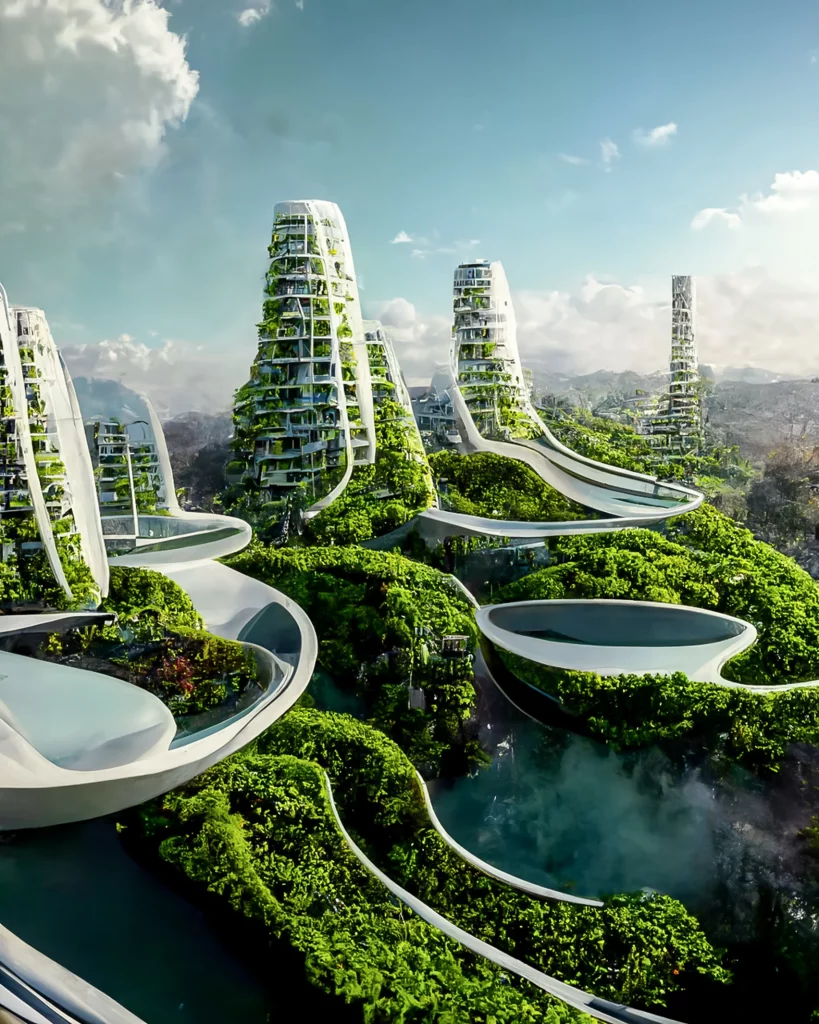
The technology also changes communication between architects, clients, and collaborators. Abstract design intentions can become visible much earlier in the process. Clients who struggle with drawings or technical language often respond better to atmospheric image based proposals. This can improve alignment around tone, experience, and ambition. It can also reduce friction during early decision making.
At the same time, text to image systems introduce serious limitations for architectural practice. Generated images often ignore structural logic, building codes, accessibility standards, and construction feasibility. They may produce seductive visuals that appear resolved but lack technical credibility. This creates a risk of overvaluing image quality over architectural rigor. Architects must therefore treat these outputs as speculative prompts, not final design evidence.
Another major impact concerns authorship, originality, and professional judgment. AI tools can remix visual conventions at scale, which may flatten cultural specificity and produce derivative aesthetics. Firms may begin to converge around similar prompt driven visual languages. This raises concerns about design homogenization and weakened critical thinking. Strong architectural practice still depends on contextual analysis, ethical judgment, and material understanding.
The most valuable role of text to image AI lies in augmentation rather than replacement. It can support concept development, presentation building, and rapid narrative testing. Its strongest contribution is cognitive leverage, not autonomous design intelligence. Architects who use it well will pair fast visual generation with deep technical and social reasoning. In that balance, the technology can enrich architecture without reducing it to surface image making.
Text to image AI is also beginning to influence internal workflows and team structures within architecture firms. Junior designers traditionally produced early visual studies and presentation imagery. AI tools now compress that effort into rapid prompt driven outputs, which can shift how teams allocate time and responsibility. Designers may spend less time rendering and more time curating, editing, and synthesizing results. This creates a need for new skills around prompt strategy, visual judgment, and narrative framing. It also raises questions about how emerging architects develop foundational visualization abilities.
Another important dimension is data ethics and intellectual property. Many AI models are trained on large image datasets that include copyrighted architectural work. This creates ambiguity around ownership, attribution, and fair use. Firms must be cautious about how generated imagery is used in client work or public presentations. There is also a risk of unintentionally replicating recognizable projects or styles. Establishing clear internal guidelines and maintaining transparency with clients will become essential as adoption increases.
Key Insights
- ETH Zurich’s Digital Building Technologies lab has pioneered AI-driven fabrication systems that enable architects to build complex geometries that would be prohibitively expensive through conventional construction methods.
- According to the American Institute of Architects, nearly 60 percent of large architecture firms are now adopting or piloting AI tools, signaling mainstream integration rather than experimental adoption.
- Topology optimization using AI has reduced material consumption by up to 40 percent in specific structural components at firms like Arup, delivering both cost and carbon savings.
- The Edge in Amsterdam consumes 70 percent less energy than comparable office buildings, demonstrating the performance potential of deeply integrated AI and digital twin systems.
- Buildings account for approximately 40 percent of global energy consumption and one-third of greenhouse gas emissions, making AI-optimized design a critical climate intervention.
- Autodesk’s generative design tools can produce over 10,000 design options from a single set of constraints, enabling exploration at a scale impossible through manual methods.
- Research at MIT’s Media Lab has demonstrated machine learning models that predict building energy performance with accuracy comparable to full thermal simulation at a fraction of computational cost.
- The global construction robotics market is projected to reach $166 billion by 2030, reflecting the accelerating integration of AI with physical building processes.
| Dimension | Traditional Architecture | AI-Augmented Architecture |
|---|---|---|
| Design Exploration | Limited by human time; 3–5 options typical per project phase | Hundreds or thousands of options generated and evaluated computationally |
| Energy Optimization | Intuition-based with post-design simulation verification | Integrated from concept stage; real-time performance feedback during design |
| Structural Efficiency | Conservative material usage based on standard engineering practice | Topology-optimized structures with up to 40% material reduction |
| Client Communication | Static drawings, physical models, rendered images | Real-time neural rendering, VR walkthroughs, interactive design sessions |
| Code Compliance | Manual review against code documents; error-prone and time-consuming | Automated scanning against thousands of provisions simultaneously |
| Construction Documentation | Weeks of manual drafting and coordination | AI-assisted documentation with automated clash detection |
| Post-Occupancy Learning | Rare; minimal data collection after building completion | Digital twins enable continuous performance monitoring and design feedback |
| Cultural Responsiveness | Dependent on architect’s cultural knowledge and sensitivity | Risk of homogenization unless training data reflects local traditions |
Real-World Examples
Autodesk’s Toronto Office, Generative Design in Practice
Autodesk used its own generative design tools to plan its Toronto office, defining constraints including team proximity preferences, daylight access targets, and accessibility requirements. The system generated over 10,000 layout options that were filtered and evaluated against employee work style data collected through surveys and sensor studies. The final design reflected a layout that no human designer had initially proposed, combining open collaboration zones with quiet focus areas in a configuration optimized for employee satisfaction. Post-occupancy surveys indicated measurably higher satisfaction with the space compared to Autodesk’s previous offices that were designed through traditional methods. Critics noted that the success depended on an unusually data-rich client organization willing to invest heavily in pre-design research, limiting the model’s applicability to typical commercial projects. The project is documented through Autodesk’s generative design case studies.
Foster + Partners and AI-Driven Airport Design
Foster + Partners deployed AI tools during the design of several international airport terminals to optimize passenger flow, wayfinding clarity, and retail placement across complex floor plans. Machine learning models trained on pedestrian movement data from existing airports predicted congestion points and identified optimal gate configurations before construction began. The AI analysis revealed that subtle adjustments to corridor widths and sightline geometry could reduce average passenger connection times by up to 12 percent in simulation. The firm integrated these findings with its architectural design vision, producing terminals that performed well technically while maintaining the spatial quality and material richness associated with the practice. A limitation was that simulation-based passenger flow models could not fully account for unpredictable human behavior during irregular operations such as flight cancellations or security incidents. Details are available through Foster + Partners’ technology practice page.
Sidewalk Labs and AI-Driven Urban Development in Toronto
Sidewalk Labs, an Alphabet subsidiary, proposed a smart neighborhood in Toronto’s Quayside district that would use AI extensively for urban planning, building design, energy management, and traffic optimization. The project intended to demonstrate how data-driven design could produce a neighborhood optimized for sustainability, affordability, and livability through continuous algorithmic adjustment. Public opposition to the project’s data collection practices and governance structure led to its cancellation in 2020, despite the technical ambition of the proposal. The Quayside experience demonstrated that AI-driven architecture and urban design cannot succeed without community trust and transparent governance of the data systems that power them. The project’s failure provided the profession with a critical lesson about the social contract required for AI-enabled built environments. Detailed analysis of the project’s rise and fall is available through the Canadian Civil Liberties Association’s review.
Case Studies
The Edge, Amsterdam, AI and Digital Twin Integration
OVG Real Estate developed The Edge with Deloitte as its primary tenant, aiming to create the world’s most sustainable and connected office building in Amsterdam’s Zuidas business district. The building integrates over 28,000 sensors monitoring lighting, temperature, occupancy, and air quality that feed a digital twin managing building operations in real time. The AI-driven management system assigns desks based on employee schedules, adjusts lighting to natural circadian rhythms, and routes energy usage to minimize waste across the building’s 40,000 square meters. The Edge achieved a BREEAM sustainability rating of 98.36 percent, the highest ever recorded at the time of its certification. A measurable limitation is the building’s dependence on continuous data infrastructure investment and maintenance that adds to operational costs over time. The cost and complexity of replicating this model in less well-resourced projects remain significant barriers to widespread adoption. Bloomberg documented the building’s performance in its in-depth feature on The Edge.
Zaha Hadid Architects and Computational Design at Scale
Zaha Hadid Architects established its Computation and Design group (ZHCODE) to integrate machine learning into the firm’s famously complex and curvilinear design approach. The team uses AI for facade panelization optimization, structural analysis of doubly curved surfaces, and environmental performance simulation across large cultural and commercial projects. ZHCODE’s tools reduced the number of unique facade panel types on a recent project by 35 percent while maintaining the complex geometry that defines the firm’s architectural identity, translating directly into fabrication cost savings. The firm has published several of its computational methods through academic papers and conference presentations, contributing to the profession’s collective understanding of AI-driven design. Critics argue that ZHA’s approach privileges formal complexity over contextual responsiveness, a tendency that AI optimization may amplify rather than correct. The case illustrates how AI can serve a firm’s existing design philosophy rather than necessarily challenging or expanding it. ZHCODE’s work is documented through ZHA’s computational design publications.
Sidewalk Labs Quayside, When AI Ambition Meets Community Resistance
Sidewalk Labs proposed Quayside as a 12-acre smart neighborhood on Toronto’s eastern waterfront, featuring modular timber construction, AI-managed energy grids, and algorithmic traffic management designed to minimize car dependency. The project planned to use continuous data collection from sensors embedded throughout the neighborhood to optimize building performance, public space usage, and service delivery through machine learning. Community groups raised concerns about data governance, privacy, intellectual property ownership, and the degree of corporate control over public infrastructure in a residential neighborhood. The Canadian Civil Liberties Association and Waterfront Toronto’s own digital strategy advisory panel identified significant gaps in the project’s data governance framework. Sidewalk Labs withdrew from the project in May 2020, citing pandemic-related economic uncertainty, though critics attributed the withdrawal to unresolvable governance disputes. The Quayside experience established that technical capability alone is insufficient for AI-driven architecture; community consent, transparent governance, and public accountability are prerequisites for social acceptance. The full timeline is documented by Waterfront Toronto.
Conclusion
Every way artificial intelligence and architecture connect reveals a steppingstone to a better future. At least from my perspective, it draws inspiration, innovation and leads the way to completely different prospects. With AI, architects get to spend less time and effort on analyzing data and more on taking the buildings to a whole new level. That’s exactly why I think architects should use AI as a form of empowerment in their daily practice.
Frequently Asked Questions
Artificial intelligence in architecture uses machine learning, generative design, and data analysis to assist architects in creating and optimizing buildings. AI tools generate floor plans, simulate energy performance, automate documentation, and enable real-time visualization. The technology is accelerating design timelines and expanding the range of options architects can explore for each project.
AI cannot fully replace architects because building design requires cultural sensitivity, aesthetic judgment, and ethical reasoning that algorithms lack. AI excels at optimization and data analysis but struggles with the subjective qualities that make architecture meaningful. The profession is evolving toward a collaborative model where AI and humans contribute complementary strengths.
Generative design allows architects to define project constraints such as site boundaries, budget, and performance targets. The AI system then produces hundreds or thousands of design options that satisfy those parameters. Architects evaluate and refine the strongest options, shifting their role from sole creator to curator of algorithmically generated solutions.
A digital twin is a virtual replica of a physical building that updates continuously from sensor data. It monitors energy use, occupancy, air quality, and maintenance needs in real time. Digital twins enable architects and facility managers to optimize building operations and feed performance insights back into future design projects.
AI simulates building energy performance across thousands of design variables including orientation, glazing, insulation, and HVAC systems. Machine learning models identify combinations that minimize energy consumption while maintaining occupant comfort. The technology also calculates embodied carbon, helping architects choose materials with lower environmental impact.
Key risks include design homogenization when multiple firms use identical AI tools, job displacement of junior architects, unresolved liability for AI-informed structural decisions, and privacy concerns in smart buildings. Cultural insensitivity can occur when AI systems trained on narrow datasets produce designs inappropriate for diverse communities. Ethical frameworks for AI use in architecture are still emerging.
Zaha Hadid Architects, Foster + Partners, Gensler, KPF, and Perkins and Will are among firms actively deploying AI tools. These firms use AI for generative design, structural optimization, energy modeling, and client visualization. Mid-size and boutique firms are also adopting cloud-based AI tools to compete with larger practices.
AI is automating entry-level tasks like drafting, rendering, and construction documentation, reducing demand for traditional production roles. New positions in computational design, data analysis, and AI tool development are emerging within architecture firms. The profession is experiencing a compositional shift that requires updated skills rather than wholesale replacement.
Liability for AI-influenced structural decisions remains legally unresolved across most jurisdictions. Responsibility could fall on the architect of record, the structural engineer, or the AI software developer depending on circumstances. Current practice requires licensed professionals to review and approve all AI-generated structural calculations before construction.
Cloud-based subscription platforms, open-source computational design tools, and cooperative models make AI accessible to smaller firms. Platforms like Spacemaker, TestFit, and Grasshopper plugins for Rhino offer affordable entry points. Partnerships with universities and participation in open-source communities further reduce implementation costs.
When multiple firms use identical AI tools trained on similar datasets, design outputs can converge toward shared formal characteristics. This homogenization risk is real and observable in markets with heavy AI adoption. Architects can mitigate it by curating region-specific training data and maintaining strong human creative leadership.
AI powers construction robotics for bricklaying, welding, concrete pouring, and site inspection tasks. It coordinates robotic tools by translating architectural models into machine instructions. AI also drives quality control in prefabrication, construction scheduling optimization, and real-time safety monitoring on building sites.
Ethical concerns include privacy in data-collecting smart buildings, equity of access to AI design tools, cultural appropriateness of algorithmically generated designs, and transparency about AI’s role in design decisions. Architects must ensure that optimization criteria reflect the values of building occupants and communities. Professional ethical codes need updating to address AI-specific responsibilities.
AI-powered neural rendering generates photorealistic images of unbuilt designs in minutes rather than days. Virtual reality walkthroughs let clients experience proposed spaces at human scale. These tools transform client meetings from passive presentations into interactive design sessions, reducing misunderstandings and costly revisions.
The future involves deeper human-AI collaboration where architects define problems and curate solutions while AI handles analysis and optimization. Multimodal systems, brain-computer interfaces, and buildings that adapt continuously through digital twins will expand design possibilities. The profession will increasingly value design judgment, cultural expertise, and ethical reasoning alongside technical competency.
References
“Embracing Artificial Intelligence in Architecture.” AIA, https://www.aia.org/articles/178511-embracing-artificial-intelligence-in-archit:46. Accessed 6 Feb. 2023.
Dreith, Ben. “How AI Software Will Change Architecture and Design.” Dezeen, 16 Nov. 2022, https://www.dezeen.com/2022/11/16/ai-design-architecture-product/. Accessed 6 Feb. 2023.
“The Architects Designing Surreal Worlds with AI.” Bloomberg, 31 Jan. 2023, https://www.bloomberg.com/news/features/2023-01-31/architects-embrace-ai-art-generator-midjourney. Accessed 6 Feb. 2023.
Coorlas, Stephen. “Midjourney Prompts for Architects.” YouTube, Video, 9 Aug. 2022, https://youtu.be/svNluNhodig. Accessed 17 Apr. 2023.
ArchDaily. “Kåre Poulsgaard, Head of Innovation at 3XN/GXN on AI in Architecture.” YouTube, Video, 24 Apr. 2020, https://youtu.be/qqdfbMVf_lo. Accessed 17 Apr. 2023.
Benge, Solomon King. “An Ai Designed This Interior.” YouTube, Video, 1 Dec. 2022, https://youtu.be/SvwwBnx47Ww. Accessed 17 Apr. 2023.
Coorlas, Stephen. “DALL·E 2 Tutorial and the Future of Architecture.” YouTube, Video, 27 Oct. 2022, https://youtu.be/koocLhsLX9I. Accessed 17 Apr. 2023.