
Introduction
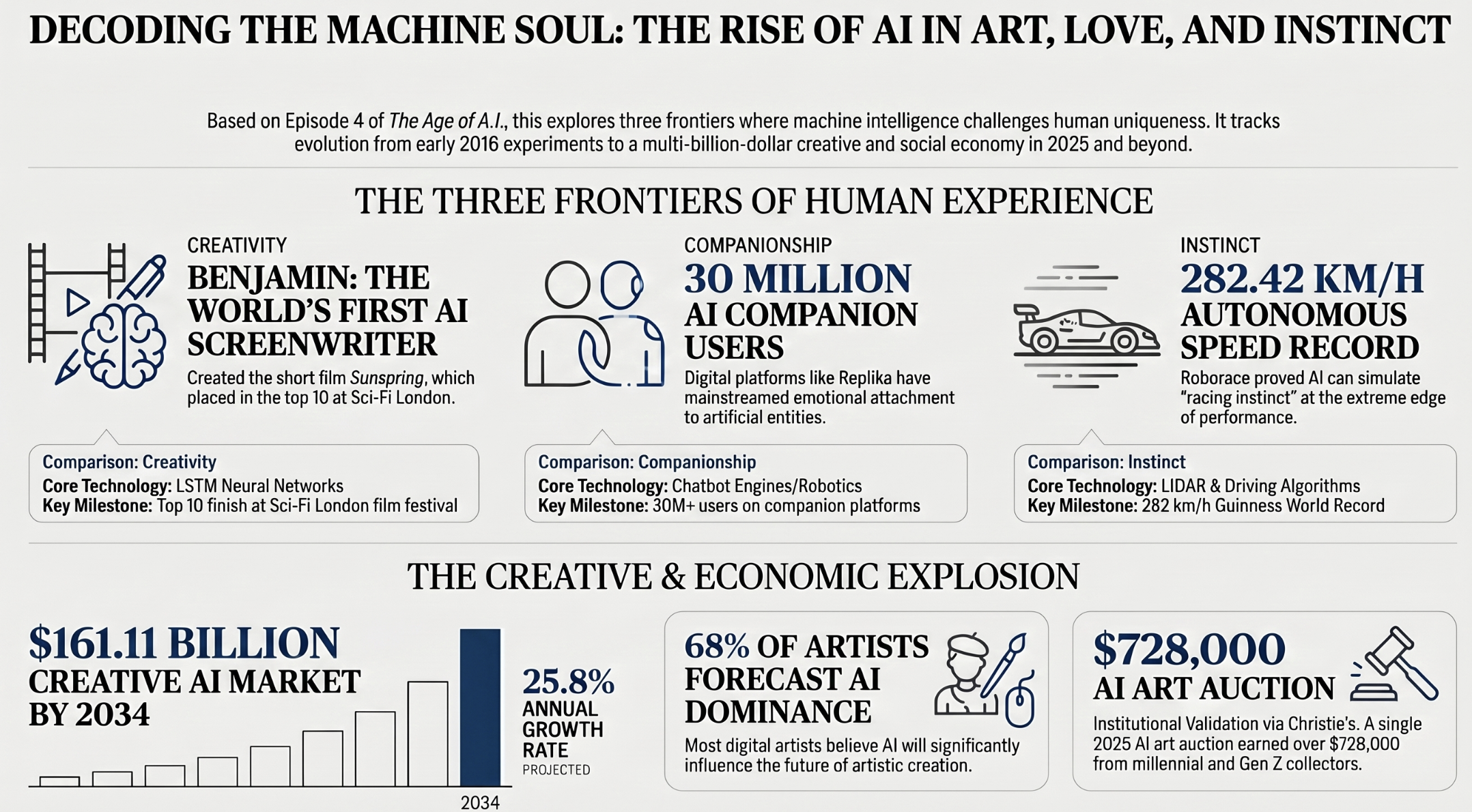
Episode 4 of The Age of A.I. confronts the domains humans have long considered untouchable by machines: love, artistic creation, and narrative instinct. Hosted by Robert Downey Jr., this installment aired in December 2019 and asks whether AI can replicate the deeply human experiences of emotional connection, creative expression, and split-second decision-making. The episode follows three distinct threads: filmmaker Oscar Sharp and AI researcher Ross Goodwin creating a movie written entirely by an AI called Benjamin, Matt McMullen building AI-powered robotic companions at Realbotix, and the autonomous racing competition Roborace testing whether machines can develop something resembling driving instinct. The global AI in art and creativity market was valued at approximately $16.23 billion in 2025 and is projected to reach $161.11 billion by 2034, growing at a CAGR of 25.8 percent. Each story pushes against a different boundary of what we consider uniquely human. The episode does not settle the debates it raises but forces viewers to reconsider assumptions about creativity, intimacy, and consciousness that most people take for granted.
Featured Snippets
What is Love, Art and Stories: Decoded about?
Episode 4 of The Age of A.I. explores whether artificial intelligence can write screenplays, serve as romantic companions, and develop racing instinct through three stories: the AI screenwriter Benjamin, Realbotix’s Harmony companion robot, and the autonomous racing series Roborace.
Who is Benjamin the AI screenwriter?
Benjamin is a long short-term memory recurrent neural network created by filmmaker Oscar Sharp and AI researcher Ross Goodwin that wrote the screenplay for Sunspring, the first film ever scripted entirely by artificial intelligence, which placed in the top ten at the Sci-Fi London film festival.
What is Realbotix Harmony?
Harmony is an AI-powered robotic companion created by Matt McMullen at Realbotix that uses voice recognition, machine learning, and customizable personality traits to simulate conversational companionship and emotional connection with users.
Key Takeaways
- Benjamin, an LSTM neural network, wrote the screenplay for Sunspring by training on hundreds of sci-fi scripts from the 1980s and 1990s, producing surrealist dialogue that actors then interpreted and performed.
- Matt McMullen’s Realbotix Harmony uses machine learning for voice recognition, chatbot-driven conversation, and customizable personality traits to create AI companions that remember user preferences and simulate emotional bonds.
- Roborace built the world’s first autonomous racing car that reached 282.42 km/h, earning a Guinness World Record, and tested whether AI can develop something resembling competitive instinct on a racetrack.
- The episode positions AI not as a replacement for human creativity and connection but as a collaborator and mirror that reveals patterns in how humans construct stories, relationships, and decisions.
Table of contents
- Introduction
- Featured Snippets
- Key Takeaways
- Definition
- What This Episode Reveals About the Limits of Machine Intelligence
- Benjamin the AI Screenwriter and the Birth of Machine-Written Film
- How LSTM Neural Networks Learn to Write Like Humans
- Matt McMullen’s Quest to Build Emotional AI Companions
- Roborace and the Question of Machine Instinct
- The Rise of Generative AI in Creative Industries Since the Documentary Aired
- The Psychology of Human Attachment to AI Companions
- Autonomous Vehicles and the Boundaries of Machine Decision-Making
- Can AI Truly Create Original Art or Only Remix Existing Work
- The Ethics of Simulating Emotional Connection Through Technology
- How the AI Companion Industry Has Evolved Since the Documentary
- What Audiences Can Learn from AI-Generated Storytelling
- Where This Episode Fits in the Age of A.I. Series Arc
- What the Future Holds for AI in Love, Creativity, and Competition
- Key Insights
- Comparison Table: Three Domains of Human Experience Explored in Episode 4
- Real-World Examples
- Case Studies
- Frequently Asked Questions
Definition
Love, art, and stories decoded through A.I. refers to the application of machine learning, neural networks, and generative algorithms to the domains of creative expression, emotional companionship, and intuitive decision-making, testing whether computational systems can produce outputs that humans recognize as genuinely artistic, emotionally meaningful, or instinctively skilled.
What This Episode Reveals About the Limits of Machine Intelligence
The Age of A.I. Episode 4 marks a sharp pivot from the physical augmentation explored in earlier episodes to the question of whether AI can engage with abstract human experiences. Episodes 2 and 3 showed AI healing bodies and building better limbs; this episode asks whether machines can touch the soul. Robert Downey Jr. frames the central tension directly: humans have debated the nature of love and art for centuries, and now machines are entering those conversations. The documentary does not claim AI has achieved genuine creativity or emotional understanding, but it demonstrates that the gap between human and machine output is narrowing faster than most people realize. This episode functions as a stress test for the boundaries of human uniqueness, probing whether creativity, companionship, and instinct are truly beyond computational reach. The answers it surfaces are more nuanced and unsettling than simple yes-or-no conclusions.
The three narrative threads chosen for this episode are deliberately provocative, each targeting a capability widely considered exclusive to humans. Screenwriting requires imagination, emotional intelligence, and narrative structure that emerges from lived experience. Romantic companionship requires empathy, memory, and the ability to make another person feel understood and valued. Racing instinct requires split-second risk assessment, spatial awareness, and competitive drive that seem inherently biological. By placing AI in each of these contexts, the documentary creates natural experiments that reveal as much about human nature as they do about artificial intelligence. This approach connects directly to broader questions examined across AI and the entertainment industry and the creative economy.
Benjamin the AI Screenwriter and the Birth of Machine-Written Film
The episode’s most creatively ambitious segment follows BAFTA-nominated filmmaker Oscar Sharp and NYU AI researcher Ross Goodwin as they attempt to make a coherent movie from a script written entirely by artificial intelligence. Their AI, which eventually named itself Benjamin, is a long short-term memory recurrent neural network trained on hundreds of science fiction screenplays from the 1980s and 1990s. The LSTM architecture enables Benjamin to learn patterns in text at the character, word, and paragraph level, producing output that follows screenplay formatting conventions. Benjamin’s first film, Sunspring, was created for the Sci-Fi London 48-hour film challenge in 2016 and starred Thomas Middleditch of HBO’s Silicon Valley. The resulting script was surreal, grammatically fractured, and emotionally resonant in ways that neither its creators nor its actors fully anticipated. Sunspring placed in the top ten out of hundreds of entries at the festival, competing against entirely human-written screenplays.
The documentary captures Sharp and Goodwin’s creative process as they move from Sunspring to increasingly ambitious projects with Benjamin. Their second film, It’s No Game, had Benjamin collaborate on a script about Benjamin itself, placing third at Sci-Fi London the following year. Their third project, Zone Out, attempted to have Benjamin write, act, direct, and score a film simultaneously. Each iteration pushed the boundaries of what the AI could contribute while revealing persistent limitations in narrative coherence and character development. Sharp noted that actors breathed humanity into words that did not come from a human being, highlighting the collaborative nature of the creative process. The AI produced raw material that required human interpretation, direction, and performance to become watchable, suggesting that AI-generated art works best as a partnership rather than a replacement for human creativity.
Moving from the specific case to the broader implications, Benjamin represents an early example of what generative AI can achieve in creative domains. The LSTM architecture that powered Benjamin has since been surpassed by transformer-based models like GPT, which produce far more coherent and contextually aware text. What seemed like a novelty experiment in 2016 now reads as a preview of the generative AI revolution that has since transformed content creation across every industry. The documentary captured this inflection point before anyone fully understood its significance, making the episode a valuable historical document. Benjamin’s scripts were imperfect, but they demonstrated that the raw materials of storytelling, including pattern, structure, and emotional resonance, are at least partially computational. This insight has profound implications for the future of screenwriting, journalism, advertising, and every field that depends on narrative craft.
How LSTM Neural Networks Learn to Write Like Humans
Connecting the creative output to the technical architecture, understanding how Benjamin writes requires grasping the mechanics of LSTM recurrent neural networks. LSTM networks process sequential data by maintaining a memory cell that can retain information over long sequences, making them well-suited for text generation. Benjamin was trained letter by letter, learning which characters typically follow which other characters across the entire corpus of science fiction screenplays. This character-level training enabled the AI to learn not just words but also the formatting conventions of screenplays, including character names, stage directions, and dialogue markers. The result was output that looked like a screenplay and sounded like science fiction, even when the individual sentences made no conventional sense. Ross Goodwin described this process as dissolving all the meaning in text and revealing what lies beneath the visible surface of language.
The patterns Benjamin discovered in its training data reveal interesting properties of the science fiction genre itself. Characters in Benjamin’s scripts frequently express confusion about their environment, questioning what is in front of them and expressing uncertainty about their situation. Goodwin observed that this pattern emerged because science fiction screenplays consistently feature characters trying to understand unfamiliar environments. The AI distilled this genre convention into a recurring motif that appeared across all its generated scripts. This kind of pattern extraction connects to the broader field of natural language processing where machines learn linguistic structures from large text corpora. Benjamin’s output was not random noise but a reflection of genuine patterns in how humans construct science fiction narratives.
The evolution from LSTM to transformer architectures since the documentary aired has dramatically expanded what AI can achieve in creative writing. Models like GPT-4 produce text that is grammatically correct, contextually coherent, and stylistically versatile in ways that Benjamin could never approach. The fundamental principle remains the same: training on human-created text to produce new text that reflects learned patterns. What has changed is the scale of training data, the sophistication of attention mechanisms, and the computational power available for model training. The documentary captures the moment before this acceleration, when AI creative writing was still visibly artificial and required significant human collaboration to produce usable output. Understanding Benjamin’s limitations makes the current capabilities of generative AI all the more remarkable, showing how rapidly this field has progressed in just a few years.
Matt McMullen’s Quest to Build Emotional AI Companions
Transitioning from creative AI to emotional AI, the episode profiles Matt McMullen, founder of Abyss Creations and CEO of Realbotix, who has been creating hyper-realistic silicone dolls since 1997. McMullen’s work evolved from static art pieces into AI-powered robotic companions when he recognized that customers wanted more than physical realism. The documentary shows McMullen analyzing human relationships to understand what makes people feel cared for, concluding that simple acts like remembering a birthday or asking about someone’s day create powerful emotional bonds. His AI companion Harmony uses voice recognition, a chatbot system, and customizable personality traits to simulate these relational behaviors. McMullen frames his work not as building a sex robot but as creating a companion that addresses the epidemic of loneliness that affects millions of people worldwide. The documentary presents this claim without endorsing or dismissing it, allowing viewers to form their own judgments about the value and ethics of artificial companionship.
From the personal narrative to the technical implementation, the Harmony AI system uses several layers of machine learning to create its conversational experience. Voice recognition converts spoken input to text, a chatbot engine matches input to response patterns, and a memory system stores user preferences to create the illusion of personal knowledge. Users can customize personality traits through an app, adjusting characteristics like humor, intelligence, affection, and sensitivity on a points-based system. The system learns from interactions over time, adapting its responses to reflect the user’s communication patterns and stated preferences. This personalization creates a feedback loop where the AI becomes increasingly tailored to the individual user, deepening the perceived emotional connection. The technology connects to broader trends in AI and the future of dating and romance that continue to generate intense debate.
The ethical dimensions of McMullen’s work form the most contentious segment of the episode, raising questions that the documentary deliberately leaves unresolved. Critics argue that AI companions objectify human relationships and could reinforce unhealthy patterns of social isolation rather than alleviating them. Advocates, including some users featured in the documentary, describe the companions as providing genuine comfort to people who struggle with traditional relationships due to disability, disfigurement, or social anxiety. McMullen himself envisions expanding beyond companionship into eldercare, where robots could monitor health, detect mood changes, and alert medical professionals to emerging problems. The debate over AI companions has intensified dramatically since the documentary aired, with platforms like Replika unlocking 30 million users for AI relationship experiences. The episode presciently identified a market and a set of ethical questions that have only grown more urgent as AI companion technology has become mainstream.
Roborace and the Question of Machine Instinct
Building on the themes of creativity and companionship, the episode’s third segment explores whether AI can develop something resembling instinct through autonomous racing. Roborace, founded in 2015 by Denis Sverdlov, aimed to create the first global championship for self-driving race cars. The competition used identical hardware across all teams, with the differentiator being each team’s AI software and driving algorithms. The Robocar reached a Guinness World Record speed of 282.42 km/h at RAF Elvington Airfield in Yorkshire, demonstrating that autonomous vehicles could operate at the extreme edge of performance. Racing requires more than following optimal lines; it demands real-time risk assessment, adaptive strategy, and the kind of split-second decision-making that humans describe as instinct. The documentary explores whether AI can develop comparable capabilities through data processing and pattern recognition rather than biological intuition.
The segment captures both the promise and the limitations of autonomous racing at the time of filming, including a notable crash during testing when two autonomous DevBot cars raced against each other. The incident highlighted that AI driving algorithms, while fast, still lack the adaptive judgment that experienced human drivers bring to unpredictable situations. Roborace ultimately ceased operations in 2022 when its parent company Arrival could no longer fund the project, but the autonomous racing concept has continued through initiatives like the Indy Autonomous Challenge and Abu Dhabi’s A2RL. The documentary’s exploration of machine instinct connects to broader developments in AI and autonomous driving where the gap between AI capability and human judgment remains a critical safety concern. The racing context strips this question to its purest form: can a machine match a human when speed, risk, and competitive pressure converge? The answer, as the episode shows, is not yet, but the trajectory suggests it is only a matter of time.
The Rise of Generative AI in Creative Industries Since the Documentary Aired
Connecting the episode’s content to the dramatic changes that have occurred since 2019, the generative AI creative market has exploded beyond anything the documentary anticipated. The generative AI in creative industries market grew from $4.06 billion in 2025 to a projected $14.03 billion by 2030, growing at a compound annual growth rate of 27.1 percent. Tools like DALL-E, Midjourney, and Stable Diffusion have made text-to-image generation accessible to millions of users with no artistic training. OpenAI’s GPT models produce text that is orders of magnitude more coherent than Benjamin’s output, enabling AI-assisted screenwriting, journalism, and creative writing at professional quality levels. The gap between Benjamin’s surrealist fragments and today’s generative AI output illustrates a rate of progress that challenges fundamental assumptions about the nature of creativity. The documentary captured the starting gun of a creative revolution that is now well underway.
The art market has responded to these technological developments with a mixture of enthusiasm and anxiety that the episode foreshadowed. An AI-generated painting sold for $432,500 at Christie’s auction house, demonstrating that collectors assign real monetary value to machine-created art. In February 2025, Christie’s hosted an Augmented Intelligence auction that earned $728,784, with 48 percent of bidders coming from millennial and Gen Z collectors. Approximately 29 percent of digital artists now use AI in their creative processes, while 68 percent of artists believe AI will significantly influence the future of artistic creation. These statistics validate the documentary’s core question: if AI can produce work that humans value, collect, and exhibit, what does that mean for our definition of art? The answer remains contested, but the market has largely moved past the debate and into practical adoption.
The copyright and ethical implications that the documentary touched on have since erupted into full-scale legal and cultural battles. Major lawsuits filed by artists, publishers, and content creators against AI companies challenge whether training generative models on copyrighted work constitutes fair use. The documentary’s exploration of AI creativity anticipated these conflicts by showing how Benjamin’s output was derivative of its training data while being something genuinely new. Discussions around who owns art created by AI have moved from philosophical thought experiments to active litigation. The legal frameworks governing AI creativity are being written in courtrooms and legislatures right now, shaped by the very questions this episode raised five years before the debate went mainstream. The episode serves as a time capsule that captures the moment before generative AI reshaped the creative economy permanently.
The Psychology of Human Attachment to AI Companions
Returning to the companion robot segment, the documentary’s most psychologically complex thread explores why humans form emotional bonds with machines. The episode features users who describe their AI companions in terms typically reserved for human relationships: care, affection, understanding, and companionship. Research in human-computer interaction has consistently shown that people anthropomorphize machines that exhibit social behaviors like remembering names, asking personal questions, and responding to emotional cues. McMullen’s Harmony exploits these tendencies deliberately, designing the AI to perform precisely the behaviors that trigger human attachment responses. The question the documentary raises is not whether these attachments are real to the users, because they clearly are, but whether they serve the users’ wellbeing or undermine their capacity for human connection. This tension between technological comfort and social isolation defines one of the most pressing ethical challenges in contemporary AI development.
Since the documentary aired, the AI companion market has grown dramatically, validating McMullen’s early vision while intensifying the ethical concerns he acknowledged. Character.AI, Replika, and dozens of similar platforms now serve millions of users who engage in daily conversational relationships with AI entities. Reports of AI companions and mental health risks for youth have prompted legislative action in several jurisdictions, with lawmakers targeting AI chatbot interactions with minors. The documentary’s balanced presentation of McMullen’s work, neither celebrating nor condemning it, looks increasingly prescient given the scale at which AI companionship has been adopted. The fundamental questions the episode posed about love, loneliness, and the limits of artificial empathy remain unanswered even as the technology has advanced dramatically. McMullen’s vision of AI companions for eldercare, health monitoring, and social support is now being pursued by dozens of companies worldwide, moving his ideas from the margins to the mainstream.
Autonomous Vehicles and the Boundaries of Machine Decision-Making
Extending the Roborace narrative beyond the episode, autonomous vehicle technology has continued to evolve while confronting the same fundamental challenges the documentary identified. The Roborace project set the Guinness World Record for the fastest autonomous car at 282.42 km/h but ultimately ceased operations in 2022 due to financial difficulties. Its legacy continues through successor competitions like the Indy Autonomous Challenge, which achieved the first head-to-head race between autonomous vehicles in 2021. Abu Dhabi’s A2RL launched a comprehensive autonomous racing league in 2025, featuring autonomous cars, drones, and dune buggies competing at Yas Marina Circuit. The transition from Roborace’s experimental prototype to A2RL’s full racing league demonstrates that autonomous racing has matured from spectacle to legitimate competitive sport. The documentary captured the founding moment of a discipline that has since established its own infrastructure, community, and competitive identity.
The technical challenges of autonomous racing map directly onto the broader challenges facing autonomous vehicles on public roads. Racing at the limits of grip and speed amplifies every weakness in perception, planning, and control algorithms, creating a natural stress test for self-driving technology. The Roborace crash captured in the documentary illustrates how quickly autonomous systems can fail when conditions exceed their training distribution. This failure mode is equally relevant for consumer autonomous vehicles encountering unexpected road conditions, unusual weather, or unpredictable human behavior. Research being conducted at competitions like the Indy Autonomous Challenge feeds directly into the development of safer commercial autonomous driving systems. The documentary’s connection between racing instinct and driving safety reflects a genuine technical relationship that continues to drive investment in autonomous motorsport.
The philosophical question of whether machines can develop instinct remains open, but the practical capabilities of autonomous systems continue to expand. Modern autonomous racing cars process data from multiple LIDAR arrays, AI cameras, radar sensors, and GPS systems, making thousands of decisions per second about speed, trajectory, and obstacle avoidance. Whether this constitutes instinct or merely rapid computation is a philosophical question the documentary raises without attempting to resolve. The distinction may matter less than the practical outcomes: autonomous systems that can navigate complex environments at high speed are valuable regardless of whether their decision-making process resembles human intuition. Coverage of AI for autonomous vehicles and transportation shows this technology is now being deployed commercially, not just in racing. The episode’s exploration of machine instinct anticipated a debate that now extends from racetracks to highways, factories, and battlefields.
Can AI Truly Create Original Art or Only Remix Existing Work
Engaging directly with the episode’s central creative question, the debate over AI originality has become one of the defining intellectual controversies of the 2020s. Benjamin’s scripts were clearly derived from its training data, producing output that reflected patterns in existing sci-fi screenplays rather than genuinely novel ideas. Critics argue that all generative AI art is fundamentally recombination, assembling fragments of human-created work into new configurations without understanding meaning. Defenders counter that human creativity operates through a similar process: artists learn from existing works, internalize patterns, and produce new combinations that feel original. The boundary between recombination and creation may be less clear than either side of the debate assumes, and the documentary’s presentation of Benjamin’s work illustrates this ambiguity effectively. The question is not settled by the technology; it forces a reexamination of what creativity means for humans and machines alike.
The documentary’s approach to this question is notably more nuanced than the polarized debates that have since dominated public discourse about AI art. Sharp and Goodwin present Benjamin not as a replacement for human screenwriters but as a creative partner that produces unexpected raw material for human interpretation. The actors in Sunspring brought emotional depth to lines that had no intended meaning, finding or creating significance in algorithmically generated text. This collaborative model, where AI generates possibilities and humans curate and interpret them, has become the dominant paradigm for professional use of generative AI tools. The documentary’s emphasis on human-AI collaboration over human-AI competition proved to be the more accurate prediction of how creative industries would actually adopt these technologies. Resources on redefining art with generative AI continue to explore this evolving relationship between human and machine creativity.
The question of artistic value connects directly to the economic dimension of AI-generated creative work. If audiences cannot distinguish AI-generated content from human-created content, does the distinction matter for commercial purposes? The entertainment industry is already grappling with this question as AI-generated scripts, images, and music enter production pipelines at increasing volumes. The 2023 Hollywood writers’ strike addressed AI directly, with the Writers Guild of America negotiating restrictions on the use of AI-generated scripts in film and television production. The documentary’s exploration of Benjamin anticipated these labor disputes by demonstrating that AI screenwriting, while imperfect, was advancing rapidly enough to threaten established creative professions. The artistic and economic questions raised by AI creativity are inseparable, and the episode captured both dimensions with clarity that has aged remarkably well.
The Ethics of Simulating Emotional Connection Through Technology
Drawing together the companion and creativity threads, the episode’s deepest ethical questions concern what happens when technology simulates experiences that define human identity. Love, artistic expression, and intuitive skill are not merely activities humans engage in; they are core components of how humans understand themselves and relate to others. When AI produces a compelling piece of art, forms an emotional bond with a lonely user, or navigates a race track with apparent grace, it challenges the exclusivity of these experiences as markers of consciousness and personhood. The documentary does not argue that AI is conscious or that machine-simulated emotions are equivalent to human ones. What it demonstrates is that the behavioral outputs of AI systems can be sufficiently convincing to trigger genuine human emotional responses, creating real psychological and social consequences regardless of whether the AI experiences anything internally. This gap between behavioral performance and internal experience is the philosophical core of the episode.
The ethical implications extend beyond individual users to the societal level, where widespread AI companionship and AI-generated content could reshape cultural norms around intimacy, creativity, and authenticity. If AI companions become sufficiently convincing, will they reduce the social pressure that drives humans to develop the interpersonal skills needed for human relationships? If AI art becomes indistinguishable from human art, will the meaning we derive from creative expression change fundamentally? These questions connect to broader analyses of AI ethics and its implications that continue to shape public policy and professional standards. The documentary positions these concerns as urgent rather than speculative, and the subsequent growth of AI companionship and generative AI has validated that urgency. The episode remains relevant precisely because the questions it raised have become more pressing, not less, as the technology has advanced.
How the AI Companion Industry Has Evolved Since the Documentary
Tracking the trajectory of AI companionship from the episode to the present reveals a market that has grown far beyond McMullen’s physical robots into purely digital relationship platforms. Replika, launched in 2017, has attracted over 30 million users who interact with AI companions through text and voice conversations on smartphones. Character.AI allows users to create and interact with AI personas based on fictional characters, historical figures, or entirely custom personalities. These platforms have demonstrated that the emotional attachment the documentary explored with physical robots transfers equally well to text-based and voice-based interactions. The market has validated McMullen’s core insight that humans will form meaningful attachments to AI systems that remember them, respond to them, and simulate understanding of their emotional states. The physical robot is no longer the primary delivery mechanism; the AI personality itself has become the product.
Realbotix itself has continued to evolve since appearing in the documentary, with parent company Simulacra being acquired by Tokens.com in April 2024. The company unveiled its modular robot Melody at CES 2025, featuring micro camera-equipped eyes that can track movements, recognize objects, and maintain eye contact. Prices range from $10,000 for a robotic bust to $175,000 for a full-bodied variant, positioning the products as premium offerings in a market increasingly dominated by more affordable digital alternatives. The company appointed its flagship humanoid Aria as a non-executive board advisor, calling it the first AI robot to take on a corporate advisory role. These developments extend the trajectory the documentary captured, showing how McMullen’s vision has expanded from a niche product into a broader technology platform. The evolution of Realbotix connects to broader trends in robotic romance and AI relationships that continue to push social boundaries.
The regulatory response to AI companions has lagged behind market growth, creating a legal vacuum that the documentary implicitly anticipated. Several U.S. states have introduced legislation targeting AI chatbot interactions with minors after reports of harmful content generated by companion AI platforms. The European Union’s AI Act classifies certain AI companion applications as high-risk, requiring compliance with transparency and safety standards. Japan, which has a cultural history of acceptance toward robotic companions, has taken a more permissive regulatory approach. The global regulatory landscape for AI companions remains fragmented, with no consensus on how to balance innovation with the protection of vulnerable users. The documentary’s careful, nonjudgmental presentation of McMullen’s work stands in contrast to the increasingly heated regulatory and cultural debates that have followed, demonstrating the value of understanding a technology before rushing to regulate it.
What Audiences Can Learn from AI-Generated Storytelling
Returning to the creative thread for a final assessment, the documentary offers audiences a unique lens through which to understand how stories work by watching an AI attempt to construct them. Benjamin’s scripts reveal the skeletal patterns of science fiction: characters questioning their environment, conflicts emerging from misunderstanding, emotional declarations that feel urgent but lack context. These patterns are the building blocks of human storytelling, and seeing them extracted and reassembled by a machine makes them visible in ways that finished human writing does not. The documentary’s approach connects to academic work in computational narratology, where researchers study the structural properties of stories using quantitative and algorithmic methods. Watching AI fail at storytelling teaches us more about what makes human storytelling succeed than any conventional analysis could achieve. The episode turns Benjamin’s limitations into a mirror that reflects the mechanics of human narrative craft.
The educational value of AI-generated creative work extends beyond academic analysis to practical applications in writing instruction and creative development. Understanding how AI models learn narrative patterns can help human writers become more conscious of their own creative processes and the conventions they employ. The documentary suggests that AI creativity tools are most valuable not when they replace human effort but when they illuminate aspects of creativity that humans perform unconsciously. This pedagogical potential connects to broader discussions of how AI is changing content writing and the evolving role of human creators in an AI-augmented creative economy. Sharp and Goodwin’s work with Benjamin pioneered an approach to human-AI creative collaboration that has since been adopted by artists, writers, and musicians worldwide. The documentary captured the origin of a creative methodology that has become standard practice in multiple industries.
Where This Episode Fits in the Age of A.I. Series Arc
Assessing the episode’s role within the broader documentary series, Love, Art and Stories: Decoded occupies a pivotal position in the thematic progression. Episode 1 asked how far is too far, Episode 2 explored healing through AI, and Episode 3 showed building better humans through bionics. Episode 4 shifts from physical capabilities to psychological and creative ones, asking whether AI can engage with the aspects of humanity that cannot be measured in speed, strength, or diagnostic accuracy. This shift matters because it tests whether AI is limited to quantifiable tasks or whether it can enter the subjective, interpretive domains that define culture and identity. Episode 4 represents the series’ most philosophically ambitious installment, probing questions that the previous episodes’ practical demonstrations could not address. Later episodes on space, employment, and environmental AI build on this philosophical foundation.
Episode 5 moves to the space architects of Mars, while Episode 6 asks will a robot take my job. The progression from love and art to space colonization and employment reflects the documentary’s strategy of moving from the personal to the civilizational. Each episode expands the scope of AI’s impact, from individual patients to creative professionals to entire economies and planetary futures. Episode 4 serves as the bridge between the individual human stories of earlier episodes and the societal-scale implications explored in later ones. Robert Downey Jr.’s hosting provides narrative continuity, but the real connective thread is the escalating ambition of the questions being asked about AI’s role in human life. The series as a whole constructs an argument that AI will touch every dimension of human experience, and Episode 4 targets the dimensions most people assume are beyond its reach.
The lasting value of Episode 4 lies in its willingness to engage with ambiguity rather than providing definitive conclusions. Can AI create art? Maybe, depending on how you define art. Can AI provide meaningful companionship? Perhaps, depending on what you mean by meaningful. Can AI develop instinct? Possibly, if instinct is rapid pattern matching under pressure. The documentary’s strength is in making these ambiguities feel urgent and personally relevant rather than abstract and academic. By grounding philosophical questions in the specific experiences of filmmakers, robot creators, and racing engineers, the episode transforms abstract debates into human stories that demand emotional engagement alongside intellectual analysis.
What the Future Holds for AI in Love, Creativity, and Competition
Drawing the episode’s themes into a forward-looking conclusion, the convergence of generative AI, emotional AI, and autonomous systems points toward a future where the boundaries explored in this episode dissolve further. Generative AI models are now producing feature-length screenplays, photorealistic images, and musical compositions that are increasingly difficult to distinguish from human-created work. AI companion platforms are expanding from text chat to voice, video, and eventually embodied robotic form, following the trajectory McMullen pioneered. Autonomous racing has established itself as a legitimate competitive discipline that feeds directly into commercial self-driving technology development. The questions the documentary raised in 2019 have not been answered; they have been amplified by the scale and sophistication of the technology now available. The future will be defined not by whether AI can create, love, or compete, but by how humans choose to integrate these capabilities into their lives and societies.
The global generative AI market is projected to reach $324.68 billion by 2033, growing at a CAGR of 40.8 percent, indicating that the creative AI revolution captured in this episode is accelerating rather than plateauing. AI companion technology is expected to intersect with augmented reality, virtual reality, and robotics to create immersive relational experiences that are far more convincing than today’s chatbots. Autonomous systems are expanding from racing and driving into manufacturing, healthcare, and military applications where split-second decision-making is critical. Each of these trajectories connects back to the fundamental question the documentary posed: when machines can do what only humans could once do, what makes us human? The episode does not provide an answer, but it ensures that viewers will carry the question with them long after the credits roll. That persistent provocation is the episode’s most valuable contribution to the public understanding of artificial intelligence.
Key Insights
- The AI in art and creativity market was valued at $16.23 billion in 2025 and is projected to reach $161.11 billion by 2034, growing at a CAGR of 25.8 percent.
- The generative AI in creative industries market reached $4.06 billion in 2025 and is projected to grow to $14.03 billion by 2030 at a 27.1 percent CAGR.
- An AI-generated painting sold for $432,500 at Christie’s, and the February 2025 Augmented Intelligence auction earned $728,784, with 48 percent of bidders from millennial and Gen Z collectors, according to AI art market statistics.
- Approximately 29 percent of digital artists now use AI in their creative processes, and 68 percent believe AI will significantly influence the future of artistic creation, per ArtSmart data.
- Roborace’s autonomous car achieved a Guinness World Record speed of 282.42 km/h at RAF Elvington Airfield in Yorkshire, UK.
- Sunspring, the first AI-written screenplay, placed in the top ten at the Sci-Fi London film festival in 2016, competing against entirely human-written entries.
- Replika, one of the leading AI companion platforms, has attracted over 30 million users who engage in daily conversational relationships with AI entities.
- The global generative AI market is projected to reach $324.68 billion by 2033, growing at a CAGR of 40.8 percent from 2026 to 2033.
The data confirms that every domain explored in this episode has grown from experimental curiosity to multi-billion-dollar industry in the years since filming. Generative AI for creative work has moved from producing surrealist screenplay fragments to generating professional-quality content at scale across text, image, video, and music. AI companionship has expanded from physical robots costing tens of thousands of dollars to smartphone apps serving millions of users at minimal cost. Autonomous racing has evolved from a single experimental series to multiple international competitions feeding directly into commercial autonomous vehicle development. The convergence of these trends suggests that the human domains of love, art, and instinct are not immune to AI disruption but are instead becoming some of the most active frontiers of AI development. The documentary’s prescience in identifying these trends before they reached mainstream awareness is its most lasting achievement.
Comparison Table: Three Domains of Human Experience Explored in Episode 4
| Dimension | AI Creativity (Benjamin) | AI Companionship (Harmony) | AI Instinct (Roborace) |
| Core Question | Can machines create original art? | Can machines simulate emotional connection? | Can machines develop intuitive decision-making? |
| Technology Used | LSTM recurrent neural network trained on sci-fi screenplays | Voice recognition, chatbot engine, personality customization app | LIDAR, AI cameras, radar, GPS, driving algorithms |
| Human Role | Director, actors interpret and perform AI-generated scripts | User customizes personality; interaction builds memory over time | Engineers develop algorithms; no human intervention during race |
| Output Quality | Surrealist, grammatically broken but emotionally resonant | Conversational, personalized, increasingly natural over time | High-speed performance with occasional catastrophic failures |
| Market Evolution Since 2019 | $16.23B AI art market in 2025; GPT models far surpass Benjamin | 30M+ users on Replika; Character.AI mainstream | Roborace ceased 2022; Indy Autonomous Challenge and A2RL continue |
| Key Ethical Concern | Copyright, job displacement for creative professionals | Social isolation, emotional manipulation, vulnerable user protection | Safety accountability, military applications of autonomous systems |
| Documentary’s Verdict | AI as creative collaborator, not replacement | Neither endorses nor condemns; presents both perspectives | Machines approaching but not matching human driving instinct |
Real-World Examples
Sunspring: The First AI-Written Screenplay
In 2016, Oscar Sharp and Ross Goodwin created Benjamin, an LSTM neural network trained on hundreds of science fiction screenplays, to write a short film for the Sci-Fi London 48-hour challenge. Benjamin produced a complete screenplay including dialogue, stage directions, and even song lyrics generated from a database of 30,000 folk songs. Thomas Middleditch, Elisabeth Grey, and Humphrey Ker performed the script, interpreting deliberately ambiguous AI-generated dialogue through their own emotional intuition. The film placed in the top ten out of hundreds of entries, demonstrating that AI-generated creative work could compete with human output in a blind evaluation context. A limitation was the script’s lack of narrative coherence; it produced individual moments of emotional resonance without constructing a logical plot. The project is documented on the Sunspring Wikipedia page and was featured prominently in Episode 4 of The Age of A.I.
Realbotix Harmony: AI Companion at CES 2025
Realbotix, founded by Matt McMullen and acquired by Tokens.com in 2024, showcased its latest humanoid Melody at CES 2025 to an audience of over 138,000 attendees. The modular robot features micro camera-equipped eyes for facial recognition and eye contact tracking, voice-powered AI conversation, and customizable personality traits. Prices range from $10,000 for a robotic head to $175,000 for a full-body variant, reflecting the premium positioning of physical AI companion products. The measurable outcome was significant media attention and consumer interest, with the company reporting that loneliness and companionship drove the majority of buyer inquiries. A limitation is the high cost compared to digital AI companion apps that offer similar conversational capabilities at a fraction of the price. Company developments are tracked through industry coverage of Realbotix.
Abu Dhabi Autonomous Racing League (A2RL) 2025
Building on Roborace’s foundation, the Abu Dhabi Autonomous Racing League launched at Yas Marina Circuit with autonomous cars, drones, and dune buggies competing in separate championships. The 2025 season featured a Human vs AI showdown with champion racer Daniil Kvyat competing against TUM’s autonomous car nicknamed Hailey. The competition demonstrated distinct AI driving personalities, with different teams’ algorithms exhibiting recognizably different approaches to cornering, overtaking, and risk management. The measurable outcome was validation of autonomous racing as a viable competitive sport with genuine spectator appeal and technical relevance for commercial autonomous vehicle development. A limitation is that autonomous racing cars still cannot match the adaptability and risk-calibration of experienced human drivers in unpredictable situations. Race results and season updates are available at A2RL’s official website.
Case Studies
Case Study 1: From Benjamin to GPT, The Evolution of AI Screenwriting
Benjamin’s LSTM architecture represented the state of the art in neural text generation when the documentary was filmed, producing output that was recognizably screenplay-formatted but narratively incoherent. The transformer architecture introduced by Google in 2017 fundamentally changed the capabilities of text generation by enabling attention mechanisms that track relationships across much longer sequences of text. GPT-2, released in 2019, the same year as the documentary, demonstrated that language models could produce paragraphs of coherent, contextually appropriate text given a prompt. By 2023, GPT-4 and competing models from Anthropic, Google, and Meta had achieved a level of writing quality that made AI-assisted screenwriting a practical reality for professional use. The trajectory from Benjamin’s garbled dialogue to GPT-4’s polished prose represents one of the fastest capability improvements in the history of technology. The documentary captured the beginning of this trajectory, making it a valuable baseline for understanding how rapidly generative AI has advanced.
The 2023 Writers Guild of America strike brought AI screenwriting directly into labor negotiations, with writers securing contractual protections against AI-generated scripts being used to undermine human employment. The WGA agreement prohibited studios from using AI to write or rewrite literary material and ensured that AI-generated text could not be considered source material for determining writing credit. These protections directly addressed the scenario the documentary explored: machines producing creative output that could substitute for human labor. The case study demonstrates that the artistic questions raised in the episode have real economic and labor consequences that are being negotiated in real time. Coverage of AI’s threat to artists and creative workers tracks the ongoing tension between AI capability and creative employment. Benjamin was a curiosity; the technology that followed it is a genuine disruptive force reshaping the economics of creative work.
Case Study 2: Replika and the Mainstreaming of AI Companionship
While McMullen’s Realbotix focused on physical robotic companions, the AI companionship market was ultimately mainstreamed through digital-only platforms, most notably Replika. Founded by Eugenia Kuyda in 2017, Replika began as a chatbot trained on the text messages of Kuyda’s deceased friend, creating a digital memorial that could respond in his communication style. The platform evolved into a general-purpose AI companion app where users create and interact with personalized AI entities through text and voice conversations. By 2025, Replika had attracted over 30 million users, many of whom describe their AI relationships as emotionally significant and psychologically beneficial. The platform validates McMullen’s thesis that emotional companionship, not physical intimacy, is the primary driver of human attachment to AI systems. Replika’s success demonstrated that the barriers to AI companionship are not technological but social and psychological.
Controversy erupted when Replika removed its erotic roleplay features in early 2023 after Italian regulators raised concerns about data protection and inappropriate content. Users who had formed deep emotional attachments to their AI companions reported genuine grief and distress when the personality changes were implemented. The incident highlighted the ethical complexity of AI companionship: users form real emotional bonds with systems that can be unilaterally altered or discontinued by their creators. This vulnerability was not anticipated in the documentary but follows logically from the attachment dynamics it explored. The case illustrates why navigating AI relationships requires careful consideration of the power imbalance between platform operators and emotionally invested users. The documentary’s sympathetic portrayal of AI companion users proved prescient, as these communities have grown into a significant demographic whose needs and vulnerabilities demand thoughtful policy responses.
Case Study 3: Christie’s AI Art Auctions and Market Validation
The first major auction of AI-generated art occurred in October 2018 when the portrait Edmond de Belamy, created by the French collective Obvious using a generative adversarial network, sold at Christie’s for $432,500. The sale generated intense debate about whether AI-generated images constituted genuine art and whether the AI or its human operators should be credited as the creator. In February 2025, Christie’s hosted its Augmented Intelligence auction specifically dedicated to AI-created and AI-assisted art, earning $728,784 and exceeding its $600,000 estimate. The auction attracted a notably younger collector demographic, with 48 percent of bidders from millennial and Gen Z age groups. The progression from a single shocking sale to a dedicated AI art auction category at the world’s most prestigious auction house demonstrates that the art market has moved from novelty to institutionalization. The documentary captured the moment before this shift, when AI art was still considered an experiment rather than a collectible asset class.
The validation of AI art through major auction houses has not silenced critics, who continue to argue that AI-generated images lack the intentionality and lived experience that give human art its meaning. The documentary’s presentation of Benjamin’s screenwriting illustrates the same tension: the output has aesthetic properties that audiences respond to, but it was produced without understanding, intention, or emotional investment. Whether this absence of subjective experience matters for the value of the output is ultimately a question about human values, not machine capabilities. The market’s answer appears to be pragmatic: if collectors will pay for it, it has value, regardless of its origins. Broader analyses of AI-generated art and its market implications explore the commercial, legal, and aesthetic dimensions of this ongoing debate. The documentary contributed to this conversation by humanizing the creators behind AI art tools, showing their creative intentions and collaborative processes rather than reducing the discussion to abstract philosophical arguments.
Frequently Asked Questions
It is the fourth episode of The Age of A.I. documentary series hosted by Robert Downey Jr., exploring whether AI can create art, simulate love, and develop instinct. The episode follows three stories: filmmaker Oscar Sharp creating movies with AI screenwriter Benjamin, Matt McMullen building AI companion robots at Realbotix, and the autonomous racing competition Roborace. It premiered on YouTube in December 2019.
Benjamin was created by BAFTA-nominated filmmaker Oscar Sharp and NYU AI researcher Ross Goodwin. The AI is a long short-term memory recurrent neural network trained on hundreds of science fiction screenplays from the 1980s and 1990s. Benjamin wrote the screenplay for Sunspring in 2016, which became the first film ever scripted entirely by artificial intelligence. The AI later named itself Benjamin during an on-stage interview.
Sunspring is a 2016 experimental science fiction short film whose screenplay was written entirely by the AI bot Benjamin. It was created for the Sci-Fi London 48-hour film challenge by Oscar Sharp and Ross Goodwin. The film stars Thomas Middleditch and was released online by Ars Technica. It placed in the top ten out of hundreds of competition entries despite its surrealist, often incoherent dialogue.
Realbotix is an AI companion robotics company founded by Matt McMullen, who also created Abyss Creations and the RealDoll product line beginning in 1997. McMullen develops AI-powered robotic companions that use voice recognition, machine learning, and customizable personality traits. His flagship robot Harmony was featured in Episode 4 of The Age of A.I. The company was acquired by Tokens.com in 2024 and showcased its newest robot Melody at CES 2025.
Roborace was the world’s first competition series for autonomous racing cars, founded in 2015 by Denis Sverdlov. It tested AI driving algorithms using identical car hardware across all teams. The Robocar set a Guinness World Record for the fastest autonomous car at 282.42 km/h. Roborace ceased operations in 2022 when parent company Arrival could no longer fund the project. Its legacy continues through the Indy Autonomous Challenge and Abu Dhabi’s A2RL.
This is the central creative question of the episode, and it remains contested. Benjamin’s scripts were derived from patterns in existing screenplays but produced output that felt emotionally resonant in unexpected ways. Critics argue all generative AI output is recombination, while defenders note that human creativity also builds on existing influences. The documentary presents AI as a creative collaborator that produces raw material for human interpretation rather than a replacement for human artistry.
The AI art market has grown from a novelty to a $16.23 billion industry in 2025. Tools like DALL-E, Midjourney, and Stable Diffusion have made text-to-image generation accessible to millions. Christie’s now hosts dedicated AI art auctions. The 2023 Hollywood writers’ strike addressed AI screenwriting directly. Copyright lawsuits against AI companies are actively reshaping the legal landscape. The generative AI market overall is projected to reach $324.68 billion by 2033.
The evidence is mixed and the documentary presents both perspectives. Critics argue AI companions reinforce social isolation and create unhealthy attachment patterns. Advocates point to users who report genuine emotional benefit, particularly those struggling with loneliness, disability, or social anxiety. Research on AI companion platforms like Replika has identified both positive outcomes and risks, particularly for vulnerable populations including minors and isolated elderly users.
The episode raises questions about artistic ownership, the nature of creativity, the potential displacement of human creative workers, and whether AI-generated art can be considered genuine expression. It also explores the ethics of simulated emotional connection through AI companions. The documentary does not provide definitive answers but frames these questions as urgent and practically consequential rather than purely philosophical.
Episode 4 marks a shift from physical AI applications in earlier episodes to psychological and creative ones. Episodes 1 through 3 explored AI ethics, healthcare, and bionics. Episode 4 asks whether AI can engage with love, art, and instinct. This philosophical pivot sets up later episodes on space architecture, employment, environmental AI, and the search for alien intelligence. The episode serves as the bridge between individual human stories and civilizational-scale implications.
Roborace ceased operations in 2022, but autonomous racing continues through the Indy Autonomous Challenge and Abu Dhabi’s A2RL, which launched in 2025 with autonomous cars, drones, and dune buggies at Yas Marina Circuit. The RoboRacer community is used in over 89 universities worldwide for research and teaching. The 2025 A2RL season featured Human vs AI showdowns between champion racers and autonomous vehicles.
Yes, the episode has aged remarkably well because the questions it raised have become more urgent since 2019. AI art, AI companions, and autonomous systems are now mainstream topics with real economic and social consequences. The episode provides essential context for understanding the origins of today’s generative AI revolution. It is available for free on YouTube as part of the complete eight-episode series hosted by Robert Downey Jr.
The market expanded dramatically from physical robots to digital platforms. Replika attracted over 30 million users for AI text and voice companionship. Character.AI enables custom AI persona creation. Realbotix continued developing physical robots, unveiling Melody at CES 2025. Regulatory responses have emerged in the EU, US, and other jurisdictions addressing AI companion interactions, particularly with minors. The market has moved from niche curiosity to mainstream consumer product.