
Introduction
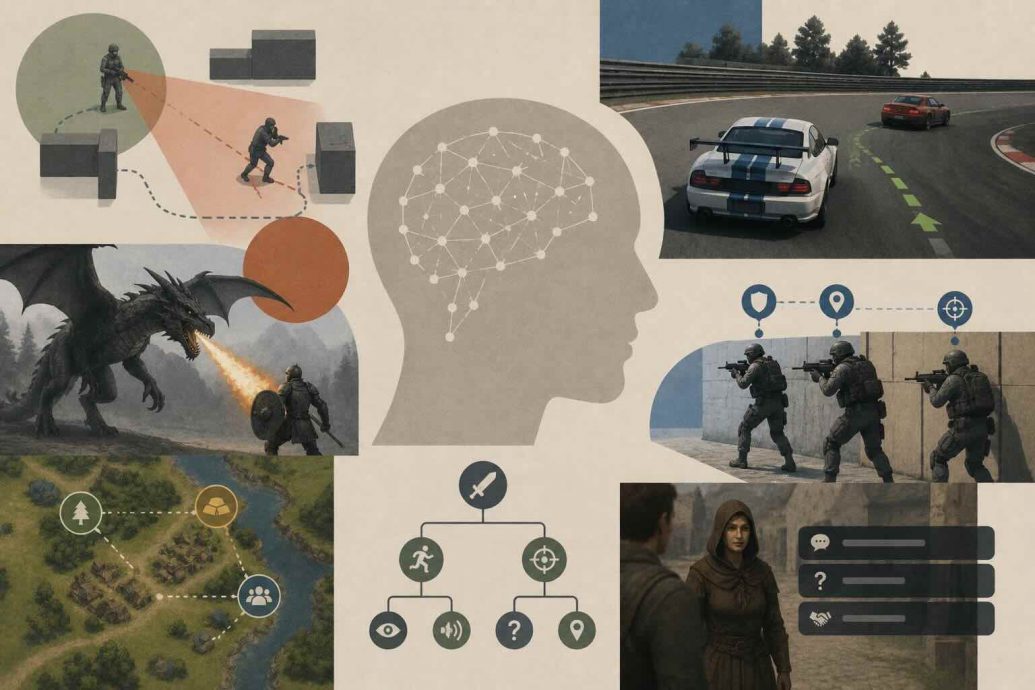
Artificial intelligence has quietly become the backbone of modern gaming, powering everything from enemy behavior to the visual fidelity of each rendered frame. The global AI in gaming market was valued at approximately USD 4.54 billion in 2025, and analysts project it will surpass $81 billion by 2035 at a compound annual growth rate exceeding 33%. What started with simple rule-based logic in arcade cabinets has evolved into a complex ecosystem of machine learning models, neural networks, and generative systems that shape every layer of game design. Studios large and small now rely on AI to build worlds faster, test games more efficiently, and deliver player experiences that feel genuinely responsive. A 2025 survey by Aream & Co. found that 84% of gaming executives are either using or testing AI tools, with 68% actively implementing AI across their studios. The shift from scripted behavior to intelligent, adaptive systems marks one of the most significant turning points in the history of interactive entertainment. From procedural level generation to AI-driven dialogue and real-time graphics upscaling, the ways that video games use AI now touch every phase of development and play. This article explores each of those layers in depth, examining the technologies, the market forces, the ethical questions, and the future that AI is building inside the games we love.
Essential Questions About AI in Video Games
How do video games use AI to create smarter characters?
Video games use AI through behavior trees, finite state machines, and reinforcement learning to give non-player characters the ability to observe, adapt, and react to player actions in real time.
What is AI-powered upscaling in gaming?
AI upscaling technologies like NVIDIA DLSS and AMD FSR render games at lower resolutions, then use trained neural networks to reconstruct near-native image quality while dramatically boosting frame rates.
Will AI replace human game developers?
AI accelerates tasks like asset creation and testing, but creative direction, narrative design, and artistic vision still require human judgment, making AI a collaborative tool rather than a wholesale replacement.
Key Takeaways
- Ethical concerns around job displacement, intellectual property, and AI-generated content flooding remain unresolved industry challenges.
- AI in gaming has evolved from simple rule-based scripts to complex systems involving machine learning, neural rendering, and natural language processing.
- Approximately 50% of studios now use AI in active production, and 97% of developers leverage AI tools for asset creation.
- Technologies like NVIDIA ACE enable autonomous NPCs that perceive, plan, and act with contextual awareness.
Table of contents
- Introduction
- Essential Questions About AI in Video Games
- Key Takeaways
- What AI in Gaming Really Means
- From Pac-Man to PUBG: A Brief History of Game AI
- Smarter Enemies and Allies Through Behavioral AI
- Pathfinding Algorithms That Guide Every Character
- Procedural Content Generation and Infinite Worlds
- How AI Creates Dynamic Difficulty Adjustment
- Natural Language Processing and AI-Driven Dialogue
- AI-Powered Graphics: DLSS, FSR, and Neural Rendering
- Machine Learning in Game Testing and QA
- How Studios Integrate AI Into Development Pipelines
- The Rise of Autonomous NPCs With NVIDIA ACE
- AI-Generated Music, Sound, and Voice Acting
- Player Behavior Analytics and Personalization
- Ethical Concerns Surrounding AI in Game Development
- Job Displacement and the Workforce Debate
- Intellectual Property and Copyright Challenges
- What the AI Gaming Market Growth Signals for the Industry
- The Next Frontier: Where Game AI Is Headed
- Key Insights on AI in Video Games
- AI in Gaming: Traditional Systems Compared to Modern Approaches
- How Leading Studios Are Deploying AI Across Gaming
- Lessons From AI Integration in Game Development
- Frequently Asked Questions About How Video Games Use AI
What AI in Gaming Really Means
AI in gaming refers to the computational techniques, including behavior trees, pathfinding algorithms, machine learning models, and neural networks, that enable video games to simulate intelligent behavior in characters, generate content dynamically, and adapt experiences to individual players. It encompasses both traditional game AI and modern deep learning approaches used across development and gameplay.
AI in Gaming Impact Calculator
Adjust sliders to explore how different AI technologies affect game development outcomes.
From Pac-Man to PUBG: A Brief History of Game AI
The story of AI in video games begins in the earliest days of the medium, when developers used basic algorithms to create the illusion of intelligent opposition. Pac-Man, released in 1980, gave each of its four ghosts a distinct behavioral pattern that made them feel like individual pursuers rather than identical threats. Blinky chased the player directly, Pinky tried to ambush from ahead, Inky used a flanking strategy, and Clyde alternated between pursuit and retreat. These simple rule-based systems set the foundation for what AI in entertainment would become over the following decades. Even at this primitive stage, the core principle was clear: AI exists in games not to be truly intelligent, but to create the experience of intelligence. That design philosophy persisted through the 8-bit and 16-bit eras, with developers gradually layering complexity into enemy behavior patterns and environmental responses.
The 1990s and 2000s introduced finite state machines and decision trees that allowed NPCs to evaluate multiple conditions before selecting an action. Games like Half-Life in 1998 stunned players with enemy soldiers who could flank, retreat, and use grenades tactically based on the player’s position. The introduction of A* pathfinding algorithms gave characters the ability to navigate complex 3D environments without getting stuck on geometry or walking into walls. Titles such as F.E.A.R. in 2005 pushed combat AI even further by combining planning systems with squad coordination, producing firefights that felt dynamic and unpredictable. Each generation built upon the last, moving game AI from reactive to proactive in ways that shaped player expectations for decades to come. Studios recognized that better AI directly translated to higher player engagement and longer retention times.
The leap from scripted intelligence to learned intelligence began with the integration of machine learning and neural network techniques in the 2010s. Games like Middle-earth: Shadow of Mordor introduced the Nemesis System, which tracked player interactions and generated unique enemy personalities that remembered past encounters. By 2025, approximately 50% of studios were using AI in active production, while 97% of developers leveraged AI-assisted tools for asset creation. The release of NVIDIA ACE in 2025 marked a milestone by enabling fully autonomous game characters that could perceive their surroundings, plan strategies, and communicate using natural language. Today, game AI is no longer a single system but a layered architecture of techniques spanning classical algorithms, statistical models, and generative neural networks. This evolution reflects a broader trend in which understanding machine learning has become essential knowledge for anyone building modern interactive experiences.
Smarter Enemies and Allies Through Behavioral AI
Behavioral AI refers to the systems that govern how non-player characters decide what to do in any given moment, from choosing whether to attack or flee to coordinating with other characters in a squad. Traditionally, developers relied on finite state machines that cycled NPCs through predefined states like idle, patrol, alert, and attack. While effective for simple scenarios, these systems produced repetitive and predictable behavior that observant players could easily exploit after a few encounters. The shift toward more sophisticated models began with behavior trees, which organize NPC decisions into hierarchical structures of conditions, actions, and fallback options. Behavior trees allow designers to build complex decision flows that remain readable and modifiable without rewriting core engine code. Modern behavior trees can incorporate dozens of branching conditions, enabling NPCs to evaluate threats, assess cover positions, and prioritize objectives in ways that mirror tactical thinking. Games such as Halo and Unreal Tournament pioneered this approach, creating enemies that felt alive because their actions emerged from layered logic rather than simple if-then statements.
Reinforcement learning has pushed behavioral AI into genuinely new territory by allowing NPCs to learn optimal strategies through trial and error during development. Rather than programming every possible response manually, developers train agents in simulated environments where they discover effective tactics on their own. A 2025 GDC presentation from Ubisoft’s AI team revealed prototypes in which enemy squads developed emergent coordination strategies that the developers themselves had not explicitly programmed. These agents noticed player tendencies, adapted their positioning, and even set traps based on observed flanking patterns. The result was combat encounters that felt different each time, dramatically increasing replay value and player satisfaction. This kind of emergent behavior represents a paradigm shift from authored intelligence to evolved intelligence.
Companion AI has become equally important as enemy AI, with players expecting allies to contribute meaningfully rather than simply following behind the protagonist. PUBG’s AI teammate Ally, built with NVIDIA ACE, can communicate using game-specific terminology, share loot, drive vehicles, and engage enemies using the full weapon roster. The system runs on the compact Mistral-Nemo-Minitron-8B language model directly on the GPU, preventing latency spikes while keeping player data on the device. Games like inZOI have introduced “Smart Zoi” characters that behave as genuine co-playable companions rather than passive followers. These developments signal that the industry is investing as much in ally believability as in adversary challenge, recognizing that both shape the overall experience. Companion AI that reacts contextually to the player’s choices and the environment creates a sense of partnership that rigid scripting could never achieve.
The convergence of behavior trees, reinforcement learning, and large language models is creating NPCs whose actions feel genuinely intelligent rather than mechanically predetermined. Studios are moving beyond scripted sequences into deep learning-driven characters that adjust their tactics, dialogue, and emotional reactions in real time. Smaller developers can now access these capabilities through SDKs from companies like Inworld AI and ConvAI, which offer plug-in tools for NPC intelligence similar to those used by major publishers. The democratization of behavioral AI means that even indie games can feature enemies that learn, adapt, and surprise players in meaningful ways. As these systems mature, the line between scripted characters and genuinely adaptive agents will continue to blur. The challenge ahead is ensuring that smarter AI enhances gameplay without making encounters frustrating or unfairly difficult.
Pathfinding Algorithms That Guide Every Character
Pathfinding is one of the oldest and most fundamental applications of AI in gaming, responsible for enabling characters to navigate game worlds without colliding with obstacles or behaving illogically. The A* (A-star) algorithm, first described in 1968, remains the industry standard because it efficiently finds the shortest path between two points by evaluating both the distance traveled and the estimated distance remaining. Modern implementations layer navigation meshes (navmeshes) on top of A* to give characters a pre-computed understanding of walkable surfaces, ledges, doors, and environmental hazards. Without robust pathfinding, even the most visually stunning game world would feel broken the moment an NPC walked into a wall or froze at a staircase. Games with large open worlds, such as Grand Theft Auto V or The Elder Scrolls series, depend on hierarchical pathfinding systems that manage movement at multiple scales, from room-level navigation to city-wide route planning. These systems must operate thousands of times per second across dozens of characters simultaneously without introducing noticeable performance overhead.
Beyond basic navigation, pathfinding AI now integrates with behavioral systems to enable tactical movement that accounts for combat positioning, stealth detection zones, and environmental storytelling. NPCs in stealth games must choose paths that reflect their patrol logic, sightlines, and awareness of the player’s last known position. Crowd simulation systems use multi-agent pathfinding to manage festivals, riots, and city life with intent-driven navigation rather than pre-baked animations. The computational challenge scales dramatically in games with hundreds of simultaneous agents, which is why developers rely on spatial partitioning, flow fields, and precomputed influence maps to keep frame rates stable. Pathfinding is the invisible infrastructure that supports every other AI system in a game, from companion behavior to crowd dynamics. Getting it wrong is one of the fastest ways to shatter player immersion and trigger frustration.
Procedural Content Generation and Infinite Worlds
Procedural content generation (PCG) uses algorithms to create game content automatically, from level layouts and terrain to quests, items, and entire narrative structures. The concept dates back to the 1980s with roguelike games such as Rogue and NetHack, which generated new dungeon layouts for every playthrough using random seed values and rule-based generators. What has changed dramatically is the sophistication of these generators, which now leverage deep learning and generative adversarial networks (GANs) to produce content that feels designed rather than randomly assembled. Procedural generation is no longer about randomness; it is about intelligent variation shaped by player behavior, design constraints, and aesthetic coherence. Games like Minecraft and No Man’s Sky demonstrated that procedurally generated worlds could sustain long-term engagement, but modern implementations go far beyond terrain by generating meaningful narrative events, character backstories, and mission objectives. The ability to produce infinite, unique content from relatively small design inputs is transforming how studios think about development scope and replayability.
AI-driven procedural generation now responds to individual player profiles, adjusting the content it produces based on how someone actually plays. If a player consistently avoids combat and prioritizes exploration, the generation systems can quietly shift to produce more discovery-focused environments with hidden lore and environmental puzzles. Researchers have used behavior trees for procedural content generation (PCGBT), applying the same modular framework used for NPC AI to model game design agents that create levels dynamically. Studios working on live-service games use PCG to extend content lifespans without requiring entirely new asset pipelines for every update cycle. The integration of machine learning into PCG pipelines also allows the system to learn from player feedback, iterating on generated content to improve quality over time. This creates a development feedback loop where the game itself becomes a co-designer, generating content that players actually want to experience.
The risks of procedural generation deserve equal attention, particularly as AI-generated content floods digital storefronts. On Steam, approximately 7,818 games identified generative AI involvement in 2025, representing 20% of new releases that year. The term “gameslop” has emerged to describe low-effort, AI-generated titles that lack meaningful design or artistic intent. Console platforms like PlayStation, Xbox, and Nintendo have maintained stricter curation, effectively filtering most of this content, but open storefronts face an ongoing challenge. The distinction between thoughtfully AI-assisted development and fully automated content production is becoming a critical quality marker for consumers and critics alike. Procedural generation is a powerful tool when guided by skilled designers, but it can also produce mediocrity at scale when treated as a shortcut rather than a creative amplifier.
How AI Creates Dynamic Difficulty Adjustment
Dynamic difficulty adjustment (DDA) uses AI to modify game challenges in real time based on the player’s observed skill level, keeping the experience engaging without becoming either trivially easy or impossibly hard. The concept has existed since the early 2000s, with Resident Evil 4 pioneering a system that silently increased or decreased enemy aggression and item availability based on player performance. Modern DDA systems are far more granular, analyzing dozens of behavioral metrics including reaction time, accuracy, movement patterns, death frequency, and completion speed to construct a nuanced player skill profile. A 2024 report from Newzoo found that games using behavioral AI retained players 34% longer than those relying on static difficulty curves. The goal of DDA is not to make games easier, but to keep players in the psychological flow state where challenge and ability are balanced. These systems operate silently in the background, adjusting variables that players rarely notice directly but consistently feel.
The ethical dimension of DDA raises questions about player autonomy and transparency, particularly when difficulty changes are invisible and unannounced. Some players feel that hidden DDA undermines their sense of genuine accomplishment, arguing that they should be able to choose their difficulty level explicitly. Games like the Dark Souls series have built entire identities around rejecting adaptive difficulty in favor of fixed, high-stakes challenges. The debate extends to competitive multiplayer, where matchmaking algorithms serve a related function by pairing players of similar skill levels to maintain engagement, a practice that overlaps heavily with predictive analysis techniques used across the technology sector. Studios must carefully weigh the benefits of seamless difficulty adjustment against the risk of alienating players who value mastery and transparent challenge. The ideal approach likely involves offering DDA as an optional setting while clearly communicating when it is active.
Natural Language Processing and AI-Driven Dialogue
The integration of natural language processing (NLP) into video games represents one of the most visible transformations in how players interact with virtual worlds, replacing static dialogue trees with open-ended conversations. Traditional game dialogue required writers to craft every possible response branch manually, a process that consumed months of development time and produced systems where most content went unseen by any individual player. Large language models have fundamentally shifted this equation by enabling NPCs to generate contextually appropriate responses based on the player’s history, the character’s personality, and the current game state. Games like Echoes of the Accord in 2025 used on-device AI to produce NPC dialogue that felt personal and reactive rather than rigidly pre-written. NLP-driven dialogue transforms every conversation into a unique interaction, making players feel that their words genuinely matter within the game world. The challenges of natural language processing in interactive contexts remain significant, particularly around maintaining character consistency, avoiding nonsensical outputs, and managing moderation at scale.
Ubisoft’s NEO NPC technology has been at the forefront of AI-driven dialogue, creating characters like Bloom and Iron who possess distinct backstories, knowledge bases, and conversational styles. These NPCs do not just answer questions; they remember past interactions, form opinions about the player, and adjust their emotional tone based on the trajectory of the relationship. At GDC 2026, NVIDIA demonstrated its ACE platform running entirely on-device, combining speech recognition, language understanding, and text-to-speech synthesis to create a complete real-time conversation pipeline. Resemble.ai’s Chatterbox model enables zero-shot voice cloning, meaning an NPC’s vocal identity can be generated from a short audio sample without additional training. The combination of NLP, voice synthesis, and emotional animation creates dialogue experiences that were genuinely impossible just three years ago. Developers who once built massive branching scripts now focus on defining character constraints and letting AI handle the conversational variation.
The rise of chat-controlled games has moved natural language interaction from a supplementary feature to a core gameplay mechanic. Meaning Machine’s murder mystery adventure Dead Meat allows players to speak or type naturally to NPCs, with the language model parsing intent and relaying it to the game engine for appropriate responses. Testing for PUBG Ally began in early 2026 for English, Korean, and Chinese language support, demonstrating that multilingual NLP in games is now a production reality rather than a research goal. Smaller developers can access similar capabilities through middleware SDKs, lowering the barrier to creating voice-interactive game experiences. The absence of free dialogue moderation tools remains a significant concern, as players will inevitably attempt to push NPC conversations into inappropriate or offensive territory. Solving the moderation challenge without destroying conversational spontaneity is one of the key unsolved problems in this space.
AI-Powered Graphics: DLSS, FSR, and Neural Rendering
AI upscaling technologies have become the single most impactful performance innovation in PC gaming, enabling players to achieve dramatically higher frame rates without sacrificing visual quality. NVIDIA’s Deep Learning Super Sampling (DLSS) uses tensor cores on RTX GPUs to render games at lower internal resolutions, then applies a trained neural network to reconstruct the image to near-native or even super-native quality. The latest iteration, DLSS 4 with Multi Frame Generation, can generate up to three additional frames for every rendered frame, delivering performance improvements that exceed 800% in supported titles. AMD countered with FSR 4, its first machine learning-based upscaler, which runs on dedicated AI accelerators in the RDNA 4 architecture and has effectively closed the quality gap that persisted for multiple generations. Intel’s XeSS 2 rounds out the competitive landscape, using Xe Matrix Extensions for hardware-accelerated neural upscaling on Arc GPUs. AI-powered upscaling has redefined what GPU performance means in 2026, making software-level intelligence as important as raw hardware power. These technologies have collectively made 4K gaming with ray tracing accessible to a far wider audience than native rendering alone would allow.
The quality difference between AI-upscaled and natively rendered images has become remarkably small, and in some cases, AI upscaling actually produces superior results. A massive blind comparison test conducted by ComputerBase in 2026 surveyed over 6,747 votes across six games at 4K, finding that DLSS 4.5 was preferred over native rendering by nearly half of voters. The transformer-based model produces sharper images with less vegetation shimmer and better temporal stability than brute-force rendering at full resolution. FSR 4 in Quality mode now delivers output comparable to DLSS Quality mode in most scenarios, representing a dramatic improvement over earlier analytical approaches. The only significant limitation remains that full FSR 4 with machine learning acceleration is exclusive to RDNA 4 hardware, while older AMD and non-AMD GPUs fall back to the algorithmic FSR 3.1. This hardware exclusivity mirrors DLSS’s long-standing requirement for NVIDIA RTX tensor cores, creating a market dynamic where AI capability is becoming a primary GPU differentiator.
Ray tracing, which simulates realistic light behavior including reflections, shadows, and global illumination, has benefited enormously from AI rendering assistance. DLSS Ray Reconstruction uses neural networks to denoise ray-traced images in real time, producing cleaner and more accurate lighting without the traditional performance cost of higher sample counts. Without AI denoising, real-time ray tracing would require far more computational resources than current hardware can deliver at playable frame rates. The combination of upscaling, frame generation, and ray reconstruction creates a rendering pipeline where AI handles multiple stages of the image processing chain simultaneously. This multi-layered approach allows developers to design games with ambitious visual targets while knowing that AI will bridge the gap between artistic intent and hardware reality. Neural rendering is no longer an optional enhancement; it has become foundational to how modern games achieve their visual targets.
The broader implication of AI rendering is that the gaming GPU has transformed into a general-purpose AI accelerator that also happens to render games. The same tensor cores and matrix accelerators that power DLSS and FSR are also used for local AI inference, including on-device language models for NPC dialogue, image generation, and AI-assisted content creation tools. NVIDIA’s strategy of positioning the GPU as an AI platform first and a graphics processor second reflects a fundamental shift in the industry’s understanding of computational priorities. Players who invest in AI-capable hardware gain benefits that extend far beyond frame rates, including access to local AI tools, faster creative workflows, and on-device NPC intelligence. This convergence means that future GPU purchasing decisions will increasingly be shaped by AI inference capability rather than raw rasterization speed alone. The era in which graphics performance was measured solely in pixels per second is giving way to a more complex equation where intelligence per watt matters equally.
Machine Learning in Game Testing and QA
Quality assurance has traditionally been one of the most labor-intensive phases of game development, requiring armies of testers to systematically explore every level, trigger every quest condition, and verify every edge case across multiple hardware configurations. Machine learning is transforming this process by enabling automated test agents that can explore game environments, identify bugs, and stress-test systems at a scale and speed that human testers cannot match. Studios use reinforcement learning-trained bots to play through games continuously, flagging collision issues, pathfinding failures, texture glitches, and performance bottlenecks across thousands of hours of simulated gameplay. AI-driven QA does not replace human testers; it amplifies their effectiveness by handling the repetitive, exhaustive coverage work while freeing humans to focus on subjective experience evaluation and edge-case creativity. Developers use automated math helpers to test thousands of puzzle variants, identifying those that are too easy, unsolvable, or accidentally trivial before a human player ever encounters them. The result is a faster development cycle with fewer critical bugs reaching production.
Automated testing also extends to balance verification, where AI agents simulate player populations with varying skill levels to evaluate whether game systems produce fair and engaging outcomes. Multiplayer games use ML-driven simulations to predict how new weapons, characters, or map changes will affect competitive balance before deploying them to live servers. Unity’s 2026 Game Development Report highlighted that project development time dropped significantly between 2022 and 2025, with practical AI adoption in testing workflows cited as a key contributor to those efficiency gains. The shift toward AI-assisted QA aligns with a broader industry trend of using automation to complement human workflows rather than replace them entirely. Studios that adopt ML-powered testing early gain a measurable competitive advantage in time-to-market and release quality. The challenge lies in training test agents that understand not just mechanical correctness but experiential quality, a distinction that still requires human judgment.
How Studios Integrate AI Into Development Pipelines
The integration of AI into game development pipelines has moved from experimental pilot programs to standard operational practice across studios of every size. Asset creation represents the largest area of AI adoption, with 97% of developers using AI-assisted tools for tasks such as texture generation, 3D model prototyping, concept art iteration, and animation blending. Tools like Midjourney and Stable Diffusion allow concept artists to generate hundreds of visual variations in hours rather than weeks, compressing the pre-production ideation phase dramatically. Audio teams use AI to generate placeholder voice lines, ambient soundscapes, and adaptive music tracks that respond to gameplay intensity. The role of AI in development pipelines is not to eliminate creative professionals but to remove bottlenecks that historically consumed disproportionate time relative to their creative impact. Studios report that AI tools are most effective when integrated as acceleration layers within existing workflows rather than deployed as standalone replacement systems.
Programming and technical implementation also benefit from AI assistance, with code generation tools helping developers write boilerplate engine code, debug shader programs, and optimize performance-critical routines. Game engines like Unreal and Unity have begun embedding AI features directly into their platforms, offering built-in support for ML-driven NPC behavior, automated level design suggestions, and real-time analytics dashboards. Smaller studios, which lack the resources for dedicated AI research teams, gain particular advantage from these engine-level integrations because they can access sophisticated capabilities without building custom infrastructure. The practical reality is that AI adoption varies enormously across studios, with some embracing it aggressively and others proceeding cautiously due to concerns about quality control, creative authenticity, and workforce implications. Industry surveys consistently show that studios view AI as an enhancement tool rather than a replacement for human talent, though the tension between efficiency gains and job security remains a persistent undercurrent. The studios that navigate this balance most effectively will likely define best practices for the rest of the industry.
The cost structure of game development is being reshaped by AI adoption, with studios redirecting savings from automated workflows toward higher-quality final outputs rather than simply reducing headcount. Prototyping cycles that once took months now compress into weeks, allowing teams to test and discard ideas faster without the sunk-cost pressure that traditionally discouraged experimentation. Live-service games benefit from AI-powered content pipelines that generate seasonal updates, events, and cosmetic items at a pace that manual production could not sustain. The feedback loop between player analytics and content generation means that studios can produce targeted content that matches observed player preferences with increasing precision. This data-driven approach to development represents a fundamental shift from intuition-based design to evidence-informed creation, though it carries the risk of optimizing for engagement metrics at the expense of creative ambition. The healthiest development cultures treat AI as one input among many, balancing algorithmic recommendations with artistic instinct and player community feedback.
The Rise of Autonomous NPCs With NVIDIA ACE
NVIDIA’s Avatar Cloud Engine (ACE) represents the most ambitious industry effort to create truly autonomous non-player characters that perceive, reason, and act independently within game worlds. First introduced in 2023 as a suite of RTX-accelerated digital human technologies, ACE evolved by 2025 into a full platform for building NPCs that can hold natural conversations, make strategic decisions, and demonstrate emotional awareness. At CES 2025, NVIDIA announced that PUBG: BATTLEGROUNDS, inZOI, MIR5, and NARAKA: BLADEPOINT MOBILE would be the first games to incorporate ACE-powered autonomous companions and enemies. The technology stack combines small language models for decision-making, speech recognition for player input, text-to-speech for character voice, and Audio2Face for real-time facial animation. ACE transforms NPCs from scripted entities into genuine interactive agents capable of surprising both players and developers with their responses. Developers partnering with NVIDIA on ACE include major studios such as Tencent, miHoYo, NetEase Games, and Ubisoft, signaling broad industry confidence in the platform’s viability.
The technical architecture of ACE prioritizes on-device inference to eliminate the latency and privacy concerns associated with cloud-based AI processing. At GDC 2026, NVIDIA introduced Nemotron 3 Nano, a 4-billion parameter small language model optimized specifically for on-device NPC decision-making, running directly on the GPU without requiring a server roundtrip. Resemble.ai’s Chatterbox v1.0.0, a 350-million parameter model, enables zero-shot voice cloning that generates character speech from a short audio sample with no additional fine-tuning required. Paired with NVIDIA Riva for multilingual automatic speech recognition, the complete pipeline allows players to speak in their native language, have the system understand their intent, and receive a response in a cloned character voice, all in real time. This architecture means that NPC interactions remain fast and private regardless of network conditions, which is critical for single-player and competitive multiplayer contexts alike. The technical achievement of running multiple AI models simultaneously on consumer GPU hardware is a direct result of the tensor core infrastructure originally developed for graphics rendering.
The implications of autonomous NPCs extend beyond individual character interactions to reshape how entire game worlds function. Tencent is exploring ecosystem-level AI, designing systems where dozens or hundreds of autonomous agents negotiate, scheme, and react to player actions independently, producing emergent narrative events that no designer explicitly authored. This approach transforms static game worlds into living simulations where player actions cascade through networks of AI-driven characters in unpredictable ways. The potential for emergent storytelling through recurrent neural network architectures adds layers of narrative complexity that handcrafted scripts cannot achieve at the same scale. The trade-off is a significant increase in development complexity, as designers must build systems that constrain autonomous behavior within acceptable narrative and gameplay boundaries. Balancing creative freedom with structural coherence is the defining challenge for studios building games around autonomous NPC ecosystems.
AI-Generated Music, Sound, and Voice Acting
Audio has become one of the fastest-growing frontiers for AI application in games, with tools capable of generating adaptive music, environmental soundscapes, and character voice performances from minimal input. Traditional game music required composers to create multiple tracks for different gameplay states (exploration, combat, stealth, cutscene) and engineers to build transition systems that blended between them. AI music generation tools can now produce hours of contextually appropriate music that responds dynamically to gameplay intensity, player location, and narrative beats without requiring pre-composed assets for every scenario. The industrialization of AI-generated soundscapes and dynamic musical composition is one of the primary drivers of growth in the AI gaming market, according to Technavio’s 2026 analysis. Studios use these tools to fill out ambient audio layers, generate placeholder scores during prototyping, and create adaptive music systems that scale with game complexity. The question of whether AI-generated music can be copyrighted remains legally unsettled, adding a layer of uncertainty to the commercial adoption of these tools.
Voice acting is perhaps the most contentious area of AI audio in gaming, as voice synthesis technology reaches a quality level where synthetic performances can be difficult to distinguish from human recordings. NVIDIA’s ACE platform includes Audio2Face technology that generates expressive facial animations from audio sources, enabling real-time lip sync and emotional expression for AI-voiced characters. Zero-shot voice cloning allows developers to create new character voices from brief samples, raising significant concerns from voice actors about consent, compensation, and the long-term viability of their profession. The SAG-AFTRA union has negotiated protections for performers whose voices and likenesses might be replicated by AI, but enforcement remains difficult in a global industry with varying labor standards. Despite these tensions, AI-generated audio from wave data offers genuine benefits for games that need hundreds of NPC voice lines, localization across dozens of languages, or responsive dialogue systems where pre-recording every possible utterance would be prohibitively expensive. The ethical path forward likely involves transparent disclosure, fair compensation structures, and industry standards that treat AI voice synthesis as a tool negotiated between performers and studios rather than a unilateral replacement.
Player Behavior Analytics and Personalization
Behind the scenes, AI-powered analytics systems process vast quantities of player behavior data to optimize engagement, retention, and monetization across every genre and platform. These systems track metrics including session length, progression speed, purchase behavior, social interactions, cheat detection patterns, and emotional response proxies to build detailed player profiles. Game designers use these profiles to tune live-service content, adjust matchmaking algorithms, personalize in-game store recommendations, and identify players at risk of churning before they leave. The scale of behavioral data that modern games collect and process would be incomprehensible without machine learning models capable of detecting patterns across millions of concurrent players. Analytics platforms from companies like GameAnalytics, Amplitude, and custom in-house solutions run predictive models that forecast player lifetime value, optimal notification timing, and content consumption patterns. The integration of AI analytics into game design decisions represents one of the most commercially significant but least publicly discussed applications of artificial intelligence in the industry.
Personalization extends beyond analytics dashboards to directly shape the in-game experience for individual players. Recommendation engines suggest content, challenges, and social connections tailored to each player’s observed preferences, using collaborative filtering and deep learning models similar to those employed by streaming platforms and e-commerce companies. Mobile games have been particularly aggressive in leveraging AI-driven personalization for in-app purchase optimization, dynamically adjusting store layouts, pricing, and promotional offers based on individual spending patterns. The ethical boundary between helpful personalization and manipulative design is difficult to define and heavily debated within the industry. Regulators in multiple jurisdictions have begun scrutinizing AI-driven engagement mechanics, particularly those targeting younger players or employing techniques that resemble addictive design patterns. The distinction between using AI to create better player experiences and using AI to extract maximum revenue from behavioral vulnerabilities is one that the industry must address proactively to maintain public trust.
The rise of anti-cheat AI represents another significant application of player behavior analytics, with machine learning models trained to identify patterns of movement, aim, and game interaction that indicate the use of unauthorized software. Traditional signature-based cheat detection struggles against rapidly evolving cheat tools, but ML models can flag suspicious behavior statistically even when the specific cheat mechanism is unknown. Games like Valorant, Call of Duty, and Fortnite deploy neural network-based anti-cheat systems that run alongside gameplay, analyzing input patterns, timing data, and performance anomalies to build confidence scores for each player. The challenge lies in minimizing false positives, which can result in legitimate players being incorrectly banned, destroying trust and generating community backlash. AI-powered cybersecurity approaches in gaming must balance detection accuracy with player rights, ensuring that anti-cheat systems are transparent enough to be challenged when they make mistakes. As competitive gaming and esports grow in economic significance, the arms race between cheat developers and AI-driven detection systems will only intensify.
Ethical Concerns Surrounding AI in Game Development
The rapid integration of AI into game development has generated a complex web of ethical questions that the industry is only beginning to address systematically. At the most fundamental level, the use of AI-generated content raises questions about creative authenticity: does a game designed primarily by AI systems carry the same artistic weight as one crafted by human designers and artists? The emergence of “gameslop” on open platforms suggests that AI can be used to produce vast quantities of superficially functional but artistically hollow content that degrades the marketplace for genuine creators. Studios that use AI responsibly often struggle to distinguish their practices from those that prioritize volume over quality, creating a transparency problem that affects consumer trust. The ethical deployment of AI in game development requires studios to establish clear guidelines about where AI augments human creativity and where it replaces it. Industry organizations have begun drafting voluntary AI disclosure frameworks, but enforcement and standardization remain inconsistent across the global marketplace.
Data privacy represents another critical ethical dimension, particularly as AI systems collect and process increasingly detailed behavioral profiles of players. The combination of gameplay telemetry, voice interactions with AI NPCs, and biometric data from VR hardware creates datasets that reveal intimate details about player psychology, preferences, and emotional responses. Current regulatory frameworks, including GDPR in Europe and emerging AI legislation in various jurisdictions, provide some protection but were not designed with the specificity of gaming data in mind. The risk of these datasets being breached, sold, or used for purposes beyond their original intent is a concern that the industry has not adequately addressed. Players rarely read terms of service agreements, making informed consent a legal fiction in many cases, and the gap between what data is collected and what players understand about that collection remains substantial. Studios building AI-driven games bear a responsibility to implement privacy-by-design principles and to communicate clearly about how player data powers their AI systems.
Algorithmic bias in game AI systems, while less discussed than bias in hiring or criminal justice contexts, can produce meaningful harm when AI reinforces stereotypes, excludes player demographics, or creates unequal experiences. Games that use AI-generated character designs, dialogue, or narrative content risk embedding the biases present in their training data, which may include cultural stereotypes, gender imbalances, or racial insensitivity. Testing AI outputs for bias requires dedicated evaluation processes that many studios do not yet have in place, particularly smaller teams without dedicated ethics or diversity staff. The gaming industry’s history with representation issues means that unchecked AI systems could amplify existing problems rather than improve them. Ethical AI development in gaming must include diverse training data, systematic bias testing, and ongoing community feedback mechanisms that catch problems before they reach millions of players. The industry’s credibility on these issues will be determined not by published guidelines but by measurable outcomes in the games that reach players’ hands.
Job Displacement and the Workforce Debate
The tension between AI-driven productivity gains and job security for game developers has become one of the most emotionally charged topics in the industry, fueling debates at conferences, in unions, and across social media. AI tools that can generate concept art, texture maps, 3D models, and dialogue scripts in minutes threaten the livelihood of artists, writers, and voice actors whose skills were previously irreplaceable. A 2025 GDC survey revealed that 52% of developers expressed concerns about AI’s impact on employment, even as the majority acknowledged its practical benefits for workflow acceleration. Studios have overwhelmingly positioned AI as an enhancement tool rather than a replacement, but layoffs at several major publishers have coincided with increased AI adoption, creating a perception gap between corporate messaging and lived reality. The question is not whether AI will change the composition of game development teams, but whether the industry can manage that transition in a way that preserves livelihoods and creative diversity. The precedent set during this period will influence how creative industries more broadly navigate the displacement pressures of intelligent automation.
Organized labor responses have been significant, with unions like SAG-AFTRA negotiating AI-specific protections for voice actors and performance capture artists. These agreements typically require informed consent before an actor’s voice or likeness is replicated by AI, fair compensation for AI-generated derivatives, and clear limitations on how synthetic performances can be used after the original contract ends. The challenge is that enforcement of these protections across a global industry with varying labor laws and cultural attitudes toward AI is inherently difficult. Independent and contract workers, who constitute a substantial portion of the game development workforce, often lack access to union protections entirely. The long-term workforce impact will depend on whether AI creates new specialized roles (AI trainers, prompt engineers, AI ethics reviewers) at a rate sufficient to offset the positions it eliminates. Training and reskilling programs, supported by both industry and government, will be essential to ensuring that the transition does not leave a generation of creative professionals behind.
Intellectual Property and Copyright Challenges
AI-generated content in games sits at the intersection of copyright law, creative ownership, and commercial interest, creating legal ambiguities that existing frameworks are struggling to resolve. When an AI system generates a piece of concept art by training on thousands of human-created images, the question of who owns the output, the studio that prompted the generation, the AI developer, or the original artists whose work informed the training data, remains contested in courts around the world. Current U.S. copyright law generally requires human authorship for protection, which means that purely AI-generated works may not be copyrightable at all, leaving them in a legal gray zone that benefits no one clearly. The European Union and other jurisdictions are developing distinct regulatory approaches, but global harmonization is years away. The intellectual property challenges surrounding AI-generated game content are not hypothetical; they are actively being litigated and will define the legal boundaries of creative AI use for decades. Studios that use AI-generated assets without addressing ownership questions risk exposure to legal challenges that could undermine the commercial value of their products.
Artists and designers whose work has been used to train generative AI models without explicit consent have mounted legal challenges that could reshape the foundations of AI content generation. Class-action lawsuits targeting companies like Stability AI and Midjourney allege that training on copyrighted images without permission constitutes infringement, a claim that could fundamentally alter how AI training datasets are compiled for gaming applications. The concept of deepfake technology adds another dimension when applied to voice acting and character likenesses in games, where synthetic reproductions of real performers create liability questions around personality rights. Some studios have begun maintaining detailed documentation of their AI training data provenance, creating audit trails that demonstrate compliance with licensing requirements. The cost of legal compliance is rising, and studios that cut corners on IP clearance may find themselves facing retroactive liability as case law develops. Proactive engagement with copyright questions is becoming a competitive advantage rather than a mere compliance burden.
The practice of redefining art with generative AI is forcing the game industry to develop new frameworks for attribution, compensation, and creative credit that existing contracts and customs do not address. Licensing models for AI-generated content are beginning to emerge, with some AI tool providers offering commercial use rights while others impose restrictions on derivative works. The game industry is also grappling with the question of player-generated AI content, as modding communities and user-generated content platforms increasingly incorporate AI tools that generate copyrightable material within game ecosystems. The legal status of a mod created using AI-assisted tools within a game that itself uses AI-generated assets represents a layered ownership question that no current legal framework fully resolves. Industry associations are collaborating on voluntary standards for AI content disclosure, attribution, and licensing that could eventually inform regulatory approaches. Until these standards mature, studios, artists, and players operate in an environment of legal uncertainty that benefits those with the resources to litigate and disadvantages independent creators.
What the AI Gaming Market Growth Signals for the Industry
The explosive growth of the AI in gaming market reflects both the genuine technological transformation underway and the investment community’s confidence in AI as a long-term value driver for interactive entertainment. Market research from Grand View Research estimated the global AI in gaming market at USD 3.28 billion in 2024 and projects it to reach USD 51.26 billion by 2033, representing a compound annual growth rate of 36.1%. North America accounted for approximately 35% of global market revenue in 2024, driven by the concentration of major publishers, GPU manufacturers, and AI research organizations. These growth projections signal that AI is not a passing trend in gaming but a structural transformation comparable in scale to the shift from 2D to 3D graphics or the transition from physical media to digital distribution. The software segment, which includes AI engines, middleware, and analytics platforms, led the market with a 44.6% revenue share, reflecting the industry’s prioritization of AI tools over hardware-specific solutions. Investment flows are directed not only at major studios but also at the ecosystem of middleware providers, AI tool developers, and analytics platforms that support AI-integrated game development.
The market data also reveals important geographic dynamics, with Asia Pacific emerging as the fastest-growing region for AI adoption in gaming. Chinese studios including Tencent, NetEase, and miHoYo have been among the most aggressive adopters of AI technologies for NPC behavior, content generation, and player analytics. The AR/VR gaming segment is expected to grow at the fastest rate through 2035, driven by the convergence of immersive hardware, AI-powered content generation, and neural rendering technologies that make virtual reality experiences more realistic and accessible. Mobile gaming continues to dominate overall market share due to its massive user base and the platform’s suitability for AI-driven personalization, adaptive difficulty, and engagement optimization. The market growth is not uniform across all applications, with game development and design accounting for the largest share at 41% of revenue, followed by NPC behavior and control as the fastest-growing application category. These trends suggest that the industry’s AI investment is shifting from experimental exploration toward production-scale deployment, creating a widening gap between studios that adopt AI effectively and those that do not.
The Next Frontier: Where Game AI Is Headed
The future of AI in gaming points toward a fundamental rethinking of what games are and how players experience them, moving from authored content consumed passively to co-created worlds shaped by player agency and AI intelligence working together. The concept of the “infinite game,” a title whose content, narrative, and challenges are generated and regenerated continuously by AI systems, is transitioning from theoretical speculation to active development at multiple studios. Games by 2030 may look nothing like the games of today, in the same way that modern streaming platforms bear little resemblance to broadcast television, because AI enables levels of responsiveness, personalization, and scale that static design cannot match. The convergence of autonomous NPCs, procedural content generation, natural language interaction, and adaptive difficulty creates the conditions for games that feel genuinely alive rather than artfully constructed. The most transformative AI applications in gaming have not yet been invented, because the tools and techniques that will define the next era are still being developed in research labs and experimental studios around the world. This uncertainty is itself a powerful creative opportunity for developers willing to experiment at the boundaries of what AI can do.
Cloud-based AI represents a significant frontier, enabling games to access computational resources far beyond what local hardware can provide. Cloud AI can power massive-scale simulations with thousands of intelligent agents, real-time world modification based on collective player behavior, and AI models too large to run on consumer devices. The trade-off involves latency, privacy, and dependency on network infrastructure, which makes cloud AI better suited for certain game types, like persistent MMO worlds, than others, like competitive shooters where milliseconds matter. Cross-game learning, where AI agents trained in one game apply behavioral knowledge to another, offers the potential for NPCs that develop genuine expertise over time rather than resetting with each session. This approach raises fascinating design questions about player expectations, as characters that truly remember and learn across play sessions would fundamentally alter the relationship between player and game. Research into these areas is advancing rapidly, with both academic labs and major industry players investing heavily in foundational AI systems designed specifically for interactive entertainment.
The integration of generative AI with virtual and augmented reality is poised to create experiences that adapt not just to player input but to physiological signals detected through VR hardware. Eye tracking, facial expression analysis, and biometric feedback could allow games to read player emotional states and adjust narrative tone, difficulty, visual intensity, and soundscapes in real time. This level of responsiveness would create genuinely personalized experiences where two players going through the same game encounter fundamentally different emotional journeys based on their reactions. The privacy implications of this approach are significant, as collecting biometric data about emotional responses crosses into territory that existing gaming regulations do not address. Developers exploring this frontier must balance the extraordinary creative potential of emotion-responsive design against the very real risks of surveillance, manipulation, and data misuse. The self-learning AI systems that power these applications will need governance frameworks as robust as their capabilities to ensure that the future of gaming serves players rather than exploiting them.
The ultimate trajectory of AI in gaming is one where the boundary between designed experience and emergent experience dissolves entirely, creating interactive worlds that are as unpredictable and alive as the real one. Games will increasingly function as platforms for AI experimentation, where new techniques in language models, computer vision, reinforcement learning, and generative content find their first consumer applications before spreading to other industries. The history of AI development has consistently shown that gaming serves as a proving ground for technologies that later transform healthcare, education, defense, and commerce. This pattern will accelerate as gaming AI becomes more sophisticated, producing spillover innovations that benefit society far beyond entertainment. The studios, researchers, and players who engage with these possibilities today are shaping not just the future of games but the future of human-computer interaction itself. AI’s evolving role in entertainment and beyond ensures that the next chapter of gaming will be written by both human imagination and artificial intelligence working in concert.
Key Insights on AI in Video Games
- The global AI in gaming market was valued at USD 4.54 billion in 2025 and is projected to reach $81.19 billion by 2035 at a CAGR of 33.57%, reflecting exponential investment in intelligent gaming systems.
- Approximately 50% of game studios now use AI in active production, and 97% of developers leverage AI tools for asset creation, signaling that AI adoption has passed the experimental threshold.
- Games using behavioral AI retained players 34% longer than those with static difficulty curves, demonstrating measurable engagement benefits from intelligent systems.
- NVIDIA DLSS 4.5 was preferred over native 4K rendering by nearly half of voters in a 6,747-vote blind comparison, proving that AI upscaling now surpasses brute-force rendering in perceived quality.
- A 2025 survey found that 84% of gaming executives are using or testing AI tools, with 68% actively implementing AI across their studios, confirming industry-wide adoption.
- On Steam, approximately 7,818 games identified generative AI in 2025, representing 20% of new releases, illustrating both the opportunity and the risk of AI-enabled content flooding.
- The AI in gaming market grew from $2.88 billion to $3.73 billion in a single year (2025 to 2026) at a 29.4% CAGR, with the forecast period through 2030 expected to sustain 30.2% compound growth.
- North America held approximately 35% of global AI gaming market revenue in 2024, with Asia Pacific projected as the fastest-growing region through the next decade.
The data makes clear that AI’s role in gaming has crossed from experimental curiosity into a structural transformation of how games are built, played, and monetized. Market growth rates exceeding 30% annually, combined with near-universal developer adoption, indicate that studios view AI not as optional tooling but as competitive infrastructure. Player engagement metrics consistently favor AI-driven systems over static alternatives, validating the investment thesis that intelligent games outperform scripted ones. The tension between productivity gains and workforce concerns remains unresolved, with industry rhetoric about AI as an “enhancement tool” sometimes contradicted by layoff patterns. The regulatory landscape is evolving but lags behind the pace of technological deployment, leaving significant gaps in areas like data privacy, intellectual property, and content quality standards. The next five years will determine whether the gaming industry manages this transformation responsibly or repeats the patterns of disruption without adequate transition support for affected workers and creators.
AI in Gaming: Traditional Systems Compared to Modern Approaches
| Dimension | Traditional Game AI | Modern AI-Driven Systems |
|---|---|---|
| Transparency | Fixed rules visible to designers; behavior fully predictable | Neural network decisions often opaque; requires interpretability tools |
| Participation | Developers define all behaviors manually; players have no input on AI | Players shape AI through behavior data; co-creation becomes possible |
| Trust | Players trust scripted consistency; outcomes are reproducible | Players trust adaptiveness; outcomes vary and may feel unfair |
| Decision Making | Finite state machines and decision trees; deterministic | Reinforcement learning and LLMs; probabilistic and emergent |
| Misinformation | NPCs deliver only authored content; no generated falsehoods | AI-generated dialogue can produce inaccurate or inappropriate outputs |
| Service Delivery | Uniform experience for all players; no personalization | Tailored difficulty, content, and recommendations per player |
| Accountability | Designer directly responsible for all NPC behavior | Responsibility distributed across AI developers, model trainers, and studios |
How Leading Studios Are Deploying AI Across Gaming
NVIDIA ACE and KRAFTON’s PUBG Ally
KRAFTON partnered with NVIDIA to build PUBG Ally, the first production-scale AI teammate in a competitive battle royale game. Ally uses the Mistral-Nemo-Minitron-8B language model running on-device via NVIDIA ACE to communicate, share loot, and fight alongside human players using game-specific tactical vocabulary. Testing began in early 2026 across English, Korean, and Chinese languages, demonstrating multilingual NPC capability in live competitive environments. The system reduces latency by processing all AI inference locally on the GPU rather than routing through cloud servers. Critics note that AI teammates can create balance issues in competitive modes and may reduce the social incentive for multiplayer cooperation with human partners. The project represents a measurable step toward autonomous game agents, though its long-term impact on competitive integrity remains an open question.
Ubisoft’s NEO NPC Experiment
Ubisoft developed NEO NPCs, including characters named Bloom and Iron, using Inworld AI technology to create agents with distinct backstories, personalities, and conversational memories. The GDC demonstrations showcased NPCs capable of contextual awareness, real-time emotional reactions, and strategic decision-making that adapted across multiple encounters. Ubisoft’s narrative team blended scripted reliability with spontaneous AI-driven interactions, maintaining story structure while allowing genuine conversational freedom. The approach has influenced how other studios think about narrative design in open-world games, particularly around balancing authored story beats with emergent character interactions. The limitations include occasional conversational drift where NPCs lose character coherence during extended interactions. Scaling this technology across a full open-world title with hundreds of NPCs remains an engineering challenge that Ubisoft continues to address.
ComputerBase Blind Test: AI Upscaling Quality Validation
ComputerBase conducted a large-scale blind comparison test in 2026, collecting over 6,747 votes across six AAA games at 4K resolution to evaluate DLSS 4.5, FSR 4, and native rendering quality. The results showed that DLSS 4.5 was preferred over native 4K rendering by nearly half of all voters, a finding that challenged the long-held assumption that native resolution always produces superior image quality. FSR 4 in Quality mode closed the gap significantly with DLSS, representing a major improvement for AMD’s competitive position. The test methodology, which removed brand labels and presented only visual output, provided the most objective comparison available at the time. The limitation of such tests is that static image quality does not capture temporal stability, motion handling, and input latency differences that affect gameplay feel. These results validated AI upscaling as a mature technology ready for universal adoption across the PC gaming ecosystem.
Lessons From AI Integration in Game Development
Case Study: NetEase Games and LLM-Driven NPC Dialogue
NetEase Games faced the challenge of creating memorable NPC interactions across its portfolio of large-scale multiplayer titles serving millions of players in the Chinese market. The studio implemented fine-tuned large language models that consider personality traits, relationship states, and gameplay events to produce context-aware dialogue and decisions that distinguish their titles from competitors. The system generates contextually relevant responses that evolve based on each player’s interaction history, creating a sense of genuine relationship building with virtual characters. Player engagement metrics improved measurably after the LLM integration, with session lengths and return rates increasing in titles that deployed the technology. Critics point out that LLM-driven dialogue can produce occasional inconsistencies that break immersion, and the computational cost of running these models at scale adds significant infrastructure overhead. NetEase continues to refine its approach, balancing conversational sophistication with the performance constraints of serving millions of concurrent players.
Case Study: Unity’s Development Efficiency Transformation
Unity Technologies documented a significant reduction in project development timelines between 2022 and 2025, attributing much of the improvement to the integration of practical AI tools into its engine and development workflows. The company’s 2026 Game Development Report emphasized that studios using Unity’s AI-assisted features for testing, asset generation, and performance optimization were completing projects faster without proportional increases in team size. Specific improvements included automated lighting setup, AI-driven level design suggestions, and ML-powered performance profiling that identified bottlenecks without manual instrumentation. The measurable outcome was a compression of development cycles that allowed studios to iterate on ideas more frequently, reducing the risk associated with creative decisions. The controversy surrounding Unity’s AI integration has centered on whether efficiency gains translate to job reductions at studios that adopt these tools aggressively. Unity has positioned its AI features as democratization tools that help smaller teams compete with larger studios, though the long-term workforce effects remain uncertain.
Case Study: The Steam “Gameslop” Phenomenon
The open nature of Steam’s marketplace allowed approximately 7,818 games with identified generative AI involvement to reach the platform in 2025, representing roughly 20% of all new releases that year. Many of these titles were produced with minimal human creative oversight, using AI to generate assets, code, and even marketing descriptions, resulting in products that functional but lacked meaningful design or artistic purpose. The flood of low-quality AI-generated games created discovery challenges for independent developers producing genuine creative work, as algorithmic recommendation systems struggled to distinguish quality from quantity. Console platforms maintained stricter curation and effectively filtered most AI-generated content, creating a quality divide between open and curated marketplaces. Valve, Steam’s parent company, has faced ongoing pressure to implement more rigorous quality standards and AI disclosure requirements. The “gameslop” phenomenon serves as a cautionary example of what happens when powerful generation tools meet open distribution channels without adequate quality gatekeeping, and it has directly informed policy discussions at platform holders worldwide.
Frequently Asked Questions About How Video Games Use AI
Most video games use a combination of finite state machines, behavior trees, pathfinding algorithms like A*, and increasingly, machine learning models for adaptive behavior. The specific mix depends on the game genre, scope, and the studio’s technical capabilities. Traditional AI techniques remain dominant for core gameplay systems, while modern ML approaches are growing in areas like content generation, dialogue, and analytics.
AI creates realistic enemies by enabling them to observe player behavior patterns and adjust their tactics accordingly over the course of gameplay. Reinforcement learning allows enemy agents to discover effective strategies through training rather than relying solely on hand-scripted responses. The combination of behavioral observation, tactical adaptation, and emergent coordination produces combat encounters that feel genuinely responsive.
Game AI traditionally refers to programmed behaviors designed to create the illusion of intelligence, while real AI involves systems that learn, reason, and adapt autonomously. The boundary has blurred significantly as modern games now incorporate genuine machine learning and neural networks. Today’s game AI often uses the same underlying technologies as general-purpose AI systems, just applied within the constraints of a game environment.
DLSS renders the game at a lower internal resolution, then uses a neural network trained on high-resolution reference images to reconstruct the output to near-native quality. The AI model runs on dedicated tensor cores within NVIDIA RTX GPUs, producing upscaled images that often match or exceed native rendering quality. Multi Frame Generation adds AI-generated interpolated frames, further boosting perceived smoothness.
AI accelerates specific development tasks like asset generation, testing, and dialogue variation but cannot replace human judgment for creative direction, emotional storytelling, and artistic vision. The industry consensus positions AI as a collaborative tool that amplifies human capabilities rather than eliminating the need for them. Roles are evolving rather than disappearing, with new positions emerging around AI training, prompt engineering, and ethics oversight.
The primary risks include job displacement for artists and voice actors, intellectual property disputes over AI-generated content, data privacy concerns from behavioral tracking, and the proliferation of low-quality AI-generated games that dilute marketplace quality. Algorithmic bias in AI-generated characters and narratives can reinforce stereotypes if training data is not carefully curated. The industry must balance innovation speed with responsible deployment to avoid long-term harm to workers and players.
Procedural content generation uses algorithms, including neural networks and generative models, to create game content such as levels, terrain, quests, and character attributes automatically. Modern PCG systems go beyond randomness by incorporating player behavior data and design constraints to produce content that feels authored rather than arbitrary. The technique enables infinite replayability and reduces the manual content burden on development teams.
An autonomous NPC is a non-player character powered by AI systems that can perceive its environment, make independent decisions, and interact with players through natural language rather than scripted dialogue. NVIDIA ACE is the leading platform for building autonomous NPCs, combining language models, speech recognition, and facial animation into a unified framework. These characters can remember past interactions, form opinions, and adapt their behavior based on ongoing player relationships.
Games use machine learning models to analyze player skill levels, play styles, and behavioral patterns to create balanced matches that keep engagement high. These systems go beyond simple skill rating by incorporating metrics like aggression level, role preference, and team cooperation tendency. The goal is to maximize the probability that each match feels competitive and enjoyable for all participants.
AI is already changing game monetization by enabling personalized in-game store recommendations, dynamic pricing experiments, and targeted promotional offers based on individual player behavior profiles. The ethical implications of AI-driven monetization are significant, particularly when personalization techniques approach manipulative design territory. Regulatory scrutiny of these practices is increasing, especially regarding younger player populations.
AI upscaling now produces image quality that rivals or exceeds native rendering in many scenarios, while delivering dramatically higher frame rates and enabling visually expensive features like ray tracing. Blind comparison tests have shown that trained neural network upscaling can produce sharper, more temporally stable images than brute-force native resolution rendering. The trade-off is hardware requirement, as full AI upscaling acceleration requires specific GPU architectures from each vendor.
Formal ethical guidelines for AI in gaming are still emerging, with most existing frameworks being voluntary and industry-led rather than legally binding. Organizations like the IGDA and platform holders are developing disclosure requirements and best practices for AI-generated content. Labor unions have negotiated specific protections for voice actors and performers, while regulatory bodies in multiple jurisdictions are beginning to address AI-driven engagement mechanics and data privacy.
The legal status of AI-generated content is contested and varies by jurisdiction, with U.S. copyright law generally requiring human authorship for protection. This means purely AI-generated works may exist in a legal gray zone where traditional copyright protections do not apply. The issue is actively being litigated, and the outcomes of current cases will establish precedents that shape the industry’s approach to AI content ownership for years to come.
The next five years will likely bring autonomous NPC ecosystems, emotion-responsive game design powered by biometric feedback, cloud-based AI enabling massive-scale simulations, and cross-game learning where AI agents carry behavioral knowledge between titles. AI-driven personalization will become more sophisticated, and regulatory frameworks will begin catching up with the pace of technological deployment. The most transformative changes will emerge from the combination of multiple AI technologies working together rather than any single breakthrough.