
Introduction
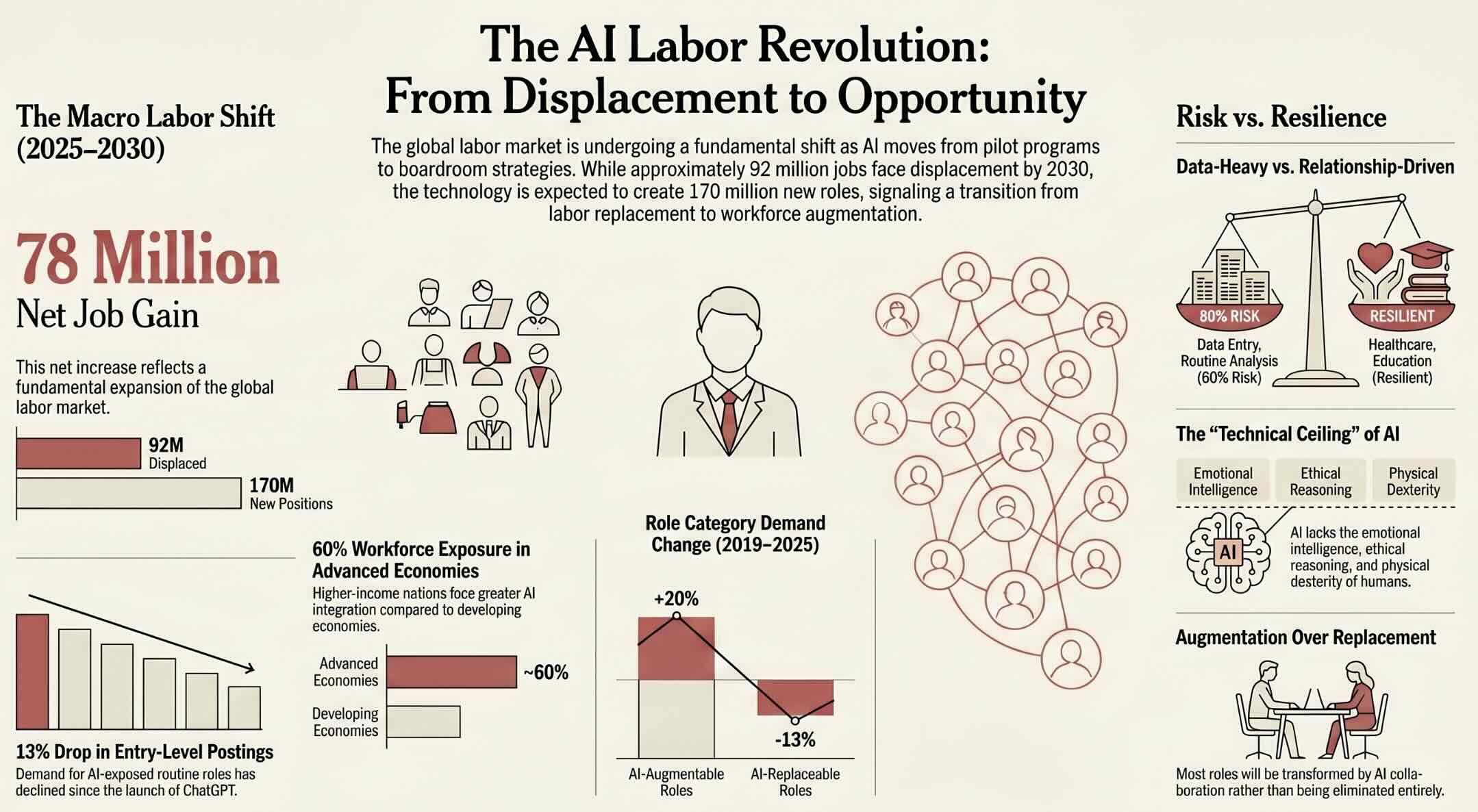
The question of whether artificial intelligence could fully replace human beings has shifted from science fiction to boardroom strategy in just a few years. According to the World Economic Forum’s Future of Jobs Report 2025, approximately 92 million jobs worldwide could be displaced by 2030 due to AI and related labor market shifts. That number represents roughly 8% of the current global workforce, and it is growing as companies scale automation beyond pilot programs. Machines now write legal briefs, diagnose medical images, compose music, and manage supply chains with minimal human oversight. Yet the same technological wave is also creating entirely new categories of employment that did not exist five years ago. The tension between displacement and creation sits at the center of one of the most consequential debates of our time. Understanding where AI excels, where it falls short, and how societies can adapt is essential for anyone navigating the modern economy.
Quick Answers on AI Replacing Humans
Could AI fully replace humans in the workforce?
AI can automate specific tasks and roles, but it cannot replicate human creativity, emotional intelligence, or complex ethical judgment, making full replacement unlikely in the foreseeable future.
Which jobs are most at risk of being replaced by AI?
Roles involving repetitive, data-heavy tasks like data entry, cashier positions, customer service, and routine financial analysis face the highest automation risk by 2030.
What is the difference between AI augmentation and AI replacement?
AI augmentation enhances human capabilities by handling routine subtasks, while AI replacement eliminates the need for human involvement in an entire role or function.
Key Takeaways
- Governments and organizations must invest in reskilling programs, social safety nets, and regulatory frameworks to manage the transition responsibly.
- AI is reshaping the labor market by automating routine and data-intensive tasks, but most roles will be transformed rather than eliminated entirely.
- Human qualities like creativity, emotional intelligence, ethical reasoning, and physical dexterity remain beyond the reach of current AI systems.
- The most resilient career strategy combines technical literacy with uniquely human skills, positioning workers to collaborate with AI rather than compete against it.
Table of contents
- Introduction
- Quick Answers on AI Replacing Humans
- Key Takeaways
- What Does It Mean for AI to Replace Humans?
- Where AI Already Outperforms People
- Jobs Most Vulnerable to AI Automation
- Why Human Intelligence Remains Irreplaceable
- The Technical Ceiling of Artificial Intelligence
- Emotional Intelligence and the Human Edge
- How Companies Are Automating Human Roles
- The Economic Ripple Effects of AI Displacement
- Ethical Dilemmas in Replacing Workers with Machines
- AI Bias and the Risk of Automated Decision-Making
- What History Teaches Us About Technology and Labor
- Reskilling and Workforce Adaptation Strategies
- The Rise of Human-AI Collaboration Models
- Industries That Will Resist Full Automation
- Regulatory Responses to AI-Driven Job Loss
- Long-Term Predictions for AI and the Future of Work
- What Experts Say About Artificial General Intelligence
- Preparing for a World Where AI and Humans Coexist
- Key Insights
- AI Capabilities Versus Human Strengths: A Comparison
- Real World Examples
- Case Studies
- Frequently Asked Questions About Whether AI Could Replace Humans
What Does It Mean for AI to Replace Humans?
AI replacing humans refers to the process by which artificial intelligence systems assume tasks, roles, or decision-making functions previously performed exclusively by people, reducing or eliminating the need for human involvement in those specific activities.
AI Job Impact Estimator
Explore how AI automation risk varies by industry, role type, and timeline. Adjust the controls to see projected displacement, augmentation, and resilience scores.
The concept spans a wide spectrum of possibilities, from narrow task automation to the theoretical prospect of machines matching general human cognition. At one end, a chatbot handling customer inquiries replaces a specific function within a broader role, while the human agent shifts to more complex cases requiring empathy and judgment. At the other extreme, some researchers envision artificial general intelligence that could perform any intellectual task a person can, though that milestone remains speculative and distant. The distinction between task replacement and total role elimination is critical because it shapes how organizations, workers, and policymakers should respond. Most current AI deployments fall firmly on the task automation side, where algorithms handle structured, repetitive subtasks while humans retain oversight, creative direction, and relationship management. Recognizing this spectrum helps separate productive planning from unproductive panic about a robotic takeover.
Framing the discussion accurately also requires understanding that replacement is rarely binary. A radiologist using AI to flag anomalies in medical scans is not being replaced; the diagnostic workflow is being restructured so that the physician spends less time on pattern recognition and more time on patient consultation. The real transformation is not the elimination of human workers but the redistribution of what humans spend their time doing. Companies that approach AI as a tool for workforce augmentation rather than wholesale replacement tend to see higher productivity gains and lower employee attrition. The language of replacement often obscures a more nuanced reality in which job descriptions evolve, skill requirements shift, and entirely new roles emerge alongside the ones that disappear.
Where AI Already Outperforms People
Artificial intelligence has already surpassed human performance in several well-defined domains, and the list continues to grow as models become more capable. In image recognition, deep learning systems now identify objects, faces, and medical anomalies with accuracy rates that exceed trained professionals in controlled settings. AlphaFold, developed by Google DeepMind, predicted protein structures with a precision that would have taken human researchers decades of laboratory work to achieve. Language models can process and summarize thousands of pages of legal documents in minutes, a task that would occupy a team of paralegals for weeks. These achievements are impressive, but they share a common characteristic: each operates within a narrowly defined problem space with clear inputs and measurable outputs. The pattern reveals that AI excels where data is abundant, rules are consistent, and success can be quantified objectively.
Manufacturing and logistics represent two industries where AI-powered automation has already reshaped daily operations. Robotic arms in automotive factories assemble components with tolerances that human hands struggle to match, and they operate around the clock without fatigue or injury risk. Amazon’s warehouse network uses machine learning to optimize inventory placement, predict demand patterns, and coordinate thousands of autonomous mobile robots across sprawling fulfillment centers. Financial trading algorithms execute millions of transactions per second, identifying arbitrage opportunities that exist for fractions of a moment, far beyond the reaction time of any human trader. In these controlled environments, the combination of speed, precision, and scalability gives AI a decisive advantage that no amount of human effort can match. Quality control systems powered by computer vision detect product defects at rates that dwarf manual inspection, reducing waste and improving consistency across production lines.
The healthcare sector offers some of the most compelling examples of AI outperformance in specific diagnostic tasks. AI models trained on retinal scans can detect diabetic retinopathy with accuracy comparable to, and sometimes exceeding, board-certified ophthalmologists, as documented in studies published in peer-reviewed journals. Pathology platforms analyze tissue samples for signs of cancer, flagging suspicious regions that human pathologists might overlook during long shifts. Natural language processing tools extract relevant clinical information from unstructured physician notes, saving hours of manual chart review per patient encounter. These tools do not replace the physician’s role in explaining a diagnosis, discussing treatment options, or providing emotional support to a frightened patient. They do replace the most time-intensive, repetitive elements of clinical workflows where automation improves outcomes, freeing clinicians to focus on the relational and judgment-intensive aspects of care.
Jobs Most Vulnerable to AI Automation
Understanding which roles face the greatest displacement risk requires looking beyond headlines and examining the task composition of specific occupations. Research from Brookings Institution found that approximately 6.1 million American workers occupy roles with both high AI exposure and low adaptive capacity, meaning they lack transferable skills, educational credentials, or geographic flexibility to transition easily. These workers are concentrated in clerical, administrative, and data-processing positions where the core tasks involve structured information handling. Office clerks, secretaries, and data entry operators top most vulnerability lists because the bulk of their work involves organizing, categorizing, and transmitting information, all tasks where AI systems excel with fewer errors and dramatically higher throughput.
The retail sector faces significant disruption as computer vision, self-checkout technology, and automated inventory management reduce the need for frontline staff. Retail cashiers confront an estimated 65% automation risk as stores deploy frictionless checkout systems that track purchases through cameras and sensors rather than human scanning. Customer service representatives in call centers are already being replaced at scale; Klarna announced in 2024 that its AI system handles work equivalent to 700 human agents, and similar deployments are accelerating across the banking, telecommunications, and insurance industries. Entry-level positions across multiple sectors are experiencing the sharpest declines, with early-career workers in AI-exposed occupations seeing a 13% drop in available job postings since ChatGPT launched in late 2022. These numbers suggest that the traditional career ladder, where young professionals learn foundational skills through routine tasks, is being disrupted before workers even begin climbing it.
Financial services represent another sector where AI is rapidly absorbing tasks once performed by junior analysts and back-office staff. Algorithmic systems now process loan applications, evaluate credit risk, flag fraudulent transactions, and generate investment research reports with minimal human intervention. Major banks anticipate average workforce reductions of around 3%, with the largest cuts concentrated in operations, compliance review, and transaction processing. Legal support roles face similar pressure, with paralegals confronting an estimated 80% automation risk as AI tools handle document review, contract analysis, and case research more efficiently than manual processes. The distinction between automation and AI becomes critical here because many of these jobs are not being eliminated by a single intelligent system but by a combination of robotic process automation, machine learning, and natural language processing working in concert.
Transportation and logistics jobs will face growing pressure as autonomous vehicle technology matures, though full replacement remains further away than some projections suggest. Long-haul trucking, last-mile delivery, and warehouse fulfillment are all targeted by companies investing billions in self-driving trucks, delivery drones, and autonomous mobile robots. The timeline for widespread adoption depends on regulatory approval, technological reliability in unpredictable real-world conditions, and public acceptance of machines operating in shared spaces. Warehouse workers already work alongside robotic systems in facilities run by Amazon, Walmart, and other major retailers, and the ratio of humans to machines shifts further toward automation with each facility upgrade. The transition will not happen overnight, but the direction is unmistakable, and workers in transportation-heavy roles should treat reskilling as an urgent priority rather than a distant consideration.
Why Human Intelligence Remains Irreplaceable
Despite the rapid progress of artificial intelligence, human cognition possesses qualities that current and foreseeable AI systems cannot replicate. Creativity, in its deepest form, involves synthesizing disparate experiences, emotions, cultural knowledge, and intuitive leaps to produce something genuinely original, not merely a statistical recombination of existing patterns. A novelist draws on decades of lived experience, emotional memory, and moral imagination to craft a story that resonates with readers on a deeply personal level. AI can generate text that mimics stylistic patterns, but it lacks the subjective experience that gives creative work its authenticity and emotional weight. The difference between generating plausible output and creating meaningful art lies in consciousness, intentionality, and the capacity to care about what is being made. These qualities are not computational problems waiting for more processing power; they emerge from the biological, social, and experiential nature of being human.
Human intelligence also excels in situations characterized by ambiguity, incomplete information, and rapidly shifting contexts. A seasoned diplomat navigating a tense negotiation reads body language, interprets cultural subtexts, manages competing interests, and adjusts strategy in real time based on intuitions that defy formal modeling. Emergency room physicians make life-or-death decisions with fragmentary data, drawing on years of training, pattern recognition, and clinical instinct that no algorithm has replicated in unstructured environments. AI systems perform best in domains with clear rules, consistent data, and measurable outcomes, but most of the situations that define human professional life involve precisely the opposite conditions. The messiness of real-world problems, where goals conflict, information is unreliable, and ethical considerations complicate technical solutions, remains a space where human judgment is not just useful but essential.
The Technical Ceiling of Artificial Intelligence
Current AI systems, including the most advanced large language models, operate through sophisticated pattern recognition and statistical prediction rather than genuine understanding or reasoning. A language model generates text by predicting the most probable next token in a sequence based on patterns learned from vast training datasets, not by comprehending meaning, evaluating truth, or forming beliefs about the world. This architecture produces remarkably fluent and often useful outputs, but it also produces confident-sounding errors, a phenomenon widely known as hallucination, that reveal the absence of any internal model of reality. The gap between statistical correlation and causal understanding represents a fundamental limitation that more data and larger models have not resolved. Researchers at institutions including MIT, Stanford, and DeepMind continue to investigate whether current approaches can ever bridge this gap or whether entirely new paradigms will be necessary.
Generalization remains one of the most persistent challenges in artificial intelligence research, and it directly limits the prospect of AI replacing humans across varied contexts. A model trained to diagnose skin cancer from dermatological images may fail when presented with images from a different camera system, patient population, or lighting condition, even though a human dermatologist would adapt effortlessly. Transfer learning and few-shot learning techniques have improved flexibility, but AI systems still struggle to apply knowledge acquired in one domain to genuinely novel situations the way human cognition does automatically. The brittleness of AI performance outside its training distribution is one of the strongest arguments against the near-term replacement of humans in roles that demand adaptability. Physical tasks requiring fine motor control, spatial reasoning in unpredictable environments, and real-time sensory integration also remain beyond the reach of AI-driven robotics in most practical settings, as anyone who has watched a robot attempt to fold laundry can confirm.
Ethical reasoning presents another ceiling that technology alone cannot break through, regardless of model scale or architectural innovation. Moral judgments require weighing competing values, considering context-dependent consequences, and applying principles that societies continue to debate and revise across generations. An AI system can be trained on ethical frameworks and instructed to follow rules, but it cannot genuinely deliberate about whether a rule is just or recognize when rigid rule-following produces outcomes that violate the spirit of the principle it was designed to uphold. Courts, hospitals, schools, and governments rely on human judgment precisely because these institutions operate in domains where the right answer depends on values, not just data. The ongoing conversation about AI ethics and accountability underscores how far technology must travel before it could be trusted to make decisions that carry moral weight.
Emotional Intelligence and the Human Edge
Emotional intelligence, the ability to perceive, understand, manage, and influence emotions, remains one of the most powerful differentiators between human workers and AI systems. Nurses who comfort frightened patients, teachers who sense when a student is struggling silently, and managers who navigate team dynamics through empathy and trust all depend on emotional capacities that no algorithm possesses. AI can analyze facial expressions, vocal tone, and text sentiment to generate probabilistic assessments of emotional states, but these outputs are pattern-matching exercises, not genuine empathy. The difference matters enormously in high-stakes interpersonal contexts where people need to feel heard, understood, and valued by another conscious being. Emotional labor, often undervalued in economic models, may prove to be the most automation-resistant category of human work precisely because it requires subjective experience that machines fundamentally lack.
The therapeutic relationship in mental health care illustrates why emotional intelligence cannot be outsourced to technology. A psychotherapist builds trust over months of sessions, reads subtle shifts in a client’s demeanor, and calibrates interventions based on a deep understanding of the individual’s history, personality, and relational patterns. AI chatbots designed for mental health support can deliver cognitive behavioral therapy exercises and track mood patterns, but they cannot replicate the healing power of a genuine human connection where one person feels truly seen by another. Grief counselors, social workers, chaplains, and hospice staff perform roles where the value they provide is inseparable from their humanity. These professions will likely grow in demand as AI automates transactional work and frees economic resources for the relational, caregiving, and meaning-making activities that define what it means to build a better human experience.
How Companies Are Automating Human Roles
Beyond the question of whether AI could replace humans lies the concrete reality of how companies are already doing it, one department at a time. The pattern across industries follows a predictable sequence: organizations identify high-volume, repetitive processes, deploy AI tools to handle those processes, measure the productivity gains, and then reduce headcount in the affected areas. Amazon announced plans to cut 14,000 corporate jobs in October 2025, with leadership explicitly citing AI’s transformative potential as a driver of organizational efficiency. Block, the payments company founded by Jack Dorsey, eliminated approximately 4,000 positions in February 2026, representing 40% of its global workforce. These are not isolated incidents but data points in a broad corporate trend toward leaner operations powered by machine intelligence.
Customer service departments have been among the first and most visible targets of AI-driven workforce reduction. Ikea announced in 2023 that it would phase out call center work in favor of an AI bot called Billie, designed to handle customer inquiries without human involvement. Insurance companies, telecommunications providers, and e-commerce platforms have followed similar paths, deploying conversational AI systems that resolve common queries, process returns, and update account information around the clock. The cost savings are substantial: a single AI agent can handle thousands of simultaneous interactions at a fraction of the cost of staffing a human call center. Workers displaced from these roles face the challenge of finding new positions in a labor market where the skills they developed, patience, communication, and problem-solving, are valuable but not easily matched to job postings that increasingly require technical proficiency.
The technology sector itself is not immune to the displacement it creates, and the way robotics is impacting the workplace extends beyond blue-collar roles into knowledge work. Google initiated multiple rounds of layoffs throughout 2024 and 2025, reallocating resources toward AI-focused teams while reducing headcount in areas where automation could absorb existing workloads. Pinterest announced a workforce reduction in January 2026, explicitly stating it was reshaping operations to prioritize AI-powered products and capabilities. The irony that technology companies are among the first to replace their own employees with the technology they build is not lost on industry observers. Software engineering, once considered one of the most automation-resistant professions, now faces questions about its long-term trajectory as AI coding assistants handle increasingly complex programming tasks, with Anthropic CEO Dario Amodei predicting AI will write essentially all code within a few years.
The Economic Ripple Effects of AI Displacement
The macroeconomic consequences of AI-driven job displacement extend far beyond the individuals who lose their positions, creating cascading effects throughout local economies and national labor markets. When a factory automates a production line and lays off 200 workers, the impact radiates outward to restaurants, retail stores, childcare providers, and housing markets that depend on those workers’ spending. Goldman Sachs estimated that AI could replace the equivalent of 300 million full-time jobs globally, a figure that, even if only partially realized, would reshape consumer spending patterns, tax revenues, and social welfare systems on a scale not seen since industrialization. Communities built around a single industry or employer face the greatest vulnerability because workforce displacement concentrates geographically, creating pockets of economic distress even amid broader national growth.
The distributional effects of AI displacement raise urgent questions about inequality and economic justice that policymakers have barely begun to address. Workers in high-exposure, low-adaptive-capacity roles tend to be disproportionately concentrated among lower-income households, communities of color, and regions with fewer educational institutions and retraining resources. The productivity gains from AI automation flow primarily to capital owners and shareholders, widening the gap between those who own the technology and those displaced by it. If left unmanaged, AI-driven displacement could accelerate wealth concentration to a degree that undermines social cohesion and democratic stability. The economic case for proactive intervention, through reskilling investment, portable benefits, earned income supplements, and equitable access to education transformed by artificial intelligence, grows stronger with each passing quarter as adoption accelerates.
International competition adds another layer of complexity because countries that adopt AI faster may gain significant economic advantages over those that move cautiously. Nations with strong technology sectors, flexible labor markets, and robust educational pipelines are better positioned to absorb the transition, while developing economies dependent on manufacturing and service outsourcing face disproportionate vulnerability. The International Monetary Fund estimates that 40% of jobs globally are exposed to AI, with the impact concentrated more heavily in advanced economies where 60% of roles could be affected. This dynamic creates a policy tension between the desire to protect workers from displacement and the competitive pressure to adopt AI quickly enough to maintain economic growth. Countries that find the right balance between innovation incentives and social protection will likely emerge from the AI transition with stronger, more resilient economies.
Ethical Dilemmas in Replacing Workers with Machines
Replacing human workers with AI systems raises ethical questions that resist easy answers and demand careful consideration from business leaders, technologists, and society at large. The most fundamental concern involves dignity: work provides not just income but identity, purpose, social connection, and a sense of contribution that pure economic analysis often undervalues. When a company automates an entire department, the affected workers lose not only their paychecks but also the daily routines, professional relationships, and self-conception that structured their lives. Ethical frameworks rooted in utilitarian calculation might justify displacement if aggregate productivity gains outweigh individual losses, but deontological perspectives insist that treating workers as expendable inputs violates basic principles of human respect. The tension between economic efficiency and moral obligation is not new, but AI accelerates it to a speed and scale that existing social institutions struggle to manage.
Corporate responsibility in the age of AI automation requires rethinking the relationship between employers and the communities that support them. Companies that extract years of labor from workers and then discard them when cheaper alternatives emerge bear some obligation to facilitate transition, whether through severance, retraining, or extended benefits. Some organizations have taken this seriously: Amazon invested $1.2 billion in its Upskilling 2025 program to retrain 300,000 employees for technical roles, though skeptics question whether warehouse workers can realistically transition to software engineering. The ethical minimum for any organization deploying AI to replace workers should include transparent communication, meaningful transition support, and honest acknowledgment that efficiency gains come at a human cost that balance sheets do not capture. The broader societal implications of AI-driven change demand that the conversation extend beyond quarterly earnings to include the long-term wellbeing of displaced workers and their families.
AI Bias and the Risk of Automated Decision-Making
When AI systems replace human decision-makers, they do not eliminate bias; they encode it into automated processes that operate at scale without the self-awareness to question their own assumptions. Training data reflects historical patterns of discrimination in hiring, lending, criminal justice, and healthcare, and models trained on this data reproduce those patterns with mechanical consistency. A hiring algorithm trained on a decade of resume data from a company that historically favored male candidates will systematically disadvantage female applicants unless explicitly corrected. The danger is compounded by the appearance of objectivity: because AI outputs arrive as numerical scores or categorical labels rather than subjective opinions, they carry an unearned aura of neutrality that makes bias harder to detect and challenge. Organizations that replace human judgment with algorithmic decision-making gain efficiency but risk institutionalizing discrimination at a velocity and scale that individual human biases rarely achieve.
The accountability gap in automated decision-making represents one of the most pressing challenges in AI governance and deployment. When a human loan officer denies a mortgage application, the applicant can ask for an explanation, file a complaint, and appeal the decision through established channels. When an AI system makes the same decision, the reasoning may be opaque even to the engineers who built it, and the pathways for contestation are often unclear or nonexistent. Regulatory frameworks like the European Union’s AI Act are beginning to address this gap by requiring transparency, human oversight, and impact assessments for high-risk AI applications. The replacement of human decision-makers with AI systems must be accompanied by robust accountability mechanisms, or the efficiency gains will be purchased at the cost of fairness, due process, and public trust. Companies deploying AI in consequential domains should conduct regular bias audits, maintain human review processes for disputed decisions, and ensure that the populations affected by automated decisions have meaningful recourse.
Bias in AI systems is not solely a technical problem that better engineering can solve; it reflects deeper structural inequities in the societies that produce the training data. Addressing algorithmic bias requires interdisciplinary collaboration among computer scientists, ethicists, sociologists, legal scholars, and the communities most affected by automated decisions. Diverse development teams are more likely to anticipate and test for bias patterns that homogeneous teams might overlook, but diversity alone is insufficient without institutional commitment to equity-centered design. The question of whether AI could replace humans in sensitive decision-making roles cannot be answered purely on grounds of technical capability; it requires answering the prior question of whether society can build AI systems that are fair enough to be trusted with the power they are given.
What History Teaches Us About Technology and Labor
Every major technological revolution in history has triggered widespread fear of permanent job destruction, and every one has ultimately created more employment than it eliminated, though the transitions were rarely smooth or painless. The introduction of the mechanical loom in the early 19th century provoked the Luddite uprising, as skilled textile workers saw their livelihoods threatened by machines that could produce fabric faster and cheaper than human hands. Agricultural mechanization displaced millions of farm workers over the course of a century, yet the manufacturing and service economies that emerged absorbed far more workers than farming ever employed. The automobile eliminated entire industries built around horse-drawn transportation while creating exponentially larger industries in manufacturing, infrastructure, energy, and suburban development. These historical parallels offer both reassurance and caution: technology creates more than it destroys in the aggregate, but the individuals and communities caught in the transition often suffer deeply before the new opportunities materialize.
The key lesson from past technological disruptions is that the timeline of adjustment matters as much as the eventual outcome, and societies that invest in transition support recover faster than those that leave displaced workers to fend for themselves. The decline of American manufacturing employment in the late 20th century illustrates what happens when policy fails to match the pace of change: entire regions were economically devastated for decades, and many have never fully recovered. History demonstrates that technological progress is inevitable, but equitable distribution of its benefits is not; it requires deliberate policy choices, institutional investment, and political will. The AI transition may follow a similar pattern, but with one critical difference: the speed of AI adoption is orders of magnitude faster than previous technological shifts, compressing the window for adjustment from decades into years.
Reskilling and Workforce Adaptation Strategies
The scale and speed of AI-driven disruption demand reskilling initiatives that go far beyond traditional corporate training programs, requiring coordinated effort from governments, educational institutions, employers, and workers themselves. The World Economic Forum estimates that by 2030, the equivalent of 92 million roles will be displaced while 170 million new roles will be created, but the new positions require fundamentally different skills than the ones they replace. Data literacy, AI tool proficiency, critical thinking, and complex problem-solving are becoming baseline requirements across industries that previously valued manual dexterity and procedural knowledge. Community colleges, online learning platforms, and employer-sponsored programs all play a role, but the current system is fragmented, underfunded, and poorly matched to the pace of change.
Effective reskilling requires understanding that the transition is not simply about teaching displaced workers to code; it is about helping them identify and develop the transferable skills they already possess. A customer service representative who spent years reading emotional cues, de-escalating conflicts, and solving problems under pressure has abilities that are highly relevant to roles in user experience research, community management, and client success. A factory worker with spatial reasoning, mechanical intuition, and quality control experience can transition to robotics maintenance, industrial inspection, or technical operations with the right bridge training. The most successful reskilling programs connect existing human strengths to emerging roles rather than asking workers to start from scratch in an entirely unfamiliar domain. Framing reskilling as capability extension rather than replacement reduces psychological resistance and improves completion rates.
Employer-led reskilling initiatives show promise when they are genuinely invested in worker outcomes rather than serving as public relations exercises. Companies like AT&T, which invested over $1 billion in workforce retraining, and Accenture, which committed to reskilling hundreds of thousands of employees in AI-related competencies, demonstrate that large-scale programs are feasible when leadership commitment matches the rhetoric. Smaller organizations can leverage partnerships with community colleges, industry associations, and government-funded programs to provide training they cannot deliver independently. The key success factor across all program sizes is relevance: training must connect to actual job openings that pay a living wage, or workers quickly recognize that they are being offered the appearance of opportunity without its substance.
Governments bear a particular responsibility to support workers who lack the resources or networks to navigate the transition independently, especially those in roles with the highest automation risk and lowest adaptive capacity. Portable benefits that follow workers between jobs and industries, extended unemployment insurance linked to retraining participation, earned income supplements that ease the financial pressure of career transitions, and public investment in regional economic diversification all represent policy tools with historical precedent and demonstrated effectiveness. The transition to an AI-augmented economy will not distribute its costs evenly, and the question of whether robots are taking our jobs is less important than the question of what society will do to support those who are affected. Without deliberate intervention, the AI transition risks repeating the pattern of past technological shifts where gains concentrate at the top while costs fall disproportionately on those least equipped to absorb them.
The Rise of Human-AI Collaboration Models
The most productive relationship between humans and artificial intelligence is not replacement but collaboration, where each party contributes the capabilities the other lacks. Harvard Business School professor Karim Lakhani captured this principle in a widely cited observation that AI will not replace humans, but humans using AI will replace those who do not. This framing shifts the conversation from a zero-sum competition between people and machines to a complementary partnership where AI handles data processing, pattern recognition, and repetitive computation while humans contribute judgment, creativity, ethical reasoning, and interpersonal skills. Organizations that adopt this collaborative model report higher productivity gains than those that pursue pure automation, because the combination of human insight and machine efficiency exceeds what either achieves alone.
In practice, human-AI collaboration takes many forms depending on the industry and task. Radiologists who use AI-assisted diagnostic tools review more cases with greater accuracy than either humans or AI working independently, because the physician catches errors the algorithm makes and the algorithm flags patterns the physician might miss. Software engineers use AI coding assistants to generate boilerplate code, identify bugs, and suggest optimizations, freeing their cognitive bandwidth for architectural decisions and user experience design that require creative judgment. Journalists employ AI tools to analyze datasets, identify trends, and generate first drafts, then apply editorial judgment, fact-checking, and narrative craft to produce stories that neither human nor machine could create as efficiently alone. The collaborative model works best when organizations deliberately design workflows that leverage the strengths of both parties rather than simply inserting AI tools into existing human-centric processes. The real stories of human-machine collaboration in the workplace demonstrate that thoughtful integration produces better outcomes than either full automation or unchanged manual processes.
The shift toward collaboration requires changes in how organizations train, evaluate, and compensate their workforce. Workers need to develop AI literacy, the ability to understand what AI tools can and cannot do, how to prompt them effectively, and when to override their recommendations. Managers must learn to design workflows that allocate tasks between human and AI participants based on comparative advantage rather than tradition or convenience. Performance metrics should reward the quality of human-AI teamwork rather than measuring human and machine contributions separately. Educational institutions, from elementary schools to professional development programs, are beginning to integrate AI collaboration skills into their curricula, recognizing that the ability to work effectively with intelligent tools will be as fundamental as computer literacy became in the 1990s.
Industries That Will Resist Full Automation
Certain industries possess structural characteristics that make full AI replacement impractical for the foreseeable future, regardless of how sophisticated the technology becomes. Skilled trades like plumbing, electrical work, carpentry, and HVAC repair require physical presence, manual dexterity, spatial problem-solving in unpredictable environments, and the ability to adapt to unique conditions in every building, home, or jobsite. A plumber diagnosing a leak in a century-old building must navigate spaces that no robot can access, interpret visual and tactile cues that sensors cannot replicate, and improvise solutions based on materials and conditions that vary with every job. These roles combine physical skill, cognitive flexibility, and real-world judgment in ways that current robotics and AI systems cannot approximate, and the shortage of skilled tradespeople in many countries suggests these positions will grow more valuable, not less.
Healthcare, education, and social services represent sectors where human connection is not a nice-to-have supplement to the primary function but the primary function itself. A kindergarten teacher who shapes a child’s social development, a hospice nurse who provides comfort during the final days of life, and a social worker who helps a family navigate a crisis all deliver value that is inseparable from their presence as caring human beings. AI tools can support these professionals by handling paperwork, analyzing data, and identifying patterns, but the core of the work remains irreducibly human. Industries where trust, empathy, and physical adaptability define the value proposition will resist full automation because the qualities they depend on are precisely the ones that machines do not possess. Creative industries, from the redefinition of art through generative AI to live performance and fine art, will continue to value authentic human expression even as AI tools transform the production process.
Regulatory Responses to AI-Driven Job Loss
Governments around the world are beginning to grapple with the regulatory challenge of managing AI’s impact on employment, though the pace of policy development lags significantly behind the pace of technological adoption. The European Union’s AI Act, which entered into force in stages beginning in 2024, represents the most comprehensive regulatory framework to date, establishing risk categories for AI applications and requiring transparency, human oversight, and impact assessments for high-risk deployments. The Act does not directly regulate job displacement, but its requirements for transparency and accountability create indirect protections by ensuring that workers and regulators can understand how AI systems are being used in consequential decisions affecting employment, access to services, and economic opportunity.
In the United States, regulatory approaches remain fragmented across federal agencies, state governments, and municipal authorities, creating a patchwork of rules that varies widely by jurisdiction and sector. Some states have enacted laws requiring employers to disclose when AI is used in hiring decisions, while others have focused on algorithmic accountability in areas like criminal justice and financial services. The lack of a unified federal framework means that workers’ protections depend heavily on where they live and work, and companies operating across state lines face compliance complexity that favors large corporations with dedicated legal teams over smaller businesses. The regulatory gap between the speed of AI deployment and the speed of governance reform is one of the most significant risks in the current transition, because it allows displacement to accelerate without the safety nets and accountability structures that responsible adoption requires.
International coordination on AI labor policy is emerging but remains fragile, driven by competing national interests and divergent economic philosophies. The G7, OECD, and United Nations have all issued frameworks and guidelines for responsible AI development, but these instruments are advisory rather than binding, and enforcement depends on the political will of individual governments. Countries that invest heavily in AI to gain competitive advantage may resist regulations they perceive as slowing innovation, while countries with weaker technology sectors may lack the institutional capacity to implement effective protections even if they are willing. The challenge is designing regulatory frameworks that protect workers without stifling the innovation that ultimately creates new employment opportunities and economic growth, and ongoing debates about AI’s broader societal transformation suggest that the conversation is far from resolved.
Long-Term Predictions for AI and the Future of Work
Forecasting AI’s long-term impact on employment requires humility, because the history of technology predictions is littered with spectacular failures in both directions, from overestimating flying cars to underestimating smartphones. The most credible projections suggest that AI will reshape far more jobs than it eliminates outright, transforming task compositions within existing roles rather than making entire occupations obsolete overnight. Boston Consulting Group’s 2026 analysis found that task automation does not equal job loss for most of the workforce, with the majority of AI-exposed roles falling into categories where technology augments human capabilities rather than substitutes for them entirely. The World Economic Forum projects that while 92 million roles may be displaced by 2030, approximately 170 million new roles will be created, resulting in a net gain of 78 million positions globally, though the skills required for the new roles differ substantially from those of the displaced ones.
The wild card in all long-term forecasting is artificial general intelligence, a hypothetical system capable of performing any intellectual task that a human being can, which would fundamentally alter the replacement equation if achieved. Current AI systems are narrow specialists that excel within defined domains but cannot transfer knowledge, adapt to novel situations, or reason abstractly the way humans do naturally. Whether AGI is five years, fifty years, or centuries away, or whether it is even possible in principle, remains one of the most contested questions in computer science, and the answer will determine whether the future of work involves collaboration with intelligent tools or competition with intelligent beings. For practical planning purposes, the most responsible approach is to prepare for a future in which AI continues to automate specific tasks within human roles while remaining alert to the possibility that more transformative breakthroughs could accelerate the timeline in ways that are difficult to predict.
What Experts Say About Artificial General Intelligence
The prospect of artificial general intelligence sits at the center of the replacement debate because AGI, if achieved, would represent a qualitative leap from tools that assist humans to systems that could potentially match or exceed human capabilities across all cognitive domains. Geoffrey Hinton, the Nobel Prize-winning computer scientist often called the godfather of AI, has warned that AI will gain the capability to replace many jobs and that the technology improves at a pace where tasks that once took hours now take minutes. His concern extends beyond economics to existential risk, as he has argued that superintelligent AI systems could pose dangers that humanity is not prepared to manage. These warnings carry weight because Hinton’s contributions to deep learning helped create the technology he now cautions against, lending his perspective a credibility that more speculative voices lack.
Other leading researchers offer more measured assessments that emphasize the distance between current capabilities and genuine general intelligence. Yann LeCun, Meta’s chief AI scientist, has argued that large language models, despite their impressive outputs, lack the world models and planning capabilities necessary for anything approaching human-level understanding. The absence of embodied experience, sensory grounding, and causal reasoning in current architectures represents a gap that scaling alone is unlikely to bridge. Researchers working on neurosymbolic AI, embodied cognition, and developmental approaches believe that fundamentally new paradigms will be necessary before machines can achieve the flexible, context-sensitive intelligence that humans develop through years of physical interaction with the world. The expert community is genuinely divided, not on whether current AI is impressive, which is universally acknowledged, but on whether the path from impressive pattern matching to genuine understanding is a straight road or requires navigating terrain that has not yet been mapped.
The practical implication of this expert disagreement is that organizations and policymakers should plan for a range of scenarios rather than betting on a single prediction. Building workforce resilience, investing in adaptable educational systems, strengthening social safety nets, and maintaining human oversight of AI systems are strategies that make sense whether AGI arrives in a decade or never. The worst outcome would be to assume AGI is imminent and surrender human agency prematurely, or to assume it is impossible and fail to prepare for capabilities that arrive sooner than expected. A measured approach that takes seriously both the potential for AI to transform how robots function in everyday life and the enduring value of human cognition provides the most robust foundation for navigating an uncertain future.
Preparing for a World Where AI and Humans Coexist
Preparing for a future of human-AI coexistence requires individuals, organizations, and societies to move beyond the binary framing of replacement versus preservation and embrace a more nuanced understanding of how intelligent systems will integrate into every aspect of economic and social life. The evidence overwhelmingly suggests that AI will transform work rather than eliminate it, but the transformation will be profound enough to demand proactive adaptation at every level. Workers who develop complementary skills, the ability to do what AI cannot, while also learning to leverage AI tools for what they do best, will occupy the strongest positions in the evolving labor market. This means investing in creativity, emotional intelligence, ethical reasoning, physical dexterity, and the capacity for complex judgment under uncertainty, the very qualities that define human distinctiveness.
Organizations bear a responsibility to lead the transition with transparency, fairness, and genuine investment in their workforce. The companies that will thrive in an AI-augmented economy are those that treat their employees as partners in transformation rather than costs to be minimized, involving workers in the design of new workflows, providing meaningful retraining opportunities, and sharing the productivity gains that AI enables rather than capturing them exclusively for shareholders. Building a culture where AI tools are seen as collaborators rather than competitors requires deliberate organizational design, clear communication about how automation decisions are made, and accountability structures that protect workers from arbitrary displacement. The human element of this transition is not a soft consideration to be addressed after the technical implementation is complete; it is the foundation on which successful adoption is built.
Educational systems must evolve to prepare the next generation for a world where AI is as ubiquitous as electricity, equipping students not just with technical skills but with the adaptive mindset and interdisciplinary thinking that rapid technological change demands. Curricula should integrate AI literacy from an early age, teaching students how to use intelligent tools effectively, evaluate their outputs critically, and understand their limitations and ethical implications. Equally important is the cultivation of capacities that AI cannot replicate: creative expression, collaborative problem-solving, moral reasoning, and the ability to find meaning and purpose in a world where machines handle an increasing share of routine cognitive labor. The goal of education in the age of AI is not to compete with machines on their terms but to develop the distinctly human capacities that make the partnership between people and technology productive, ethical, and fulfilling. The role of AI in reshaping how we think about inside Amazon’s smart warehouses and beyond offers a preview of how integrated these systems will become across all sectors.
The question posed in the title, “Could AI replace humans?”, ultimately has a more complex answer than a simple yes or no. AI will replace specific tasks, transform many roles, eliminate some jobs, and create others that do not yet have names. It will not replace human consciousness, creativity, empathy, moral reasoning, or the desire for meaning that drives the most important dimensions of human life. The future belongs not to those who resist AI or those who surrender to it, but to those who learn to work alongside it while preserving and cultivating the qualities that make human beings irreplaceable in the deepest sense. Societies that invest in this balance, through education, policy, corporate responsibility, and individual initiative, will navigate the AI transition successfully and emerge stronger for having met the challenge.
Key Insights
- According to the World Economic Forum’s Future of Jobs Report 2025, approximately 92 million jobs could be displaced globally by 2030, while 170 million new positions are expected to emerge, resulting in a net gain of 78 million roles that require fundamentally different skill sets.
- Research from the Brookings Institution found that 6.1 million American workers, roughly 4.2% of the workforce, face both high AI exposure and low adaptive capacity, making them the most vulnerable to displacement without targeted intervention.
- A Harvard Business School working paper analyzing job postings from 2019 through March 2025 found that postings for AI-replaceable occupations fell 13% while demand for AI-augmentable roles grew 20%, revealing a clear bifurcation in the labor market.
- The International Labour Organization’s 2025 research determined that only 3.3% of global employment falls into the highest AI exposure category, with the vast majority of affected workers in the augmentation zone rather than the replacement zone.
- BCG’s 2026 analysis concluded that task automation does not equal job loss for most roles, with the majority of AI-exposed occupations requiring human oversight, judgment, and relational skills that technology cannot provide.
- A Goldman Sachs report estimated that generative AI could automate the equivalent of 300 million full-time jobs worldwide, representing the most significant potential labor market shift since industrialization began.
- Data compiled by DemandSage from multiple industry sources indicates that 37% of business leaders plan to replace human workers with AI by the end of 2026 as pilot programs transition to full-scale deployment.
The convergence of these data points paints a picture of a labor market in rapid transformation rather than collapse. The net job creation projections from the World Economic Forum suggest that AI is generating more opportunities than it destroys, but the skills mismatch between displaced and created roles creates a critical adjustment gap. Workers in routine, structured occupations face genuine displacement risk, while those in adaptive, judgment-intensive, and relational roles are more likely to see their positions enhanced rather than eliminated. The central challenge is not total job destruction but the speed and equity of the transition, which depends on investments in reskilling, social protection, and policy frameworks that ensure the gains from AI-driven productivity are broadly shared.
AI Capabilities Versus Human Strengths: A Comparison
| Dimension | AI Systems | Human Workers |
|---|---|---|
| Transparency | Operates as a black box in complex models; decisions often opaque even to creators | Can explain reasoning, justify decisions, and be held personally accountable |
| Participation | Cannot participate in social, civic, or organizational governance meaningfully | Actively shapes workplace culture, advocates for change, and engages in collective bargaining |
| Trust | Earns procedural trust through consistent outputs but cannot build relational trust | Builds trust through shared experiences, empathy, vulnerability, and demonstrated integrity |
| Decision Making | Excels at data-driven decisions in structured environments with clear objectives | Navigates ambiguity, weighs competing values, and makes judgment calls in unstructured contexts |
| Misinformation | Prone to generating plausible but false outputs (hallucinations) at scale without self-awareness | Capable of critical evaluation, source verification, and contextual skepticism |
| Service Delivery | Delivers consistent, scalable, 24/7 service for routine transactions and inquiries | Provides personalized, emotionally attuned service that adapts to individual needs and crises |
| Accountability | Accountability gaps persist; no legal personhood or moral responsibility for outcomes | Bears moral, legal, and professional responsibility for decisions and their consequences |
Real World Examples
Walmart’s AI-Powered Supply Chain Optimization
Walmart deployed machine learning across its supply chain to forecast demand, optimize inventory placement, and reduce waste across thousands of stores and distribution centers. The system analyzes billions of data points, including weather patterns, local events, and historical sales trends, to predict what products customers will need before they arrive at the store. According to Walmart’s corporate technology team, the initiative reduced out-of-stock incidents by approximately 30% and cut food waste significantly, generating billions in savings annually. Critics note that the gains have coincided with reduced staffing in store logistics departments, raising questions about whether efficiency improvements are being shared equitably with the workers whose roles are changing.
JPMorgan Chase’s COiN Contract Intelligence Platform
JPMorgan Chase developed COiN, a contract intelligence platform that uses natural language processing to review commercial loan agreements and extract critical data points, a task that previously required approximately 360,000 hours of lawyer and loan officer time annually. The system processes documents in seconds that would take human reviewers hours to analyze, with fewer errors and greater consistency across thousands of contracts. According to JPMorgan’s technology leadership, the platform freed legal and compliance teams to focus on higher-value advisory work rather than document review. The limitation is that COiN handles structured, repetitive document analysis well but struggles with unusual contract structures, ambiguous language, and the kind of judgment-intensive interpretation that complex deals require.
Siemens Healthineers’ AI-Driven Diagnostic Imaging
Siemens Healthineers integrated AI algorithms into its diagnostic imaging platforms, enabling automated detection of anomalies in chest X-rays, CT scans, and MRI images that radiologists might miss during high-volume reading sessions. The system flags suspicious findings and prioritizes urgent cases, reducing the time between scan acquisition and clinical action in emergency departments. According to Siemens Healthineers’ clinical evidence publications, hospitals using the platform reported a 25% reduction in diagnostic turnaround time and measurable improvements in early detection of conditions including pulmonary embolism and stroke. The technology works as an assistive tool rather than a replacement for radiologists, and its performance degrades when applied to image types, patient populations, or equipment configurations that differ from its training data.
Case Studies
Klarna’s AI Customer Service Transformation
Klarna, the Swedish buy-now-pay-later company, faced mounting customer service costs as its user base expanded rapidly across international markets, with millions of daily inquiries straining its human agent capacity. The company deployed a conversational AI system in 2024 capable of handling the equivalent workload of 700 full-time customer service agents, managing common queries including payment tracking, return processing, and account management. The system resolved most inquiries within minutes, operating in multiple languages around the clock, and Klarna reported significant cost reductions that contributed to the company’s path toward profitability. Skeptics point out that Klarna’s approach shifts jobs from the company’s balance sheet to external agencies rather than eliminating them entirely, and customer satisfaction data for complex, emotionally charged service interactions has not matched the performance of human agents.
AT&T’s Workforce Reskilling Initiative
AT&T recognized in the mid-2010s that rapid technological change was rendering many of its existing roles obsolete, with nearly half its workforce lacking the skills needed for the company’s evolving operations. The company launched a $1 billion reskilling program called Future Ready, offering employees access to online courses, nanodegree programs through partnerships with Udacity, and tuition reimbursement for relevant degree programs at accredited universities. According to AT&T’s workforce development reports, employees who participated in reskilling programs were twice as likely to receive promotions and significantly less likely to leave the company voluntarily, demonstrating that investment in human capital can yield measurable returns. The program’s limitation is that participation was voluntary and completion rates were uneven, with workers in the most vulnerable roles often the least likely to engage, highlighting the gap between offering opportunity and ensuring equitable access.
Unilever’s AI-Powered Talent Acquisition
Unilever overhauled its graduate recruitment process by implementing AI-driven screening tools that assess candidates through online games measuring cognitive abilities, video interviews analyzed by machine learning algorithms, and digital simulations of workplace scenarios. The system processes hundreds of thousands of applications annually, reducing the time from application to offer by approximately 75% and cutting recruitment costs substantially, according to Unilever’s human resources leadership. The AI system also increased diversity in Unilever’s candidate pipeline by reducing the influence of resume-based signals like university name and prior employer that correlate with socioeconomic background. The controversy centers on whether AI can reliably assess qualities like leadership potential and cultural fit from brief digital interactions, and critics have raised concerns about algorithmic bias in video analysis that may disadvantage candidates with certain speech patterns, accents, or physical characteristics.
Frequently Asked Questions About Whether AI Could Replace Humans
Complete replacement of human workers by 2030 is extremely unlikely based on current evidence and expert analysis. The World Economic Forum projects that while 92 million roles may be displaced, approximately 170 million new roles will emerge, creating a net gain of 78 million positions globally. Most AI deployments are transforming task compositions within existing jobs rather than eliminating entire occupations.
Roles requiring deep emotional intelligence, complex physical dexterity in unpredictable environments, creative originality, and ethical judgment are most resistant to AI automation. Skilled trades like plumbing and electrical work, healthcare professions centered on patient relationships, creative roles requiring authentic human expression, and leadership positions demanding moral reasoning all possess qualities that current AI cannot replicate.
Entry-level positions are disproportionately affected because they often involve the structured, repetitive tasks that AI automates most effectively. Research shows a 13% decline in job postings for AI-exposed entry-level roles since late 2022, threatening traditional career ladders where young professionals develop foundational skills through routine work before advancing to more complex responsibilities.
AI can generate novel combinations of existing patterns, producing text, images, and music that appear creative, but it cannot originate ideas from lived experience, emotional depth, or intentional meaning-making. The distinction between statistical recombination and genuine creativity lies in consciousness and subjective experience, qualities that current AI architectures do not possess and that more computing power alone is unlikely to produce.
Workers should develop skills that complement AI rather than compete with it, focusing on creativity, emotional intelligence, complex problem-solving, ethical reasoning, and the ability to use AI tools effectively. Investing in continuous learning, building transferable skills across domains, and cultivating adaptability will position workers to thrive in roles where human-AI collaboration defines the workflow.
Regulatory responses vary widely by region. The European Union’s AI Act establishes the most comprehensive framework, with risk-based categories and transparency requirements for high-stakes AI applications. The United States relies on a patchwork of state-level regulations and agency-specific guidelines, while international bodies like the OECD and UN have issued advisory frameworks without binding enforcement mechanisms.
AI augmentation enhances human capabilities by handling routine subtasks within a role, allowing workers to focus on higher-value activities requiring judgment, creativity, and interpersonal skills. AI replacement eliminates the need for human involvement in an entire function or role. Research consistently shows that augmentation produces better outcomes than full replacement for most occupations.
Expert opinion is deeply divided on AGI timelines. Some researchers believe current scaling trends could produce AGI within a decade, while others argue that fundamentally new architectural paradigms are necessary and that the timeline could extend decades or longer. The gap between impressive pattern matching and genuine general intelligence remains substantial and may not be bridgeable through incremental improvements to existing approaches.
When AI replaces human decision-makers, it can encode historical biases into automated systems that operate at scale without self-awareness. Training data reflecting past discrimination in hiring, lending, and criminal justice produces outputs that systematically disadvantage affected populations. Robust bias auditing, diverse development teams, and human oversight are essential to prevent AI replacement from institutionalizing and amplifying existing inequities.
Education must evolve to integrate AI literacy, critical thinking, and adaptive skill development alongside traditional academic content. Students need to learn how to use AI tools effectively, evaluate their outputs critically, understand their limitations, and develop the distinctly human capacities, including creativity, ethical reasoning, and collaborative problem-solving, that AI cannot replicate.
Historical precedent and current projections suggest that AI will create more positions than it eliminates in the aggregate, though the transition period involves significant displacement for specific workers and communities. The World Economic Forum projects a net gain of 78 million jobs by 2030, but the new roles require different skills than the displaced ones, making reskilling investment critical to realizing that potential.
Manufacturing, financial services, retail, customer service, transportation, and administrative support face the highest near-term displacement risk because they involve large volumes of structured, repetitive tasks. Healthcare diagnostics, legal research, and content production are also experiencing significant AI integration, though typically in augmentation rather than full replacement configurations.
Ethical management requires transparent communication about automation plans, meaningful investment in retraining and transition support, fair severance for displaced workers, and genuine effort to share productivity gains across the organization rather than capturing them exclusively for shareholders. Companies should involve affected workers in the design of new workflows and maintain accountability for the human impact of their technology decisions.
AI-driven displacement creates cascading economic effects because job losses in one sector reduce consumer spending that supports adjacent businesses and services. Communities dependent on a single industry or employer face the greatest vulnerability, potentially experiencing prolonged economic distress similar to the effects of deindustrialization in the late 20th century. Proactive investment in economic diversification and social safety nets can mitigate these impacts.