
Introduction
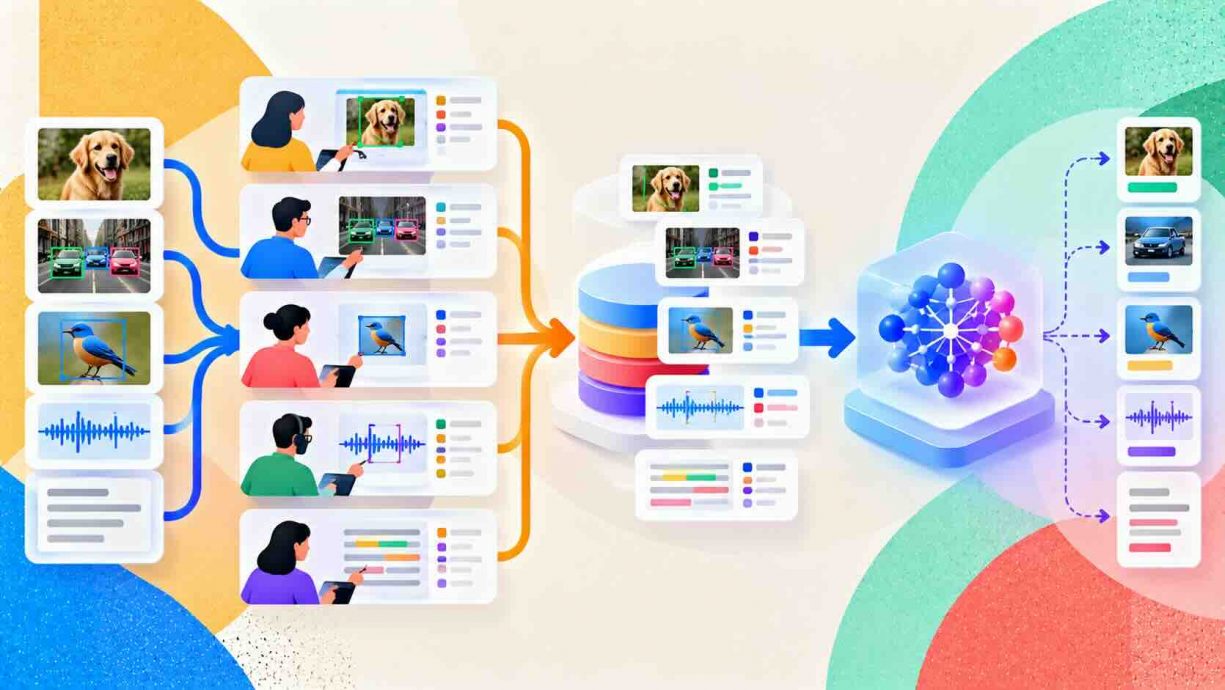
Every supervised model learns from examples that people described first, and one question sums up that work: What Is AI Data Labeling Explained How Training Data Is Annotated? Data labeling attaches tags, boxes, transcripts, or rankings to raw files so that an algorithm can measure its own mistakes during training. The market around that work is growing quickly, with Technavio estimating growth of USD 1,414.9 million between 2025 and 2029 at a 21.1 percent compound annual rate. Behind that figure sit people, platforms, and quality rules that decide whether a model learns the right lesson or a confident mistake. Researchers found that roughly 3.3 percent of test labels across ten popular benchmarks were wrong on average, so even famous datasets carry noise. This article walks through definitions, label types, workflows, quality control, costs, ethics, and the future of annotation. By the end, you will know how a raw photo, sentence, or voice clip becomes a reliable lesson for a machine.
Quick Answers on AI Data Labeling and Training Data
What is AI data labeling?
AI data labeling is the process of attaching tags, boxes, transcripts, or rankings to raw images, text, audio, or video so a model can learn from examples. Those attached answers are called ground truth.
How is training data annotated?
Teams write guidelines, assign items to trained annotators, collect labels, measure agreement, resolve disputes, and export the approved dataset. Model-assisted pre-labeling speeds the first pass while humans verify the output.
Why does labeling quality matter for AI?
Models copy their labels, including the mistakes. A 2021 study found about 3.3 percent of test labels were wrong across ten benchmark datasets, enough to change which model looks best.
Key Takeaways
- AI data labeling turns raw files into ground truth that supervised models learn from and are tested against.
- Good annotation depends on clear guidelines, trained reviewers, agreement metrics, and repeated audits, not on tools alone.
- Labels come from in-house experts, crowds, managed vendors, programmatic rules, and increasingly from models acting as judges.
- Costs, wages, privacy duties, and label noise are real constraints that deserve a budget and an owner before scaling.
Table of contents
- Introduction
- Quick Answers on AI Data Labeling and Training Data
- Key Takeaways
- Understanding AI Data Labeling in Plain Terms
- Why Supervised Models Depend on Ground Truth
- The Anatomy of a Labeled Example
- Label Types for Images, Video, Text, and Audio
- Building an Annotation Workflow from Guidelines to Delivery
- Who Does the Labeling: In-House, Crowd, and Managed Teams
- Annotation Tools and Model-Assisted Pre-Labeling
- Quality Control: What Is Good Enough and How Agreement Is Measured
- Weak Supervision and Programmatic Labeling
- How Human Feedback Labels Shape Large Language Models
- What Data Labeling Costs and How This Spend Is Budgeted
- Where Labeling Falls Short: Noise, Bias, and Drift
- Ethics of the Data Work Behind AI
- Privacy, Security, and Regulation of Training Data
- Putting Labeling Into Practice: A Pilot Playbook
- Future of Data Labeling: Synthetic Labels and AI Feedback
- Key Insights
- Lessons From Labeling in Practice: Three Worked Examples
- Lessons From Case Studies in AI Data Labeling
- Common Questions About AI Data Labeling and Annotation
Understanding AI Data Labeling in Plain Terms
What Is AI Data Labeling Explained How Training Data Is Annotated? It is the human and machine work of tagging raw images, text, audio, and video with correct answers, called ground truth, so supervised models can learn patterns and be tested.
An Interactive From AIplusInfo
Estimate Your Annotation Budget and Label Accuracy
Move the controls to see how dataset size, label type, and reviewer count change the hours, cost, and expected accuracy of a labeling project.
50,000
Bounding boxes
3
90%
$15
0
All annotators plus 20% review overhead.
$0
Per item: $0
0%
0
Out of the full dataset.
Planning defaults for seconds per item are illustrative, so replace them with timings from your own pilot. The model assumes independent annotators and binary decisions. For a real benchmark, a study of ten popular datasets found about 3.3 percent label errors in test sets on average.
Why Supervised Models Depend on Ground Truth
A supervised model begins as a flexible function with random settings, and it improves only by comparing its guesses against known answers. Those known answers are the labels, and the gap between a guess and a label is the error signal that drives learning. Without that signal the model has nothing to correct itself against, which is why the supervised learning paradigm is the most common approach in applied machine learning. Labels are therefore not decoration on a dataset; they are the teacher that defines what the model is allowed to call correct. A photo tagged "cat" teaches a vision model to associate certain pixel patterns with that word, and a mislabeled photo teaches the wrong association just as faithfully.
Ground truth also serves a second purpose, because the same labels measure how well a trained model performs on unseen data. Teams hold back a validation set and a test set, then compare predictions against the reference labels to compute accuracy, precision, recall, and similar scores. If the held-back labels contain errors, every reported score inherits that error, and a model can look better or worse than it truly is. This double duty is why careful teams treat the test set labels as the most protected asset in the whole project. A common safeguard is to have senior reviewers label the test set separately from the training pool. Doing so keeps quick, noisy production labeling from leaking into the numbers that decide whether a model ships.
Not every system needs hand labels, and the contrast clarifies the role of annotation. Unsupervised methods find structure without answers, and semi-supervised learning methods combine a small labeled pool with a large unlabeled one to stretch scarce annotation budgets. Self-supervised pretraining, used by large language models, creates its own targets from raw text by predicting hidden words. Even those systems return to human labels later, because fine-tuning for a specific task or a safe assistant still needs curated examples and preference judgments. Annotation did not disappear with bigger models; it moved to the stages where precision and values matter most.
The Anatomy of a Labeled Example
Every labeled example has three layers that teams should keep distinct: the raw input, the label itself, and the metadata that explains how the label was produced. The input might be a chest X-ray, a customer email, or a ten-second audio clip. The label is the answer attached to it, such as a class name, a set of bounding boxes, a transcript, or a ranking against another output. The metadata records who labeled it, when, under which guideline version, and how confident or contested the decision was. Teams that store only the label lose the context they need to audit disagreements later.
A small image example shows how much structure hides inside one label. A street photograph may carry a classification tag such as "urban scene," twelve bounding boxes around cars and pedestrians, and a pixel mask outlining the road surface. Each of those annotations answers a different question and costs a different amount of effort to produce. A guide on annotating an image shows that the choice of annotation type is a design decision made before any labeling starts. Choosing a bounding box when the task needs a pixel mask wastes budget, and the opposite choice wastes time. The same logic applies to every dataset, as explained in a piece on how AI learns from datasets.
Label Types for Images, Video, Text, and Audio
Beyond the basic idea of a label, different tasks need different label shapes, and the shape determines both the tool and the price. For images, the simplest label is a class tag, and richer options include bounding boxes, polygons, keypoints for body pose, and per-pixel segmentation masks. Video adds time, so annotators track objects across frames and mark events, and a minute of footage can hide thousands of frame-level decisions. Teams building vision systems often start with boxes because they are fast, then add masks only where the model needs precise boundaries. A practical walkthrough of labeling images properly for AI covers the common pitfalls in these choices.
Text labeling spans several families of tasks that look different but share one workflow. Classification assigns a topic or sentiment to a document, while named entity recognition marks spans such as people, places, drugs, or dates inside a sentence. Relation labeling links entities to each other, and coreference labeling tells the model that "she" and "the senator" point to the same person. Intent and slot labeling for chatbots marks what the user wants and the details needed to fulfil it. Text labels are cheap per item but ambiguous, so agreement between annotators is often lower than people expect.
Audio and speech work adds transcription, speaker identification, language tagging, and the marking of non-speech events such as laughter or background noise. Transcription needs conventions for accents, filler words, overlapping speech, and numbers, because two careful transcribers will otherwise format the same sentence differently. Speech datasets also record the recording conditions, since a model trained on quiet studio audio can fail in a noisy kitchen. Labels for audio therefore combine linguistic judgment with technical metadata, and both feed the final quality score. The effort per minute of audio is usually several times the length of the clip itself.
Preference and ranking labels have become the fastest growing type because they train conversational models. Instead of asking for one correct answer, the annotator sees two or more model outputs and picks the better one, or writes an ideal response from scratch. These judgments teach a model style, helpfulness, and safety boundaries that no fixed category list could capture. They are also the hardest to standardize, since reasonable people disagree about what counts as helpful or harmless. Clear rubrics with worked examples are the main defense against drift in subjective labels. The same discipline that works for boxes and tags applies here, only with more training and more review.
Building an Annotation Workflow from Guidelines to Delivery
Stepping back from individual label types, every successful project follows a repeatable workflow with five stages: scoping, guidelines, pilot, production, and review. Scoping defines the task, the label set, the data sources, and the quality target before a single item is tagged. A vague scope produces vague labels, and teams that skip it usually discover the problem after thousands of expensive items are done. The output of scoping is a short document that names the model's intended use, the classes, and the edge cases already known. A related piece on how data labeling drives model performance shows why that early clarity pays off downstream.
Guidelines are the heart of the workflow, and the best ones read like a field manual rather than a policy memo. Each class gets a definition, three or four positive examples, three or four negative examples, and a rule for the borderline cases that confuse newcomers. Screenshots, counter-examples, and a changelog keep every annotator working from the same version. When a question appears twice, the guideline gets an update and the change is announced to the whole pool. A guideline that is never revised during a project is usually a sign that nobody is reading it.
A pilot round of fifty to two hundred items comes next, labeled by several people independently. The pilot reveals which instructions are unclear, which classes overlap, and how long each item truly takes. Agreement scores from the pilot set the quality bar for production and give a realistic estimate of cost and schedule. Teams that run a pilot typically revise the guideline two or three times before it is stable. Only then does production begin, with items routed to annotators, some of them seeded with known answers to check attention.
Who Does the Labeling: In-House, Crowd, and Managed Teams
From there, the first staffing choice is between in-house experts, open crowds, and managed vendor teams, and each fits a different risk profile. In-house staff deliver the best context and the tightest feedback loop, which suits medical, legal, and safety-critical data. Crowdsourcing platforms offer thousands of registered workers for simple tasks and short deadlines, but quality varies and needs strong checks. Managed vendors sit in the middle, supplying trained teams, project managers, and service-level targets in exchange for a higher price. A case on outsourcing data annotation to Anolytics illustrates how that middle option works in practice.
Expertise should drive the staffing decision more than raw cost alone. Labeling a bird photo needs attention, but labeling a pathology slide or a contract clause needs training that takes years to acquire. For expert tasks, teams often pay specialists to label a small gold set and then let trained generalists handle the volume under review. Specialists also set the rules that the larger pool follows. For consumer tasks such as sentiment or object tagging, a well-instructed crowd with redundancy can reach strong quality at a fraction of the price. The right mix usually changes as the project matures and the guideline stabilizes.
Annotation Tools and Model-Assisted Pre-Labeling
Moving on to tooling, an annotation platform does four jobs: it shows the item, captures the label, routes work between people, and records every action. Open-source options such as Label Studio provide configurable labeling templates and storage connectors, while commercial platforms add workforce management, analytics, and security certifications. Good tools reduce clicks, support keyboard shortcuts, and keep reviewers fast without sacrificing accuracy. They also export in standard formats so the labels can flow into training code without custom conversion. Tool choice matters less than the process wrapped around it, but a clumsy interface multiplies cost on every item.
Model-assisted pre-labeling is now standard practice because it removes the blank-page problem for annotators. A trained model proposes a box, a transcript, or an entity span, and the human accepts, edits, or rejects it. Done well, this cuts time per item, since correcting a good suggestion is faster than drawing from scratch. Done badly, it anchors annotators to the model's mistakes, so teams monitor how often people accept suggestions without changes. Active learning adds a second loop by sending the items the model finds most uncertain to humans first. That focus lets a small annotation budget improve the model faster than random sampling would.
Review layers sit on top of the tool and determine final quality. A common pattern sends a sample of every annotator's work to a senior reviewer and sends disputed items to an expert panel. Dashboards track throughput, rework rates, and per-annotator agreement so that managers can coach or remove weak contributors early. Audit logs make it possible to trace any final label back to the people and guideline version that produced it. That traceability becomes essential when regulators or customers ask how a dataset was built.
Quality Control: What Is Good Enough and How Agreement Is Measured
Rounding out the workflow, quality control answers the hardest question in annotation, which is how anyone knows a label is right. The first tool is simple agreement, where several annotators label the same item and the team counts how often they match. Raw percent agreement flatters easy tasks, because two people guessing between two classes will match half the time by luck. Chance-corrected statistics fix that by subtracting the agreement that randomness alone would produce. Cohen's kappa, defined as observed agreement minus chance agreement divided by one minus chance agreement, is the standard choice for two annotators.
The scale of kappa runs from negative one for total disagreement to one for perfect agreement, and zero means no better than chance. The widely quoted Landis and Koch bands call 0.61 to 0.80 substantial and 0.81 to 1.00 almost perfect. Those bands are only guidelines, since kappa shifts with how common each class is and with how many categories exist. For more than two annotators, teams use Fleiss' kappa or Krippendorff's alpha, which also handle missing labels and different data scales. Whichever statistic is chosen, the number should be reported by class, because an overall score can hide one class that nobody agrees on.
Beyond agreement, teams use gold standard items, which are examples with known answers that are mixed invisibly into the work queue. An annotator who misses several gold items in a row is flagged for retraining or removed from the task. Honeypot checks, speed alerts, and duplicate-label tests catch people who click randomly to finish faster. Consensus rules then turn multiple noisy labels into one final answer, using majority vote, weighted vote by annotator skill, or escalation to an expert. Guidance on ensuring data quality for effective AI places these controls inside a broader data governance program.
Disagreement is a source of information as much as it is a source of noise. When experts split on an item, the guideline is often ambiguous, the class definitions overlap, or the item is genuinely borderline. Reviewing the most contested items each week produces more guideline improvements than any other activity. Some teams keep the full distribution of votes as a soft label, which lets the model learn that certain items are uncertain. Others add a "cannot decide" option so that annotators are never forced to invent an answer. Treating disagreement as a signal, not a nuisance, steadily raises the quality ceiling of the dataset.
Weak Supervision and Programmatic Labeling
Shifting from manual work to automation, weak supervision replaces some hand labeling with rules, patterns, and existing knowledge bases. Experts write short labeling functions, such as "if the report contains this phrase, label it positive," and each function votes on thousands of items at once. The votes are noisy and often conflict, so a statistical model estimates how accurate each function is and combines them into probabilistic labels. The Stanford-originated Snorkel system popularized this approach and reported that subject matter experts built models about 2.8 times faster than with seven hours of hand labeling. Programmatic labeling trades some per-item accuracy for enormous speed and for rules that can be audited and edited.
The method works best when domain experts can express their knowledge as heuristics and when the data volume is large. Typical sources include keyword lists, regular expressions, existing classifiers, distant supervision from knowledge bases, and crowd labels used as one more noisy vote. The resulting training set can be refreshed in minutes by editing a function, instead of relabeling thousands of items by hand. A small hand-labeled set still serves as the check on whether the rules are trustworthy. Teams that combine a modest gold set with programmatic labels often reach strong results at a fraction of the manual cost.
How Human Feedback Labels Shape Large Language Models
Looking at modern chat models, human labels take a new form that goes beyond tags and boxes. In the InstructGPT study, labelers wrote prompts and demonstrations of desired behavior, then ranked model outputs against each other. Those rankings trained a reward model, and the language model was tuned with reinforcement learning to score well against it. The published InstructGPT paper reports that outputs from a 1.3 billion parameter model were preferred to those of the 175 billion parameter GPT-3. That result shows that a small amount of well-targeted human judgment can matter more than a hundredfold increase in model size.
Reinforcement learning from human feedback depends on the same quality disciplines as any other annotation program. Labelers need rubrics for helpfulness, honesty, and harm, and they need examples of hard cases where those goals conflict. Their preferences encode cultural and organizational values, so who is hired, trained, and paid shapes how the final assistant behaves. A guide on reinforcement learning with human feedback explains the training loop in more technical detail. The key point for annotation teams is that preference data is now a core product input, not a side task.
Human preference labeling is also expensive and slow, which led researchers to test AI judges. Constitutional AI, described in an Anthropic research paper, has a model critique and revise its own answers using a written set of principles. A second phase uses AI-generated preference judgments in place of human labels for harmful content, a method called reinforcement learning from AI feedback. The authors report more precise control of behavior at a lower human labeling cost. Humans still write the principles and audit the outcomes, so the labor shifts from labeling items to designing and checking the rules.
What Data Labeling Costs and How This Spend Is Budgeted
Turning to money, labeling cost is the product of volume, effort per item, review overhead, and the wage level of the people doing the work. A bounding box may take seconds, a pixel mask several minutes, and an expert medical annotation far longer, so the label type often matters more than the item count. Review multiplies cost, because having three people label each item triples the base spend before any senior review. Rework from unclear guidelines adds a further hidden line that many first budgets ignore. The cheapest label is the one done right the first time, which makes guideline quality the best cost control available.
Market data shows how much money now flows through this work. Technavio's analysis of the AI data labeling market reports a 21.1 percent compound annual growth rate for 2025 to 2029, with North America contributing about 33.9 percent of growth. The same report notes that the manual method held the largest revenue share, which confirms that people still do most of the work. Analysts also describe a fragmented vendor landscape, so buyers have many options and wide price differences. Comparing quotes on a pilot batch beats comparing price lists.
Practical budgeting starts with a pilot that measures seconds per item, agreement, and rework rate on real data. Multiply the measured time by the hourly rate and the redundancy factor, then add review, tooling, project management, and a contingency of fifteen to twenty-five percent. Compare that total against the value of a better model, such as fewer false alarms or higher conversion. Ongoing costs matter too, since models drift and need fresh labels on new cases each quarter. The interactive estimator earlier in this article lets you test how redundancy and item count change the total. Every budget discussion should begin with the same basic question: What Is AI Data Labeling Explained How Training Data Is Annotated?
Where Labeling Falls Short: Noise, Bias, and Drift
Despite the care taken, labels are never perfect, and the scale of imperfection surprises most teams. The label-error study led by Northcutt and colleagues found that the ten most-used benchmark datasets carry about 3.3 percent errors in their test sets on average. ImageNet's validation set was estimated to contain at least 6 percent mislabeled images. The authors showed that these errors can reverse model rankings, so a simpler model can look better than a larger one on corrected labels. When the yardstick itself is bent, leaderboard gains of a point or two may mean nothing. The story of how bad training data turned a chatbot toxic shows how quickly poor data reaches the public.
Bias enters through the people and the instructions as much as through the data. Annotators bring their own backgrounds, and a narrow pool can encode one culture's judgments about humor, toxicity, or professionalism as if they were universal facts. Ambiguous classes produce systematic splits, such as consistent over-labeling of certain dialects as offensive. Work on the dangers of AI bias and discrimination shows how such patterns reach end users. Counter-measures include diverse annotator pools, bias audits on label distributions, and explicit review of sensitive classes. Drift is a third failure mode, because new slang, products, and fraud patterns make old labels stale while the guideline stays fixed. Regular re-annotation of a small gold sample reveals drift in both the world and the annotators before the model quietly degrades.
Ethics of the Data Work Behind AI
Beyond the polished interface of every AI product stands a workforce that is often invisible, and its conditions raise real ethical questions. A TIME investigation reported that labelers in Kenya, working through the firm Sama, took home roughly 1.32 to 2 dollars per hour. Their task was reviewing text about sexual abuse, hate speech, and violence. OpenAI's contract rate to Sama was reported at 12.50 dollars per hour, several times what workers received. Workers described lasting psychological strain from the material they had to read. Ethical data labeling starts with treating annotators as skilled colleagues whose wellbeing and pay are part of the product's real cost.
Fair pay is one lever, and good practice includes more. Companies can offer content warnings, rotation away from harmful material, counseling access, and the right to skip distressing items without penalty. Transparent contracts, clear payment schedules, and a channel to raise concerns reduce the exploitation risk that crowd platforms invite. Researchers at the Oxford Internet Institute have scored some platforms against fair-work principles and found weak results, which shows the problem is structural. Buyers can ask vendors for wage floors, turnover figures, and wellbeing programs the same way they ask for security audits.
Consent and provenance form a second ethical front, because the raw material also comes from people. Photos, voices, and writings often enter datasets without the knowledge of the people in them, and labeling adds a further layer of interpretation about those individuals. An analysis of the dangers of AI data exploitation argues that consent and compensation deserve far more attention than they receive. Responsible teams document where data came from, what permissions apply, and which uses are off limits. These records protect people and also protect the company when questions arrive later.
Finally, ethical review should examine the label set itself, not only the people who apply it. Classes such as "suspicious behavior," "attractiveness," or "emotion" invite pseudo-scientific judgments that can harm the people being classified. ImageNet's person categories offer a warning, since its maintainers later removed most of them after finding many offensive or non-visual labels. Teams should ask whether a category is observable, whether it is fair to infer, and who could be hurt by an error. Declining to build a label can be the most responsible annotation decision of all.
Privacy, Security, and Regulation of Training Data
Moving on to compliance, annotation exposes data to many hands, so privacy and security controls must travel with the work. Personal data in images, transcripts, and documents can be redacted or pseudonymized before it reaches annotators, and access can be limited to the fields each task needs. Secure workspaces, device restrictions, and non-disclosure agreements reduce the risk of leaks from vendor sites. Healthcare and financial data call for stricter measures, including audit trails and region-specific storage. Guidance on handling data privacy and security lists practical controls that apply directly to labeling projects.
Regulation is steadily turning these good habits into legal duties for high-risk systems. Article 10 of the EU AI Act requires providers of high-risk systems to consider data-preparation operations such as annotation and labelling. It also requires datasets to be relevant, sufficiently representative, and as free of errors as possible, with examination of biases likely to harm health and safety. For high-risk systems, documented labeling procedures are no longer a nice extra but evidence a regulator may ask to see. Teams should keep guideline versions, agreement reports, and bias reviews in an audit-ready folder.
Security also concerns the labels themselves, which can be attacked. A data poisoning attacker who controls even a small share of labels can plant a backdoor that triggers wrong behavior on a chosen pattern. Defenses include provenance tracking, anomaly checks on label distributions, and holding out trusted gold sets that attackers cannot touch. Vendor selection should include questions about background checks, tooling security, and how label changes are logged. Treating labels as a supply chain, not just a file, closes a gap that many organizations still leave open.
Putting Labeling Into Practice: A Pilot Playbook
In practice, the fastest route from idea to a reliable dataset is a two-week pilot with a narrow scope and honest measurements. Start by defining the single decision the model must support, then list the classes and write a first guideline with examples for each. A narrow pilot with honest measurements beats a large launch built on guesses. Select two hundred real items, have three annotators label them independently, and compute agreement by class. The simplest test of readiness is whether your team can answer one question: What Is AI Data Labeling Explained How Training Data Is Annotated? Study the disagreements, revise the guideline, and repeat until the key classes reach an agreement level the project can live with. A human-in-the-loop review process keeps experts involved at the decisions that matter most.
Next, train a baseline model on the pilot labels and inspect its errors. Many errors will trace back to labels, not to the model, and fixing the top error patterns gives a large quality gain per hour spent. Decide whether to scale with an in-house team, a crowd, or a vendor, using the measured seconds per item and rework rate. Write acceptance criteria into the contract, including target agreement, gold-set accuracy, and turnaround time. Track the essential AI data quality metrics on the first production batch before approving the rest, because early drift is cheap to correct.
Future of Data Labeling: Synthetic Labels and AI Feedback
Looking ahead, the center of gravity in annotation is shifting from labeling raw items to supervising automated labelers. Large models already pre-label images, draft transcripts, and propose entity spans, and humans increasingly review samples instead of every item. Methods such as reinforcement learning from AI feedback extend the idea to preference judgments. Synthetic data, generated by simulators or generative models, arrives with perfect labels by construction, which is attractive for rare events such as unusual road scenes. Its limits are realism and diversity, since a model trained mostly on synthetic data can inherit the quirks of the generator. Research on AI labeling present and future describes how these automated methods are expected to mature.
The work that remains for people is becoming more specialized and more valuable. Frontier model builders now seek domain experts such as physicians, lawyers, mathematicians, and engineers to write hard problems, grade long answers, and spot subtle errors. Routine tagging is increasingly automated, while expert judgment, red-teaming, and rubric design grow in importance. This shift raises wages for some workers and removes entry-level tasks for others, a transition that policy makers and employers should plan for. Annotation careers will look more like editorial and quality roles than like click work.
Evaluation will matter even more as automation spreads across the labeling pipeline. LLM-as-judge systems score outputs at scale, but they inherit biases and need regular calibration against human gold sets. Teams will manage labeling as a continuous pipeline, with monitoring, active learning, and drift detection, instead of a one-time project. Open standards for dataset documentation and agreement reporting should make labels easier to compare and reuse. The durable skill is not clicking faster but defining what correct means and proving that the data meets it.
After all these sections, the opening question still deserves a direct reply: What Is AI Data Labeling Explained How Training Data Is Annotated? The reply is that it is a disciplined, auditable process of turning raw data into trustworthy lessons, with people and machines sharing the effort. Teams that invest in guidelines, agreement metrics, fair treatment of workers, and honest budgeting build better models and fewer surprises. The tools will keep changing, and the questions of quality, accountability, and care will stay the same. Anyone who plans a model today should plan the labeling program that feeds it first.
Chart From AIplusInfo
What labelers were paid versus what was billed
Reported hourly figures for data labeling work on OpenAI safety projects, in US dollars per hour.
Source: TIME investigation of Sama and OpenAI labeling work, January 2023.
Key Insights
- Technavio's AI data labeling market forecast projects growth of USD 1,414.9 million from 2025 to 2029, a 21.1 percent compound rate that signals sustained demand for annotation.
- ImageNet relied on 49,000 Mechanical Turk workers from 167 countries to filter and label images for a dataset of about 14 million pictures, proving crowdsourcing can scale.
- A study of ten benchmark datasets estimated that about 3.3 percent of test labels are wrong, which is enough to change which model appears best.
- The Snorkel labeling-function approach let experts build models about 2.8 times faster than seven hours of hand labeling while raising predictive performance by an average of 45.5 percent.
- The CheXpert dataset covers 224,316 chest radiographs from 65,240 patients and uses an automated labeler on reports, showing that existing text can supply labels at scale.
- In the InstructGPT study, a 1.3 billion parameter model tuned with human rankings was preferred over the 175 billion parameter GPT-3, a hundredfold size gap.
- TIME reported that Kenyan labelers earned roughly 1.32 to 2 dollars per hour while OpenAI's contract rate to the vendor was 12.50 dollars per hour, exposing a wide pay gap.
- Scale AI's reported Meta stake of 49 percent, priced at more than 14 billion dollars, shows how strategic labeled data has become to the largest AI companies.
Taken together, these figures describe an industry that is growing fast, still depends heavily on human judgment, and carries real quality and labor risks. Crowdsourced and programmatic methods both cut cost, yet each introduces noise that must be measured with agreement statistics and gold sets. Benchmark errors of three to six percent show that nobody can assume a famous dataset is clean. Human preference data has proved that small, targeted sets of labels can outweigh enormous increases in model size. The wage gap between vendor rates and worker pay makes ethical sourcing a business question as well as a moral one. Teams that treat labeling as a measured, accountable process are the ones that turn this growth into reliable models.
| Dimension | In-house experts | Crowdsourcing | Managed vendor | Programmatic labeling | Model-assisted labeling |
|---|---|---|---|---|---|
| Best for | Medical, legal, and safety-critical data | Simple tags at high volume | Mid-size projects needing managed delivery | Large text sets with clear rules | Speeding up any task with a decent base model |
| Speed | Slow to moderate | Fast with enough workers | Moderate to fast | Very fast once rules exist | Fast per item after setup |
| Cost per item | High | Low | Medium | Very low | Low to medium |
| Quality control | Direct feedback and expert review | Needs gold sets and redundancy | Vendor QA plus client audits | Measured against a small gold set | Human spot checks of suggestions |
| Domain expertise | Highest | Limited unless screened | Trained but variable | Encoded by the rule writers | Inherited from the base model |
| Scalability | Limited by headcount | High | High | Highest | High |
| Transparency and auditability | Strong records | Weaker, anonymous workers | Contract-based reporting | Rules are readable and editable | Depends on model logs |
| Main risk | Cost and bottlenecks | Noise and fair-pay concerns | Opaque subcontracting | Systematic rule bias | Annotators anchoring to model errors |
Lessons From Labeling in Practice: Three Worked Examples
ImageNet's Crowdsourced Label Factory
Beyond the theory, the clearest large-scale demonstration of annotation is ImageNet, which researchers built between July 2008 and April 2010 using Amazon Mechanical Turk. The team ran a labeling pipeline in which 49,000 workers from 167 countries filtered and labeled over 160 million candidate images, with each kept image verified three times. The finished dataset held 14,197,122 images across 21,841 categories, and 1,034,908 of them carried bounding boxes. The original plan of 400 million images was scaled back because humans can classify at most two images per second, which implied 19 human-years of nonstop labor. The payoff was the benchmark that powered the deep learning breakthrough of the following decade. The limit is that over 6 percent of the ImageNet-1K validation labels are reported to be wrong, and the person categories later needed removal because many were offensive.
CheXpert's Report-Mining Labeler
Turning to medicine, Stanford researchers built CheXpert by running an automated labeler over radiology reports to extract 14 observations for 224,316 chest radiographs from 65,240 patients. The labeler deliberately marked uncertain findings as uncertain, and the team trained convolutional networks with several strategies for handling those uncertainty labels. For validation, three board-certified radiologists annotated 200 studies, and a five-radiologist consensus labeled a 500-study test set. On that test set, the CheXpert paper reports that the model's curves sat above all three comparison radiologists' operating points for cardiomegaly, edema, and pleural effusion. The approach produced a large reduction in manual effort compared with having specialists read every one of the 224,316 images by hand. The limit is that report-derived labels are noisy and reflect how radiologists wrote, so the evaluation sets still required expert review, and the best uncertainty strategy varied by pathology.
Snorkel's Labeling Functions
Next, the Snorkel project shows programmatic labeling at work, where experts wrote labeling functions instead of tagging items one by one. The team deployed the system with the U.S. Department of Veterans Affairs and the U.S. Food and Drug Administration, plus four open-source text and image datasets. In a user study, Snorkel's published results show that experts built models about 2.8 times faster than with seven hours of hand labeling. Their predictive performance rose by an average of 45.5 percent. Across the collaborations, predictive performance improved by 132 percent on average over other heuristic approaches. The resulting models came within an average of 3.60 percent of the performance of large hand-curated training sets. The drawback is that the method still needs a small hand-labeled set to validate the rules, and weak functions can add systematic bias that the denoising model cannot always detect.
Recommended by AIplusInfo
Books to go deeper on annotation
Hand-picked titles that map to the labeling workflows described in the examples above.
As an Amazon Associate, AIplusInfo earns from qualifying purchases.

Book
Human-in-the-Loop Machine Learning: Active Learning and Annotation for Human-Centered AI
A practical Manning guide to active learning, annotation interfaces, and quality control for the human side of building labeled datasets.
Buy on Amazon
Book
Designing Machine Learning Systems: An Iterative Process for Production-Ready Applications
Chip Huyen's O'Reilly guide has a clear chapter on training data, labeling strategies, weak supervision, and active learning.
Buy on AmazonLessons From Case Studies in AI Data Labeling
Case Study: OpenAI, Sama, and the Price of Safety Labels
To make ChatGPT less toxic, OpenAI faced a clear problem. It needed a detector for violence, hate speech, and abuse, and that detector required labeled passages that a person had to read first. The company chose a solution that relied on the outsourcing firm Sama, whose Kenya-based team of about three dozen workers was split into three groups by subject. According to TIME's investigation, three contracts worth about 200,000 dollars were signed in late 2021. Workers said they were expected to label 150 to 250 passages in a shift of nine hours, while Sama said the expectation was 70 passages. The labels fed a safety tool that helped filter harmful output from the chatbot. The human cost was a central controversy, because workers described mental strain from the material.
Pay became the second point of controversy, since workers took home roughly 1.32 to 2 dollars per hour while OpenAI's rate to Sama was reported at 12.50 dollars per hour. Sama canceled all of the OpenAI work in February 2022, eight months before the contracts were due to end. Most of the affected workers were moved to lower-paying tasks without a 70 dollar monthly bonus, and others lost their jobs. In January 2023 Sama announced it would leave natural language processing and content moderation work entirely, which cost about 200 jobs in Nairobi. The episode shows that safety labeling has a human price, and buyers still need wage floors, wellbeing support, and transparent subcontracting.
Case Study: Scale AI and the Remotasks Workforce
AI labs and autonomous vehicle teams faced a problem in the mid-2010s, because they needed enormous volumes of accurate labels faster than internal teams could produce them. Scale AI, founded in 2016, built a solution that combined software with the Remotasks crowd platform it launched in 2017, later adding RLHF services and model evaluation. The business grew rapidly, with a valuation of 7 billion dollars in July 2021 and a 1 billion dollar raise at a 14 billion dollar valuation in May 2024. In June 2025, Meta reportedly agreed to buy a 49 percent non-voting stake, as Scale AI's company history notes. The same source records serious criticism, including a 2022 Oxford Internet Institute finding that Remotasks met minimum fair-work standards on only one of ten criteria. Some tasks reportedly paid less than one cent, and lawsuits filed in December 2024 and January 2025 alleged wage theft, misclassification, and psychological harm.
Case Study: Label Errors in the Benchmarks Everyone Trusts
Machine learning progress is judged on shared test sets, and the problem is that nobody had systematically checked whether those test labels were correct. A research team led by Curtis Northcutt developed a solution that used confident learning to flag likely label errors in ten widely used datasets spanning vision, language, and audio. Crowdsourced reviewers then examined the flagged items, and about 51 percent of the candidates were confirmed as truly mislabeled, according to the study's abstract. The impact was large, with an average of roughly 3.3 percent errors across the test sets and at least 6 percent in the ImageNet validation set. On corrected labels, a smaller ResNet-18 model outperformed ResNet-50 once the share of mislabeled test examples rose by only 6 percent.
The finding changes how practitioners should read leaderboards and choose models for production. A limitation is that the method inspects only the candidates the algorithm flags, so errors that look confident to the model can still slip through undetected. The roughly 51 percent confirmation rate also means that about half of the flagged candidates were not errors, so human review remains essential. Teams can apply the same idea to their own data by auditing disputed items, correcting test labels first, and re-running comparisons. Treating test labels as living assets, not fixed truth, is the practical lesson.
Common Questions About AI Data Labeling and Annotation
AI data labeling is the work of attaching correct answers to raw data such as photos, sentences, and audio clips. Those answers, called labels or ground truth, show a model what it should learn to predict. Without them, a supervised model cannot measure its own errors. Labeling is therefore the foundation of most practical machine learning systems.
Most practitioners use the two terms interchangeably, and tool vendors mix them freely in their documentation. When a distinction is drawn, annotation describes the act of marking up data, while labeling describes the resulting tag or class. Both terms describe work that produces the training signal for supervised learning. The practical differences lie in the label type and the quality controls, not in the vocabulary.
Teams define the task and classes, write a guideline with examples, and run a pilot with several annotators. They measure agreement, revise the instructions, and then move into production with review layers. Finally, they audit a sample, resolve disputes, and export the approved dataset in a standard format. Each step leaves records that explain how any single label was produced.
Image labels include class tags, bounding boxes, polygons, keypoints, and pixel masks. Text labels include topic, sentiment, named entities, relations, and intents. Audio labels cover transcripts, speaker identity, and sound events, while preference labels rank model outputs against each other. The right type depends on what decision the model must support.
The work is done by in-house specialists, crowdsourced workers on open platforms, and managed vendor teams. Expert tasks such as medical imaging or legal review go to trained professionals, and simple tasks often go to larger crowds. Many projects blend all three, with experts writing the rules and checking samples. Workers are frequently based in lower-wage countries, which raises pay and wellbeing questions.
Teams compare labels from several annotators and compute chance-corrected agreement, such as Cohen's kappa for two raters or Krippendorff's alpha for many. They also mix in gold standard items with known answers and track each annotator's accuracy. Expert review of disputed items turns disagreement into guideline improvements. Reporting results by class prevents an average from hiding one weak category.
Cost depends on the label type, the effort per item, the number of reviewers, and the wages of the workforce. A class tag may take seconds, while a segmentation mask or expert medical annotation can take many minutes. Redundancy and review multiply the base price, and unclear guidelines add expensive rework. A small pilot that measures seconds per item gives the most reliable estimate.
Yes, models can pre-label images, draft transcripts, and judge outputs, and these methods are spreading quickly. Reinforcement learning from AI feedback replaces some human preference labels with model judgments guided by written principles. Automated labels still inherit the biases of the model that produced them. Humans remain necessary to write the rules, audit samples, and handle hard cases.
Weak supervision generates many noisy labels from rules, patterns, and existing knowledge bases instead of tagging every item by hand. A statistical model then estimates how reliable each rule is and combines them into probabilistic labels. It works best when experts can express knowledge as heuristics and data volume is large. A small hand-labeled set is still needed to validate the results.
Reinforcement learning from human feedback depends on labelers who write demonstrations and rank model outputs. Those rankings train a reward model that guides the language model toward preferred behavior. In the InstructGPT study, a small model tuned this way was preferred over a much larger untuned one. Preference labeling therefore uses the same quality disciplines as any other annotation program.
The main risks are label noise, annotator bias, drift as the world changes, and privacy leaks during handling. Research found about 3.3 percent errors in the test sets of ten popular benchmarks. Poor working conditions for annotators add an ethical and reputational risk. Regular audits, diverse annotator pools, and strong security controls reduce all of these.
Article 10 of the EU AI Act sets data governance duties for providers of high-risk AI systems. It names annotation and labelling among the data-preparation operations that must be considered. Datasets must be relevant, sufficiently representative, and as free of errors as possible, with biases examined. Documented labeling procedures and quality reports therefore become important compliance evidence.
Start with a narrow pilot of about two hundred real items and a short written guideline. Have three annotators label the pilot independently and compute agreement by class. Study the disagreements, revise the instructions, and train a baseline model to see which errors trace back to labels. Only then should you choose a staffing model and scale into production.